

If an implant can survive for decades, why do some still bleed, loosen, or need treatment within a few years? That question matters more than any advertised price when you're searching for dental implants near me. An implant isn't a one-time purchase you install and forget. It's a lifelong maintenance commitment built on three things patients often underestimate: what the quote covers, whether the planning imaging answers a real question, and whether your gums can stay healthy around the restoration. Get those three right, and the long-term record is strong. Get them wrong, and a technically surviving implant can still become uncomfortable, inflamed, and expensive to manage.
Dental Implant Costs and Options Compared
Start with the only honest benchmark. CareCredit reported in 2026 that the U.S. national average cost of a complete endosteal dental implant was $4,344 per tooth, with a reported range of $3,457 to $8,122. The underlying price research was conducted in 2024 by ASQ360° for Synchrony's CareCredit. That's a national figure, not a Manhattan quote. Local fees vary by practice, case complexity, lab work, and what's bundled into the estimate, so you should compare itemized estimates rather than headline prices.
What a Quote Usually Covers
A complete single-tooth quote should name the implant fixture, the abutment that connects it to the crown, the final crown, the surgery visit, planning imaging, and follow-up checks. Items often billed separately include extraction of a failing tooth, bone grafting, a sinus lift, sedation, a temporary tooth during healing, and a night guard if you clench or grind. None of those extras means you're being overcharged. They mean you need them in writing before treatment starts, because a low quote that excludes the crown isn't comparable to a higher quote that includes it.
Implant options and what drives the price
| Option | What it replaces | What adds to the fee |
|---|---|---|
| Single-tooth implant with crown | One missing tooth | Extraction, grafting, sedation |
| Implant-supported bridge | Several missing teeth in a row | Number of implants and the bridge material |
| Full-arch implant restoration | All teeth in one arch | Number of implants, provisional teeth, arch type |
| Bone graft or sinus lift | Insufficient bone for an implant | Graft material and a separate healing period |
| 3D cone-beam scan | Planning the implant position | Imaging is ordered only when needed |
The table shows why per-tooth math breaks down quickly. A bridge on two implants can replace three or four teeth, so it may cost less per missing tooth than individual implants. A full-arch restoration adds provisional teeth, more lab work, and more appointments. Grafting adds material and healing time, not just a fee.
How to Read an Estimate Line by Line
Ask four direct questions. Does the fee include the final crown or only placement of the fixture? Is a second surgery to uncover the implant included? Are maintenance visits after the crown billed separately? If grafting becomes necessary during surgery, what's the added charge? I would collect two or three itemized quotes and compare scope line by line, using a detailed breakdown of dental implant costs as a checklist rather than choosing on the total alone.
Payment routes deserve the same scrutiny. Many dental plans contribute toward implant care depending on whether the plan treats the work as restorative, so check whether your annual maximum applies to implant work and whether the crown is covered separately from the fixture. Medical credit plans can spread the cost over time, but compare the repayment term, interest conditions, and total amount repaid before signing, not just the monthly payment.
Practical rule: The cheapest quote is the one whose scope matches the finished tooth and the first year of follow-up, not the one with the smallest deposit.
Implant Timeline From Consultation to Final Crown
Most delays aren't caused by the surgery. They're caused by biology. Bone needs time to heal after grafting and time to bond to the implant, and rushing those phases to hit a date in your calendar is how predictable cases become complicated ones.
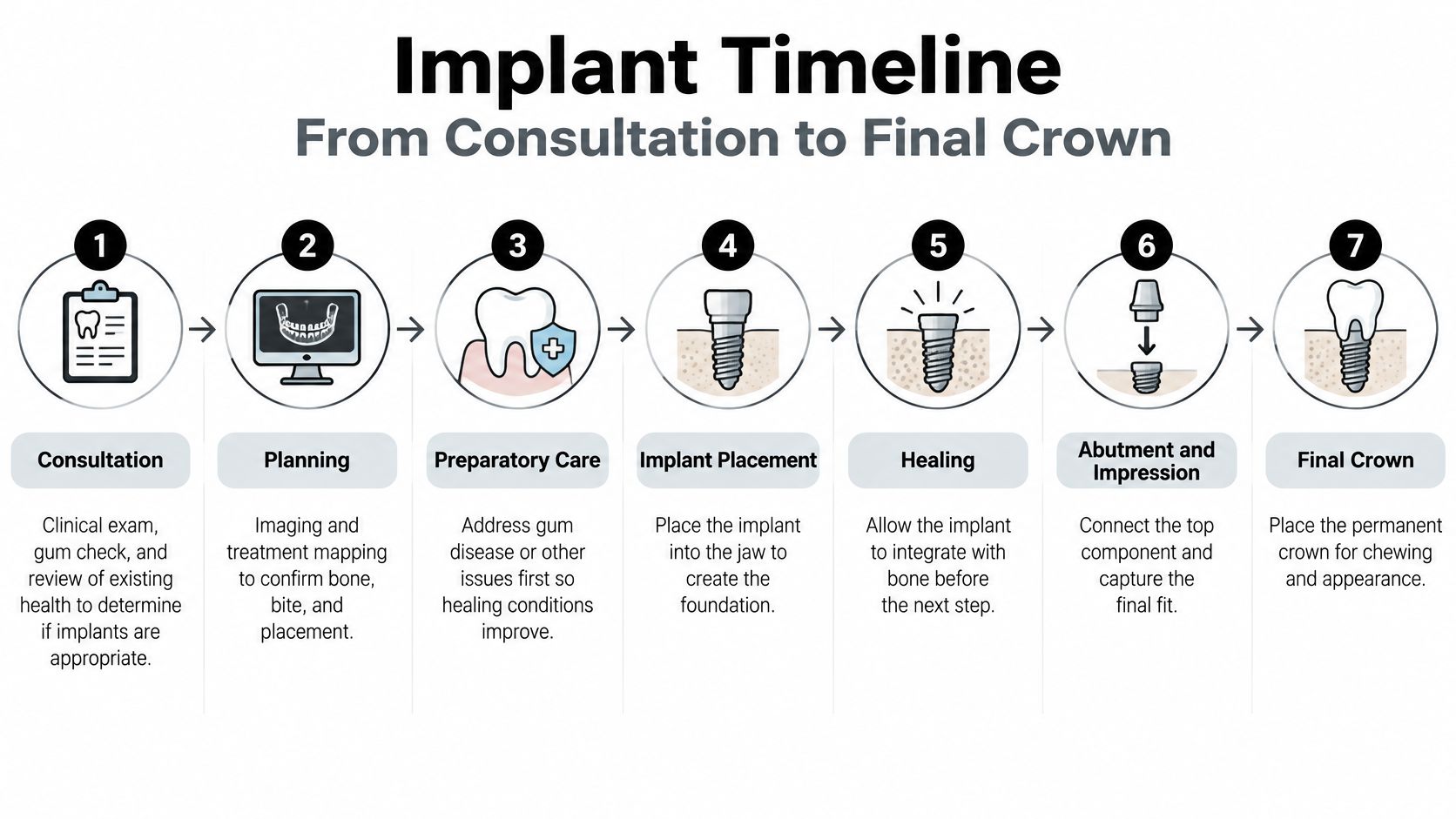
The Seven Phases in Order
- Consultation, one or two visits. The clinician examines the site, checks your gums, reviews existing X-rays, and confirms whether an implant fits your health and bite. This visit should also surface medical conditions, medications, and smoking status.
- Planning imaging. Two-dimensional X-rays answer many questions. A 3D cone-beam scan is added only when bone width, the sinus, or the nerve canal can't be measured reliably another way, because position errors here are hard to reverse.
- Extraction and any grafting. A failing tooth is removed and the socket may be grafted to preserve bone. When bone volume is low, expect three to six months of graft healing before placement.
- Implant placement, a single surgery visit. Under local anesthesia or sedation, a titanium or zirconia fixture is set into the jawbone. Most of the appointment is preparation and precise positioning.
- Osseointegration, about three to six months. Bone bonds to the implant surface. This quiet phase, not the surgery day, is why total timelines run longer than patients expect.
- Abutment and final crown, two to four weeks after healing. The connector is placed, impressions or scans are taken, and the custom crown is fitted with a careful bite check.
- Maintenance, every three to six months. Cleaning, examination, and bite review continue for as long as you have the implant. Skipping this phase doesn't pause risk, it just lets problems grow unseen.
Why the Scan Decision Matters
The FDA guidance on dental cone-beam computed tomography notes that the FDA and American Dental Association recommend dental radiographic examinations, including cone-beam CT, only when necessary for diagnosis or treatment, with exposure settings optimized to the lowest radiation dose that still provides adequate diagnostic quality. In implant cases, that scan earns its place when two-dimensional imaging can't reliably define the mandibular canal, maxillary sinus, nasal floor, buccolingual ridge width, or the space between a proposed implant and adjacent roots. Ask what specific question the scan will answer and how the answer could change implant position, grafting, guide design, or referral.
Typical implant timeline by phase
| Phase | Typical timing | What happens |
|---|---|---|
| Consultation and imaging | One or two visits before surgery | Exam, gum check, 2D X-rays or 3D scan if the case needs it |
| Extraction and any grafting | Day of surgery, then often three to six months of graft healing | Socket preservation or bone graft where bone volume is low |
| Implant placement | Single surgery visit | Titanium or zirconia fixture set into the jawbone |
| Osseointegration | About three to six months | Bone bonds to the implant surface |
| Abutment and final crown | Two to four weeks after healing | Impressions, custom crown, bite check |
| Maintenance | Every three to six months | Cleaning, examination and bite review |
Immediate placement at the time of extraction is possible in selected cases, but the clinician decides from imaging and exam findings, not patient preference. A reliable office gives you a written timeline before treatment starts, and a fuller walkthrough of the implant procedure can help you test whether the schedule you've been quoted matches each healing phase above.
Who Qualifies for Dental Implants
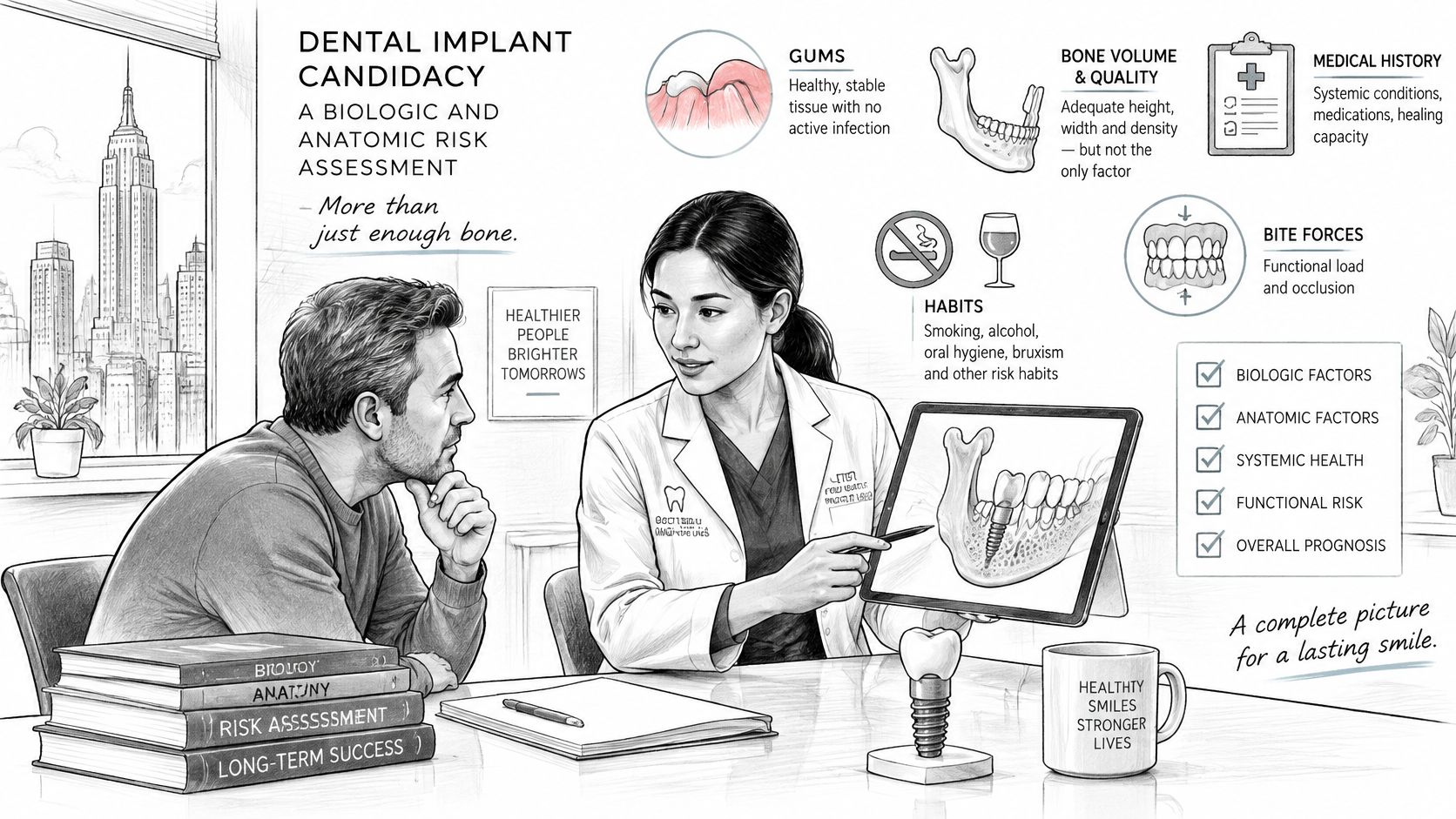
"Do I have enough bone?" is only half the candidacy question. The better question is whether your gums, medical history, habits, and bite give an implant a stable environment for years. Bone can often be rebuilt. Uncontrolled gum inflammation around natural teeth, left untreated, travels with you to the implant.
This consultation image shows the point where candidacy should be discussed as a risk plan, not a yes or no verdict.
Gum Health Changes the Risk Picture
A recent mixed-effects analysis in Clinical Oral Implants Research reported a hazard ratio of 3.6 (95% CI, 1.89 to 6.97) for peri-implantitis in patients with a history of periodontitis compared with patients without periodontitis. Systematic-review data in that literature also estimate peri-implant mucositis at approximately 43% and peri-implantitis at approximately 22% across studied populations, with rates varying because studies use different diagnostic thresholds. That's why gums are usually stabilized before placement, with baseline probing measurements and radiographs recorded so later changes can be detected early.
Risk factors and how they change implant planning
| Factor | Effect on outcome | Planning response |
|---|---|---|
| History of periodontitis | Hazard ratio of 3.6 for peri-implantitis | Stabilize gums before placement and set a maintenance schedule |
| Smoking | Higher complication and bone loss risk | Quit or delay surgery and discuss timing |
| Poorly controlled diabetes | Higher infection and slower healing | Glucose review with the physician before surgery |
| Low bone volume | May need grafting or a narrower implant | 3D imaging to measure the site |
| Obesity | Documented risk indicator for complications | Medical review and a tailored healing plan |
| Bruxism or heavy bite forces | Extra stress on implant and crown | Night guard and bite adjustment |
| Limited hygiene access | Plaque and cement retention around the restoration | Restoration designed for cleaning and flossing |
Other documented indicators include inadequate plaque control, tobacco exposure, hyperglycemia, malpositioned implants, poorly designed prostheses, and residual excess cement. A crown shape you can clean, plus precise cement control, isn't cosmetic detail. Trapped plaque or cement can drive persistent inflammation, progressive bone loss, and eventual loss of the bond between bone and implant.
The short video below is a useful prompt for questions to bring to your own consultation, especially about preparatory treatment.
A risk factor doesn't automatically exclude you. A good consultation names the specific changes that would make treatment safer, whether that's periodontal therapy first, a physician review, a quit plan for smoking, or bone grafting to rebuild the site before an implant goes in. If an office can't explain your risk plan in plain terms, you're not ready to sign a treatment plan there.
Implants Compared With Bridges and Dentures
You're rarely choosing between an implant and nothing. You're choosing between an implant, a fixed bridge, and a removable denture, and each one shifts cost, surgery, and maintenance to a different place.
Implants, bridges and dentures on the same criteria
| Criterion | Dental implant | Fixed bridge | Removable denture |
|---|---|---|---|
| Neighboring teeth | Left untouched | Adjacent teeth prepared as anchors | Left untouched, but clasps can stress them |
| Bone around the gap | Stimulated by the fixture | Not stimulated | Little stimulation |
| Cleaning | Brush and floss around the restoration | Floss under the bridge | Removed nightly for cleaning |
| Durability | High long-term survival with scheduled maintenance | Depends on the health of the anchor teeth | Needs periodic relining or replacement as fit changes |
| Upfront cost | Highest per tooth | Often less than one implant per tooth | Lowest |
Where the Options Diverge Most
The sharpest difference is what happens to the neighboring teeth. A bridge needs the teeth on either side of the gap prepared as anchors, which means removing healthy enamel and tying their future to the bridge. An implant stands on its own, so those teeth stay untouched and can be treated independently if they ever need work. A denture also leaves teeth unprepared, but clasps on a partial denture can stress the teeth they grip.
The second difference is bone. The implant fixture loads the jawbone during chewing in a way a bridge doesn't, which is why bone loss around a missing tooth is a reason to consider an implant rather than watch the ridge shrink. A removable denture does little to protect that bone, and as the ridge changes shape, the denture needs relining or replacement to keep fitting.
If the neighboring teeth are healthy and strong, a bridge may be a fair choice. If they're heavily filled or already weakened, an implant often protects them better by asking nothing of them.
Cleaning cuts the other way for some patients. A denture comes out at night, which some people find easier than floss threaders under a bridge or careful cleaning around an implant crown. It also costs least upfront and can be sensible if you're not ready for surgery or need a tooth replaced while other treatment is staged. The trade-off is stability. Dentures can move during eating and speaking, and that movement is the complaint that sends many denture wearers to ask about implants later, which is why a direct comparison of implants and dentures is worth reading before you commit to either.
There's no universal winner here. The right choice depends on your bone, gum health, the condition of adjacent teeth, and your budget across the next decade, not just this year. A clinical exam settles those variables more reliably than any general rule, including the one in the blockquote above.
How Long Implants Last and What Protects Them
The durability record is strong, and it's also often oversold. Both things are true, and understanding the gap between them is what protects your investment.
Survival Is Not the Same as Disease Free
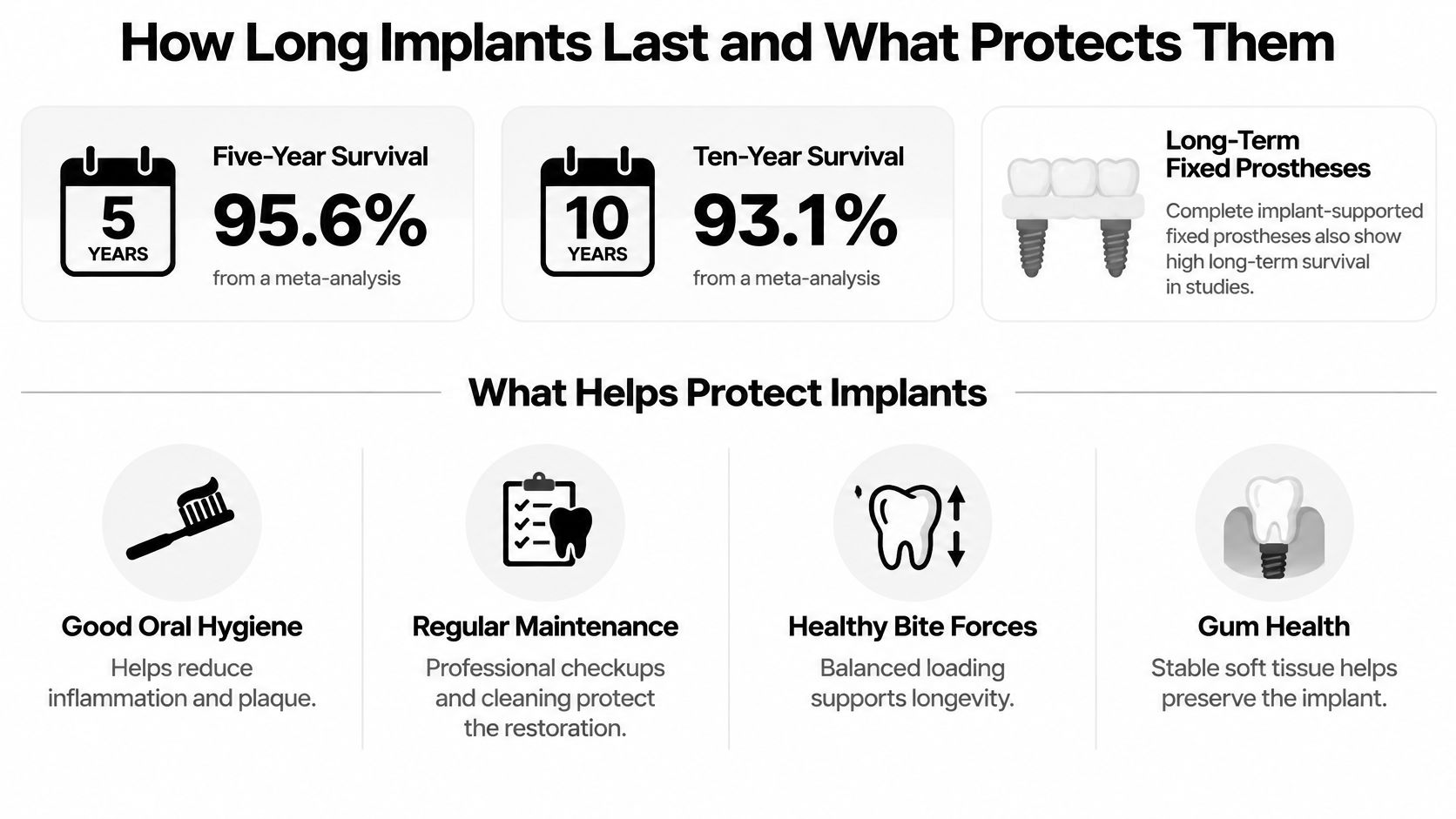
A meta-analysis indexed on PubMed of studies with at least five years of follow-up estimated implant survival at 95.6% after five years and 93.1% after ten years. The same review reported that complete implant-supported fixed dental prostheses had survival of approximately 95.4% after five years and 80.1% after ten years. Read those two lines together. The fixture usually outlasts the restoration on top of it, so crowns, bridges, screws, and veneering materials may need repair or replacement even when the implant itself is fine.
Over very long follow-up, the estimates get less certain. A 2024 20-year meta-analysis summarized prospective studies involving 237 implants and found a mean survival rate of 92%, with a 95% confidence interval of 82% to 97%. Five retrospective studies involving 1,440 implants in that analysis reported an 88% survival rate, with a 95% confidence interval of 78% to 94%. Those differences reflect study design, patient selection, and follow-up completeness, not a single universal lifetime percentage anyone can promise you.
Survival also says nothing about comfort. A 2025 narrative review on peri-implant disease reports 10-year implant survival around 90 to 95%, while citing peri-implant disease prevalence of approximately 28 to 30% in some patient populations. An implant can be counted as surviving while the gum around it bleeds, swells, and slowly loses bone. That's the honest answer to the opening question of this article. Mucositis, inflammation without bone loss, is reversible with cleaning and better plaque control. Peri-implantitis, inflammation with progressive bone loss, is harder to treat and easier to prevent, which is why prevention starts at treatment planning, not at the first symptom.
Warning Signs That Should Not Wait
Implant warning signs and what to do
| Symptom | What it may mean | What to do |
|---|---|---|
| Bleeding when brushing around the implant | Peri-implant mucositis, which is reversible | Book a cleaning and gum examination |
| Swelling, pus or pain at the implant | Possible peri-implantitis | Contact the dentist promptly |
| Crown or implant feels loose | Loose screw, crown failure or bone loss | Same-week evaluation |
| Bad taste or repeated gum swelling | Trapped cement or plaque | Radiograph and professional cleaning |
| Bite changes or jaw pain | Excess bite force on the implant | Bite adjustment and night guard check |
What moves your personal outcome toward the favorable end of these figures isn't mysterious. It's lifelong maintenance visits, daily plaque control you can sustain, not smoking, keeping blood sugar managed if you're diabetic, and showing up for recall appointments even when nothing hurts. Implants fail without symptoms before they fail loudly. The patients who keep them for decades are usually the ones whose problems were caught at the bleeding stage, when a cleaning fixed them.
Dental Implant Questions Answered
Does Placement Hurt and How Long Is Recovery
Placement is done under local anesthesia or sedation, so you shouldn't feel pain during the procedure itself. Soreness and swelling afterward are managed with the aftercare plan your clinician gives you in writing, including medication guidance, diet, and hygiene around the site. Ask for those instructions at the consultation, not in the recovery room, so you can plan work and travel around the first few days.
Can a Failed Implant Be Replaced
Usually, but not immediately and not blindly. The clinician first finds the cause, such as infection, overload from bite forces, or bone loss, because replacing an implant into the same conditions invites the same result. Depending on the findings, the implant may need to be removed, the site grafted and healed, and a new implant placed later. I would always ask what specifically will be done differently the second time.
Can I Go Without a Tooth While I Heal
Ask whether a temporary tooth or removable appliance is possible during healing. The answer depends on the implant's position and how stable it is at placement, since pressure on a healing implant can disturb the bond forming with bone. Front teeth often get a cosmetic temporary that stays clear of the implant. Back teeth sometimes heal without one. Get this settled before surgery if appearance at work matters to you.
Is the 3D Scan Safe
The scan should be ordered only when it answers a specific planning question, such as bone width or the location of the nerve canal or sinus. Before it's taken, the practice should state the reason for the scan and confirm that settings use the lowest dose that still gives adequate diagnostic quality. If nobody can explain what decision the scan changes, that's a fair reason to pause and ask more questions.
What If I Grind My Teeth at Night
Tell the clinician before planning starts. Heavy bite forces stress the crown, the screw, and the bone around the fixture, so the plan may include a night guard, bite adjustment, and restoration materials chosen for load rather than appearance alone. Grinding doesn't disqualify you, but hiding it can shorten the life of the crown.
Choosing a Provider and Booking in Manhattan
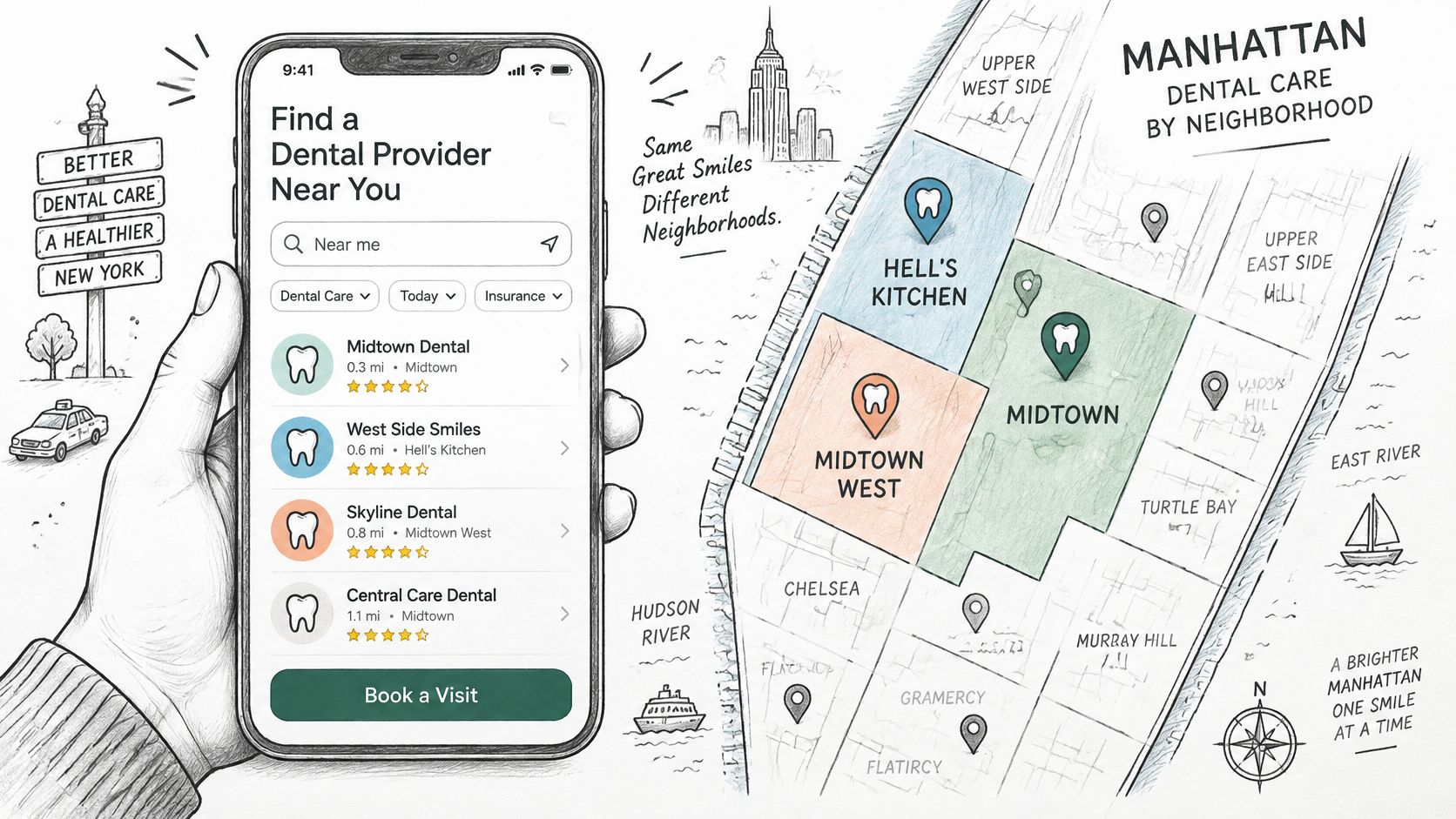
A search for dental implants near me in Manhattan can return practices that are fifteen minutes apart or an hour apart, because the borough's neighborhood labels aren't one uniform travel area. The NYC Department of City Planning community district data states that New York City is divided into 59 community districts, established under the City Charter to review and monitor quality-of-life issues within local neighborhoods. The city's official Community Board 4 boundaries include Chelsea and Clinton/Hell's Kitchen, extending from 14th Street north to 60th Street, with the Hudson River as the western boundary and Columbus Circle forming part of the northern and eastern boundary. That's why a practice near West 57th Street can reasonably serve adjacent central Manhattan neighborhoods without implying that all of Manhattan is the same trip.
Neighborhoods Are Not Landmarks
Patients commonly describe themselves by areas including Midtown, Midtown West, Chelsea, Hell's Kitchen, the Theatre District, Hudson Yards, the Upper West Side, the Upper East Side, Lenox Hill, Turtle Bay, Gramercy Park, the West Village, Greenwich Village, NoHo, the East Village, SoHo, Tribeca, Chinatown, and the Wall Street area. Treat Columbus Circle and Central Park South as landmarks for orientation, not neighborhoods with shared boundaries, and judge convenience by your actual commute to repeat visits. Implant care involves several appointments across months, plus maintenance afterward, so a practice you'll realistically return to beats a distant one with a marginally lower quote.
The screenshot below shows the practice website where Manhattan patients can review implant services and request an appointment.
At 57 W 57th St near Central Park South and Columbus Circle, Paul L. Gregory, DDS provides implant consultations, planning, surgical placement, healing review, and final restoration, alongside bone grafting and site preservation when a site needs rebuilding first. Wherever you book, confirm the details that change from practice to practice, including the exact address, insurance assistance, teledentistry availability, and urgent-appointment access, directly with the office before relying on them. A comparison of what defines the best dental implant options for your case is a reasonable starting point for that conversation, and busy practices increasingly manage dental bookings with VoiceAgent style systems so scheduling and reminders for multi-visit treatment don't fall through the cracks.
A Provider Checklist Worth Using
- Gum assessment: How are periodontal health and plaque control measured before placement, and what's treated first if they're poor?
- Imaging reasoning: When would you recommend a 3D scan for my site, and what decision would it change?
- Quote scope: Does my estimate include grafting, the abutment, the final crown, and follow-up visits?
- Maintenance plan: How often will you examine and clean around the implant after the crown is placed?
- Problem pathway: If the implant bleeds, loosens, or hurts, how quickly can I be seen and who manages it?
What to Bring and What to Expect
Bring a list of medications, your medical conditions, any past X-rays you can obtain, your history of gum disease treatment, your smoking status, and your timeline questions in writing. Expect a gum and bone assessment, a stated reason for any scan, a written itemized plan, a maintenance schedule, and an emergency contact plan for the days after surgery. Book through the practice website or by phone, then choose the quote that covers grafting if needed, the final crown, and follow-up care. That's the comparison that predicts your real cost and your long-term result. The lowest advertised price predicts neither.
If you're comparing dental implants near me in Manhattan, book a consultation that covers your gum health, imaging needs, itemized cost, and maintenance schedule before any surgery is proposed. At Paul L. Gregory, DDS, you can review implant treatment from planning through final restoration at 57 W 57th St and request an appointment that fits your schedule. Bring your questions about candidacy, grafting, and long-term care, and leave with a written plan you can compare line by line.