

Pain after root canal retreatment is most likely in the first 24 to 48 hours, drops sharply by day seven, and is reported by only about 2 percent of patients at one week. That's a very different picture from the week of misery many people brace for when they hear a tooth needs to be opened and treated again.
That gap between fear and reality matters. If you're expecting constant pain, every mild ache on day one can feel like proof that something went wrong. If you understand the normal curve, you can judge your own recovery by pattern, not by panic. Is it strongest early, then easing each morning? That's the expected shape. Is it getting worse on day four, with swelling joining in? That's a different story, and it deserves a call, not more waiting.
Think of root canal retreatment pain as a timeline you can measure, not a vague warning that you'll be sore for a few days. The sections below walk through that timeline with real numbers, explain why a retreated tooth can hurt at all, and separate routine soreness from the smaller set of symptoms that need prompt care.
How Long Retreatment Pain Usually Lasts
The direct answer is short. When pain happens after retreatment, it's concentrated in the first 24 to 48 hours and it's uncommon by one week. Many patients report no pain at all, even on the first day.
A useful way to see this is to follow one group of patients hour by hour. The 2022 prospective clinical study of 48 patients examined pain after nonsurgical root canal reintervention, including removal of the previous filling material and canal re-instrumentation. Researchers asked about pain after the first session, when the tooth was reopened and cleaned, and again after the second session, when the canals were filled.
What the Timeline Looks Like in Numbers
| Time After Treatment | Pain After First Session | Pain After Filling Session |
|---|---|---|
| 12 hours | 9 patients (18.75%) | 3 patients (6.25%) |
| 24 hours | 7 patients (14.58%) | 2 patients (4.16%) |
| 48 hours | 4 patients (8.33%) | 1 patient (2.08%) |
| 7 days | 1 patient (2.08%) | 1 patient (2.08%) |
Read the first column from top to bottom and the pattern is clear. At 12 hours, 9 of 48 patients (18.75%) reported pain after the first session. By 24 hours that fell to 7 patients (14.58%), by 48 hours to 4 patients (8.33%), and by 7 days only 1 patient (2.08%) still reported pain.
The filling session was gentler at every point. Only 3 patients (6.25%) reported pain at 12 hours, 2 patients (4.16%) at 24 hours, and 1 patient (2.08%) at both 48 hours and 7 days. That makes sense when you picture the work. The first visit involves removing old material and cleaning canals that may still hold infection. The second visit mostly seals a space that's already been cleaned.
Translating Percentages Into Expectations
Flip those numbers around and they get more reassuring. More than 81% of patients had no reported pain 12 hours after the first session. At seven days, more than 97% were pain free.
Practical expectation: Plan for one or two sore days, not a week of pain. Keep pain relief on hand for the first evening, and expect each morning to feel a little better than the one before.
Two limits are worth keeping in mind. First, this study measured how common pain was, not how intense it felt for each person. A patient counted in that 18.75% might have had a mild ache with dinner, not a severe toothache. Second, a group average can't predict your tooth. Anatomy, the amount of infection present, and how sore you were before treatment all shift your personal curve.
So use the table as a map, not a promise. If your ache is stronger than you'd expect, doesn't follow the downward trend, or is still bothering you well past the first week, that's a reason to check in rather than tough it out. Our guide to what to expect during root canal recovery walks through the healing stages that sit behind these numbers. For many people, though, the honest summary is encouraging. Retreatment doesn't always hurt, and when it does, the sore window is usually brief.
Why a Retreated Tooth Can Hurt
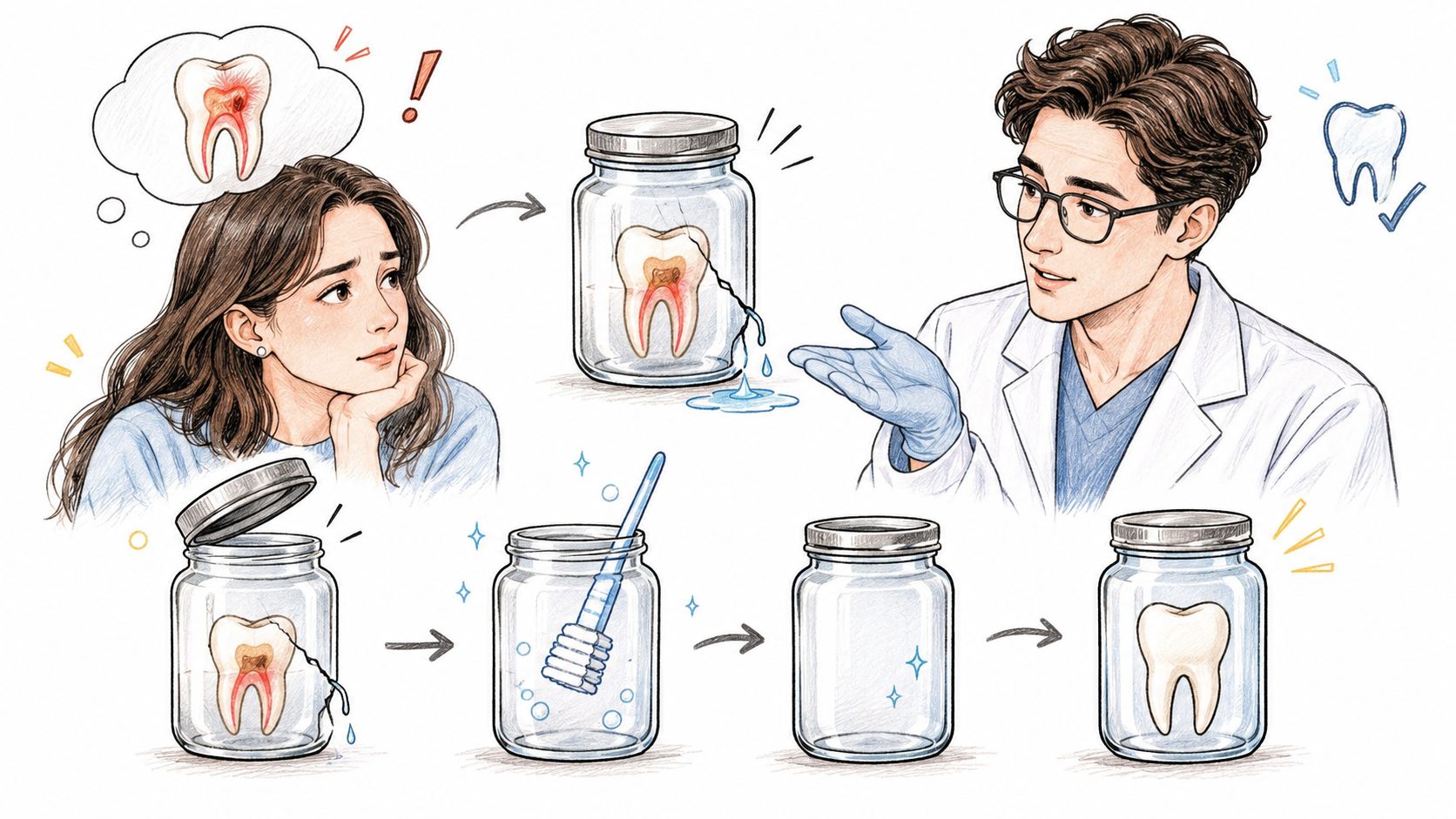
Picture a sealed jar that's started to leak. You can't fix it by wiping the outside. You have to open the lid, empty the contents, wash the jar thoroughly, and seal it again with a fresh lid. Retreatment works the same way, and understanding that sequence explains both why it's needed and why it can leave you sore.
The American Association of Endodontists page on endodontic retreatment explains that retreatment involves reopening the tooth to gain access to the root canal filling, removing the previous materials, carefully examining the canals, and cleaning and shaping them again before placing new filling material and restoring the tooth. It's done because an earlier root canal didn't heal as expected, or because the tooth developed a new problem later.
Here's a visual walkthrough of that reopen, clean, and reseal process.
Five Reasons a First Root Canal Needs Redoing
- A missed canal. Roots can hide extra, narrow canals. If one was never cleaned, it can keep holding bacteria.
- An incomplete original treatment. Curved or blocked canals sometimes prevent full cleaning the first time.
- Leakage under a crown or filling. When the seal on top breaks down, saliva and bacteria seep back in.
- New decay. A fresh cavity can expose the treated canals to bacteria again.
- A crack or fracture. A split in the tooth or root gives bacteria a direct path inside.
Notice what these causes share. In each case, bacteria reach tissue that was supposed to stay sealed and sterile. The result is ongoing irritation or infection around the root tip. That's why the goal of retreatment isn't just to quiet pain for a while. It's to remove the source so the bone and tissue around the root can heal. If you're comparing how different practices explain this process, the overview of endodontics at Wellingborough Dental & Implant Clinic lays out the same reopen and disinfect steps in plain terms.
Why the Repair Work Itself Causes Soreness
Now for the part patients feel. The tissue around your root tip is often already inflamed before the appointment starts. Retreatment then disturbs that same area. Old filling material comes out, files reshape the canals, and disinfecting solutions wash through. Even careful work adds temporary irritation to tissue that's already sensitive, and your body answers with the swelling and tenderness you feel as an ache.
Say two patients have retreatment on the same day. One felt fine beforehand and only learned about the problem from an X ray. The other arrived with a throbbing tooth that hurt to bite on. The second patient is far more likely to be sore that evening, because inflamed tissue has a lower threshold for extra irritation. The instruments matter much less than people assume. Whether the dentist uses rotary files that spin continuously or reciprocating files that move back and forth, the starting condition of your tooth predicts your discomfort better than the tool does.
An ache after retreatment usually means your body is responding to treatment of an active problem. It isn't, by itself, proof that the tooth was damaged.
That reframe helps with the most common worry, that lingering soreness means bacteria are still winning. Sometimes infection does persist, and our page on signs of infection after root canal retreatment covers how that's identified. But early soreness alone is expected inflammation doing its job.
Normal Soreness Versus a Warning Sign
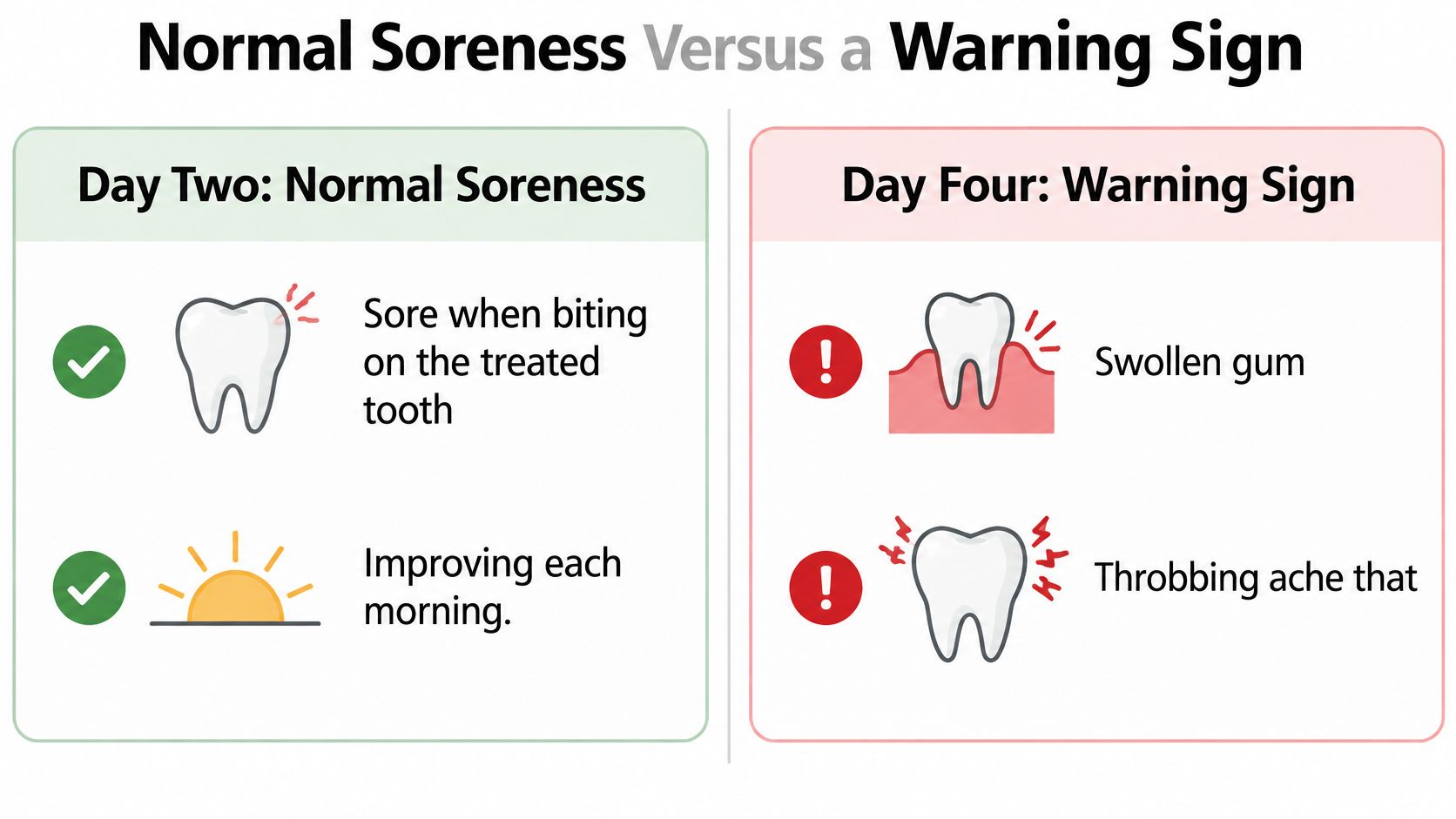
Consider two patients. The first is on day two. The treated tooth is sore when she bites down, so she's chewing on the other side. But this morning felt better than yesterday morning, and yesterday felt better than the evening of the procedure. The second patient is on day four. His gum near the tooth looks puffy, and a throbbing ache that had started to fade is now getting stronger instead.
Both patients have pain. Only one pattern is reassuring. Pain works like a smoke alarm. It tells you something is happening, but the pattern over time tells you whether to wait or to call. Intensity on a single afternoon is far less informative than direction across several days.
The checklist below puts those two patterns side by side.
The Thresholds Dentists Actually Use
The American Association of Endodontists guidance on root canal pain states that sensitivity when biting or touching the tooth is common during the initial healing period and that symptoms improve within three to five days in the majority of cases. Increasing or prolonged pain is uncommon and warrants evaluation. You should also contact your clinician promptly for severe pain or pressure lasting more than a few days, or for visible swelling inside or outside the mouth.
That gives you three practical tests. First, is it improving day by day, even slowly? Second, has it lasted beyond a few days without easing? Third, is swelling present? Those answers sort most situations correctly.
| Pattern | What It Usually Means | What to Do |
|---|---|---|
| Tenderness when biting or touching the tooth, improving daily | Normal early healing, usually improving within 3 to 5 days | Chew on the other side and keep watching |
| Ache that eases with over-the-counter pain relief | Expected inflammation | Continue relief as labeled and track the trend |
| Sharp pain on one bite | Temporary or new filling sitting high | Call for a quick bite adjustment |
| Pain or pressure lasting more than a few days | Needs reassessment | Call the dentist promptly |
| Visible swelling inside or outside the mouth | Possible infection or flare-up | Call the dentist promptly |
| Fever, trouble swallowing or feeling generally unwell | Signs of spreading infection | Seek urgent evaluation the same day |
This short video reinforces how to read those early symptoms before you decide to wait or call.
Two Patterns People Misread
The first is the sharp zing on one specific bite. Patients often assume this means the retreatment failed. Far more often, the temporary or new filling sits a fraction too high, so that tooth takes the full force of your bite before the others meet. A quick adjustment, where the dentist polishes down the high spot, usually settles it. The second misread pattern is a strong ache on day one that steadily fades. A rough first evening doesn't predict failure. What matters is that each day trends downward.
Sort by direction, not by a single bad hour: Improving soreness is healing. Pain that's level for days, climbing, or joined by swelling is a reason to be seen.
Swelling deserves special respect because it can signal a collection of infection rather than simple inflammation. If you notice puffiness, a pimple like bump on the gum, or a bad taste, our overview of dental abscess symptoms and treatment explains what's happening and why it shouldn't wait. When in doubt, describe your pattern to the office. "Better each day" and "worse since Tuesday" lead to very different advice.
Home Care That Eases Pain Safely
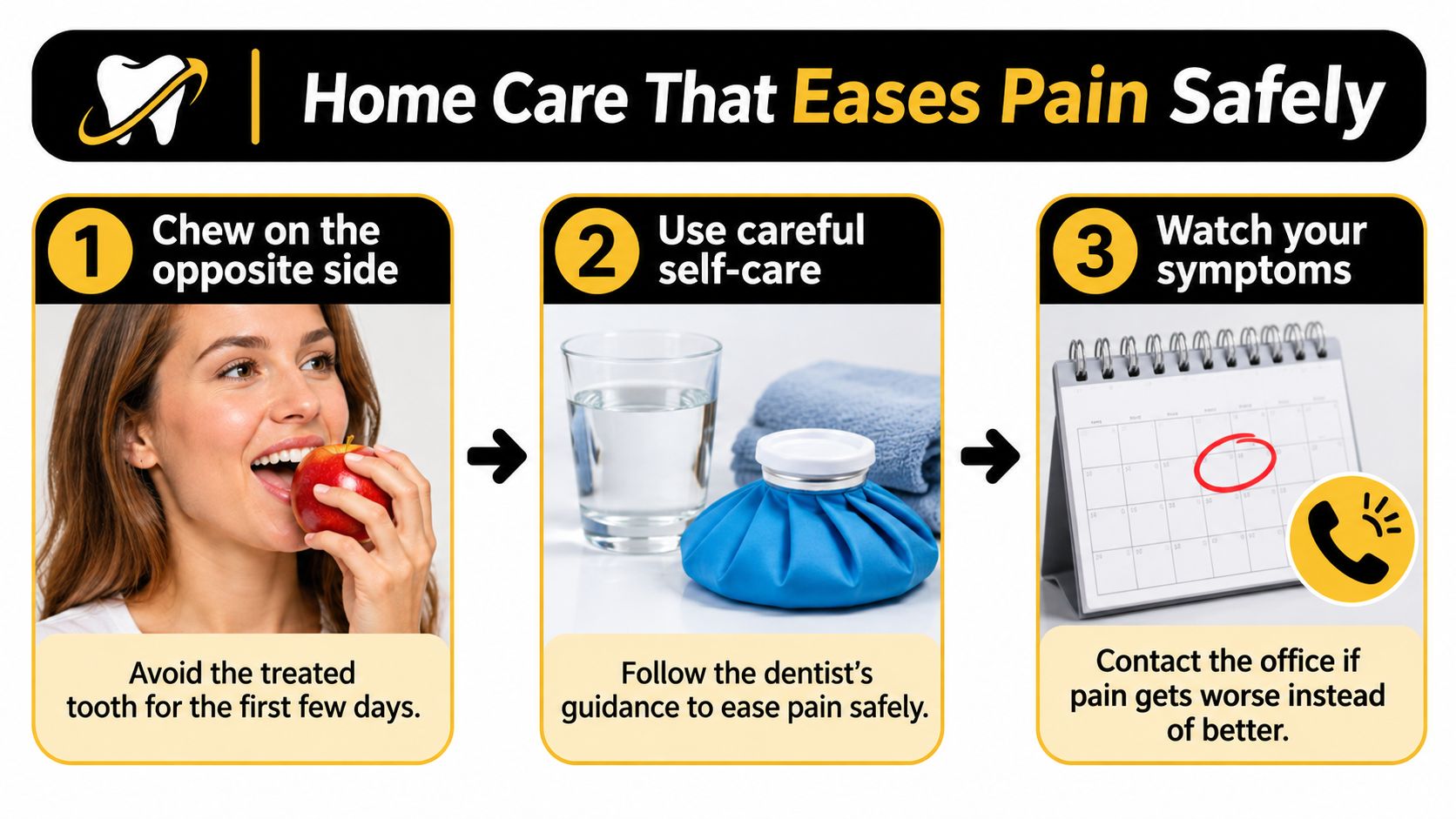
Good home care after retreatment isn't a pile of tips. It's a short routine, done in order, for the first few days. Each step targets a specific trigger, and most setbacks come from skipping a step or stopping too early.
This three part routine summary shows the order to follow.
The Routine, Step by Step
- Chew on the opposite side. Pressure is the most common pain trigger after retreatment, so keep food off the treated tooth for the first few days. The common slip is testing the tooth with something crunchy because it felt fine that morning.
- Start pain relief before the numbness wears off. Take an over-the-counter option such as ibuprofen or acetaminophen exactly as the label or your dentist directs. Getting ahead of the ache works better than chasing it once it's built up. Check with your dentist or doctor first if you have kidney, stomach, or bleeding concerns, take blood thinners, or have relevant allergies.
- Use a cold pack on day one. Hold it against your cheek for 15 to 20 minutes at a time, with breaks between applications. Cold eases both swelling and throbbing during the first day, when inflammation peaks.
- Rinse gently after the first 24 hours. Warm salt water, swished softly two or three times a day, keeps the area clean without disturbing healing tissue. Don't swish forcefully, and don't use strong mouthwash unless your dentist suggests it.
- Choose soft, lukewarm foods. Yogurt, eggs, pasta, and soups that have cooled a bit all work well. Very hot food can intensify throbbing in an inflamed area, and hard or sticky foods load the tooth you're trying to rest.
- Protect the temporary filling. If your retreatment is being done over two visits, that temporary seal keeps bacteria out between appointments. Skip chewing gum, don't pick at the filling, and avoid pressing on it with your tongue to check how it feels.
- Sleep with your head slightly raised. An extra pillow reduces blood pressure in the area overnight, which often means less throbbing when you lie down. Many patients notice pain feels worse in bed because they're flat.
The Two Mistakes That Cause Most Setbacks
The first is stopping pain relief too early. You feel decent by the second evening, skip the dose before bed, and wake at 2 a.m. with the ache rebuilt. Follow the labeled schedule through the first day or two, then taper as the trend improves. The second is loading the tooth too soon. One hard bite on a crusty roll can bruise already tender tissue and restart soreness that was fading.
If you want more comfort measures to layer into this routine, this guide to find relief for aching teeth from Mouthology covers additional at home options and their limits. Just remember that home care manages symptoms while you heal. It doesn't treat a worsening infection, which is why the trend still matters.
Keep a simple pain log for the first few days. Note the time, a rough intensity from 1 to 10, and what made it better or worse. That record turns a vague worry into information your dentist can act on.
Finally, don't skip the boring basics. Brush and floss the rest of your mouth normally, and be gentle around the treated tooth. A clean mouth heals with less irritation, and neglecting hygiene because you're sore only adds gum inflammation to the picture. Our overview of root canal treatment and aftercare ties these steps to the full recovery sequence.
When Pain Lingers After the Tooth Heals
Most retreatment soreness follows the downward curve. A smaller number of patients have an ache that hangs on, plateaus, or returns after quiet weeks. That experience is uncommon, but it's real, and it calls for investigation rather than either panic or endless waiting.
Start with what the evidence says about causes. The randomized clinical trial indexed on PubMed found that continuous rotary and reciprocating instrumentation produced no statistically significant differences in pain incidence, intensity, duration, or analgesic consumption after retreatment. The strongest independent predictor of pain at 24 hours was preoperative pain. In plain terms, lingering soreness is primarily an inflammatory response in tissue around the root, not a sign that the wrong file system was chosen.
What Your Dentist Checks, in Order
- A missed canal. An extra canal that still holds infected tissue can keep the area irritated.
- A crack or fracture. A split root lets bacteria in and often hurts on biting or on release of a bite.
- An overloaded bite. A filling or crown sitting high concentrates force on one tooth.
- A leaking restoration. A failed seal on a crown or temporary filling lets bacteria re-enter.
- A non tooth source. Sinus congestion, jaw joint strain, and muscle pain can all refer pain to the teeth and mimic a toothache convincingly.
The workup is methodical. Expect bite tests on individual cusps, gentle tapping to compare neighboring teeth, gum probing to look for a deep isolated pocket that can signal a crack, and X rays from more than one angle. A second image sometimes reveals anatomy or a shadow at the root tip that the first angle hid. The goal is to reproduce your exact symptom in the chair, because a symptom that can be triggered on demand can usually be located and named.
A Day Ten Example
Say a patient calls on day ten. The ache never fully left, it's worse at night, and over-the-counter relief barely touches it. That pattern breaks the expected curve in three ways. It's past the first week, it isn't trending down, and it isn't responding to medication. A clinician hearing that description moves to reassessment, checking for missed anatomy, debris or irrigant pushed beyond the root tip, occlusal overload, fracture, or unresolved infection. Waiting another week would only trade information for time.
There's also a wider context worth knowing. A meta-analysis found persistent pain six months after endodontic treatment in approximately 5% of patients, about one in 25, often involving nonodontogenic pain rather than continuing infection, as reported in the 2026 systematic review in the Journal of Dental Anesthesia and Pain Medicine. That means a tooth can be technically healed on an X ray while pain continues from a jaw muscle, a sinus, or an irritated nerve. Naming that possibility early prevents unnecessary repeat procedures on a sound tooth.
We've heard this relief from patients who arrived mid problem, including Emmett, who said, "He helped me when I was in an emergency from a failed procedure at another office." A structured second look is often what turns a frustrating ache into a specific plan.
Bring these details to your appointment: when the pain started, what triggers it, how it changes through the day and night, what relief you've tried, and your pain log if you kept one.
Decide Whether to Call Your Dentist Now
You don't need to memorize every symptom. You need a timing rule you can apply at 9 p.m. on a Tuesday. Here it is, in three tiers.
Wait and keep monitoring if your pain improves day by day, even slowly. Tenderness only when you bite, no swelling, and no fever all fit this tier. Stay with the home routine, chew on the other side, and keep logging the trend so you can describe it accurately later.
Call the same day if swelling appears inside or outside your mouth. The same goes for fever, trouble swallowing, difficulty opening your mouth, or pain that is clearly getting worse rather than better. These signs suggest the problem is expanding, and same day assessment protects both the tooth and your overall health.
Call within a few days if tenderness has not eased after three to five days, if one particular bite stays sharp, or if any pain lasts beyond the first week. None of these is an emergency on its own, but each one breaks the expected downward curve enough to deserve a look. A high filling, for instance, takes minutes to adjust and should not be endured for a fortnight.
Make the Call Count
When you phone, the front desk is doing triage, not just taking a message. The clearer your answers about when the pain started, how it moves through the day and night, and what relief has worked, the more accurately the team can judge whether you need a same day slot or a routine appointment. Even rough notes on your phone beat memory at 9 p.m., and a pain log lets the office see the shape of your curve rather than a single snapshot.
Our practice offers short notice visits and makes every effort to schedule dental emergencies as quickly as possible, including emergency tooth extraction near 57th Street in NYC when a tooth cannot be saved. If your symptoms fall in the same day tier, our guide to handling emergency tooth pain explains what to do while you wait to be seen. The office sits at 57 W 57th St, near Central Park South and Columbus Circle, and serves patients from Midtown West and the broader New York metropolitan area.
Wherever you are coming from, bring your timeline. Knowing whether your curve is falling, flat, or climbing is the single most useful thing you can tell us, and it is what turns a worried phone call into the right next step.
If your retreatment ache isn't following the expected downward curve, or you're deciding whether a sore, previously treated tooth needs attention now, we can examine it, review the imaging with you, and explain your options in plain language. Book an assessment with Paul L. Gregory, DDS and bring your pain log, so we can match your symptoms to a clear plan at the first visit.