

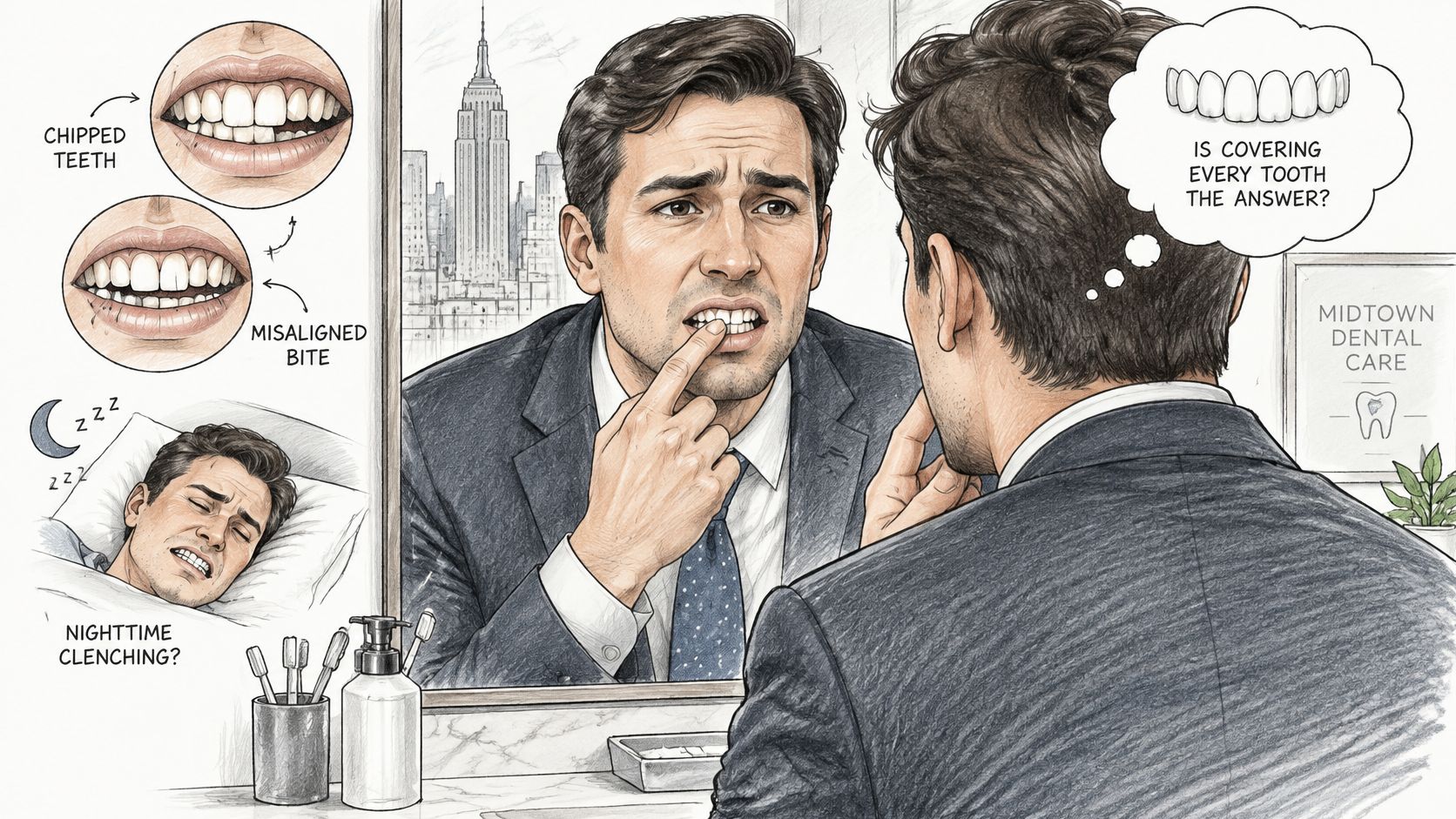
A chipped front tooth, a jaw that feels tired in the morning, and a bite that no longer seems to meet evenly can make a dramatic solution sound appealing. If you're wondering whether crowns on nearly every tooth would solve the problem, the first step is finding out what's causing the damage and whether a less extensive treatment could restore a stable bite.
Who Needs Full Mouth Crowns and When
A Midtown professional who clenches at night might notice that the front teeth look shorter, the edges are chipping, and the bite feels different. That doesn't automatically mean every tooth needs a crown. Full mouth crowns means crowns placed on most or all teeth in one or both arches, usually when widespread damage makes individual repairs inadequate to rebuild chewing function and a stable bite.
The conditions below can point toward extensive rehabilitation, but each has a different first step. A crown protects a tooth; it doesn't, by itself, stop grinding, treat reflux, or resolve gum disease.
| Condition | What It Looks Like | Why Full Coverage Helps | Usual First Step |
|---|---|---|---|
| Severe tooth wear from grinding | Flat, shortened teeth and chipped edges | Restores height and bite contact across many teeth | Night guard and bite analysis |
| Erosion from reflux or acidic drinks | Thin, translucent enamel and sensitivity | Covers weakened tooth structure on many teeth | Medical evaluation and diet review |
| Multiple large or failing restorations | Cracks, leaks and recurrent decay | Replaces many failing restorations in one plan | Assessment of each tooth's remaining structure |
| Congenital enamel or dentin defects | Discoloured, brittle or thin teeth from an early age | Protects teeth and improves function | Specialist diagnosis and staged plan |
| Collapsed bite after tooth loss | Short teeth, cheek biting and jaw discomfort | Rebuilds vertical dimension and tooth contacts | Diagnostic wax-up and provisional trial |
| Several cracked or fractured teeth | Broken cusps and pain when chewing | Holds weakened teeth together and limits further cracks | Imaging and occlusal evaluation |
A full-mouth plan is a large-scale restorative intervention, not a cosmetic covering for visible teeth. A systematic review of tooth-wear treatments reported a first-year failure rate of 5.4% across the restorations assessed. In that review, cumulative survival was 62.0% for direct restorations and 74.5% for indirect restorations, a category that included full-gold crowns. Those figures are a historical benchmark from the populations and treatments assessed, not a forecast for every modern case. (The systematic review of tooth-wear treatments notes that outcomes depend on the restoration type and the condition being treated.)
The number of crowns alone can't predict whether treatment will work well. Remaining enamel and dentin, bite forces, gum health, oral hygiene, material choice, and maintenance all matter. If you recognize your own symptoms in a row of the table, use that as a starting point for a diagnostic conversation, not as a self-diagnosis. A broader full-mouth reconstruction plan can include crowns, but it should begin with identifying the cause and deciding which teeth can be preserved.
How Full Mouth Crown Treatment Unfolds Step by Step
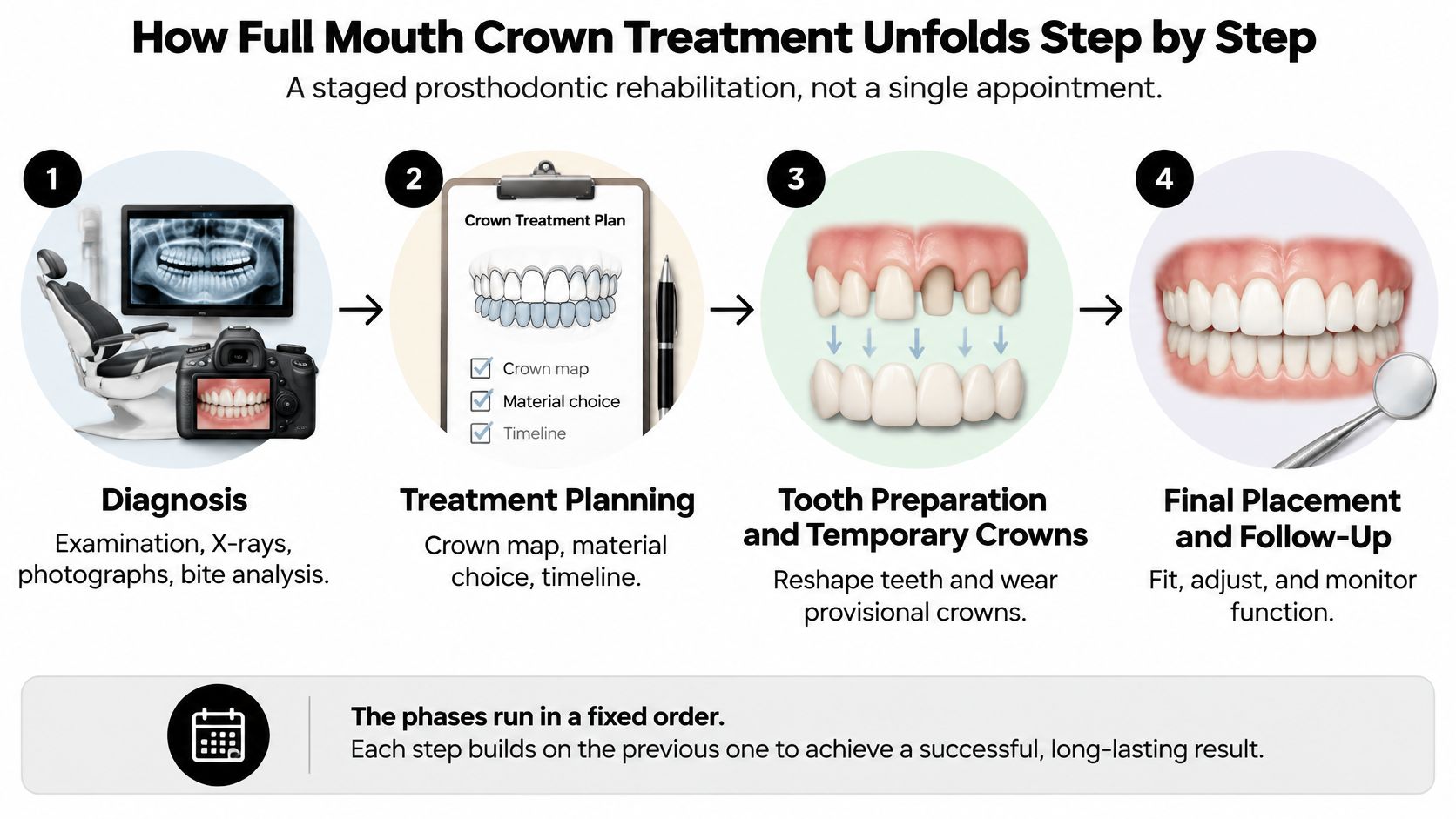
A full-mouth case works like a set of interlocking gears. Every surface you change alters how the others meet, so the order of work matters as much as the crowns themselves. This is a staged prosthodontic rehabilitation, and the clinician has to coordinate tooth preparation with bite contacts, tooth shape, gum health, and the space available for the final restorations. Changing the bite height, or vertical dimension of occlusion (VDO), without a clear functional reason can remove healthy tooth structure without reliably preventing grinding or restoration fracture. (Clinical guidance on occlusal philosophies supports testing a plan before definitive preparation.)
1. Diagnosis
The clinician examines the teeth and gums, reviews X-rays and photographs, records the bite, and checks each tooth for decay, cracks, root problems, and periodontal support. The common mistake is planning crowns around appearance before finding active disease or deciding whether a tooth is strong enough to support one. A tooth with a compromised root or deep decay may need extraction and an implant instead, which changes both the sequence and the price of the plan.
2. Records and bite analysis
Mounted models or digital scans help assess how the teeth meet, how much restorative space is available, and whether the bite height needs to change. This is the stage that settles whether the bite gets rebuilt at a new height or kept close to where it is now. Skipping it can leave the clinician preparing teeth before testing how the proposed bite will function.
3. Diagnostic wax-up
A wax-up previews the planned tooth shapes and lengths, giving the patient a chance to respond before teeth are reshaped. It should translate the patient's goals into a realistic design, rather than assume that longer or whiter teeth are automatically the right answer.
4. Provisional restorations
Temporary crowns let the patient test chewing, speech, appearance, and comfort before the final restorations are made. If the provisionals feel wrong or make the bite uncomfortable, that feedback is a reason to reassess the design, not something to ignore. This phase also shows whether a new bite height is tolerable over weeks rather than minutes at a single appointment.
5. Preparation
Once the plan has been tested, the clinician reshapes the teeth with a defined finish line. A tooth may need gum treatment or root canal treatment before it is ready for a crown, and preparing every tooth aggressively before resolving those needs risks sacrificing healthy structure unnecessarily. Because each prepared tooth loses some enamel permanently, the number of teeth on the list is the biggest single driver of both risk and cost. Ask why each tooth is included.
6. Impressions or scans
Conventional impressions or digital scans record the prepared teeth and the bite so a dental laboratory can fabricate the restorations. Digital scanning can be more comfortable, but it does not guarantee a better clinical result. A 2023 systematic review of 1,598 restorations in 1,161 patients, with a mean follow-up of 3.6 years, reported higher biological, technical, and esthetic complication ratios for CAD/CAM restorations than for conventionally manufactured ones. (The 2023 systematic review of CAD/CAM restorations notes that the included studies were heterogeneous.)
7. Definitive crowns
The clinician checks the fit, contacts, appearance, and bite before cementing the crowns, often working arch by arch. A crown that looks right but hits too hard can cause discomfort or place excess force on the tooth. Fit at the margin and contact with the neighboring tooth are checked alongside the bite in side-to-side movements.
8. Follow-up
Bite checks and recall visits help the clinician find pressure points, gum irritation, or other problems early. Crowns do not decay, but the tooth and gum around them can, and a night guard is often part of the plan for people who grind. Ask what the maintenance schedule involves and what it costs, since it is a recurring expense rather than a one-time purchase. A practice that handles crowns, implants, dentures, cosmetic work and pediatric care in one place, such as Paul L. Gregory, DDS, can carry most of this staging without sending you elsewhere.
Crown Materials and How Long Each One Lasts
"Is metal, ceramic, or zirconia best?" The useful answer is that a material should fit the tooth's position, the force it takes, and the tooth's condition. Choosing between them works like choosing footwear: a hiking boot and a dress shoe can both be well made, but swapping them for the wrong job ruins the shoe and the day. A material that looks natural may be a poor choice for a heavily loaded, grinding-prone tooth, while a strong metal crown may not suit a front tooth where appearance is the priority.
| Material | Main Strength | Main Trade-off | Reported Durability |
|---|---|---|---|
| Full gold | Strong, and wears at a similar rate to natural enamel | Visible metal and higher cost | 74.5% cumulative survival for indirect restorations including gold crowns, in a review of tooth-wear restorations |
| Metal-ceramic | Strong, with a long track record | Metal line can show at the gumline | In a five-year study of fixed dental prostheses, veneer chipping was 10% and prosthesis fracture 8.5% |
| Zirconia | Strong and metal-free for back teeth | Needs precise bite adjustment | In the same five-year study, veneer chipping was 5% and prosthesis fracture 2.5% |
| Lithium disilicate ceramic | Natural translucency for front teeth | Less suited to heavy grinding | Anterior full-coverage crowns averaged 96.4% five-year survival in one review, pooled across ceramic types |
| Direct composite | Lowest cost and placed in one visit | Shorter life in heavily worn teeth | 62.0% cumulative survival in the same tooth-wear review |
Read those numbers with their sources attached. The 74.5% and 62.0% figures come from a review of restorations placed for tooth wear, so they describe how indirect and direct restorations held up in worn mouths, not how a single crown will behave in yours. The systematic review of tooth-wear restorations also separates plain survival from survival without complications, which is a stricter test. The chipping and fracture figures come from a five-year study of fixed dental prostheses, a multi-unit structure rather than an individual crown on one tooth.
The longevity estimates for anterior work come from a different review again, which put the annual failure rate for full-coverage crowns at 0.72% and five-year survival at 96.4%; those findings describe anterior full-coverage crowns as a group and do not isolate lithium disilicate as a material. (The 2023 review of anterior restorations provides that broader context.)
Front teeth often call for ceramic that lets light through and matches nearby teeth. Back teeth take more chewing force, so a clinician may consider gold or zirconia; lithium disilicate can suit many front teeth but may be less appropriate under heavy grinding. Direct composite may cost less and be placed in one visit, though it tends to be less durable in heavily worn mouths than laboratory-made indirect restorations.
A crown's material is only part of its risk profile. Any crown can fracture, lose retention, develop recurrent decay underneath the margin, turn sensitive, or irritate the gum. Material choice shifts some of that risk. Bite balance and daily cleaning shift more of it, which is why two crowns of identical ceramic can have very different careers in two different mouths. Ask which material is proposed for each tooth zone and why, and compare the rationale with this zirconia versus porcelain-fused-to-metal guide.
Alternatives Like Veneers, Implants and Partial Crowns
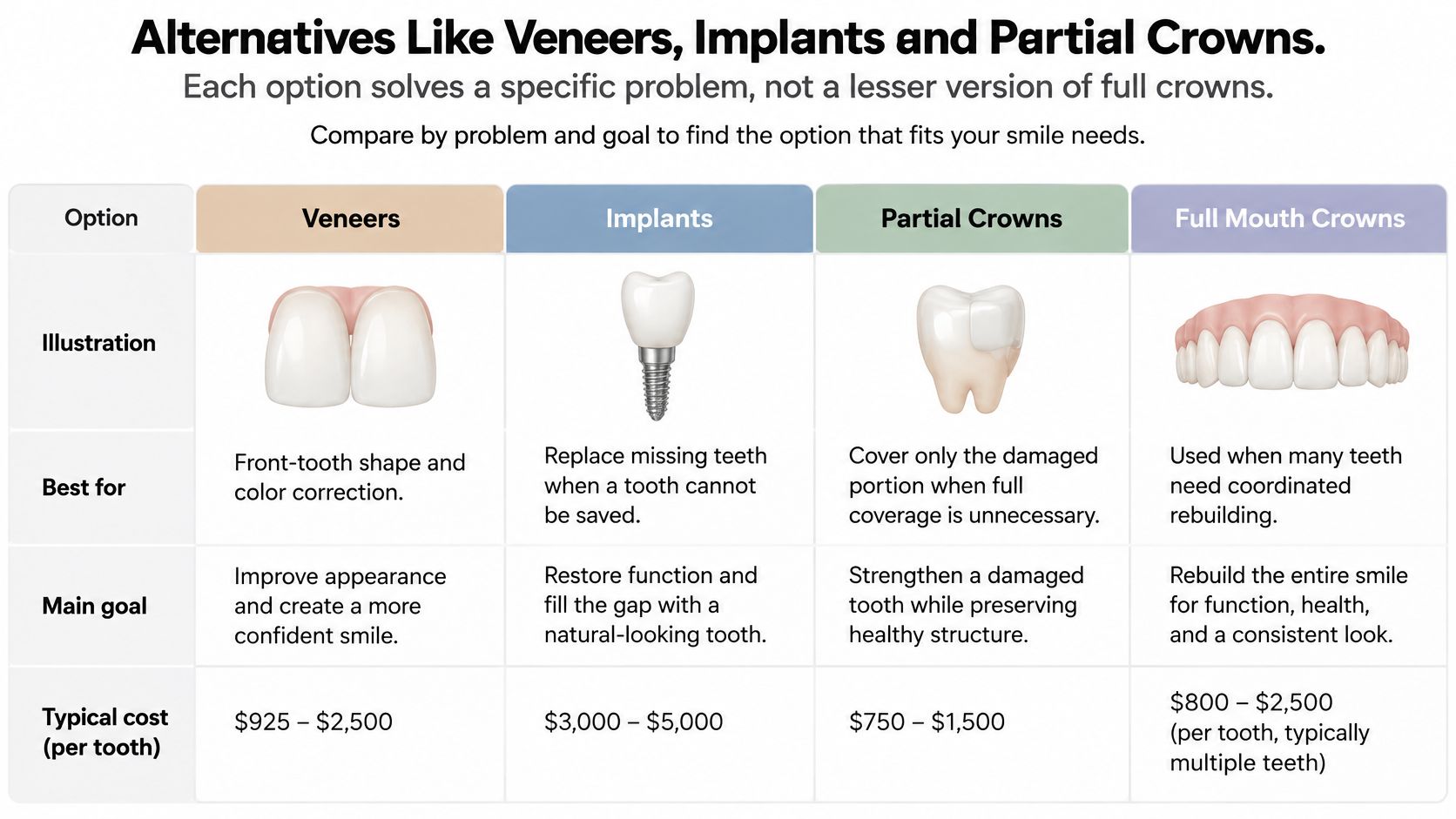
An alternative isn't a lesser version of full crowns. It may be the better treatment when it matches the actual problem and preserves more healthy tooth structure. A patient with a chipped front tooth and healthy back teeth has different needs from someone with widespread wear or several missing teeth.
| Option | Best For | Tooth Reduction | Key Limit |
|---|---|---|---|
| Full mouth crowns | Many damaged or worn teeth needing full coverage | Significant on every covered tooth | Lifelong maintenance and bite control |
| Porcelain veneers | Front teeth with shape or colour problems | Thin layer of front enamel only | Not for heavy grinding or many damaged back teeth |
| Dental implants | Missing teeth where a root replacement is needed | None on neighbouring teeth | Needs adequate bone; grafting may come first |
| Partial crowns and onlays | Teeth with localised damage | Less than full crowns | Not enough for widespread wear |
| Complete dentures | Many missing teeth and lower upfront cost | None on remaining natural teeth | Removable and less stable than fixed work |
| Staged treatment | Large cases where time or budget is limited | Spread over the phases | Longer timeline with interim results |
Veneers address front-tooth shape or colour concerns, but they don't protect numerous damaged back teeth or solve heavy grinding. Implants replace missing tooth roots without requiring the neighbouring teeth to be reshaped. A clinician first checks whether there's enough bone to support them; grafting may be recommended if there isn't. Partial crowns and onlays cover a damaged portion of a tooth, preserving more structure when full coverage isn't necessary.
When many teeth are missing, complete dentures may be a lower-cost route, but they're removable and don't feel as stable as fixed teeth. Treatment can also combine approaches, such as implants supporting crowns, or proceed in stages so the patient and clinician can address urgent problems before completing the whole plan. A comparison of porcelain veneers and crowns can help clarify which option fits a front-tooth concern, but the choice should account for the rest of the bite too.
Before agreeing to full coverage, ask three questions: Which teeth are failing? Can the bone support implants where teeth are missing? Could the bite be stabilised with less tooth reduction? The answers help separate a coordinated rehabilitation from a treatment plan that crowns every tooth by default.
Survival Rates and What Keeps Crowns Working
A crown isn't a one-time fix with a guaranteed lifespan. In an English national study of approximately 1.2 million crowns, including about 880,000 metal-ceramic crowns, 77% survived to five years, 63% to ten years, and about 53% remained in place at fifteen years. (The English national crown study found that survival also varied with patient age and treatment need.)
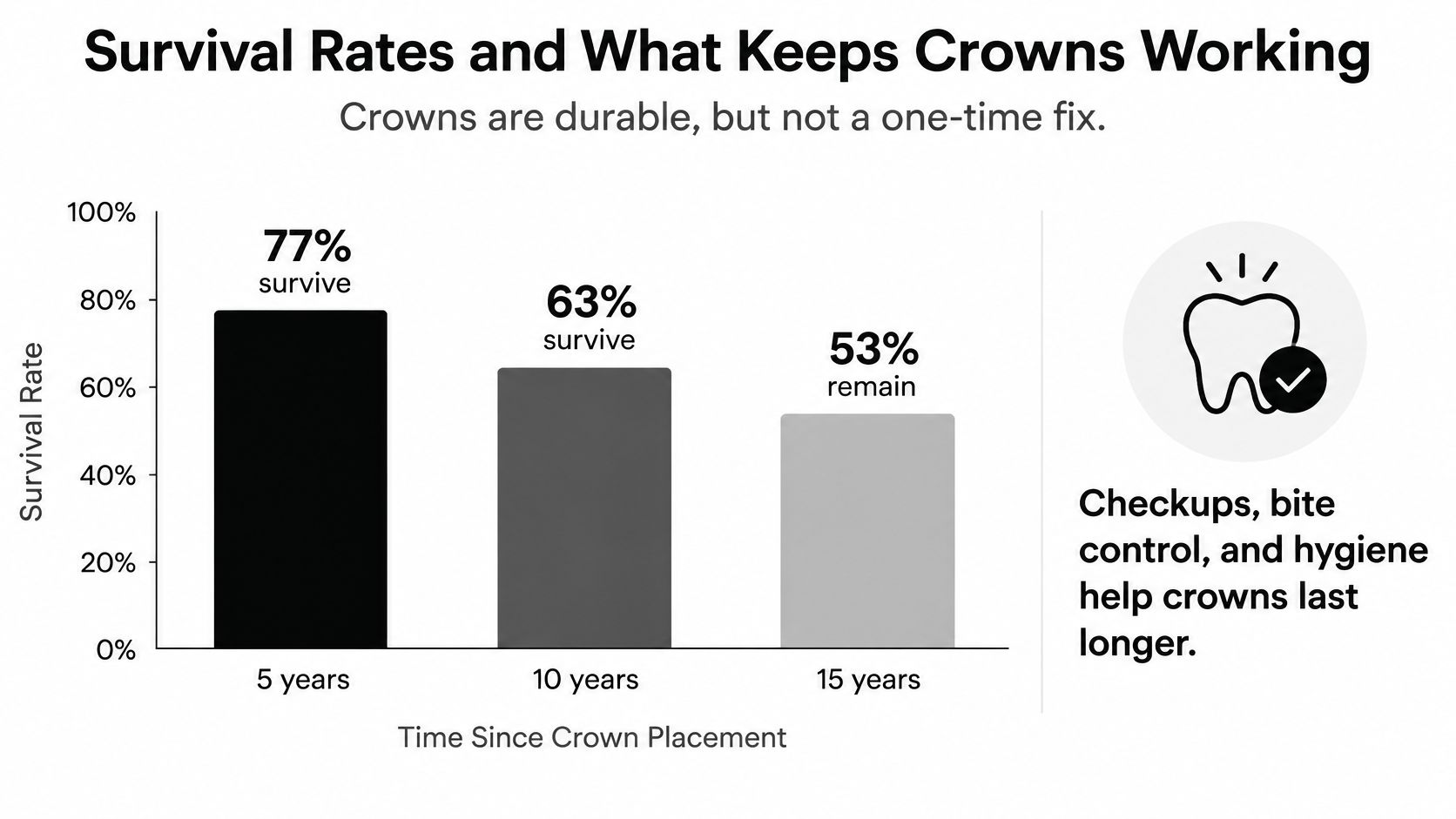
Those are population figures, not a personal expiration date. One failed crown may be straightforward to manage, but multiple failures across an arch can mean more visits, replacement costs, and coordination. The forces and health of each tooth matter, so a full-mouth case needs a plan for bite control as well as for the restorations themselves.
The habits and checks that protect the result
- Attend recall visits: The dentist can check the margins, gums, and bite for changes that may not be obvious at home.
- Control grinding: If you clench or grind, ask whether a custom night guard is appropriate and wear it as directed.
- Manage reflux and acidic exposure: Seek medical advice for ongoing reflux, and limit repeated exposure to acidic drinks that can weaken tooth structure.
- Keep plaque under control: Brush and clean between teeth consistently, and follow any periodontal maintenance plan.
- Address new damage promptly: Report sensitivity, a loose crown, a chip, or a changed bite rather than waiting for pain to worsen.
What if you grind, have reflux, or develop decay under a crown? Treat the cause as well as the restoration. A dentist may repair or replace a damaged crown, while the tooth beneath it could need a new filling or root canal treatment depending on the extent of decay or other damage. Crowns cover tooth structure, but they don't make the tooth immune to disease. Chipping and cracks are among the complications clinicians monitor, which is why bite protection matters alongside hygiene and follow-up. For more on the factors that affect longevity, see this guide to how long dental crowns last.
What Full Mouth Crowns Cost and How Long They Take
A useful starting point for checking the arithmetic is the 2024 U.S. benchmark of $1,211 for an average metallic dental crown, published by Becker's Dental. (Becker's Dental's 2024 dental-cost benchmark gives the single-crown figure.) Multiply that amount by the number of crowns to estimate a basic comparison total. It's not a quote for a full-mouth case.
| Crowns in the case | Benchmark arithmetic | Not included in the benchmark |
|---|---|---|
| 10 crowns | $12,110 | Imaging, root canals, gum treatment, bone grafts, sedation, and provisional and final laboratory fees |
| 14 crowns | $16,954 | Imaging, root canals, gum treatment, bone grafts, sedation, and provisional and final laboratory fees |
| 20 crowns | $24,220 | Imaging, root canals, gum treatment, bone grafts, sedation, and provisional and final laboratory fees |
These totals are comparison floors, not expected final prices. Porcelain and zirconia crowns usually cost more than the benchmark for a metallic crown, and the actual plan may include other treatment. Ask the office to itemise each phase so you can see which charges are for the crowns and which address underlying problems or laboratory work. This dental crown cost overview can help you prepare questions about the estimate.
Treatment moves through diagnosis and planning, provisional restorations, preparation, and placement of definitive crowns. It takes multiple visits and may extend over several months, with timing influenced by gum and bone health and by any treatment needed before crown placement. Staging treatment can spread payments and let the clinician work arch by arch, but it means living with interim restorations while the case progresses.
Before committing, request a written, itemised estimate for each phase. Check whether your insurance limits coverage per tooth or per year, and compare the full-crown estimate against at least one suitable alternative plan.
Confirm Your Plan Before You Commit to Full Coverage
Don't agree to full coverage before a clinician has completed a full diagnosis and given you a written plan that compares crowns with at least one alternative. Bring recent X-rays if you have them, and note symptoms such as clicking, sensitivity, or morning headaches. Mention any history of grinding or reflux, then ask to review the wax-up, provisional plan, material proposed for each tooth zone, maintenance schedule, and itemised cost by stage.
A sound plan should show which teeth can be saved, which need treatment first, and which can wait. It should also explain how the proposed bite will be tested before the final crowns are made.
Paul L. Gregory, DDS is located at 57 W 57th St, near Central Park South and Columbus Circle. The practice offers crowns, dental implants, All-on-4 dental implants, bone grafting, and dentures, allowing patients to discuss restorative options in one place. Manhattan's community-board listings identify Midtown, Chelsea, Hell's Kitchen, Turtle Bay, and the Upper East and West Sides among the city's distinct areas. (Manhattan's official community-board listings provide neighborhood references.) Downtown neighborhoods also include Greenwich Village, SoHo, NoHo, Tribeca, Chinatown, and the Financial District. (The Community Board 2 district profile describes its neighborhood boundaries.)
Patients travelling from Chelsea, Midtown, Hudson Yards, Turtle Bay, Hell's Kitchen, the Theatre District, the Upper West Side, the Upper East Side, Lenox Hill, Gramercy Park, the West Village, Greenwich Village, NoHo, the East Village, SoHo, Tribeca, Chinatown, or Wall Street can plan a diagnostic visit around work or home. Book a diagnostic consultation and bring the checklist, so you can review the diagnosis, alternatives, and written cost plan before deciding.
Paul L. Gregory, DDS offers dental crowns, implants, All-on-4 dental implants, bone grafting, and dentures for patients comparing ways to rebuild a damaged or incomplete smile. Visit Paul L. Gregory, DDS to arrange a diagnostic consultation and discuss a plan for your teeth, bite, and long-term maintenance.