

You're in the chair, holding two very different promises in your hand. One keeps most of the tooth and changes the front surface only. The other covers the whole tooth and takes a much bigger bite out of what nature gave you.
That's the core question behind porcelain veneers or crowns. Not which one looks nicer in a before-and-after photo. Which one preserves the tooth you still have, fits the bite you live with, and gives you the least regret five years from now.
| Criterion | Porcelain Veneer | Full-Coverage Crown |
|---|---|---|
| Tooth structure removed | Minimal facial reduction | Much more tooth reduction around the tooth |
| Main job | Refine appearance while preserving enamel | Restore strength, shape, and coverage |
| Best fit | Healthy front teeth with enough enamel | Heavily damaged, cracked, or heavily restored teeth |
| Bonding substrate | Works best when bonded to enamel | Often used when enamel is already compromised |
| Reversibility | Limited once enamel is removed | Also irreversible, but for a different reason |
| Typical decision driver | Conservation | Structural protection |
The Decision Every Cosmetic Patient Faces
Most patients walk in asking for a prettier smile and leave with a more complicated choice. The fork in the road is whether the tooth needs conservation or coverage. If the tooth is still structurally sound, a veneer usually makes more sense. If the tooth is weakened, broken down, or already heavily restored, a crown starts to look less like an overreach and more like the honest fix.
The wrong question and the right one
The wrong question is, “Which one is better?” Both restorations do real work, but they do different jobs. A veneer is a facial restoration, it changes the visible front of the tooth. A crown is a full-coverage restoration, it replaces most of the external tooth surface and protects more of the tooth under function.
The right question is, “How much healthy tooth do I still have?” That question matters more than color, celebrity smile references, or whatever sounded trendy on social media this week. A tooth with strong enamel and modest cosmetic concerns usually deserves the least invasive option that will still hold up.
Practical rule: if the tooth is healthy and the problem is mostly cosmetic, start by asking whether you can keep it conservative.
Why this matters to your future options
Once more tooth structure is removed, you can't give it back. That's why a crown can be the right treatment and still be the more aggressive one. Veneers became mainstream after decades of material and bonding progress, and demand expanded quickly once adhesive dentistry and porcelain processing matured, with veneer prescribing in one major public system rising from about £250,000 in 1988/89 to more than £7 million in 1994/95, then stabilizing at over 100,000 veneers a year (British Dental Journal timeline summarized here).
That history matters because veneers aren't a fad or a shortcut. They're the product of a long clinical evolution, and they earned their place by letting dentists change smiles without turning every front tooth into a full cap. If you're comparing porcelain veneers or crowns, the first decision is not cosmetic style. It's how much tooth you're willing to sacrifice.
What Veneers and Crowns Actually Are
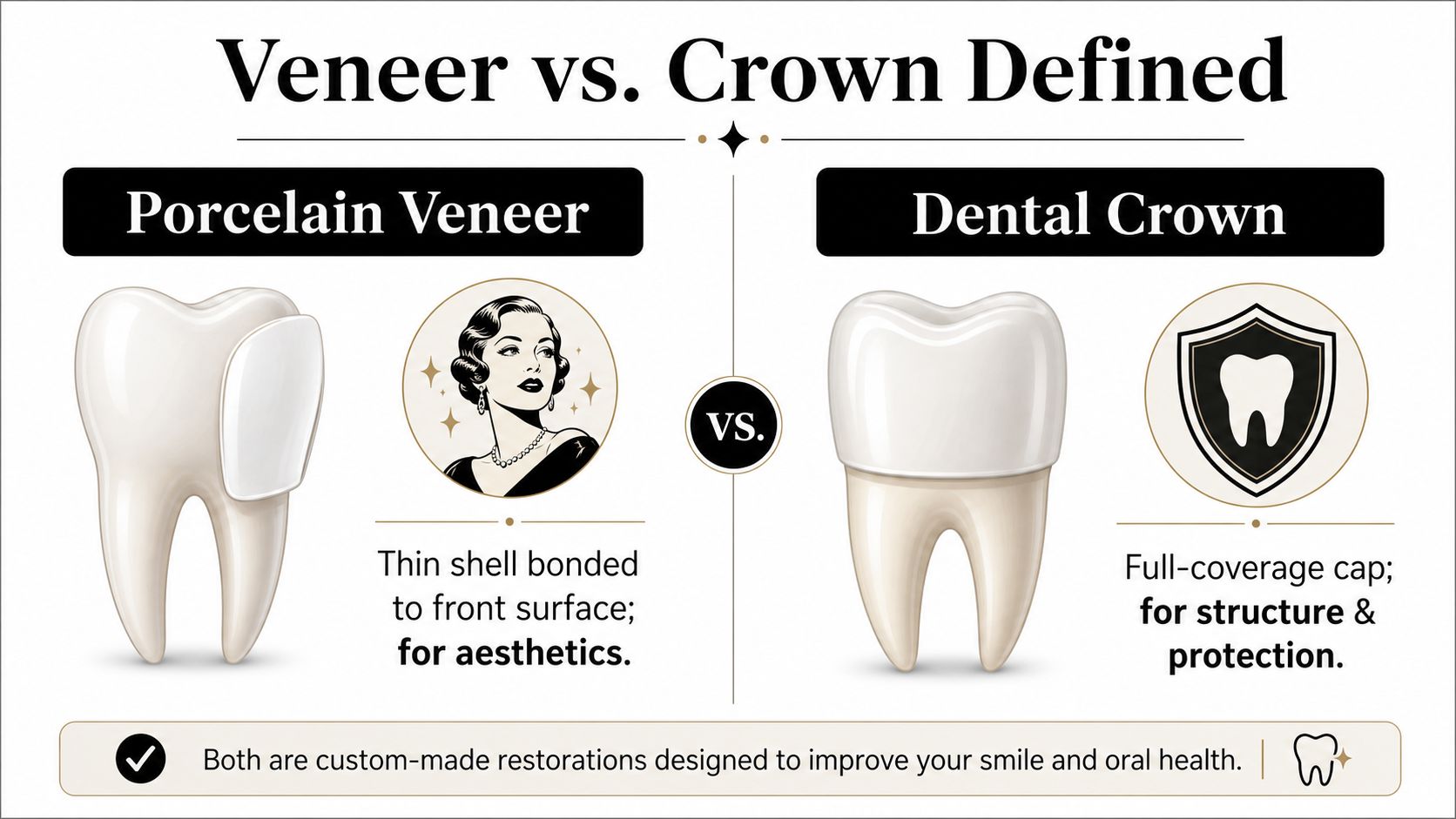
A veneer is a thin porcelain facing bonded to the front of a tooth. Think of it as a custom shell for the facial surface only. A crown covers the whole visible tooth, which is why it can rebuild more structure but also demands much more preparation.
How modern veneers became possible
The idea wasn't born in a lab yesterday. Dr. Charles Pincus first developed the concept in 1938 to temporarily improve actors' teeth, but the modern version only became clinically practical after the 1980s, when reliable fabrication and bonding methods changed what porcelain could do (historical overview and market context). That shift from temporary cosmetic trick to durable restorative option is why veneers now sit in normal treatment planning instead of movie-set history.
Today, porcelain veneers are chosen when the tooth is still worth preserving and the smile issue lives mostly on the surface. Crowns are chosen when the tooth needs more than a makeover, it needs structural support. The distinction sounds simple, but in the chair it's the whole game.
The vocabulary that actually matters
Dentists talk about facial reduction, circumferential reduction, monolithic, and layered restorations because those details change the outcome. Facial reduction means how much is removed from the front. Circumferential reduction means the tooth is trimmed all the way around, including the biting surface.
A veneer is not a “thin crown.” It's a different design with a different purpose, and that difference starts with how much tooth gets touched.
If you want a plain-English look at how a Midtown cosmetic consultation is organized around veneers, the practice overview for porcelain veneers shows how this treatment is framed clinically, not just aesthetically. The point is simple. Veneers and crowns may both improve a smile, but they're not interchangeable wrappers.
Side by Side on the Criteria That Matter
Here's the comparison that helps a decision.
| Criterion | Porcelain Veneer | Full-Coverage Crown |
|---|---|---|
| Preparation depth | About 0.3 to 0.5 mm of facial enamel reduction (comparison source) | About 1.5 to 2.0 mm of circumferential reduction, including the biting surface (comparison source) |
| Tooth preservation | More conservative | More aggressive |
| Bonding surface | Best when bonded to enamel | Used when more coverage is needed |
| Durability question | Depends heavily on enamel bonding and case selection | Depends on material, design, and bite forces |
| Best use | Healthy front teeth with cosmetic concerns | Teeth with major structural compromise |
| Reversibility | Limited once enamel is removed | Also irreversible once prepared |
What the table hides
The preparation difference is not small. A crown usually removes roughly 3 to 5 times more tooth structure than a veneer (comparison source). That's why the word “conservative” belongs to veneers when the tooth can support them. If the enamel is intact and the tooth is otherwise healthy, shaving off more structure just to get a stronger-looking outer shell is usually the wrong trade.
The issue is not vanity versus durability. It's conservation versus coverage. A veneer preserves more natural tooth, which often gives you more flexibility later if the tooth ever needs additional treatment. A crown can be completely appropriate, but it should earn its place through need, not habit.
Why cost isn't the first filter
Patients ask about price because price is visible. Tooth loss is invisible until it becomes a problem. Insurance also tends to treat crowns and veneers differently, with crowns more often framed as restorative and veneers more often framed as cosmetic, so the financial picture can diverge quickly.
If you want a straightforward crown treatment overview, the dental crowns page is useful because it reflects the structural side of the decision. Still, don't let the billing conversation outrun the biology. The better restoration is the one that matches the tooth, the bite, and the amount of enamel left.
Why the Enamel Question Changes Everything
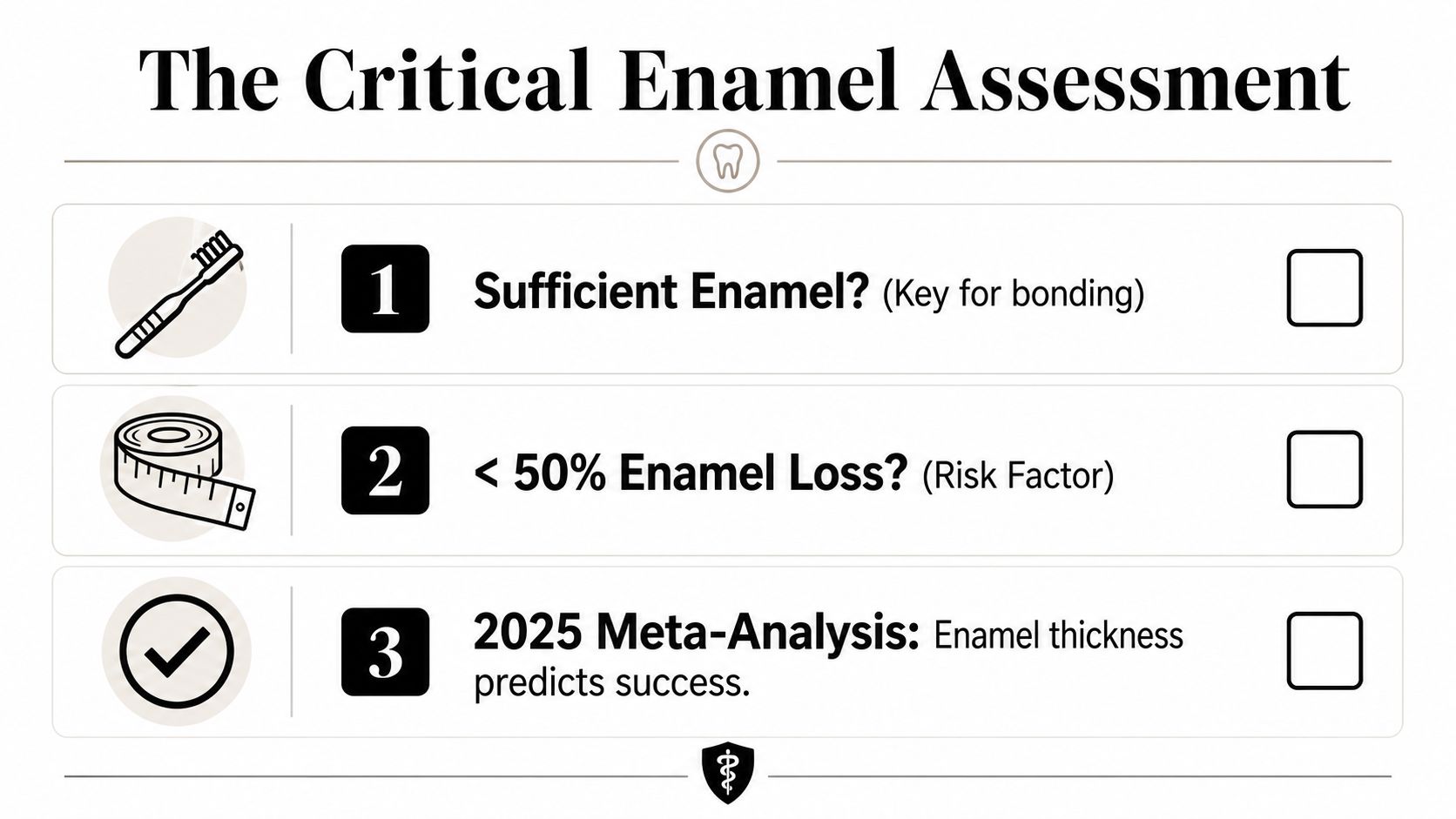
This is the part most marketing pages skip, and it's the part that should drive the consult. Veneers do best when they bond to enamel, not dentin. That's not a small technicality. It's the reason two teeth that look similar on a smile line can have very different long-term outlooks.
Why enamel bonding wins
A 2025 meta-analysis found ceramic veneers bonded to enamel had survival and success rates around 99%, while veneers bonded to dentin had more complications and worse failure performance (PubMed meta-analysis). This is a key decision point. If enough healthy enamel is still present, a veneer is not just less invasive, it's also the more predictable restoration.
This is why a thoughtful dentist doesn't ask first, “Do you want veneers or crowns?” The first question is whether the facial enamel is still there to support a veneer. If the answer is yes, and the bite is manageable, veneers become the conservative default. If the answer is no, the conversation changes fast.
What patients actually notice when things go wrong
Most veneer problems aren't dramatic failures. They're lower-grade issues like marginal adaptation, gingival inflammation, discoloration, food impaction, and cleaning difficulty (same meta-analysis). Those are not glamorous complications, but they're the ones that frustrate patients in everyday life.
That's why a tiny chip isn't always a catastrophe, and why a “perfect” smile that's hard to floss is still a bad restoration. The aim is not just pretty porcelain. It's a restoration that your mouth can maintain without constant irritation.
If the front tooth still has strong enamel, the bite is calm, and the cosmetic issue is localized, a veneer is usually the cleaner choice.
If you can answer three things before your consult, you'll ask better questions. Is there enough enamel left? Is the bite heavy or light? Is the tooth intact, or already structurally compromised? Those answers decide more than the name on the treatment plan.
Durability Beyond the Marketing Claims
Longevity is not a slogan. It's a fit problem. Some teeth live in a calm environment and some live in a storm, especially if the patient clenches or grinds at night. That's why asking which restoration “lasts longer” is too broad to be useful.
What the crown data actually says
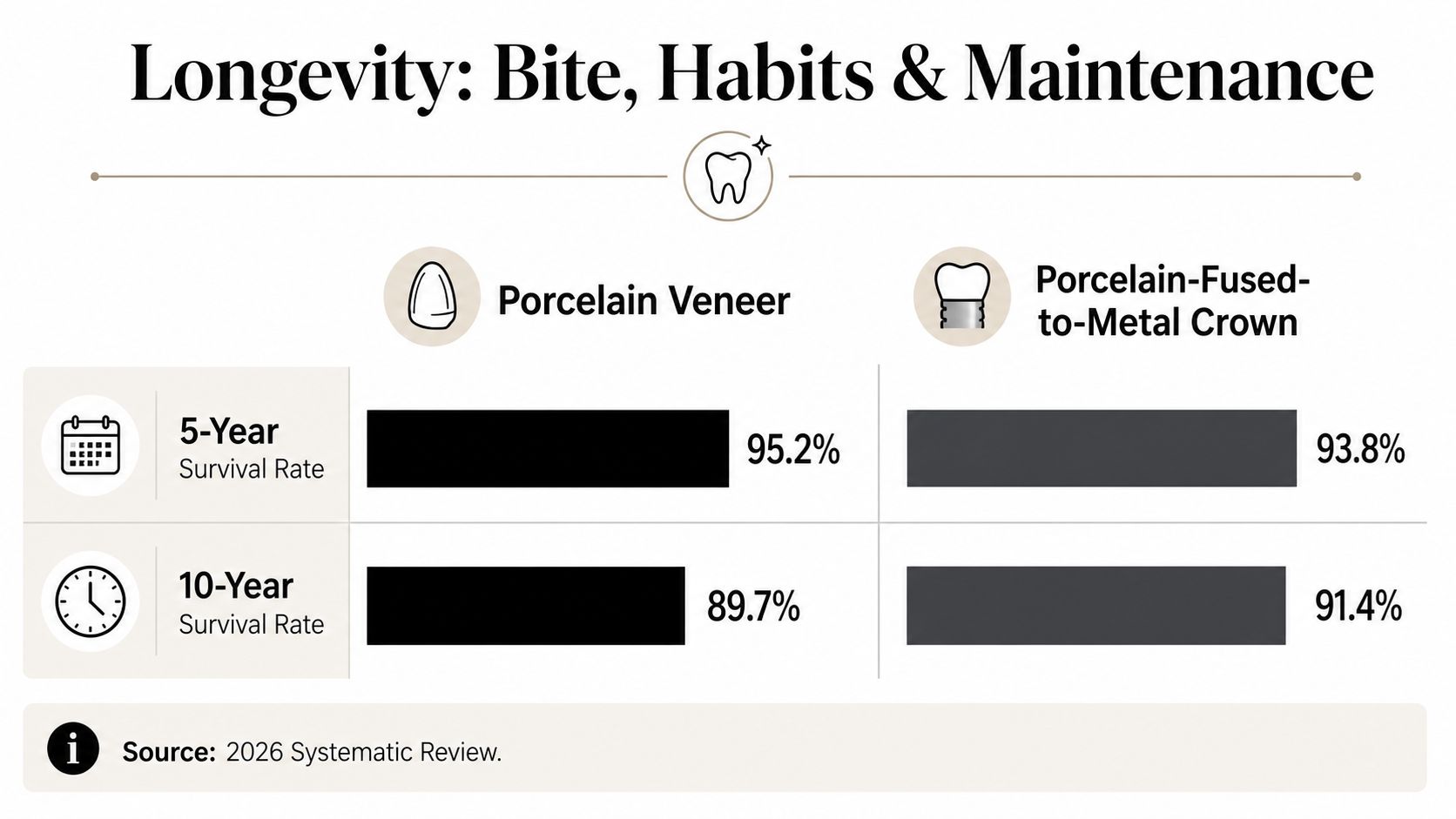
A 2026 systematic review of tooth-supported single crowns reported 5-year survival rates of 98.5% for monolithic lithium-disilicate crowns, 97.1% for metal-ceramic crowns, and 96.8% for monolithic zirconia (PubMed review). That's strong survival across several modern crown materials.
The same review also showed veneered zirconia and veneered glass-ceramic carried more technical risk than monolithic designs, which is a useful reminder that layer-by-layer esthetics can come with more maintenance. For implant-supported crowns, veneered ceramic crowns had a higher annual ceramic chipping rate, 1.65% versus 0.39% for monolithic crowns (PubMed review). That's not a reason to fear crowns. It's a reason to choose the right crown design for the bite.
Why monolithic matters more than people think
Monolithic materials changed the durability conversation because they avoid some of the chipping risk that comes from layered porcelain. That matters most in people who grind, clench, or put high force through the back teeth. A heavy bruxer is not the same patient as someone with a relaxed, even bite.
For a tooth that already needs endodontic treatment, the structural question gets even sharper. A root-canal-treated tooth often needs coverage for protection, which is why the discussion often points toward a crown rather than a veneer. If that's your situation, the root canal treatment page is the right place to understand why a stronger restorative plan matters after the infection is cleared.
The useful takeaway
Crowns can be very durable, but the material and design matter. Veneers can also be durable, but only when the tooth is a good candidate and the enamel bond is strong. Ask your dentist which restoration fits your bite, not just which one sounds stronger on paper.
Matching the Restoration to the Real-Life Scenario
A good dentist doesn't pick a category first. They look at the tooth in front of them and work backward. The scenario determines the restoration, not the other way around.
A chipped front tooth with healthy enamel
If the chip is small and the rest of the tooth is sound, I'd usually lean veneer. It preserves the tooth and restores the front surface without turning a healthy incisor into a crown case. If the chip is deeper than it looks or the tooth has old restorations across much of the surface, that answer can flip.
A back tooth that has lost more than half its structure
That's crown territory. A veneer is a facial solution, not a structural rebuild for a molar that's missing major walls. You need coverage and protection, not just a prettier outer layer.
A root-canal-treated molar
Crowns usually win in this situation. Once a tooth has had endodontic treatment, the restoration has to protect what remains under chewing load. A veneer is rarely the right tool for that job, because the tooth needs more than facial refinement.
A uniformly worn smile from grinding
This one depends on the bite. If the wear is mostly cosmetic and the patient's bite is controlled, veneers can still work on the front teeth. If clenching is heavy or the wear pattern is severe, more coverage and a more substantial plan are usually smarter.
A single dark tooth that needs masking
If the tooth is otherwise intact and the enamel is usable, a veneer can mask color while conserving structure. If the dark tooth also has a large filling, cracks, or prior trauma that weakens it, a crown becomes more sensible.
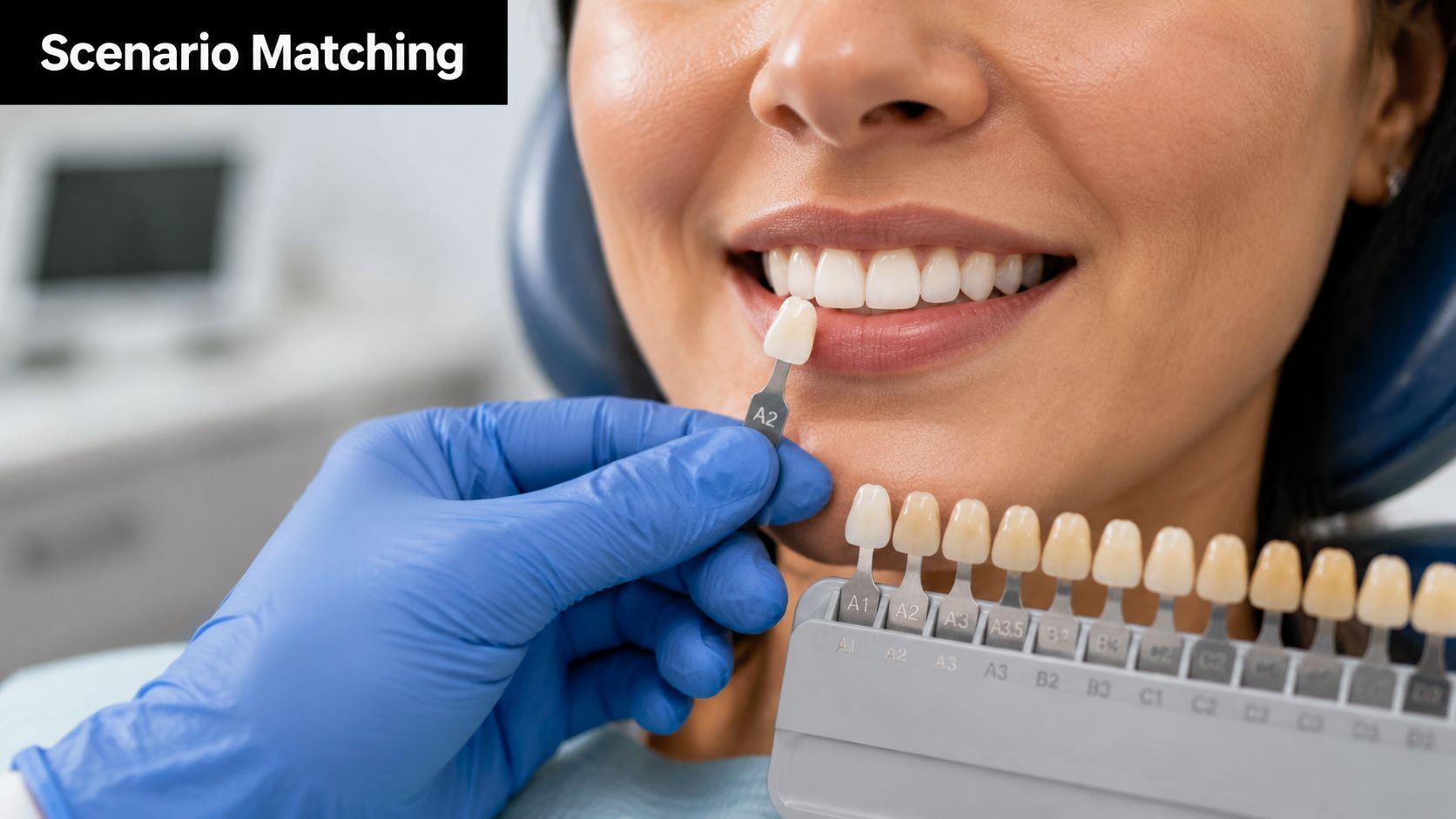
If you're trying to decide whether your own tooth fits the veneer lane, Invisalign may also matter when spacing or alignment is part of the problem. The Invisalign option can sometimes create a better foundation before cosmetic work starts, especially when the smile needs positioning help before porcelain is even considered.
A Practical Recommendation Framework
Start with the tooth, not the product. If the tooth still has healthy enamel and the problem is mostly cosmetic, choose the most conservative option that will predictably work. If the tooth has major structural loss, a crown is usually the more honest answer.
Use this order of thinking
- How much healthy tooth is left? If most of the enamel is intact, a veneer stays on the table. If the tooth is heavily broken down, a crown moves ahead.
- What's the bite doing? Heavy clenching and grinding push the decision toward more protective planning.
- Is the problem cosmetic, structural, or both? Veneers solve surface issues. Crowns solve more than appearance.
- How much maintenance are you willing to accept? Veneers can be wonderful, but they're less forgiving when bonding conditions are poor.
- What happens if the tooth changes later? Keeping more tooth now usually preserves more options later.
At a Midtown consultation, a dentist should not sell you on the pricier restoration just because it sounds more complete. A serious exam should use digital scans, intraoral imaging, and bite analysis to show why one route beats the other. That's how Paul L. Gregory, DDS and similar practices organize restorative planning, by looking at the tooth, the bite, and the full mouth picture before naming a treatment.
The most conservative correct answer is usually the best one. The most dramatic answer is not automatically the strongest one.
If the recommendation is a veneer, that's often because it protects the tooth better. If the recommendation is a crown, it's usually because the tooth can't safely stay partially covered. Either way, the decision should feel like dentistry, not a sales pitch.
Questions Patients Wish They Had Asked Sooner
The question everyone wants answered first is whether veneers are reversible. They're not, because enamel is removed. That's exactly why the enamel decision matters so much before anyone starts prepping a tooth.
How long do they last? There isn't a single honest number that fits every mouth, because survival depends on tooth condition, bite forces, and maintenance. The better question is not “How long do they last?” but “What makes this tooth a good or bad candidate?”
Insurance is another blunt reality. Veneers are often treated differently from crowns because veneers are usually framed as cosmetic and crowns as restorative. That's one reason the same tooth can generate very different coverage outcomes depending on whether the issue is appearance or structure.
Whitening and orthodontics should usually come before porcelain if they're part of the plan. Whitening changes tooth color, Invisalign changes position, and porcelain should be matched to the final tooth setup, not to a temporary one. Doing porcelain too early can lock you into the wrong shade or the wrong alignment.
What happens when a restoration fails? Usually replacement, repair, or a shift to a more protective design depending on what broke and why. Veneer complications are often small and local, which is another reason careful case selection matters from the start.
The shortest honest version is this. Porcelain veneers or crowns is not a beauty contest. It's a clinical decision about enamel, structure, bite forces, and how much natural tooth you want to keep.
If you want a straight answer for your own tooth, schedule a consultation with Paul L. Gregory, DDS in Midtown Manhattan. The practice can evaluate whether a veneer, a crown, or a different restorative sequence fits your enamel, bite, and cosmetic goals, then map out the least aggressive treatment that still makes sense.