

You're between meetings in Midtown when a broken tooth changes your afternoon. The dentist says you may need a crown, and you're searching for dental insurance no waiting before booking the next appointment. You don't want another brochure promising immediate benefits. You want to know whether a new policy will help pay for the treatment you need.
My advice is straightforward: shop for the procedure, not the slogan. A plan that lets you schedule an examination immediately can still leave you paying for most of the restorative work afterward. The useful conversation starts with your treatment codes, enrollment date, and written benefit details.
What No Waiting Period Really Means for Dental Plans
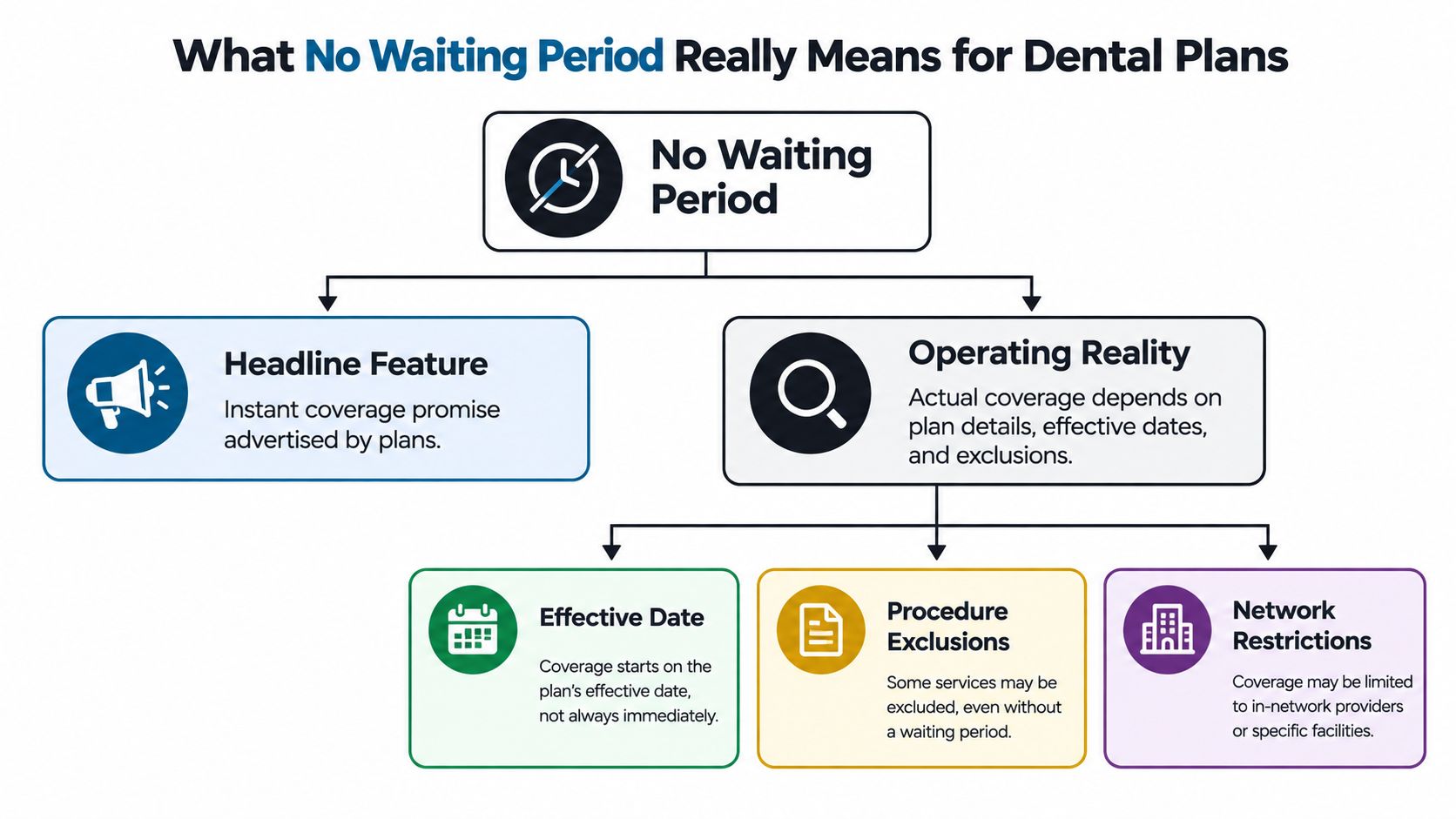
Suppose you've already had a Midtown emergency consultation and now need a crown or an implant. Buying a policy labeled no waiting period doesn't settle whether that treatment qualifies. It removes a timing restriction only where the policy itself says it does.
The National Association of Dental Plans' explanation of dental benefits distinguishes preventive, basic, and major services and describes waiting periods as uncommon in large-group policies but more common in individual and small-group policies. Its historical industry materials describe major-service waits of 3 to 18 months, typical orthodontic waits of 12 months, and waits reaching 24 months in some federal plans.
How Waiting Periods Apply by Service Category
| Service Category | Typical Waiting Period | What No-Waiting Typically Allows | Examples Relevant to Manhattan Patients |
|---|---|---|---|
| Preventive | Commonly available immediately | Eligible preventive benefits from the effective date | Examination or routine cleaning |
| Basic | Depends on the policy | Earlier access if the category's wait is removed | Filling or extraction, depending on classification |
| Major | Historically longer waits, as described above | Immediate eligibility for covered major services, not unrestricted payment | Crown, bridge, denture, or eligible implant work |
| Orthodontic | Separate waiting rules may apply | Access only if orthodontic benefits are included and immediately eligible | Clear braces or aligner treatment |
Start with the policy's definitions
Ask the insurer which category contains your actual treatment. Don't assume that every policy classifies root canals, periodontal procedures, or surgical extractions the same way. Then confirm whether the no-wait provision applies to that category.
This diagram separates the advertised feature from the details that determine usable benefits.
Insurers have historically used waiting periods to address adverse selection, meaning enrollment by people who already expect expensive treatment. Broader employer enrollment can reduce that concern, which helps explain the difference between large-group and individually purchased coverage described by NADP.
Practical rule: Don't ask only whether you can use the plan today. Ask whether your specific procedure is eligible on the date it will be performed.
Comparing Plan Types by Service Category
Employer-sponsored coverage is an enrollment arrangement, not a guarantee of a particular benefit design. Start with the employer's actual policy, then compare it with individual options. For a Garment District professional who needs a root canal this week, the decisive question is immediate endodontic eligibility, not whether the plan comes through work.
The Investopedia discussion of dental insurance limitations notes that waiting periods most often affect basic and major treatment, while preventive services are commonly available immediately. Some plans remove the basic-service wait but retain a 6–12-month delay for major procedures.
Compare access without assuming coverage depth
Use this quick-reference table as a document-review checklist. It identifies what to establish rather than promising benefits across every policy bearing the same label.
Plan Type Compared by Immediate Access and Coverage Depth
| Plan Type | Preventive Access | Basic Access | Major Access | Network Requirement |
|---|---|---|---|---|
| Employer-sponsored group | Check the employer benefit schedule | Confirm category eligibility | Verify any group waiver | Depends on the underlying plan |
| Individual PPO | Confirm effective-date benefits | Look for category-specific waits | Check immediate eligibility and first-year limits | Verify preferred-network and out-of-network terms |
| DHMO | Review the service schedule | Confirm listed services and patient charges | Check covered procedures and authorization requirements | Confirm participating dentist and assignment rules |
| Indemnity | Review policy eligibility | Check reimbursement terms | Verify exclusions and payment ceilings | Confirm dentist-choice and reimbursement provisions |
| Discount program | Check activation terms | Request the participating dentist's discounted fee | Request a procedure-specific discounted estimate | Confirm participating providers; don't treat discounts as insurance reimbursement |
For a Battery Park family enrolling during open season, I'd compare the children's planned preventive services against the actual schedule. For a Theatre District freelancer choosing between individual plans, I'd request written answers about the needed procedure before comparing premiums.
Periodontal care deserves its own review. Use the practice's guide to dental insurance for periodontal treatment to organize questions about the recommended gum treatment rather than assuming a routine-cleaning benefit applies.
If you're also helping a relative compare coverage outside New York, Copeland Insurance Agency's resource to find budget dental insurance Kansas is a geographically relevant starting point. Don't transfer another state's plan assumptions to your Manhattan enrollment.
My recommendation: favor the option whose written terms fit your treatment timeline and dentist choice. No format wins automatically.
The Four Numbers That Matter Most
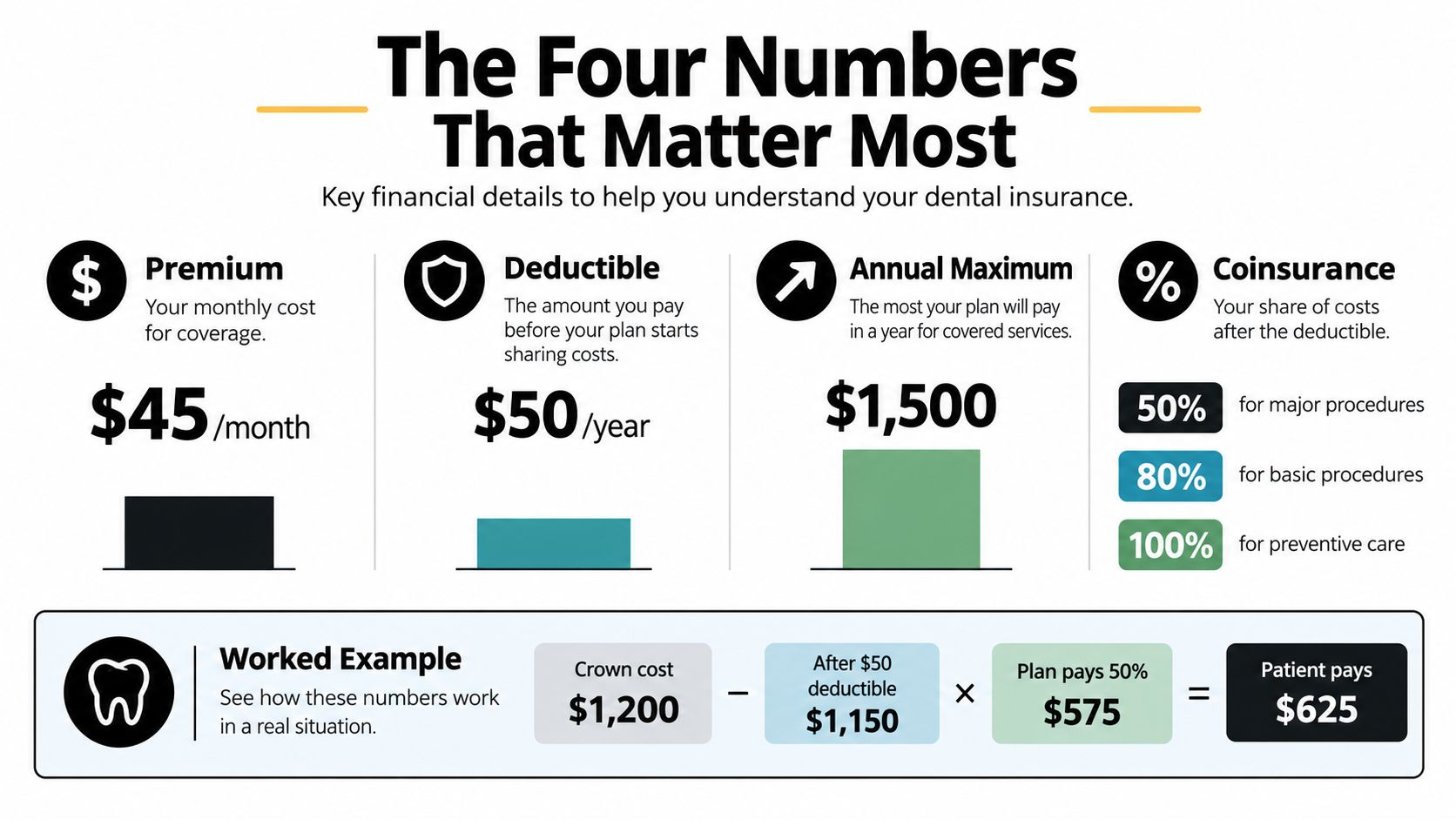
A no-wait policy is useful only if its payment terms justify its cost. Put premium, deductible, annual maximum, and coinsurance beside each other before enrolling.
The ADA's dental benefit plan design guidance reports common annual maximums of approximately $1,000–$1,500. Separately, CareQuest Institute's report on exhausted dental benefits found that 12% of adults reported maxing out their dental benefits during 2025.
The visual below illustrates the financial terms. Its example amounts aren't a quote for this practice or a promise from your insurer.
Read the payment terms together
- Premium: Treat the cost of maintaining coverage separately from what the insurer contributes toward treatment.
- Deductible: Identify which services require it and whether you've already satisfied it.
- Annual maximum: Establish how much insurer reimbursement remains, not just the original allowance.
- Coinsurance: Confirm the insurer's share for the relevant category and the fee basis used to calculate it.
Consider a Midtown patient planning an implant and crown after emergency assessment. Using the ADA benefit-design framework cited above, a hypothetical 50% major-service benefit with a $1,500 annual maximum could exhaust the insurer's contribution after approximately $3,000 in eligible charges. That calculation assumes eligibility and ignores deductibles, exclusions, prior benefit use, and differences between allowed and billed fees.
An implant exclusion or missing-tooth provision would change the estimate before that calculation even becomes useful. Ask whether the maximum applies per person or across the family, whether imaging uses the allowance, and whether out-of-network reimbursement follows a reasonable-and-customary allowance.
For an endodontic treatment plan, consult the office's root canal cost with insurance guide alongside your written estimate.
Use the accompanying video as supplementary material, then return to your own benefit schedule.
How to Verify Coverage Before You Sit Down
Send your insurance information before the appointment. A photograph of the card is a start, but the front desk also needs enough policy information to investigate the treatment you're considering. Waiting until checkout makes the financial conversation harder than it needs to be.
Delta Dental's overview of updated eligibility workflows describes systems and clearinghouses that offer instantaneous eligibility responses at scheduling or check-in, helping teams review active coverage, benefit use, and outstanding waiting periods. That capability doesn't mean every response contains every detail needed for a complex treatment estimate.
Bring a documented checklist
- Coverage documents: Insurance card, benefit summary, policy certificate, and exclusions.
- Recent claims: Explanations of benefits from earlier visits so the office can investigate remaining benefits.
- Transition records: Prior-policy certificates, termination information, and the new effective date if coverage recently changed.
- Treatment information: An existing treatment plan or referral, including procedure codes when available.
- Written questions: Network status, deductible remaining, annual benefits remaining, and predetermination or preauthorization requirements.
This checklist visual is a useful reminder before calling the insurer.
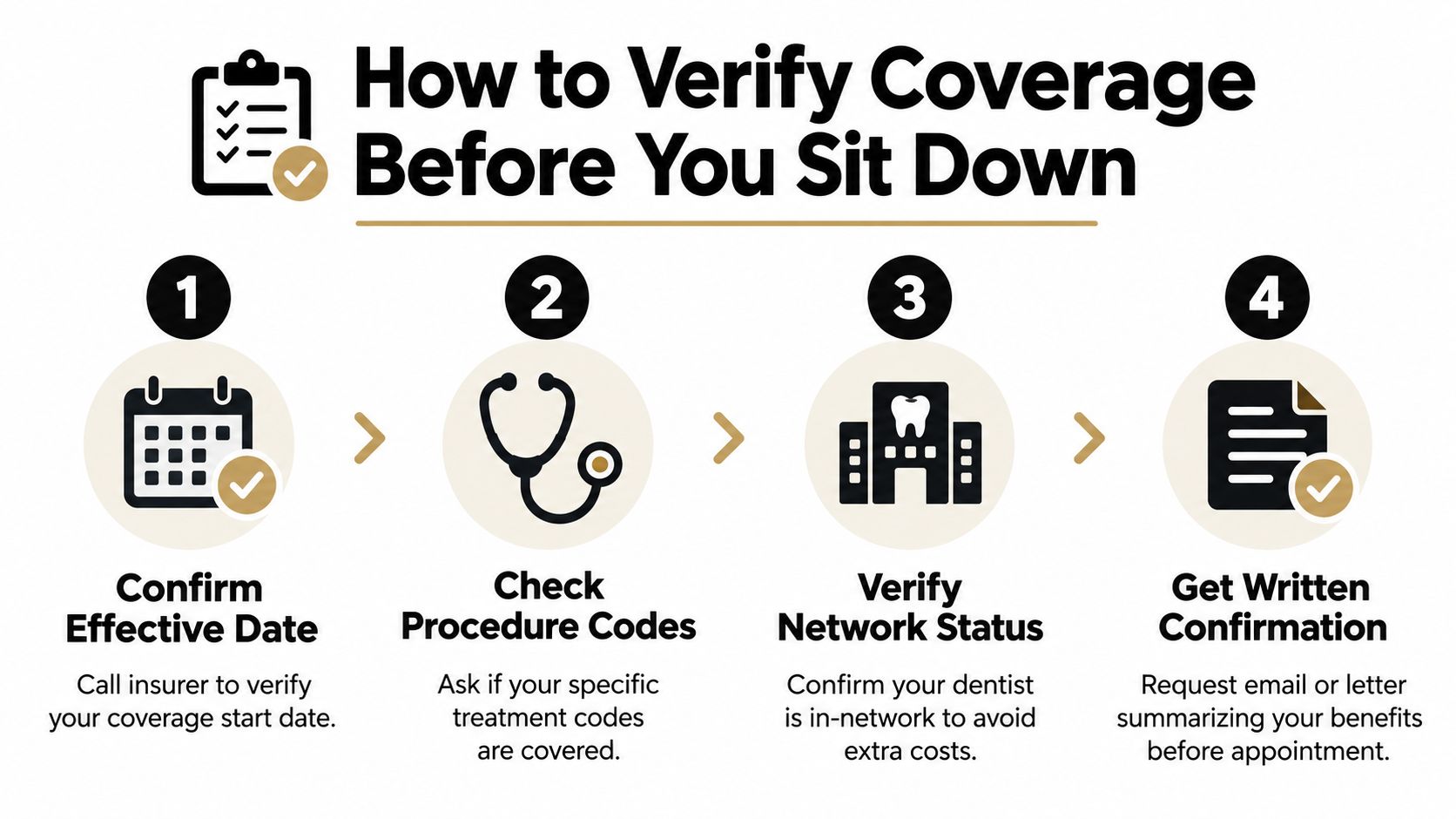
The Midtown office can help verify benefits, explain the breakdown in plain English, and submit a predetermination when appropriate. Ask for an estimate that separates expected insurance reimbursement from your expected responsibility. An estimate isn't a guarantee of claim payment, so keep the insurer's written response with your records.
Don't confuse accepting insurance paperwork with confirmed network participation. For background on the administrative questions to ask, Clarity's explanation of how payer enrollment services work provides a resource on enrollment and credentialing.
Elective treatment needs an equally specific inquiry. The practice's explanation of whether dental insurance covers teeth whitening can help you prepare that separate conversation.
Get the answer attached to the procedure, provider, and treatment date. A general statement that your insurance is active isn't enough.
Why Prior Continuous Coverage Changes Everything
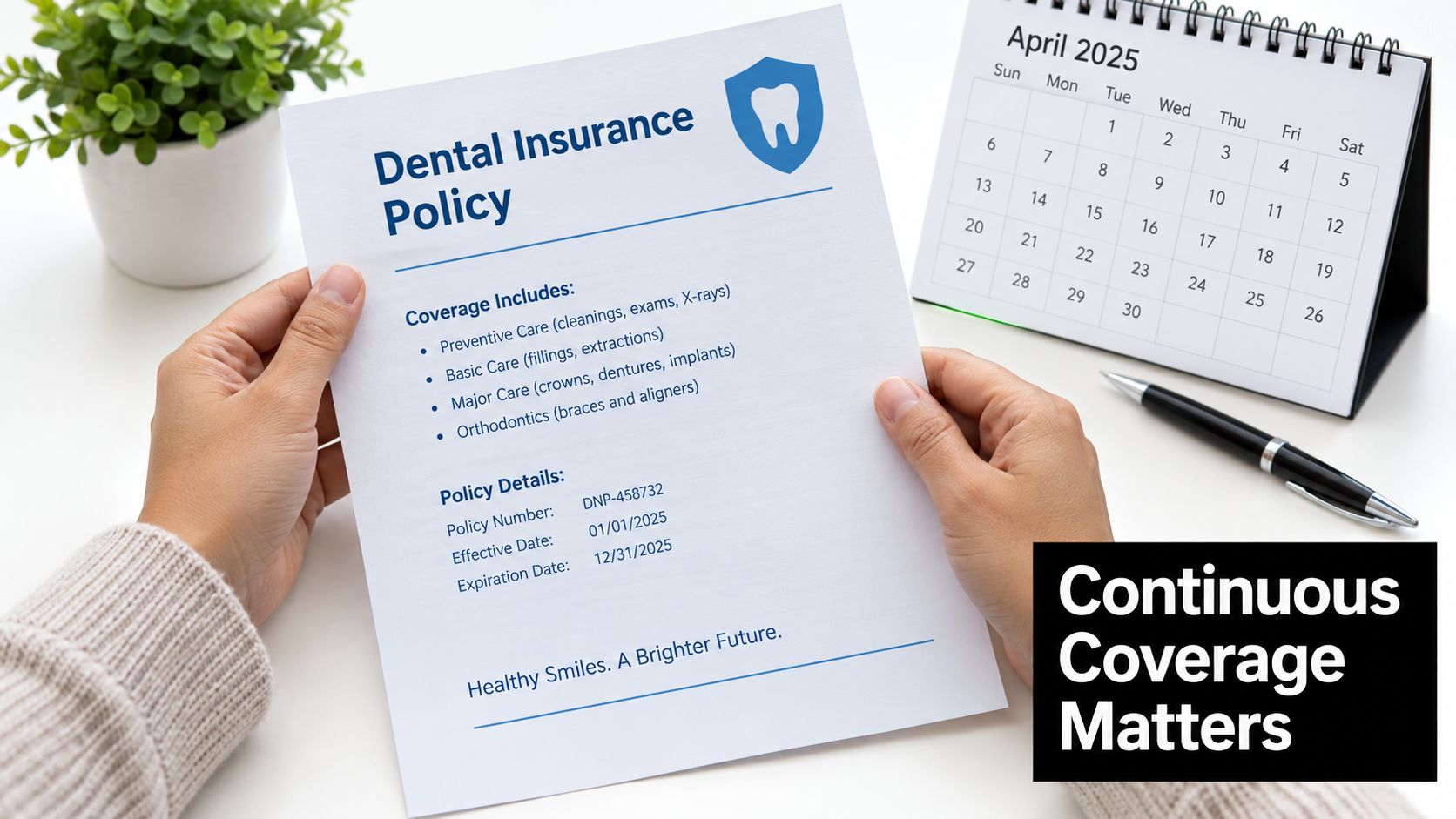
Before buying replacement coverage, find out whether your existing insurance can qualify you for a waiting-period waiver. That question can change which policy makes sense more than its advertised no-wait label.
Guardian's explanation of full coverage and no-waiting options describes policies that waive waits when patients document comparable prior coverage, often around 12 consecutive months. A lapse may restore the waiting period, and the waiver's scope depends on the policy.
Keep the old policy documents beside the new enrollment paperwork.
Preserve eligibility during a transition
Consider a hypothetical Financial District employee changing jobs while planning implant treatment. The important comparison isn't the old premium versus the new premium. It's whether the replacement policy accepts the prior coverage, removes the relevant major-service wait, and covers the planned treatment when it occurs.
A freelancer becoming an employee should ask the benefits administrator when dental enrollment becomes effective. Someone losing coverage after divorce should obtain termination documentation promptly rather than reconstructing the timeline later. Neither scenario should be treated as an automatic waiver.
- Verify continuity: Ask what evidence the new insurer accepts and how it defines comparable coverage.
- Check the waiver's reach: Establish whether it applies to basic services, major services, or both.
- Match the dates: Put termination, enrollment, effective, and proposed treatment dates on the same calendar.
- Review existing approvals: Ask whether a prior predetermination has any relevance under the replacement policy.
My recommendation is to settle these questions before canceling a policy or committing to treatment dates. A cheaper replacement can be poor value if it introduces a delay that your current coverage avoids.
Don't assume preserving continuity guarantees implant reimbursement either. The waiver addresses timing; the new contract still determines what qualifies. Ask the insurer to document its waiver decision, not merely acknowledge that you had insurance before.
Manhattan Neighborhoods and Why Geography Matters Here
A Midtown office is a practical meeting point for patients who work in one neighborhood and live in another. The practice at 57 W 57th St, near Central Park South and Columbus Circle, provides a central location for coordinating examinations, restorative visits, and follow-up care.
The MTA's Manhattan geographic reference supports a commonly used definition of Midtown between approximately West 34th and West 59th Streets, with Chelsea generally extending from West 14th to West 34th Street, from Sixth Avenue toward the Hudson River. Neighborhood labels are useful conventions, not uniformly fixed administrative boundaries.
Plan around your actual route
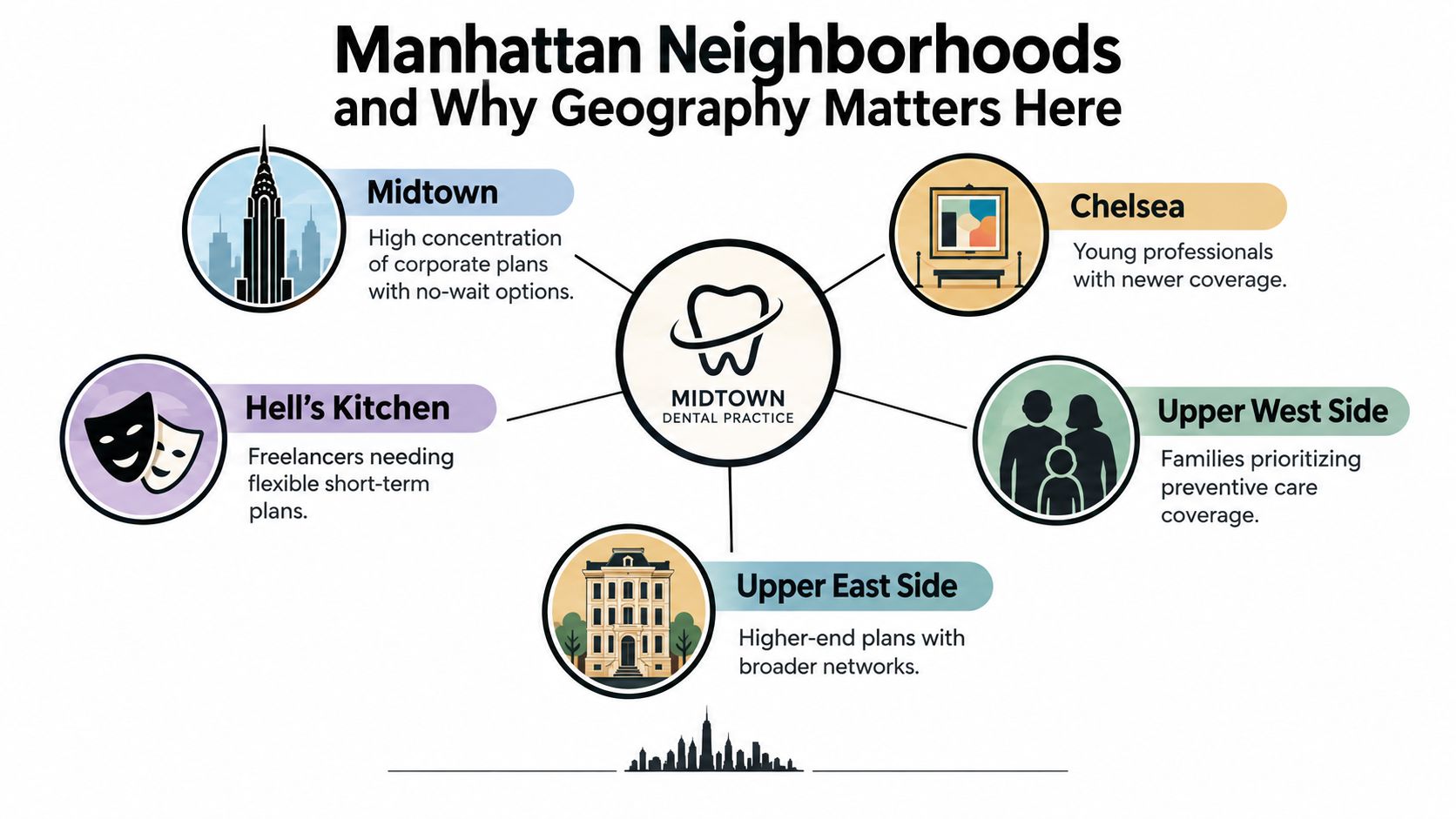
Midtown, Chelsea, Hell's Kitchen, Hudson Yards, and the Theatre District: If you work nearby but live elsewhere, ask whether an assessment and later restorative appointments can fit around your workday. Don't choose a plan before confirming the dentist you intend to visit.
Upper West Side, Upper East Side, Lenox Hill, and Turtle Bay: For family continuity or ongoing treatment, compare the trip from home with the trip from work. A convenient examination matters less if subsequent appointments become difficult to attend.
Gramercy Park, West Village, Greenwich Village, NoHo, East Village, and SoHo: Build the schedule around the treatment plan rather than assuming every visit has the same purpose. Ask the office which appointments involve diagnosis, preparation, treatment, or review.
Tribeca, Chinatown, and Wall Street: For patients traveling uptown, provide insurance documents before leaving home or the office. That gives the front desk an opportunity to investigate benefit questions before your arrival.
The concept map below groups possible scheduling concerns. Its neighborhood examples shouldn't be read as demographic evidence or predictions about anyone's insurance.
Convenience should support continuity
Use the practice's Midtown Manhattan dentist guide to consider location alongside the services you need. Check current subway or bus routing yourself rather than relying on a universal travel-time promise.
Your neighborhood doesn't determine whether you need preventive, emergency, cosmetic, or implant care. Choose a dental home you can realistically return to, especially when treatment requires coordination over multiple visits.
Matching Plan Type to Real Manhattan Use Cases
Patients don't always enroll before problems develop. The ADA's coverage, access, and outcomes research reports that 21.3% of U.S. adults had untreated dental caries during 2017–2020. That's a reason to compare coverage against an actual diagnosis, not just a hypothetical cleaning.
An unexpected crown in Midtown
For a professional with a newly recommended crown, I'd investigate existing employer benefits first. If replacement coverage is necessary, compare individual PPO, DHMO, and indemnity documents against the crown code and intended dentist.
Next step: obtain a written crown estimate and ask each insurer what it would reimburse for that exact treatment. A discount option belongs in the comparison only with a confirmed participating-provider fee, not an assumed insurance payment.
Preventive care for a Downtown family
For a family considering sealants and an orthodontic evaluation, separate the child's preventive needs from possible future orthodontic treatment. Don't buy a policy solely because routine appointments begin immediately.
Ask whether the listed sealants qualify, what frequency or eligibility restrictions apply, and whether orthodontics is included at all. Next step: compare the family's anticipated services with each benefit schedule, including any separate orthodontic lifetime limit.
Full-arch rehabilitation on the Upper West Side
An Upper West Side patient considering All-on-4 needs a component-level treatment plan before selecting coverage. Ask the dental team to identify the proposed surgery, implant, provisional, and final-restoration services so the insurer can respond to each component.
Here, I'd put reimbursement capacity and exclusions ahead of the no-wait slogan. Compare employer coverage or an individual policy with documented discounted fees and payment planning, without expecting any option to fund the entire rehabilitation.
Decision test: Choose the arrangement that produces a workable treatment-and-payment plan, not the one with the most reassuring headline.
These are hypothetical situations, not patient case studies. The common recommendation is to make the financial comparison after the dentist identifies the care being considered.
Maximizing Benefits and How the Practice Helps
Use your benefits deliberately, but don't let insurance scheduling replace clinical judgment. The dentist should determine whether care can safely be staged. An urgent problem shouldn't be left untreated because a different benefit year looks financially attractive.
If you have access to multiple policies, ask the office and insurers to clarify coordination-of-benefits rules before estimating their combined contribution. Don't assume the policies will add their payments together without adjustment.
Keep the administrative work organized
- Coordinate policies: Provide both cards and ask which plan should receive the claim first.
- Check benefit-year timing: For clinically appropriate staged treatment, ask whether separate benefit years could provide additional available reimbursement.
- Retain the record: Keep treatment plans, insurer responses, explanations of benefits, and payment receipts together.
- Discuss the uncovered amount: Review the practice's dental insurance and payment plans guidance before agreeing to a financial arrangement.
The Midtown team assists with insurance questions, claim submissions, predetermination, and payment planning. The office also offers short-notice assessment and stabilization for dental emergencies, allowing the clinical problem and the coverage investigation to be addressed without treating them as the same task.
Ask the front desk what documentation it needs and what remains unresolved. Before treatment begins, the conversation should distinguish confirmed benefits, estimated reimbursement, and costs you may need to cover yourself.
No-waiting coverage becomes useful when the insurer's written terms and the dentist's treatment plan line up. Active verification is what turns an advertising phrase into a realistic financial decision.
Paul L. Gregory, DDS offers family, cosmetic, and restorative care in Midtown, with assistance navigating insurance benefits, claims, and payment planning. Bring your insurance card and any existing treatment recommendation, and visit Paul L. Gregory, DDS to arrange an assessment and discuss what your no-waiting coverage may contribute before you commit to treatment.