

Most dental insurance doesn't cover teeth whitening because insurers classify it as cosmetic, and only about 17% of dental plans offer any whitening benefit. When a benefit exists, it's usually a small, capped allowance rather than full payment.
You may be asking because a wedding, presentation, interview, reunion, or important photograph is coming up. You've found a dental office, chosen a treatment date, and assumed your insurance will handle at least part of the bill. Then a representative tells you that whitening is excluded, leaving you wondering whether the office or the plan made a mistake.
The confusion is understandable. Dental insurance often covers cleanings, fillings, crowns, and other care that protects oral health or restores function. Whitening changes the appearance of healthy teeth, so it usually falls into a different category. The word “covered” can also mean several different things, including a payment allowance, a negotiated discount, or reimbursement after a waiting period.
This guide will help you understand the rule, recognize the limited exceptions, read your benefits documents, and compare practical ways to pay for treatment. A Midtown dental office such as Paul L. Gregory, DDS's guide to restorative and cosmetic dentistry can also help you separate cosmetic planning from medically necessary treatment before you commit to an appointment.
Introduction Why Whitening Coverage Confuses So Many Patients
A Midtown professional named Elena recently called a dental office with a simple question. She wanted a brighter smile before an upcoming event and assumed her dental plan would help because a dentist would do the work. Her plan already paid for examinations and restorative care, so she expected whitening to fall into the same bucket.
The claim was denied. The reason was straightforward. The plan treated whitening as cosmetic care, which means it improves appearance without treating disease, pain, damage, or loss of function.
That is where confusion starts for many patients. Insurance follows the purpose of the procedure, not just the setting where it happens. A dentist may provide both a crown and whitening, but the plan reviews those services separately. A crown restores a damaged tooth. Whitening changes the color of healthy teeth.
Why the label matters
The label affects what happens before treatment. If a plan excludes cosmetic dentistry, a claim can be submitted and still pay nothing. If the plan includes a whitening allowance, the office still has to confirm the amount, timing, and any limits that apply. A verbal comment like “cosmetic services may be included” does not tell you what you will owe.
The broader answer to does dental insurance cover teeth whitening is usually no, but not always. Investopedia's explanation of dental insurance and whitening notes that about 17% of dental plans included some form of whitening benefit, so a small share of patients may have partial help.
What you'll want to check before booking
Your own benefits document is the place to start. Look for the sections labeled cosmetic services, exclusions, limitations, and allowance schedules. Then compare that language with what the dental office can provide, whether that is in-office whitening, dentist-provided trays, or another option. A clear example of how cosmetic and restorative treatment are separated appears in Paul L. Gregory, DDS's guide to restorative and cosmetic dentistry.
The goal is a clear yes or no before you book. Once you know whether your plan pays, discounts, or excludes whitening, you can compare treatment choices with fewer surprises at checkout.
How Dental Insurance Decides What Is Cosmetic vs Medically Necessary
Dental insurance works a little like a repair policy for a house. If a pipe bursts and threatens the structure, the policy may help with covered repairs. If you want to repaint the living room because you prefer a new color, that usually falls outside the repair benefit. Whitening is similar to repainting. It can make a meaningful visual difference, but it generally doesn't repair a health problem.
Insurers usually sort dental services into broad categories:
- Preventive care helps reduce the chance of disease. Cleanings, examinations, and some screenings commonly fit here.
- Restorative care repairs damage or restores function. Fillings, crowns, and bridges are typical examples.
- Cosmetic care changes appearance without addressing a covered health or functional problem. Teeth whitening generally fits here.
The key question is not whether a treatment has value. Whitening can improve confidence and help a patient feel more comfortable smiling. The insurance question is narrower: does the treatment address a condition the plan has agreed to cover?
Core principle: Cosmetic treatment is usually excluded unless the plan creates a specific cosmetic benefit, allowance, rider, or discount arrangement.
Why dental offices can't override the classification
A dentist can explain the treatment, submit documentation, and request a benefit review. The office can't change an exclusion written into your contract. If the plan says whitening is cosmetic and excluded, submitting a claim won't turn it into restorative care.
Patients sometimes ask whether whitening becomes medically necessary when discoloration follows trauma or a disease. That situation needs careful clinical assessment. Treatment for a darkened individual tooth may involve a different procedure connected to infection, internal damage, or restoration, rather than ordinary cosmetic whitening. Documentation may be relevant, but patients shouldn't assume that a history of trauma automatically creates coverage.
The same logic helps predict coverage for other appearance-focused services. Veneers, elective reshaping, and some forms of bonding may be treated differently from fillings or crowns because the insurer looks at the primary purpose of care.
For a related example of how plans evaluate restorative treatment, patients can review how dental insurance approaches crowns. The important habit is to ask what problem the procedure solves and which benefit category contains it.
Rare Exceptions When Whitening Might Be Partially Covered
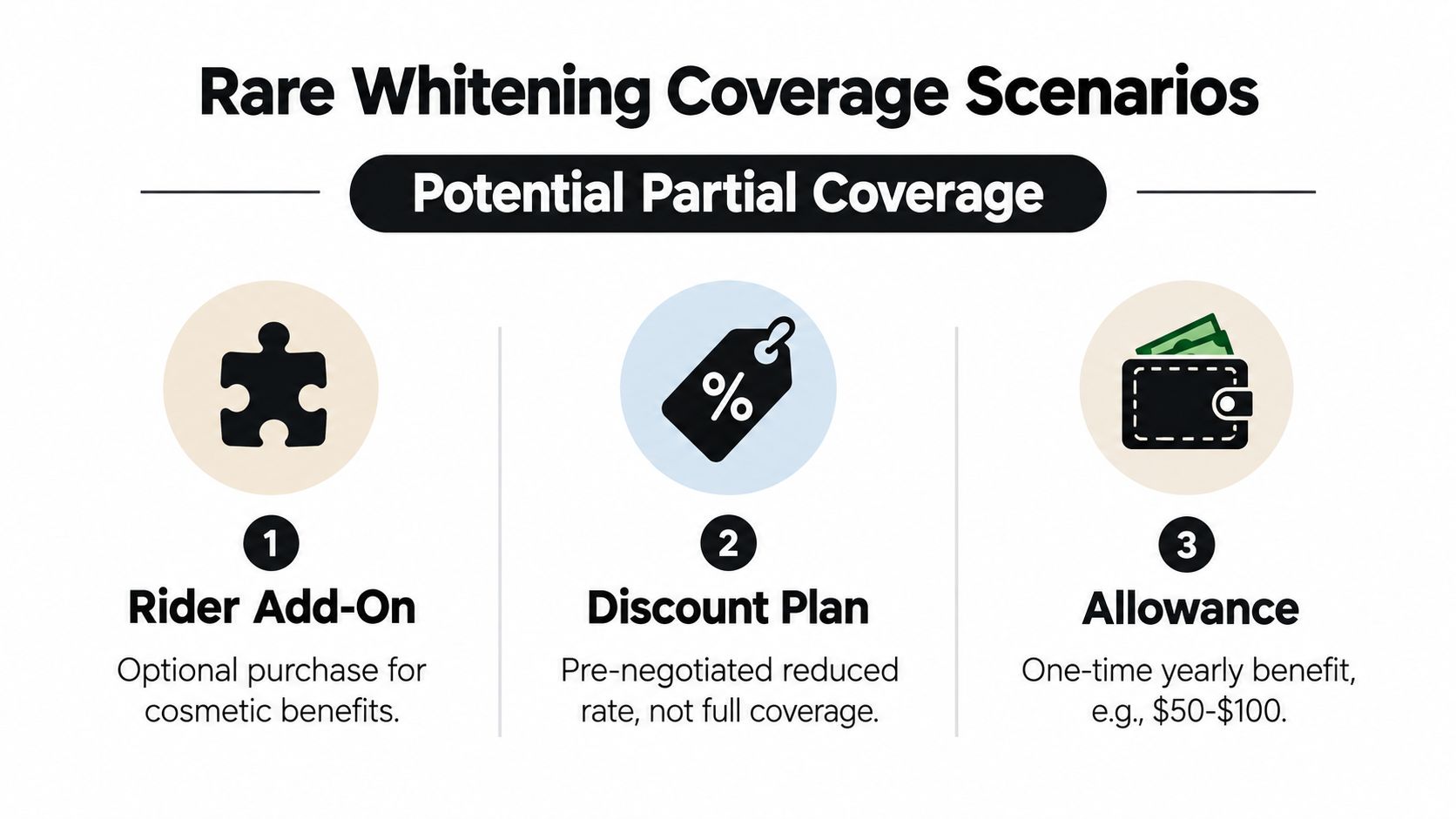
A whitening benefit, when it appears in a plan, usually works more like a coupon or add-on than like coverage for a filling. The plan may pay a set amount, reimburse part of the office fee, or offer a discounted contracted rate. Those arrangements can help, but they still require a close look at the wording.
The Humana Bright Plus plan example shows one common pattern, with a $100 annual allowance for in-office teeth whitening. Other state and individual plans may reimburse 40% to 50% and may impose waiting periods of 6 or 12 months. These figures describe plan examples, not a universal rule.
What partial coverage can look like
If your plan lists whitening under a cosmetic rider, the insurer may still limit how that benefit works. It might set a fixed allowance, restrict how often you can use it, limit the provider network, or require a waiting period. Some plans also require the dental office to use specific procedure codes.
Annual maximums can change the picture too. Many dental plans set yearly maximums in the range of $500 to $2,500, and a whitening allowance may count inside that total rather than sit outside it, as noted in the Investopedia coverage overview. If you have already used benefits for other treatment, less may remain for whitening.
A discount plan works differently from insurance. It may lower the contracted fee, but it does not usually create a claim payment or reimbursement. A rider is an extra benefit attached to the plan, while an allowance is a limited pool of money available under defined rules.
Why special medical circumstances still need caution
Discoloration tied to trauma or a medical condition can sound like an exception, but ordinary external whitening and treatment of a damaged tooth are not the same service. The plan may ask for records, diagnostic images, or a clinical explanation. Even then, the insurer may cover the medically related procedure and still exclude elective whitening for the rest of the smile.
That same distinction shows up in the cost factors for periodontal deep cleaning, where the treatment is about disease management rather than appearance. Reading your own benefits becomes much easier once you separate cosmetic care from medically necessary care.
How to Check Your Own Dental Benefits Before You Book
You don't need to become an insurance specialist. You need the right document, the right search terms, and a written confirmation of what happens if the claim is denied.
Start with the plan documents
Sign in to your insurer's member portal and locate the Summary of Benefits and Coverage, Evidence of Coverage, or certificate of benefits. If you can't find the documents online, call the number on your insurance card and ask for the current version.
Search the document for:
- Whitening
- Teeth bleaching
- Cosmetic dentistry
- Elective procedures
- Exclusions
- Rider
- Allowance
- Waiting period
- Annual maximum
An exclusion is different from a missing reference. If whitening isn't mentioned in the summary, the full Evidence of Coverage may contain the controlling language.
Ask member services precise questions
Avoid asking only, “Does my insurance cover whitening?” Ask the representative to check your specific plan and treatment setting.
- Is dentist-provided in-office whitening excluded?
- Are custom take-home trays treated differently?
- Does the plan include a cosmetic rider, allowance, or discount?
- What is the maximum available for whitening?
- Does the benefit have a waiting period?
- Does it count toward the annual maximum?
- Is pre-authorization required?
- Which procedure codes should the dental office use?
- Can you send the answer through the member portal?
Write down the representative's name, the date, and the reference number if one is provided. A phone conversation is useful, but a written response gives you something to compare with the office's estimate.
Request a pre-treatment estimate
Ask the dental office for the expected fee, the procedure code, the amount the plan may consider, and your estimated responsibility. A pre-treatment estimate isn't always a guarantee of payment, but it can reveal differences between the office's submission and the plan's interpretation.
The team at Paul L. Gregory, DDS in Midtown Manhattan can assist with insurance verification and fee communication. You should still confirm benefits directly with your insurer because eligibility, exclusions, and remaining benefits can change.
Professional Whitening Options and What They Typically Cost Without Insurance
Because insurance rarely pays for whitening, compare treatments by speed, supervision, sensitivity management, and expected experience, not only by the sticker price. The cheapest option isn't automatically the most suitable, especially if you have gum recession, visible restorations, uneven staining, or a short deadline.
| Whitening Method | Best For | Typical Cost Range Without Insurance | Results and Duration |
|---|---|---|---|
| In-office professional whitening | Patients who want a dentist-supervised treatment and a faster appointment | Ask the practice for its current fee | A controlled clinical treatment, with results and maintenance varying by staining and habits |
| Dentist-provided take-home trays | Patients who prefer a gradual approach and reusable custom trays | Ask the practice for its current fee | Gradual brightening at home, with future touch-ups depending on the tray and gel plan |
| Store-bought strips or kits | Patients seeking an accessible self-directed option | Retail pricing varies by product and seller | Results vary with product fit, use, staining, and consistency |
In-office treatment
In-office whitening is performed under dental supervision. The clinician can examine your teeth first, identify cavities or gum concerns that may affect comfort, and protect the soft tissues during treatment. This option suits someone who values a scheduled, professionally managed appointment.
It may not be the right first step if you have untreated decay, significant sensitivity, or restorations in the visible smile area. Whitening changes natural tooth structure's color, but it doesn't lighten crowns, veneers, or existing bonding, so sequencing matters.
Custom take-home trays
Dentist-provided trays offer more control over timing. You can follow the practice's instructions at home and adjust the pace with professional guidance. Custom fit can also make application more even than a poorly fitting retail product.
Ask whether the quoted fee includes the trays, whitening material, instructions, and follow-up guidance. Clarify the cost of replacement gel or future maintenance before you begin. For a closer look at dentist-supervised chairside care, see in-office teeth whitening options.
Store-bought products
Retail strips and kits can be convenient, but they don't include a dental examination. They may also fit unevenly, irritate the gums, or produce inconsistent results when staining has a deeper cause. If one tooth is much darker than the others, or if you have pain or sensitivity, schedule an examination rather than masking the symptom.
Before choosing, ask for a complete written fee. Practices may offer payment plans, financing, or membership arrangements, but availability and terms vary. Those options are separate from insurance and should be explained before treatment.
Real Coverage Scenarios You Might Encounter
Consider three patients with the same goal, a brighter smile, but different plan language.
The standard PPO with a cosmetic exclusion
Marcus checked his benefits portal and found coverage for preventive and restorative procedures. Under exclusions, the plan listed cosmetic dentistry. The office confirmed that in-office whitening and dentist-provided trays weren't payable under his plan, so Marcus received a clear self-pay fee before deciding whether to proceed.
His outcome wasn't a billing error. The plan was functioning according to its contract. The dental office could still help him compare treatment methods, but it couldn't submit whitening as a covered filling or crown.
The plan with a limited allowance
Sofia's plan contained a whitening benefit. Member services confirmed that the allowance applied to in-office treatment, but only within the plan's stated limit and conditions. The office submitted the information for verification and explained that Sofia would remain responsible for any fee above the allowance.
She had coverage, but not full coverage. That distinction helped her budget accurately and avoid assuming that the word “benefit” meant the insurer would pay the entire charge.
The patient using personal payment resources
Daniel's plan excluded whitening, so he asked the practice about other ways to pay. He compared in-office treatment with custom take-home trays and chose the option that matched his timeline and sensitivity concerns. He then reviewed whether his own tax-advantaged account rules permitted the expense and discussed available financing directly with the office.
These examples show why the same question can produce different answers. The result depends on the contract, the specific whitening method, benefit timing, and the patient's chosen payment route. Checking first doesn't guarantee coverage, but it makes the financial decision much calmer.
Next Steps to Get a Brighter Smile With Clear Costs
Start with your plan documents, not with an assumption. Look for whitening, cosmetic exclusions, allowances, riders, waiting periods, and annual maximum language. Then call member services and ask about the exact treatment you're considering, whether it's in-office whitening or custom take-home trays.
Next, arrange a dental evaluation if you have pain, sensitivity, gum recession, visible crowns, veneers, or one tooth that has changed color. Whitening may not address the underlying issue, and a dentist can help determine whether you need preventive, restorative, or elective cosmetic care first.
Ask the office for a written estimate that separates the clinical fee from the expected insurance contribution. Confirm whether the practice will submit a claim, whether a pre-treatment estimate is appropriate, and what you'll owe if the insurer excludes the service. If insurance won't help, compare treatment choices and ask about available payment plans or membership options.
Paul L. Gregory, DDS, located at 57 W 57th St in Midtown Manhattan, provides cosmetic, restorative, preventive, and emergency dental care, along with insurance and claim assistance. The practice also offers modern diagnostics, including digital imaging, intraoral cameras, and impression-free digital scanning, which can support a clear evaluation before whitening.
A consultation or teledentistry visit can help busy professionals and families get answers before committing to treatment. You don't need to decide on the spot. You can ask what will change, what won't, how sensitivity will be managed, and exactly how the fee will be handled.
For a personalized whitening evaluation, insurance benefits check, and written cost discussion, visit Paul L. Gregory, DDS. The Midtown team can compare professional whitening options, explain claim expectations, and help you choose a practical path to a brighter smile.