

You notice it in ordinary life first. A front tooth chips in a work photo, an old crown starts looking too dark next to the teeth around it, or a missing molar makes chewing feel awkward on one side. By the time people call a Midtown dentist, they usually aren't asking for one thing, they're asking for a plan that fixes how their smile works and how it looks.
That's exactly where restorative & cosmetic dentistry comes together. One part rebuilds teeth so you can bite, chew, and protect what's left. The other part shapes color, contour, symmetry, and the overall smile so the result doesn't look patched together. In real cases, the two sides rarely stay separate for long.
A good example is the patient who wants to “fix the front tooth” but also has old crowns, small gaps, and a back tooth that's been missing for years. A careful plan doesn't just replace one problem tooth. It looks at the whole bite, the gum line, the shade of the teeth, and the order in which each step should happen so the final result feels natural, not staged.
When a Smile Needs More Than a Quick Fix
A chipped edge is easy to see. The part people miss is everything around it. If one tooth has worn down, the neighboring crown may no longer match, the bite may have shifted, and a missing tooth can make the rest of the mouth do extra work.
That's why patients often walk in with a cosmetic concern that turns out to be partly restorative, or the other way around. A dark crown can be mostly an appearance issue, but it can also mean the tooth underneath has changed. A missing molar is obviously a function problem, yet many also care about how the space affects the smile line and the way the face reads in photos.
Restorative dentistry has remained a major part of care for decades, even as prevention has expanded. In the United States, restorative procedures made up 21.6% of all dental procedures in 2001 and 11.9% by 2018, while diagnostic and preventive services rose from 63.7% to 75.3% over the same period, according to the ADA's research summary on restorative care demand and patient age. The same report notes that in 2005–2008, more than one in five people had untreated dental caries and about 75% had at least one dental restoration, which shows how common repaired teeth already are in adult mouths. ADA restorative care demand brief
For many adults, the issue is not whether to treat a tooth. It's how to treat it so the repair lasts and still looks like it belongs there.
What Restorative and Cosmetic Dentistry Actually Mean
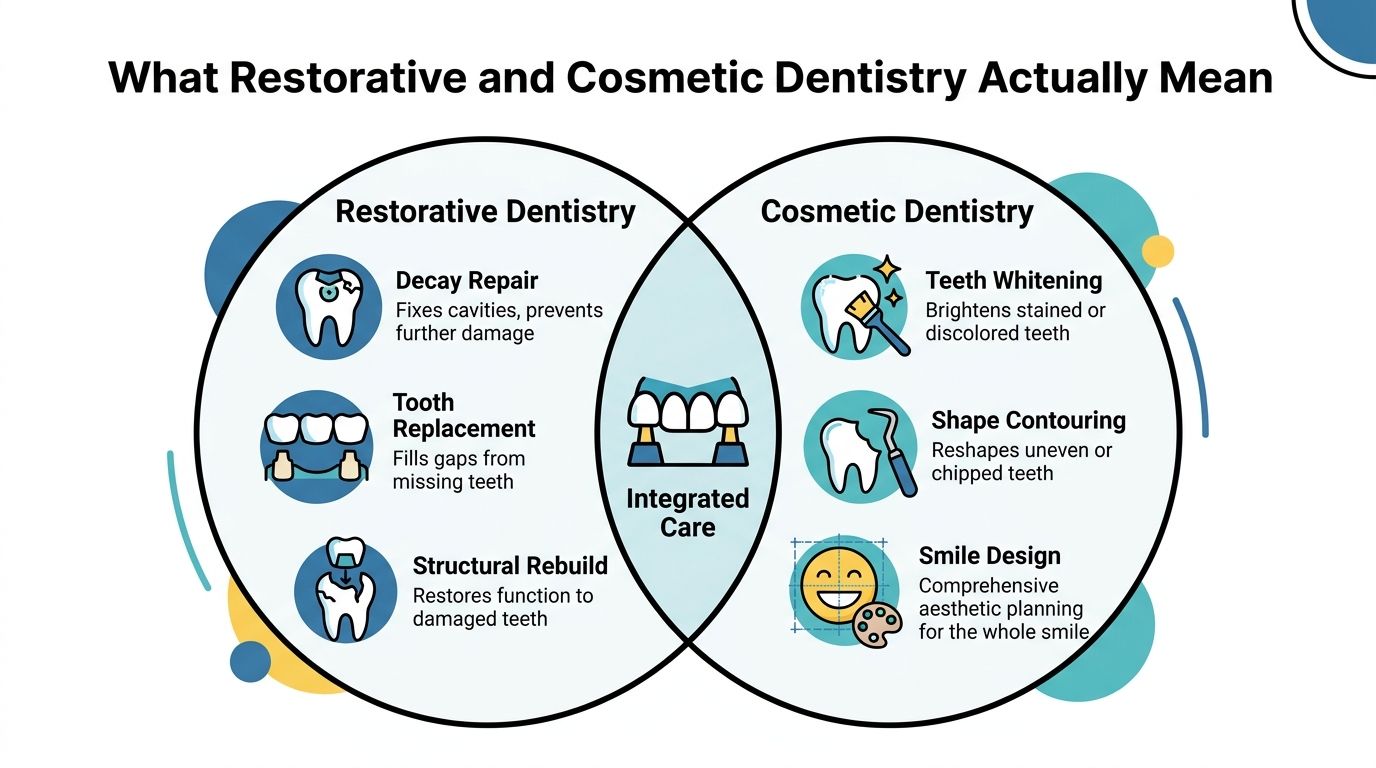
Think of restorative dentistry as the structural work. It repairs decay, rebuilds broken teeth, replaces missing structure, and helps the mouth function the way it should. If a tooth has infection, fracture, wear, or loss, restorative care is the part that puts strength and utility back into the system.
Cosmetic dentistry focuses on appearance. That means color, shape, symmetry, proportion, and the way the teeth frame the smile. Whitening, veneers, subtle contouring, and alignment changes all live here.
The easiest analogy is a house. Restorative work is the foundation, framing, roof, and wiring. Cosmetic work is the paint, trim, tile, and finishes that make the home look polished. In dentistry, the two overlap because the structure has to hold up before the polish matters.
The overlap is where most adults end up. A crown can restore a cracked tooth and improve its appearance. A veneer can reshape a front tooth, but only after the bite is stable enough for that thinner restoration to survive. A bridge or implant can fill a gap and also bring back the look of a complete smile.
Practical rule: if a tooth needs both strength and better appearance, the plan should answer both problems at once.
That's why coordinated treatment usually works better than a series of isolated fixes. If each tooth is treated as if it lives alone, the bite, color match, and long-term maintenance tend to suffer.
The Main Treatment Options Explained
The right treatment depends on what's damaged, what's missing, and what the patient wants the final smile to look like. A small chip doesn't need the same solution as a failing root canal or a full-mouth rebuild.
Here's a simple way to compare the main choices side by side, using the same questions a patient can ask in the chair.
| Treatment | Primary Purpose | Typical Lifespan | Best Suited For |
|---|---|---|---|
| Composite or porcelain fillings | Repair small areas of decay or chips | Varies by material and wear | Small cavities, edge chips, minor reshaping |
| Crowns | Cover and protect a weakened tooth | Varies by material and care | Cracked teeth, heavily restored teeth, teeth after root canal treatment |
| Bridges | Replace a missing tooth using neighboring teeth for support | Varies by design and hygiene | A gap where adjacent teeth are strong enough to support the restoration |
| Implants | Replace a missing tooth with a root-like post and custom crown | Varies by maintenance and bone support | Single-tooth replacement or larger fixed solutions |
| Veneers | Improve front-tooth color and shape | Varies by material and habits | Staining, worn edges, small gaps, uneven front teeth |
| Bonding | Smooth or rebuild small visible defects | Usually shorter-term than ceramic options | Minor chips, simple contour changes, small spaces |
| Whitening | Lighten natural tooth color | Not permanent | Stains that don't come off with cleaning |
| Clear aligners | Move teeth more gradually and discreetly | Depends on retention afterward | Crowding, spacing, bite refinement |
| Full-arch fixed restoration | Rebuild most or all teeth in an arch | Varies by maintenance and support | Extensive tooth loss or severe damage |
For implants, patients often want a more detailed breakdown of how the replacement works, and a practical overview is available on the practice's implant page at dental implant treatment options. A single implant usually replaces one missing tooth without depending on the teeth next to it, while a bridge uses adjacent teeth as anchors.
Crowns sit in the middle of the spectrum. They're more protective than bonding and more structural than whitening. Veneers are more conservative than crowns on front teeth, but they only work well when the bite and tooth health make them a good fit.
Simple takeaway: the “right” option isn't the fanciest one. It's the one that solves the problem without creating a new one.
How an Integrated Treatment Plan Comes Together
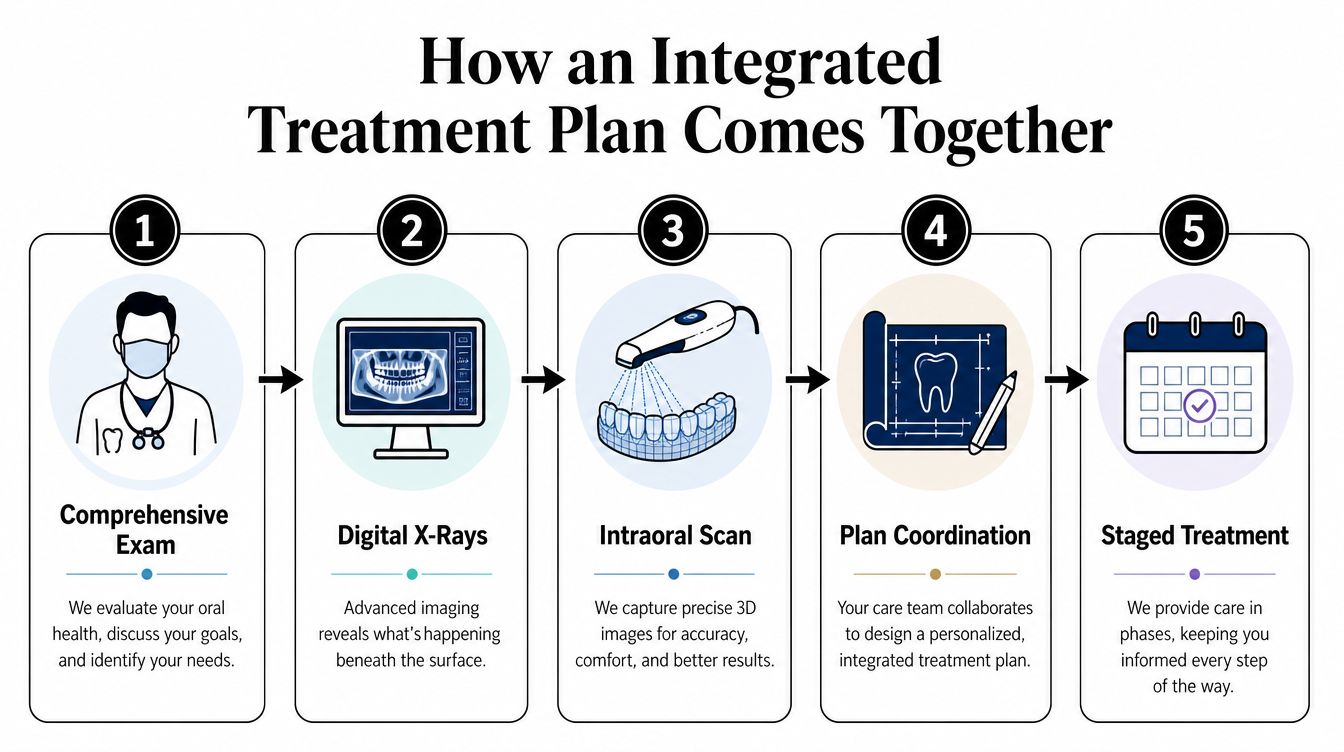
A combined plan usually starts with a full exam, digital X-rays, and an intraoral scan. Those tools show more than what's visible in a mirror, especially when a crown edge, a fracture line, or an old filling is hiding decay underneath. If you want to see how a crown page fits into that kind of planning, the office's crown information is here: dental crowns treatment details.
The next step is priorities. What hurts? What's failing? What does the patient want the smile to look like when the plan is finished? That conversation matters because it determines sequence. Health comes first, then structure, then appearance.
In the representative case of a patient with two failing crowns, a chipped front tooth, and one missing molar, the order usually isn't random. If one crown is leaking or the tooth underneath is infected, that tooth gets addressed before any cosmetic polishing begins. If the missing molar needs an implant, the site may need extraction and bone preservation first, then healing time, then implant placement, then a later crown.
Digital impressions and photos help the team coordinate shade, shape, and fit. They also help patients understand what's being rebuilt and why. That's where the plan gets realistic about fees and timing instead of promising everything in one visit.
Good sequencing protects the result. If alignment, gum health, or healing need attention first, skipping those steps usually shortens the life of the final cosmetic work.
When the case is staged well, the patient sees progress without losing the bigger picture. The bite gets stable, the restorations fit better, and the final smile looks intentional instead of improvised.
Real Patient Combinations and What They Teach Us
The cleanest treatment plans are rarely one-procedure plans. They're combinations, timed in the right order.
A working professional with worn, stained front teeth and small gaps might start with clear aligners, then whitening, then four porcelain veneers on the teeth that still need shape and symmetry. The lesson is simple. Whitening comes before veneers if the goal is to match the final restorations to the new shade, not the old one.
A second patient may come in with a failing root canal and a dark crown that no longer blends with the smile. In that case, the tooth may need extraction, site preservation, and then a single-tooth implant with a custom abutment and crown. If the gum line around the new tooth needs help matching the neighboring teeth, gum contouring can be part of the finish work. The main lesson is timing. Implants need time to integrate before the final crown is attached.
A third patient may be missing most lower teeth and struggling with chewing. That kind of case often begins with periodontal therapy if the gums are inflamed, then moves into implant placement and a fixed multi-unit restoration. The practical lesson is that the foundation has to be healthy before a full-arch restoration can do its job.
For a fuller example of how broad rehabilitation can restore both function and confidence, see this case-focused discussion of full-mouth care in Midtown Manhattan.
Across these cases, one pattern keeps showing up. The final smile looks better because the teeth were treated in the right sequence, not because the team rushed to the visible part first.
The Hidden Tradeoff Between Looks and Function
Cosmetic work can be beautiful and still be the wrong move if the bite isn't respected. Long veneers placed on an uncorrected bite can chip. Whitening on teeth with micro-cracks can make sensitivity worse. A polished implant crown still has to handle force correctly, or the hardware can suffer over time.
That's why experienced clinicians check occlusion, grinding habits, and joint symptoms before they commit to a cosmetic change. They're asking a practical question, not a theoretical one. Can this tooth survive the way this person bites, chews, and sleeps?
The material matters too. A recent review on next-generation restorative materials reports that advanced bioactive composites, nanocomposites, and fibre-reinforced composites can reach about 1.5% shrinkage, flexural strength over 150 MPa, and 44–60% higher wear resistance than conventional composites. Lower shrinkage helps reduce stress at the tooth-restoration edge, while higher strength and wear resistance help a restoration hold up under daily load. PMC review on advanced restorative materials
But no material is indestructible. Even strong ceramics and improved composites still need a bite that matches the design and maintenance that matches the material. If you're considering veneers, the office's veneer information is a useful place to review how appearance and durability are balanced in front-tooth work: porcelain veneers overview.
Ask how the plan holds up against your real habits, not just how it photographs on day one.
That question usually reveals whether a cosmetic recommendation is being made for the long run or only for the reveal.
Cost, Access, and Choosing High-Value Care
Once patients understand the options, the next questions are usually practical ones. What does this cost? What does insurance cover? How do I know the plan is worth it?
The honest answer is that advanced restorative and cosmetic work is often paid out of pocket, and coverage can vary a lot. Access is uneven too. Recent literature notes that cost and accessibility remain persistent barriers, and that inequalities in state-of-the-art care are likely to widen for low-income and rural patients. Access and inequality in advanced dental care
That means patients need to evaluate value, not just price. Ask for a written phased plan that separates restorative items from cosmetic items. Request scans and photographs so you can see the same findings the clinician sees. Verify that the dentist has experience with the exact procedure being proposed, and ask which materials and lab partners are being used.
It also helps to ask what happens if something fails early. A crown, veneer, or implant restoration should come with a clear explanation of follow-up care and what the office does if the first version doesn't fit, match, or hold up as expected.
For patients trying to decode benefits and paperwork in plain English, this insurance guide may be helpful: understanding dental insurance in Manhattan.
Bring this checklist to the consultation:
- Full treatment breakdown: Ask for each restorative step and each cosmetic step on paper.
- Visual proof: Review photos, scans, or mock-ups before you commit.
- Material details: Know whether the plan uses composite, ceramic, porcelain, or implant-supported parts.
- Follow-up policy: Clarify repairs, adjustments, and early-failure handling.
Putting It All Together for Your Own Smile
The patient from the opening scene usually doesn't need a random set of fixes. They need a plan that treats the tooth, the bite, the gums, and the smile as one case. That's the link between restorative & cosmetic dentistry and durable results.
Three ideas tend to hold up best. Restorative and cosmetic care overlap far more than many patients realize. Integrated planning turns a list of procedures into something that lasts. The strongest results come from a clinician who thinks in stages, not just in individual teeth.
If your smile has damage, wear, gaps, or old dental work that no longer blends in, schedule an exam, bring photos of smiles you like, and ask for a phased plan that addresses health, function, and appearance in that order.
Paul L. Gregory, DDS provides restorative and cosmetic dental care in Midtown Manhattan, including crowns, veneers, implants, Invisalign, and full-mouth rehabilitation planning. If you want a clear, staged approach that connects function with appearance, visit Paul L. Gregory, DDS to start the conversation.