

You've chosen a dentist, set aside time for a crown, and heard the reassuring phrase “we take your insurance.” Then the estimate arrives, and the number doesn't match what you expected. That's usually when patients start searching for in network vs out of network dentist advice.
The network label matters, but it doesn't tell you what you'll owe. For that, you need to know the insurer's allowed amount, your coinsurance, and the dentist's billed charge. Compare those figures before treatment, and ask who pays any gap between them.
| What to compare | In-network dentist | Out-of-network dentist |
|---|---|---|
| Dentist's fee | Contracted fee for covered services | Dentist's own charge |
| Insurer's calculation | Usually based on the negotiated fee | Based on the plan's allowed amount |
| Patient's possible responsibility | Deductible and coinsurance, subject to plan terms | Coinsurance plus a possible balance bill |
| Useful question | “What's my estimated share of the contracted fee?” | “What's the allowed amount, and could I owe the difference?” |
A Midtown Dental Bill That Surprised Everyone
A patient schedules a crown with a dentist near West 57th Street. The office confirms the dentist is in network, so the patient expects the plan's contracted rate to make the bill predictable. At checkout, however, the estimate includes a charge tied to an out-of-network lab partner. The patient looks at the estimate, then back at the insurance card. “I thought this was in network.”
That confusion is familiar. A practice's network status doesn't automatically tell you whether every service, treating clinician, or outside partner involved in your care follows the same reimbursement terms. It also doesn't tell you the plan's allowance for the procedure, how much of that amount the insurer will reimburse, or whether a separate charge could be billed to you.
The questions that clear up the math are simple:
- What does my plan pay?
- What does the dentist or other provider charge?
- What do I owe between those amounts?
This guide uses a Midtown West perspective, but the same questions apply whether you're coming from Hell's Kitchen, Chelsea, the Upper West Side, or further downtown. A nearby office can be convenient, but convenience and network participation aren't substitutes for a written estimate.
The practical rule: Don't stop at “Are you in network?” Ask what amount the office expects you to pay if the insurer allows less than the billed charge.
Once you have those figures, you can judge the choice on its actual cost and clinical fit, rather than relying on a label that may not tell the whole story.
How Dental Networks Actually Work
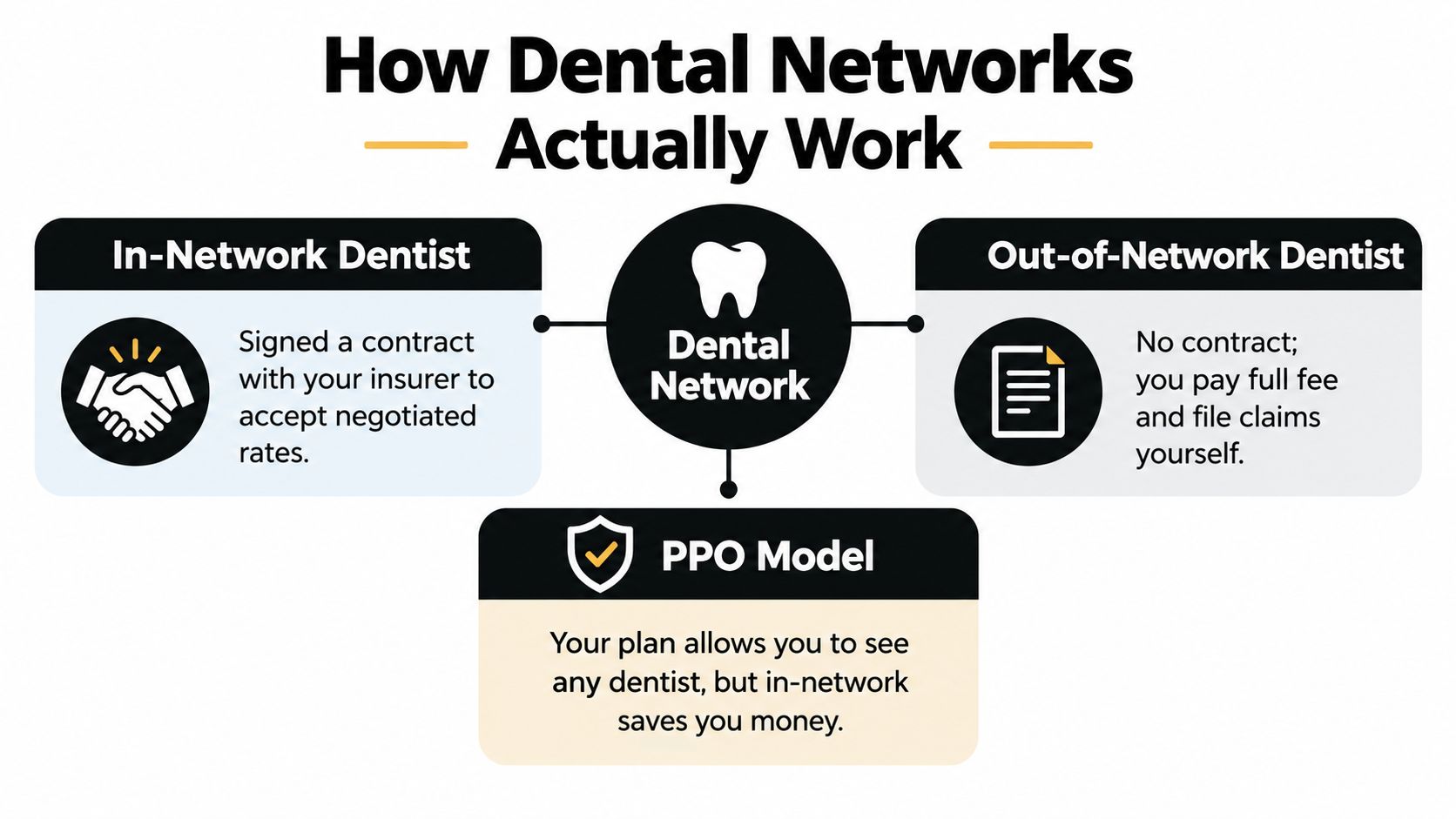
An in-network dentist has a contract with an insurer. Under a PPO plan, the dentist agrees to accept a negotiated fee for covered services. The contracted fee is generally lower than the dentist's standard charge, and the plan calculates the patient's deductible and coinsurance from that agreed amount. For covered services, a participating dentist generally can't bill above the contracted fee because the office's usual charge is higher.
An out-of-network dentist hasn't agreed to that insurer's contracted fee. The dentist sets the charge, while the plan may calculate reimbursement using its own allowed amount. If the dentist's charge exceeds that allowance, the patient may owe the difference, as well as any applicable coinsurance. The American Dental Association advises patients to base an out-of-network estimate on the dentist's full fee, not only on the insurer's estimated payment (ADA guidance on out-of-network billing).
A contract, not a quality rating
The distinction is financial. “In network” doesn't mean a dentist is more skilled, and “out of network” doesn't mean a dentist provides better care. The label describes a contractual pricing arrangement between the dentist and insurer.
Dental coverage also often works differently from the medical insurance patients expect. Plans may use fee schedules, annual maximums, and percentage-based coinsurance for different procedure categories. A statement such as “the plan covers part of a crown” doesn't establish what the plan will pay in dollars, because the applicable allowance and benefit limits still matter.
Participating dentists generally submit claims to the insurer, and the office may receive payment directly. Out-of-network patients may need to pay the office first and seek reimbursement, though practices differ in how they handle claims. Ask the office what it does before you schedule.
The history helps explain why network status became so influential. Employer-sponsored dental benefits began in the United States in the 1950s. The first widely recognized plans began in Washington State in 1954 and California in 1955, while the term “preferred provider organization” first appeared in 1982. By 2017, approximately 77% of Americans reportedly had dental insurance, making network participation an important part of how patients compare providers (history of dental insurance networks).
The Three Numbers Behind Your Out-of-Pocket Cost
To understand an out-of-network estimate, separate the allowed amount, the insurer's reimbursement, and the dentist's billed charge. The patient's potential balance bill is the difference between the allowed amount and the full charge. Coinsurance is a separate part of the calculation.
Consider a hypothetical crown billed at $1,000, with the plan recognizing an allowed amount of $700 and paying 50% of that allowed amount. The insurer's share is $350. The patient's coinsurance on the allowed amount is also $350, and the patient may owe the remaining $300 between the allowed amount and the dentist's charge. That makes the patient's total $650, before any deductible or other plan restriction.
Those figures illustrate the math, not a universal estimate. Actual allowances, reimbursement rules, deductibles, and benefit limits depend on the specific plan. Milliman describes this additional charge as balance billing, which can apply when an out-of-network dentist bills the patient for the difference between the insurer's allowance and the dentist's regular charge (Milliman on dental benefit design and network fees).
| Line item | In-network dentist | Out-of-network dentist |
|---|---|---|
| Dentist's billed charge | $1,000 | $1,000 |
| Plan's allowed amount | $700 contracted fee | $700 |
| Insurer pays | $350 | $350 |
| Patient's coinsurance | $350 | $350 |
| Possible balance bill | $0 above contracted fee for covered service | $300 |
| Patient total before deductible or restrictions | $350 | $650 |
The in-network comparison assumes the dentist's contracted fee is $700 and the plan pays 50% of it. That's why the same billed charge can produce a different patient responsibility depending on network status.
For a crown, implant, root canal, periodontal surgery, or orthodontic treatment, don't settle for “the plan covers 50%.” Ask for the dollar-specific allowance, your coinsurance, the remaining annual maximum, and any deductible or service restriction. If you're reviewing your options, Duncan & Associates dental insurance offers a resource for understanding individual dental coverage. For related details on payment arrangements, see dental insurance and payment plans.
PPO, EPO, and Passive Plans Compared
The plan type changes how much freedom you have to choose a dentist, and how costly that choice may be. Read the benefit details rather than assuming the acronym on your card explains the whole arrangement.
| Plan type | What happens out of network | What to watch |
|---|---|---|
| PPO | The plan commonly retains an out-of-network benefit | The deductible, reimbursement percentage, annual maximum, and potential balance bill may be less favorable |
| EPO | The plan may provide no out-of-network benefit | You could be responsible for the full charge if you go outside the network |
| Passive PPO | The plan may reimburse at the same percentage in or out of network | The dentist can still bill above the plan's allowance |
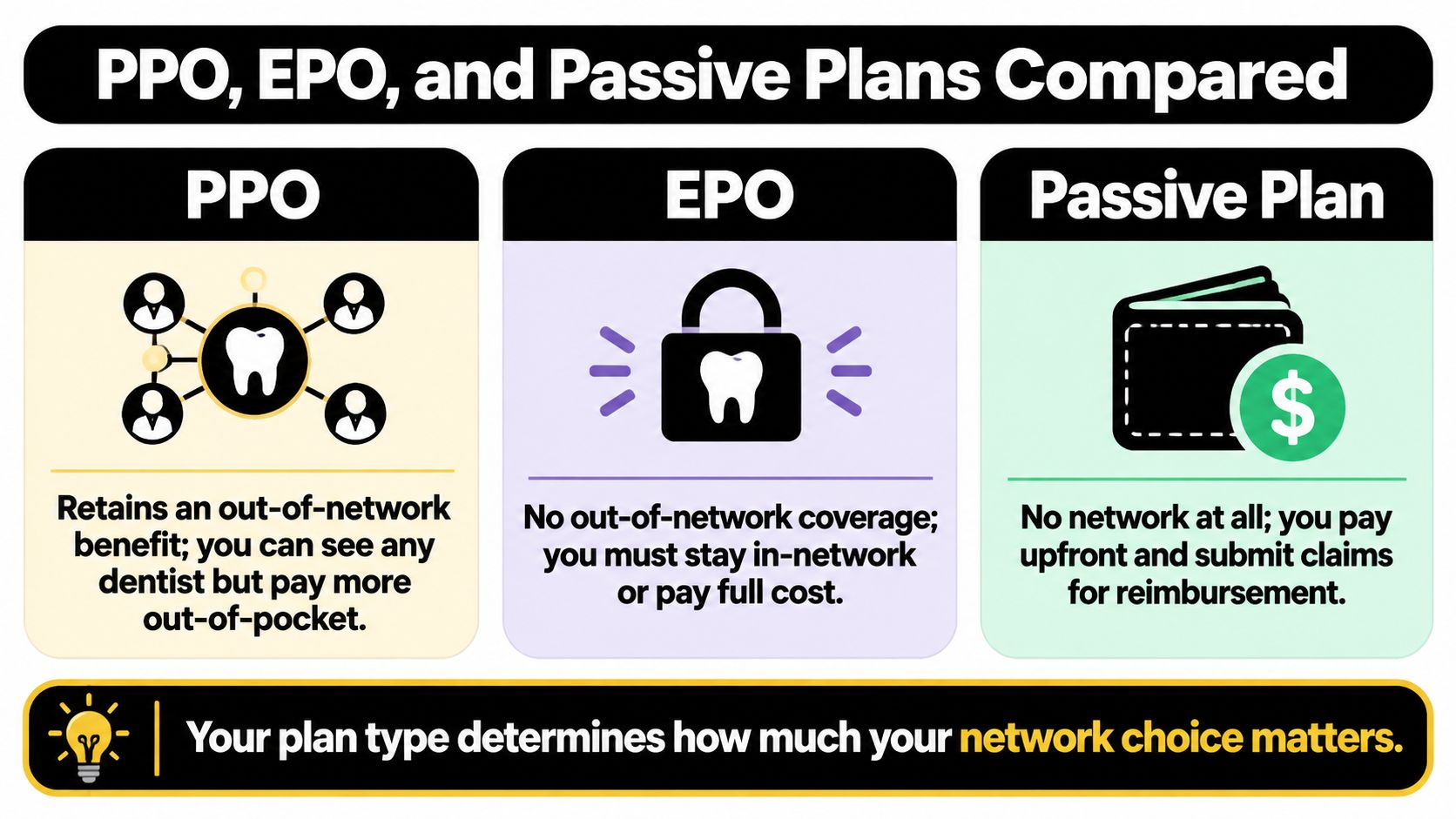
A PPO often gives patients more choice than an EPO, but that doesn't make out-of-network care financially equivalent. Out-of-network reimbursement may be based on a lower allowance, and the patient can face a higher deductible, lower annual maximum, lower reimbursement percentage, or balance billing. The actual rules are plan-specific.
An EPO calls for more caution. If the plan excludes out-of-network benefits, choosing a dentist outside the network could leave you paying the full charge. Confirm the rule directly with the insurer before booking.
A passive PPO may apply the same reimbursement percentage inside and outside the network. That sounds reassuring, but the percentage is only one part of the equation. If the out-of-network dentist charges more than the plan's allowance, the patient may still owe the difference.
Don't let the percentage do all the talking. Ask what amount the percentage applies to, and whether the plan pays anything for out-of-network treatment.
For gum treatment, check the applicable procedure and limits before beginning care. This overview of dental insurance for periodontal treatment can help frame the questions to raise with your insurer and practice.
How to Verify Coverage Before You Sit in the Chair
Do the verification before treatment, not at checkout. A short call to the insurer and a direct conversation with the practice can expose a mismatch while you still have time to compare options.
Call the insurer with the right details
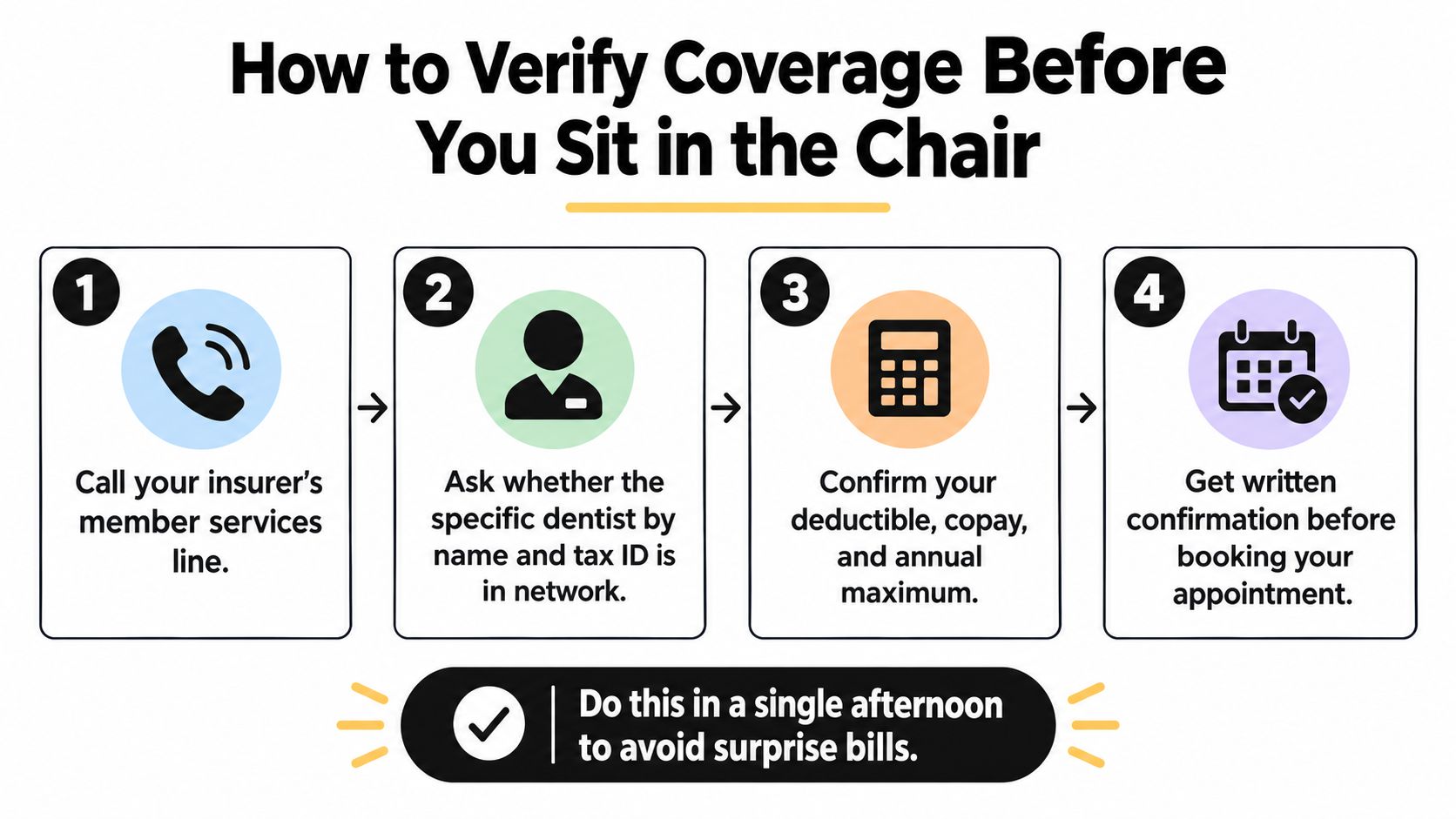
Give the insurer the dentist's name and tax identification number, and ask whether that specific provider is in network for your exact plan. “The office takes my insurance” is not the same confirmation. The practice may accept claims from your insurer without holding an in-network contract for your plan.
Then ask for the allowed amount for the planned procedure code. Confirm your deductible status, coinsurance, remaining annual maximum, and any waiting period, frequency limit, alternate-benefit clause, or missing-tooth restriction that could apply. For a crown, implant, root canal, or orthodontic consult, ask the insurer to explain what the estimate does and doesn't include.
You can use this script:
“I'm considering treatment with [dentist's name]. Can you confirm whether this dentist is in network for my specific plan, and tell me the allowed amount and my estimated responsibility for [procedure]?”
Ask the practice what it will handle
The front desk can clarify whether the office submits claims, accepts assignment of benefits, and requests a pre-treatment estimate. Ask for a written estimate that separates the dentist's fee from the plan's projected payment and your estimated share. If an outside clinician, lab, or facility may be involved, ask whether it has separate billing or network status.
Before you commit to treatment, keep these confirmations together:
- Provider status: The insurer's confirmation for the named dentist and exact plan.
- Procedure allowance: The plan's dollar-specific allowed amount for the proposed service.
- Benefit details: Your deductible, coinsurance, annual maximum, and applicable restrictions.
- Practice billing process: Whether the office submits the claim or accepts assignment.
- Written estimate: The expected patient portion, plus what could change if the insurer pays less than estimated.
The insurer's estimate isn't a guarantee of final payment. Still, getting the details in writing gives you a sound basis for deciding whether to proceed. For more help reading benefits, consult this guide to understanding dental insurance at a Manhattan office.
The video below offers another way to think through the questions to ask before scheduling.
When Out of Network Is Actually the Better Deal
“In network” often makes routine care easier to budget, but it isn't automatically the lowest-cost or best-fit choice. Compare the total expected cost with the care you need, not the network label in isolation.
A dentist's self-pay fee may be comparable to, or lower than, what you'd pay at an in-network office after applying your plan's allowance, coinsurance, and remaining maximum. That can matter if you have a high deductible, limited benefits left, or no insurance. Ask both offices for the full fee and a written estimate rather than assuming a contracted rate guarantees the best price.
Clinical fit matters too. A dentist with experience in complex rehabilitation, sedation, or full-arch implant treatment may be a better match for a patient's needs than a nearby in-network office that doesn't provide that care. Continuity, appointment availability, and the ability to coordinate related treatment can also affect the value of care. Those advantages don't erase the cost difference, so verify the out-of-network benefit before deciding.
Choose the clinician first when the treatment is complex, then make the insurance math explicit. Don't accept an unclear estimate just because you trust the dentist.
The No Surprises Act is not a general shield against bills from a dentist you knowingly choose outside your network for scheduled office-based treatment. Its protections focus mainly on emergency services and certain out-of-network clinicians encountered at in-network facilities. New York's Attorney General explains that in-network providers generally can't bill beyond the patient's applicable cost sharing, while out-of-network providers may bill more; its 2025 report says 42% of complaints to the Health Care Bureau concerned provider billing practices (New York Attorney General's health care billing report). For general background on surprise billing protections, review the National Association of Insurance Commissioners' guide.
If you're comparing self-pay with insurance pricing, this overview of the average cost of a tooth filling without insurance can help you identify the right questions. For people reviewing reimbursement options related to specialized care, ABA Finder's guide to out-of-network benefits provides another example of how to evaluate coverage beyond a network label.
Choosing a Dental Home Across Manhattan Neighborhoods
A Midtown office can be practical for patients who work, live, or travel through several parts of Manhattan. Near West 57th Street, a practice can serve Midtown, Hell's Kitchen, the Theatre District, and Hudson Yards, as well as Chelsea to the south. Patients also come from the Upper West Side, Upper East Side, Lenox Hill, and Turtle Bay. These are distinct areas, even when people use neighborhood names loosely in everyday directions.

Downtown patients may travel from Greenwich Village, the West Village, NoHo, the East Village, SoHo, Tribeca, Chinatown, or Wall Street. These neighborhood names are commonly used local or commercial labels, not all legally fixed administrative boundaries. New York City's Department of City Planning uses defined community districts and Neighborhood Tabulation Areas for planning, while familiar names such as Midtown and Gramercy Park don't all map neatly to a single official district (New York City community district map).
Proximity matters most when you need urgent access, have a treatment plan requiring multiple visits, or want consistent care for your family. For a routine cleaning, your schedule and preferred dentist may matter more than the neighborhood label. For an emergency or ongoing restorative care, a convenient route from home or work can help you keep appointments and avoid delays.
Before choosing a dental home, consider when you're most likely to go: during a workday near Midtown, from home uptown, or between other downtown commitments. Then weigh that practical fit alongside the coverage estimate. You can learn more about selecting a dentist in Midtown Manhattan without treating neighborhood names as precise borders.
Which Network Choice Fits Your Situation
The right choice depends on your plan, your treatment, and what you need from the practice. Use these profiles as a starting point, then confirm your actual benefits.
The insured professional with a PPO
If you want predictable costs for checkups and routine treatment, start with an in-network dentist. The contracted fee usually makes the estimate easier to interpret. Consider an out-of-network specialist only when the clinical fit justifies the added work of checking allowances, reimbursement, and any possible balance bill.
The family looking for one dental home
For a family that needs care across ages and treatment types, prioritize a practice that can support continuity, preventive visits, pediatric needs, orthodontic care, and urgent appointments. If keeping costs manageable is the priority, compare in-network options first, then confirm whether the plan covers every family member's proposed care under the same terms.
The patient with sudden pain or a broken tooth
When you need urgent attention, ask whether the office can assess and stabilize the problem, and get a clear estimate before treatment whenever possible. Don't postpone necessary care just to avoid an out-of-network decision, but don't mistake an appointment opening for confirmation of insurance coverage. Verify both.
The patient considering cosmetic or full-mouth rehabilitation
For extensive restorative or cosmetic work, weigh clinical experience, treatment planning, and continuity more heavily than a small difference in a reimbursement percentage. Request a written estimate and compare the total expected cost. If you're considering implants, crowns, orthodontics, or coordinated treatment, ask what services the practice provides and whether referrals could add visits or separate billing.
The anxious patient who values a trusted relationship
A calm, judgment-free experience can be a meaningful reason to stay with a dentist you trust. If that dentist is out of network, ask the insurer for the exact allowance and reimbursement terms, then ask the practice whether it submits claims and provides a written estimate. You're entitled to make the relationship part of the decision, provided you understand the financial trade-off.
The cash-pay patient without insurance
Compare the dentist's self-pay fee with other available fees directly. Don't assume an in-network rate is automatically cheaper for someone paying without insurance, and don't assume that an out-of-network office will offer a lower price. Ask what the full fee includes and whether the estimate changes if your treatment plan changes.
The strongest decision is the one you can explain before sitting in the chair: who is treating you, what the plan allows, what the dentist charges, and what you may owe. Paul L. Gregory, DDS offers full family, cosmetic, and restorative care in Midtown, with assistance on insurance claims and care ranging from preventive visits to complex treatment.
Visit Paul L. Gregory, DDS to discuss your treatment needs, confirm how the office can assist with your insurance claim, and request a clear estimate before care begins.