

A well-integrated dental implant shows roughly 94% to 99% survival at 10 years and about 78% to 94% at 15 to 20 years, while the visible crown or bridge attached to it typically needs repair or replacement sooner. Dental implant lifespan is a probability shaped by bone, hygiene, smoking, and systemic health, not a guaranteed number of years.
That distinction matters if you're sitting in a Midtown office after implant treatment, already planning around work, travel, or family appointments and wondering whether the implant will still serve you decades from now. The honest answer is encouraging, but it isn't a lifetime warranty. The embedded fixture, the connector, the surrounding bone and gums, and the visible restoration each have different responsibilities and different timelines.
Why Lifespan Is the Wrong First Question
A busy professional in Midtown may ask, “How long will my implant last?” It's a sensible question, but it combines several separate questions into one. A dental implant isn't one object with one expiration date.
The fixture is the titanium component placed in the jaw. During osseointegration, bone bonds with its surface and gives it root-like support. The abutment connects that fixture to the restoration. The prosthesis, which may be a crown, bridge, or overdenture, is the part you see and use when you chew.
The tissues around the fixture matter just as much. Peri-implant bone supports the embedded component, while the surrounding gums form a protective seal. Inflammation in those tissues can threaten an implant that was initially stable. A helpful overview of candidacy and treatment planning is available in this guide to who is a good candidate for dental implants.
A better way to interpret the question
Think of lifespan as a probability curve rather than a promised date. A study may report how many implants remained functional after a certain follow-up period, but that result describes a group. Your outcome also depends on bone volume, periodontal health, bite forces, smoking, systemic conditions, home care, and professional maintenance.
Practical rule: Ask how long each part is expected to function, what can cause it to fail, and how you'll monitor the risks.
This framing prevents two common mistakes. “Implants last forever” creates false confidence, while “the implant will need replacing after a fixed number of years” creates unnecessary anxiety. Many fixtures remain functional for decades, but a crown may chip, a screw may loosen, or gum inflammation may need treatment while the fixture itself remains stable.
The useful goal isn't to chase a single number. It's to improve the odds that the fixture, restoration, bone, and soft tissue continue working together.
Anatomy of an Implant and Why Each Part Ages Differently
A completed implant restoration has three main structural layers, plus living tissues that support the whole system.
The fixture
The fixture is the implant body placed inside the jaw. It's usually titanium, although some systems use zirconia. Once osseointegration is established, the fixture is held by bone rather than by neighboring teeth. That biological connection is why the fixture can remain functional long after the original crown has changed.
The fixture doesn't experience chewing in isolation. Every bite transfers force through the crown and abutment into the implant and surrounding bone. If the bone loses volume because of inflammation, or if excessive forces create mechanical stress, the fixture's long-term stability can be affected.
The abutment
The abutment sits between the fixture and the restoration. It may be a separate connector or part of a customized design. Its screw joint experiences repeated loading every time you chew, clench, or grind. A loose screw doesn't automatically mean the implant has failed, but it needs prompt evaluation because continued movement can damage the connection or restoration.
The prosthesis
The prosthesis is the crown, bridge, or overdenture that replaces the visible tooth structure. It absorbs contact with food, opposing teeth, temperature changes, acidic conditions, and everyday wear. Porcelain can chip, acrylic can wear, and a bridge can fracture or loosen even when the fixture beneath it remains firmly integrated.
That's why a 20-year-old fixture may support a newer crown. Replacing a restoration isn't the same as losing the implant. It's often normal maintenance of the visible part of the treatment.
The final component is biological. Bone and soft tissue around the implant must remain healthy, cleanable, and stable. A strong fixture with inflamed surrounding tissue still needs treatment, because the support system is part of the implant, not an afterthought.
Evidence-Based Survival Rates at 5, 10, 15, and 20 Years
Long-term evidence supports a durable outlook, but the figures vary according to follow-up length, study design, restoration type, and patient selection. A large U.S. university-clinic dataset reported 98.6% survival across 50,333 implants over an average follow-up of about 84 months, with immediate-placement implants showing 98.4% survival compared with 98.6% for implants placed in healed sockets (clinical data on implant survival).
At longer follow-up, attrition becomes more visible. A systematic review covering 23 longitudinal studies and 7,711 implants found average cumulative survival of 94.6%, with a mean follow-up of 13.4 years. Mean marginal bone resorption was approximately 1.3 millimeters (the long-term systematic review). Bone levels matter because the fixture depends on the surrounding bone for continued support.
What happens as observation continues
A large cohort of 10,871 implants followed patients for as long as 22.2 years and reported implant-level survival of 98.9% at 3 years, 98.5% at 5 years, 96.8% at 10 years, and 94.0% at 15 years (the long-term cohort analysis). The same source reported lower patient-level survival, because a person with several implants has more opportunities for at least one implant to fail.
At 20 years, a meta-analysis found 92% survival in three prospective studies, involving 237 implants. After statistical imputation expanded the analyzed sample to 422 implants, the estimate was 78%. Five retrospective studies involving 1,440 implants reported 88% survival (the 20-year meta-analysis).
| Follow-up | Implant survival | Prosthesis survival | Key caveat |
|---|---|---|---|
| 5 years | 95% to 99% in commonly reported long-term evidence | 95.6% for implant-supported fixed prostheses | Results vary by patient group and restoration |
| 10 years | About 96% to 98% in well-maintained cohorts | 93.1% for implant-supported fixed prostheses | The crown or bridge can need attention first |
| 15 years | 94.0% in a large cohort | Varies by design and study | Bone, inflammation, and mechanical complications matter |
| 20 years | 78% to 92% in prospective estimates, 88% retrospectively | Not equivalent to fixture survival | Study design and follow-up completeness change estimates |
The prosthesis figures come from a meta-analysis of implant-supported fixed dental prostheses, which reported 95.6% survival at 5 years and 93.1% at 10 years (prosthesis survival evidence). In other words, a stable fixture and an original crown aren't the same endpoint.
How Implants Compare With Bridges Dentures and Natural Teeth
An implant isn't automatically the right answer for every missing tooth. The comparison should include biology, maintenance, appearance, comfort, and the condition of the teeth that would support an alternative.
A conventional bridge uses neighboring teeth as anchors. It can restore chewing efficiently, but those teeth may need preparation and can later develop decay, fracture, or loss of support. A removable denture avoids surgical placement and can replace several teeth, but the fit changes as the jaw ridge remodels. An implant-supported restoration avoids using adjacent teeth as bridge supports and can help preserve bone in the area, but it requires surgery, healing, hygiene, and long-term professional monitoring.
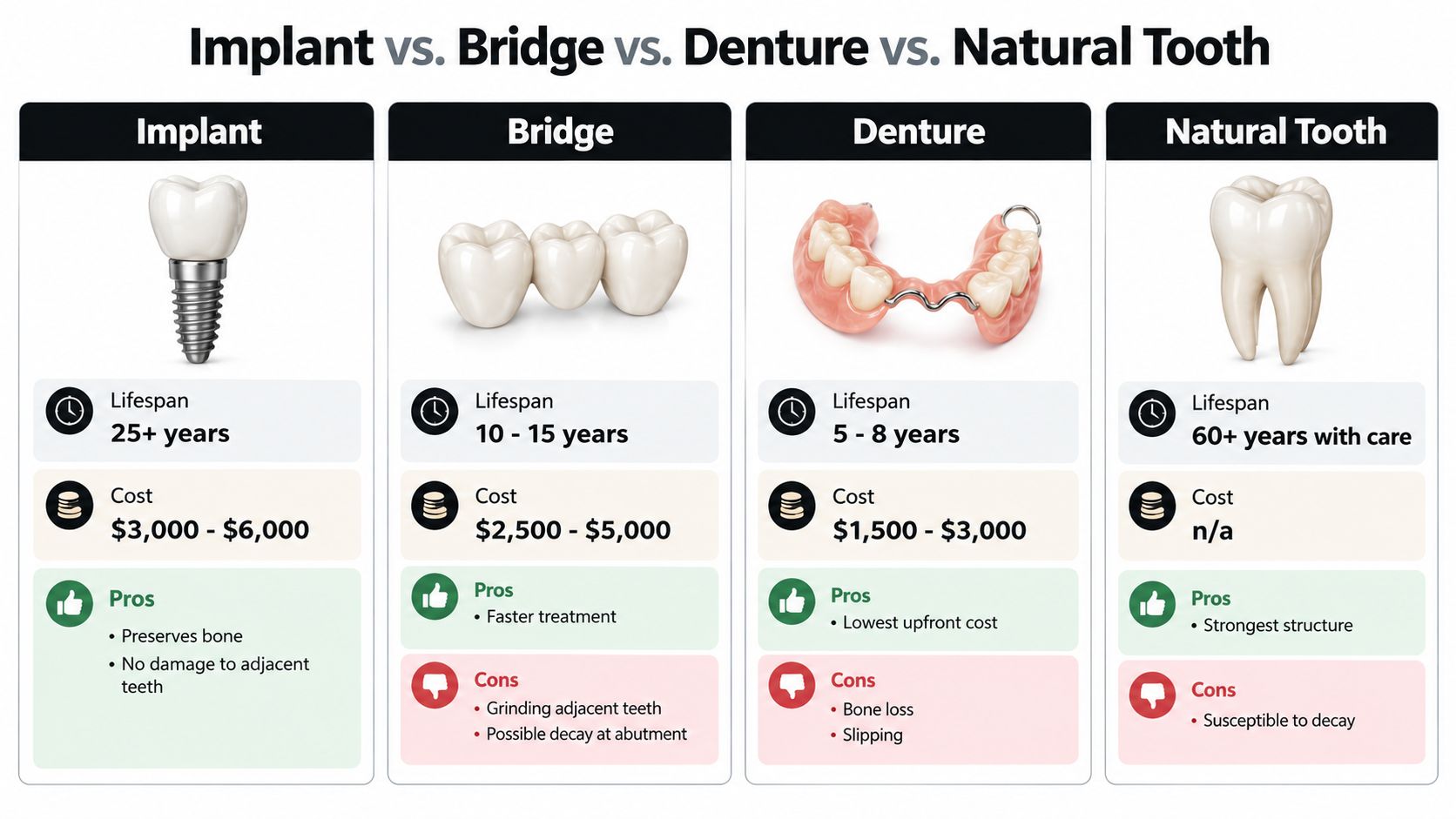
A review of studies with at least 15 years of follow-up found implant loss rates ranging from 0% to 33%, while tooth-loss rates ranged from 3.6% to 13.4%. The authors concluded that implants didn't necessarily outperform compromised natural teeth that had been adequately treated and maintained (long-term comparison of implants and teeth).
That finding changes the treatment conversation. If a natural tooth can be predictably restored and maintained, extraction isn't automatically the more durable choice. If the tooth has a poor prognosis, an implant may offer a strong replacement strategy without reducing healthy neighboring teeth.
For a Manhattan patient, the practical question is not which option has the longest advertised lifespan. It's which option fits the condition of the remaining teeth, bone, gums, bite, schedule, and willingness to maintain it. A comparison of dental implants and bridges can help clarify the biological tradeoffs before treatment begins.
Factors That Move the Lifespan Needle
Two patients can receive similar implants and experience different outcomes. The difference often comes from the conditions surrounding the fixture, not from the fixture alone.
Bone and periodontal history
The surgeon evaluates bone height, width, density, and the position of nearby structures before placement. If the site lacks adequate support, grafting or another site-development procedure may be needed. Previous periodontal disease also matters because the bacteria and inflammatory patterns that damaged natural teeth can affect tissues around implants.
Bacterial plaque is identified as the principal driver of peri-implantitis in recent prevention guidance. That makes daily plaque control more than a cosmetic habit. It protects the living tissues that hold the fixture stable.
Smoking, systemic health, and age
Smoking intensity and duration are linked with higher peri-implant mucositis risk. Diabetes also requires individualized attention, especially when glycemic control is poor. These factors don't automatically rule out treatment, but they change the planning and maintenance conversation.
Age alone isn't a reason to reject implants. A 2025 systematic review of 3,892 implants reported 96.8% five-year survival in patients older than 75, compared with 92.1% in patients aged 65 to 75 (age and implant survival evidence). Healing capacity, medication history, dexterity, periodontal stability, and the ability to attend maintenance appointments may matter more than the number of birthdays.
Bite forces and treatment design
Clenching and grinding increase the mechanical demand on the crown, abutment, and fixture connection. If you wake with jaw fatigue, notice worn teeth, or have a history of fractured restorations, tell the dentist before the final crown is designed. Guidance on the relationship between jaw tension and tooth wear can be found in these TMJ teeth grinding insights.
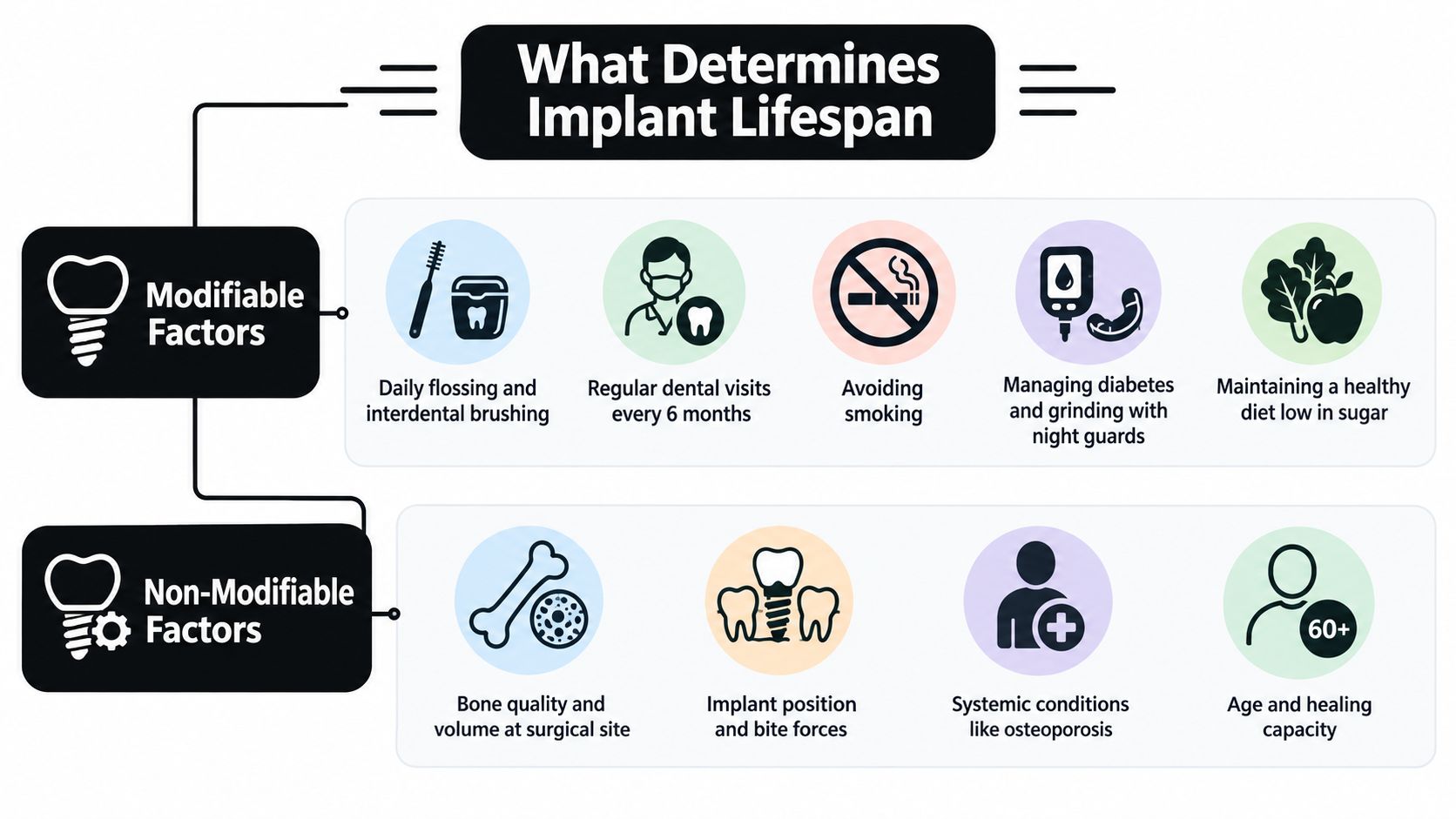
Some variables can be changed directly. Others need professional management.
- Control plaque: Clean around the restoration every day with tools suited to its shape.
- Disclose risk factors: Report smoking, diabetes, periodontal history, medications, and grinding.
- Protect the bite: A properly designed night guard may reduce damaging contact forces.
- Assess the site: Discuss whether bone quality and volume support the planned restoration. Learn more about bone grafting for dental implants.
- Choose a maintainable design: The crown or bridge should allow access for home care and professional inspection.
Maintenance Habits That Add Decades
Implant maintenance starts at home, but it doesn't end with brushing. The objective is to disrupt biofilm around the crown, abutment, and gumline before inflammation affects the supporting tissues.
Use a soft toothbrush and clean the visible surfaces twice daily. Add implant-safe floss, an interdental brush, or a water flosser for spaces a toothbrush can't reach. The correct tool depends on the restoration's contours, so ask the dental team to demonstrate the technique rather than assuming ordinary floss will work.
Match recall frequency to risk
Low-risk patients may need one or two professional maintenance visits annually. Patients with smoking exposure, previous periodontal disease, systemic risk factors, or a history of peri-implant inflammation may need three or four visits each year. The right interval is based on tissue response, plaque control, bleeding, pocket findings, and radiographic changes.
Professional care may include implant-compatible instruments, titanium-safe scalers, air polishing with glycine or erythritol powder, and probing methods calibrated for implant sulci. The appointment should evaluate more than whether the crown still looks attractive. It should check tissue health, restoration stability, occlusion, and access for cleaning.
A maintenance visit is part of the treatment, not an optional add-on.
Night-guard use can protect the restoration and abutment connection when grinding is a concern. Smoking cessation, diabetes management, and prompt treatment of bleeding or swelling also reduce avoidable stress on the implant environment.
Radiographs may be used to monitor crestal bone when clinically appropriate. Your dentist can establish a baseline and choose follow-up imaging based on the implant, symptoms, tissue findings, and risk profile.
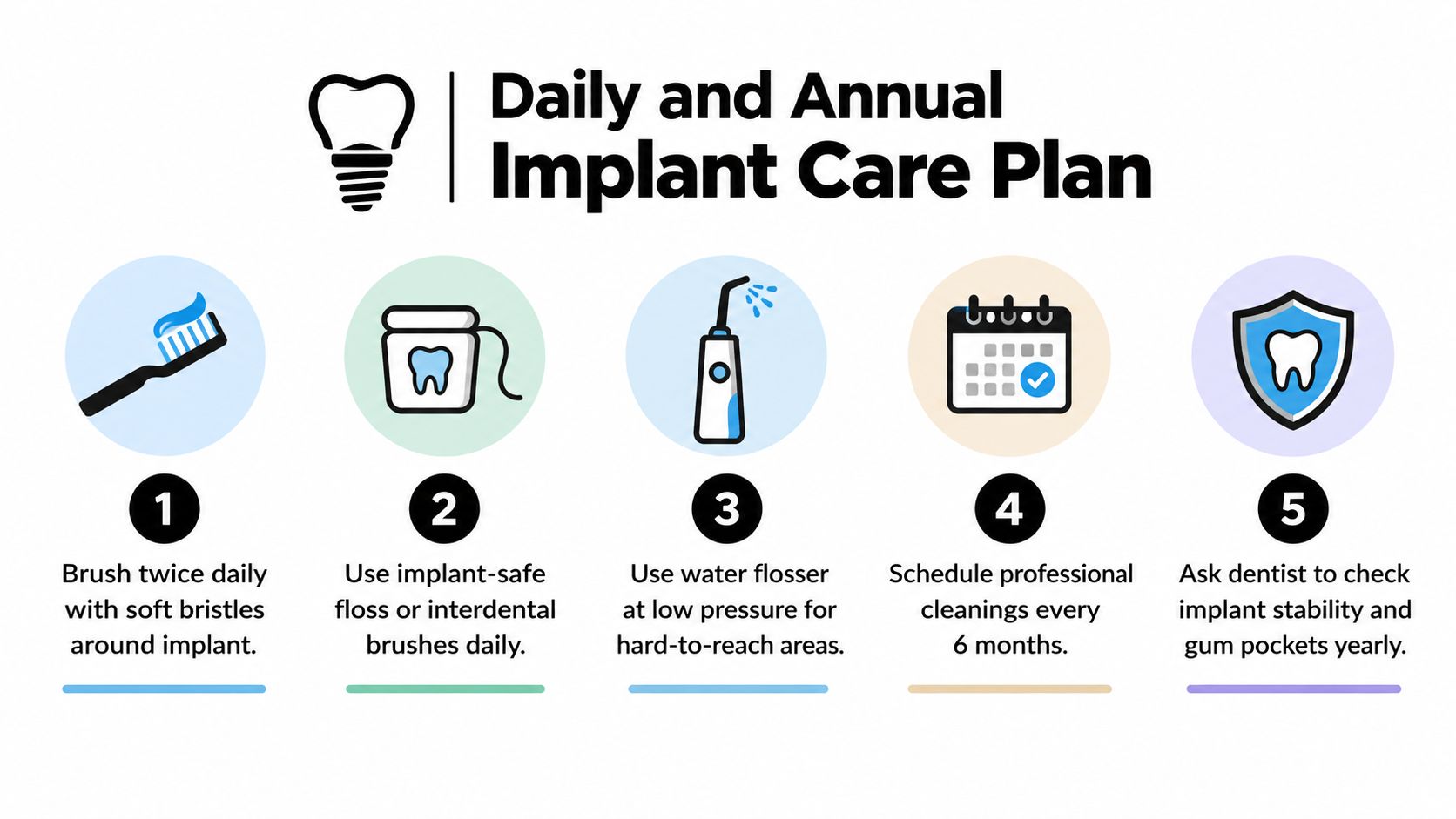
A practical home routine should feel specific:
- Brush carefully: Use soft bristles around the crown and gumline.
- Clean between teeth: Use floss or interdental brushes selected for the restoration.
- Reach difficult areas: Add a water flosser when anatomy or prosthesis design makes access difficult.
- Attend recalls: Keep the interval recommended for your risk level.
- Report changes: Call if the crown moves, the bite changes, bleeding persists, or swelling develops.
For step-by-step home instructions, see this guide to cleaning dental implants.
A Year in the Life of a Manhattan Implant Patient
Consider a hypothetical patient living near Hell's Kitchen and working in Midtown. Winter begins with a cleaning, tissue check, and bite review. In spring, a small chip in the crown is repaired before it becomes a larger fracture.
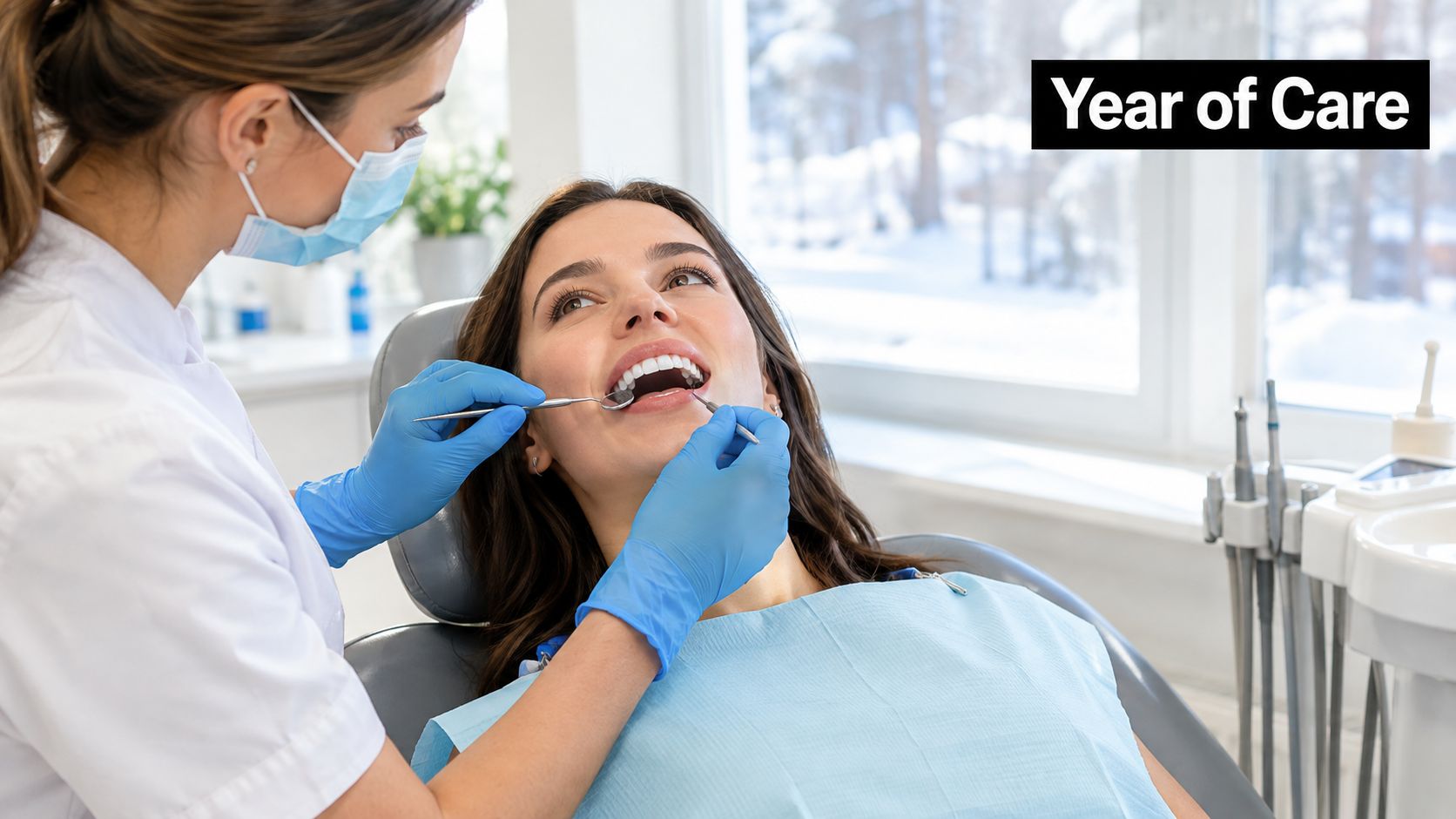
Before a summer trip, the patient returns for a night-guard adjustment. A patient in Chelsea might coordinate the same type of visit around a school schedule, while a finance professional on Wall Street may book maintenance outside earnings season. These visits are ordinary, but they protect the restoration from becoming an emergency.
Later in the year, the patient notices bleeding around the implant and books an appointment instead of waiting. The dentist diagnoses localized peri-implant mucositis, reviews home care, and provides targeted treatment. If an abutment screw loosens after a long day at a Hell's Kitchen office, short-notice evaluation can determine whether the issue is limited to the connection or whether the surrounding tissues also need attention.
In December, a clinically indicated radiograph helps confirm that bone levels remain stable. The patient also reviews the next year's recall schedule and replaces worn interdental supplies.
The same principle applies across Manhattan, from the Upper West Side and Upper East Side to Lenox Hill, Turtle Bay, the Theatre District, Gramercy Park, West Village, Greenwich Village, NoHo, East Village, SoHo, Tribeca, Hudson Yards, Chinatown, and Wall Street. Implant longevity is built through small, timely decisions rather than one heroic appointment.
A clear understanding of the healing stage also makes these visits less alarming. This explanation of the dental implant healing process can help patients know what changes deserve a call.
The following video offers another visual explanation of implant care and evaluation:
Building a Lifespan Strategy You Can Actually Follow
A useful plan separates four timelines.
The fixture depends on osseointegration, bone stability, inflammation control, and mechanical protection. The prosthesis carries the visible chewing load and may need repair or replacement sooner. The supporting bone requires monitoring because gradual loss can threaten stability. The surrounding gums need daily plaque control and professional assessment.
Those timelines overlap, but they aren't interchangeable. A new crown doesn't repair bone loss, and a stable fixture doesn't make a loose crown harmless. Your dentist should explain which component is being evaluated at every visit.
Turn risk into appointments and habits
A practical plan connects each risk to a response:
- Plaque and periodontal history: Use daily interdental cleaning and keep periodontal maintenance appointments.
- Smoking: Discuss cessation support before and after treatment.
- Diabetes or other systemic conditions: Coordinate care so health conditions are managed responsibly.
- Grinding: Ask whether a night guard and occlusal adjustment are appropriate.
- Complex restorations: Confirm how the bridge or overdenture will be cleaned and inspected.
- Busy scheduling: Reserve maintenance visits before work travel, school terms, or demanding business periods.
The treatment discussion should also cover restoration material, occlusal design, access for cleaning, recall frequency, and the possibility of future prosthetic repairs. Patients evaluating how practices communicate and attract new patients may also find this guide to dental patient acquisition useful, although the same principle applies to clinical care: clear information supports better decisions.
Most well-maintained implants can function for decades, but the crown or bridge may require attention sooner. That's a normal cost of ownership, not evidence that the fixture failed. The better question is, “What can I do to keep the fixture, restoration, bone, and gums healthy for as long as possible?”
Paul L. Gregory, DDS provides implant, restorative, periodontal, diagnostic, and emergency dental care for patients who want one coordinated plan for long-term function. Visit Paul L. Gregory, DDS to discuss your implant restoration, maintenance schedule, bite protection, and the next practical step for preserving your smile.