

The most popular advice about a zirconia crown vs porcelain fused to metal is also the least useful: choose the material that lasts longer. In practice, that usually isn't the deciding factor. Modern evidence shows that both materials can provide highly durable service, while the meaningful differences involve ceramic chipping, metal margins, preparation space, opposing-tooth wear, and gum response.
PFM crowns remain a proven restorative option. Zirconia has earned its place as a modern alternative, especially when a patient wants a metal-free restoration or when the risk of veneer fracture matters. The right choice depends on the tooth, the bite, the surrounding gums, the available space, and the appearance you want to preserve.
Zirconia vs PFM Overview
Longevity rarely separates a zirconia crown vs porcelain fused to metal decision. Both can serve reliably for years. The more useful question is which complication fits the tooth and patient less poorly: veneer chipping, a visible metal margin, limited preparation space, opposing-tooth wear, or periodontal concerns.
PFM crowns became a long-standing benchmark after their introduction in 1963, although some accounts place clinical use in the late 1950s. Zirconium oxide entered dentistry in the early 2000s, first as a framework and later as a full-contour crown. One major dental laboratory reported that by the 2020s, 81% of its crown production was monolithic zirconia compared with 7% PFM (laboratory history of zirconia). That production shift reflects changing laboratory workflows and patient preferences, not proof that PFM has become unreliable.
A comparative evidence summary found five-year PFM crown survival ranging from 95.7% to 97.6%. A prospective study in the same summary reported 94.0% five-year survival for zirconia, with a 95% confidence interval from 87% to 100% (comparative dental crown evidence summary). Event-free performance differed, 74.3% for zirconia versus 85.0% for metal-ceramic crowns. A crown can remain in place while still needing polishing, repair, adjustment, or other treatment.
| Clinical question | Zirconia | PFM |
|---|---|---|
| Appearance at the gumline | Metal-free, often easier to blend with thin or receding tissue | May show a dark or opaque margin |
| Structure | Ceramic throughout, monolithic or layered | Metal coping covered by porcelain |
| Chipping concern | Monolithic forms avoid a separate porcelain veneer | Porcelain can chip while the framework remains intact |
| Preparation | May allow a conservative design, depending on the system and occlusion | Requires space for metal and porcelain |
| Posterior function | Strong option, particularly in monolithic form | Reliable under heavy function |
| Biological considerations | Suitable for patients avoiding metal | Usually well tolerated, with margin design and alloy selection affecting the result |
| Best decision driver | Esthetics, tissue, space, and complication avoidance | Proven design, selected bridges, limited space, and budget |
A five-year randomized clinical study of posterior single crowns found similar estimated cumulative survival, 97.73% for zirconia-based crowns and 97.44% for PFM crowns, with cumulative success of 92.64% and 91.11%, respectively. The authors found no significant difference in esthetic, functional, or biological outcomes (randomized posterior crown study). A clinical consultation for dental crowns should therefore identify the failure mode to avoid rather than declare one material the universal winner.
Aesthetics and Appearance Differences
A crown can be technically sound and still look wrong when you smile, speak, or laugh. That matters particularly for visible teeth, where the restoration needs to work in changing light, not just under the operatory lamp.
PFM combines a metal substructure with a porcelain outer layer. The metal provides strength and blocks some light transmission, so the crown can appear more opaque than natural enamel. If the gum recedes or the tissue is naturally thin, the cervical area may reveal a gray or dark line. A skilled laboratory can improve the margin design, but the underlying metal remains part of the optical equation.

Where zirconia has changed the conversation
Modern zirconia isn't one uniform product. Monolithic zirconia is milled from a solid block and doesn't rely on a porcelain veneer over the surface. Layered or micro-veneered zirconia adds artistic porcelain in selected areas to create more depth and characterization. Translucent zirconia systems allow more light interaction than earlier generations, although the final result still depends on the specific material, shade, thickness, cement, and laboratory work.
For an anterior tooth, I look at the neighboring teeth before recommending a material. Their translucency, surface texture, incisal character, and color determine whether a monolithic design will look natural or whether a layered approach is more appropriate. Zirconia can produce an excellent result, but selecting zirconia doesn't guarantee a lifelike crown.
What patients should inspect
Ask to see the proposed shade and design before cementation. Look at the restoration from conversational distance, under natural daylight, and with the lips relaxed. A crown that looks bright and attractive in a dental chair can still appear too flat, too opaque, or too white beside natural enamel.
Patients comparing crowns with other cosmetic options can also review how restorative material affects the overall smile in this guide to porcelain veneers or crowns. The practical point is simple: PFM is more vulnerable to a visible metal-related margin issue, while zirconia offers more freedom for a metal-free transition, provided the design and shade are well controlled.
Tooth Preparation and Structural Needs
Preparing a tooth for a crown permanently changes it. The dentist must remove enough structure to create room for the restoration, while preserving sound enamel and dentin wherever possible.
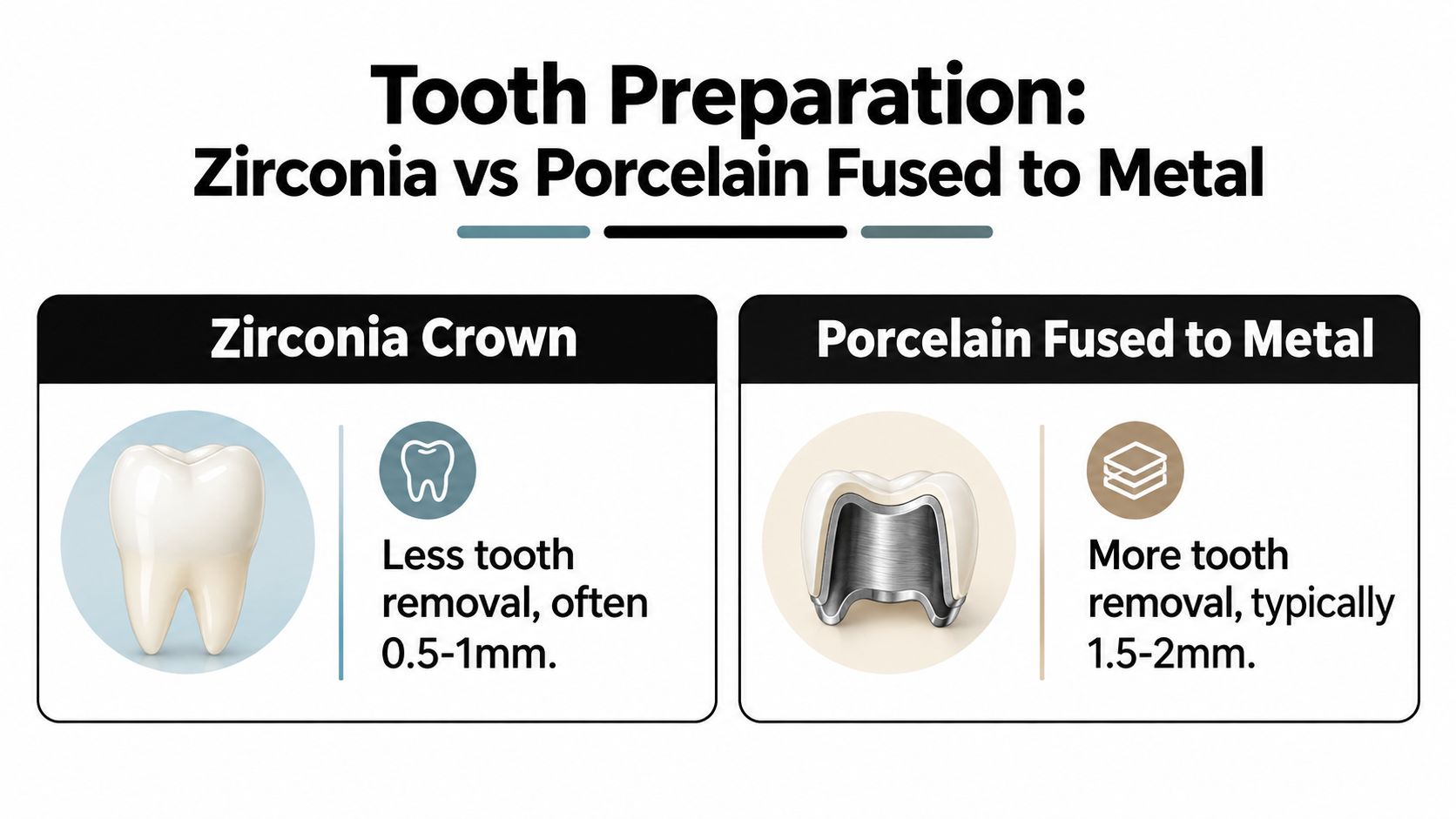
PFM requires space for two components. The metal coping forms the internal foundation, and the porcelain veneer must have enough thickness to reproduce contour, shade, and occlusion. That combination can require a more substantial reduction, especially on facial and incisal surfaces.
Zirconia can often be designed with a thinner profile because the material itself provides the structural foundation. Exact preparation depends on the zirconia system, the laboratory protocol, the tooth position, and the patient's bite. A thin crown isn't automatically a conservative crown if the dentist must compensate for inadequate clearance or an unfavorable occlusal relationship.
A practical preparation sequence
- Evaluate remaining tooth structure. Large fillings, cracks, decay, and previous root canal treatment influence how much support the tooth needs.
- Measure the available occlusal space. A short clinical crown or tight bite may limit material choices.
- Select the crown design before preparation. Monolithic zirconia, layered zirconia, and PFM don't require identical contours.
- Preserve the margin when possible. A well-finished, cleansable margin is more important than removing tooth structure to follow a generic measurement.
- Check the bite before finalizing the laboratory prescription. Bruxism, deep overbite, and opposing restorations can change the design.
The supplied preparation visualization describes zirconia as often requiring 0.5 to 1 millimeter and PFM as typically requiring 1.5 to 2 millimeters. Those figures belong to the infographic's design context, not a universal rule for every tooth or crown system. Your dentist should measure the actual clearance rather than promise a fixed reduction.
For patients who want to understand the restorative workflow visually, the following clinical video can provide useful background:
Strength and Wear on Opposing Teeth
A crown should withstand chewing without creating a new problem for the opposing tooth. The practical concern is not just which material is stronger. It is whether the restoration is more likely to chip, wear enamel, or transmit excessive force through a patient's bite.
PFM has a strong metal substructure, but its chewing surface may contain layered porcelain. That porcelain can chip under concentrated loading, especially with an uneven bite, heavy clenching, or repeated grinding. Its surface may also wear opposing enamel if the occlusal anatomy is poorly designed or the porcelain is left rough after adjustment.
Monolithic zirconia removes a separate porcelain veneer from much of the functional surface, reducing exposure to veneer chipping. A carefully adjusted and polished zirconia crown can provide a smooth contact with the opposing tooth. Zirconia is not automatically harmless to enamel, however. Rough finishing, inadequate polishing, sharp cusp anatomy, or overly concentrated contacts can still produce wear.
Practical rule: Material choice matters, but final polish, contact pattern, cusp shape, and nighttime habits matter just as much.
With bruxism, I examine more than the crown being replaced. Flattened cusps, fracture lines, muscle tenderness, wear facets, and damaged restorations show how the patient loads the bite. A night guard may be appropriate with either zirconia or PFM. The laboratory prescription should describe the occlusion clearly, not only the desired shade.
PFM remains useful when a specific layered design or conventional bridge framework is needed. Zirconia often makes more sense when limiting veneer-chipping risk is the priority. In a 5-year prospective randomized trial of implant-supported posterior crowns, monolithic zirconia and PFM produced comparable overall clinical and radiographic results, while minor chipping occurred only in the PFM control group (implant-supported crown trial). The decision should focus on which complication is more likely in your bite, rather than on which crown sounds stronger.
Patients comparing other durable restorative options can also review dental gold fillings when their tooth, bite, and cosmetic priorities support that approach.
Biocompatibility and Gum Tissue Response
The edge of a crown sits beside living tissue. A restoration that looks acceptable from the front can still create problems if its margin is overcontoured, difficult to clean, or positioned too far under the gum.
PFM is not naturally incompatible with healthy tissue. Many patients wear PFM crowns successfully for years. The biologic result depends on the alloy, the margin, the contour, the cement, the patient's hygiene, and the condition of the gum before treatment. A poorly designed zirconia crown can also irritate tissue, so metal-free does not excuse imprecise clinical work.
Why zirconia can be advantageous
Zirconia provides a tooth-colored margin without a metal coping beneath it. That is valuable for patients with thin gingival tissue, a high smile line, or a history of gum recession. If the margin becomes visible, the color transition is generally less conspicuous than a gray metal edge.
A 12-month comparative study in young adults with endodontically treated teeth reported better gingival and plaque indices with zirconia than with PFM, along with fewer adverse reactions and more stable pocket depths (comparative study of zirconia and PFM tissue response). The result supports a meaningful clinical question, but it shouldn't be exaggerated into a promise of permanent periodontal superiority. The available evidence is uneven, and short-term findings don't answer every question about high-risk patients over many years.
Margin design still controls the outcome
The most biologically respectful crown is one that the patient can clean and the dentist can monitor. That usually means a smooth, closed margin, natural emergence profile, adequate contact, and a location that doesn't unnecessarily invade the attachment.
- Thin tissue: A tooth-colored margin may reduce the visual penalty if recession occurs.
- Metal sensitivity: Zirconia avoids the metal alloy used in a PFM framework, but a documented allergy still warrants careful material review.
- Inflamed gums: Treat active periodontal disease before choosing a crown material.
- Recession history: Plan the margin with the expected tissue position in mind, not only today's appearance.
Patients with recession, bleeding, or persistent plaque around an old crown should address the underlying tissue problem rather than replace PFM with zirconia. A consultation about gum recession treatment can be more important than the material label.
Best Use Cases by Tooth Location
Tooth location changes the priorities. A central incisor is judged during conversation and in photographs, while a first molar must tolerate repeated vertical and lateral forces. Crown selection should follow those demands, not a blanket preference for zirconia or PFM.
Anterior teeth
For visible front teeth, zirconia suits patients who want a metal-free cervical area and a shade that blends with neighboring teeth. Layered zirconia allows detailed characterization. Selected translucent monolithic zirconia can work when strength, limited space, and a simpler design matter more than extensive optical layering.
PFM remains capable of an excellent appearance when the laboratory controls the porcelain, margin, and shade. Its main concern in the anterior region is the visible metal margin if the tissue recedes. That risk matters more for patients with thin tissue, a broad smile, or a history of recession. The practical question is how much margin exposure the patient is willing to accept over time.
Posterior teeth
Molars generally place greater emphasis on load management than on optical complexity. Monolithic zirconia is often a practical choice because it avoids a porcelain veneer over the chewing surface and can support a conservative design under heavy function. A randomized posterior crown study found no significant difference in esthetic, functional, or biological outcomes between zirconia-based crowns and PFM during the reported study interval (posterior crown clinical evidence).
PFM remains reasonable when occlusal space, bridge design, bite stability, or laboratory workflow favors a metal framework. It also suits patients without a metal-margin concern. The choice should account for the likely complication. Zirconia may shift concern toward chipping or fracture of veneering material, while PFM may carry more concern about porcelain fracture or a future visible margin.
Implant restorations and bridges
Implant restorations require separate planning because an implant lacks the periodontal ligament that helps a natural tooth absorb force. Comparative evidence for posterior implant restorations has found similar overall outcomes for monolithic zirconia and PFM, so access for repair, fracture type, hygiene, esthetics, and occlusal control remain important (implant restoration comparison).
For multi-unit implant restorations, a systematic review reported 3-year survival of 98.3% for PFM, 97.5% for veneered zirconia, and 98.9% for monolithic or micro-veneered zirconia, with no statistically significant overall difference (systematic review of implant-supported multi-unit restorations). Those figures make complication type, hygiene access, repairability, and bite control more useful than survival rates alone.
Cost and Insurance Considerations
Zirconia often carries a higher fee than PFM because the restoration may involve digital scanning, computer-aided design, milling, sintering, staining, glazing, and laboratory customization. PFM uses a mature workflow and may be priced more competitively. The actual fee varies by practice, laboratory, tooth, design, and the complexity of the surrounding treatment, so a responsible comparison shouldn't rely on a generic citywide price.
Insurance adds another layer. A plan may cover a crown according to its own allowance, material language, replacement rules, waiting periods, deductibles, and annual maximum. Some policies may contribute toward a covered crown without paying the full fee for a preferred material. That doesn't mean the insurer has determined which restoration is clinically right.
Ask for a written estimate
Before treatment, request an itemized explanation that separates:
- Examination and imaging: Diagnostic work needed to determine whether the tooth can support a crown.
- Tooth preparation and provisional: The temporary restoration and appointments included in the plan.
- Laboratory crown: The selected material, design, shade work, and any custom characterization.
- Core buildup or additional treatment: Procedures needed if decay or missing structure affects retention.
- Insurance estimate: The portion the office expects the plan to consider, not a guarantee of payment.
The lowest initial fee may not represent the lowest practical burden if a crown chips, requires repair, or creates a visible margin that later demands cosmetic correction. Conversely, a more expensive material isn't automatically better if the dentist cannot create adequate clearance or manage the bite.
Review your benefits before scheduling through this explanation of dental crown insurance coverage. Then compare the proposed material with the tooth's risk profile, not with advertising claims.
How to Choose Your Restoration
A sound decision starts with the tooth, not the brand name of the ceramic. Ask your dentist to explain the recommendation using the actual clinical findings, including the remaining tooth structure, margin location, available space, opposing contacts, gum condition, and any evidence of grinding.
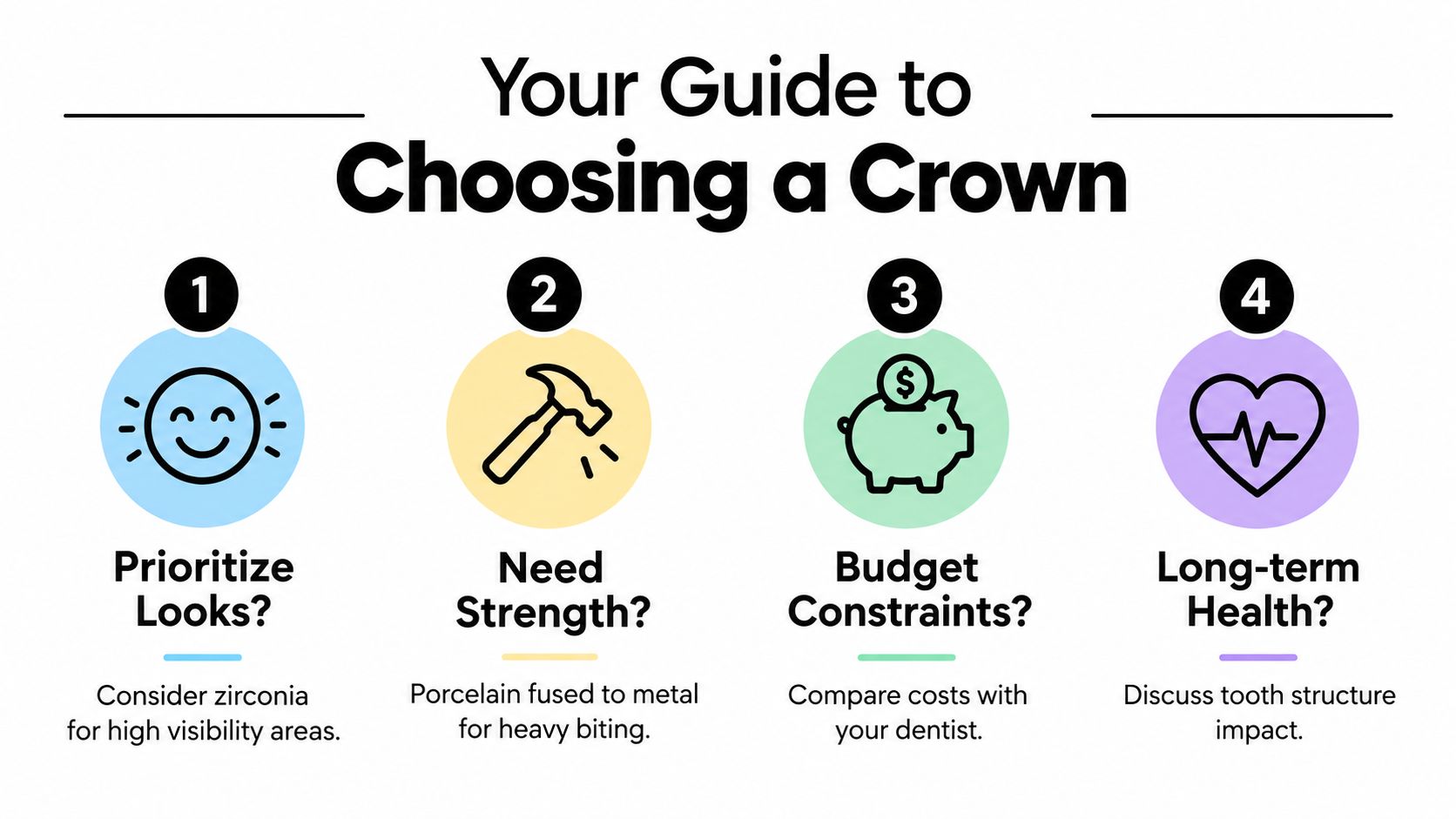
Four questions that clarify the choice
- How visible is the tooth? If the crown shows prominently when you smile, a metal-free margin may carry more value than a small difference in laboratory fee.
- How much space is available? A tight bite may favor a design that provides strength without requiring excessive reduction, but the dentist must verify the material's minimum thickness and functional requirements.
- What does the bite do at night? Clenching and grinding raise the importance of occlusal adjustment, surface polish, cusp design, and protective appliance use.
- How stable are the gums? Recession, bleeding, plaque retention, and thin tissue should influence both margin placement and material selection.
The best crown is the one whose likely complications fit your priorities and your anatomy.
Choose zirconia when the case calls for a metal-free appearance, conservative design, or reduced exposure to veneer chipping, particularly when the laboratory and dentist can control the contours and shade. Choose PFM when its framework, available space, bridge design, established workflow, or financial terms make it the more predictable option for that specific tooth.
Don't accept a recommendation based only on the phrase “stronger material.” Ask what could fail first in your case. Will the concern be a visible margin, porcelain chipping, opposing-tooth wear, limited clearance, plaque retention, or access for repair? That answer is more clinically useful than a generic longevity ranking.
Paul L. Gregory, DDS provides crown evaluation and restorative treatment planning for patients comparing zirconia and PFM, with digital diagnostics and intraoral imaging available to assess fit, space, margins, and occlusion. Visit Paul L. Gregory, DDS to discuss which restoration fits your tooth, bite, gum health, appearance goals, and insurance considerations.