

A root canal with insurance in Midtown Manhattan often leaves you paying roughly $300 to $900 out of pocket for the root canal itself when the plan covers 50% to 80% after the deductible. The crown is separate, commonly costs $1,000 to $2,000, and may be classified as a major service with lower reimbursement.
You're probably reading this after a dentist said, “You need a root canal,” while your insurer's website promised generous coverage. The uncomfortable truth is that “covered” doesn't mean inexpensive. Your deductible, coinsurance, annual maximum, negotiated fee, and provider network status can matter more than the percentage printed on your benefits summary.
A root canal also rarely ends the bill. The treated tooth may need a crown, and the crown can fall under a different benefit category. Before you compare an in-network general dentist with an out-of-network endodontist near Midtown, get the numbers in writing.
What a Manhattan Patient With Insurance Stays Really Like
A Midtown professional came into the office with severe pain and a reasonable assumption: their “good” dental plan would absorb most of the treatment. The plan showed coverage for root canals, the practice accepted insurance, and the patient expected a manageable copay.
The first estimate looked different. The root canal was covered as a basic restorative service, but the plan applied a deductible first, then coinsurance to the insurer's allowed amount. The dentist's full fee was higher than that allowed amount, and the patient had already used benefits for routine care during the year. The annual maximum reduced the insurer's payment again.
Then came the crown.
The patient had budgeted for one procedure, but the tooth needed protection after endodontic treatment. The crown was quoted separately and classified as a major service, with a lower reimbursement level. The result wasn't a single small copay. It was a root canal balance of several hundred dollars, followed by a substantial crown balance that could push the total into four figures.
The five forces behind the bill
Coinsurance determines the portion left after the deductible, but only within the plan's rules. A plan that advertises 80% coverage may apply that percentage to the allowed fee, not the dentist's full charge.
The deductible comes off before the plan begins paying according to its percentage. If you haven't met it, your first treatment line can cost much more than expected.
The annual maximum caps what the insurer pays during the benefit year. FAIR Health explains that dental plans commonly apply deductibles, coinsurance, negotiated provider rates, annual maximums, and network rules to the final calculation in its guide to dental plan basics.
Network status changes the allowed fee and can expose you to a larger balance when you choose an out-of-network endodontist. A specialist may be clinically appropriate, particularly for a difficult molar, but the financial estimate must reflect the specialist's network status.
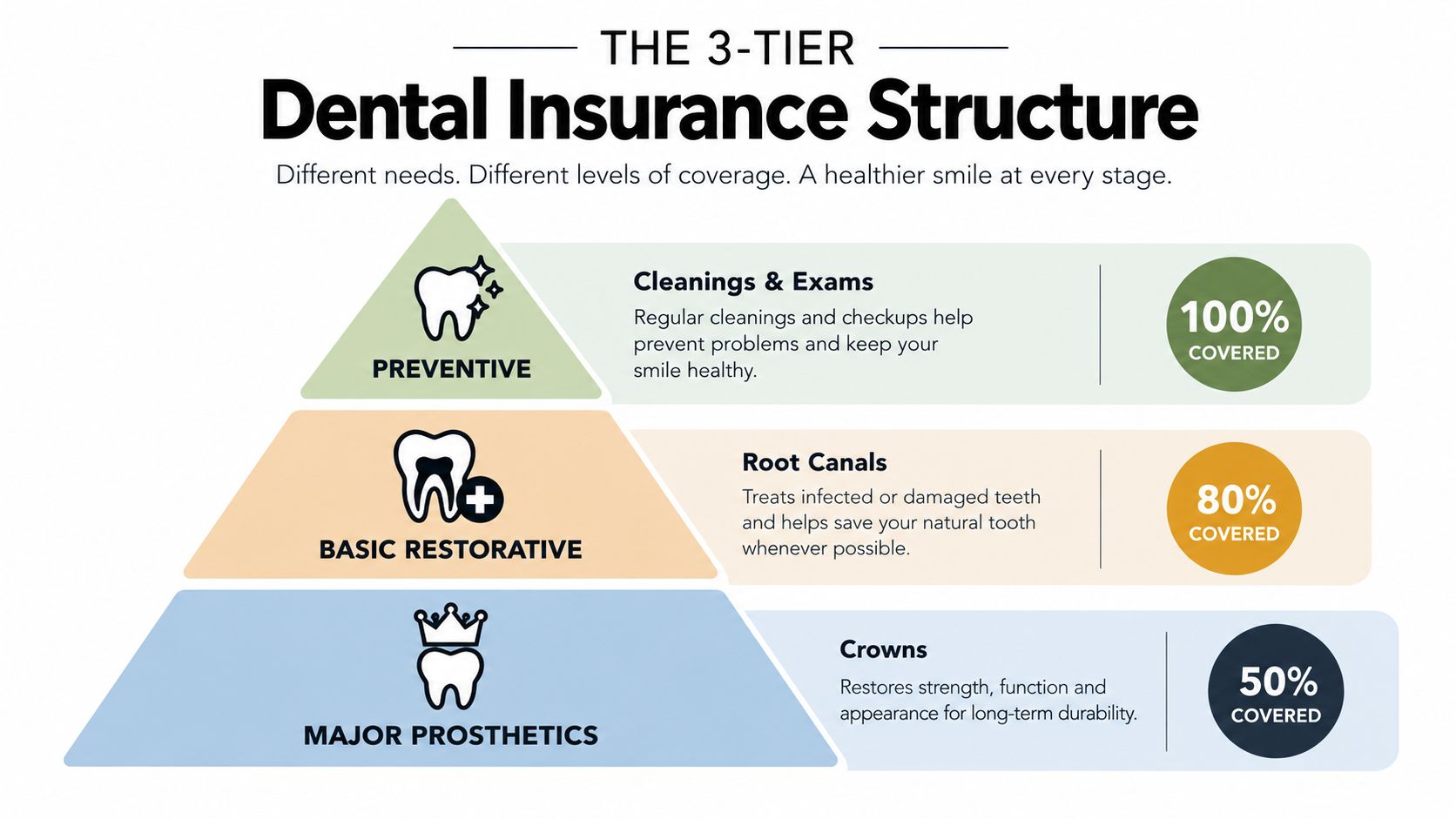
The crown is a separate financial event. The American Dental Association describes a typical structure in which preventive care receives about 100% coverage, basic procedures about 80%, and major treatment about 50%, subject to plan limits, as discussed in its overview of dental insurance misunderstandings.
Practical rule: Treat the root canal and the crown as one treatment decision, but expect them to appear as separate insurance calculations.
A useful overview of whether dental insurance delivers enough value for a patient's situation is available through Benely's benefits brokerage insights. For a procedure-specific explanation of treatment and planning, review this root canal treatment guide. The point isn't to avoid treatment. It's to avoid committing to treatment without knowing what happens after the first appointment.
How Dental Plans Actually Classify Root Canal Treatment
Most dental plans place root canal therapy in the basic restorative category. That label helps only until the treatment plan includes the restoration. The canal procedure may receive basic-service coverage, while the crown that protects the weakened tooth may receive major-service coverage.
The familiar three-tier structure looks like this:
- Preventive care: Exams and cleanings are commonly covered at about 100%.
- Basic restorative care: Root canals and similar procedures are commonly covered at about 80%.
- Major prosthetic care: Crowns and other major treatment are commonly covered at about 50%.
Those percentages are not applied automatically to whatever a Manhattan practice charges. Insurers generally calculate their payment from an allowed or negotiated amount. If an out-of-network specialist's fee exceeds the plan's allowance, the patient can owe coinsurance plus the difference between the allowed amount and the dentist's charge.
A patient in Chelsea might compare an in-network general dentist with an endodontist near Hudson Yards or the Upper West Side. The higher specialist fee may be justified by complexity, but an insurance percentage alone won't tell you what you'll owe. Ask whether each provider is in network, what fee the plan allows, and whether the office accepts the insurer's payment as payment in full for covered services.
A billing explanation from a dental practice owner billing guide can help clarify why provider charges and payer allowances don't always match. Patients should focus on four numbers before agreeing to treatment:
- Deductible, what you must pay before the plan begins its percentage calculation.
- Allowed fee, the amount the insurer recognizes for the procedure.
- Coinsurance, your share after the deductible.
- Annual maximum, the most the plan will pay during the benefit year.
For a broader discussion of handling treatment payments, see this dental insurance and payment plans resource. Those four figures, plus the crown's separate classification, provide a far more reliable forecast than the headline percentage on your benefits card.
Reading Your Treatment Estimate Line by Line
A credible Manhattan dental office should provide a pre-treatment estimate before scheduling substantial work. The estimate should identify the procedure codes, the dentist's charge, the plan's allowed amount when available, the expected insurer payment, and your projected responsibility.
Start with the deductible. In the documented example, the patient has a $150 deductible, a $950 bicuspid root canal, and a $1,000 crown. The deductible applies first, leaving $1,800 for the plan's coinsurance calculation. With coverage at 70% of that remaining amount, the patient owes $540 in coinsurance, plus the deductible, for a total of $690 before other restrictions, as explained in the ADA-related insurance discussion.
That example is useful because the percentage sounds generous, but the patient still pays a meaningful balance. If the annual maximum is nearly exhausted, the insurer may pay less than the theoretical percentage. Diagnostic services, imaging, a buildup, a post, lab charges, or an out-of-network difference can increase the final amount.
Common Line Items on a Root Canal Estimate
| Line item | What it means | Who decides |
|---|---|---|
| Deductible | The amount applied before coinsurance begins | Your insurer and plan document |
| Allowed fee | The amount the plan recognizes for the code | Your insurer's fee schedule |
| Dentist's full charge | The practice's stated fee before insurance adjustments | The dental practice |
| Coinsurance | Your percentage of the covered allowed amount | Your plan design |
| Annual maximum | The remaining benefit available during the year | Your insurer |
| Diagnostic fees | Exams and imaging connected with diagnosis or treatment | The practice, subject to plan rules |
| Crown | The later restoration, often classified separately as major care | The dentist and insurer |
The estimate should also show whether the provider is in network. For an out-of-network endodontist, ask how the insurer calculates reimbursement and whether you're responsible for the difference between the allowed amount and the full charge. Resources explaining how practices can fight payer underpayments effectively offer useful context for understanding that dispute.
Before signing: If the crown appears nowhere on the estimate, the estimate is incomplete for a tooth that may need one.
Ask for a written predetermination using the exact codes submitted by the office. The insurer should confirm your deductible status, remaining annual maximum, estimated payment for each code, coinsurance, network status, and any exclusions or limitations. You can also review this guide on whether insurance covers dental crowns before accepting a root-canal-only quote.
What to Ask Your Insurer and Your Midtown Dentist Before Treatment
Call the insurer before you schedule, even if the office has verified your benefits. Verification confirms eligibility and general coverage. It doesn't guarantee the final payment.
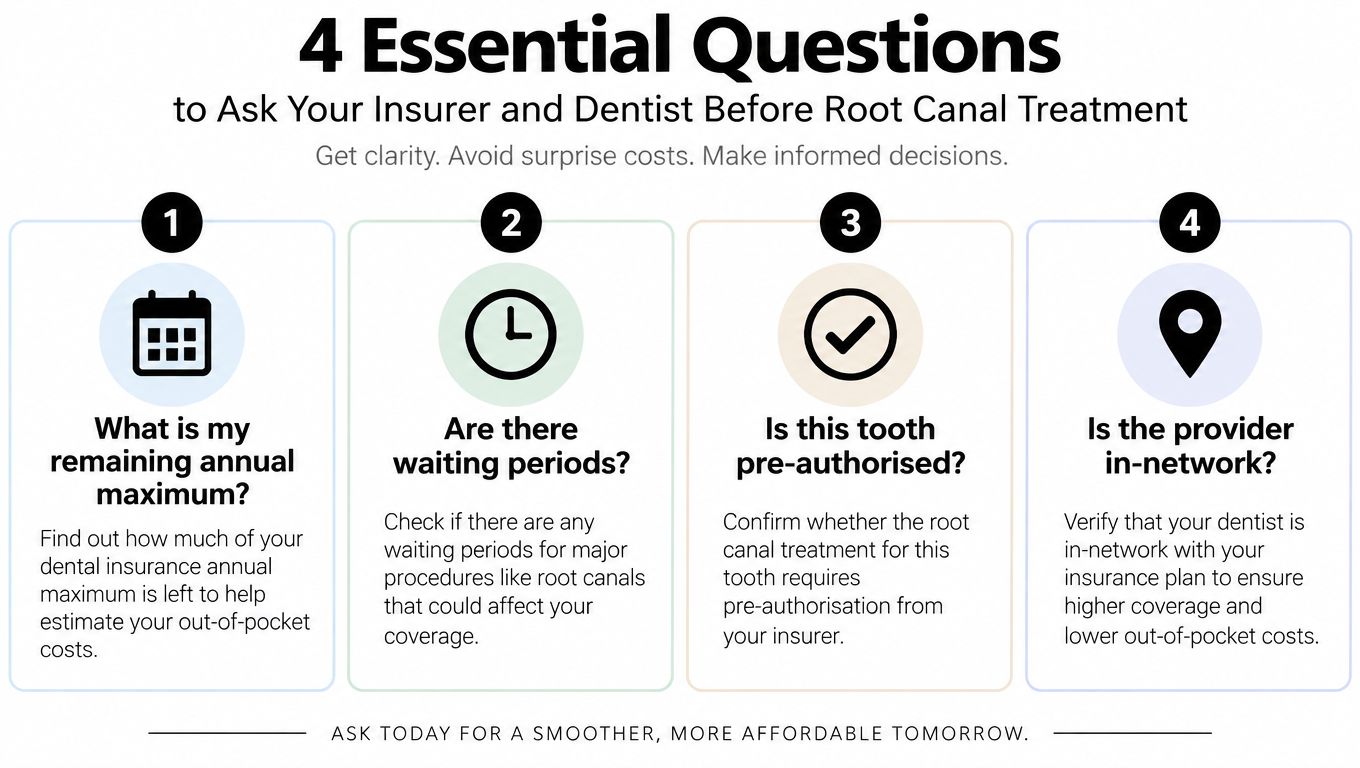
Ask the insurer these four questions
- What is my remaining annual maximum? Ask how much the plan has already paid during the benefit year and whether examinations, cleanings, fillings, or other services have reduced the balance.
- Is there a waiting period? Newly purchased policies can impose waiting periods of roughly 6 to 12 months for basic or major services, according to available plan information summarized in this dental coverage guide. If pain or infection has already started, don't assume a new policy will help immediately.
- Are there tooth-specific limits? Some plan summaries limit root-canal therapy to once per lifetime per tooth and restrict coverage to permanent teeth. Ask specifically about the tooth being treated.
- Is the provider in network? Confirm the exact dentist or endodontist, not only the practice name. A provider near Columbus Circle may have a different network relationship from another clinician in the same office.
Request a predetermination or pre-treatment estimate for every planned code. Ask the representative for a reference number and retain the written response.
Bring three questions to the dental office
Ask for the exact procedure codes for the examination, imaging, root canal, buildup or post, and crown. Then ask whether the crown is classified separately and when it will be billed. Finally, ask what payment options are available if the annual maximum leaves a balance.
Confirm whether the practice submits claims on your behalf and whether it provides an itemized invoice or claim documentation for out-of-network care. If you're comparing a general dentist with a specialist, request matching estimates so you're comparing the same treatment, not two different bundles.
For complex pain, retreatment, or a difficult molar, a specialist may be appropriate. This root canal specialist resource can help you frame the clinical and financial questions before choosing between providers.
Comparing Three Real Manhattan Scenarios Side by Side
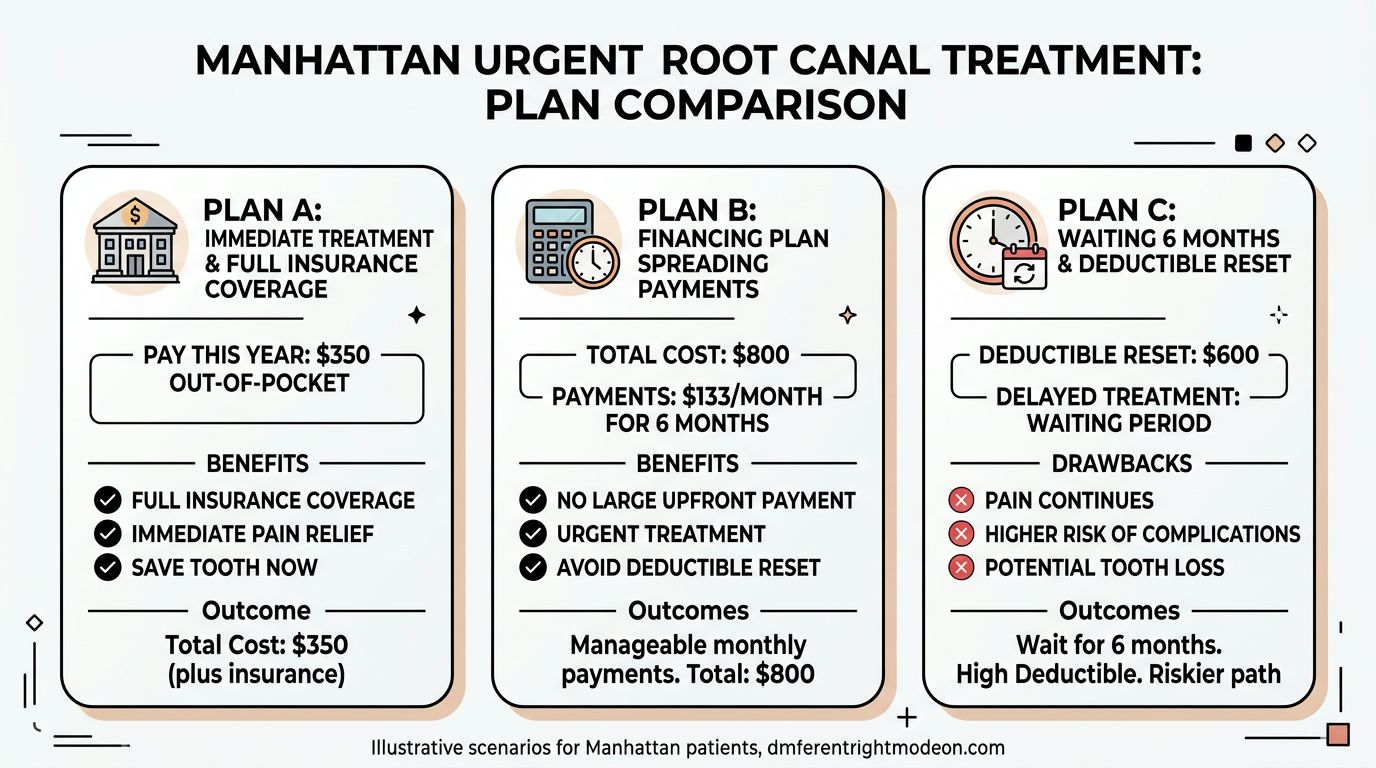
When treatment becomes urgent, Midtown patients usually face three practical choices. The right decision depends on clinical timing, available cash, annual maximum usage, and whether the dentist believes the crown can safely wait.
| Option | Out-of-pocket approach | Time to completion | Main risk | Annual maximum effect |
|---|---|---|---|---|
| Treat under the current plan | Pay the verified patient share now | Treatment proceeds without insurance delay | The plan may cover less than expected if the maximum is low | Uses benefits in the current year |
| Use payment or financing arrangements | Spread the balance instead of postponing care | Treatment can proceed while payments continue | Financing terms may add cost or create repayment pressure | Uses current benefits while preserving treatment timing |
| Coordinate across plan years | Complete clinically urgent care first and place the crown later only if approved | Completion takes longer | Infection or tooth damage may worsen if treatment is delayed improperly | May use benefits from different years |
Option one, treat now
If the tooth is infected or painful, treating under the current plan is usually the most medically responsible route. Confirm the insurer's estimate first, then decide whether the verified balance fits your budget. An in-network general dentist may produce a more predictable fee, while an out-of-network endodontist may offer specialized care with greater exposure to balance billing.
Option two, finance the balance
A payment plan can make sense when delaying treatment isn't clinically safe but the annual maximum leaves a large balance. Ask for the total repayment amount, fees, interest rules, and whether the arrangement applies to the crown as well as the root canal.
Option three, split treatment carefully
Coordinating treatment across calendar years can improve benefit access only when the dentist approves the timing. A new plan may impose a 6 to 12 month waiting period, and a low annual maximum can still be exhausted by the root canal, crown, and other care. Delaying necessary treatment merely to wait for insurance can allow a treatable infection to become an emergency, extraction, or more extensive replacement treatment.
Use a root canal treatment cost guide without insurance to compare financing, current coverage, and direct payment. The cheapest financial path is irrelevant if it causes the tooth to deteriorate.
Where the Practice Fits in the Manhattan Service Area
New York City doesn't maintain one universally official map defining neighborhood borders. The New York Times explains that boundaries shown by Google and real-estate companies aren't official, and that residents often determine how neighborhoods are understood in daily life, as described in its New York neighborhood guide.
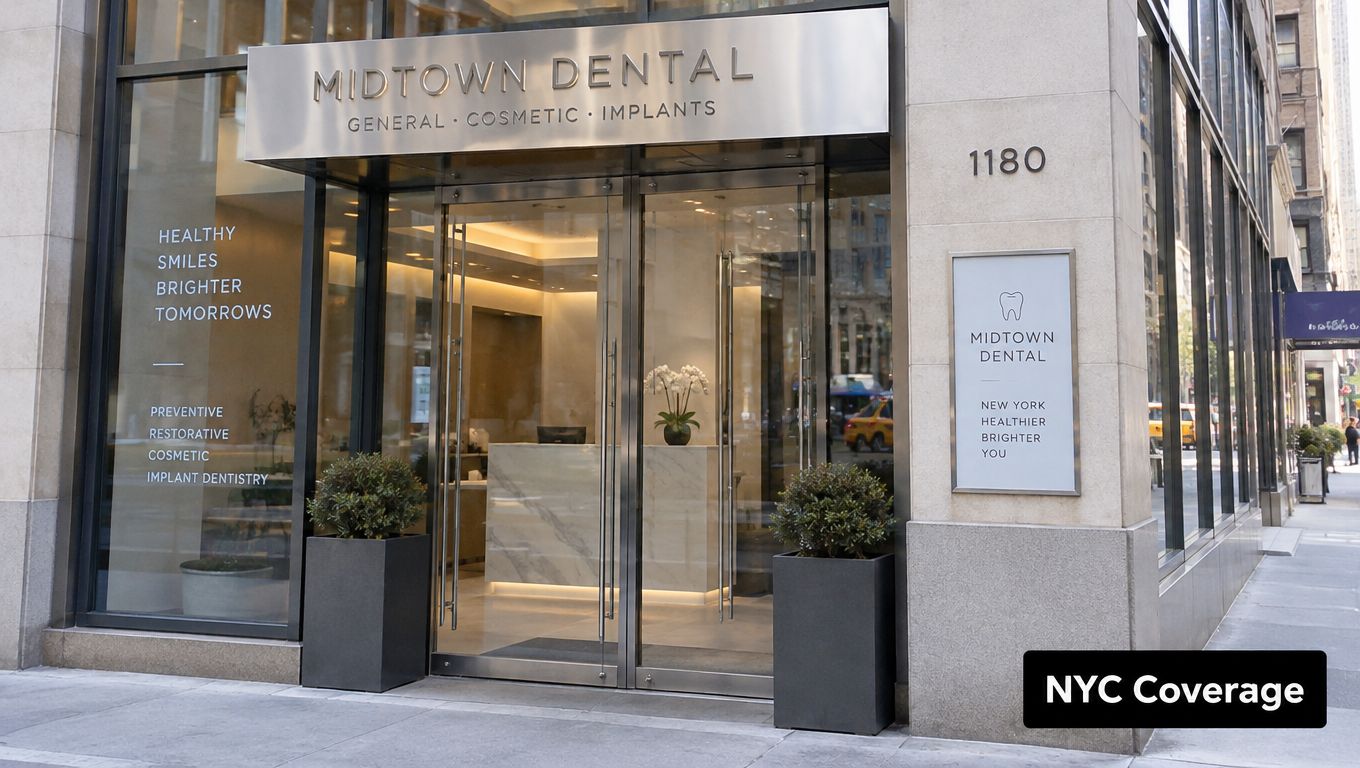
For practical scheduling, the office at 57 W 57th St, near Central Park South and Columbus Circle, serves Midtown and broader Manhattan. Midtown-related service areas include Hell's Kitchen, the Theatre District, Hudson Yards, Chelsea, and Turtle Bay.
Patients also come from central and downtown areas such as Gramercy Park, the West Village, Greenwich Village, NoHo, East Village, SoHo, Tribeca, Chinatown, and Wall Street. On the east and west sides, that includes Lenox Hill, the Upper East Side, and the Upper West Side.
These names describe a convenient service area, not rigid legal districts. The central location works well for patients traveling from offices, residential buildings, and transit connections across Manhattan who need insurance verification, urgent evaluation, root canal treatment, or crown planning in one practice.
Why a Higher Coinsurance Percentage Is Not Always a Better Plan
A plan advertising 80% coverage can leave you with a larger bill than a plan advertising 50% coverage if the first plan has a low annual maximum. About four in five in-network annual maximums reportedly fall between $1,000 and $2,500, while a root canal followed by a crown can approach or exceed $3,000, according to the cost explanation in Dental Roundup's root-canal guide.
Consider an 80% plan with a $1,000 annual maximum beside a 50% plan with a $2,500 annual maximum. Once the root canal and crown consume the available benefit, the higher percentage may stop helping. The second plan may pay a larger total amount despite its lower headline coinsurance.
Out-of-network status makes the comparison harsher. The insurer may apply its percentage to an allowed amount while the Manhattan specialist charges more, leaving you with coinsurance and the fee difference.
The better plan isn't automatically the one with the largest percentage. Compare the annual maximum, allowed fees, deductible, network rules, crown category, and remaining benefit before choosing coverage during open enrollment.
A One-Page Checklist Before You Schedule the Procedure
| Call the insurer | Bring to the dentist | Verify before signing |
|---|---|---|
| Annual maximum: Confirm what remains this benefit year. | Procedure codes: Request codes for every planned service. | Pre-treatment estimate: Match the office estimate to the insurer's response. |
| Waiting period: Ask whether newly purchased coverage is active for this treatment. | Crown details: Ask about material, classification, fee, and billing date. | Network status: Confirm the exact provider is in network, if applicable. |
| Tooth-specific limits: Check lifetime or permanent-tooth restrictions. | Payment options: Discuss financing or payment arrangements if coverage is limited. | Full scope: Include imaging, buildup, post, lab fees, root canal, and crown. |
Bring the insurer's written response to the appointment. Don't rely on a benefits percentage displayed online or a verbal estimate that omits the crown.
The cheapest root canal is rarely the uninsured one. The most expensive one is usually the one you didn't verify.
Paul L. Gregory, DDS provides root canal evaluation and restorative care at its Midtown Manhattan office, with assistance for insurance claims and payment planning. Visit Paul L. Gregory, DDS with your insurance details and ask for a written estimate that includes the root canal, crown, and expected patient balance.