

A dental cleaning and exam often begins with a small moment of uncertainty. You settle into the chair, tuck a paper napkin under your collar, and wonder whether the hygienist will find a problem you haven't noticed. Maybe your gums bleed when you brush. Maybe one tooth has become sensitive. Or maybe you are just trying to fit preventive care into a crowded workweek.
The visit isn't just a polish followed by a quick look. Dental cleanings and exams combine preventive maintenance with risk assessment. The hygienist removes deposits that home care can't reliably eliminate, while the dentist evaluates teeth, gums, bite, and soft tissues for changes that may need monitoring or treatment. Routine visits create opportunities to identify cavities, gum disease, oral lesions, and developing tooth or bite problems before symptoms become severe, as the Centers for Disease Control and Prevention explains.
What Actually Happens During a Dental Cleaning and Exam
The overhead light pivots down. The hygienist checks your chair position, asks how your mouth has felt since the last visit, and places a mirror where you can see the instruments. That quiet preparation is part of the appointment's purpose. The team isn't treating every mouth as average, because your symptoms, medications, home care, and previous findings shape what happens next.
Two connected appointments
The cleaning is usually performed by a dental hygienist. Using hand instruments and, when appropriate, an ultrasonic device, the hygienist disrupts plaque biofilm and removes hardened calculus above and around the gumline. A polish smooths the surfaces and removes some external stain, but it can't diagnose a cracked cusp, evaluate a suspicious patch of tissue, or decide whether a tooth needs restorative treatment.
The exam is performed by a dentist. The dentist looks for decay, gum changes, defective restorations, bite problems, soft-tissue abnormalities, and other findings that may not cause pain. The CDC describes routine dental visits as opportunities for preventive services, education, and early detection and treatment, rather than cosmetic appointments alone.
Practical rule: A clean surface helps the dentist see. A careful exam helps the practice decide what the cleaning should accomplish next time.
Consider a back tooth with a small crack. The hygienist may remove plaque around it, but the dentist must assess the tooth's structure, symptoms, bite forces, and imaging if indicated. The two parts work together, but neither replaces the other.
A practice's patient communication and scheduling systems can also affect how clearly these findings are documented and explained. Dental teams exploring operational support can try rednea for your dental office as one resource, while patients should focus on whether the practice listens, explains, and records their concerns.
The rest of the visit may include measurements, imaging, fluoride, and home-care coaching. The tools and conversation won't be identical for someone with stable gums and someone with bleeding, dry mouth, or recurrent decay.
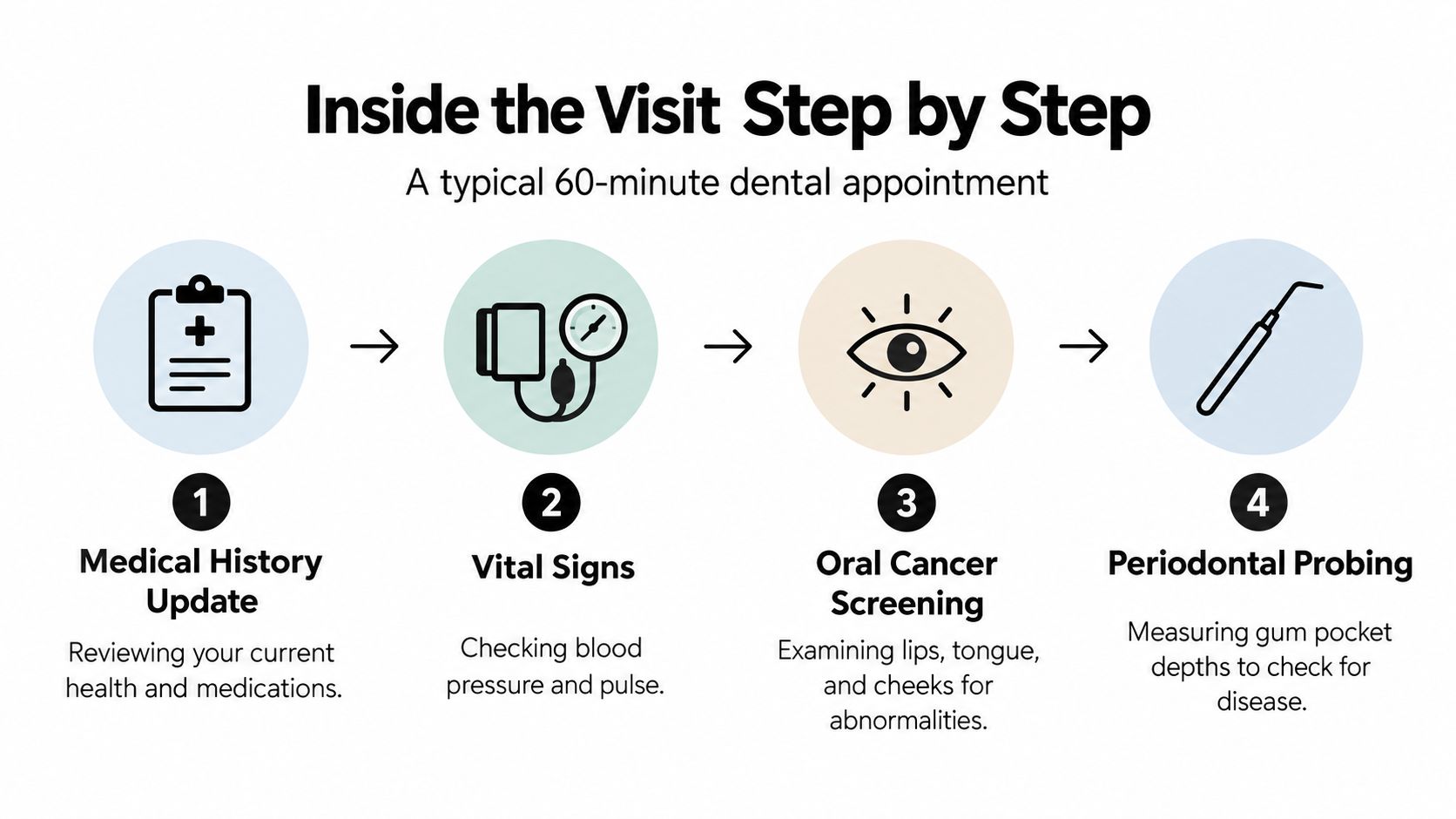
Inside the Visit Step by Step
A typical appointment follows a familiar rhythm, although every practice orders the steps a little differently. You may hear a soft suction sound, feel cool air against a tooth, or taste the gritty paste used during polishing. Each action has a reason.
Before the instruments begin
Health history update. The team reviews medical conditions, medications, allergies, pregnancy status when relevant, and changes since your last appointment. Health history can affect treatment planning, bleeding considerations, dry mouth, and sensitivity.
Vital signs. The office may check blood pressure and pulse. These readings give the team current information before treatment and can prompt a conversation if something needs attention.
Soft-tissue screening. The hygienist or dentist examines the lips, cheeks, tongue, gums, palate, and other visible areas. This isn't a promise that disease will be prevented. It is an opportunity to notice an abnormality and decide whether it needs observation, reevaluation, or referral. The U.S. Preventive Services Task Force describes oral cancer examination as inspection and palpation of the mouth, face, neck, and related tissues.
Periodontal probing. A slender probe with markings is gently placed around selected or all teeth, depending on the practice and your condition. The measurements help identify gum-pocket changes, bleeding, recession, and possible periodontal disease. The hygienist may linger around the lower front teeth because calculus commonly collects there near the openings of saliva ducts.
Cleaning and examination
Scaling. Hand instruments scrape deposits precisely, while an ultrasonic tip may produce a soft hum and water spray to break up calculus and cool the tooth. The goal is to remove hardened deposits that brushing and flossing can't reliably dislodge.
Polishing and flossing. The hygienist applies a mildly gritty paste, polishes tooth surfaces, rinses away the residue, and cleans between teeth. Polishing smooths external deposits, while flossing checks the spaces your brush misses.
Fluoride or other preventive care. Fluoride varnish may be recommended when your cavity risk, sensitivity, age, or clinical findings make it appropriate. The dentist may also discuss sealants, home-care changes, or a periodontal maintenance plan.
Dentist's exam and imaging review. The dentist visually evaluates the teeth, gums, bite, and soft tissues, then reviews available X-rays when they are indicated. Tapping a tooth gently with a mirror handle or asking you to bite can provide clues about tenderness, cracks, or bite-related problems.
For a more visual explanation of the cleaning sequence, patients can review this dental cleaning process guide.
A short educational video can also help first-time patients recognize the instruments and sounds before arriving.
You can ask the hygienist to pause, raise the chair, explain an instrument, or show you an X-ray. Clear questions make the appointment more collaborative.
How Often You Really Need a Cleaning
The familiar six-month appointment is a useful starting point, not a universal law. The American Dental Association explains that reviews haven't established one optimal recall frequency for every patient. Your interval should reflect disease activity, risk factors, examination findings, and how well your current home routine is working.
A patient with stable periodontal measurements, little plaque, controlled cavity risk, and no active disease may need a different schedule from someone with bleeding on probing, deeper pockets, recurrent decay, dry mouth, diabetes, tobacco exposure, orthodontic appliances, or frequent sugar and acid exposure. The purpose of shortening an interval is closer surveillance and professional disruption of deposits, not punishment for imperfect brushing.
A practical self-check
Before accepting an automatic recall date, consider what has changed:
- Gum signals: Do your gums bleed during brushing or interdental cleaning?
- Tooth signals: Have you developed new sensitivity, food trapping, or a rough edge?
- Health signals: Do medications or a medical condition leave your mouth persistently dry?
- History signals: Have you recently needed treatment for decay or gum disease?
- Access signals: Do crowded teeth, braces, or limited dexterity make cleaning difficult?
These signs don't diagnose disease, but they give you useful questions for the dentist. Ask which findings place you in a lower, moderate, or higher-risk category and what would cause the interval to change.
| Risk Level | Adult Recall Interval | Pediatric Recall Interval | Typical Triggers |
|---|---|---|---|
| Lower risk | Personalized, often less frequent than an active-disease schedule | Set by the child's dentist and development | Stable gums, low plaque, controlled cavity risk |
| Moderate risk | Personalized around emerging findings | Adjusted when risk or development changes | Bleeding, sensitivity, inconsistent interdental cleaning, early lesions |
| Higher risk or active disease | Often closer monitoring and periodontal care | More frequent review when disease or orthodontic needs require it | Active gum disease, recurrent decay, dry mouth, diabetes, tobacco exposure, appliances |
Children need early dental guidance, and the CDC identifies routine pediatric visits as an avenue for preventive services and early detection. Insurance frequency limits don't define clinical need. A dentist can recommend a different recall plan when your mouth changes.
The Diagnostic Tools Your Dentist May Use
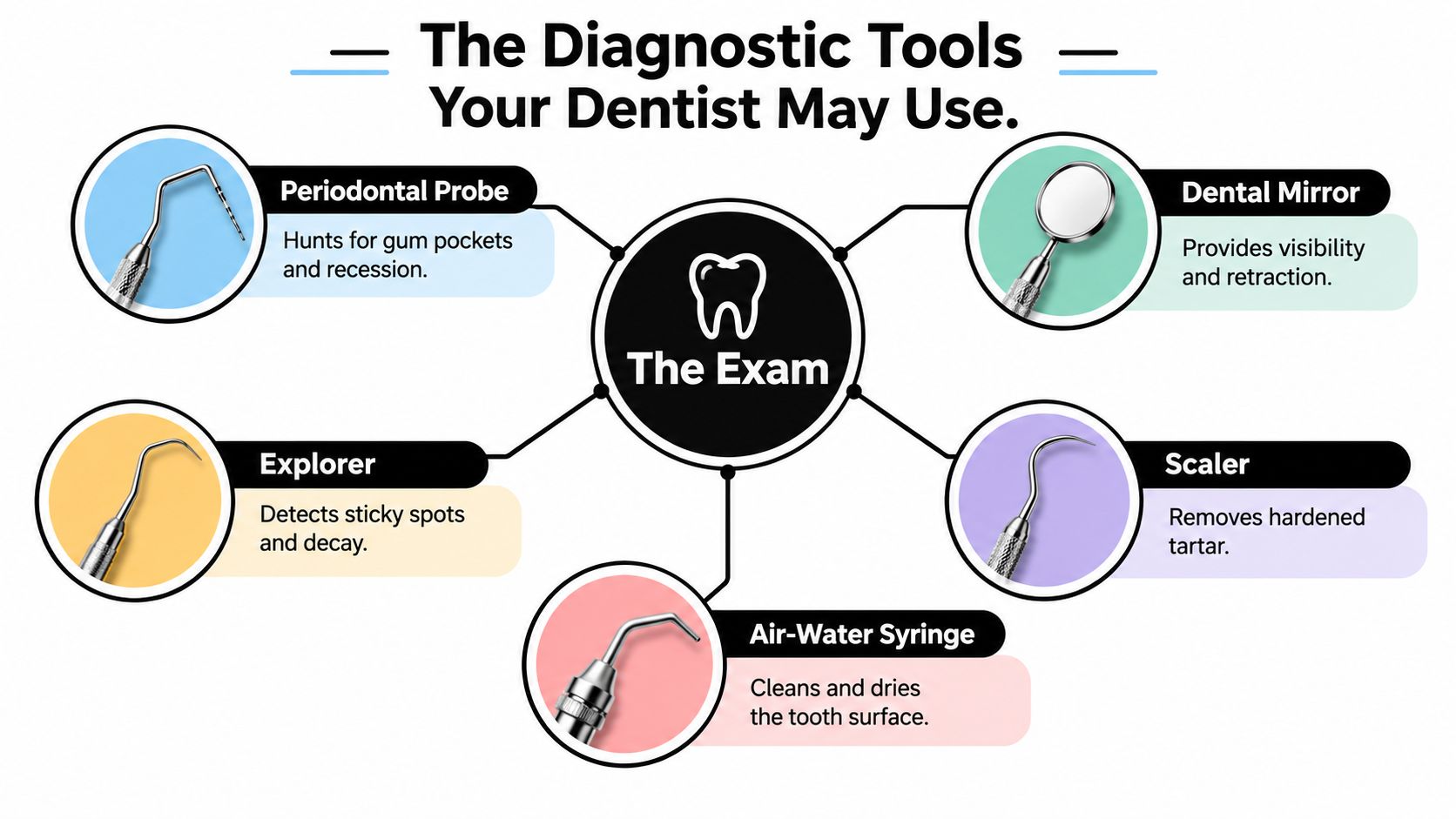
The instruments on the tray answer different questions. A periodontal probe asks about the gum attachment. An X-ray looks beyond the visible surface. An intraoral camera lets you see what the clinician sees.
What each tool is looking for
The periodontal probe resembles a skinny metal ruler. The clinician gently measures around teeth to assess pocket depth, bleeding, recession, and changes over time. It doesn't scrape away tartar. It helps answer, “Are the gums showing signs of inflammation or attachment loss?”
The dental mirror and explorer improve visibility and access. The mirror reflects light and moves the cheek or tongue aside. An explorer may help the dentist assess grooves, margins, or suspicious areas, but no single instrument should be treated as a stand-alone diagnosis.
Digital X-rays show areas eyes can't reach. Bitewing images can help evaluate the spaces between back teeth. Periapical images focus on an entire tooth and its surrounding bone when the root or deeper structures need review. Panoramic imaging provides a broader view of the jaws when clinically appropriate. You can read about the role of digital X-rays for teeth before your appointment.
The intraoral camera is a small wand that projects close-up images onto a screen. Seeing a fractured filling edge or plaque along a gumline can make the recommendation easier to understand.
Additional assessment tools
An oral cancer screening combines visual inspection with touch. The clinician may examine and palpate the lips, tongue, cheeks, floor of the mouth, palate, neck, and relevant lymph nodes. A persistent abnormality lasting more than two weeks needs reevaluation and may require referral for biopsy, as the USPSTF notes.
Some practices use fluorescence devices such as VELscope, saliva testing, caries-risk assessments, or three-dimensional cone-beam imaging for selected situations. These tools aren't automatic upgrades for every cleaning. Each should answer a specific clinical question.
A clear periodontal charting guide can help patients understand why the team records measurements around individual teeth. The most useful question isn't “Which tool are you using?” It's “What are you trying to find, and how will the result change my care?”
Pediatric and Adult Visits Compared
A child's appointment is designed around development and trust. An adult appointment often spends more time investigating silent changes, medical influences, and long-term risks. Both include prevention, but the conversation and techniques evolve.
Toddlers may be examined in a knee-to-knee position, with a parent nearby and a short explanation before each action. A hygienist might count teeth aloud, use flavored prophy paste, or turn the exam into a simple game. The aim is to make the chair familiar rather than force a child through unfamiliar sensations.
As children grow, the team watches for emerging teeth, jaw development, brushing quality, and areas that trap food. Fluoride varnish may strengthen the prevention plan, while sealants can cover susceptible grooves on permanent molars. Orthodontic treatment, cavity risk, and cooperation can all change the timing of follow-up.
Adults usually receive more detailed discussion about gum recession, dry mouth linked to medications, grinding, changing restorations, tooth wear, and soft-tissue findings. Tobacco exposure and age can influence the clinician's risk assessment, but a routine examination still isn't a guarantee against oral cancer. Patients should report unusual changes rather than waiting in silence.
| Aspect | Pediatric Visit | Adult Visit |
|---|---|---|
| Main emphasis | Comfort, prevention, growth, and developing habits | Early detection, maintenance, risk assessment, and treatment planning |
| Communication | Simple language, demonstration, games, caregiver involvement | Shared decision-making, medical history, symptoms, and priorities |
| Preventive options | Fluoride, sealants, brushing coaching, growth monitoring | Fluoride when indicated, periodontal guidance, sensitivity and dry-mouth care |
| Findings discussed | Emerging teeth, cavities, bite development, orthodontic needs | Gum measurements, restorations, recession, wear, decay, and soft tissues |
| Recall planning | Adjusted for development, disease, and appliances | Adjusted for caries and periodontal risk |
Caregivers can review guidance on when a child should first see a dentist. A child's first visit may focus mostly on building comfort. For an adult, the same calm approach supports early recognition of problems that may not hurt yet.
Making the Visit Work for Anxious Patients
Anxiety is a reason to plan, not a reason to postpone indefinitely. A 2025 U.S. survey reported that 21% of adults had avoided dental care because of anxiety, with fear of pain or discomfort the leading trigger, according to Delta Dental's survey release. Parents in that survey reported anxiety about cleanings and exams in 26% of children, rising to 31% among children ages 6 to 12, from the same source.
Before you sit down
Tell the practice what makes care difficult when you book. Say, “I have a strong gag reflex,” “I fear needles,” or “I had a traumatic dental experience.” That information lets the team prepare, allow more time, explain imaging, and avoid surprising you.
Choose a time when you typically have the most energy. Bring noise-canceling headphones, a familiar playlist, or a small stress ball, and arrive early enough to settle rather than rush.
During the cleaning
Agree on a raised hand as your stop signal. The hygienist can pause, bring the chair up, offer a water break, or discuss topical anesthetic for a sensitive area. You remain part of the pace.
For gagging, breathe through your nose when possible and tell the clinician before instruments enter the mouth. Some practices may discuss strategies such as a small amount of salt on the tongue, but ask first and stop if anything feels uncomfortable.
You can also read about dental anxiety management and decide which ideas fit you.
A partial visit can still provide useful information. Afterward, plan a small reward, tell the office what helped, and record what made the appointment harder. Each visit gives the team better information for the next one.
What to Do Between Visits
A professional cleaning gives you a clearer starting point, but daily habits protect the spaces between appointments. The goal isn't to brush aggressively. It's to clean consistently without injuring the gumline.
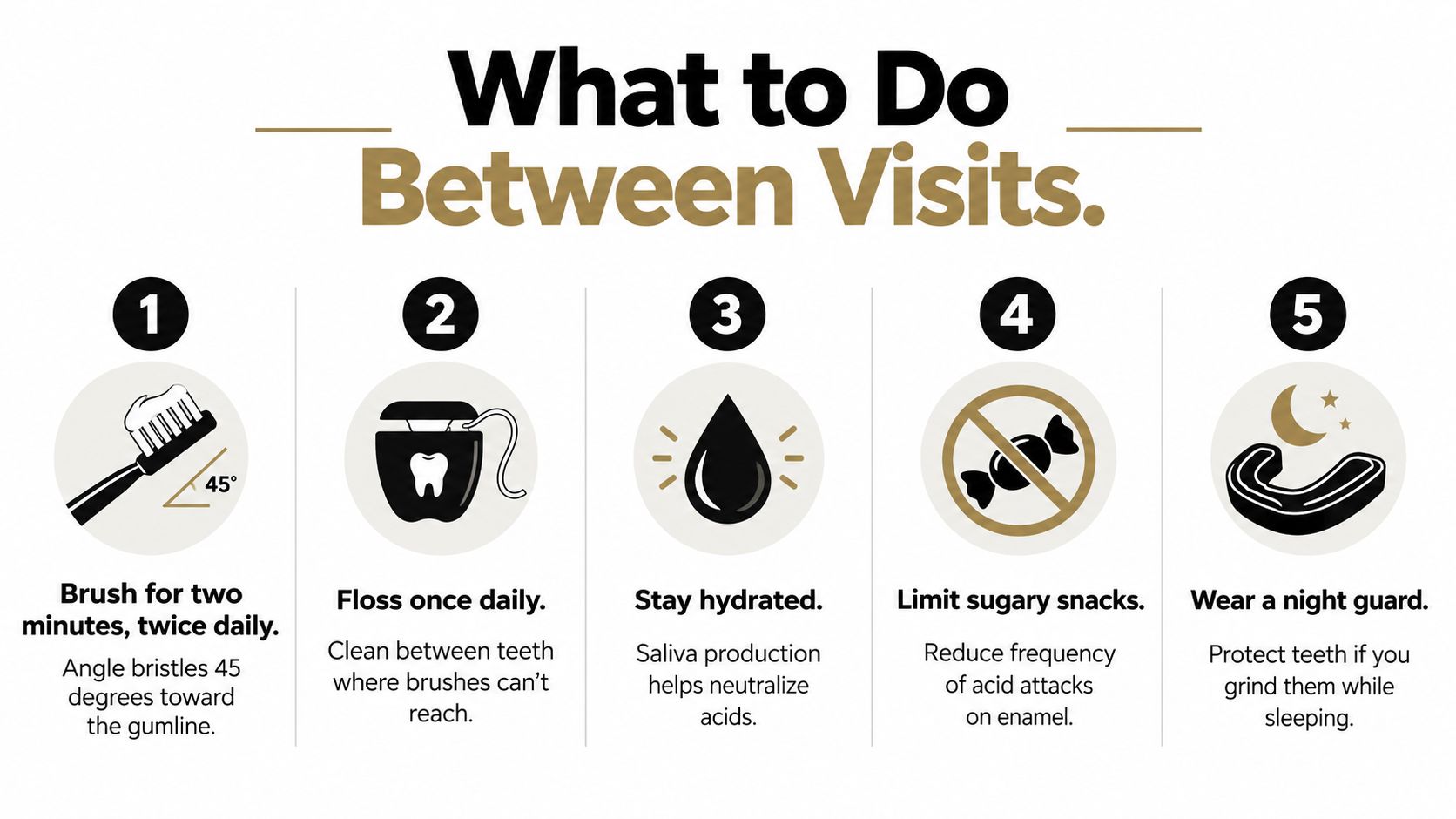
Brush twice a day for two minutes, using a soft brush and angling the bristles toward the gumline. Use gentle movements rather than pressing hard. Clean the chewing surfaces and the tongue, then use string floss, interdental brushes, or a water flosser once daily according to what fits your mouth and hand control.
Watch for changes, not just pain
Pain is only one possible signal. Contact the practice sooner if you notice:
- Bleeding: Gums bleed repeatedly during brushing or interdental cleaning.
- Persistent odor: Bad breath continues despite regular cleaning.
- Structural changes: A filling cracks, a tooth chips, or an edge feels sharp.
- Soft-tissue changes: A white or red patch, lump, ulcer, or color change persists.
- Temperature sensitivity: Hot or cold triggers a new or worsening response.
- Jaw symptoms: Clicking, morning soreness, or discomfort appears with chewing.
Limit frequent exposure to sugary or acidic drinks between meals. Drink water regularly, especially if your mouth feels dry, and ask about products or habits that support saliva when medications affect moisture.
A simple phone note can improve your next appointment. Once a month, write one line about new sensitivity, bleeding locations, food trapping, broken restorations, or jaw soreness. Bring the note to the visit so the exam starts with a useful history instead of a vague memory.
Insurance Costs and Choosing the Right Practice
Price questions are part of preventive care. Coverage depends on the plan, the practice's network status, frequency limits, deductibles, and whether imaging or additional periodontal treatment is included. Ask for a written estimate before the appointment if you aren't sure what your plan covers.
| Service | Typical Cash Price | Typical Insurance Coverage |
|---|---|---|
| Preventive cleaning | Varies by practice and complexity | Often covered under preventive benefits, subject to plan rules |
| Dental examination | Varies by examination type | Often covered partly or fully under preventive benefits |
| X-rays | Billed according to image type and clinical need | May be separate from the cleaning and exam benefit |
| Periodontal treatment | Higher than routine prophylaxis | Coverage varies and may involve different benefits |
Read your summary of benefits and ask whether the dentist is in network. Confirm how the practice handles waiting lists, missed appointments, claim submission, and services that fall outside a routine preventive visit. A plan's allowance isn't the same thing as a clinical recommendation, so ask whether the proposed recall interval reflects your risk.
A useful practice should explain the difference between routine prophylaxis, periodontal maintenance, diagnostic imaging, and treatment. It should also tell you whether X-rays are scheduled during the first visit or reviewed at a later appointment. Busy New York patients may value online booking, efficient scheduling, and a clear route for urgent concerns, but communication matters more than speed alone.
For help understanding benefit questions and payment arrangements, review this dental insurance and payment plans resource. Before booking, send a short intake message that includes your last cleaning, current symptoms, anxiety triggers, insurance details, and any request for extra explanation.
Paul L. Gregory, DDS offers preventive cleanings and exams, digital X-rays, oral cancer screenings, pediatric care, periodontal treatment, and gentle diagnostics for patients with anxiety or limited time. Visit Paul L. Gregory, DDS to request an appointment and discuss the cleaning and exam schedule that fits your oral-health needs.