

If a machine can make a crown while you wait, does that mean your tooth is ready to receive it? Not necessarily. Same-day tooth restoration describes how a restoration is made, not whether a damaged tooth is healthy enough to finish today.
For an appropriate tooth, digital scanning and chairside milling can eliminate laboratory waiting and a temporary crown. For a tooth with infection, a deep fracture, or too little supporting structure, the right first appointment may involve treatment that prepares it for a lasting restoration. The useful question isn't whether treatment can be fast. It's whether finishing today is the right clinical decision.
Which Restorations Can Be Finished in One Visit
Single crowns, inlays, and onlays are the most common candidates for chairside restoration. A crown covers the prepared tooth, an inlay fits within its chewing surface, and an onlay replaces a larger area that includes a weakened cusp. These selected applications, along with some veneers, are described in the historical clinical review of dental CAD/CAM.
Not every damaged tooth needs a milled restoration. A smaller defect may be suitable for a direct filling, which the dentist shapes inside the tooth rather than manufacturing separately. Understanding the difference between a filling and more extensive tooth restoration helps you ask why a particular option is recommended.
Same-day suitability by restoration type
The table describes typical candidates, not a guarantee. The examination at the chair determines whether a restoration can safely be completed that day.
| Restoration | Same-day suitability | Usually needs staged care when |
|---|---|---|
| Single crown | Common candidate | Extensive buildup or a margin below the gum line is needed |
| Inlay or onlay | Common candidate | Cusp coverage or bite forces exceed what the material design allows |
| Veneer | Selected cases | Multiple shade layers or complex esthetic planning is required |
| Multi-unit bridge | Selected cases | Several connected units or complex occlusal design is required |
| Implant crown | Case by case | Implant healing or stability is not yet confirmed |
| Complete or full-arch denture | Not typical | Laboratory fabrication and several fittings are needed |
Veneers require particular attention to color and thickness because the underlying tooth can influence the final appearance. Bridges introduce connected units and more complicated bite relationships. An implant crown also requires confirmation that the implant is ready to support it, not merely that a milling machine is available.
A complete or full-arch denture isn't the same task as milling a crown. A definitive denture requires assessment of tissue fit, tooth position, and bite relationships, usually through staged fabrication and fittings.
Emergency access isn't definitive restoration
A same-day emergency visit means prompt assessment, not a promise of a final crown. A 2025 International Endodontic Journal study reviewed 5,795 records and identified 892 same-day emergency visits over five years, with annual proportions ranging from 12.2% in 2019 to 27.4% in 2020. Those figures describe emergency attendance, not chairside crown delivery.
Emergency care may focus on pain relief, infection management, or stabilization. Active infection needs its own treatment decision before definitive restoration.
Practical rule: A single restoration on a tooth with adequate remaining structure and no unresolved infection is worth discussing as a same-day option.
Tooth Conditions That Call for a Staged Plan
Same-day is a manufacturing speed. Diagnosis decides whether the tooth is ready. Before scanning, the dentist examines the tooth, its supporting tissues, and the way it meets the opposing teeth.
Pain doesn't automatically mean root canal treatment is necessary, and a painless tooth isn't automatically healthy. The dentist combines your symptoms with examination findings, appropriate imaging, and tests of the tooth's nerve response. If pulp disease is present, understanding what affects root canal treatment time helps you plan for the treatment that must come first.
What the dentist needs to establish
The examination must establish whether decay or a fracture extends beneath the gum, how much sound tooth remains, and whether the restoration's edge can be clearly captured. That edge, called the finish line, needs to be readable during scanning and accessible during placement.
The dentist also evaluates grinding, strong bite forces, and moisture control. Saliva or bleeding can make adhesive placement unreliable. A tooth may be technically scannable yet still unsuitable for immediate bonding.
| Tooth condition | Effect on same-day plan | What comes first |
|---|---|---|
| Active infection or pulp disease | Definitive restoration is postponed | Root canal treatment or infection control, as indicated |
| Decay or fracture below the gum line | Margin is hard to isolate and read; often staged | Gum treatment or crown lengthening when indicated, then scanning |
| Extensive loss of tooth structure | Buildup needed; laboratory fabrication may be chosen | Buildup assessment and design review |
| Heavy grinding or strong bite forces | Material choice and occlusal design become critical | Bite analysis and material selection |
| Complex shade or translucency demands | Layering may be better done in the laboratory | Shade planning and laboratory referral |
| Limited moisture control | Bonding becomes unpredictable | Isolation plan or staged appointment |
A buildup replaces missing supporting structure beneath a crown. It isn't extra cement, and the dentist must decide whether the remaining tooth can support the proposed restoration. Some teeth can receive a buildup and crown together; others need reassessment before the final design.
Appearance can justify additional time
A highly visible front tooth may require careful control of translucency, surface texture, and shade transitions. A systematic review comparing CAD/CAM and conventional restorations describes differences in material choices and workflow accuracy, supporting a case-specific rather than speed-first decision.
For example, matching a neighboring natural front tooth may require laboratory characterization that isn't readily achieved with the available chairside block.
A staged plan isn't a failed same-day appointment. It's a decision not to place a definitive restoration before the tooth and treatment design are ready.
A candid dentist should explain both the obstacle and the next step, rather than promise completion regardless of prognosis.
How the One-Visit Workflow Replaces Lab Steps
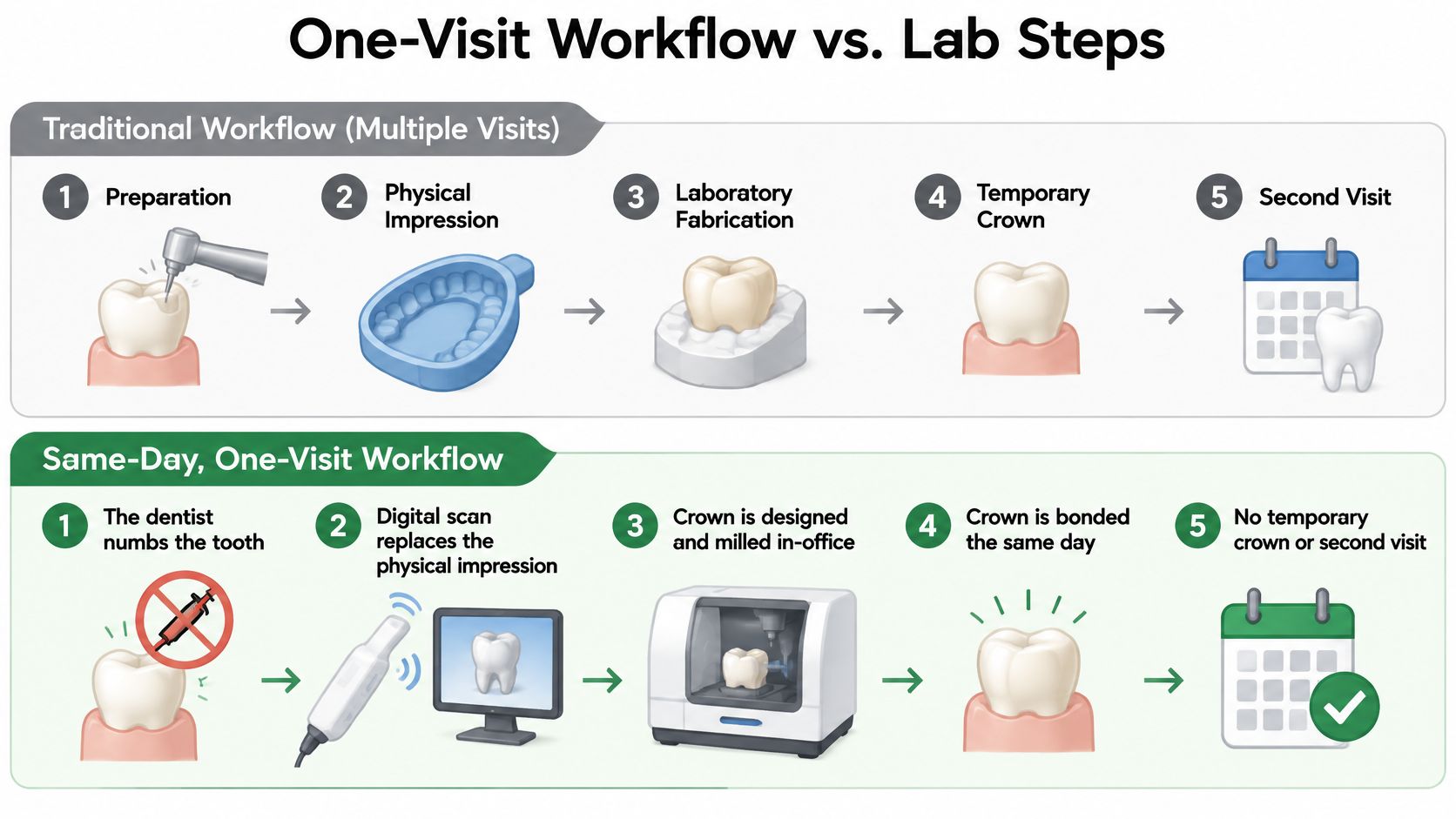
The conventional route involves tooth preparation, a physical impression, laboratory fabrication, a temporary crown during the waiting period, and a return visit for placement. Chairside computer-aided design and manufacturing, or CAD/CAM, replaces external fabrication with digital capture, software design, and in-office milling, as described by Dental Economics.
The comparison below shows how the manufacturing pathway changes.
What happens while you're in the chair
Numbing and preparation. The dentist numbs the area, removes compromised material, and shapes the tooth. Before proceeding, the dentist confirms that the finish line is visible and the preparation can support the chosen restoration.
Digital scanning replaces impression material. An optical intraoral scanner records the prepared tooth, neighboring teeth, and opposing bite. The team controls saliva and bleeding so the scanner captures the actual tooth surface rather than an obscured edge.
The restoration is designed on screen. CAD/CAM software helps shape the crown or partial-coverage restoration. The dentist reviews its contour, neighboring contacts, and relationship to the opposing teeth.
The milling unit cuts the restoration. A ceramic block is machined while you wait. Lithium disilicate is an option when the preparation permits suitable thickness and rounded internal angles; required firing or other finishing follows the selected material's process.
Try-in tests the physical result. The dentist checks seating, shade, and contacts. A design that looks acceptable on screen still needs to fit the prepared tooth and neighboring teeth in your mouth.
Finishing and placement follow. The restoration is polished or characterized as appropriate, then bonded or conventionally cemented according to the material and clinical situation. Reliable isolation is particularly important when resin cement is used.
The final bite is checked. The dentist verifies how your teeth meet and makes necessary adjustments. You leave with instructions about chewing, cleaning, and symptoms that warrant contact.
Production time isn't total appointment time
A DataIntelo market report states that chairside CAD/CAM can reduce restoration production time from 7–14 days to under 90 minutes for crowns, bridges, and inlays. That's a production comparison, not a guaranteed appointment duration or proof that every bridge qualifies.
Expect a longer treatment appointment, rather than a brief scan followed immediately by departure. Preparation, finishing, try-in, and bonding all require attention beyond milling.
When reviewing dental crown treatment options, distinguish fabrication time from the full clinical plan. A fast milling cycle cannot replace infection treatment or a necessary foundation beneath the crown.
Fit and Durability Compared With Lab-Made Crowns
Digitally captured crowns can achieve clinically acceptable fit. A randomized split-mouth study of 19 patients, summarized in a clinical overview of digital crown workflows, reported median marginal gaps of 60 μm for digitally scanned crowns versus 78 μm for conventional-impression crowns, with both receiving clinically acceptable marginal-integrity ratings at 6 and 12 months.
The marginal gap is the space measured at the restoration's edge. These findings support digital impression accuracy, but they don't establish that every digitally scanned crown is better or that scanning alone guarantees a successful same-day result.
Long-term evidence needs the right context
A systematic review of CAD/CAM single-tooth restorations pooled 1,957 restorations, recorded 170 failures over a mean exposure of 7.9 years, and estimated a failure rate of 1.75% per restoration-year with modeled five-year survival of 91.6%. These are pooled outcomes, not a personal forecast for an individual tooth.
Same-day placement also shortens the period a prepared tooth spends beneath a temporary restoration that could fracture, leak, or come off. Avoiding that provisional phase is useful, but it doesn't remove the need for careful restoration design.
Same-day chairside crown compared with a lab-made crown
The fit figures below describe the digital-versus-conventional impression comparison above, not a direct test of all chairside and laboratory manufacturing systems.
| Measure | Same-day chairside CAD/CAM | Lab-made conventional crown |
|---|---|---|
| Visits for a typical single crown | One treatment visit | Preparation and placement visits, with a temporary crown between |
| Impression method | Optical digital scan | Physical impression material |
| Median marginal gap | Smaller median gap in the cited split-mouth comparison | Larger median gap, also clinically acceptable |
| Impression time | Significantly shorter in the cited clinical comparison | Longer in that comparison |
| Five-year survival | Modeled pooled estimate reported above | No directly comparable figure reported in these sources |
Material and technique matter as much as the manufacturing location. Adequate ceramic thickness helps the restoration tolerate chewing forces. Rounded internal preparation angles reduce stress concentration, and the dentist must design contacts that don't overload the ceramic.
Contamination during adhesive placement can weaken a resin-cement bond. A precise scanner can't compensate for inadequate isolation, an unsuitable preparation, or a poorly adjusted bite. Daily cleaning and professional maintenance remain important after either manufacturing route.
Material discussions should address the tooth's actual demands. A comparison of zirconia and porcelain-fused-to-metal crowns can help frame questions about strength and appearance without assuming either material is appropriate for every chairside system.
Fast milling still may not suit extensive buildup, a margin beneath the gum, complex shade layering, full bite reconstruction, or active infection. Good same-day fit starts with appropriate selection, followed by direct checks of seating, contacts, and shade before final placement.
Cost, Adjustments and Remakes to Ask About
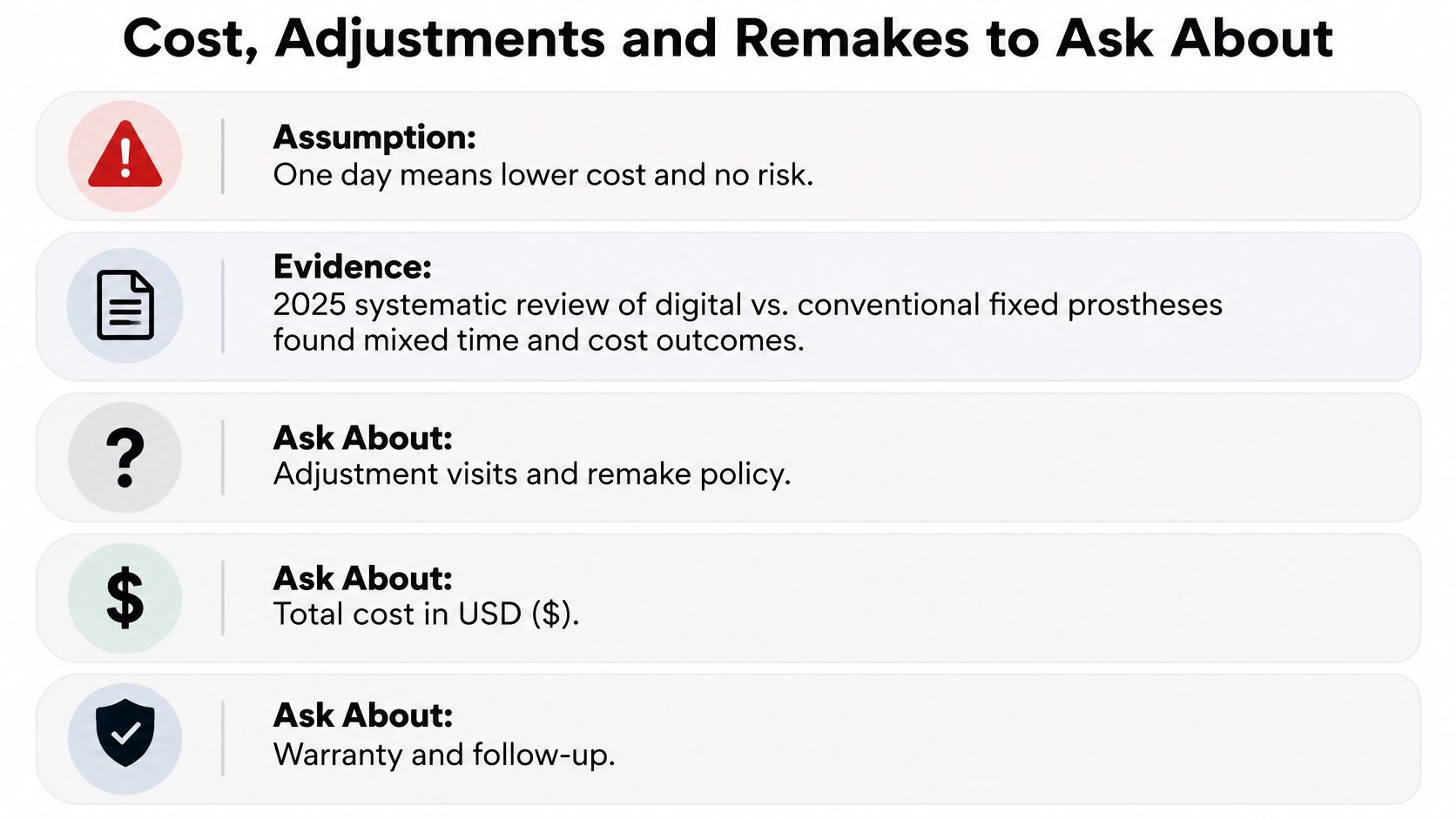
One calendar day doesn't automatically mean a lower bill or no follow-up. You may avoid laboratory waiting and another planned placement visit, but the dentist still performs preparation, design review, try-in, cementation, and bite adjustment.
A 2025 systematic review of digital versus conventional fixed-prosthesis workflows found mixed timing results: digital scans were faster in some single-crown and three-unit cases, but not all. It found no difference in clinical evaluation or chairside adjustment for single crowns, and no included articles compared prosthesis costs.
That last finding matters. The review doesn't establish that digital treatment is cheaper, equally priced, or more expensive.
Questions to take to the appointment
Use this checklist to clarify the agreement before treatment begins.
What restoration am I receiving, and what is it made from? Confirm whether the plan is a crown, inlay, onlay, or another restoration, and identify the material.
How much chair time should I reserve? Include preparation, scanning, milling, any firing, try-in, bonding, and bite adjustment.
What happens if the fit or shade isn't acceptable? Establish whether the restoration can be revised that day or whether a temporary restoration and return visit would be needed.
Are adjustment appointments included? A bite that feels high after numbness wears off should have a clear route for reassessment.
What is the remake policy? Ask for written terms, including any guarantee, exclusions, and responsibilities if the restoration needs replacement.
What follow-up and emergency access are available? Clarify whom to contact after hours and how postoperative concerns are assessed.
What will I pay after insurance? Request a written estimate and distinguish expected insurance benefits from confirmed coverage.
The visual checklist highlights the financial and follow-up topics to discuss.
For a fuller discussion of the factors behind a quote, review what affects dental crown cost. Don't assume that follow-up, additional tooth treatment, or remakes are included unless the written estimate says so.
Before agreeing: Clear written answers about cost, adjustments, and remakes are more useful than a promise of speed alone.
How a Manhattan Schedule Changes the Visit
A crowded work calendar explains why Manhattan patients ask about same-day treatment. It doesn't determine whether a tooth qualifies. At our Midtown office at 57 W 57th Street, near Central Park South and Columbus Circle, planning starts with the clinical need and then considers the time you can reasonably reserve.
A convenient location helps with attendance, but the examination still comes first.

Neighborhood names help with planning
The U.S. Census Bureau's Manhattan sub-borough map groups Chelsea, Clinton, and Midtown together, and Stuyvesant Town with Turtle Bay. It identifies the Upper West Side, Upper East Side, and Greenwich Village/Financial District in separate planning units.
Patients use more detailed wayfinding names, including Midtown, Chelsea, Hell's Kitchen, the Theatre District, Turtle Bay, Lenox Hill, the Upper West Side, the Upper East Side, Gramercy Park, the West Village, Greenwich Village, NoHo, the East Village, SoHo, Tribeca, Hudson Yards, Chinatown, and Wall Street. NYC's neighborhood-tabulation-area materials caution that statistical names and boundaries don't definitively represent neighborhoods.
The Department of City Planning neighborhood map also labels SoHo, Chinatown, and the Financial District. These names are useful for describing a journey, not for deciding treatment eligibility.
Two schedules with different clinical answers
Consider a Wall Street patient whose molar has already been examined and accepted for a single crown, with travel approaching. A longer chairside appointment may consolidate treatment and avoid coordinating a separate placement appointment before departure. That patient should still reserve the full estimated appointment, rather than expect to leave as soon as milling finishes.
A Hudson Yards patient with swelling needs a different booking. The immediate priority is an emergency assessment, not reserving a milling slot or choosing a ceramic shade. Our practice offers short-notice visits and makes every effort to schedule dental emergencies as quickly as possible.
This video provides an additional visual companion to the treatment discussion.
Work location and travel plans can shape appointment logistics once the tooth has been assessed. Another visit remains the correct choice when infection, a deep margin, or a necessary buildup must be addressed first.
Confirm the Plan Before You Book
Book a diagnostic examination before reserving a definitive milling appointment. Describing a cracked tooth over the phone helps with triage, but it doesn't establish whether the tooth needs a filling, partial coverage, a crown, or treatment before restoration.
Bring information that helps the dentist understand the problem:
- Recent X-rays, if available, so the team can review them and determine whether additional imaging is needed.
- A short symptom history, including sensitivity, pain on biting, swelling, a visible crack, or a lost filling.
- Earlier treatment records, especially information about existing crowns or root canal treatment.
Leave with a decision, not just a time slot
At the examination, the dentist should establish whether the tooth is a single-unit candidate, whether infection or missing supporting structure needs attention, and whether the chosen material and shade can be finished chairside. Before agreeing, obtain written answers about expected chair time, out-of-pocket cost, and the remake policy.
Scheduling technology can help organize booking and reminders. Hyperleap AI's resource on automating dental appointment scheduling explains that administrative side, but an appointment confirmation isn't clinical approval for same-day restoration.
Our Midtown office at 57 W 57th Street offers short-notice visits and makes every effort to schedule dental emergencies quickly. Call the same day about pain or swelling, rather than waiting for a planned crown appointment. Rapidly spreading swelling or difficulty breathing or swallowing requires immediate emergency medical attention.
Choose same-day tooth restoration when the examination and written treatment terms support completion in a visit. Choose a staged plan when the diagnosis requires it, even if your calendar would prefer otherwise.
Paul L. Gregory, DDS offers restorative care, including fillings and crowns, along with short-notice emergency assessment at our Midtown office. Visit Paul L. Gregory, DDS for current booking information and arrange an examination to determine whether same-day restoration or a staged plan is appropriate for your tooth.