

Published fees for ceramic clear braces in the United States sit around one average, then fan out across a range wide enough that two similar cases rarely share a bill. Two people can wear the same style of bracket on the same tooth and still land at opposite ends of that spread.
A single posted price cannot show who is overpaying. The fee follows how far the teeth have to travel, how many visits that movement needs, and which services the quote covers. Records, retainers, and repairs bundled into one fee are a different product from a lower quote that bills each item later. Every national figure is a benchmark, not a promise of what your case will cost.
A lifetime orthodontic maximum pays only up to its cap. Your balance is the full fee minus that benefit, so a written estimate should total those pieces instead of stopping at the headline price.
Average Clear Braces Cost Compared With Other Options
Clear braces usually refers to fixed braces with tooth-colored or ceramic brackets. Clear aligners are removable and work differently, so prices are best compared by treatment type rather than by the word “clear.”
National pricing estimates put ceramic braces at roughly $4,000 to $8,000 before insurance, with a broader reported 2024 range of $4,480 to $11,312, according to this comparison of clear braces and metal braces. The range is a planning benchmark, not a guaranteed quote. Fees depend on the treatment being priced and what it includes.
Published comparisons report average costs of $5,834 for ceramic braces, $6,343 for traditional metal braces and $5,108 for in-office clear aligners (Real Dental Costs). These figures summarize different cases and providers, so they do not predict an individual patient's fee.
| Appliance | Average cost | Reported range |
|---|---|---|
| Ceramic (clear) braces | $5,834 | $4,480 to $11,312 |
| Traditional metal braces | $6,343 | Not reported |
| In-office clear aligners | $5,108 | Not reported |
The averages do not mean ceramic braces are always less expensive than metal. In practice, ceramic braces typically cost about $500 to $2,000 more than metal braces. The difference between a national average and a clinic's quote can reflect the cases included in each figure, as well as what the fee covers.
For a fair comparison, ask whether the total includes appointments, repairs and retainers. A lower headline price may leave some of these costs out, making the final balance higher. If the aim is a less visible smile without moving teeth, straighter smiles without moving teeth explains cosmetic alternatives.
For a comparison of the two clear treatment options, see this guide to clear aligners vs. braces. Paul L. Gregory, DDS offers both clear braces and Invisalign.
Use the ranges as a starting point, then compare written estimates for the same treatment and included services. A quote above or below the benchmarks is a reason to ask what the fee covers, not proof that the price is wrong.
Treatment Complexity and Duration Drive Most of the Price
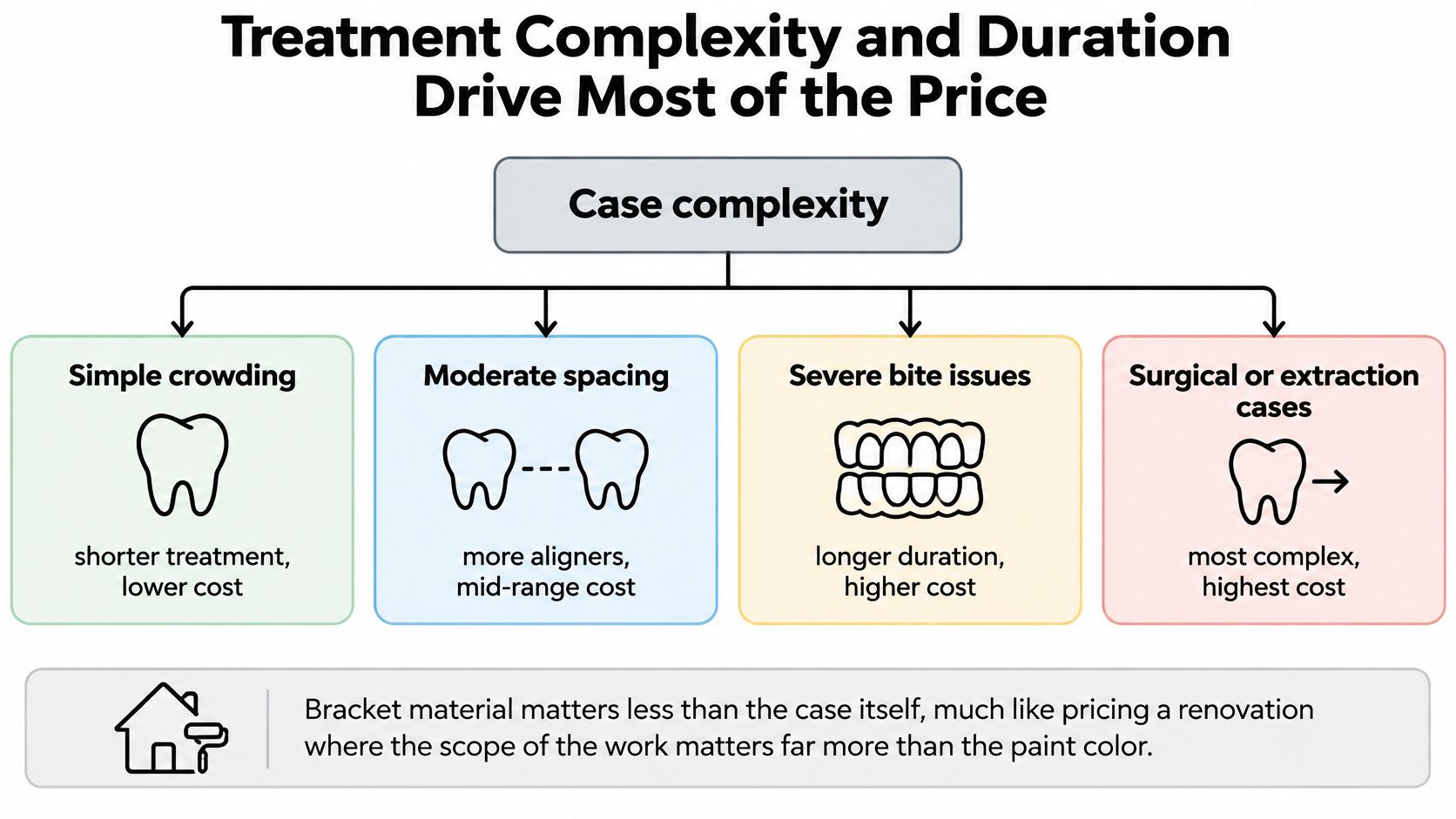
Pricing an orthodontic case works like pricing a renovation. The scope of the work sets the bill. The finish on the cabinets barely moves it. Bracket material is the finish. The case is the scope.
What the timeline actually looks like
A 2025 study of fixed orthodontic treatment in Scientific Reports found an average course of 816 days, about 27 months, with 28.8 visits scheduled at three- to four-week intervals. Longer treatment tracked with greater malocclusion complexity and with missed appointments. Moderate crowding or bite correction is the row that belongs near that average: plan it at about 27 months (816 days), not as an open-ended series of adjustments. The same review cites a European Journal of Orthodontics analysis that found a strong positive correlation between cost and duration (Spearman rho = 0.71) and concluded that roughly 55% of costs were influenced by case- and operator-dependent factors.
Slightly more than half of what you pay is decided by the shape of your bite, how many visits the correction takes, and whether you keep those visits. The bracket is the smaller slice.
Where the ceramic premium comes from
Clear braces generally cost more than conventional metal braces because ceramic or sapphire brackets require specialized materials, aesthetic archwires and careful finishing. An orthodontic cost review reports a typical premium of approximately $500 to $2,000 over metal braces, while citing an adult treatment range of roughly $4,800 to $7,135 in the United States. Both figures are planning benchmarks, not a guaranteed office quote.
Ceramic is more brittle, so brackets fracture and need replacing more often. The wire can also drag harder against a ceramic slot than an all-metal one. Higher friction can slow tooth movement in some cases, which adds appointment time or stretches the course.
| Case type | Typical treatment length | Main cost drivers |
|---|---|---|
| Mild alignment correction | A few months | Few visits, minimal refinements |
| Moderate crowding or bite issues | About 27 months (816 days) | Extra adjustment visits, possible retainer changes |
| Severe crowding, crossbite or extraction | Longer than the 27-month average | Extra visits, chair time, repairs, possible additional phase |
Compare quotes on the written total, not the headline appliance fee. Ask the office to list, in the estimate:
- how many adjustment visits the fee includes
- whether a fractured ceramic bracket is replaced inside that fee
- whether aesthetic wires, diagnostic records, emergency visits, refinements and retainers are included or billed later
A missed appointment and a broken bracket do the same thing to the balance. Each one adds a visit. If the fee stops at a set visit count, visits past that count are yours to pay. For the aligner version of the same timing question, our guide to how long Invisalign takes maps the visit schedule and what each stage covers.
The assessment and records stage looks like this in practice:
How Insurance Changes What You Actually Pay
A plan that covers 50% of orthodontic treatment may pay far less than half your bill. The percentage usually applies only to eligible charges, and a lifetime orthodontic maximum can cap the insurer's contribution.
A useful way to read a quote is to follow the money from the treatment fee to your balance. Suppose the fee is $5,834 and your plan pays 50% of eligible treatment, up to a $1,500 lifetime maximum. The uncapped half would be $2,917, but the maximum limits the plan's payment to $1,500.
| Line item | Example amount |
|---|---|
| Total treatment fee | $5,834 |
| Nominal 50% benefit before the cap | $2,917 |
| Plan lifetime orthodontic maximum | $1,500 |
| Benefit the plan actually pays | $1,500 |
| Remaining patient cost before deductibles | $4,334 |
| Effective benefit share of the fee | about 26% |
The patient balance is the treatment fee minus the benefit paid, with any deductible or other uncovered charges added separately. Here, the plan pays about 26% of the fee, not 50%. Every figure in this example is a benchmark, not a guaranteed quote.
Timing can change your cash flow without changing the total benefit. An insurer may make an initial payment when active treatment begins, then distribute the rest over the treatment period, sometimes for as long as 18 months (Fair Health Consumer's guide to paying for orthodontics). That schedule means you may owe more early in treatment than a simple percentage suggests.
The six checks that change your balance
- Separate benefit or not: Ask whether orthodontics has its own lifetime maximum or draws on the annual dental maximum.
- Adult eligibility: Check whether the plan covers adult orthodontics, since coverage can differ by age.
- Appliance classification: Confirm whether ceramic braces are covered and how the plan distinguishes them from clear aligners.
- Network status: Ask how an out-of-network provider affects the plan's allowed amount and your share.
- Retainers: Check whether retainers are included in the benefit or billed separately.
- Prior use: Find out whether any orthodontic benefit has already been used under the plan.
"Linda was great about explaining what my insurance would pay for, and they both were very considerate about my budget while creating a treatment plan." Jeffries
Before treatment begins, request a written estimate showing the allowed amount, expected insurer payment, deductible, remaining lifetime maximum and your estimated balance. A guide to dental insurance deductibles explains how a deductible affects what you pay. For general background on coverage and payment paperwork, see insurance and payment information.
Payment Options That Spread the Cost
Spread a $5,834 fee across 24 months and the payment lands near $243 a month before any interest. That figure feels manageable. It also hides the full number, because 24 payments of $243 total about $5,832, and anything layered on top (interest, an origination fee, a replacement retainer) changes the total without moving the monthly figure much.
Three routes do most of the work.
In-house installments. Most practices take a down payment at bonding and divide the balance across the treatment months, often interest free. Ask what the down payment is and whether the schedule assumes a fixed number of months.
Third-party healthcare financing. Longer terms and larger amounts, usually with interest or with a promotional period that expires. The promotional window is the trap: if the balance isn't cleared by the deadline, deferred interest can land retroactively.
Paying in full. Practices sometimes discount for it, so it costs nothing to ask whether one is offered before you assume installments are the only path.
Questions to settle before you sign
- What is the total amount financed, not the monthly payment?
- What is the interest rate, and does it start on day one or at the end of a promotional period?
- What does monthly payment multiplied by term come to, and how does that compare with the fee?
- Are there late fees or missed-payment penalties?
- What happens if treatment runs longer than the financed period?
Pre-tax money is the other lever. Flexible spending and health savings accounts can pay for orthodontic care, and the saving depends on your tax situation and on whether your plan allows the expense, so confirm eligibility before you contribute. Our overview of dental insurance payment plans covers how practices and plans usually structure these arrangements.
The rule that keeps financing honest: match the term to the expected treatment length. A 24-month plan on a 27-month course leaves three months of visits with no financing behind them, which is exactly when the extras get charged.
Clear Braces Prices Across Manhattan Neighborhoods
A full orthodontic course in the United States may cost about $3,000 to $13,000, while clear aligner treatment is reported at roughly $1,800 to $9,500; the lower end generally corresponds to minor corrections needing only a few months, and treatment for moderate or severe alignment problems costs more (guide to orthodontic costs, insurance and financing).
Manhattan quotes can differ from that band and from each other. Official city community-district materials name areas including Midtown, Chelsea, Tribeca and the Upper East Side/Lennox Hill, and offices serving them advertise different starting prices.
If you're comparing practices around Midtown, Hell's Kitchen, the Theatre District, Turtle Bay, the Upper West Side, the Upper East Side, Lennox Hill, Gramercy Park, the West Village, Greenwich Village, NoHo, the East Village, SoHo, Tribeca, Hudson Yards, Chinatown or the Wall Street area, the neighborhood name is a weak signal. Rent and case mix can shift a fee by a few hundred dollars. The scope of care shifts it by thousands.
That's the confusion worth clearing up early. An office can advertise a lower starting price because the number covers the appliance and little else: records billed separately, retainers billed at the end, replacement brackets charged per visit, extra aligner sets invoiced as they arrive. Another office quotes higher and includes all of it. On the same case, the second quote can be the cheaper one.
Compare quotes for identical scope, not identical headlines. Two numbers only mean something when they cover the same records, the same visit count, the same retention and the same repair policy.
The practical move is to ask every office the same question in the same words: does this fee cover the complete course of care, from diagnostic records through post-treatment follow-up and retainers, and what triggers an extra charge? For the aligner side of that comparison in this city, our breakdown of Invisalign cost in NYC applies the same accounting.
Confirm Your Total Cost Before You Start Treatment
A headline fee works like a menu price for the entrée. Sides, tax, and a broken plate still change the bill. Clear-braces quotes work the same way. The figure that matters is the full course of care, and every number you hear is a benchmark until that office confirms your own case.
Use six questions so two estimates can be compared on total cost, not on the first number at the top. Ask for the answers in a form you can reread later. A verbal figure is a conversation. A written one is something you can set beside another office's total.
- Itemize the estimate. Records, X-rays or scans, adjustment visits, and post-treatment follow-up should each appear as a line, so nothing shows up later as a surprise invoice.
- Confirm inclusions. Find out whether retainers, replacement brackets, emergency repairs, and refinements sit inside the fee or are billed separately.
- Verify the insurance items. Check the orthodontic lifetime maximum, the deductible, network status, ceramic coverage, and whether earlier treatment has already used part of that maximum. What remains is the balance to plan for.
- Get the timeline and the visit count. Proposed length matters as much as the fee. A longer course with more visits is where extra charges tend to pile up.
- Ask about misses and breakage. Find out what a missed appointment or a fractured bracket costs, in money and in added months.
- Match the financing term to the course. A payment plan that ends before treatment does leaves the final months unfunded.
Here is the same checklist in a form you can screenshot and bring with you.
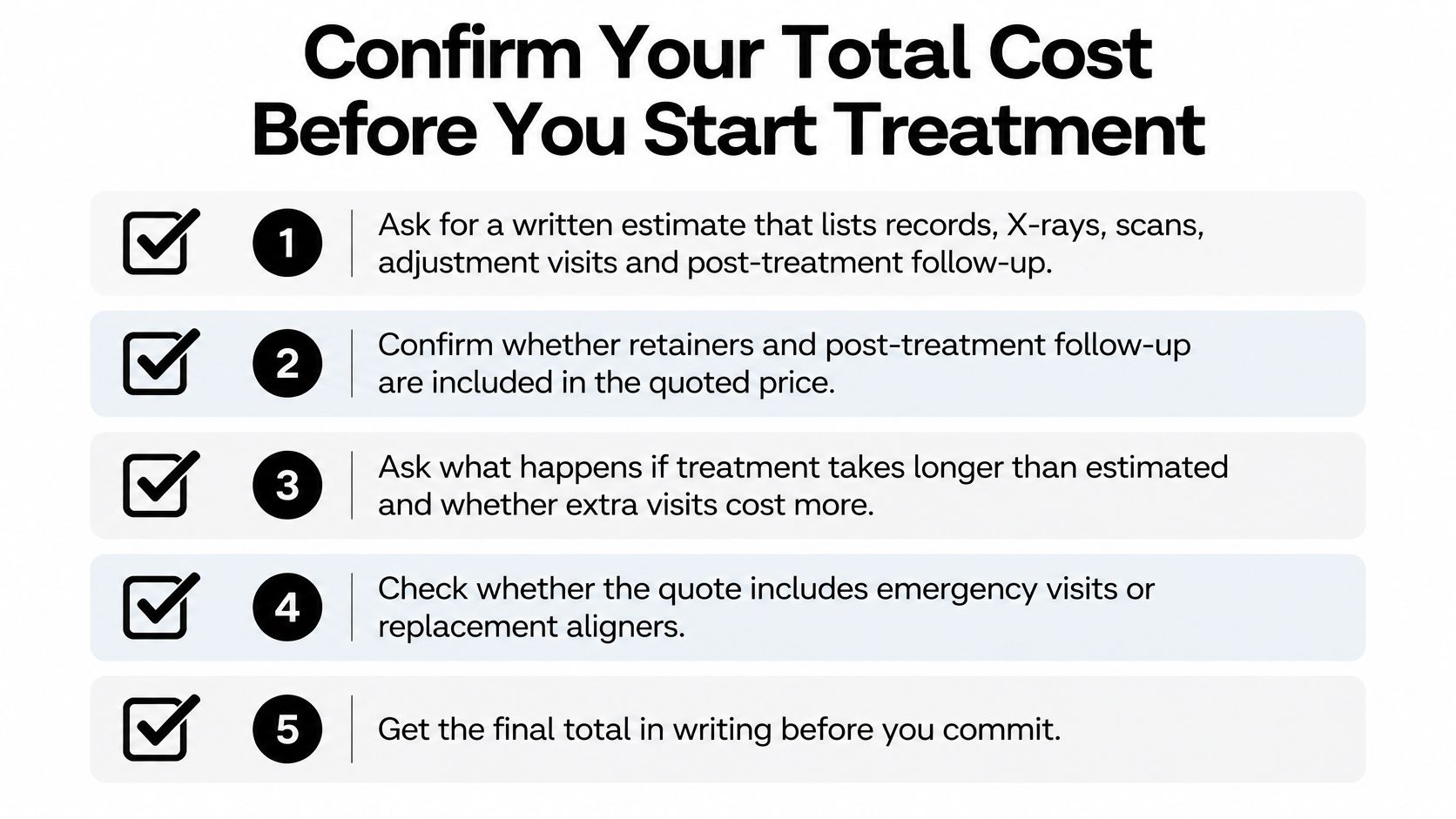
Lay two or three estimates side by side only after the lines match: same records, same visit count, same retention, same repair policy. If one total leaves retainers or a broken bracket off the page, that lower headline is not yet the lower bill. Fill the gaps before you decide.
Clear braces and Invisalign for teens and adults are both available at Paul L. Gregory, DDS, at 57 W 57th St in Midtown. Dr. Gregory tries minimum fixes first and tells patients upfront if additional procedures are required. He and Linda go over procedures and charges beforehand, and the team can explain what your insurance is likely to cover while shaping a plan around your budget. Visit Paul L. Gregory, DDS to book a consultation and bring this checklist with you.