

A dental insurance deductible is the amount you pay toward covered care before your insurer starts paying benefits. Many plans set it at $50 to $100 per plan year.
You open an estimate between stops in Midtown and Chelsea. The balance does not match the “covered” line from open enrollment. A crown, filling, and cleaning already done this year appear on one sheet, and the office wants a number before the longer visit. The deductible is only the first gate. The annual maximum and the order those amounts apply in determine what you pay.
What a Dental Insurance Deductible Means
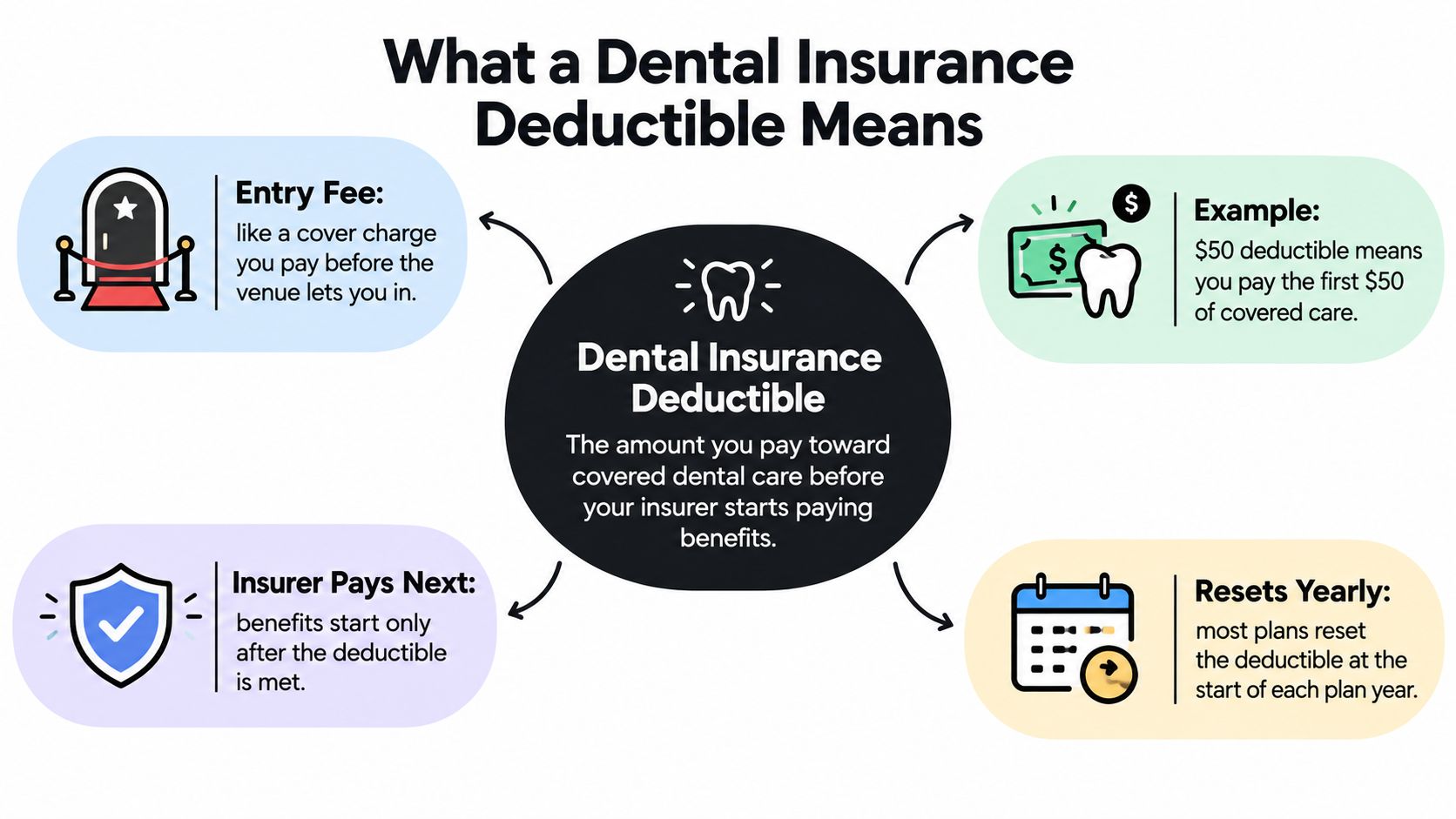
A dental deductible is the amount you pay toward covered services before the insurer begins paying benefits. It works like a cover charge: you pay the threshold first, then the plan may share the cost of eligible care. For most covered services, the plan's share doesn't start until that threshold is met; many plans waive the deductible for preventive care such as cleanings and exams.
The American Dental Association's PPO plan basics identifies $50 as the most common dental deductible. The guide also reports that deductibles for many dental products are usually between $50 and $100, with approximately 46% between $50 and $99. Check whether yours resets each calendar or plan year or is a one-time charge. It may apply to one person or to the family together.
For example, with a $50 deductible and a covered crown, you generally pay the first $50 of applicable expenses. After that, the plan applies its benefit percentage, network rules, and exclusions to the remaining allowed amount. Meeting the deductible is only one step in working out the bill.
The charge follows the plan
Your deductible follows the terms of your plan, not the office address. Whether you come from Hell's Kitchen, Hudson Yards, Turtle Bay, Lennox Hill, or the Upper West Side, the network can affect which fee counts toward the deductible. That fee is the starting point for figuring out your share.
Practical rule: The deductible is one threshold, not the total cost of a visit.
Deductibles Next to Premiums, Coinsurance and Maximums
Most surprise bills start on a plan summary where five costs sit in one box and hit at different moments. They don't replace each other. A premium doesn't shrink a deductible, and meeting the deductible doesn't erase your share of the next claim.
| Term | When It Applies | What It Means | Example |
|---|---|---|---|
| Premium | Every month or pay period | Keeps the policy active | Paid even in a year with no visits |
| Deductible | Once per plan year, or one time | Amount you pay before benefits begin | $50 applied to the first covered filling |
| Coinsurance | On each claim after the deductible | Your percentage share of the allowed fee | 20% of a crown on an 80% plan |
| Copayment | Per service | Flat fee set by the plan | A set visit fee, uncommon on most dental PPO plans |
| Annual maximum | Plan year total | Most the insurer pays in a year | $1,500 cap on plan payments |
The premium is the membership card. You pay it so the policy stays active, whether or not you sit in a chair. The deductible is the entry fee, usually once in the plan year. Coinsurance is the split on each bill after that fee is met, such as 20% of a crown when the plan pays 80%. A copayment is a flat fee per service, and it's uncommon on most dental PPO plans. The annual maximum is the insurer's budget for the year.
When you compare options, read the deductible, the coinsurance, and the maximum on the same page. One low number can hide a tight yearly cap. If you want a plain walk-through of how those pieces fit coverage for your dental care needs, start with the certificate, not the marketing page.
How the Deductible, Coinsurance and Maximum Work Together
Every claim runs through the same order. Learn the order before you argue with the dollars.
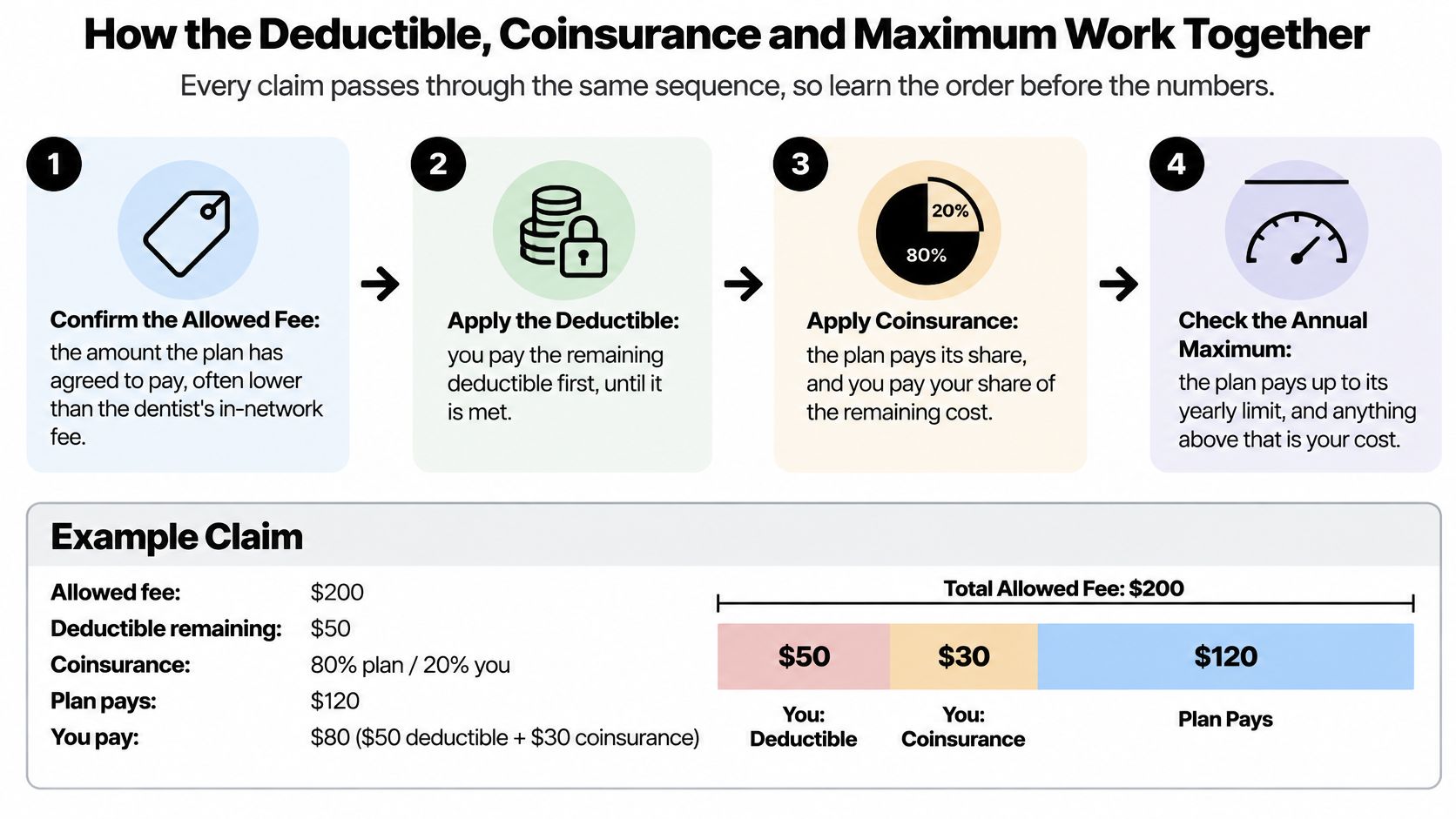
- Confirm the allowed fee. That's the amount the plan has agreed to recognize, often lower than the dentist's fee when you're in network.
- Subtract any deductible still owed this plan year. You pay that slice first.
- Apply the coverage percentage for the service category. A common sample design in the American Dental Association's introduction to dental benefits uses about 80% for basic restorative work and 50% for major restorative work.
- Check the annual maximum balance. The insurer pays the lesser of the calculated benefit and what remains.
- You pay the rest. That's the deductible, your coinsurance, and anything past the maximum.
The American Dental Association describes a common annual maximum as $1,000 or $1,500, although some plans provide $2,000 or $3,000. The National Association of Dental Plans, in that same introduction, reports that about 65% of dental preferred-provider organization plans have annual maximums of at least $1,500. The maximum caps what the insurer reimburses, not your total bill. A modest deductible can still leave a large balance on a crown, periodontal therapy, or several restorations once the yearly contribution is used up. A short explainer on whether insurance covers dental crowns is worth reading before you lock a treatment date.
Think of a toll road. The deductible is the first gate. Coinsurance is the split on each trip. The maximum is the insurer's budget. Once that budget is spent, every remaining dollar is yours.
A two-minute walk-through of the same sequence is here if you'd rather see the gates in order.
Cost Scenarios From a Cleaning to a Maxed-Out Year
Follow one Midtown professional through a single plan year. She lives on the Upper East Side, grabs weekend plans in the West Village or Greenwich Village, and carries a plan with a $50 deductible, 80% on basic restorative work, 50% on major restorative work, a $1,500 annual maximum, and preventive care at 100% with no deductible.
The cleaning and exam are allowed at $150. The plan pays all of it, and the deductible stays untouched. She still used $150 of the yearly budget. A basic filling comes next, allowed at $200. She pays the $50 deductible, the plan pays 80% of the remaining $150 ($120), and she pays $80.
The crown is allowed at $1,200 and paid at 50%, so each side pays $600. Plan payments so far are $150 + $120 + $600, which is $870. Only $630 of the maximum remains.
A second major procedure is allowed at $1,400. At 50%, the insurer would owe $700, but only $630 is left, so the plan pays $630 and she pays $770. A later $300 visit, after the cap, is entirely hers.
| Service | Allowed Fee | Plan Pays | You Pay |
|---|---|---|---|
| Routine cleaning and exam | $150 | $150 | $0 |
| Basic filling | $200 | $120 | $80 |
| Crown, major restorative | $1,200 | $600 | $600 |
| Second major procedure | $1,400 | $630 | $770 |
| Any care after the maximum | $300 | $0 | $300 |
| Plan year total | $3,250 | $1,500 | $1,750 |
She paid $1,750 of $3,250 in allowed fees. The deductible was $50 of that. Coinsurance and the exhausted maximum did the rest. The cleaning counted toward the cap even though it skipped the deductible, which is why only $630 was left.
Many adult plans stop paying after a benefit cap commonly about $1,000–$2,500. The HealthInsurance.org FAQ on dental out-of-pocket costs cites the American Dental Association's 2024 analysis, which found that only 3.4% of dental patients reached a typical annual maximum, yet another 3.3% came within $100 of common $1,000 or $1,500 limits. Patients near the cap still paid coinsurance on the way there.
Moving a crown into the next benefit year can change your share only when your dentist says the delay is clinically fine. A fracture, an infection, or sudden pain should not wait for a reset.
Your benefit year may not match the calendar year, and meeting the deductible doesn't refill the maximum or promise payment for every code. If the first visit of the year is the one that sets the clock, book dental cleanings and exams while benefits are still full.
When the Deductible Works Differently
Two cards in your wallet don't mean two full benefits. The American Association of Oral and Maxillofacial Surgeons coordination paper explains that the primary carrier generally adjudicates the claim first, while the secondary carrier applies its own rules to the remaining allowable expense. Maintenance-of-benefits and nonduplication rules can leave you with more cost sharing, and an individual policy may not coordinate the way a group plan does. If the first insurer applies the deductible, the second may not reimburse it. You can still owe it.
Families feel this fast. Spouses with separate employer plans, and children covered under both, show up from NoHo, the East Village, and Chinatown with two member IDs and one confused statement.
| Situation | How the Deductible Changes | What to Verify |
|---|---|---|
| Preventive cleanings and exams | Often exempt from the deductible | Certificate of benefits for each service category |
| New enrollee in a waiting period | Major services not yet payable; deductible applies once benefits start | Effective date and waiting period by category |
| Two dental plans | Primary plan pays first; secondary applies its own rules to the remaining balance | Which plan is primary and whether it recognizes the first deductible |
| Switching jobs mid-year | Plan active on the date of service usually governs the claim | Plan year dates and any deductible credit from the old plan |
| Out-of-network dentist | Higher deductible or lower maximum possible; reimbursement on allowed fee | Network status before booking |
| Family coverage | Deductible may be per person or one family total | Individual or family deductible and who has met it |
A job change mid-year doesn't automatically carry last month's progress forward. The plan in force on the date of service usually owns the claim. Out of network, reimbursement often tracks the plan's allowed fee, not the dentist's full charge. Before gum treatment, check how insurance handles periodontal care so a second policy isn't treated like a second full wallet.
Reading Your Plan Documents and Claim Statements
The numbers only help if you can find them on your own paperwork.
Start with the certificate of benefits or the summary of benefits. It should list the deductible amount, whether it's annual or one time, whether it applies per person or to the family, which services skip it, the coverage percentages, the annual maximum, and the benefit-year dates.
After each visit, read the explanation of benefits. It shows the billed amount, the allowed amount, the portion applied to the deductible, what the plan paid, and patient responsibility. On a $200 allowed filling with $50 still owed, you should see $50 applied to the deductible, $120 paid by the plan (80% of the remaining $150), and $80 as your responsibility.
What to match before the next visit
- Deductible applied: It should match the amount you still owed, not a fresh $50 if you already met it.
- Allowed fee: It should be the contracted fee, not automatically the office's full charge.
- Plan payment: It should equal the percentage times the amount left after the deductible, capped by whatever maximum remains.
- Patient responsibility: It should equal deductible plus your coinsurance plus any amount past the maximum.
A mismatch is a question for the office or the insurer before the next appointment, not a surprise at checkout. Keep the statements in one folder so you can see the maximum shrink visit by visit. Network status changes that allowed fee, which is why it pays to sort in-network and out-of-network care before you book.
Verify Benefits and Plan Midtown Care
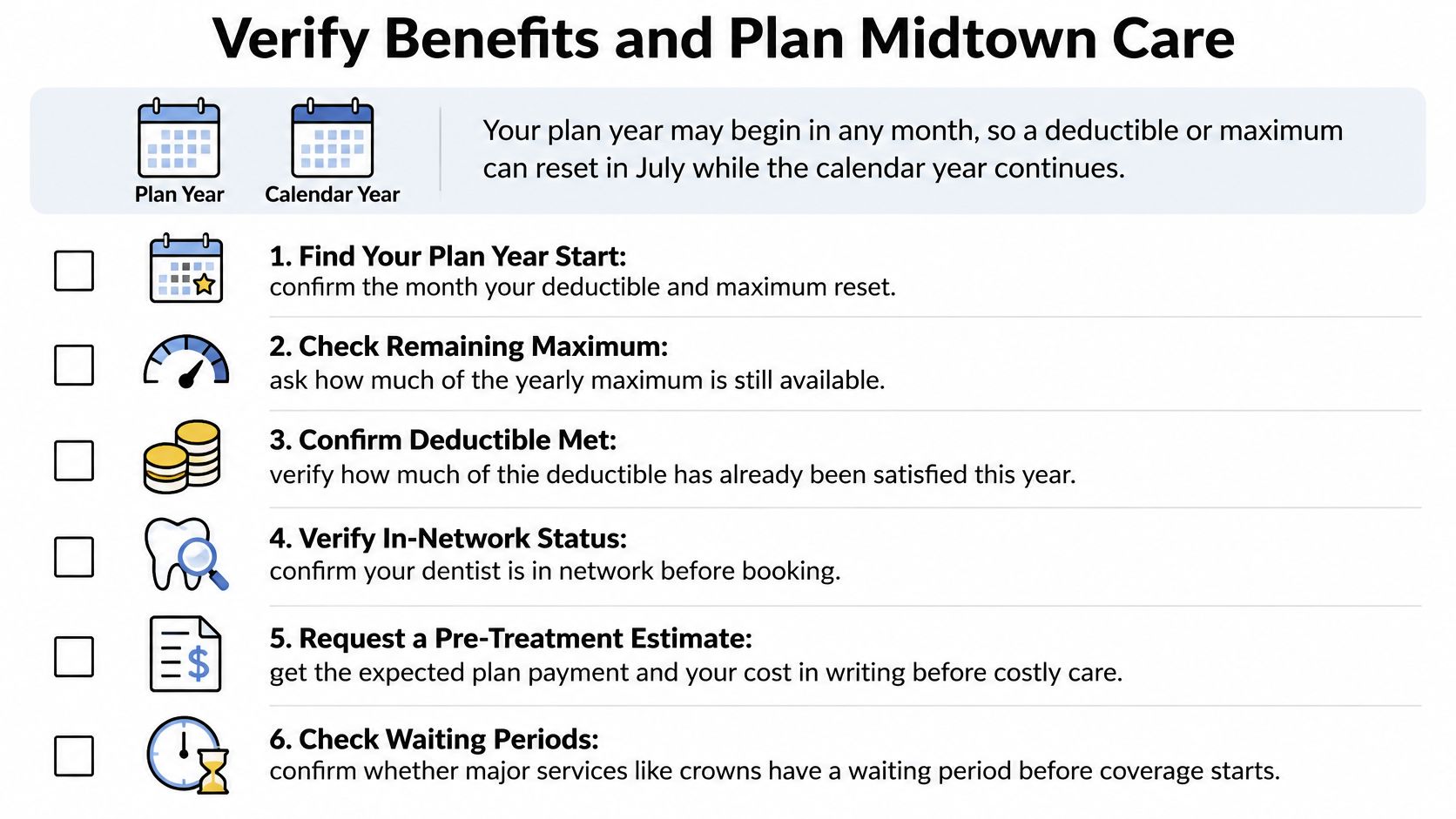
Your plan year can start in any month. A deductible or a maximum can reset in July while the calendar year keeps going. Confirm which calendar you're on before you schedule costly care.
The ACE Dental Resource guide to dental insurance describes a waiting period as a plan-defined interval during which certain services aren't yet payable. Preventive care can be available sooner than a crown, bridge, or periodontal procedure. Reaching the deductible doesn't end that wait. After the wait ends, the deductible can still apply.
- Confirm active coverage, the effective date, and any waiting period for that service.
- If you hold two plans, ask which is primary and whether the secondary honors the first deductible.
- Request the remaining deductible, the maximum balance, and the benefit-year end date.
- For a crown, implant, or periodontal surgery, ask for a written predetermination with the allowed fee, coverage percentage, exclusions, and expected patient share.
- Set that share next to the remaining maximum so you can see whether plan money runs out this year.
- Ask for a recheck if the treatment plan changes.
For day-to-day habits, schedule covered preventive visits early in the plan year. Keep one in-network office so the family's claims stay in one history. If you're coming from Hudson Yards, Hell's Kitchen, or the Theatre District, bundle appointments on one trip. If you change jobs around Wall Street, Tribeca, or SoHo, write down the date. Plans with no wait on major care are covered in this note on dental insurance without a waiting period.
Never delay urgent care, a fracture, an infection, or sudden pain, to wait for a benefit reset. Bring your plan name, member ID, and group number to Paul L. Gregory, DDS, at 57 W 57th St near Columbus Circle, and the team can run this check with you.
Paul L. Gregory, DDS helps Manhattan patients sort deductibles, remaining annual maximums, and written estimates before restorative or preventive visits. The Midtown office at 57 W 57th St reviews coverage and expected patient responsibility so a surprise bill is less likely. Visit Paul L. Gregory, DDS to book a benefits check or a short-notice visit.