

Can you get a dental implant if you have gum disease? Many patients hear a quick yes and stop asking questions. The yes is accurate and incomplete, because the decision that shapes the next twenty years isn't whether an implant is allowed. It's whether your gums were stabilized first, and whether anyone keeps checking them after the crown goes on.
Gum disease is far more common than most patients assume. The World Health Organization estimates that severe periodontal disease affects more than 1 billion people worldwide, according to a global burden analysis published in Oral Diseases. Plenty of those people are missing teeth, and plenty of them are still reasonable implant candidates.
The confusion starts with how implant treatment gets described. It's sold as a replacement tooth: pick a shade, book the surgery, chew again. In reality an implant is a titanium root placed into living tissue, and that tissue carries the history of everything that has already happened in your mouth. Gum disease is the loudest part of that history.
So the useful question isn't whether implants are permitted. It's what has to happen before placement, and what has to keep happening afterward. The order matters more than the brand on the titanium.
Whether Gum Disease Rules Out a Dental Implant
Gum disease rarely rules out an implant on its own. Active gum disease postpones one. That distinction turns a yes-or-no question into a sequence with a defined starting line.
The American Academy of Periodontology lists three requirements for an ideal implant candidate: good general and oral health, enough jawbone to support the implant, and healthy gum tissue free of active periodontal disease. The logic is structural rather than bureaucratic. Periodontitis destroys the soft tissue and bone that hold teeth in place, and the same loss of support that loosened your tooth leaves an implant with less to anchor into.
That's why a patient who lost a molar to gum disease shouldn't plan on extraction and implant placement in a single sitting. The dentist checks gum inflammation, periodontal pocket depth, bone volume and daily plaque control before scheduling anything. Where bone is gone, site preservation or bone grafting comes first, and the timeline stretches to match.
The verdict by gum and bone status
| Gum and bone status | Implant decision | What must happen first |
|---|---|---|
| Healthy gums, no active disease, enough bone | Candidate for implant placement | Confirm plaque control and bone volume at consultation |
| Active periodontitis | Defer placement | Periodontal therapy and infection control first |
| Past periodontitis, now stable | Possible with monitoring | Baseline charting, smoking and diabetes review, recall plan |
| Significant bone loss after gum disease | Possible with preparation | Site preservation or bone grafting before placement |
| Uncontrolled smoking or diabetes with gum disease | Higher risk, discuss alternatives | Medical coordination; a bridge or removable option may fit better |
Bone and gum tissue don't read zip codes. A patient from the Upper West Side, a freelancer in Tribeca and someone working late in Hudson Yards all get the same three questions answered the same way, because the biology is identical whether you arrive from Chelsea or Midtown. Convenience changes where you go. It doesn't change what's possible.
The hardware side of implant dentistry has improved steadily, and titanium posts plus the guided surgical tooling used to place them are precision-manufactured medical devices. If the manufacturing end of that world interests you, you can explore medical device production solutions to see how it works. Better hardware still can't compensate for inflamed tissue.
Bring three questions to the consultation, and don't leave without answers:
- What is my periodontal status right now? Ask for your probing depths and how many sites bleed on probing.
- How much bone is left, and is it enough? Ask whether a graft would be needed and what that adds to the timeline.
- How do my smoking or diabetes numbers change the plan? Ask what would have to improve before surgery is scheduled.
If you'd rather think through candidacy before you book anything, this explanation of who is a good candidate for dental implants covers the same criteria from the patient's side of the chair.
What Gum Disease Does to Implant Survival Rates
Ask a clinician what "implant survival" means and you'll get a narrow definition: the implant is still in the jaw. Success is broader. It requires stable bone levels, quiet soft tissue, a restoration that fits and functions, and a patient who can keep the site clean. Survival gets quoted because it's easy to count. Success is what you live with.
An implant that's still in the bone has survived. An implant that's still in the bone with stable bone levels, healthy gums and a crown you can clean has succeeded. Gum disease is the factor that separates the two.
| Source | Population | Reported result | What it means for gum disease |
|---|---|---|---|
| 2024 twenty-year meta-analysis in Clinical Oral Investigations | 237 implants across three prospective studies | 92% mean survival | Two decades of follow-up still measures survival, not full tissue health |
| 2025 retrospective cohort study of 4,556 implants | 4,556 implants, mean five-year follow-up | 96.8% survival, 144 implants lost | A concrete base rate for how often implants are lost |
| Systematic review of osseointegrated implants | Pooled studies at five and ten years | 97.66% at five years, 96.94% at ten | Survival was higher in the mandible than the maxilla, where bone and access differ |
| 2025 systematic review of peri-implant disease | Patient-level data | 46% peri-implant mucositis, 21% peri-implantitis | Periodontitis, smoking, diabetes and alcohol use were significant risk indicators |
| University of Illinois College of Dentistry summary | National implant population | About 12% of implants affected by periodontal disease | Risk is higher when the replaced tooth was lost to gum disease |
Reading the numbers together
The pattern across those sources holds steady. Losing an implant is the exception. Inflammation around one is close to the norm, and the same handful of factors keep showing up behind it: a history of periodontitis, plaque the patient can't reach, smoking, poorly controlled diabetes.
That reframes what you're buying. The surgery is the durable part. The years after it are the fragile part, and they're the part you and your dentist control.
Patients from Gramercy Park, NoHo and SoHo tend to ask the same question in slightly different words: will this last? The honest answer is that the range in implant lifespan is mostly a range in hygiene and monitoring, not a range in titanium. This overview of how long dental implants last sets out what shifts a given implant toward one end of that range or the other.
How to Stabilize Gum Disease Before Implant Surgery
A history of periodontitis is a risk factor, not just a checkbox on an intake form. A systematic review and meta-analysis of prospective cohort studies found that patients with previous periodontitis had a higher risk of implant failure than those without that history: relative risk of 1.62 at follow-up of five years or less and 2.26 beyond five years. The authors rated the evidence as low certainty because randomized trials are lacking. The review also found more peri-implantitis and greater marginal bone loss among patients with a history of periodontitis.
That is why the sequence matters: stabilize gum disease before replacing a tooth, rather than placing an implant while inflammation is active.
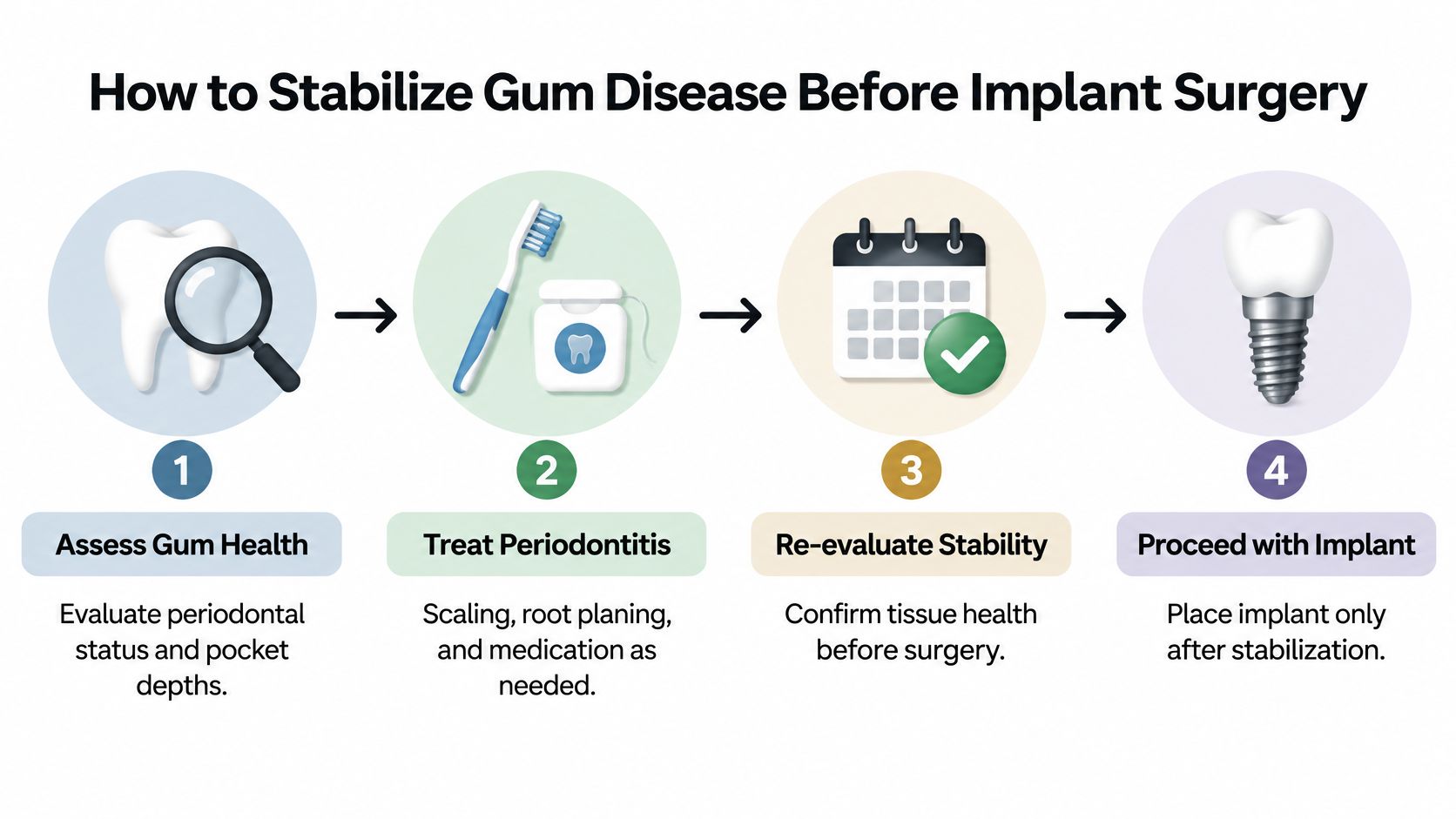
The pathway runs through seven steps, and the discipline lives in the detail behind each one.
The stabilization sequence
Record a baseline periodontal chart. Measure probing depths around each tooth and record bleeding points, recession and mobility. Without a pre-surgery baseline, a later 5 mm pocket cannot be compared reliably with its earlier condition.
Treat active pockets, then reassess. Scaling and root planing removes plaque and calculus from below the gum line. Deeper sites may need another treatment pass or a locally applied antibiotic. Reassessment matters just as much: the findings help determine whether it is appropriate to proceed.
Practice plaque control until it becomes routine. Use interdental brushes sized for each gap, thread floss under a bridge, and angle a soft toothbrush toward the gum margin. These daily habits help control the inflammation that treatment alone cannot prevent from returning.
Discuss smoking and diabetes candidly. Both affect the risk assessment. Addressing them as part of planning can help establish a safer starting point.
Document bone levels on radiographs. The pre-surgical image gives the dentist a reference for later comparisons, including years after placement.
Wait for demonstrated stability. The timing is a clinical judgment based on your charting and response to treatment, not a fixed calendar date.
Consider grafting if bone is missing, while understanding its limits. Bone grafting rebuilds anatomy. It does not remove the inflammation that contributed to bone loss, so plaque control remains part of the plan.
The part patients underestimate: grafting is a construction project. Plaque control is the maintenance contract, and that contract lasts for life.
Paul L. Gregory, DDS offers dental implants, All-on-4 dental implants, bone grafting and dentures. When periodontal therapy and implant care are coordinated, the treatment steps can follow one another without losing sight of earlier findings. That continuity helps keep the periodontal chart and the treatment plan connected.
If active disease is present, nonsurgical gum disease treatment is usually the first step. Before implant surgery, ask for a written decision to proceed, wait or consider an alternative, along with a maintenance schedule. Stabilization is not a one-time clearance. It sets the pattern for caring for the implant and the surrounding gums over the long term.
Telling Peri-Implant Mucositis From Peri-Implantitis
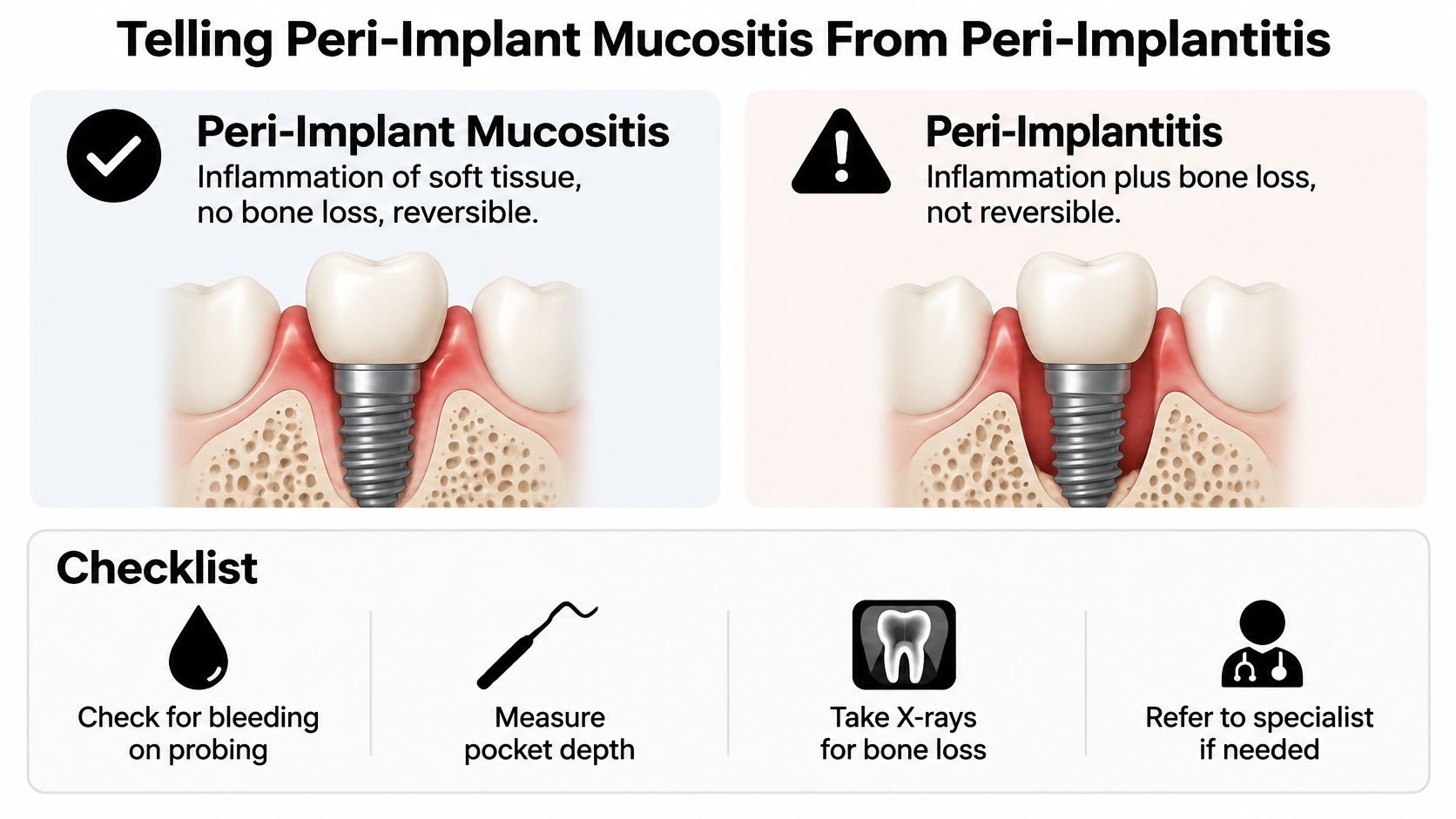
What separates a reversible gum problem from damage to the bone supporting an implant? Peri-implant mucositis is inflammation in the soft tissue around an implant without bone loss. Peri-implantitis combines inflammation with loss of supporting bone, and may require surgical treatment rather than cleaning alone.
The distinction depends on several findings together. A review of peri-implant diagnosis and management explains that bone loss on an X-ray by itself does not establish peri-implantitis. If earlier records are unavailable, a working diagnostic threshold is probing depth of at least 6 mm together with bone loss of at least 3 mm, measured from the most coronal intraosseous portion of the implant. Bleeding or pus during probing adds support to the diagnosis. The measurements work like comparison marks on a ruler: each helps put the other findings in context.
Plaque control affects the risk of inflammation and bone loss. An overcontoured crown or a shape that is difficult to clean can let plaque collect around the implant. A crown should allow access for daily cleaning, not merely look good in photographs.
Maintenance visits should check four things:
- Probing depth and bleeding points, measured at the same sites and compared with the baseline recorded after loading.
- Excess cement around cement-retained crowns. Cement left beneath the margin can keep nearby gum tissue inflamed.
- Cleanability. If floss shreds or an interdental brush cannot pass, the restoration may need adjustment; extra brushing effort cannot fix an inaccessible shape.
- Radiographs compared with the baseline, rather than interpreted alone.
A walkthrough can show how probing, radiographs and clinical findings fit together:
These checks apply wherever you live. Long-term implant care depends on watching gum tissue and bone over time, not treating the crown fitting as the finish line.
Symptoms, Causes and Fixes for Implant Gum Problems
The most common complaint is the mildest one. The gum around the implant looks a little red, and a trace of blood shows on the brush. That's usually the moment the problem is easiest to fix and the moment people decide it's nothing.
| Symptom | Likely cause | Action | Urgency |
|---|---|---|---|
| Red, tender gums that bleed when brushing | Early peri-implant mucositis from plaque | Professional cleaning and improved home care, then reassessment | Book soon; usually reversible |
| Bleeding or pus on probing with deepening pockets | Peri-implantitis with bone loss | Reassessment, surface decontamination, possibly surgery | Urgent, before bone loss advances |
| Food trapping under the crown or floss that shreds | Overcontoured or inaccessible restoration | Adjust or replace the restoration to allow cleaning | Schedule at next visit |
| Painless gum recession or a loose-feeling implant | Progressive bone loss without pain | Probing and radiographic evaluation | Urgent |
| Worsening gums after smoking resumes or uncontrolled diabetes | Systemic and behavioral risk | Coordinate risk-factor control with the dentist and physician | Ongoing, review each visit |
Which fixes take days and which take months
Read down the urgency column before the action column. A cleaning plus a coaching session changes the tissue in a few weeks, and most early inflammation settles once the plaque that fed it is gone. Surgical therapy runs on a different clock, because the bone has to heal after the procedure, and the site has to be left alone long enough to do so.
That timing difference is why the second row earns its urgency label. Waiting on a deepening pocket doesn't buy you time; it spends bone you can't get back without a graft.
Whether you're squeezing in an appointment from Hell's Kitchen between shifts, coming from the Theatre District after a show, or crossing from Wall Street on a lunch break, the symptom table reads the same way. Match the symptom, then respect the urgency.
Keeping Implant Gums Healthy After the Crown Is Fitted
Fitting the crown is the midpoint, not the finish line. The American Academy of Periodontology explains why: bacteria collect below the gum line at the base of the implant, where they inflame the surrounding tissue and, if the inflammation persists, damage the bone holding the implant. The early warning signs look like ordinary gum trouble, red or tender tissue around the implant and bleeding while brushing, which is exactly why they get dismissed as nothing.
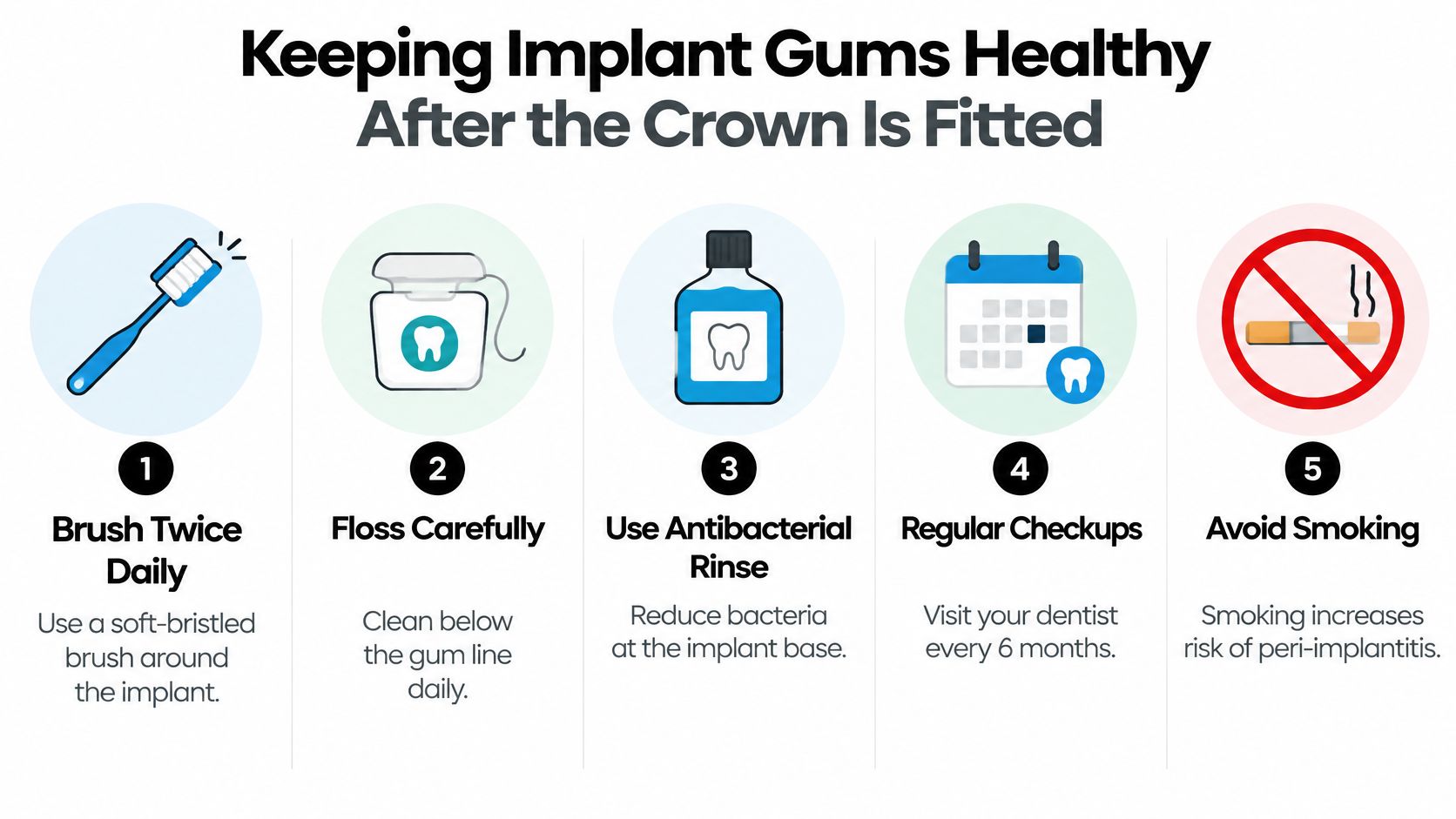
The home routine that keeps those tissues quiet takes about two minutes a day.
What the daily routine actually looks like
- Brush twice a day with a soft brush, angling the bristles into the margin where the crown meets the gum rather than scrubbing the flat of the crown.
- Clean between the implant and its neighbors every day, with an interdental brush sized to that specific gap or floss threaded under a bridge.
- Use an antibacterial rinse if your dentist recommends one for a set period, never as a substitute for the mechanical cleaning that removes the plaque.
- Keep your recall interval, which is shorter for anyone whose history includes periodontitis, smoking or diabetes, and longer for patients with easy access and clean charts.
The professional side matters just as much. At each visit the clinician probes the same sites and compares radiographs with the baseline taken after loading, so a change shows up as a number before it shows up as a symptom. One patient here described Dr. Gregory walking them through how to better care for an implant they'd had done years earlier, and said they'd highly recommend him for it. That's the standard: a home-care plan explained clearly enough that it still works years later.
The same follow-up principle holds near Central Park South, in the East Village or out toward Tribeca. Detailed guidance on how to clean dental implants covers the tools and angles in more depth than a single visit can.
Confirm Your Gum Status Before Booking Implant Surgery
One action makes the rest of this manageable: request a periodontal evaluation before any implant surgery is booked, and ask for the findings in writing. Not a verbal "you're fine," but pocket depths, bone status and a decision.
Bring these to the first visit, and the conversation gets specific fast:
- Your most recent periodontal chart, if any dentist has ever probed your gums.
- Recent dental X-rays, so bone levels can be compared rather than guessed.
- A medication list, since some drugs affect bleeding, healing and gum tissue.
- Current smoking status and diabetes control, including your most recent HbA1c if you have it.
- Records of past gum treatment or extractions, which tell the dentist where and why you lost teeth.
A good answer has three parts. A clear statement of gum status. A go, wait or alternative decision. And a named plan for who monitors the implant afterward, at what interval, measured against which baseline. If any of those is missing, you don't have a plan yet.
If you're still deciding who should run that evaluation, this guide to finding a dentist for gum disease covers what to ask and what a thorough periodontal workup includes.
Paul L. Gregory, DDS, at 57 W 57th St near Central Park South and Columbus Circle, sees Midtown patients along with people traveling from the Upper West Side, Upper East Side, Turtle Bay, the West Village and beyond. One patient who has been coming for thirty years put it this way: Dr. Gregory does everything he can to preserve natural teeth, and has helped with crowns, root canals, fillings, implants and even closing a gap between front teeth. That instinct to preserve before replacing is the right frame for this decision.
Schedule the periodontal evaluation this week, before anything else gets booked.
Gum disease and dental implants work out well together when the gums are stabilized first and monitored afterward, and that's the order Paul L. Gregory, DDS follows at 57 W 57th St, with periodontal therapy, bone grafting and implant dentistry in one Midtown office. If you've been told you need an implant but nobody has measured your pockets, start with the evaluation and get a written go, wait or alternative decision before scheduling surgery. Visit Paul L. Gregory, DDS to arrange your periodontal evaluation.