

The full cost of Invisalign includes more than the advertised treatment fee. Budget for diagnosis, active treatment, any needed refinements, and retainers, then subtract the amount your insurer pays and account for any financing charges.
Your quote depends on the case, treatment length, number of aligners, refinements, retainers, diagnostic records, and the dentist's fees. Compare estimates by checking which parts of care each includes, not by headline price alone.
What Invisalign Costs in NYC Right Now
A useful starting range for NYC Invisalign treatment is $5,200–$10,500 before insurance. Broader New York estimates are $4,700–$9,500, according to Check Dental Cost's New York pricing guide. These figures offer a budgeting reference, not a guaranteed fee for a particular Manhattan case.
Invisalign cost benchmarks for NYC and nearby
The local estimates help frame the treatment fee. Insurance limits and monthly payments affect what you may ultimately pay, but depend on your policy and financing terms.
| Benchmark | Range or average | What it covers |
|---|---|---|
| NYC market estimate | $5,200–$10,500 | Treatment estimates before insurance |
| Broader New York estimate | $4,700–$9,500 | Treatment estimates before insurance |
| Orthodontic insurance maximum | $1,500–$3,000 | Typical lifetime cap, rather than an uncapped percentage of the fee |
| Monthly financing payment | $150–$300 | Illustrative payments that vary with balance, term, credit arrangement, and down payment |
The insurance maximum is not the same as a guaranteed benefit. Your plan may cover less, and its rules determine whether Invisalign qualifies. Monthly payments also do not show the total cost unless you know the financed balance and repayment terms.
Invisalign has no single universal price because individual dentists set fees. A local estimate can differ from a broader state range, and neither figure identifies the exact treatment package or clinical work included.
Place your case before comparing prices
A limited correction may fall below the NYC estimate, while a case involving more extensive movement or bite correction may reach or exceed its upper end. For another example of how a practice presents treatment budgeting, see Invisalign estimates at Amanda Family Dental. Use that estimate as a comparison point, not as a quote for your case.
Ask whether the price includes scans, office visits, refinements, and retainers. Without that breakdown, two headline fees may cover different services, making the lower figure a poor basis for comparison.
What Changes Your Price From One Case to the Next
Case complexity is the main clinical cost driver. A fresh coat of paint and a full gut renovation of the same room both count as redecorating, but they require very different work. Straightening slightly shifted teeth and correcting a complicated bite can differ just as substantially.
NewMouth's clear-aligner cost guide explains that limited corrections generally require fewer aligners and monitoring visits, while more extensive treatment may involve attachments, interproximal reduction, elastics, bite correction, refinements, and longer retention follow-up. Those differences matter more than whether two advertisements use the same product name.
The work behind the aligners
- Tooth movement and bite correction. Moving visible front teeth isn't necessarily the whole treatment. The dentist also needs to assess how the upper and lower teeth meet.
- Aligner count. A longer sequence of planned movements can require more trays. Ask whether the quoted package accommodates the full proposed sequence.
- Treatment length. More time can mean additional monitoring and opportunities to reassess movement. Duration and tray count are related, but they aren't interchangeable measures.
- Refinement planning. Additional aligners may be needed to fine-tune the result. Their financial effect depends on what the agreement includes.
If your concern is bite-related, our explanation of whether Invisalign can fix an overbite in adults can help you prepare more focused consultation questions. Don't classify your own case as minor solely because only a few teeth look uneven.
Separate setup costs from treatment scope
Diagnostic records and digital scans are planning costs that may appear inside the treatment fee or as separate charges. Their inclusion can make otherwise similar quotes look different before treatment even begins.
Midtown operating overhead also influences fees, but each practice sets its own charges. You can receive different estimates for the same clinical problem without either estimate necessarily being misleading.
A useful way to compare clear aligner treatment prices through The Dental Retreat's guide is to separate the proposed treatment from the payment presentation. A low starting price deserves scrutiny if refinements or retainers sit outside it.
Bring these questions to your consultation:
- Case type. Is my treatment limited correction or full treatment, and why?
- Included services. What clinical work and follow-up does this quote cover?
- Planned sequence. How many aligners and refinement stages are anticipated, and what happens if the plan changes?
How Insurance and Financing Lower Your Real Cost
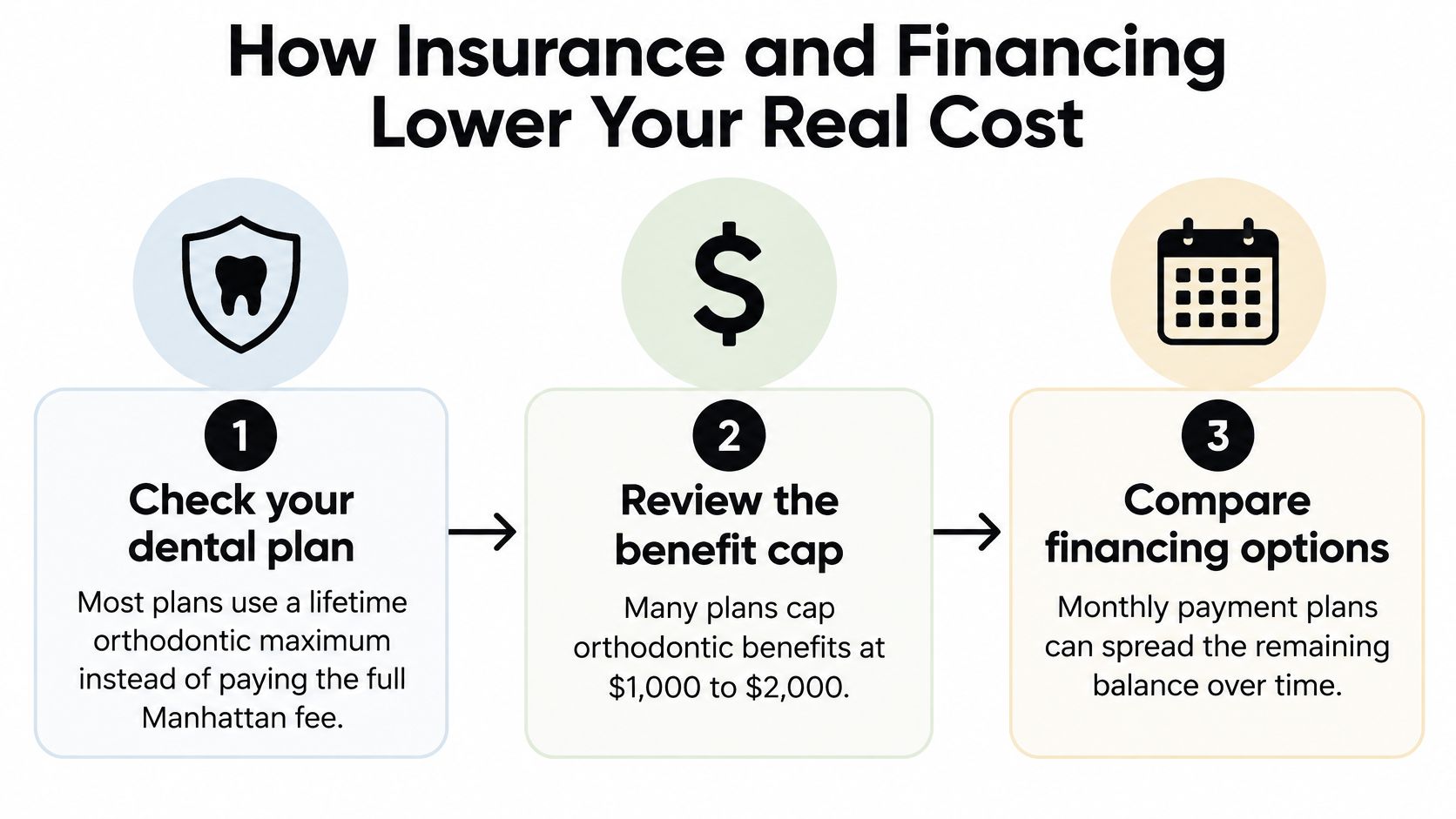
Insurance reduces your treatment responsibility only to the extent that your policy covers the proposed care. A percentage benefit can sound generous while producing a much smaller contribution once the insurer applies the remaining lifetime orthodontic maximum.
Mordor Intelligence's invisible-orthodontics market discussion describes many supplemental plans with orthodontic lifetime maximums of approximately $1,000–$2,000 and published New York payment plans of approximately $150–$300 per month. Those payments depend on the financed balance, repayment term, credit arrangement, and required down payment, rather than representing a standard treatment discount.
The process starts with benefit verification, not a financing application.
Calculate the benefit before the payment
The basic calculation is:
Contracted treatment fee minus the lesser of the eligible percentage benefit or the remaining lifetime maximum.
Deductibles, age restrictions, waiting periods, in-network rules, and excluded services can change the result. If previous orthodontic treatment used part of your lifetime benefit, don't budget against the original maximum.
Net balance under a lifetime orthodontic benefit
These are hypothetical calculations using the planning fees and benefit caps identified above. They assume the stated benefit is fully available and payable, without deductibles, exclusions, financing charges, or additional services.
| Total fee | Orthodontic benefit | Balance before deductibles |
|---|---|---|
| $5,200 (low NYC planning estimate) | $1,500 | $3,700 |
| $7,000 (illustrative mid-range fee) | $1,500 | $5,500 |
| $10,500 (high NYC planning estimate) | $1,500 | $9,000 |
| $7,000 (illustrative mid-range fee) | $3,000 (top of typical maximum) | $4,000 |
The important distinction is between available coverage and expected reimbursement. Adult eligibility isn't automatic, and a policy may classify aligners differently from braces or exclude refinements and retainers.
Verify before you sign
- Request a written predetermination. Have the insurer assess the proposed treatment rather than relying only on a general benefits summary.
- Confirm the financial rules. Check the remaining maximum, deductible, coinsurance, waiting period, and adult eligibility.
- Identify retention coverage. Establish whether retainers are eligible and whether their cost is part of the treatment agreement.
- Compare the uncovered balance with financing. Review the down payment, interest, total repayment amount, and any promotional conditions.
Our practice assists with insurance questions and claim submissions. Our guide to dental insurance and payment plans provides a starting point for that conversation.
Eligible FSA or HSA funds may help you pay qualifying expenses with tax-advantaged money, subject to your account's rules. They're your funds, not an additional insurer contribution, so don't subtract them twice when calculating affordability.
For a payment-focused comparison outside New York, Ultra Smile DentalSpa's guide to budgeting for a straighter Miami smile offers another framework for evaluating installments. Compare the financing terms, not the cities' treatment fees.
Verify What Your Quote Actually Includes
Excluded refinements and retention are potential add-on costs to clarify before signing. A quote for the initial aligner course isn't necessarily a quote for the complete treatment episode.
Published prices often leave the scope unclear. That makes an office-based plan difficult to compare with a lower-priced remote plan unless you identify who provides monitoring, how revisions are handled, and what happens when treatment doesn't proceed exactly as planned.
Use the following visual as a starting checklist, then obtain the office's written terms.
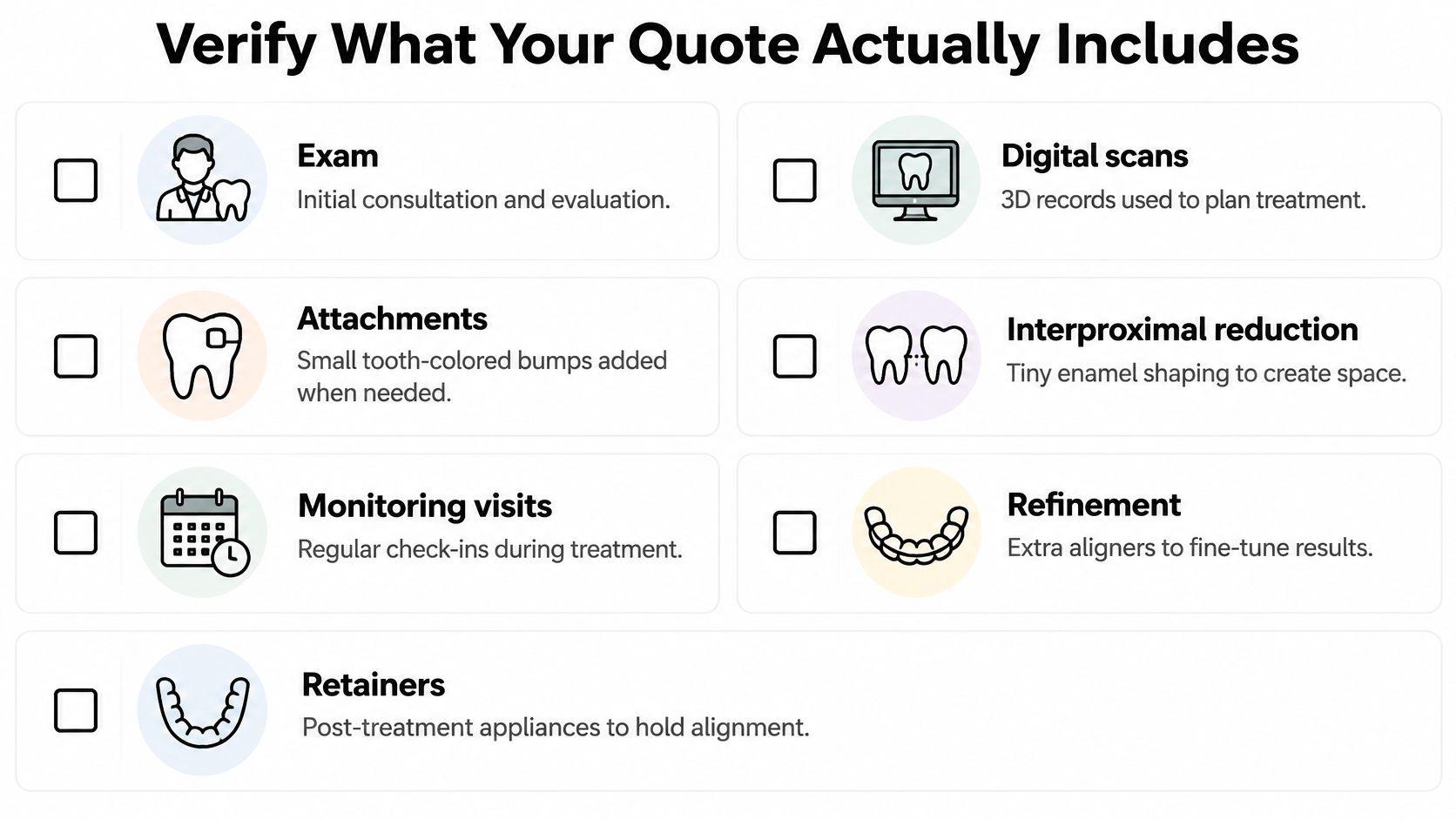
Quote items that change the total Invisalign price
| Quote item | Why it changes the price | Question to ask |
|---|---|---|
| Diagnostic records and digital scans | Needed before aligners are made | Is the scan fee included in the quote? |
| Attachments | Small bonded bumps help aligners grip teeth | How many are included, and is replacement covered? |
| Interproximal reduction | Enamel shaping between teeth creates space | Is it in the quoted fee? |
| Elastics | Additional appliances support bite correction | Are they priced separately? |
| Refinement trays | Additional aligner sets fine-tune the initial course | How many refinements are included? |
| Monitoring visits | In-person checks require clinical time | How many visits are included, and what if I miss one? |
| Replacement trays | Lost or broken aligners may require replacement | What does a replacement tray cost? |
| Retainers | Post-treatment appliances maintain alignment | Is the retainer included, and what does a replacement cost? |
Account for disruption as well as invoices
For a busy Manhattan professional, an extra appointment can also mean time away from work. A lost aligner can create both a replacement charge and an unplanned visit, so ask how the office handles these situations before they occur.
Convenience and adherence belong in the financial conversation because a plan must fit your routine to be workable. Don't interpret a low advertised price as proof that treatment will be easier to complete.
Your insurance network status is another separate question. Our explanation of in-network versus out-of-network dental care can help you distinguish the office's fee from the amount your plan recognizes.
Request an itemized estimate separating the diagnostic fee from the full episode-of-care price, with replacement aligner and replacement retainer charges stated explicitly.
Keep that estimate with your treatment agreement. If an inclusion is important to your decision, it should appear in writing rather than remain an assumption from the consultation.
Invisalign Versus Traditional Braces in New York
Clear aligners aren't automatically cheaper than braces. In a 2025 survey of treating clinicians, 53.5% considered Invisalign treatment priced the same as or less than braces, according to Invisalign's affordability guide. That was provider-reported information and excluded retention, so it doesn't establish which option will cost less for your case.
The comparison requires matching treatment goals and included services. Otherwise, you could be comparing full bite correction with a more limited cosmetic plan.
Compare the demands of each option
- Clinical suitability. Ask which appliance the dentist recommends for your particular tooth movements and bite, rather than choosing from price alone.
- Treatment sequence. For Invisalign, examine the anticipated aligner course and refinement arrangements. For braces, discuss adjustment visits and the expected treatment course.
- Daily routine. Removable aligners require you to manage wear and storage consistently. Consider whether that responsibility fits your working day.
- Appointment access. Compare the proposed monitoring schedules against your commute, travel, and ability to attend during office hours.
- Retention. Require each estimate to identify the post-treatment appliances and follow-up, so neither option appears cheaper because retention was omitted.
Convenience deserves more attention than it often receives. A scoping review indexed in PubMed found that only 3.6% of included studies addressed convenience and 3.6% addressed adherence, underscoring how little those practical concerns appear in the published comparisons.
That finding doesn't tell you which appliance is easier for you. It tells you not to assume a clinical comparison has fully measured the scheduling and daily-management issues that affect your decision.
Obtain comparable treatment proposals
Our practice offers Invisalign and clear braces for teens and adults, alongside dental cleanings and mouth guards. That allows you to discuss both orthodontic approaches within the same consultation framework.
Our guide to clear aligners versus braces can help you prepare for the appliance discussion. The financial conclusion is straightforward: request equally itemized proposals and choose using total episode-of-care cost, clinical suitability, and the visit schedule, not the starting fee.
How Your Manhattan Neighborhood Fits Into Pricing
Manhattan neighborhood names describe where you live or work, not a regulated orthodontic price zone. New York City's neighborhood materials provide a geographic framework within a city organized into 59 community districts, while recognizing that neighborhood names don't always have fixed boundaries.
The neighborhood illustration below is location context, not evidence of dental prices. Its apartment-rent labels shouldn't be used to estimate Invisalign fees.
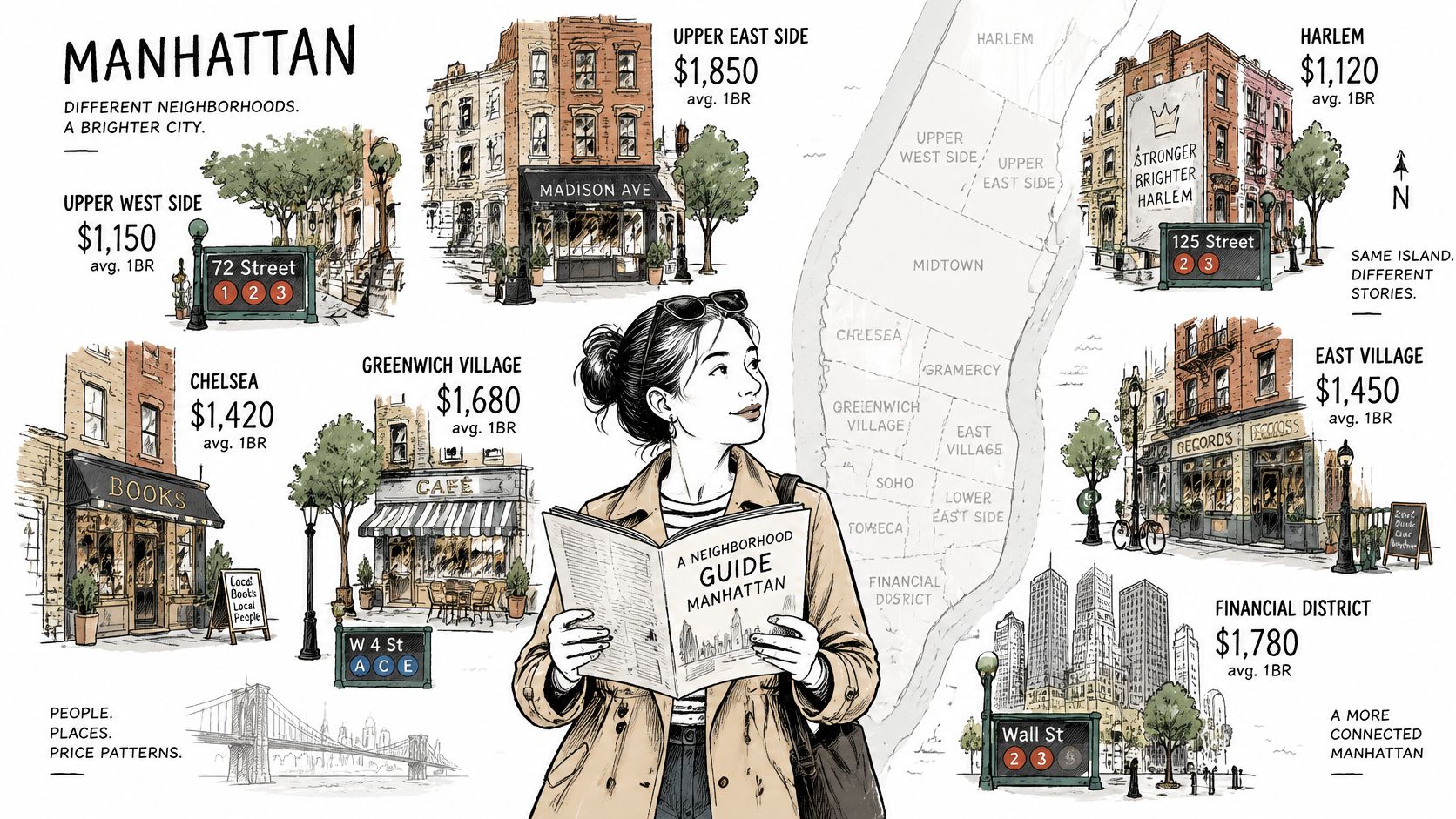
Community board lookup for Manhattan neighborhoods
The district descriptions from Manhattan Community Board 1, Community Board 2, and Community Board 4 help distinguish official districts from overlapping local labels.
| Community board | Neighborhoods covered |
|---|---|
| CB1 | Tribeca, Financial District, Wall Street area, Battery Park City, Civic Center, Seaport |
| CB2 | Greenwich Village, West Village, SoHo, NoHo, parts of Chinatown, Hudson Square, Little Italy |
| CB3 | East Village and parts of Chinatown |
| CB4 | Midtown West areas including Chelsea, Hell's Kitchen, Theatre District, and Hudson Yards |
| CB7 | Upper West Side and Lincoln Square |
| CB8 | Upper East Side and Lenox Hill; Turtle Bay is nearby, not part of CB8 |
Turtle Bay should not be treated as a CB8 neighborhood. Likewise, Wall Street is a location within the Financial District, not a separate pricing district, and Chinatown spans more than one community-board area.
Searches sometimes use spellings such as helsea, Lennox Hill, Hells Kitchen, Grammercy Park, NOHO, and Soho. The conventional neighborhood names are Chelsea, Lenox Hill, Hell's Kitchen, Gramercy Park, NoHo, and SoHo; none establishes a standard treatment fee.
Choose a repeatable journey
Our office is at 57 W 57th Street, Manhattan, NY 10019, convenient to Midtown workplaces. The practical question is whether you can reach the office consistently, not whether your home and dentist share a neighborhood label.
For location planning, see our guide to choosing a Midtown Manhattan dentist. Consider the journey from work as well as from home.
The following video provides an additional viewing resource.
Our service area includes New York City, Long Island City, Astoria, Queens, Brooklyn, The Bronx, Staten Island, Hoboken, Jersey City, Weehawken, and Fort Lee. For patients traveling across borough or state lines, a manageable appointment journey belongs alongside the written estimate in the decision.
Book an In-Office Estimate Before You Commit
Call Paul L. Gregory, DDS at (212) 826-0505 to arrange an in-office estimate at 57 W 57th Street, Manhattan, NY 10019, near Central Park South and Columbus Circle. Bring your goals and insurance information so the conversation can move from a market range to a treatment proposal that applies to you.
Our practice uses digital, impression-free scanning rather than traditional molds for digital models. The consultation provides an opportunity to review your alignment, discuss the proposed approach, and understand the scope behind the written estimate.
A scan supports planning, but it isn't a promise of an exact result or price before the dentist evaluates your case. You should leave understanding what the dentist recommends, what remains uncertain, and which financial assumptions need confirmation.
Prepare for a useful consultation
- Call to arrange the visit. Explain that you're seeking an Invisalign assessment and written estimate. If work limits your availability, ask about short-notice openings and special Wednesday or Friday appointments.
- Bring insurance details and previous X-rays. Have your member information available, and arrange access to prior records if you have them. The dentist can decide whether those records are sufficient or additional imaging is needed.
- Request the written proposal and benefit review. Obtain an itemized estimate, request insurer predetermination where applicable, and compare the expected net balance with available financing before authorizing treatment.
Our practice assists with most insurance plans and claim submissions. That support helps organize the process, but the insurer's coverage decision remains separate from the dentist's clinical recommendation.
Make clarity part of the decision
If you feel anxious about dental treatment, say so when scheduling. You don't need to arrive knowing which appliance you want or understanding every insurance term.
“Dr. Gregory took the time to explain everything clearly, answered all of my questions, and made sure I felt comfortable throughout the entire visit.”
Drew, practice reviews page
Use the consultation to test whether you understand the proposal well enough to make a decision. Ask for clarification whenever a charge, treatment stage, or coverage assumption is unclear.
A responsible commitment starts with a suitable treatment plan and a readable estimate, not a monthly payment selected before the scope is known. Call the office to request that assessment before committing to treatment.
At Paul L. Gregory, DDS, we offer Invisalign and clear braces with digital diagnostics and a written treatment-cost discussion. Call (212) 826-0505 to request an in-office estimate and review your treatment options, expected insurance contribution, and payment arrangements before you begin.