

If you can leave surgery with fixed teeth, does that mean your mouth has already healed? That's the central misunderstanding in All-on-4 dental implant recovery: being able to smile, speak, and eat carefully isn't the same as having fully integrated implants.
Recovery has several milestones, and each requires different care from you. Early on, you'll manage swelling and protect the surgical sites. Later, your dentist will check the bridge, bite, and supporting tissues. The first year is a monitoring window, not just the time after your new teeth arrive.
All-on-4 Recovery Timeline at a Glance
Many appropriately selected patients receive a fixed provisional arch on surgery day or shortly afterward. A systematic review of All-on-4 treatment documented 1,201 prostheses delivered within 48 hours, but also found that 74% of recorded implant failures occurred within the first 12 months.
That distinction matters when you plan time off, meals, and appointments. The table is a planning framework, not permission to advance your diet or activity without clearance.
All-on-4 recovery timeline by phase
| Phase | Timing | Milestone | Your Focus |
|---|---|---|---|
| Surgery day | Day of surgery | Provisional fixed arch placed in suitable cases | Rest, ice, soft liquids |
| Early swelling | Days 1-3 | Swelling and soreness peak, then ease | Prescribed pain relief, head elevated |
| First week | Days 4-7 | Post-operative review, sutures checked | Light walking, soft foods |
| Weeks 2-4 | Days 14-28 | Swelling settles, many return to desk work | Soft diet, gentle cleaning |
| Months 1-3 | First three months | Healing checkpoint, most early complications appear | Clinical check of bite and bridge fit |
| Months 3-6 | Months 3-6 | Bone bonds to implants, final prosthesis prepared | Gradual return to firmer foods as cleared |
| Month 6 onward | About six months | Final restoration fitted when healing permits | Maintenance visits and daily cleaning |
| Year one | Months 6-12 | Monitoring continues | Regular check-ins with your dentist |
Use milestones, not just dates
The early phase centers on comfort and wound protection. As the swelling settles, your priorities shift toward cleaning access, comfortable speech, and avoiding excessive chewing pressure. Feeling better is useful information, but it doesn't tell you whether the bone has finished healing.
The definitive bridge appointment also requires more than reaching a calendar date. Your dentist needs to confirm tissue health, implant stability, bite, and readiness for the planned restoration. Our guide to the dental implant healing process explains how these stages fit together.
Planning rule: Keep follow-up appointments even when you feel comfortable. You can't assess everything happening beneath the gums at home.
Bone quality, smoking, oral hygiene, existing infection, general health, and extractions can change the pace. A straightforward recovery and a more complex surgical plan shouldn't be expected to follow identical schedules.
Why a Same-Day Bridge Does Not Mean Healed
Think of fresh concrete: being ready for limited use isn't the same as reaching its final strength. The comparison isn't exact, but it helps separate early function from biological healing.
The illustration shows those distinct processes.
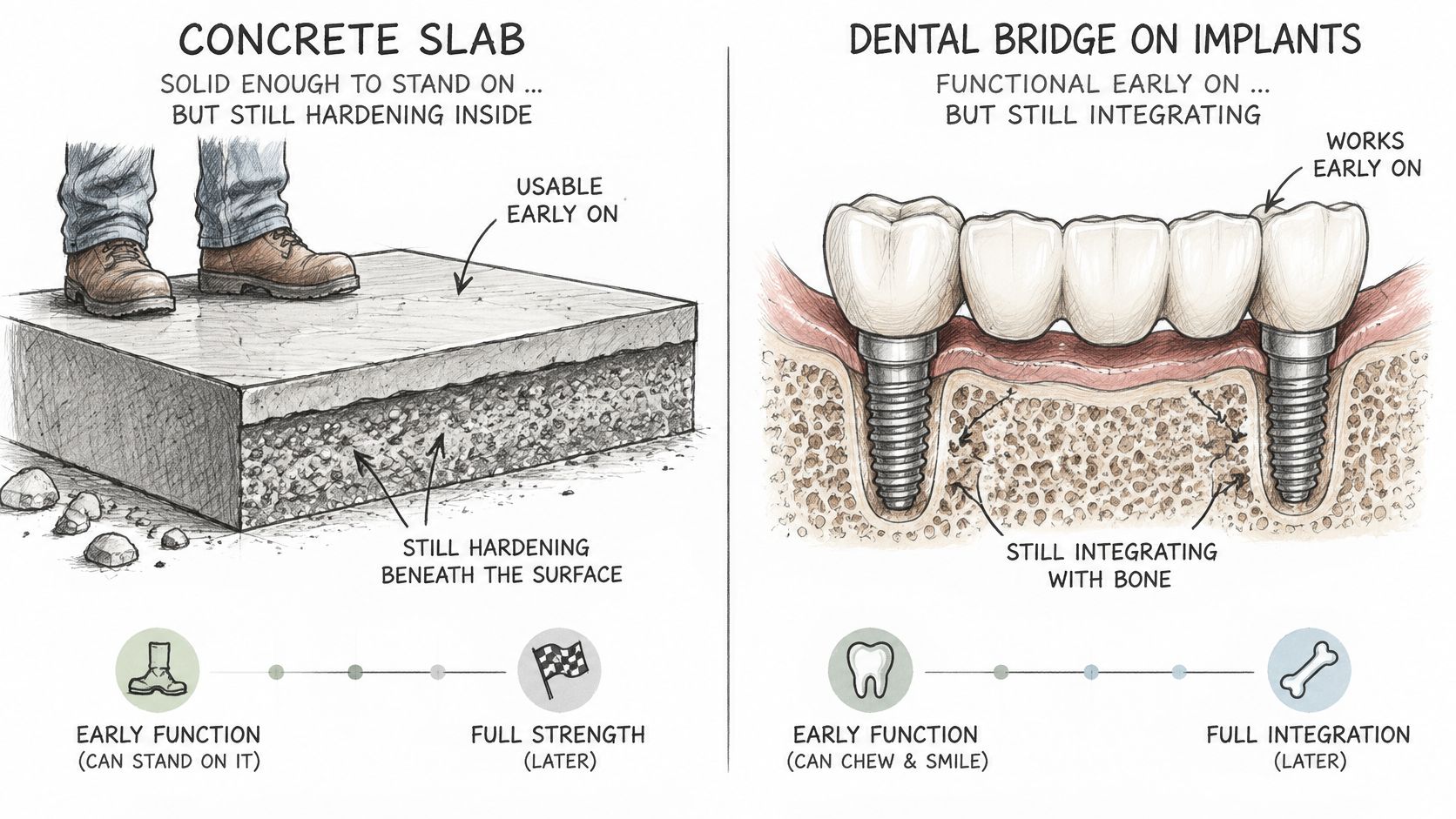
An implant initially relies on its mechanical grip in the bone. During osseointegration, living bone develops a stable connection with the implant surface. Your provisional bridge provides appearance and carefully controlled function while that slower process continues.
Immediate loading isn't automatic. An All-on-4 review discussing the AWMF S3 guideline cites approximately 30-50 Ncm of insertion torque before immediate loading is considered and describes definitive prosthetic treatment as generally postponed for approximately six months.
Stability determines the next step
Insertion torque measures resistance during implant placement. It helps the clinician judge initial stability, but it isn't something you can estimate by biting down or checking whether the bridge feels firm.
If the implants don't achieve suitable stability, the dentist may delay loading or change the treatment strategy. Small movements at the implant-bone interface can interfere with integration, so a different schedule can be a protective decision rather than a setback.
This creates a protected-healing phase. The bridge is fixed, but hard foods, sticky foods, aggressive cleaning, and testing your bite can still create problems. The dental implant procedure includes both the surgical and restorative decisions that determine these restrictions.
The video provides another visual explanation of implant treatment.
Early review gives the team an opportunity to identify pressure points, fit problems, and tissue concerns before they worsen. Don't treat the final bridge appointment as your next necessary contact.
Your temporary bridge helps you live during healing. It doesn't certify that healing is complete.
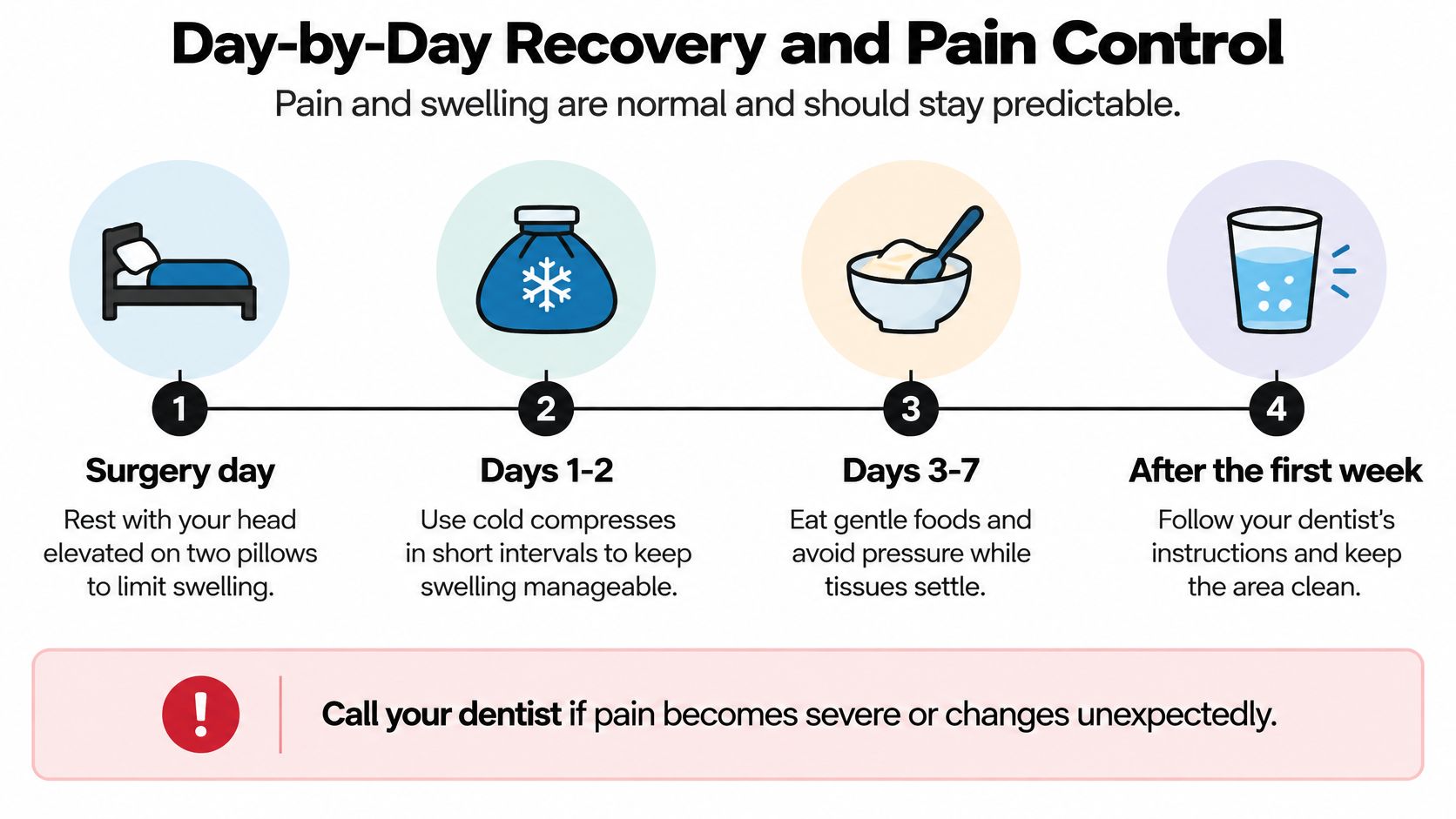
Day-by-Day Recovery and Pain Control
Some soreness, swelling, bruising, and light oozing are expected after full-arch surgery. What matters is the pattern: symptoms should remain manageable and eventually improve, rather than becoming progressively more severe.
Your surgical team's written instructions take priority over a general routine, particularly if you've had extractions, bone grafting, or changes to your usual medicines. Keep those instructions beside your medication schedule and the office's contact details.
A practical routine for the first week
Surgery day, prepare for rest.
Support your head on two pillows or use a reclined position that keeps it comfortably raised. Sip cool liquids from a cup without a straw, and take the prescribed analgesic according to your team's schedule rather than waiting for pain to build. Don't add extra doses or combine pain medicines without checking their ingredients and your instructions.Night one, protect the surgical sites.
Sleep with your head above your heart. If your team has placed gauze, use gentle, steady biting pressure as instructed, but remove it before sleeping. Avoid vigorous rinsing and forceful spitting, which can disturb healing extraction sites.Day two, establish a simple care rhythm.
Begin any prescribed rinse at the time your team specifies. Plan three soft meals so medication, hydration, and nutrition don't become an afterthought. If your surgeon recommends cold therapy, wrap the pack in cloth and use it for 20 minutes on and 20 minutes off while awake during the first 48 hours, rather than applying ice directly to your skin.Day three, watch the direction of change.
Swelling can be most noticeable around day two or three. Add gentle walking if you feel steady, but don't use a burst of energy as a reason to exercise hard. Once permitted, clean the accessible bridge surfaces with a soft toothbrush, keeping pressure away from tender incisions and stitches.Days four and five, reassess work and medication needs.
Desk work may be reasonable if you're comfortable, rested, and not taking medicine that affects alertness. Reduce pain medication only according to the prescribed plan as symptoms ease. A physically demanding shift requires a separate discussion, even if answering emails feels easy.Days six and seven, attend the planned review.
The team can assess sutures, soft tissues, bite, and bridge fit. Bring a written list of concerns, including rubbing, food trapping, speech changes, or a spot that feels higher when you close. Don't try to adjust the bridge yourself.
Keep the basic priorities visible during recovery.
What normal improvement can look like
Bruising may spread along the cheek or jaw before fading through yellow and green. Saliva can look pink from a small amount of bleeding, and your tongue may need time to adjust to the bridge's contours. These changes should be interpreted alongside your overall comfort and the instructions you received.
Avoid smoking and vaping during healing. Don't use straws or eat very hot foods while the surgical sites are vulnerable, and don't probe around stitches with your tongue, fingernail, or cleaning tools.
If extractions were part of your procedure, our tooth extraction aftercare instructions provide additional guidance on protecting those sites.
Pain that worsens after day three, instead of gradually improving, deserves a call to the office.
Don't keep increasing medication to cover an unexpected change. Contact the team if pain becomes severe, your prescribed medicine isn't controlling it, or you develop a concerning reaction. Trouble breathing or swallowing requires emergency medical care.
Eating, Speaking and Working Through Recovery
Eating and speaking may be more disruptive than ordinary desk work. In a prospective study of 50 patients receiving immediate full-arch provisional restorations, average impairment was 1.1 out of 10 for everyday life and work, compared with 2.2 for eating and 1.9 for speech.
Those averages aren't a prediction for your particular job or surgery. They do explain why someone might feel ready to answer emails while still finding lunch or a client presentation awkward.
Build meals around texture and nutrition
Use these stages as meal-planning options, not automatic clearance to chew more firmly.
- Days 0-3: Choose smooth broth, yogurt, seed-free smoothies sipped from a cup, mashed potatoes, and soft eggs when permitted. Keep foods cool or lukewarm rather than hot.
- Weeks 1-4: Add soft pasta, flaked fish, scrambled eggs, blended soups, oatmeal, and ripe bananas. Small portions are easier to manage than a large mouthful.
- Weeks 4-12: If cleared, consider tender cooked vegetables, moist soft meat, rice, and cooked fruit. Follow your dentist's instructions about chewing distribution. A full-arch bridge doesn't necessarily have an unaffected side.
- After clearance: Reintroduce approved foods gradually. Nuts, popcorn, hard candy, ice, and sticky caramel deserve particular caution because they can overload or damage a restoration.
A useful kitchen test is whether food breaks apart easily with a fork. Even then, stop if chewing creates pain, pressure, or movement. Don't test implant strength with a crusty sandwich just because soft pasta feels comfortable.
Make room for speech and work adjustments
Your tongue has to learn the shape of the new bridge. Read a familiar passage aloud at home, slow down during calls, and keep water nearby. Persistent whistling, rubbing, or difficulty forming sounds is worth discussing because adaptation and prosthetic fit aren't the same issue.
If possible, keep major presentations for the second week rather than the first. Arrange shorter calls, allow breaks, and remember that commuting can be tiring even when the work itself is sedentary.
Heavy lifting, strenuous exercise, and contact sports require clearance. Meanwhile, include a protein source in soft meals, such as eggs, yogurt, fish, or blended beans, so a restricted texture doesn't become an unnecessarily restricted diet.
Complications to Watch For and When to Call
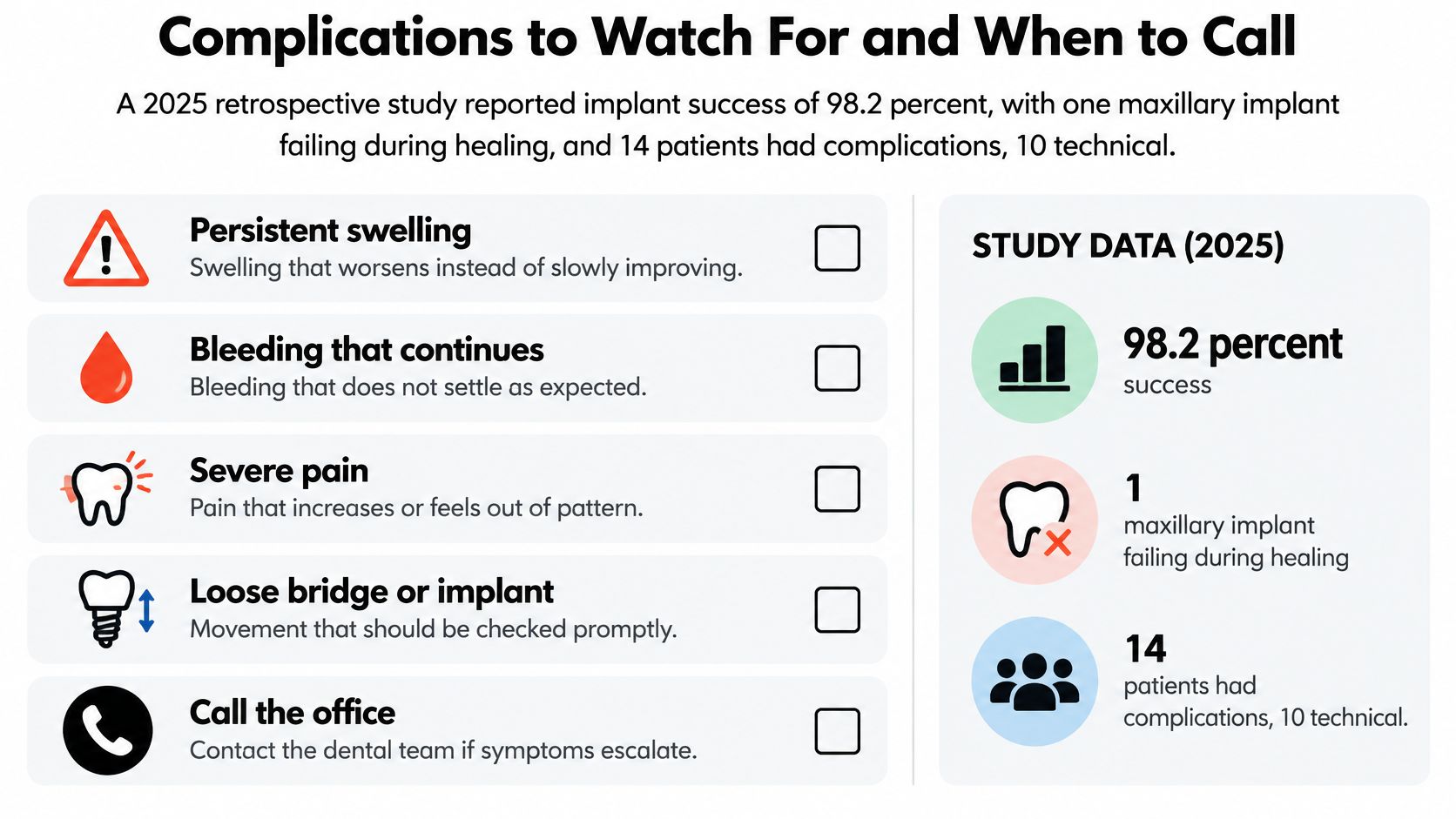
A 2025 retrospective All-on-4 study reported by the Online Scientific Hub reported 98.2% implant success, with one maxillary implant failing during healing; 14 patients experienced one complication each, comprising 10 technical and four biological complications.
Technical complications affect the restoration or its components, such as a chipped bridge or loose screw. Biological complications affect living tissues, including inflammation or infection around an implant. You can't reliably distinguish them by symptoms alone.
The checklist highlights changes that shouldn't be ignored.
Match the symptom to an action
The causes below are possibilities, not diagnoses. A bridge that moves, for example, could have a prosthetic connection problem rather than a failing implant, but both require professional assessment.
Recovery symptoms, likely causes and actions
| Symptom | Likely Cause | What to Do |
|---|---|---|
| Bleeding after 20 minutes of gentle pressure | Surgical site bleeding | Call the office the same day |
| Bridge or implant feels loose or moves | Early instability, micromotion, or a loose connection | Call the same day and avoid chewing on the affected area |
| Swelling increasing after day three | Infection or delayed healing | Call promptly |
| Fever, pus or foul taste | Possible infection | Seek urgent contact with the office |
| Bridge chipped or cracked | Possible acrylic fracture | Call and keep the piece safe |
| Numbness that persists beyond the expected anesthetic period | Possible nerve irritation | Contact the team promptly, especially if persistent or worsening |
| Bite suddenly feels wrong | Prosthetic fit or occlusion shift | Call for a bite check |
A small change in bite can matter even if it doesn't hurt. Don't repeatedly clench to see whether the sensation disappears, and don't use household glue on a fractured bridge. Our emergency tooth pain guidance can help you recognize when urgent assessment is needed.
Know when not to wait
Call the same day for anything that's getting worse. Save a broken bridge fragment in a clean container, stop chewing on the damaged area, and describe when the change began.
Don't wait for the healing checkpoint. Rapidly spreading swelling, difficulty breathing or swallowing, or heavy uncontrolled bleeding requires emergency medical attention rather than waiting for a routine dental callback.
Follow-Up Visits and Long-Term Maintenance
Feeling able to chew does not mean the bone has finished healing around the implants. The first year is the key monitoring window, and maintenance is part of recovery. A clinical and long-term outcomes paper describes checks during the initial three-month healing period and at one year, alongside a 10-year retrospective cohort with 96.05% implant-level survival and five screw-loosening episodes in two patients.
Integrated implants can still support a bridge that loosens, wears, or needs adjustment. That is why visits continue after comfort returns.
Appointments work best on a risk-based schedule. The All-on-4 review discussing the AWMF S3 guideline, summarized in this review, describes three-to-four-month visits for higher-risk patients and five-to-six-month visits for stable, lower-risk patients.
Follow-up intervals by patient profile
| Patient Profile | Review Interval | Why It Matters |
|---|---|---|
| Prior periodontitis | Every 3-4 months | Higher risk of gum inflammation and peri-implant disease |
| Poorly controlled diabetes | Every 3-4 months | Slower healing and higher infection risk |
| Stable health, good hygiene | Every 5-6 months | Routine checks confirm bite and tissue health |
| First year after surgery | About 3 months and 1 year, alongside earlier surgical reviews | Checks for healing and prosthetic complications |
| Night clenching or grinding | At each visit, plus a prescribed night guard when appropriate | Helps protect screws and bridge from overload |
Daily cleaning protects that schedule. Use the interdental brush, threader, or water-flossing method your team demonstrates, and keep pressure gentle near healing incisions. These steps for how to clean around an All-on-4 bridge explain how to reach under the bridge without injuring the tissue.
Report bleeding, persistent odor, wear, or a change in fit between visits. A longitudinal study with follow-up extending from three to 17 years found lower patient-level than implant-level survival, with the maxilla showing lower cumulative survival than the mandible.
Keep the office urgent-contact pathway saved in your phone. Some offices use tools like AI call answering for dentists to route after-hours messages, so ask how urgent recovery calls are triaged at your practice.
Maintenance mindset: A comfortable bridge still needs examination. Keep appointments rather than waiting for pain.
Plan Your Follow-Up Around Your Manhattan Schedule
Before surgery, put your three-month and one-year reviews in your calendar, along with the early postoperative visits. Ask which appointment times fit your workday, and allow enough travel time that you won't need to rush straight back into a meeting.
Whether you're coming from Midtown, Chelsea, the Upper West Side, Upper East Side, Lenox Hill, Turtle Bay, Hell's Kitchen, or the Theatre District, the commute belongs in your recovery plan. The same applies from Gramercy Park, West Village, Greenwich Village, NoHo, East Village, SoHo, Tribeca, Hudson Yards, Chinatown, and Wall Street.
Make the logistics easier
- Protect your calendar: Keep the first week free of major presentations where possible, and leave flexibility for calls during the second week.
- Pack deliberately: Bring water, an appropriate soft meal, an ice pack if advised, and your medication schedule when traveling.
- Separate remote and hands-on care: Ask whether a symptom discussion is suitable for a teledentistry check-in. Bite, bridge fit, and implant stability still require appropriate in-person assessment.
- Write questions down: Record changes in comfort, cleaning access, and speech before each visit.
Comfort concerns deserve discussion before treatment. Megan described her experience in a practice review: “During the actual procedure, both of them made sure I felt no pain.” That's an individual experience, not a promise about postoperative recovery.
Book your planned healing review before surgery day so follow-up doesn't become another task to postpone.
Paul L. Gregory, DDS offers dental implants, All-on-4 dental implants, bone grafting, and dentures, with treatment planning that connects your restoration to its recovery needs. Visit Paul L. Gregory, DDS to discuss your options and arrange a follow-up plan that fits your health, work, and Manhattan schedule.