
A practical planning range for full mouth dental implants cost NYC is about $44,000 to $76,000 for both arches with a fixed All-on-4-style restoration, and about $22,000 to $38,000 for one arch. Neither figure means much until the quote shows what is included.
A headline number often covers implant placement or a temporary set of teeth and leaves the rest off the page. I would ignore any single sticker price and ask for three totals instead: the diagnostic and surgical phase, the provisional teeth, and the definitive teeth plus long-term maintenance. Those three lines are where extractions, grafting, sedation, and the final bridge appear, and they are what change the bill you pay.
Full Mouth Implant Prices in NYC at a Glance
A practical planning range for full-mouth dental implants in New York City is $44,000–$76,000 for both arches with a fixed All-on-4-style restoration, or $22,000–$38,000 for one arch, according to Newmouth's implant cost guide. These are planning ranges, not menu prices. A low advertised figure may cover surgery or temporary teeth while excluding the definitive bridge and other treatment.
| Option | What It Covers | Typical NYC Range | Watch For |
|---|---|---|---|
| All-on-4 style, one arch | Four implants and a fixed bridge on one jaw | $22,000–$38,000 per arch | Whether the provisional teeth and final bridge are included |
| All-on-4 style, both arches | Eight implants and two fixed bridges | $44,000–$76,000 for both arches | Imaging, extractions, grafting, sedation and lab upgrades may be extra |
| Implant-retained dentures | Removable dentures held by implants | Priced according to attachment type and treatment needs | Compare attachment type and the cost of future relines |
| Individual implants, 20 to 28 teeth | One implant, abutment and crown per tooth | $3,100–$5,800 per implant; arithmetic total $62,000–$162,400 | Full-arch cases are rarely billed tooth by tooth |
| Zirconia or grafted reconstruction, both arches | A higher-end framework with added grafting and material | Starts above $44,000 and may reach $90,000 or more | Material, grafting and complex bite needs affect the total |
How to read each row
One arch, four implants. The price covers a fixed bridge on one jaw, but confirm that both the provisional teeth and final bridge appear on the estimate.
Both arches, eight implants. The two-arch range is $44,000–$76,000. Extractions, grafting, sedation or a lab upgrade can raise the total.
Implant-retained dentures. These are removable, unlike a fixed bridge. Their price depends on the attachment type and treatment needs, so compare written quotes that specify both the attachments and the cost of future relines.
Tooth-by-tooth math. Multiplying the cost of an implant, abutment and crown across 20 to 28 teeth produces a large arithmetic total. Full-arch treatment is rarely billed that way, so compare the actual arch treatment and its included components.
Zirconia or grafted cases. A premium framework or bone grafting can push the two-arch total above the $44,000 starting point, with some plans reaching $90,000 or more.
Check each quote for the arches covered, implant count, prosthesis type, and whether extractions and grafting are included. Missing details make prices difficult to compare.
What Goes Into Every Full-Arch Quote
A full-arch quote is a set of separate charges, not one fee. It typically covers three phases: diagnostic and surgical care, provisional teeth during healing, and definitive teeth with long-term maintenance. A quote that lists only implant placement leaves out much of the treatment.
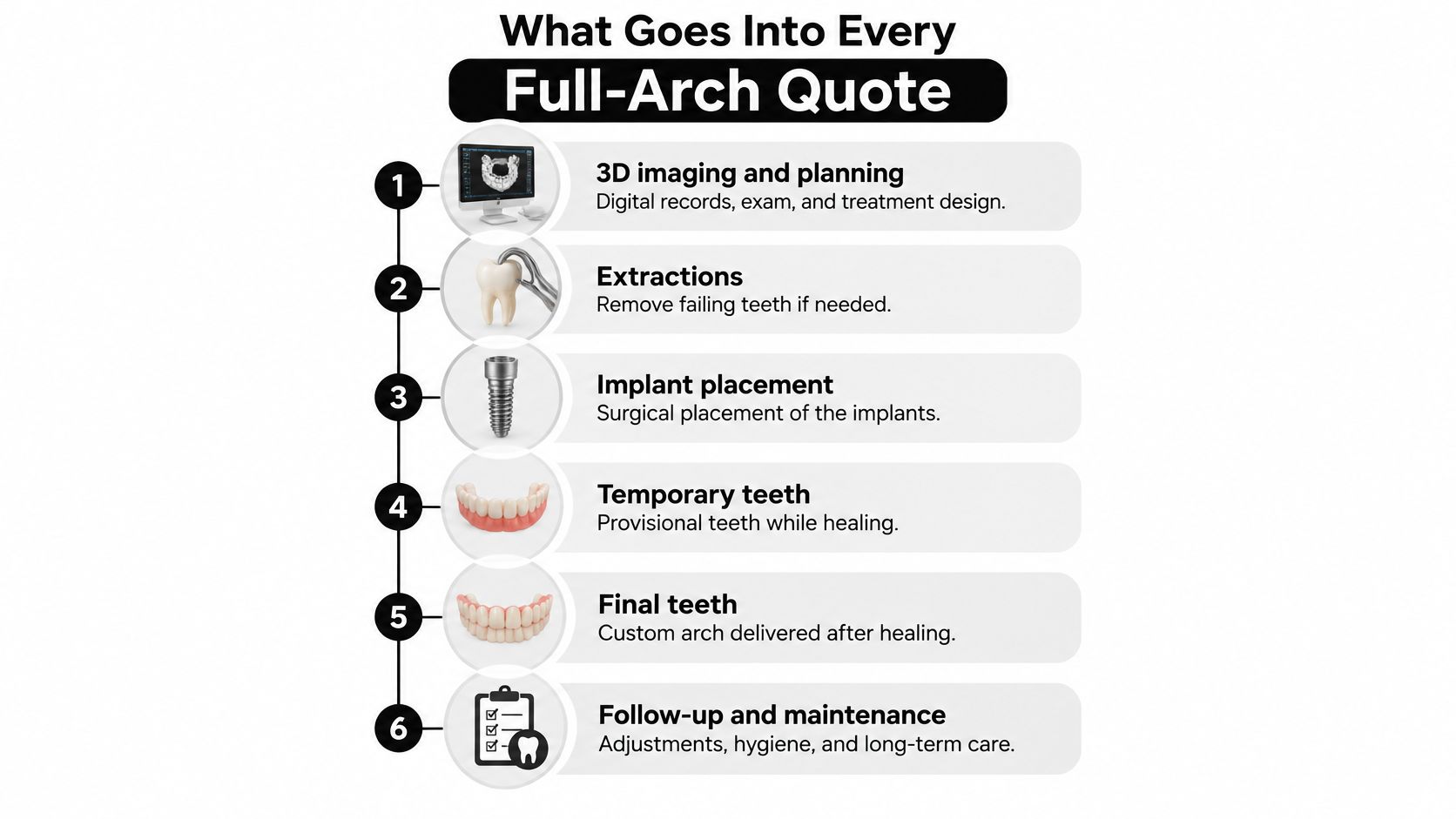
For example, an estimate might list implant placement and four fixtures, then omit the temporary bridge, final prosthesis, or sedation. That is a surgery-only quote, not a complete comparison with an All-on-4 package. The All-on-4 versus All-on-6 comparison explains how the number of fixtures affects support as well as the fee.
| Cost Component | What It Covers | Cost Signal |
|---|---|---|
| 3D imaging and planning | CBCT scan and digital surgical plan | Often billed before surgery; ask whether it is included |
| Extractions | Removing failing teeth before implant placement | Charged per tooth and by complexity |
| Implant placement | Surgical placement of each implant | Ask whether the quoted fee covers fixtures, surgery, or both |
| Abutments | Connectors between implant and prosthesis | Usually itemized per implant |
| Provisional teeth | Temporary bridge worn during healing | May be bundled; confirm what is included |
| Final prosthesis | Permanent fixed bridge or implant-retained dentures | Confirm the type of prosthesis and whether fabrication is included |
| Bone grafting or sinus lift | Adds bone where the jaw is thin | Added charge; scope depends on bone loss |
| Sedation and anesthesia | Comfort during surgery | May be priced separately from surgery |
| Laboratory fees | Custom bridge and teeth fabrication | Ask which material and fabrication costs are included |
| Maintenance and repairs | Cleanings, adjustments and replacement parts | Recurring; request the repair policy in writing |
Three phases, three checks
Separate the estimate into diagnostic and surgical care, provisional teeth, and definitive teeth plus long-term maintenance. This makes it easier to see which costs are due at each stage and which are absent from the headline price.
Check three details on every line:
- Billing category: Is it listed as surgery, laboratory work, anesthesia, or a package that combines several services?
- Unit: Is the charge per arch, tooth, or visit? Per-tooth extraction charges can add up.
- Repair coverage: Does the written policy explain whether a failed implant or chipped bridge tooth is replaced, and for how long?
If the estimate does not specify these details, ask for an itemized version before comparing totals.
What Raises or Lowers Your Total Cost
A cheap material is not a bargain if it cracks in year four and the lab fee comes back. Envy Dental's full-arch overview describes how prosthetic design and material can shift a two-arch plan from roughly $38,600 toward $90,000 or more. The lower end matches standardized fixed full-arch restorations. The upper end tracks extra implants, zirconia bridges, advanced grafting, or a difficult bite and smile zone.
What actually moves the fee
Bone loss and infection add preliminary surgery before any fixture goes in. Our office handles bone grafting for dental implants when the ridge won't hold a fixture, and that visit is its own charge, not a footnote.
Limited restorative space or heavy bite forces push the lab toward a stronger framework. More implants, or a different angulation, spreads that load. Fewer fixtures can work, but only when the bone and the bite agree.
Smile-zone esthetics buy laboratory time. Shade, gum line, and tooth shape are where a "standard" bridge and a custom one part company.
The material ladder you will see on quotes runs acrylic, composite, titanium-reinforced hybrid, then zirconia. Acrylic and composite keep the first fee down and wear sooner. A hybrid adds a metal substructure. Zirconia costs more up front and usually needs fewer cosmetic repairs. I would not pick the cheapest rung if you grind or if the teeth show in every photo.
Insurance commonly treats implants and definitive prostheses as limited or excluded benefits, so an annual maximum covers a small fraction of a complete case. Payment paths are a separate decision from these clinical drivers.
A Midtown-style case
Say someone in Midtown has failing upper teeth, thin bone, and wants zirconia on both arches. Start from a standardized All-on-4 package. Then add grafting, sedation, and the zirconia lab fee. Those three charges have to be itemized. Buried inside one round number, they reappear as "extras" after you have already booked the surgery.
Ask for these in writing before you compare offices:
- Implant system: brand and whether the components stay available for repairs.
- Count and angulation: four, six, or more, and why they are tilted or straight.
- Provisional loading protocol: same-day teeth, or a delay while grafts heal.
- Final material: acrylic, composite, titanium-reinforced hybrid, or zirconia.
- Repair or replacement policy: what happens if an implant fails, and who pays the lab.
A Realistic NYC Timeline From Consultation to Final Teeth
Fees land on visit dates, so a calendar is part of the quote. Ranges below are typical office patterns, not a guarantee for your bone or your schedule.
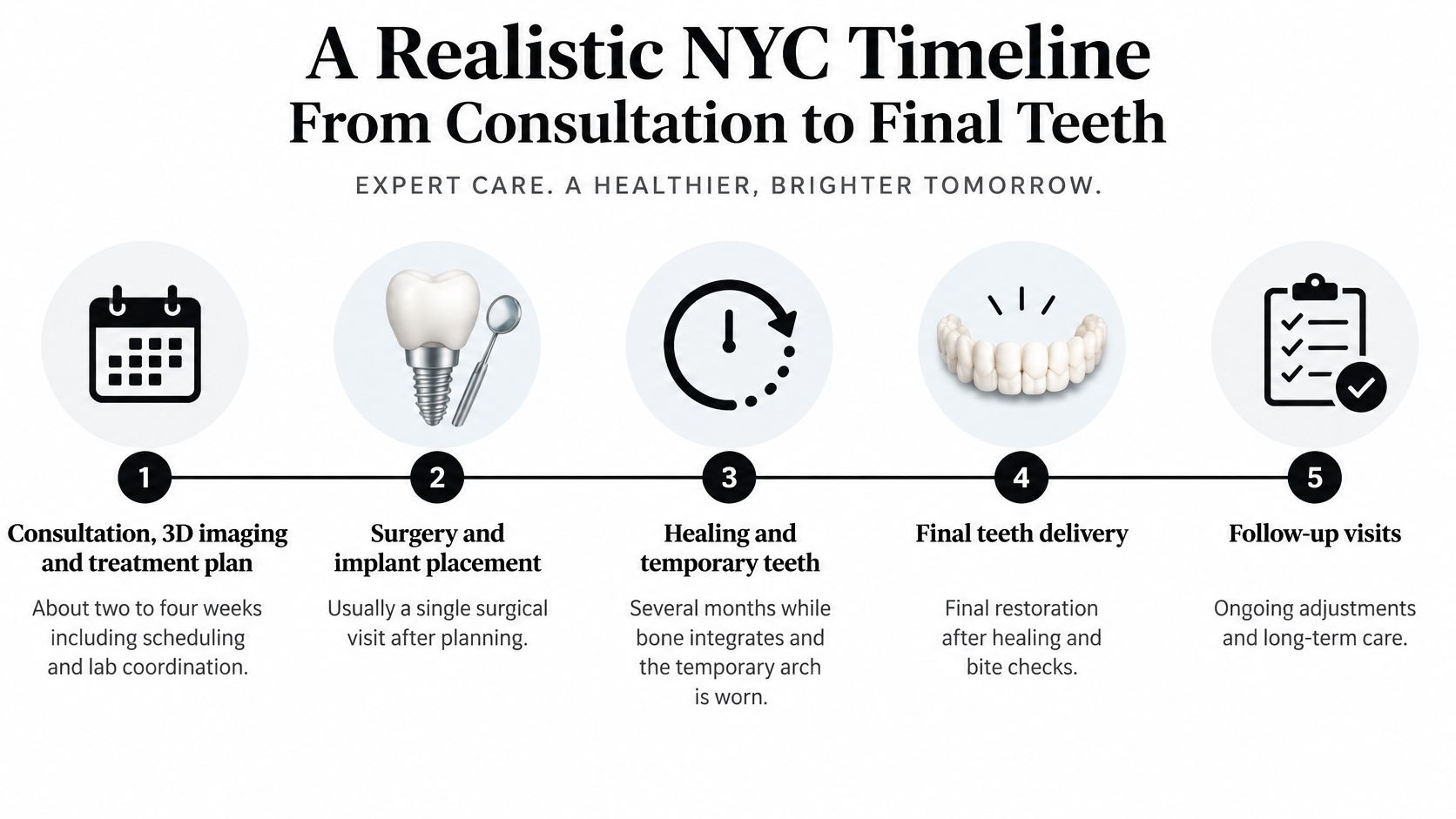
Consultation and the 3D plan usually take about two to four weeks once you count scheduling and lab coordination. This is when the three-phase estimate should be in your hand.
Extractions, and grafting if the scan shows thin bone, happen on surgery day or in a visit of their own. Grafting can add months before fixtures are placed. That gap is a natural place to split payments instead of funding the final bridge on day one.
Implant placement with a provisional fixed bridge is often the same day on an All-on-4 protocol, so you leave with teeth in place. Comfort in that first stretch is usually swelling and a soft diet, not a return to steak. People who heal in a straightforward way describe getting back to comfortable chewing once the provisional is stable. If your case needs grafts first, don't expect that same-day bridge.
For what the first weeks feel like in more detail, read our notes on All-on-4 dental implant recovery.
Healing and osseointegration typically run three to six months before the permanent bridge is made, longer when grafting came first. The provisional is doing a job here. It is not the final teeth, and treating it like a finished zirconia arch is how people crack it.
Final prosthesis fitting is usually two to four weeks after the final impression, with bite checks in between. Maintenance after that is check-ups and professional cleanings, often every six months, plus whatever the repair policy already spelled out.
Practical rule: Ask for a dated schedule that ties each phase to a visit and a payment. If the office can't put a date next to the final bridge, the price for that bridge isn't real yet.
A short walkthrough of how a full-arch case is sequenced on camera helps before that first planning visit.
Insurance and Financing That Change What You Pay
Coverage almost never pays a full-arch case in full. Build the estimate so covered diagnostics and surgery sit on a different line from the prosthesis you will self-fund.
Milliman's analysis of 2025 Medicare Advantage plans, based on 2024 enrollment cross-walked to 2025 plans, found that only 21% of general-enrollment plans offered an implant benefit. An American Dental Association Medicare Advantage infographic in that same review reported that 59% of Medicare Advantage beneficiaries had a dental supplemental benefit worth less than $1,000 per year. A thousand-dollar allowance is small next to surgery and a bridge, which is why older patients still fund most of the case.
| Payment Pathway | How It Works | Limit to Check |
|---|---|---|
| Private dental insurance | Pays a share of covered treatment | Annual maximums often near $1,000–$1,500 |
| Medicare Advantage dental | Supplemental dental benefit for enrollees | 59% of beneficiaries had a benefit under $1,000 per year (ADA) |
| Medicaid | Covers medically necessary implant care for eligible patients | Eligibility and medical necessity rules apply |
| 0% promotional financing | Interest-free payments for a set period | Usually a short promotional term |
| Fixed-rate loan, 6 to 60 months | Spreads the cost into monthly payments | Interest raises the total repayment |
| HSA or FSA funds | Pre-tax money for qualified care | Confirm the plan allows the treatment |
Private dental plans often cap benefits near $1,000–$1,500 a year. They may pay toward an exam, a scan, or a restorative code and stop. New York Medicaid may cover medically necessary implant treatment for eligible patients, so eligibility and medical necessity come before any assumption that the bridge is included.
Loans, schools, and discount plans
A 0% promotional offer usually runs a short term. Miss the payoff window and deferred interest can reprice the whole balance. A 6 to 60-month loan spreads the fee and, with interest, makes total repayment higher than the quoted treatment fee. Before you sign, read how APR and interest are explained by Toya AI so the monthly payment isn't the only number you compare. HSA or FSA funds can pay qualified care when the plan allows it.
Two lower-cash paths sit beside insurance. Dental school teaching clinics may charge less and take longer, with faculty oversight and a busier calendar. Discount dental plans cut fees. They are not insurance, and they don't create an annual maximum you can "use up."
Our page on what a dental insurance deductible is is worth reading before you assume the first dollars of a surgical claim are paid.
Use this checklist before you accept a plan:
- Confirm whether the policy treats the tooth loss as medically necessary or cosmetic.
- Request written preauthorization.
- Ask whether the benefit is per arch or per calendar year.
- Note waiting periods and missing-tooth exclusions.
- Compare APR and promotional terms, not just the monthly amount.
- Confirm HSA or FSA eligibility before you sign.
Choosing a Manhattan Provider and Preparing for Your Consultation
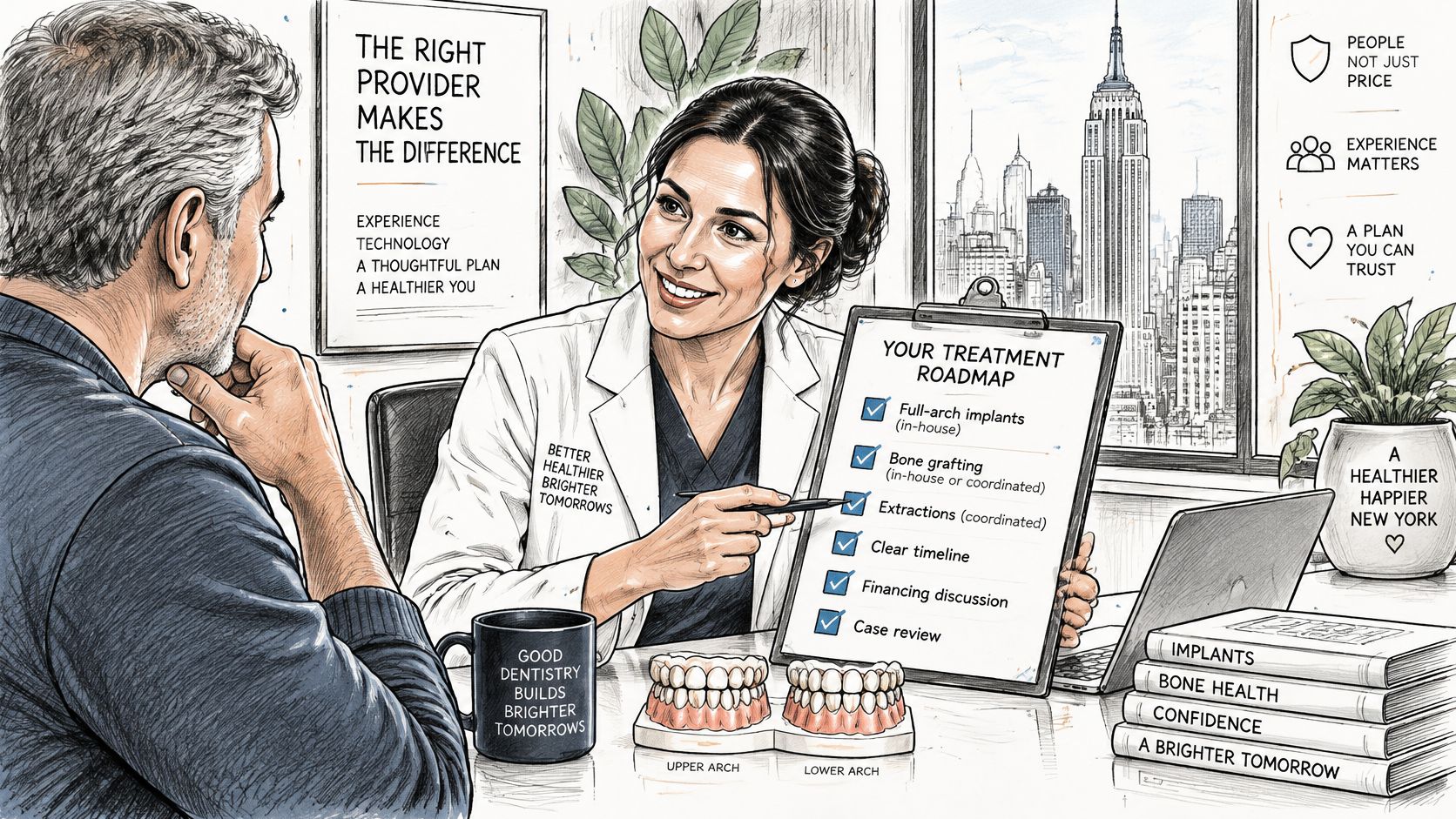
A full-arch quote is easier to judge when you know who handles each phase. Ask whether implant placement, grafting, extractions, provisional teeth, and the definitive bridge are included or referred elsewhere. Paul L. Gregory, DDS, at 57 W 57th St, offers dental implants, All-on-4 treatment, bone grafting, and dentures. Confirm which of those services your proposed treatment requires and which charges the estimate covers.
Dr. Gregory is an experienced cosmetic dentist in Midtown Manhattan. For background on treatment choices, see this guide to dental implant options.
Neighborhood labels don't set the fee
Paul L. Gregory, DDS is in Midtown Manhattan and serves New York City and the broader metropolitan area. Neighborhood names do not determine an implant fee. The New York City Council district descriptions show how some named areas fall within shared districts, while Manhattan Community Board 1's district description includes Tribeca and the Financial District. Those boundary descriptions help locate areas; they do not establish dental prices. Compare the treatment scope and the office address instead.
What to bring, and who does the work
Ask who places the implants, who plans the final bridge, and whether the estimate includes the laboratory work and any repair terms. Request the estimate in writing, with separate amounts for diagnostics and surgery, provisional teeth, and definitive teeth plus maintenance.
Bring recent imaging, a medication list, your insurance summary, and records of earlier treatment or a failed procedure. A patient, Drew, said Dr. Gregory explained the treatment clearly, answered questions, and helped him feel comfortable. At the consultation, make sure you understand the proposed phases and what each quoted amount covers before scheduling surgery.
If you leave without a written estimate, you have a conversation, not a quote.
Confirm the Itemized Quote Before You Book
Compare at least two written estimates using the same details: arch, implant count, prosthesis material, grafting, sedation, and maintenance. Ask each office to show three totals separately: diagnostics and surgery, provisional teeth, and the definitive teeth plus long-term maintenance. This makes it easier to spot costs left out of a headline quote, such as extractions, grafting, sedation, or the final bridge.
Before choosing a payment option, check eligibility, fees, promotional terms, and the repair policy for a failed implant, including how long coverage lasts and whether lab fees are included. The backlash over dental credit card fees is a reminder to read payment terms closely. Bring imaging, a medication list, and your insurance summary when you discuss treatment.
Call Paul L. Gregory, DDS at (212) 826-0505 to ask about a full-arch evaluation. Request a written, itemized estimate from each office before booking, and compare what each total includes. A lower advertised full mouth dental implants cost in NYC may not reflect the full bill if treatment phases appear later as separate charges.