

The popular advice about finding the best dental implants is usually too narrow. Patients are told to compare titanium brands, implant shapes, or crown materials as if the product alone determines the result. In practice, the implant is only one part of a treatment system that also includes diagnosis, bone and gum health, surgical planning, restoration design, bite management, and years of maintenance.
For a busy Midtown Manhattan professional, the better question is not “Which implant brand should I choose?” It's, “Which treatment plan gives me the most reliable function with risks I understand and maintenance I can realistically manage?” The provider's workflow, communication, and ability to respond when a crown loosens or inflammation appears may matter more to your day-to-day experience than a brand name on the implant package.
Redefining the Best Dental Implants for Long-Term Success
A premium implant can still produce a poor outcome if it's placed into an unstable biological environment or restored without sufficient attention to the bite. Conversely, a well-selected implant system can perform predictably when the clinician controls the important variables, including bone volume, periodontal health, implant position, emergence profile, occlusion, and access for hygiene.
That's why I'd evaluate an implant consultation through four questions:
| Evaluation area | What a strong plan should address | Why it matters |
|---|---|---|
| Biology | Gum inflammation, bone levels, healing capacity, and plaque control | Healthy tissue supports integration and long-term stability |
| Position | Three-dimensional implant location and restorative space | Position affects appearance, cleansability, and mechanical stress |
| Restoration | Crown, bridge, or full-arch design, including access for repairs | The restoration is the part you'll use and maintain every day |
| Continuity | Follow-up, periodontal maintenance, and access to urgent care | Small problems are easier to manage before they become major ones |
Hardware is only the foundation
Titanium remains central to modern implant dentistry because it can integrate with bone, but osseointegration alone doesn't guarantee a trouble-free result. A fixture may remain stable while the crown needs adjustment, the abutment needs attention, or the surrounding tissue develops inflammation. The final restoration must be designed so that you can clean around it and the clinician can inspect or repair it.
Digital planning helps connect the surgical and restorative stages. A clinician can use three-dimensional imaging, an intraoral scan, and a proposed crown design to decide where the implant should go before surgery. That approach is different from placing an implant first and trying to make the restoration work afterward.
For a practical overview of modern planning and treatment tools, see this guide to dental implant technologies. Technology doesn't replace clinical judgment, but it can make that judgment more precise and easier to communicate.
Practical rule: Choose the clinician who can explain how the implant, restoration, bite, hygiene access, and maintenance plan fit together, not merely the clinician who names the most familiar brand.
The maintenance question busy patients often miss
Ask what happens after the final crown is delivered. Who checks the tissue around the implant? How will the office identify screw loosening, excess cement, ceramic wear, or changes in your bite? What happens if you travel frequently, grind your teeth, or can't attend routine visits as planned?
The most durable implant outcome is personalized around your anatomy and habits. A treatment plan that looks efficient on day one may become inconvenient if it creates difficult-to-clean contours or requires repeated repairs. For many professionals, low-friction follow-up and clear access to care are essential parts of choosing the best implant solution.
Clinical Survival Rates and Osseointegration Evidence
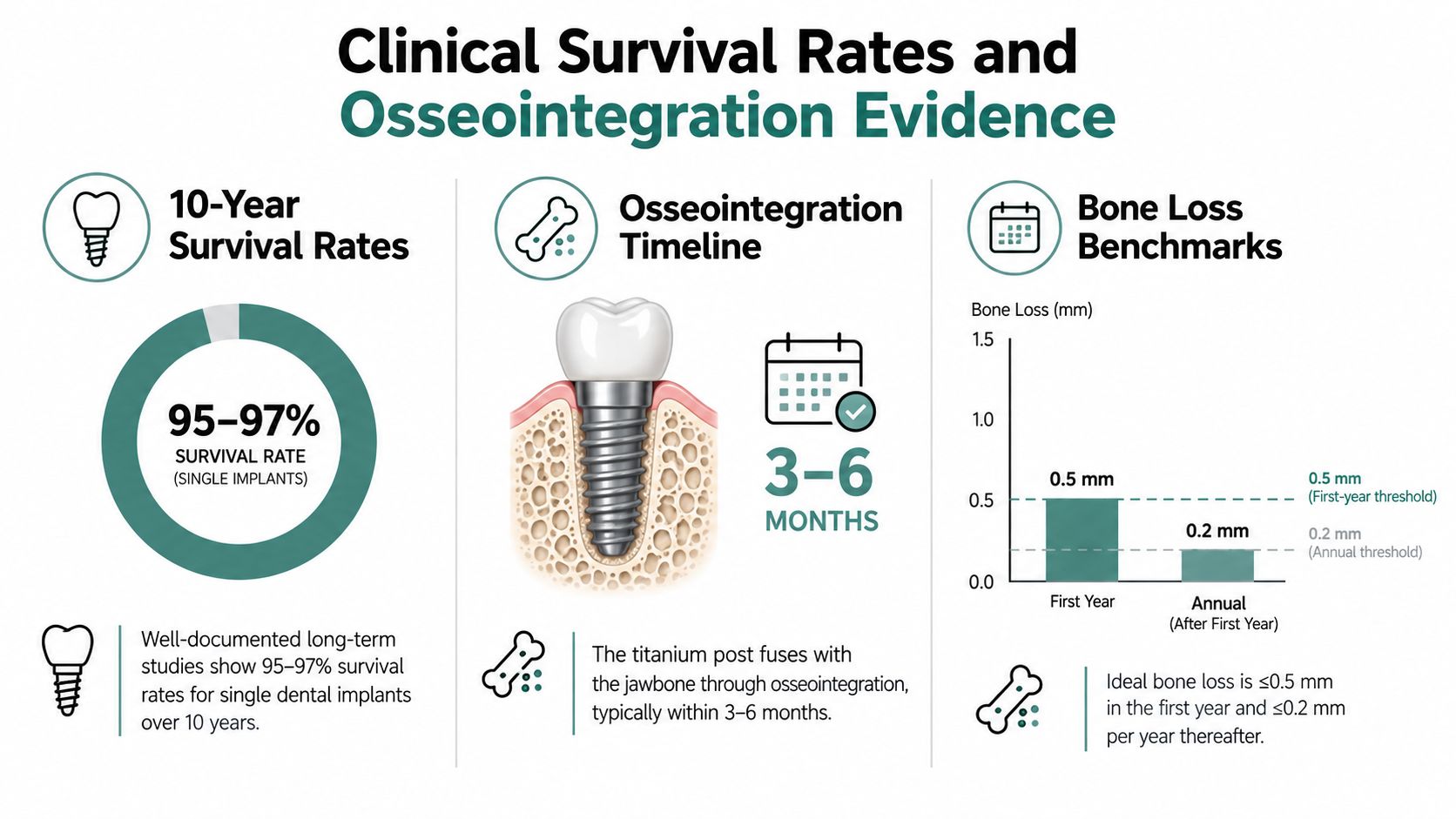
Dental implants earned their reputation through long-term clinical evidence, not through marketing language. The biological principle behind them is osseointegration, the direct bond between implant material and living bone. In 1952, Per-Ingvar Brånemark observed titanium bonding directly to bone and later named the phenomenon osseointegration. The first osseointegrated oral implants were placed in humans in 1965, establishing the foundation for the endosseous implant systems used today. These historical milestones are described in this review of implant history and long-term evidence.
Fixture survival versus restoration survival
Patients often hear that implants have excellent survival and assume the crown will last in exactly the same way. Those are separate outcomes. The implant fixture is the part anchored in bone, while the prosthesis is the visible crown, bridge, or full-arch restoration attached to it.
A systematic review of single-tooth implant crowns found 97.2% implant survival at 5 years and 95.2% at 10 years. In the same review, the supporting implant fixtures had 96.3% survival at 5 years and 89.4% at 10 years, while the review's reported prosthesis figures were 96.3% at 5 years and 89.4% at 10 years for the stated outcome grouping. The detailed findings and confidence intervals are available in the systematic review of single implant crowns.
These figures support a realistic conversation. Implant treatment can be highly predictable over long follow-up, but survival isn't the same as zero maintenance. A stable fixture may support a crown that needs polishing, repair, replacement, or occlusal adjustment. Your treatment plan should account for both layers.
What the evidence does and doesn't promise
Another meta-analysis of implant-supported fixed prostheses reported 95.6% survival at 5 years and 93.1% at 10 years for the evaluated restorations. Those results help explain why titanium implants became a reference approach for replacing missing teeth in major markets, but they shouldn't be interpreted as a personal guarantee.
Your result depends on factors such as bone anatomy, periodontal stability, restorative design, oral hygiene, smoking, systemic health, and the forces placed on the restoration. The evidence gives us a strong foundation for selecting implants. It doesn't eliminate the need for a careful examination.
The embedded video offers a visual introduction to the clinical concept before you discuss your own imaging and treatment options.
If you're preparing for treatment, this explanation of the dental implant healing process can help you understand why the final restoration is not always placed immediately after surgery.
Comparing Single Tooth and Full Arch Implant Systems
The right implant system follows the pattern of tooth loss. Replacing one missing premolar is a different engineering and biological problem from rebuilding an entire arch with a fixed prosthesis. Bone volume, the condition of neighboring teeth, the number of restorations required, the bite, and the patient's ability to maintain the result all influence the recommendation.
| System Type | Bone Volume Needed | Surgical Timeline | Ideal Patient Profile |
|---|---|---|---|
| Single-tooth implant | Adequate bone at one tooth site, with grafting considered when the site has changed | Assessment, possible site preparation, implant placement, healing, then crown delivery | Patient missing one tooth with suitable neighboring teeth and a manageable site |
| Multi-unit fixed restoration | Sufficient bone at several planned implant positions, with anatomy guiding implant distribution | Staged planning and placement, followed by bridge or individual restoration delivery | Patient missing several teeth who wants a fixed solution and has viable restorative support |
| All-on-4 full-arch system | Bone must support the planned implant positions, sometimes using available anatomy strategically | Comprehensive full-arch planning, implant placement, provisional restoration, healing, and definitive prosthesis | Patient with extensive tooth loss or a failing arch who needs a fixed full-arch rehabilitation |
Single-tooth replacement
A single implant is often the most conservative fixed replacement when the missing tooth site and surrounding teeth are suitable. It replaces the root without requiring the neighboring teeth to serve as bridge abutments. That can preserve otherwise healthy adjacent tooth structure.
The challenge is precision. A front-tooth implant must respect the gum architecture, facial bone, smile line, and crown proportions. A back-tooth implant must tolerate chewing forces while remaining accessible for cleaning. The best choice may involve site preservation or grafting rather than immediate placement if the extraction socket has lost support or contains infection.
Multiple missing teeth
For several adjacent spaces, individual implants aren't automatically superior to an implant-supported bridge. A bridge can reduce the number of surgical sites and may be appropriate when implant positions, hygiene access, and the planned span are favorable. Individual crowns can offer more independent access and repair options, but they may require additional implants and more restorative components.
Your clinician should show you the proposed tooth arrangement, not just the implant count. Ask how the bridge will be cleaned, where the access points will be located, and whether the design can be repaired without removing the entire restoration.
Full-arch rehabilitation
An All-on-4 approach uses a planned implant distribution to support a fixed full-arch prosthesis. It can be useful when many teeth are failing or when a removable denture doesn't meet the patient's functional or lifestyle needs. It also demands thorough planning because the clinician is managing the entire bite, speech, smile display, hygiene routine, and prosthesis design.
The term shouldn't be treated as a universal shortcut. Some patients need a different implant distribution or a different restorative strategy. Review the distinctions in All-on-4 versus All-on-6 treatment planning before assuming that a named system automatically fits your anatomy.
How Surface Engineering and Digital Workflows Improve Outcomes
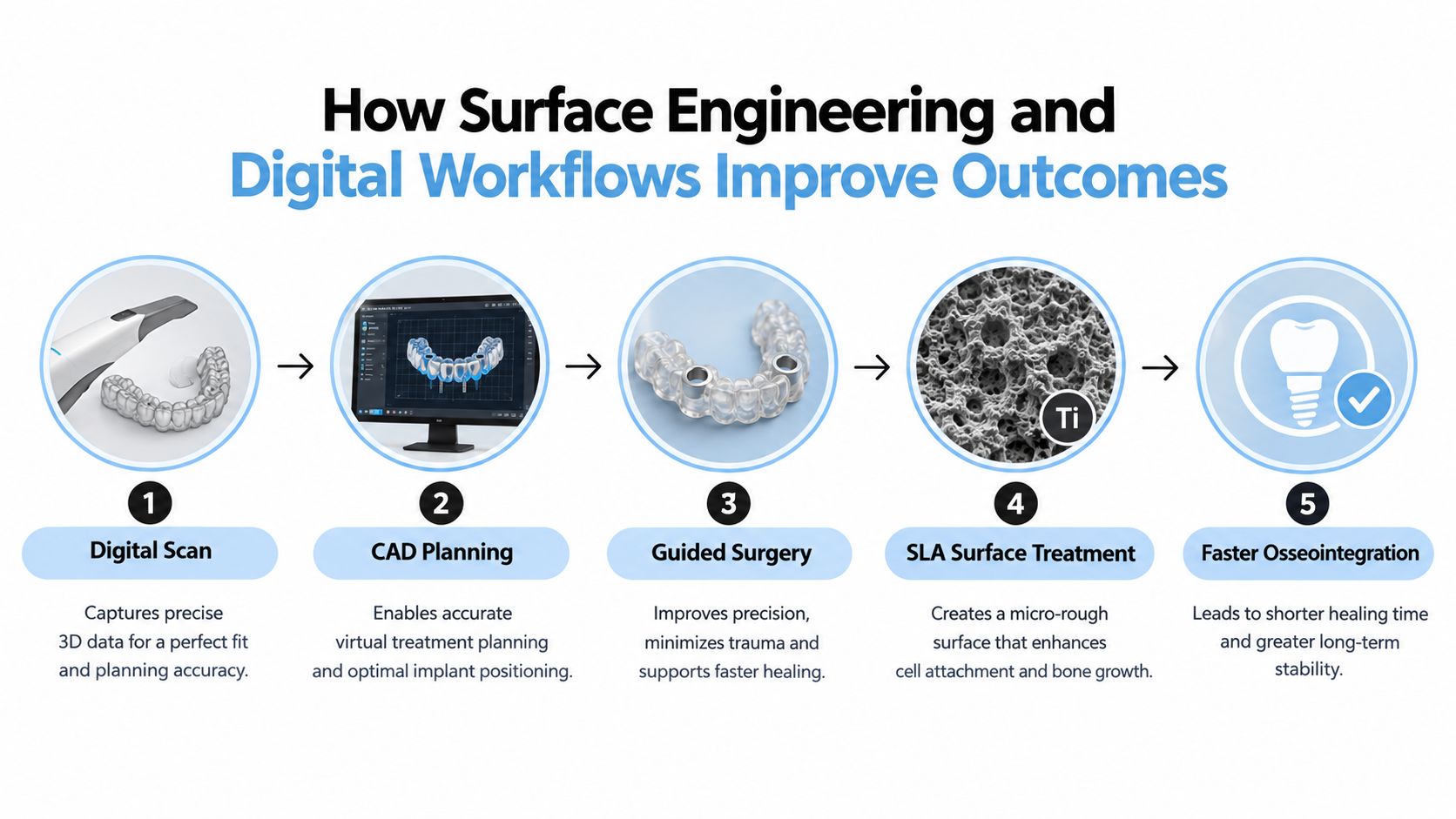
Two separate advances influence implant treatment. Surface engineering affects how the implant interacts with bone, while digital workflow affects how the team diagnoses, positions, and restores it. The strongest planning connects both rather than treating them as unrelated selling points.
Modern implant surfaces may be roughened, hydrophilic, nanostructured, or activated with ultraviolet or plasma techniques. A systematic review reported that these surface approaches generally improve osseointegration-related outcomes, including bone-to-implant contact, bone volume, and earlier implant stability. The same review also associated rough surfaces with better osseointegration than smooth surfaces. You can review the systematic analysis of implant surface engineering.
Why surface design matters clinically
Surface treatment doesn't make a poorly positioned implant successful. It supports the biological phase after the clinician has selected an appropriate site and placed the implant with adequate primary stability. The practical question isn't whether a surface sounds advanced. Ask whether the clinician can explain why that implant design suits your bone, loading plan, restoration, and medical history.
The implant connection and prosthetic components matter as well. A system must offer a restoration that can be fabricated accurately, cleaned effectively, and serviced when necessary. A technically advanced fixture paired with a difficult-to-maintain crown can still create problems later.
The digital chain
An intraoral scanner creates a digital model without the discomfort and distortion associated with traditional putty impressions. Three-dimensional imaging supplies anatomical information, while restorative software can show the planned tooth position before the implant is placed. A surgical guide may then help transfer that plan to the mouth.
That chain is valuable because implant placement is restorative work performed surgically. The final tooth determines where the implant should ideally support it, not the other way around. Digital tools can also improve communication between the dentist, surgeon, and laboratory.
A digital X-ray for teeth is one part of a broader diagnostic process. It shouldn't be confused with a complete implant assessment, which may require additional imaging and clinical examination.
Better technology improves the information available to the team. It doesn't remove the need for a clinician who knows how to interpret that information.
Evaluating Candidacy and Long-Term Maintenance Risks
The best implant plan starts by identifying when treatment should be delayed, modified, or replaced with another option. A patient may have enough apparent bone for an implant but still face high risk because of uncontrolled plaque-related inflammation, compromised healing, or a restoration that can't be maintained.
Reviews note that immune deficiency, cardiovascular disease, and plaque-related inflammation can impair healing and osseointegration, while peri-implant inflammation can contribute to progressive bone loss and implant failure. The relevant issue isn't a label alone. Your dental team needs to understand your medical history, medications, healing capacity, periodontal condition, and ability to maintain the site.
When candidacy needs improvement first
A person may be a poor immediate candidate if active gum disease remains untreated, home care is inconsistent, or the proposed implant site lacks suitable bone and soft-tissue support. A history of medical problems doesn't automatically rule out implant treatment, but it can change the sequence, monitoring, or need for medical coordination.
Before surgery, ask whether the plan includes:
- Periodontal stabilization: Active inflammation should be evaluated and treated before placing a fixture into the area.
- Medical coordination: Your dentist should know about relevant diagnoses, medications, and prior healing problems.
- Bite assessment: Clenching, grinding, and unfavorable contacts may require protective planning.
- Maintenance access: The final crown or bridge should permit daily cleaning and professional inspection.
- Contingency planning: You should know what happens if integration is delayed or the restoration develops a complication.
The candidate evaluation for dental implants should be individualized rather than reduced to a checklist of age or implant material.
Complications are part of the decision
Independent reviews and consensus statements reported peri-implantitis and soft-tissue complications in 8.6% of patients after 5 years, connection-related complications in 7.3%, and suprastructure complications in 14.0%. The same consensus source reported implant loss before loading of about 2.5% and implant loss during function of 2–3% for fixed reconstructions. These figures come from the ITI consensus statement on implant survival and complications.
Those numbers don't predict your personal outcome, but they show why long-term care belongs in the initial consultation. Technical complications may include screw loosening, fracture, or ceramic chipping. Biological complications may begin as bleeding or swelling around the implant and progress if the cause isn't addressed.
Maintenance is part of the implant treatment, not an optional service after treatment ends.
A busy schedule isn't a reason to avoid implants, but it is a reason to choose a design that fits your routine. You need a realistic hygiene plan, scheduled reviews, and a clear response pathway if the bite changes or the implant-supported crown feels unstable.
Choosing the Right Implant Provider in Midtown Manhattan
A provider should be evaluated as a clinical system, not only as an individual who can place a fixture. The office needs a reliable way to examine your gums, analyze your bone, plan the restoration, coordinate laboratory work, and manage complications after delivery.
Start with the questions below. A direct answer is more useful than a polished brochure.
Five questions worth asking
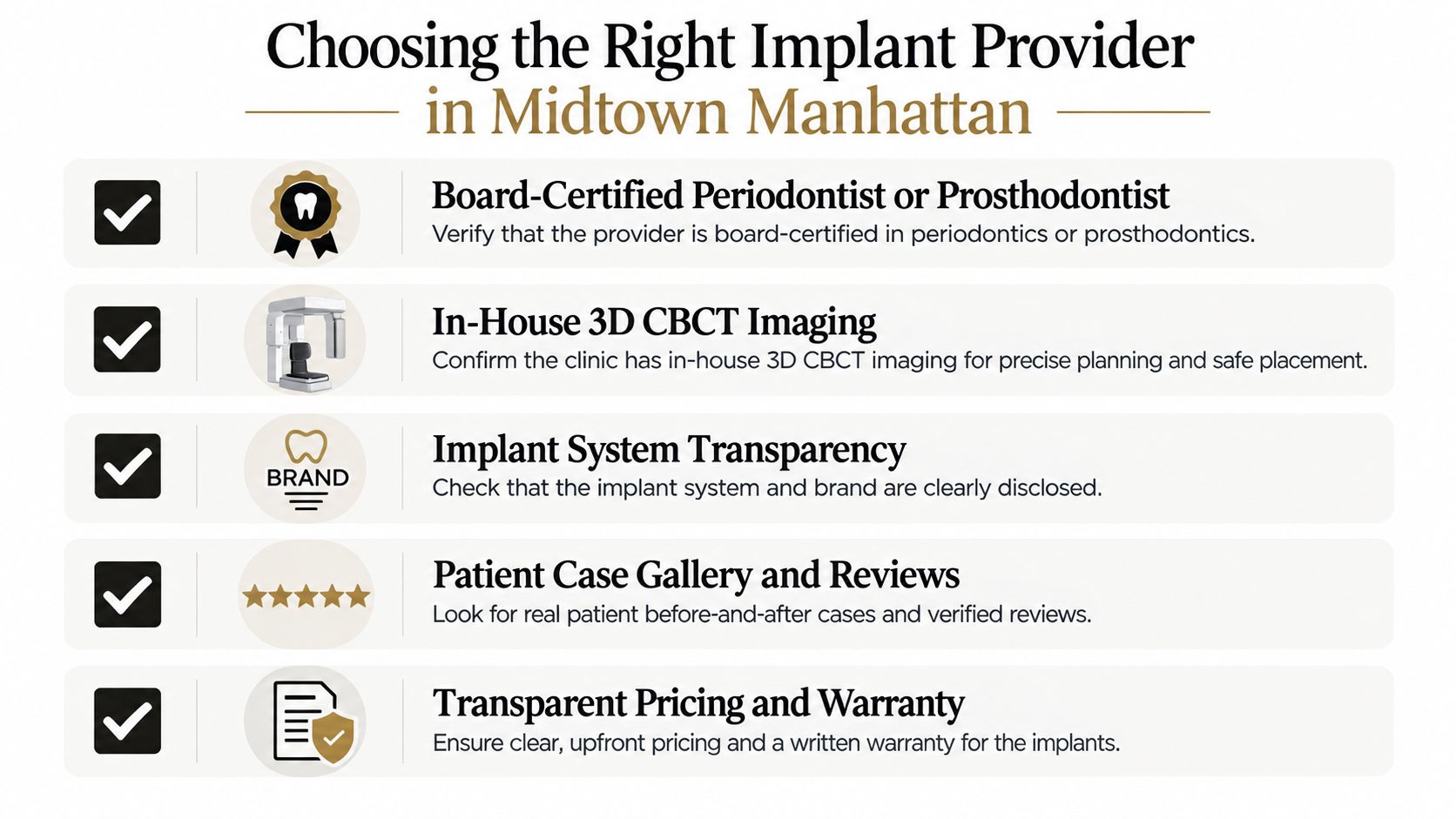
Who will diagnose, place, and restore the implant? Clarify whether one clinician coordinates the full case or whether you'll move between offices. Referrals can be appropriate, but responsibility for communication should remain clear.
What imaging and scanning tools are available? Ask whether the practice uses three-dimensional imaging when indicated, intraoral scanning, intraoral cameras, and digitally planned restorations. The tool matters less than how it changes the treatment decision.
Which implant system will you use, and why? The provider should identify the system and explain the connection, restorative components, laboratory support, and future availability of replacement parts. Avoid a consultation that treats the brand as self-explanatory.
How are emergencies handled? A loose crown, fractured restoration, swelling, or sudden bite change shouldn't leave you searching for a new office. Ask about short-notice appointments and who will evaluate an urgent problem.
What does the fee include? Request a written plan that separates diagnostic work, surgery, grafting if needed, temporary teeth, final restoration, follow-up, and potential maintenance. Insurance assistance and financing discussions should be clear before treatment begins.
Convenience has clinical value
A central Midtown location can make scheduled maintenance easier to keep, especially if you work near Central Park South, Columbus Circle, or Midtown offices. Convenience isn't a substitute for expertise, but missed follow-ups create avoidable gaps in care.
Look for continuity across restorative, periodontal, surgical, and emergency services. A practice that can review your treatment history and arrange timely care for a broken restoration may offer a smoother experience than a disconnected series of providers.
You should also assess communication. A good consultation leaves you understanding the diagnosis, alternatives, sequence, risks, and maintenance obligations. If the explanation relies on pressure, vague guarantees, or an unexplained brand preference, seek another opinion.
Planning Your Consultation and Restorative Timeline
A productive consultation should end with a decision pathway, not just an estimate. The clinician should examine the missing tooth or failing restoration, assess the gums and neighboring teeth, review appropriate imaging, and show how the proposed crown or prosthesis will fit the rest of your bite.
Bring a complete medical and dental history, including medications, prior implant or grafting procedures, clenching concerns, and any symptoms around the site. Tell the team how often you travel and what appointment pattern is realistic. The best plan is one you can complete and maintain, not merely one that looks fast on paper.
What the plan should clarify
- Diagnosis: What caused the tooth loss, and is the surrounding tissue stable?
- Alternatives: Could a bridge, removable restoration, or tooth-preserving procedure serve you better?
- Preparation: Will gum treatment, extraction, site preservation, or bone grafting be needed?
- Sequence: Which visits involve surgery, provisional teeth, healing review, scanning, and final delivery?
- Maintenance: How will you clean the restoration, and how will the team monitor the implant?
- Fees and coverage: Which services are included, what may be separate, and how will insurance claims be handled?
Bone grafting and site preservation can extend treatment because the clinician may need to establish a more suitable foundation before placing or restoring the implant. That extra time isn't automatically a disadvantage. In a compromised site, rushing may create a less maintainable result, while preparation can support better positioning and restorative design.
Continuity makes the timeline easier to manage
Ask who will coordinate the temporary restoration, laboratory communication, surgical review, and final crown. You should also know who to contact if you develop increasing swelling, unusual pain, a changing bite, or a restoration that feels loose.
For a professional managing a demanding NYC schedule, centralized care can reduce unnecessary travel and repeated explanations. A digital consultation can also help you understand the proposed tooth position and sequence before committing to surgery.
Don't choose an implant based on a product name alone. Choose a documented plan that accounts for biology, anatomy, technology, restoration design, maintenance, and your actual lifestyle.
Paul L. Gregory, DDS provides implant dentistry, periodontal therapy, bone grafting, site preservation, digital scanning, and restorative care in Midtown Manhattan, with emergency assessment for urgent dental problems. Visit Paul L. Gregory, DDS to request a consultation focused on a durable, personalized implant plan.