

Invisalign can fix mild to moderate overbites in adults through tooth repositioning, with adult studies reporting a pooled mean overbite reduction of 1.79 mm for deep bites. For anterior open bites, the pooled overbite increase was 3.07 mm, but severe skeletal deep bites often require different mechanics or combined therapies.
The popular advice is simple: upload a scan, approve the digital simulation, and let a series of clear trays solve the bite. That version leaves out the part that matters most in adult treatment. A digital plan is a movement proposal, not a guarantee that every tooth will respond exactly as shown.
For a busy professional, Invisalign can be an excellent way to improve an overbite without visible brackets. It can also disappoint when the diagnosis confuses a tooth-position problem with a jaw-position problem. The important questions aren't only whether the trays fit or whether the front teeth look straighter. They're whether the bite has been corrected with stable mechanics, whether the roots are in a healthy position, and what will keep the result from drifting later.
The Reality of Adult Overbite Correction
An overbite describes the vertical overlap of the upper front teeth over the lower front teeth. A mild dental overbite may result from the way the incisors lean, crowding in the front of the mouth, or the way the upper and lower arches meet. A more pronounced deep bite can involve several relationships at once, including incisor position, posterior tooth height, facial growth pattern, and the position of the jaws.
That distinction determines whether Invisalign is a sensible choice. Clear aligners are most useful when the problem is primarily dentoalveolar, meaning the teeth can be repositioned within the supporting bone to create a healthier contact pattern. They're less suited to correcting a major skeletal discrepancy by themselves because an aligner moves teeth, not the adult jaw as a whole.
The diagnosis matters more than the brand
A digital simulation may show the upper incisors moving backward, the lower incisors moving forward, or the front teeth changing their vertical position. Those movements can improve the appearance of an overbite, but they don't all represent the same clinical correction.
A patient may see a visibly reduced overlap because the incisors have tipped into a better relationship. Another patient may need genuine intrusion, posterior eruption, elastics, fixed appliances, temporary anchorage, or orthognathic treatment. The tray may look similar in both cases, while the underlying biomechanics are entirely different.
Practical rule: A provider should explain whether your overbite is mainly dental, skeletal, or a combination before showing you the projected smile.
Adult treatment also has less biological flexibility than treatment during active growth. Mature teeth can move effectively, but vertical movements and complex root control are less predictable than simple alignment or buccolingual tipping. That doesn't make Invisalign ineffective. It means the treatment plan should be narrower, more realistic, and monitored closely.
For many adults, the right goal isn't a dramatic simulation. It's a functional bite with comfortable tooth contacts, healthy gums, acceptable facial balance, and a retention plan you can follow for years.
What Clinical Data Shows About Aligner Efficacy
The strongest recent evidence supports a qualified yes, not a universal yes. Adult clear aligner treatment can produce measurable vertical bite correction, but the amount depends heavily on the original bite and the mechanics selected.
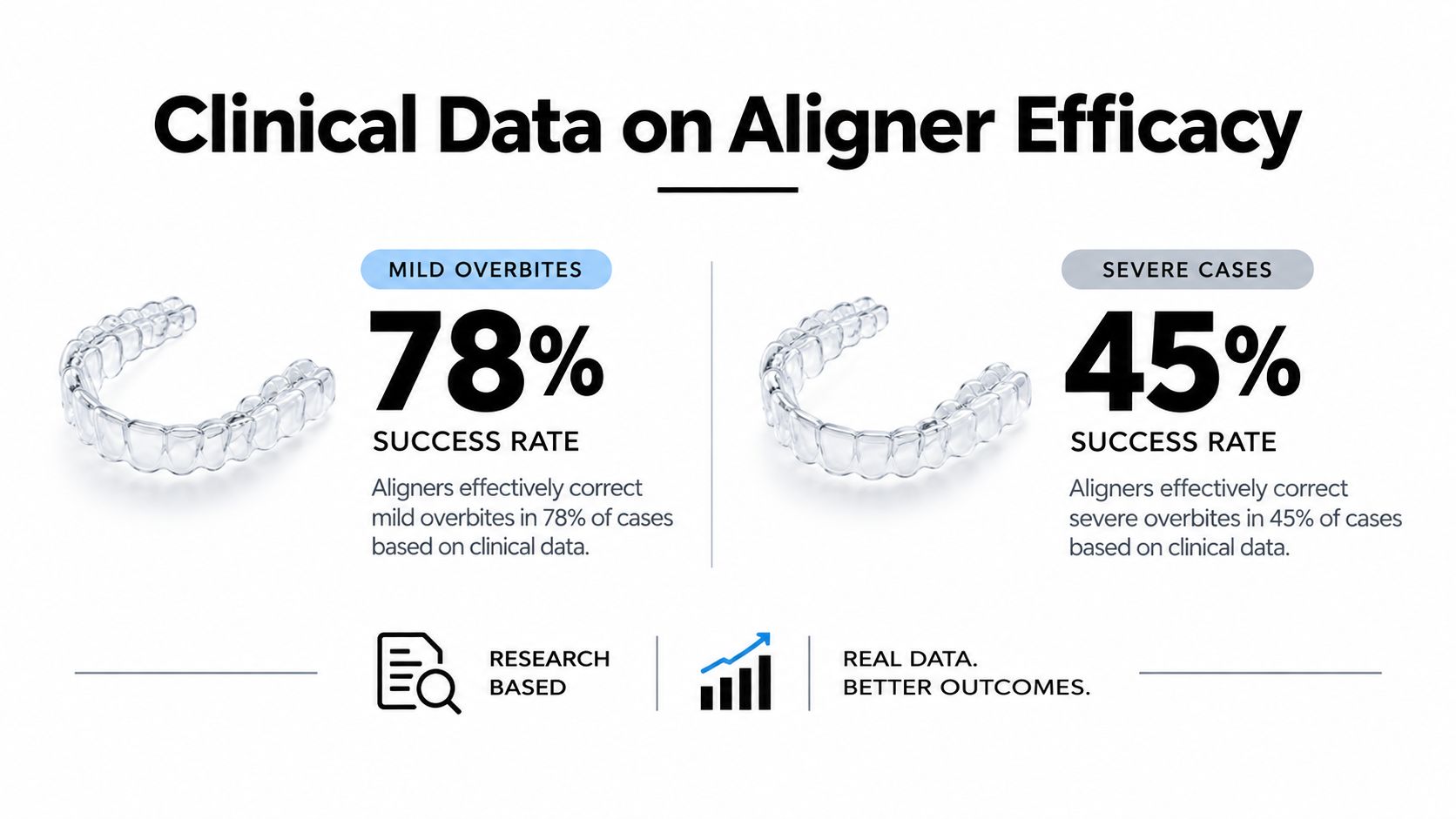
A 2026 systematic review of adult anterior open-bite treatment included 10 studies published between 2017 and 2025 and 421 aligner-treated participants. The pooled overbite increase was 3.07 mm, with a 95% confidence interval of 2.46 to 3.69 mm. Individual reported improvements ranged from 2.28 mm to 4.26 mm. The review still rated the certainty of evidence as very low and found substantial heterogeneity, with I² = 93%, so those results shouldn't be treated as a promise for every adult case. The findings are available in the systematic review of adult anterior open-bite treatment.
Deep-bite correction is a different mechanical problem. Rather than closing a gap between the front teeth, treatment must reduce excessive overlap. A 2026 systematic review and meta-analysis examined six retrospective studies and included 177 adults. It found a pooled mean overbite reduction of 1.79 mm, with a 95% confidence interval of 1.03 to 2.54 mm and p < 0.001. The included adults had mean age ranges from 24.50 to 40.00 years. These figures come from the adult Invisalign deep-bite meta-analysis.
How to interpret the millimeters
The open-bite and deep-bite findings shouldn't be compared as if they measure the same task. Closing an anterior open bite and reducing a deep bite involve different tooth movements, different force systems, and different sources of error. A larger change in one condition doesn't mean aligners are generally better at all vertical corrections.
Earlier adult clinical evidence cited in the deep-bite review reported a mean overbite change of 2.3 mm with clear aligners, compared with 1.8 mm with fixed appliances. That comparison doesn't establish that Invisalign is superior. It shows that aligners can correct adult overbite, while the final result still depends on the starting anatomy, treatment mechanics, compliance, and the clinician's ability to adjust the plan.
For a patient evaluating Invisalign clear aligner treatment, the useful question is not, “What percentage of overbites does Invisalign fix?” Ask instead, “How much correction is clinically appropriate in my case, and which part will come from incisor movement versus true vertical control?”
That question moves the conversation away from promotional outcome labels and toward a treatment plan that can be examined tooth by tooth.
Biomechanical Limits of Moving Adult Teeth
An aligner works by delivering a sequence of forces through plastic that fits over the crowns of the teeth. Attachments can improve the tray's grip and help create force. The aligner can guide tipping, rotation, bodily movement, and selected vertical changes, but each movement has a different level of predictability.
A deep bite often improves because the incisors are repositioned. The upper incisors may be moved into a less prominent relationship, the lower incisors may be adjusted, or the front teeth may receive limited intrusion. This is dentoalveolar correction. It changes the position of teeth and their supporting structures without substantially changing the adult jaw skeleton.
True skeletal intrusion is a more demanding objective. Moving a tooth crown in the planned direction is not the same as moving the root and the entire tooth vertically through the supporting bone. Likewise, changing the vertical position of the molars or altering the mandibular plane requires force control that a removable tray may not deliver consistently.
What the adult evidence reveals
A retrospective study of 120 adults found a median overbite reduction of 1.5 mm, mainly from incisor repositioning, with minimal change in molar vertical position or mandibular plane angle. The same research reported that mandibular incisor intrusion accuracy was lower in adults than adolescents, 45.3% versus 63.5%, and achieved intrusion was 0.9 mm in adults versus 1.7 mm in adolescents. Those findings are reported in the adult deep-bite study on incisor intrusion accuracy.
The practical meaning is straightforward. If your desired correction depends on moving the front teeth modestly, Invisalign may perform well. If the plan depends on substantial intrusion, molar control, or a skeletal change, the clinician may need attachments, elastics, fixed appliances, temporary anchorage, or a surgical referral.
A tray can also fit perfectly while a tooth fails to track precisely. The plastic follows the intended geometry, but the biology may not follow the software. That's why a refinement phase isn't automatically a failure. It's often the clinician's response to the difference between predicted movement and observed movement.
Gum health belongs in this conversation as well. Moving incisors beyond the supporting bone can create recession or compromise an already thin tissue pattern, so patients with exposed roots or delicate gum margins may need a periodontal assessment before orthodontic movement. The clinical discussion may include gum recession treatment alongside the aligner plan.
Comparing Invisalign to Braces and Surgery
The right appliance depends on the source of the overbite, the amount of vertical control required, and how much responsibility the patient can manage. Invisalign offers discretion and removability, but those benefits come with a compliance requirement. Braces remain fixed and provide continuous contact between the appliance and the teeth. Surgery addresses jaw position rather than asking tooth movement to compensate for a skeletal mismatch.
| Treatment Modality | Best For | Aesthetic Impact | Biomechanical Control |
|---|---|---|---|
| Invisalign | Mild to moderate dentoalveolar overbites and patients who value removability | Clear and discreet | Good for selected tooth movements, with less predictable vertical control |
| Fixed braces | More complex dental movements, significant rotations, and cases needing continuous appliance engagement | Visible, though ceramic options are available | High three-dimensional control and no tray-removal variable |
| Orthognathic surgery with orthodontics | Severe skeletal discrepancies that tooth movement alone can't correct | Braces and surgical planning are visible during treatment | Direct correction of jaw position, combined with orthodontic finishing |
Where Invisalign earns its place
For an adult whose bite problem is mainly tooth-based, Invisalign can fit an active professional routine. You can remove the trays for meals, hygiene, presentations, and social events. That convenience only helps if the trays return to the mouth consistently and the patient follows instructions for attachments or elastics.
Fixed braces may be more appropriate when the clinician needs dependable control over multiple teeth at the same time. They can be especially useful when a plan calls for substantial root movement, complex vertical mechanics, or correction that would be difficult to maintain with removable trays. Adults who prefer a less visible option can ask about clear braces for adults, while still recognizing that ceramic brackets don't change the underlying diagnosis.
When surgery enters the conversation
Orthognathic surgery isn't a routine escalation for an ordinary dental overbite. It becomes relevant when the jaws themselves are positioned in a way that tooth movement cannot correct without creating an unstable or compromised result. In those cases, orthodontics may prepare the teeth, surgery may reposition the jaws, and additional orthodontics may refine the bite.
The decision should be based on facial structure, function, periodontal limits, and long-term stability, not on which appliance looks least noticeable. A discreet treatment that asks the teeth to compensate beyond their biological limits isn't a better treatment.
The Treatment Journey and Digital Planning
A modern adult consultation usually starts with a clinical examination, photographs, digital records, and an impression-free intraoral scan. The scan creates a three-dimensional model of the arches and bite. It helps the clinician visualize crowding, contact points, rotations, and the proposed sequence of tooth movement.
That model is valuable, but it isn't the diagnosis by itself. The provider still needs to assess the gums, existing restorations, tooth mobility, jaw relationship, facial proportions, joint symptoms, and radiographic findings when indicated. A digital simulation can show an attractive endpoint while hiding the amount of root movement or the biological compromise required to reach it.
What happens during active treatment
The first aligners are designed to express the planned movement in stages. Some teeth receive attachments, small bonded shapes that give the plastic additional purchase. Other cases may use bite ramps or elastics, depending on the relationship between the arches and the force system selected by the clinician.
Patients should expect active participation. Aligners must be worn according to the prescribing clinician's schedule, removed for eating and hygiene when instructed, and seated fully so the plastic can apply force as intended. Missed wear, poor seating, broken attachments, and changes in the bite can all alter tracking.
A digital plan starts treatment. It doesn't finish the clinical decision-making.
At review visits, the provider checks whether the teeth have followed the planned path. A tooth that lags behind may need additional attachment design, a pause in progression, a revised sequence, or a refinement scan. Refinement trays are common in adult orthodontics because vertical movement and root control can diverge from the initial projection.
The finishing stage focuses on contacts, overbite, comfort, aesthetics, and function. The length of treatment depends on the correction required and how the teeth respond, rather than on the software's first estimate. Patients considering how long Invisalign can take should ask whether the quoted timeline includes likely refinements and the transition into retention.
Long-Term Stability and Relapse Risks
The tray may be finished, but the biology of retention begins after active movement ends. Teeth are influenced by surrounding fibers, occlusal forces, tongue and lip pressure, periodontal support, grinding, and natural age-related changes. Vertical bite corrections deserve particular attention because the movement can be less predictable during treatment and may be vulnerable to relapse afterward.
A 2025 adult deep-bite case series concluded that Invisalign was effective but called for more research on long-term retention and stability. A 2026 scoping review of clear aligner therapy also emphasized that digital planning can overestimate movement predictions, that iterative refinement may be needed, and that standardized long-term outcomes remain limited. These points are discussed in the review of clear aligner planning and long-term stability.
Retention is part of the treatment
A clinician may recommend removable retainers, a bonded lingual wire, a nighttime appliance, or a combination. The choice depends on the original bite, periodontal condition, tooth positions, grinding pattern, and the patient's ability to maintain the appliance.
A retainer doesn't make the teeth permanently immune to movement. It provides a continuing restraint against drift, but its effectiveness depends on fit, wear, hygiene, and replacement when it becomes damaged or distorted. A fixed wire also needs professional checks because the bonding can loosen and plaque can collect around it.
A practical retention plan includes:
- Clear instructions: Know when to wear each retainer and what to do if it no longer fits.
- Periodic monitoring: Have the bite, tooth contacts, gums, and retainers reviewed rather than waiting for a visible shift.
- Gum surveillance: Report bleeding, recession, sensitivity, or changes in tooth mobility promptly.
- Night protection: If grinding or clenching is present, ask whether a suitable night guard can protect both the teeth and the corrected bite.
The most stable aligner result is the one supported by a retention plan you can maintain, not the one with the most impressive simulation.
Patients often ask whether they can stop wearing retainers once the bite feels settled. The honest answer is that long-term retention remains an ongoing responsibility, particularly when the correction involved vertical tooth movement. The exact protocol should be individualized, but no responsible provider should present overbite correction as a permanent, maintenance-free event.
Preparing for Your Orthodontic Consultation
Bring the consultation back to diagnosis and mechanics. A good appointment should explain why your overbite exists, what movement is planned, what movement is uncertain, and how the provider will respond if the teeth don't track.
Ask to see the proposed movement from more than one angle. The front view may look excellent while the side view reveals excessive incisor tipping or an incomplete posterior relationship. Ask whether the plan is correcting the upper teeth, the lower teeth, or both, and whether the expected change is dentoalveolar or skeletal.
Questions that improve the consultation
- Diagnosis: Is my overbite primarily dental, skeletal, or mixed?
- Movement: Which teeth need intrusion, tipping, bodily movement, or extrusion?
- Limits: Could the plan place pressure on thin gum tissue or move teeth beyond their supporting bone?
- Planning: How will you compare the digital prediction with the actual tooth positions during treatment?
- Refinements: What happens if an incisor or molar doesn't track as planned?
- Alternatives: Would fixed braces, elastics, temporary anchorage, or a surgical opinion provide better control?
- Retention: Will I need removable retainers, a bonded wire, a night guard, or ongoing bite monitoring?
A careful provider may use low-radiation digital X-rays, high-resolution intraoral images, and an impression-free scan, but the equipment should support clinical judgment rather than replace it. Ask how the records will identify root position, bone support, existing restorations, gum concerns, and jaw relationships.
You should also discuss the practical side. Can you keep up with the prescribed wear schedule during travel, client meetings, and long workdays? Are attachments visible when you speak? Who handles a lost tray or loose attachment? Does the practice provide a clear refinement policy and a retention plan in writing?
Adult treatment is most predictable when the patient and clinician agree on a realistic endpoint. Adult orthodontic care should address the bite as a functional system, not just straighten the teeth visible in a photograph. If a provider promises a severe skeletal correction from trays alone without discussing limitations, alternatives, and retention, seek a more complete evaluation.
Paul L. Gregory, DDS provides adult orthodontic care with Invisalign clear aligners and clear braces, supported by digital scanning, imaging, and broader dental evaluation when gum, restorative, or bite concerns affect treatment. Visit Paul L. Gregory, DDS to schedule a consultation focused on your overbite diagnosis, realistic movement goals, refinement needs, and long-term retention.