

You're heading from the subway to a client meeting, checking your reflection in a shop window, and noticing the same thing you've noticed for months: your teeth are crowded, rotated, or separated. You want to improve your smile, but you don't want a treatment plan that complicates presentations, travel, dinners, or photographs.
That's why clear braces on adults have become an important option. Ceramic brackets offer a fixed system that blends more naturally with your teeth, while clear aligners provide a removable alternative. The choice isn't about which treatment looks less noticeable. It also involves tooth movement, gum health, daily discipline, appointment logistics, and the stability of your final result.
Adults now make up a substantial part of orthodontic care. The American Association of Orthodontists reported that adults represented 30% of orthodontic patients in its 2024 census, while clear aligners accounted for 23% of orthodontic treatment starts in 2024. Those figures, summarized with their source in this overview of adult clear-aligner adoption, help explain why discreet orthodontics matters so much to working professionals.
Introduction to Clear Braces for Busy Adults in NYC
A Midtown attorney may want straighter front teeth before a series of depositions. A financial professional may be comfortable with orthodontic treatment but less comfortable with a visible metal appliance during investor meetings. A physician, architect, or consultant may need a system that keeps working during a full day of conversations, commuting, and changing plans.
Clear ceramic braces address that concern by using tooth-colored or translucent brackets with an archwire. They stay attached to the teeth, so you don't need to remember where you placed them before a restaurant meal or a flight. They're subtler than traditional metal braces, although they aren't completely invisible.
That distinction matters because adults often use “clear braces” to describe two different treatments. Clear ceramic braces are fixed brackets and wires. Clear aligners, such as Invisalign, are removable trays. Both can be discreet, but they place different demands on your schedule and behavior.
Aesthetic treatment still has a biological job: the appliance must move teeth safely, coordinate the bite, and support a result you can maintain after treatment.
Adult orthodontics also belongs within a broader dental plan. Existing gum inflammation, recession, crowns, implants, worn enamel, or missing teeth can affect sequencing and appliance selection. A consultation with a provider offering adult orthodontics in Manhattan should therefore examine more than the teeth that show when you smile.
The practical questions are straightforward. How do ceramic braces move teeth? How do they compare with Invisalign? Which adults are suitable candidates? What does daily care look like between meetings, and what happens after the brackets come off? The answers depend less on marketing language than on the complexity of your bite, the condition of your gums, and the routine you can sustain.
How Clear Braces Actually Move Teeth
A busy professional may notice only a small ceramic bracket during a presentation. Underneath that discreet appearance, the appliance is guiding teeth through a biological process. Orthodontic treatment applies controlled force over time, while the bone and tissues around each root gradually adapt. Teeth move through that living support, not through solid bone like furniture across a floor.
The track and handle analogy
Each bracket acts like a small handle or station attached to a tooth, while the archwire acts like the track. The orthodontist shapes and adjusts the wire to direct pressure with control. As the wire engages the brackets, it influences a tooth's angle, height, rotation, and position.
The response occurs around the roots. Bone changes gradually in the areas where teeth are moving, allowing each tooth to follow its planned path. The process is measured rather than sudden, which is why appointments and adjustments matter even when the appliance looks unchanged between office visits.
Ceramic braces use the same basic mechanics as metal braces. Their main difference is the bracket material and appearance. Tooth-colored or translucent ceramic can blend more closely with enamel, making the appliance less conspicuous during work conversations, client meetings, and social events.
Why fixed control matters
A fixed appliance stays attached during meals, presentations, flights, and long office days. You do not need to remember where you put it or whether you replaced it after lunch. The orthodontist adjusts the wire during appointments, and the brackets continue transmitting those forces between visits.
That continuity can help when treatment requires demanding movements. Research indicates that aligners can work well for mild-to-moderate malocclusion, while comparable correction depends on high wear time. Aligners may also be less predictable for complex torque, extrusion, or extraction-based movement, as described in the clinical review of clear aligner biomechanics and adult treatment.
Ceramic brackets are not automatically the right choice for every complex case. Bracket design, wire selection, tooth anatomy, gum condition, and the treatment plan all affect the decision. A fixed system does, however, give the orthodontist a direct way to adjust force and control tooth position.
Treatment planning also changes across age groups. Growth and cooperation can influence timing for younger patients, while a fully grown professional may have different periodontal and scheduling considerations. Information about braces for teens can help families understand why one appliance and timetable may not suit everyone.
Clear Braces vs Invisalign for Adults
A presentation runs late, lunch becomes a networking event, and an evening flight leaves little time for dental routines. Those ordinary workdays often reveal the practical difference between ceramic braces and Invisalign more clearly than appearance alone.
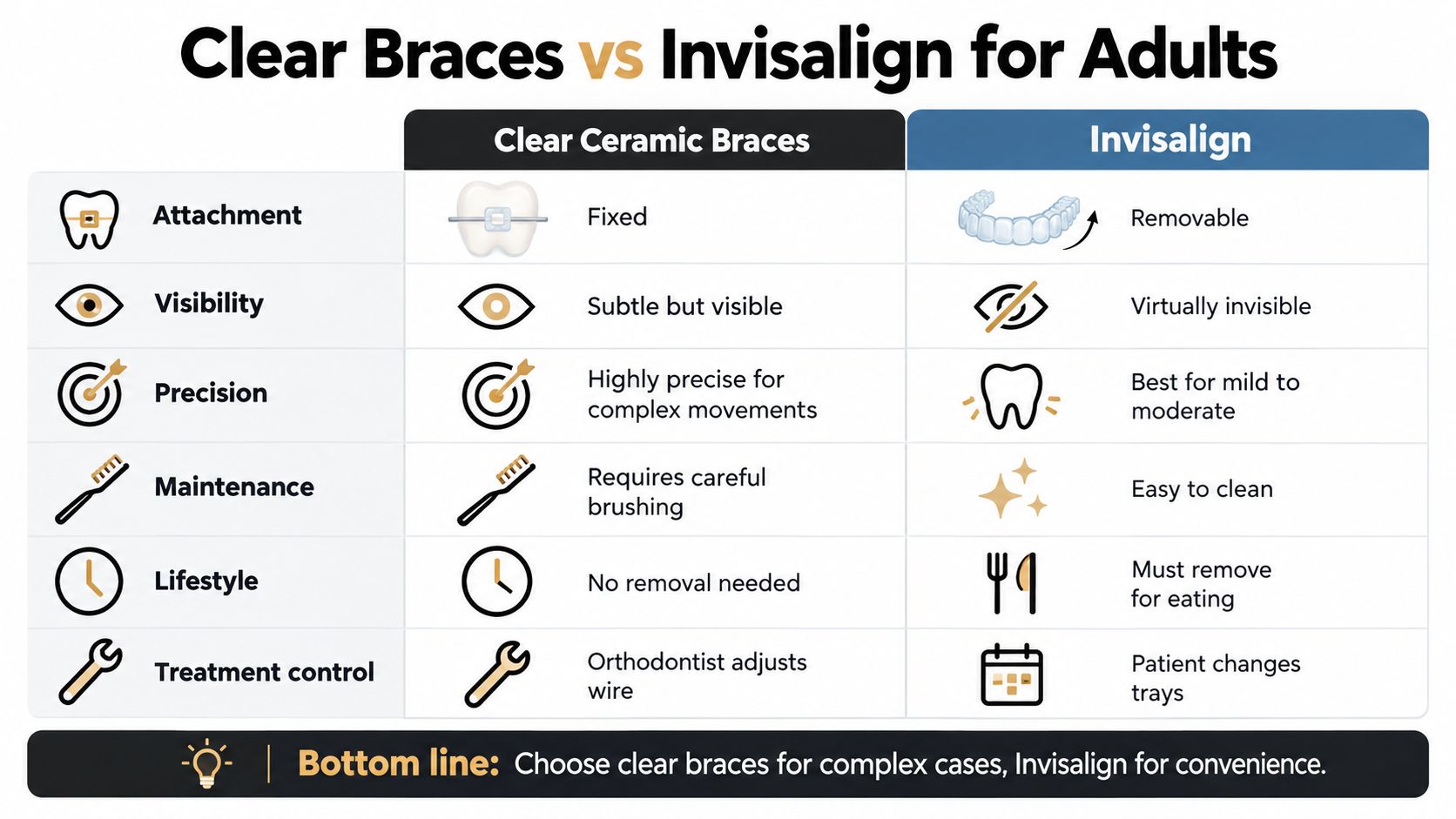
Ceramic braces stay attached to the teeth. Invisalign uses a series of clear aligners that come out for eating, drinking anything besides water, brushing, and flossing. Aligners can suit adults who want minimal visibility, but their results depend on wearing them close to the prescribed 20 to 22 hours per day. Treatment performance is therefore tied to daily consistency, as discussed in the earlier review of aligner effectiveness and wear time.
What matters during a workday
| Feature | Clear Ceramic Braces | Clear Aligners |
|---|---|---|
| Attachment | Fixed brackets and archwire | Removable trays |
| Visibility | Subtle, but visible on close inspection | Usually less noticeable |
| Compliance | The appliance stays in place | You must wear the trays as prescribed |
| Complex movement | Often offers strong control for demanding movements | Usually most predictable for suitable mild-to-moderate cases |
| Eating | Avoid foods that can damage brackets or wire | Remove aligners before eating |
| Cleaning | Brush and floss carefully around brackets | Clean teeth and trays separately |
| Office routine | No removal during meetings | Keep a case available and replace trays after meals |
A removable tray may fit a client-facing schedule until a long lunch, networking event, or travel day keeps it out for several hours. Ceramic braces remove that particular compliance decision, though they require careful cleaning and attention to foods that could damage brackets or wires.
Periodontal health adds another layer. The question is not whether an appliance looks clear. The review of periodontal outcomes and orthodontic appliance performance reports lower plaque, gingival inflammation, and bleeding scores with clear aligners than with fixed appliances, while fixed appliances may offer greater finishing precision for root torque, occlusal contacts, and extraction cases.
Adults considering Invisalign treatment in Manhattan should ask which movements are planned and how the appliance fits the workday. The consultation should also clarify whether the result depends on attachments, refinements, or consistent tray wear. Clear aligners can make meals and meetings easier, while ceramic braces provide continuous control without removal. The better choice is the system that matches the planned tooth movement, gum-care routine, and ability to maintain treatment habits through busy professional life.
Are You a Candidate and How Long Treatment Takes
Candidate selection starts with the teeth and supporting tissues, not with age alone. Many adults can receive orthodontic treatment, but the clinician needs to evaluate crowding, spacing, rotations, the bite, root position, gum health, restorations, and any previous orthodontic work before recommending ceramic braces.
The candidacy questions that change the plan
A mild spacing concern may require a simpler approach than a rotated tooth combined with a bite discrepancy. Teeth with existing crowns or significant wear may need coordinated restorative planning. Active gum disease, recession, or a history of periodontal maintenance also deserves attention before forces are applied.
Use these questions to prepare for an evaluation:
- What is the primary movement? Is the goal straightening, closing spaces, correcting rotations, improving the bite, or coordinating several issues?
- How healthy are the gums? Bleeding, recession, bone loss, and previous periodontal treatment can influence monitoring and timing.
- What dental work is present? Crowns, bridges, implants, large fillings, and worn teeth may affect bracket placement or sequencing.
- What can your schedule support? Fixed braces remove daily tray compliance, but you'll still need adjustment visits and consistent home care.
- What happens after treatment? A retainer plan should be part of the initial discussion, not an afterthought.
Treatment timing is case-specific. Clear aligners may shorten average treatment time in comparable adult cohorts when the case is appropriate and wear time is high, according to the clinical evidence cited above. Fixed braces can be advantageous when the orthodontist needs continuous control over more complicated movements.
Planning around Manhattan work
A busy calendar doesn't make treatment impossible, but it rewards planning. Bring your travel schedule, major presentations, weddings, conferences, and periods when regular visits may be difficult. Ask whether digital scans can replace conventional impressions, how appointments are spaced, and what the office's process is if a bracket loosens during a trip.
Adults should also distinguish calendar time from treatment quality. Rushing a biologic process to fit a deadline may not be realistic, and missed appointments or poor hygiene can create delays. A sensible plan protects the teeth and gums first, then fits treatment into the rhythm of work and life.
For a related discussion of aligner timing and planning, review how long Invisalign takes, while remembering that the final timeline must be individualized.
Benefits Drawbacks and What Research Really Shows
Ceramic braces offer a middle path. They're less visually prominent than metal brackets, but they still provide a fixed system that works continuously. That can appeal to professionals who want discreet treatment without managing trays during every meal or coffee break.
The drawbacks are practical. Brackets create more surfaces around which plaque can collect, and ceramic materials may be more vulnerable to damage than metal in some situations. The appliance can also irritate the cheeks during the adjustment period, and food choices require more care.
The gum-health question deserves precision
Adults often ask whether clear aligners are healthier for the gums than fixed braces. Research generally favors aligners on plaque, gingival inflammation, and bleeding indices, but the differences are reported as small, and the evidence is heterogeneous with possible observational bias. That means a removable tray isn't a substitute for brushing, flossing, professional cleaning, or periodontal supervision.
The more important limitation concerns adults who already have periodontitis. A 2025 expert consensus found no definitive evidence that clear aligners are superior to fixed appliances for maintaining periodontal health in patients with periodontitis. If you have recession, bone loss, or a history of periodontal maintenance, the right question is not “Which appliance is cleanest?” It's “Which plan can my gums tolerate with appropriate monitoring?”
For an adult with gum disease, appliance choice should follow periodontal assessment, not advertising language.
The black-triangle conversation
The final appearance of the smile can involve more than tooth alignment. Adults may notice open gingival embrasures, commonly called black triangles, after treatment. A 2023 retrospective cohort study reported higher rates after clear-aligner treatment than after fixed appliances, with open embrasures at the maxillary central incisors in 35.0% versus 18.0%, and at the mandibular central incisors in 38.0% versus 24.0%. Those figures come from the PubMed record on post-treatment open gingival embrasures.
That finding doesn't mean clear aligners cause an undesirable result in every adult. Tooth shape, contact position, gum architecture, bone support, age-related tissue changes, and the amount of crowding all influence the outcome. Ask whether your plan includes space management, enamel reshaping, composite bonding, or other finishing options if needed.
Retention creates another tradeoff. Clear plastic retainers may support favorable periodontal conditions, but they also carry a higher failure risk than some other retainer types. A beautiful result still depends on long-term retainer use and follow-up.
Daily Care Costs and Life With Clear Braces in Manhattan
The first week is usually about learning a new routine. Your lips and cheeks may need time to adapt, and your teeth may feel tender after placement or later wire adjustments. Softer foods, orthodontic wax, and following your clinician's instructions can make that transition easier.
Cleaning takes more intention than it does without brackets. A rushed morning routine before the subway isn't enough if plaque remains around the ceramic edges and gumline.
A workable office-day routine
- Pack a compact kit: Keep a soft toothbrush, fluoride toothpaste, floss or an interdental cleaner, and orthodontic wax in your desk or work bag.
- Brush by sections: Clean above the brackets, directly across the bracket surfaces, and below them. Angle the brush toward the gumline rather than scrubbing only the front of the appliance.
- Clean between teeth: Use floss threaders, orthodontic floss, or an interdental brush to reach areas a standard toothbrush misses.
- Choose foods strategically: Avoid hard, sticky, or chewy foods that can loosen brackets or bend wires. Cut firm foods into smaller pieces instead of biting directly with the front teeth.
- Protect the appearance: Coffee, tea, dark sauces, and red wine can discolor elastic components used with some ceramic systems, so ask how your specific appliance is maintained.
- Respond quickly to damage: A loose bracket, poking wire, or persistent soreness deserves a call rather than improvised repairs.
Costs and appointment logistics
The fee depends on case complexity, appliance design, treatment length, diagnostic records, refinements, retention, and whether other dental care must happen first. Insurance benefits vary, so ask the office to verify coverage and explain claim procedures before treatment begins. Request a written estimate that separates the orthodontic fee from optional or additional services.
A centrally located practice can reduce friction for professionals working near Central Park South, Columbus Circle, or Midtown offices. Choosing a Midtown Manhattan dentist can also be relevant when you want orthodontic planning coordinated with cleanings, fillings, periodontal care, or restorative treatment.
For travel, keep wax and the office contact details accessible. If you're leaving the city, schedule needed adjustments early and ask what to do if an appliance problem occurs while you're away.
Taking the Next Step Toward Your New Smile
Clear braces can give adults a discreet fixed option when the treatment plan requires continuous control. They may suit a professional who doesn't want removable trays, who prefers not to manage wear-time compliance, or whose bite requires movements that are better controlled with brackets and wires.
Clear aligners may be more convenient for an adult who can reliably wear them, remove them for meals, clean them consistently, and keep track of each tray. Neither option wins automatically. Case complexity, gum condition, daily routine, appearance preferences, and retention expectations should determine the recommendation.
Before your consultation, write down the changes you want, list previous orthodontic treatment, note any gum bleeding or recession, and bring your work and travel constraints. Ask to see the proposed movement plan, understand what could extend treatment, and discuss how the finished result will be retained.
Paul L. Gregory, DDS, at 57 W 57th St, offers adult clear braces and Invisalign alongside digital X-rays, intraoral imaging, impression-free scanning, periodontal care, and restorative services. That combination can help coordinate orthodontic planning with the wider dental conditions that affect a stable, healthy smile.
Retention deserves the same seriousness as active treatment. Teeth can shift after braces or aligners, so wearing the prescribed retainer and attending follow-up visits protects the alignment you invested time and effort to achieve.
Schedule an evaluation with Paul L. Gregory, DDS to discuss whether clear braces or Invisalign fits your bite, gum health, appearance goals, and Midtown schedule. Bring your questions about treatment control, daily care, costs, and retention so you can leave with a plan built around your actual work life.