

You're on the way to work in Midtown when a tooth starts throbbing. By the time you reach your office, cold water causes a jolt, chewing feels impossible, and you're wondering whether the dentist will recommend the treatment you've been trying not to think about: a root canal.
That fear is understandable, but a root canal isn't a punishment for neglect. It's a tooth-preservation procedure designed to remove diseased tissue, stop infection inside the tooth, and keep your natural bite working. The decision usually isn't between discomfort and comfort. It's between treating a tooth that may still be saved and removing it, then planning how to replace it.

This guide walks through the diagnosis, the appointment, recovery, and the honest comparison with extraction and replacement. If a broken tooth is part of the problem, you can also review this practical guide to what to do after breaking a tooth. A clear plan can make the next dental visit feel much less intimidating.
When Tooth Pain Disrupts Your Day
A toothache rarely arrives at a convenient time. You may wake before an important presentation with a deep pulse in one molar. You may notice swelling while riding the subway home, or discover that a tooth that hurt for days has suddenly gone quiet. That last change can feel reassuring, but it doesn't always mean the underlying problem has resolved.
Many people associate root canal dental treatment with pain. In practice, the treatment is intended to address the source of pain inside the tooth. A dentist first determines whether the pulp, the living tissue in the center of the tooth, is inflamed or infected and whether the remaining tooth structure can be restored.
A useful mindset: The question isn't simply, “Can I tolerate this toothache?” It's, “Can this tooth be stabilized and kept functional?”
Root canal therapy often becomes part of a broader restorative plan. The dentist may recommend a filling for a tooth with enough remaining structure, or a crown when the tooth needs more protection after treatment. If the tooth is too cracked, weak, or damaged to restore, extraction may be safer. That's why diagnosis matters more than the word “root canal” alone.
A prompt evaluation is especially important if swelling is spreading, you have fever, you can't open your mouth normally, or swallowing and breathing feel difficult. Those symptoms require urgent professional attention rather than waiting for the pain to pass. A Midtown practice with emergency assessment can help determine whether the tooth needs immediate stabilization, root canal treatment, extraction, or another type of care.
For a busy New Yorker, the practical benefit of an early visit is control. You can learn what is happening, understand your choices, and schedule treatment before the tooth forces an emergency decision during a weekend or workday. The sections below explain the process in plain language, including what you'll feel, what recovery usually involves, and why saving a natural tooth can be worth discussing before choosing removal.
Understanding What a Root Canal Really Does
Think of a tooth as a small house. The enamel and dentin form the protective walls, while the pulp chamber and canals act like a narrow plumbing and electrical system inside. The pulp contains nerves and blood vessels, so damage to this inner space can create intense sensitivity or pain.
A cavity, crack, repeated dental work, or trauma can allow bacteria to reach the pulp. Once the pulp becomes severely inflamed or infected, the tissue may not recover on its own. The dentist then treats the inside of the tooth while preserving the outer shell.
The treatment in four straightforward actions
Create access. The dentist makes a small opening through the biting surface or back of the tooth to reach the pulp chamber.
Remove diseased tissue. Tiny instruments remove the damaged pulp from the chamber and the root canals.
Clean and shape the canals. The dentist uses irrigation and shaping instruments to reduce debris and bacteria and prepare the canals for filling.
Seal the space. A root-filling material closes the cleaned canals so bacteria have less opportunity to re-enter. The tooth then receives a temporary or permanent restoration, depending on the treatment plan.
Antibiotics can sometimes help control a spreading dental infection, but they don't remove infected pulp trapped inside the tooth. They may support urgent care when swelling or systemic symptoms are present, yet they aren't a substitute for treating the source. The dentist decides whether medication is appropriate after examining you.
Keeping the natural tooth also preserves its position in the bite and avoids the immediate loss of tooth structure caused by extraction. That doesn't mean every tooth should be saved at any cost. A vertical root fracture, inadequate remaining structure, or severe bone and gum problems can change the recommendation. The useful question is whether the tooth has a reasonable restorative outlook.
For a broader explanation of how the treatment fits into restorative care, see this overview of root canal treatment and tooth preservation. The key idea is simple: root canal therapy treats the infected interior while allowing the restored natural tooth to continue doing its job.
Symptoms That Suggest You Need a Root Canal and How Dentists Confirm It
Symptoms can point toward a pulp problem, but they can't confirm one by themselves. A tooth that hurts with cold may have decay, a crack, a worn filling, exposed root surface, or irritated pulp. The dentist combines your history with clinical tests and imaging before recommending treatment.
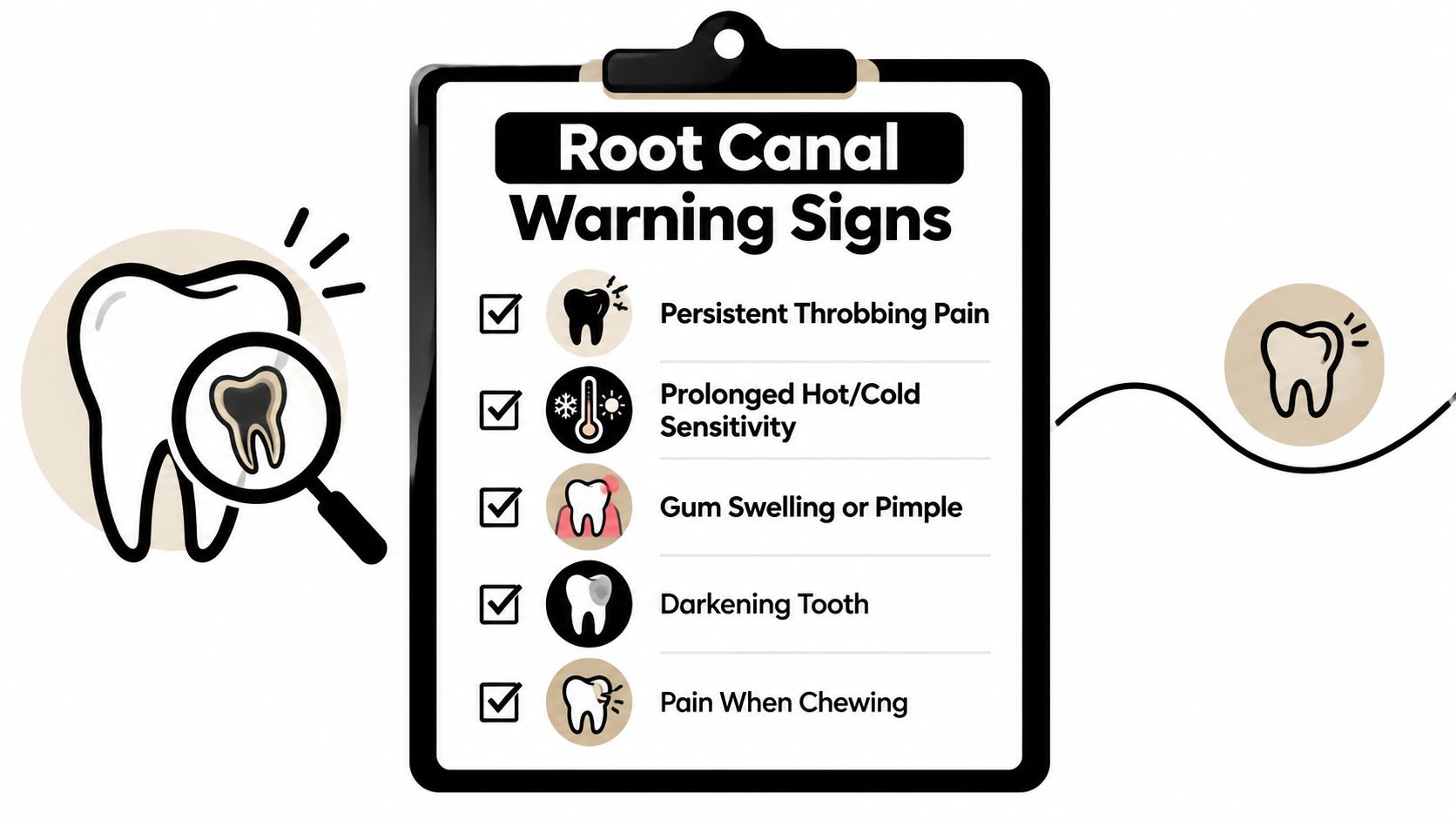
Symptoms worth reporting clearly
- Persistent or throbbing pain: Pain that lingers, interrupts sleep, or returns without a clear trigger deserves an examination.
- Prolonged hot or cold sensitivity: A quick response that disappears immediately is different from pain that continues after the drink or food is gone.
- Pain when biting: Pressure pain can involve the pulp, the ligament around the tooth, a crack, or an uneven restoration.
- Swelling or a gum pimple: A small draining spot may be the visible path of an infection, even when the tooth itself doesn't hurt much.
- Tooth darkening: A gray or brown change can follow trauma or loss of pulp vitality.
- A sudden decrease in pain: If the nerve stops responding because the pulp has died, infection may still remain around the root.
The dentist may begin with a visual examination and an intraoral camera. This can reveal cracks, leaking fillings, decay, gum changes, and areas you can't see in a bathroom mirror. Tapping the tooth and asking you to bite on a small device helps assess the tissues supporting the root.
What the diagnostic tests reveal
A cold test compares the response of the suspected tooth with nearby teeth. The timing, intensity, and duration of the response help the dentist evaluate pulp health. Digital X-rays show roots, surrounding bone, decay, restorations, and the shape of the tooth, although a standard image can't answer every question.
A three-dimensional CBCT scan may be considered when the anatomy is complex, symptoms don't match the two-dimensional image, a crack is suspected, or a previously treated tooth needs evaluation. It isn't automatically necessary for every patient. The dentist weighs the diagnostic benefit against the need for additional imaging.
You can make the appointment more productive by describing when the pain began, what triggers it, whether it lingers, and whether chewing or lying down changes it. Bring information about recent dental work or an injury. For a closer look at the imaging side of diagnosis, review this guide to digital X-rays for teeth.
Seek urgent care for facial swelling, fever, rapidly worsening pain, difficulty swallowing, or difficulty breathing. Don't wait for a gum pimple or a pain-free day to decide that the problem has disappeared.
Inside the Root Canal Procedure From Numbing to Sealing
The appointment follows a controlled sequence. Your dentist explains the plan, confirms the tooth, and uses local anesthetic before beginning. You should feel pressure, vibration, or movement, but you shouldn't feel sharp pain. If you do, raise your hand so the dentist can pause and add anesthesia.
What happens in the chair
Numbing the area: Local anesthetic desensitizes the tooth and surrounding tissues. The team checks numbness before treatment starts.
Isolating the tooth: A rubber dam keeps saliva away and helps protect your mouth from instruments and cleaning solutions. It also creates a cleaner working field.
Creating access: A small opening gives the dentist a direct route to the pulp chamber. Magnification, illumination, intraoral imaging, and digital planning can help the dentist see and preserve sound tooth structure.
Cleaning and shaping: Fine files remove pulp tissue and shape the canals. Irrigation helps flush debris and reduce microorganisms in spaces that instruments can't contact directly. The dentist may take images during treatment to confirm working length and anatomy.
Filling and sealing: The canals are filled with a root-filling material, commonly gutta-percha, and sealed. The outer opening receives a temporary or permanent restoration.
The treatment can feel repetitive because the dentist alternates between instrumentation, irrigation, drying, and checking. You may hear a high-pitched sound or feel vibration, but the anesthetic should prevent sharp sensations. A bite block can reduce jaw fatigue, and you can agree on a stop signal before treatment begins.
A first treatment differs from retreatment. During retreatment, the dentist removes the previous filling material, looks for missed or complex canals, and evaluates the restoration and surrounding tissues. A fractured tooth or acute infection may also require emergency stabilization before definitive treatment. The immediate priority may be drainage, medication when indicated, a temporary restoration, or a plan to return for complete treatment.
Digital scanning can help plan the restoration that protects the tooth afterward. In some cases, minimally invasive access, enhanced visualization, guided techniques, or CBCT-assisted planning may help the dentist remove less sound structure. Reviews of newer endodontic approaches describe a movement toward conservative dentin removal, improved visualization, enhanced irrigation, and emerging bioactive or regenerative materials, while some applications remain developing rather than routine for every case. A recent endodontic review provides background on these advances.
Here is a short visual explanation of the sequence:
The filling technique can affect how well material adapts to canal walls, but available evidence doesn't show a clear short-term clinical winner among commonly used methods. A 2026 systematic review and meta-analysis reported similar primary-treatment success across filling techniques at six and twelve months, with reported rates of 87.1% and 87.2%, respectively, and no significant difference among the evaluated methods. The review also discusses voids and adaptation across techniques. The dentist's diagnosis, disinfection, restoration, and follow-up remain central to the result.
For practical planning around appointment length, use this guide to how long a root canal takes. The exact schedule depends on the tooth, anatomy, infection, restoration, and whether treatment is initial or a retreatment.
Pain Management Recovery and Aftercare You Can Follow
After the anesthetic wears off, the tooth may feel tender when you bite. The surrounding ligament can remain irritated, especially if the tooth was painful or infected before treatment. Mild soreness should gradually become easier to manage, but worsening pain, increasing swelling, or a bite that feels clearly too high deserves a call to the dental office.
A practical recovery rhythm
During the first day, avoid chewing until normal sensation returns so you don't bite your cheek or tongue. Choose softer foods, chew on the opposite side, and use any pain medication exactly as directed by your dentist or medical clinician. A cold compress placed against the cheek for short intervals may help with soreness.
Over the next few days, brush and floss carefully around the treated tooth unless your dentist gives different instructions. Don't test the tooth repeatedly with hard foods, ice, or deliberate clenching. If you received a temporary restoration, protect it and contact the office if it loosens or falls out.
During the following week or two, the tooth should become more comfortable as the tissues settle. Keep the restoration appointment, because a root-treated tooth may need a crown or another cuspal-protecting restoration when the remaining structure is vulnerable to fracture. The dentist decides based on tooth type, remaining walls, cracks, bite forces, and the size of the restoration.
Workday planning: Schedule the procedure when you can keep the rest of the day flexible, especially if you're unsure how you'll respond to numbness or soreness. Many patients can resume routine activities, but your own instructions should take priority.
Call promptly if pain escalates instead of easing, swelling returns, the temporary filling breaks, you develop fever, or the tooth feels taller than the others when you close your teeth. Don't assume antibiotics are needed without an examination. Follow-up imaging may be recommended when the dentist needs to monitor healing or investigate persistent symptoms.
The best aftercare protects both comfort and the restoration. Keep the area clean, avoid chewing hard foods on an unprotected tooth, and treat the final crown or filling as part of the root canal plan, not as an optional cosmetic step.
How Successful Is a Root Canal Compared to Extraction and Implants
A root canal should be evaluated as a tooth-preservation decision, not as an isolated procedure. The outcome depends on the diagnosis, the amount of sound tooth remaining, the quality of cleaning and sealing, the final restoration, the bite, cracks, gum support, and long-term maintenance.
A systematic review of primary root canal studies published from 2003 to 2020 reported pooled success of 82% under strict criteria and 92.6% under looser criteria for cases with at least one year of follow-up. The updated review explains why those definitions matter. Strict criteria generally include clinical findings and radiographic healing, while looser criteria may focus more heavily on symptom resolution.
The decision matrix
| Option | Best For | Key Trade Offs | Follow Up Needed |
|---|---|---|---|
| Root canal and restoration | A restorable tooth with diseased or inflamed pulp | Preserves the natural tooth, but requires internal treatment and a protective restoration when indicated | Restoration checks, routine exams, and imaging when clinically appropriate |
| Extraction without replacement | A tooth that can't be predictably restored or is causing an urgent problem | Removes the source, but leaves a gap that can affect chewing and tooth position | Wound review and discussion of replacement or observation |
| Extraction and implant | A missing tooth with adequate planning for implant treatment | Replaces the tooth without using the original root, but involves surgical planning and staged restorative care | Implant, bone, gum, and crown maintenance |
| Extraction and bridge | A missing tooth where adjacent teeth can support a fixed replacement | Provides a fixed option, but requires preparation of supporting teeth | Checks of the bridge, supporting teeth, and gums |
| Extraction and no replacement | A tooth whose position and function make a gap acceptable | Avoids replacement treatment, but may affect chewing or neighboring teeth over time | Regular assessment of the gap and bite |
An implant isn't a direct substitute that makes extraction automatically preferable. It can be an excellent replacement option when a tooth can't be saved, but it introduces its own surgical, restorative, healing, and maintenance considerations. A root canal also isn't automatically the right choice if the tooth has an unmanageable fracture or insufficient structure.
For patients comparing these paths in detail, a dentist who provides both endodontic and implant services can coordinate the decision. You can learn more about the stages involved in dental implant treatment. Ask for a tooth-specific explanation: What can be saved? What would extraction involve? What restoration would follow? What happens if you postpone treatment?
One more point matters when comparing studies or practices. A 2022 systematic review of 39 studies reported weighted pooled success of 92.6% under loose criteria and 82.0% under strict criteria. The review details the difference between symptom-based and clinical-radiographic definitions. Those figures shouldn't be treated as a personal guarantee. They show why your dentist should define success clearly and monitor the tooth consistently.
Common Questions About Anxiety Sedation and Cost
Will a root canal hurt?
The purpose is to remove the diseased tissue causing the problem. Local anesthetic should control sharp sensation, while you may still notice pressure, vibration, or mouth fatigue. Tell the dentist immediately if you feel anything sharp.
What can help with dental anxiety?
Agree on a stop signal, ask for explanations before each stage, and discuss breaks, topical anesthetic, calming techniques, or sedation when appropriate. Sedation choices depend on your health, medications, procedure, and the clinician's assessment. Don't take a sedative on your own before an appointment.
How long will I stay numb?
Numbness varies by tooth, anesthetic, and individual response. Avoid chewing until sensation returns, and follow the specific instructions given after treatment.
Can I work the next day?
Many people plan normal activities after treatment, but soreness, numbness, or the complexity of the procedure may affect your schedule. Keep the next day flexible if your job requires prolonged speaking, travel, or demanding concentration.
Will insurance help with the cost?
Coverage depends on your plan, diagnosis, restoration, deductible, exclusions, and remaining benefits. Ask the dental office for a written estimate and request that the team check benefits before treatment. The fee for a root canal should also be considered alongside the restoration and any replacement option if the tooth is removed.
What if pain returns months later?
Contact the dentist rather than waiting. Persistent or returning symptoms can reflect a new cavity, a leaking restoration, a crack, complex anatomy, reinfection, or a problem from a neighboring tooth. Evaluation may lead to observation, retreatment, a surgical endodontic option, restoration repair, or extraction, depending on the findings.
Paul L. Gregory, DDS offers root canal evaluation and treatment, retreatment when indicated, digital diagnostics, restorative care, implant planning, and short-notice emergency assessment at 57 W 57th St. Visit Paul L. Gregory, DDS to request an evaluation, discuss tooth-preservation options, or ask about teledentistry screening before coming into the office.