

You've spent weeks noticing the same thing in work calls, restaurant conversations, and photographs: your smile doesn't match the confidence you feel in the rest of your professional life. You want a change that looks natural, fits a demanding Manhattan schedule, and won't create new problems with sensitivity, cleaning, or chewing.
That's why choosing a dentist for veneers is more important than choosing a shade, material, or attractive before-and-after gallery. Veneers are custom restorations, but the dentist determines whether they're appropriate, how much enamel is preserved, how the bite is managed, and whether the finished teeth remain comfortable and maintainable.
The dental veneers market reflects strong interest in cosmetic treatment. One market summary estimated the global market at $2.47 billion in 2024, up from $2.29 billion in 2023, and projected about $4.3 billion by 2030 at an 8.3% CAGR. The same source reported that North America represented 49% of global veneer revenue, while roughly 8% of Americans have veneers and about 600,000 Americans receive them each year. These figures describe a significant but still specialized elective treatment category, not a one-size-fits-all service. Read the cosmetic dentistry market overview.
This guide will help you evaluate a provider through three filters: candidacy, process transparency, and long-term maintainability. You'll learn what veneers can and can't correct, what happens during treatment, which technical questions matter, and how to assess results beyond the first photograph. For broader context on how cosmetic treatment can fit into overall care, review this guide to restorative and cosmetic dentistry.
Understanding What Veneers Are and Who Makes a Good Candidate
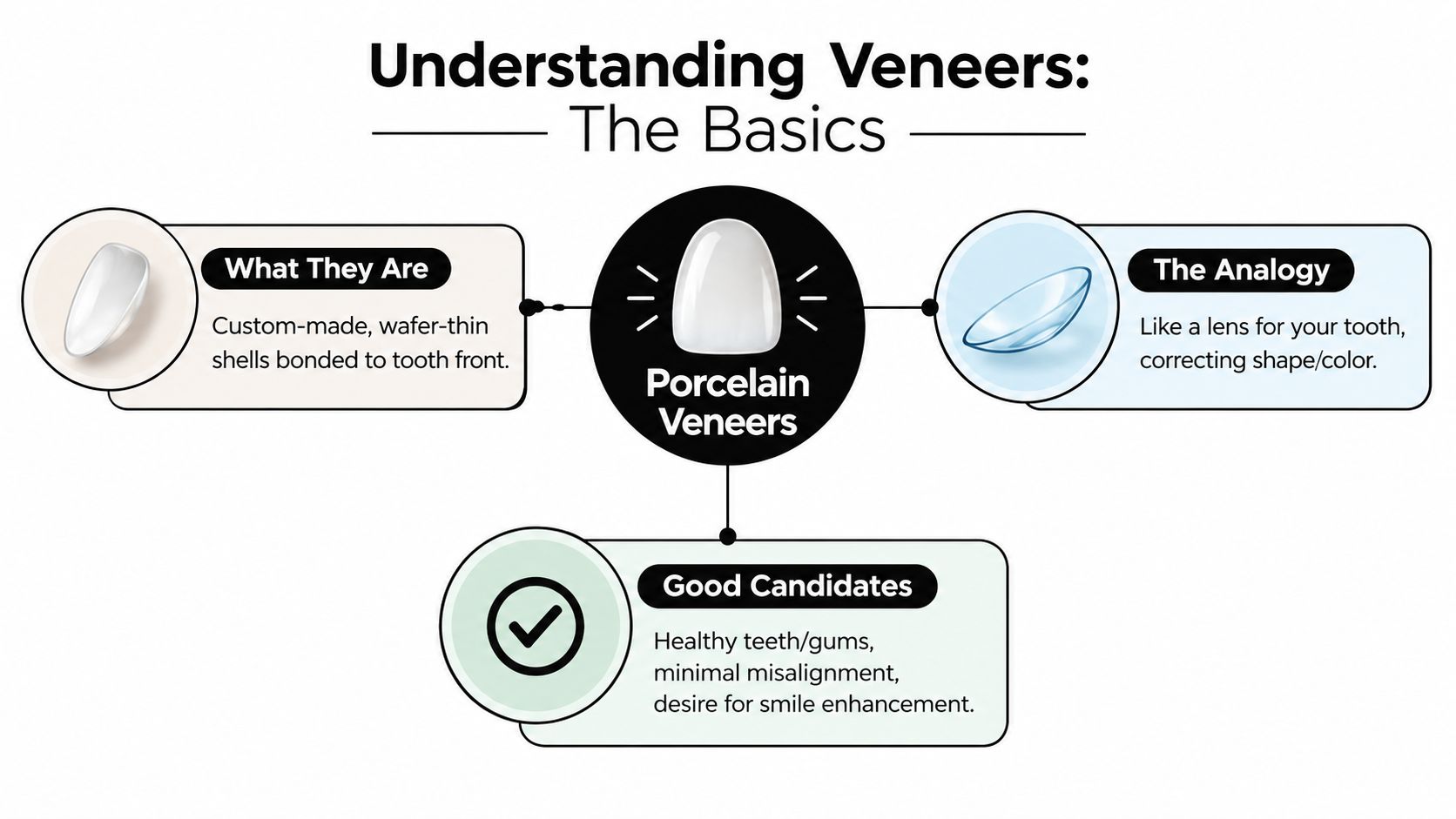
A porcelain veneer is a thin, custom-made shell bonded to the front of a tooth. It is similar to a contact lens, but for tooth shape and color. A contact lens changes how the eye focuses without replacing the eye itself. A veneer changes the visible surface of a tooth while the natural tooth remains underneath.
Veneers can improve several appearance concerns at once. They may help with chips, discoloration, uneven tooth shape, small spaces, and mild visual misalignment. They're not the same as orthodontic treatment, however. Veneers camouflage the visible position of teeth, while braces or clear aligners move teeth and can address certain bite relationships.
Porcelain and composite serve different purposes
Porcelain veneers are fabricated outside the mouth and then bonded to the teeth. Porcelain is commonly selected when a patient wants carefully controlled translucency, shape, and color. A separate market summary estimated that porcelain veneers account for about 60% of the market, reinforcing their established role in aesthetic dentistry. Review the 2026 veneer market summary.
Composite bonding uses tooth-colored resin placed directly on the tooth. It can be useful for a small chip or limited contour change, especially when a patient wants a more conservative or simpler option. The right choice depends on the amount of correction needed, the condition of the tooth, the bite, the patient's priorities, and the dentist's ability to control the final result.
Candidacy starts with health, not appearance
An attractive smile design can't compensate for active dental disease. A dentist should evaluate:
- Enamel availability: Veneer bonding is more predictable when the restoration attaches primarily to enamel.
- Gum health: Inflammation, bleeding, or untreated periodontal disease can compromise comfort, margins, and cleaning.
- Tooth structure: Significant decay, cracks, or extensive prior restorations may make a crown or other restorative treatment more appropriate.
- Bite forces: Heavy clenching or grinding increases stress on ceramic restorations and may require protective planning.
- Treatment goals: A patient seeking a subtle refinement may need a different approach from someone seeking a broad smile makeover.
A consultation should also consider whitening, orthodontics, or bonding before veneers. If teeth can be moved or lightened without removing enamel, that may be a more suitable first step. Patients exploring the question in more detail can review whether porcelain veneers are appropriate.
How the Veneer Treatment Process Works From Consultation to Final Bonding
A veneer case should feel planned, not improvised. Your dentist first studies your teeth, bite, gums, and goals, then tests the proposed design before deciding whether preparation is needed. That sequence protects the structure that will support the veneers and makes future cleaning, maintenance, and repairs easier to manage.
Consultation and smile design
The first visit may include photographs, a dental examination, bite evaluation, and digital scans. An intraoral camera can reveal cracks, old fillings, gum contours, and wear that a mirror may not show. Digital design helps assess proportions, though clinical judgment still determines whether the plan is healthy and functional.
A mock-up or trial smile lets you assess tooth length, lip support, speech, and facial balance before treatment is finalized. Use this stage to discuss whether you prefer a restrained refinement or a more noticeable change. The goal is a smile that suits your face and bite, rather than a copied celebrity look.
Preparation and temporaries
If preparation is needed, the dentist removes a controlled amount of enamel to make room for the ceramic and establish a stable path of insertion. Enamel provides a more predictable bonding surface than dentin, so preserving it supports the restoration's bond and helps limit future repair risk. One clinical review identified preserving at least 40% enamel during preparation as an essential threshold for adequate bond strength and long-term performance. Read the clinical review of ceramic laminate veneer preparation and bonding.
Preparation guides commonly cite about 0.3 millimeters for feldspathic porcelain and about 0.6 millimeters for lithium-disilicate systems. The actual design depends on the tooth, material, color change, position, and desired shape. A dentist should explain whether minimal preparation, no preparation, or selective reduction fits your anatomy. “No-prep” is not automatically more conservative if the final contours interfere with cleaning or the bite.
Temporary veneers protect prepared teeth and provide a practical rehearsal. Speak normally, check your bite, floss around each contact, and notice whether food catches near the gums. These observations help the dentist and laboratory adjust the final design before bonding.
Laboratory fabrication and final bonding
The laboratory fabricates each veneer from the approved design, photographs, scans, shade information, and functional instructions. At delivery, the dentist checks fit, contacts, margins, color, and bite before permanent cementation. For a visit-by-visit overview, read this guide to the porcelain veneers process.
For glass-ceramic veneers, the internal surface is typically treated with hydrofluoric acid etching, followed by silane coupling and adhesive resin cementation. The tooth surface is conditioned with 30% to 37% phosphoric acid for 15 to 30 seconds in commonly cited protocols. These steps create the chemical and micromechanical conditions that help the veneer remain attached.
Digital scanning can improve the workflow, but results still depend on technique. Evidence for veneer scanning remains inconclusive, and interdental spaces and operator experience can affect scan accuracy, scan time, and the number of images required. Review the PubMed evidence on digital workflows for veneers.
How to Evaluate a Dentist for Veneers Credentials Technology and Artistry
A general dentist may offer veneers, but occasional availability isn't the same as deep experience with aesthetic diagnosis, adhesive dentistry, bite management, and laboratory communication. You're evaluating a treatment system, not just a person holding a dental handpiece.
Start with clinical qualifications and relevant experience. Ask whether the dentist routinely performs cosmetic and restorative dentistry, how they handle worn or heavily restored teeth, and whether they can coordinate periodontal, orthodontic, endodontic, or restorative care when needed. A veneers-focused provider should be comfortable saying when veneers aren't the appropriate treatment.
Compare the evidence in a portfolio
Before-and-after photographs are useful only when you know what you're seeing. Look for cases with concerns similar to yours, such as worn edges, dark underlying color, spaces, short teeth, or uneven gum levels. Review images taken from comparable angles and lighting, and ask whether the photographs show immediate results or a later follow-up.
A polished gallery can demonstrate artistry, but it doesn't tell you how the restorations feel during cleaning. Ask to see margins, close-ups, and examples where the dentist made a subtle change rather than a dramatic makeover.
A strong portfolio shows consistency, not just one spectacular smile.
Technology supports judgment
Useful tools may include low-radiation digital X-rays, intraoral cameras, digital scanners, and digital smile-design software. Scanners can create impression-free models and help the dentist communicate with the laboratory. Intraoral photographs make it easier to discuss tooth proportions and gum contours.
Technology doesn't guarantee accuracy. A 2025 consensus found reliable accuracy for intraoral scanning inlays and onlays, while evidence for veneer restorations remained inconclusive because the study base was smaller. A 2024 in-vitro study found several digitally fabricated laminate veneer systems achieved clinically acceptable trueness and precision under controlled conditions. The practical lesson is simple: equipment matters, but operator technique, case selection, and quality control matter just as much.
Watch this overview of the veneer process before your consultation:
Continuity of care can also help. If a tooth needs evaluation for infection before cosmetic treatment, access to an endodontic specialist for root canal care within a coordinated practice can reduce fragmented planning. The same principle applies when veneers intersect with whitening, aligners, gum therapy, crowns, or night-guard treatment.
Smart Questions to Ask During Your Veneer Consultation
A consultation should be a two-way clinical discussion, not a sales presentation. Bring a short list, take notes, and compare the answers from each dentist while the details are fresh.
Questions that reveal planning quality
Ask:
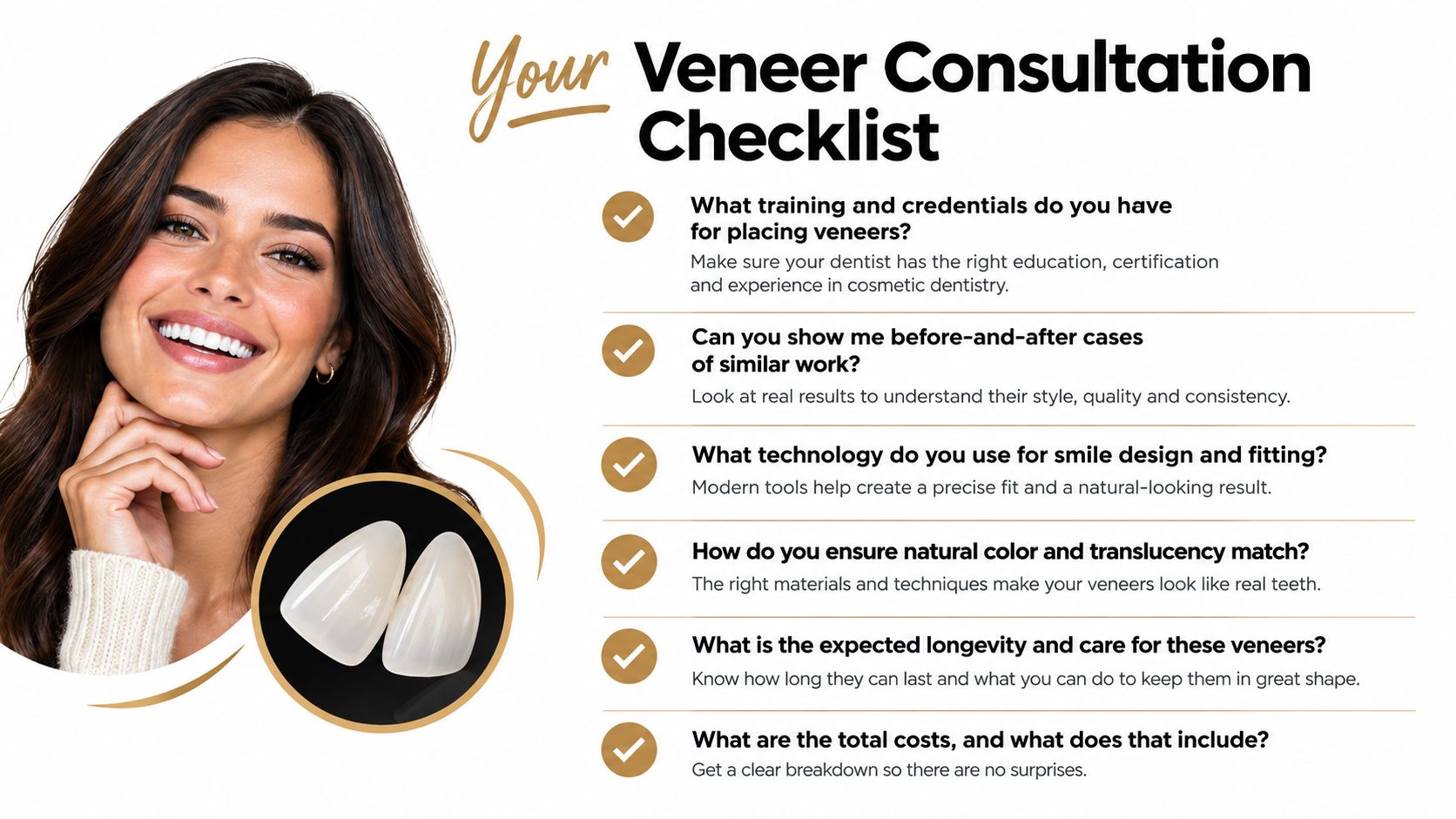
- What material do you recommend, and why? A useful answer should connect the material to your enamel, bite, color requirements, tooth position, and maintenance expectations.
- How much enamel can you preserve? Look for a specific explanation of where preparation is needed and where it isn't.
- What alternatives should I consider? A trustworthy dentist should discuss whitening, bonding, orthodontics, crowns, or no treatment when those options make sense.
- How will you evaluate my bite and grinding habits? The answer should address clenching, wear patterns, contact points, and whether a night guard may be appropriate.
- How will you check gum health and cleanability? Ask how the dentist will shape margins and contacts so you can brush and floss effectively.
- What happens if a veneer chips, debonds, or doesn't meet expectations? The dentist should explain likely causes, repair possibilities, replacement decisions, and financial policies in writing.
How to interpret the answers
A reassuring provider explains trade-offs without promising perfection. Be cautious if the dentist dismisses enamel preservation, guarantees a particular lifespan without discussing risk, or presents a single material as ideal for every patient.
Material choice deserves special attention because long-term complication risk varies. A systematic review reported 10.4-year complication rates of 41.48% for feldspathic veneers, 29.87% for leucite-reinforced glass ceramics, and 6.1% for lithium disilicate. The figures come from a review of available evidence, not a personal prediction for your case, but they show why material selection shouldn't be reduced to a shade preference. Review the systematic evidence on veneer complications.
Use a simple comparison sheet:
| Decision point | Consultation A | Consultation B |
|---|---|---|
| Enamel-preservation plan | ||
| Material rationale | ||
| Bite and grinding assessment | ||
| Cleaning and gum-health plan | ||
| Preview and temporary process | ||
| Repair and revision policy | ||
| Total fee and included services |
The best answer isn't always the longest. It's the one that makes the clinical reasoning understandable and leaves room for your questions.
Expected Results Maintenance Costs and Before and After Realities
A natural veneer result shouldn't look like a row of identical white tiles. The teeth should suit your face, lip movement, speech, age, and existing smile. Subtle differences in translucency, surface texture, length, and edge position often create a more believable result than uniform brightness alone.
Daily function deserves equal attention. A long-term outcomes study reported that common complications included marginal adaptation, gingival inflammation, and marginal discoloration. Patients were especially dissatisfied with function, food impaction, and cleaning difficulties, which makes the shape of the contacts and margins as important as the visible shade. Read the long-term outcomes study on veneer complications and patient satisfaction.
The real test of a veneer is not only how it looks in a photograph. It's whether you can clean it, chew comfortably, and keep the surrounding gums healthy.
Maintenance is part of the treatment
Brush and floss veneers as you would natural teeth, using a technique that protects the gumline and removes plaque around each margin. Keep regular examinations and professional cleanings so the dentist can monitor bonding, gum response, bite wear, and any changes in the supporting teeth.
If you clench or grind, ask about a custom night guard. Avoid using veneers to bite hard objects, open packaging, or apply force that your natural teeth wouldn't tolerate. A veneer can be strong, but it isn't indestructible, and repair may not always be possible.
Cost requires a complete conversation
Veneers are generally elective cosmetic treatment, so insurance may not cover the procedure or may cover only related diagnostic or restorative services. Manhattan fees can vary with the number of teeth, laboratory, material, preparation complexity, provisional restorations, diagnostic records, and whether other treatment comes first.
Ask for a written estimate that separates the consultation, scans and photographs, mock-up, temporaries, laboratory work, final bonding, follow-up visits, and possible maintenance. Also ask whether the practice helps with insurance claims or offers payment arrangements. A lower initial fee may not represent a lower total cost if the plan excludes essential diagnostic or follow-up care.
When reviewing before-and-after photos, ask about timing, lighting, camera angle, and whether the images show the gumline and side views. A strong result should hold up beyond the front-facing smile photograph.
Choosing Your Manhattan Veneers Provider With Confidence
Choosing a dentist for veneers becomes clearer when you stop treating the veneer as the product and start evaluating the treatment as a biological, functional, and artistic process.
Use three filters:
- Candidacy: Are your teeth, gums, enamel, and bite ready for veneers, or would another treatment protect more natural structure?
- Process transparency: Can the dentist explain the design, preparation, temporaries, laboratory work, bonding protocol, and adjustment process in language you understand?
- Maintainability: Will the finished restorations support comfortable chewing, effective flossing, healthy gums, and practical long-term care?
A provider who focuses only on shade and symmetry may miss the details that determine whether veneers remain comfortable in everyday life. A provider who evaluates enamel, contacts, margins, bite forces, material, and cleaning access is addressing the full treatment rather than just the photograph.
For busy professionals, location and continuity also matter. A centrally located office can make consultations and follow-ups easier to fit around work, while a practice offering cosmetic, restorative, periodontal, endodontic, and orthodontic services can coordinate care when veneers aren't the only issue. Use this guide to finding a Midtown Manhattan dentist as you compare providers.
Book a veneer consultation with Paul L. Gregory, DDS to discuss enamel preservation, material selection, digital planning, bite, and long-term cleaning needs. Visit Paul L. Gregory, DDS to learn about porcelain veneers and arrange a consultation that fits your Manhattan schedule.