

You've watched your smile on a video call, noticed a chip or uneven color, and started comparing your teeth with the polished smiles filling your social feeds. With a demanding schedule in Manhattan, the appeal is obvious: porcelain veneers can change the visible shape, color, and proportion of several teeth at once. The harder question is whether that change makes sense for your enamel, bite, budget, and long-term maintenance.
The most responsible answer to “should I get porcelain veneers?” isn't based on a before-and-after photo. Veneers are bonded restorations, not removable accessories. They may require permanent tooth preparation, and their future performance depends on how much healthy enamel remains, how your teeth contact, and how carefully you protect them. This guide focuses on those trade-offs so you can walk into a consultation with realistic expectations.
The Real Question Behind the Smile Upgrade
A busy professional often arrives at this decision after a small moment. Perhaps a front tooth catches the light differently during a presentation. Perhaps years of coffee, old dental work, a minor chip, or naturally uneven tooth shapes have made smiling feel more deliberate than spontaneous. Whitening may improve color, but it won't change tooth length. Aligners may improve position, but they won't correct every shape or shade concern. Veneers appear to offer one coordinated answer.
That convenience can be valuable, but it can also make the treatment seem simpler than it is. Porcelain veneers are thin ceramic restorations designed for the front surfaces of teeth. A dentist evaluates your bite, gum health, existing fillings, enamel thickness, tooth position, and cosmetic goals before deciding whether veneers are appropriate. The visible result may be immediate after final bonding, but the clinical decision extends far beyond that appointment.
The practical question: Don't ask only whether veneers can create the smile you want. Ask whether your teeth can support them conservatively and whether you're prepared to maintain them over time.
Veneers became a mainstream cosmetic option through a long technical evolution. Temporary acrylic veneers were used for performers in the 1920s, while permanent porcelain bonding became practical in 1982. A PubMed-indexed historical account later described porcelain veneers as the second most requested porcelain restoration in the United States over a 15-year span. That history supports their established role, but it doesn't make every case low risk. (Read the history of porcelain veneers in dentistry)
A consultation should therefore feel more like restorative planning than a retail purchase. You're deciding whether a durable aesthetic change is worth altering healthy tooth structure, accepting possible repairs, and committing to protective habits. For a broader view of how cosmetic goals intersect with restorative health, see this guide to restorative and cosmetic dentistry.
Who Makes a Strong Candidate for Porcelain Veneers
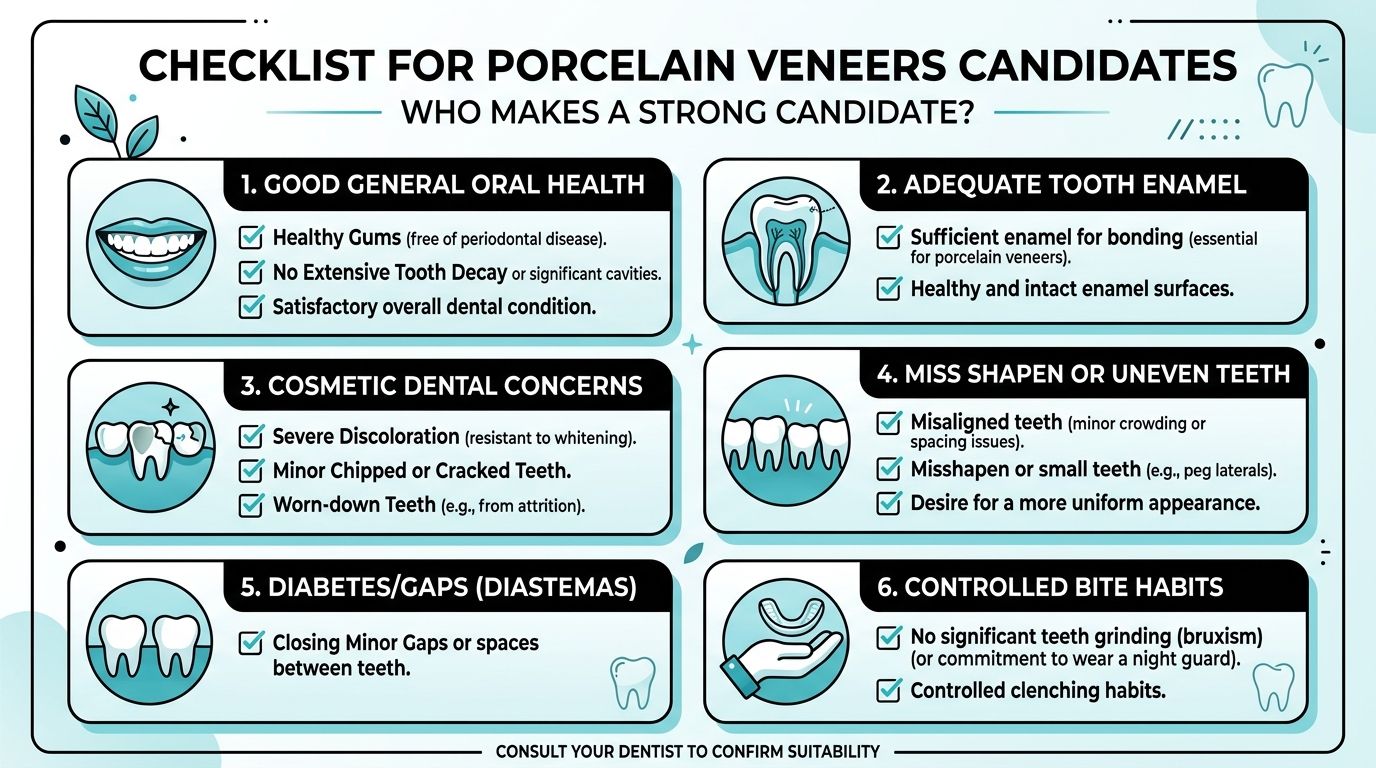
The strongest candidates usually have healthy teeth and gums, clear cosmetic goals, adequate enamel, and a manageable bite. Veneers can address concerns such as persistent discoloration, small chips, uneven contours, or limited shape differences, but they shouldn't be used to hide untreated decay, active gum disease, or an unstable bite. Those problems need attention before elective cosmetic treatment.
Enamel is the foundation
The most important technical question isn't which porcelain or cement a dentist selects. It's how the restoration bonds to the tooth. A British Dental Journal study found that limiting preparation to enamel mattered more for bond performance than the specific resin cement used. Broader evidence also identifies ceramic fracture as a major failure cause and reports stronger outcomes when preparation remains predominantly within enamel. (Review the enamel-preservation evidence)
That changes how you should evaluate a proposed treatment plan. Ask how much enamel the dentist expects to preserve, where preparation is needed, and why. A conservative plan may involve changing the contour minimally, while a more aggressive plan may be necessary for teeth with substantial discoloration, position problems, or prior restorations. The distinction matters because bonding becomes less predictable when little enamel remains.
Bite forces can decide the outcome
A deep bite, heavy occlusal loading, or uncontrolled bruxism can increase the chance of chipping and debonding. Patients who clench or grind may still have options, but the dentist needs to identify the habit and discuss protection, bite adjustment, or a different restoration before bonding porcelain.
Existing dental work also changes the risk assessment. Teeth with large fillings, significant surface loss, or limited remaining structure may not be ideal veneer candidates. A full-coverage crown can sometimes provide more appropriate structural support, while orthodontic treatment may improve tooth position before any cosmetic restoration. If alignment is part of your concern, review the practical considerations in how long Invisalign takes.
Use these questions to prepare for an examination:
- Enamel: Can the planned preparation remain predominantly in enamel?
- Bite: Do your front teeth experience deep or heavy contact?
- Grinding: Do you clench, grind, wake with jaw tension, or wear a night guard?
- Tooth structure: Do existing fillings or wear leave enough support for veneers?
- Goals: Are you correcting a defined concern, or pursuing a generalized social-media look?
A strong candidate isn't someone with a perfect mouth. It's someone whose dental condition, expectations, and habits make a conservative, maintainable result realistic.
Comparing Veneers to Bonding Crowns and Aligners
Veneers are useful when several visible characteristics need coordinated change, but they're not automatically the right response to every cosmetic complaint. Treatment should follow the source of the problem. A small chip may need additive bonding, while a tooth weakened by extensive damage may need a crown. A color-only concern may respond to whitening without altering enamel.
Veneers vs Alternatives at a Glance
| Treatment | Best For | Tooth Reduction | Longevity | Reversibility |
|---|---|---|---|---|
| Porcelain veneers | Coordinated changes in visible color, shape, minor chips, or limited spacing | Usually requires some preparation, with preservation of enamel as the priority | Multi-year restorative service, with outcomes varying by case and maintenance | Generally not reversible if enamel is removed |
| Composite bonding | Small chips, localized shape changes, and limited cosmetic repairs | Often minimal or additive | Requires ongoing evaluation and may be more repairable than porcelain | Often more conservative, depending on preparation |
| Crowns | Teeth with extensive structural damage or substantial existing restorations | More extensive coverage of the tooth | Designed for restorative support, with service dependent on tooth health and loading | Not reversible once tooth preparation occurs |
| Professional whitening | Teeth whose main concern is color | None | Color change requires maintenance and won't alter shape | Yes |
| Clear aligners | Position, spacing, or selected bite concerns | None | Alignment depends on retention and continued wear as directed | Treatment can be changed before completion |
The table's most important distinction is tooth preservation. If you mainly want a brighter smile, whitening is the least invasive place to start. If one or two teeth have small chips, bonding may solve the problem without committing an entire smile to porcelain. If the concern is crowding or spacing, aligners may address tooth position rather than masking it with restorations.
Crowns deserve careful separation from veneers. A veneer covers the visible front surface, while a crown is selected when a tooth needs more thorough structural protection. That doesn't mean a crown is “better.” It means the two restorations solve different clinical problems. Compare the indications in this discussion of porcelain veneers or crowns.
A useful filter: If your desired change is small, start by asking whether a smaller treatment can achieve it. Reserve veneers for goals that genuinely require their combination of color, contour, and coordination.
Some patients need sequencing rather than a single procedure. A dentist may recommend treating gum inflammation first, aligning teeth before cosmetic work, or repairing structural damage before considering facial restorations. The right plan may involve more than one treatment, but it shouldn't involve more tooth reduction than your goals require.
What the Survival Data Tells Us About Longevity
Porcelain veneers are a multi-year restorative investment, but survival data shouldn't be interpreted as a promise that every veneer will remain untouched for the same period. A systematic review found survival rates from 80.1% to 100% for follow-ups under five years, while studies with 10- to 12-year follow-up ranged from 53% to 94.4%. (Review the systematic evidence on porcelain veneer survival)
A separate clinical performance study estimated survival at 94.4% at five years, 93.5% at 10 years, and 82.93% at 20 years, while another long-term outcome study in general dental services found that 53% survived without re-intervention at 10 years. These figures describe different study populations, definitions, and clinical conditions, so they shouldn't be reduced to one guaranteed lifespan. They do show that veneers can perform for many years, while also making clear that repairs, replacement, or other intervention are part of the long-term picture.
Survival is not the same as untouched service
When a study reports survival, it may be tracking whether a restoration remains in place, whether it avoids a particular failure, or whether it survives without re-intervention. For a patient, those distinctions matter. A veneer can still be present while requiring adjustment, repair, monitoring, or attention to the tooth beneath it.
Common complications include fracture, chipping, debonding, marginal discoloration, resin dissolution, incomplete seating, and secondary caries. A longitudinal study found that 17% of restorations had a problem during follow-up, including 11% that debonded or were removed. A meta-analysis identified fracture and debonding as the main failure modes. (Review the long-term complication evidence)
Your starting point changes the forecast
The same restoration can carry different expectations in different mouths. Existing restorations and surface loss are associated with higher failure rates in the evidence summarized above, and inappropriate luting agents can also affect performance. Heavy bite forces, grinding, deep contacts, and preparation that extends beyond enamel add further concerns.
If you're in your thirties or forties, think beyond the first reveal. Over the next decade or two, your teeth, gums, bite, and restorations will continue to change. You may need future dental work, and replacing veneers can be more complex once teeth have already been prepared. Patients considering broader restorative needs should also understand how veneers differ from dental crowns, especially when tooth structure is compromised.
The practical conclusion is balanced: high survival is possible, but maintenance-free dentistry is not. Ask what could fail, how your dentist would manage it, and what protection your bite requires before you approve treatment.
The Treatment Process and Daily Maintenance Reality
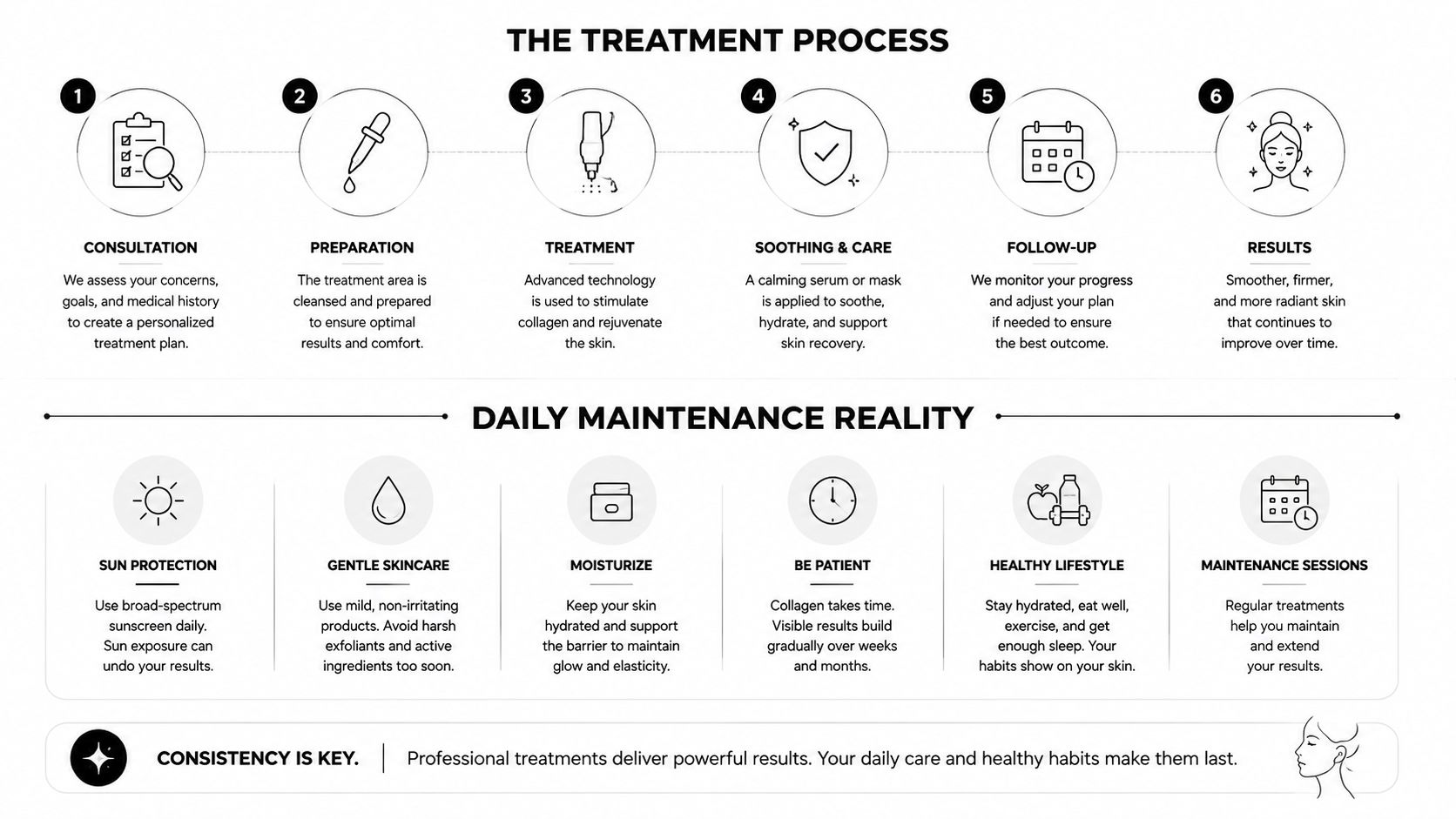
A veneer plan usually begins with a consultation focused on diagnosis, design, and tooth preservation. The dentist examines your teeth and gums, evaluates your bite, discusses the shade and shape you want, and may use digital scans or intraoral images to plan the result. You should learn whether veneers are appropriate at this stage, not just choose a color.
What the appointments involve
The treatment commonly unfolds across a small number of visits:
- Consultation and preparation: The dentist evaluates oral health and prepares the teeth conservatively if veneers are appropriate.
- Impressions and laboratory design: Physical impressions or digital scans guide the fabrication of custom porcelain.
- Temporary protection: Temporary veneers can protect prepared teeth and help you assess speaking, comfort, contour, and appearance.
- Final bonding and adjustment: The dentist checks fit, contact, color, and bite before bonding the permanent restorations.
Temporaries aren't just a waiting-room cover. They can reveal whether the proposed length feels natural, whether your speech changes, and whether the design suits your facial proportions. Raise concerns before final bonding, when changes are easier to make.
Protecting the result every day
Veneers don't decay, but the natural tooth at the margins still can. Brush carefully with a non-abrasive toothpaste, clean between teeth each day, and keep regular preventive appointments so your dentist can monitor the veneer margins, gums, bite, and underlying teeth.
Your daily habits matter:
- Use your teeth normally: Don't bite ice, pens, fingernails, or packaging.
- Manage grinding: If you clench or grind, ask whether a custom night guard is appropriate.
- Protect against impact: A properly fitted mouth guard matters for contact sports.
- Watch the margins: Bleeding gums, persistent sensitivity, rough edges, or a change in bite deserve an examination.
This maintenance isn't complicated, but it is ongoing. The veneer protects the visible surface, not your entire oral health routine.
Hidden Trade-Offs Most Guides Overlook
The biggest trade-off is permanence. If enamel is removed, the tooth won't return to its original condition when a veneer is removed. Even a conservative preparation can commit you to future restorative decisions, because the prepared surface may need another restoration when the original veneer eventually fails or reaches the end of its service.
That doesn't mean veneers are a poor choice. It means the decision should match the size and importance of the problem. If a patient wants a modest shade improvement or a subtle contour change, whitening or bonding may offer a more proportionate starting point. If the patient wants a coordinated change across color, shape, and visible proportions, porcelain may justify the commitment.
Cosmetic expectations need restraint
Social media tends to reward uniformity, brightness, and highly edited presentation. Natural-looking veneers should account for your complexion, facial features, gum display, speech, tooth proportions, and the way light moves through porcelain. A smile that looks striking in a filtered image may feel conspicuous in ordinary conversation.
Natural doesn't mean unnoticeable. The strongest cosmetic result is usually one that fits the person, not one that overwhelms the face.
Future care becomes more involved
Veneers can chip, fracture, debond, or develop marginal concerns. The evidence also identifies lower-frequency but non-zero problems such as secondary caries and endodontic issues. If a tooth already has substantial surface loss or a large restoration, the dentist must consider whether placing a veneer could complicate future treatment rather than simplify it.
The maintenance burden also includes decisions you may not anticipate. A veneer may need repair or replacement, and the tooth may require additional care beneath or around it. Ask how the practice handles a damaged veneer, what happens if the underlying tooth develops decay, and whether a night guard is part of your plan.
The right question isn't whether veneers are permanent. It's whether you accept the long-term cycle of monitoring, protection, repair, and eventual restorative planning that can follow enamel alteration.
Making Your Final Decision with Confidence
Before booking treatment, write down the concern you want to solve. Is it color, shape, a chip, spacing, wear, or a combination? Then ask whether whitening, bonding, or alignment could address the issue with less alteration. A responsible consultation should compare options rather than assume porcelain is the destination.
Bring these questions to the appointment:
- What will change: Which teeth need treatment, and what specific feature will each veneer correct?
- What remains: How much enamel can be preserved, and where would preparation extend beyond it?
- What could go wrong: How would the dentist manage chipping, debonding, sensitivity, or marginal problems?
- What protects the result: Do you need a night guard, bite adjustment, alignment, or gum treatment first?
- What comes later: How might future fillings, crowns, root canal treatment, or replacement affect the plan?
Look for a dentist who uses diagnostic records, explains the proposed design, and can show how the bite and tooth structure influence the recommendation. Digital scanners and intraoral cameras can make the discussion more concrete, but technology should support clinical judgment, not replace it.
Cost should be discussed before preparation, including the number of teeth, laboratory work, temporaries, follow-up care, and possible future repairs. For context, review this guide to how much veneers cost, then request a written plan specific to your mouth.
If the recommendation feels rushed or the dentist dismisses questions about enamel, grinding, or alternatives, get a second opinion. Veneers can be an excellent choice for the right patient, but confidence comes from understanding the commitment, not from being persuaded by a dramatic preview.
Paul L. Gregory, DDS offers cosmetic and restorative consultations for patients weighing porcelain veneers against whitening, bonding, crowns, or Invisalign, with digital scanners and intraoral cameras to support treatment planning. Visit Paul L. Gregory, DDS to discuss your goals, enamel preservation, bite, and a maintainable path to a healthier-looking smile.