

A root canal itself typically costs about $620 to $1,800 without insurance, depending on the tooth, while the crown that commonly follows can add $800 to $2,500, making the all-in cost closer to $1,500 to $4,700 per tooth. (Source: 2026 root canal cost guide)
You're sitting at the front desk with a numb jaw, a treatment recommendation, and a printed estimate sliding toward you. The root canal line looks expensive, but the crown listed underneath may be what turns an uncomfortable bill into a financial emergency. I've walked uninsured patients through enough estimates to know that focusing only on the endodontic procedure is the fastest way to underestimate what treatment will cost.
The practical question isn't, “How much is a root canal?” It's, “What will it cost to save this particular tooth, restore it properly, and pay for the care without creating a larger problem later?” The answer depends on tooth location, canal complexity, provider, restoration, and the payment arrangement you choose.
What Uninsured Patients Pay in 2026
A painful front tooth may fall near the lower end of the self-pay range. A molar, multiple canals, or difficult retreatment can push the combined root-canal-and-crown bill toward the top. Major consumer pricing guides place root canal fees around $1,200 on average, with front teeth at $700 to $1,100, premolars at $800 to $1,400, and molars at $1,000 to $1,800. (Source: root canal cost without insurance)
Those figures cover the procedure, not the permanent restoration. A crown can add $800 to $2,500, putting the complete treatment above $2,000 even when the root-canal quote looks manageable. Across 2026 pricing guides, the combined cost runs roughly $1,500 to $4,700 per tooth, based on tooth location, provider type, and restoration choice. (Source: 2026 uninsured root canal and crown costs)
The insurance-cap problem
A dental plan may contribute and still leave you paying like an uninsured patient. Typical annual maximums sit around $1,000 to $1,500, according to this root canal cost calculator guide. One root canal plus crown can consume much or all of that allowance, especially if the plan pays for the procedure first and leaves the crown outside the remaining benefit.
Start with the full bundle, then subtract the insurance contribution. That order exposes the amount you must fund yourself. If the annual maximum is exhausted before the crown is placed, plan for the restoration as direct payment.
Ask the office to price four paths: the standard self-pay bundle, any discount plan, an in-house membership option, and staged treatment when clinically safe. Compare each against your plan's $1,000 to $1,500 cap. A cash discount can beat a small insurance benefit, while a staged crown may spread payments without changing the treatment recommendation.
Provider choice also changes the bill. Review whether general dentists can perform root canals before paying an endodontist's fee, but choose based on tooth complexity and the dentist's experience, not the cheapest isolated line item.
How Tooth Type Drives the Root Canal Price
A front tooth is usually easier to reach and often has a simpler canal system. Premolars sit farther back, with canal shapes that vary. Molars commonly contain three to four canals in a harder-to-access position, so their complete treatment bundle usually costs more than treatment for a front tooth. The procedure fee is only part of the decision. Compare the root canal, buildup, and crown together, especially against a dental plan cap of $1,000 to $1,500.
The clinical work behind the bill follows four steps:
- Locate the canals. The clinician must find every opening, including canals that are narrow, calcified, curved, or hidden.
- Clean and shape each canal. More canals require more instrumentation, irrigation, working-length checks, and sealing.
- Control access and visibility. Back teeth can require difficult positioning, magnification, or imaging.
- Seal the system and prepare restoration. Removing infected pulp does not finish care. The tooth still needs a restoration suited to its remaining structure.
The four practical price tiers
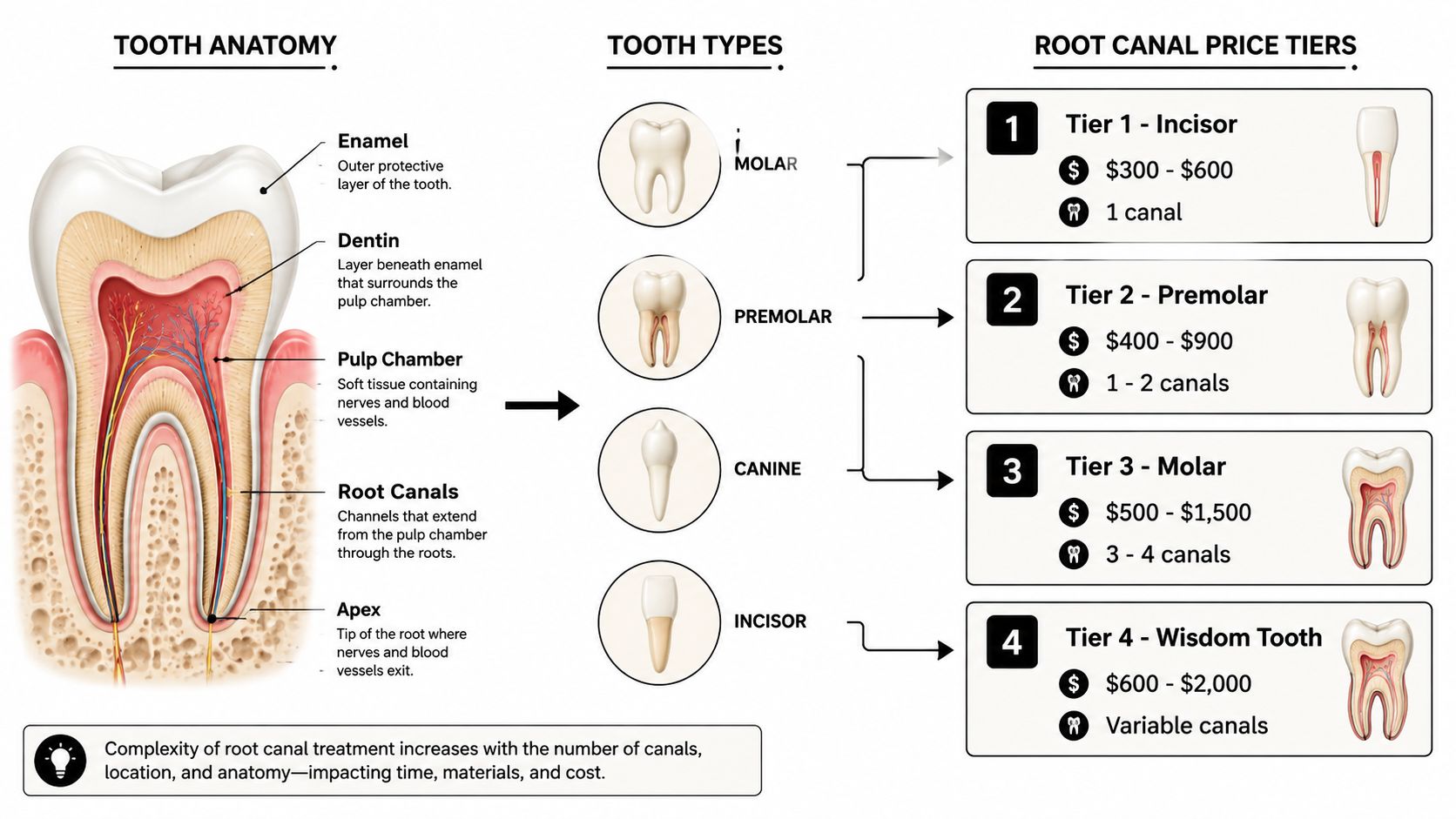
Consumer pricing places front-tooth treatment near $620 to $1,100, while molars commonly fall near $890 to $1,800. (Source: independent 2026 root canal cost ranges) Treat these as procedure ranges, not your complete self-pay budget. Add the buildup and crown before comparing the result with your plan's annual maximum.
A front tooth generally falls into the simpler tier. Premolars occupy the middle because access and canal shape vary. Molars belong to the complex tier because they commonly have three or four canals and demand more difficult work. Wisdom teeth require an individual assessment because their anatomy and restorability differ widely.
Ask the office to identify the tooth by name or number and state how many canals the clinician expects to treat. Request the root-canal-plus-crown total, along with the cash price, discount-plan price, in-house membership option, and any clinically safe staged-treatment plan. A generic “root canal” fee is not enough for a useful comparison.
Also ask how long the appointment may take and whether a general dentist can manage the case. This guide to root canal appointment length can help you prepare that conversation.
Price Ranges by Tooth and the Crown Factor
Your workable budget is the root-canal-plus-crown bundle, because the restoration can equal or exceed the procedure fee. Planning data places crowns around $800 to $2,500, with complete treatment reaching approximately $1,500 to $4,700 per tooth. (Source: 2026 root canal and crown bundle costs)
| Tooth Type | Root Canal Only | Crown Only, PFM / Zirconia | Combined Bundle |
|---|---|---|---|
| Anterior teeth | About $620 to $1,100 | About $800 to $2,500 | About $1,500 to $3,600 |
| Premolars | About $800 to $1,400 | About $800 to $2,500 | About $1,600 to $3,900 |
| Molars | About $890 to $1,800 | About $800 to $2,500 | About $1,700 to $4,700 |
Use these as general planning ranges, not promises. They assume cash payment, no dental coverage, routine treatment, and no retreatment. Your market, provider, imaging needs, tooth condition, laboratory, and restoration material can change the total.
Material choice affects each tooth differently. A front tooth may require a more appearance-focused ceramic option, while a molar may prioritize strength and cuspal coverage. PFM or zirconia can therefore shift the bundle for different reasons, even when the listed crown range is the same. Review the dental crown cost guide before accepting an unlabeled restoration fee.
After pulpal tissue is removed, the remaining tooth often needs cuspal coverage to reduce fracture risk, particularly in posterior teeth. On an anterior tooth, the crown may represent the larger share because the root canal is often simpler. A molar can demand a larger overall commitment because both canal treatment and restoration may be more involved.
Ask for the crown material, buildup, temporary restoration, laboratory charge, and final bundle total in writing. Compare that figure with your typical $1,000 to $1,500 dental plan cap. If the cap leaves most of the bundle unpaid, price the self-pay, discount-plan, in-house membership, and staged-treatment options instead of treating the plan as meaningful coverage.
What Moves Your Final Bill
Two patients can receive treatment on the same tooth and still receive different bundle estimates. Provider training, case difficulty, local operating costs, and the restoration plan all affect what an uninsured patient pays.
Provider and case complexity
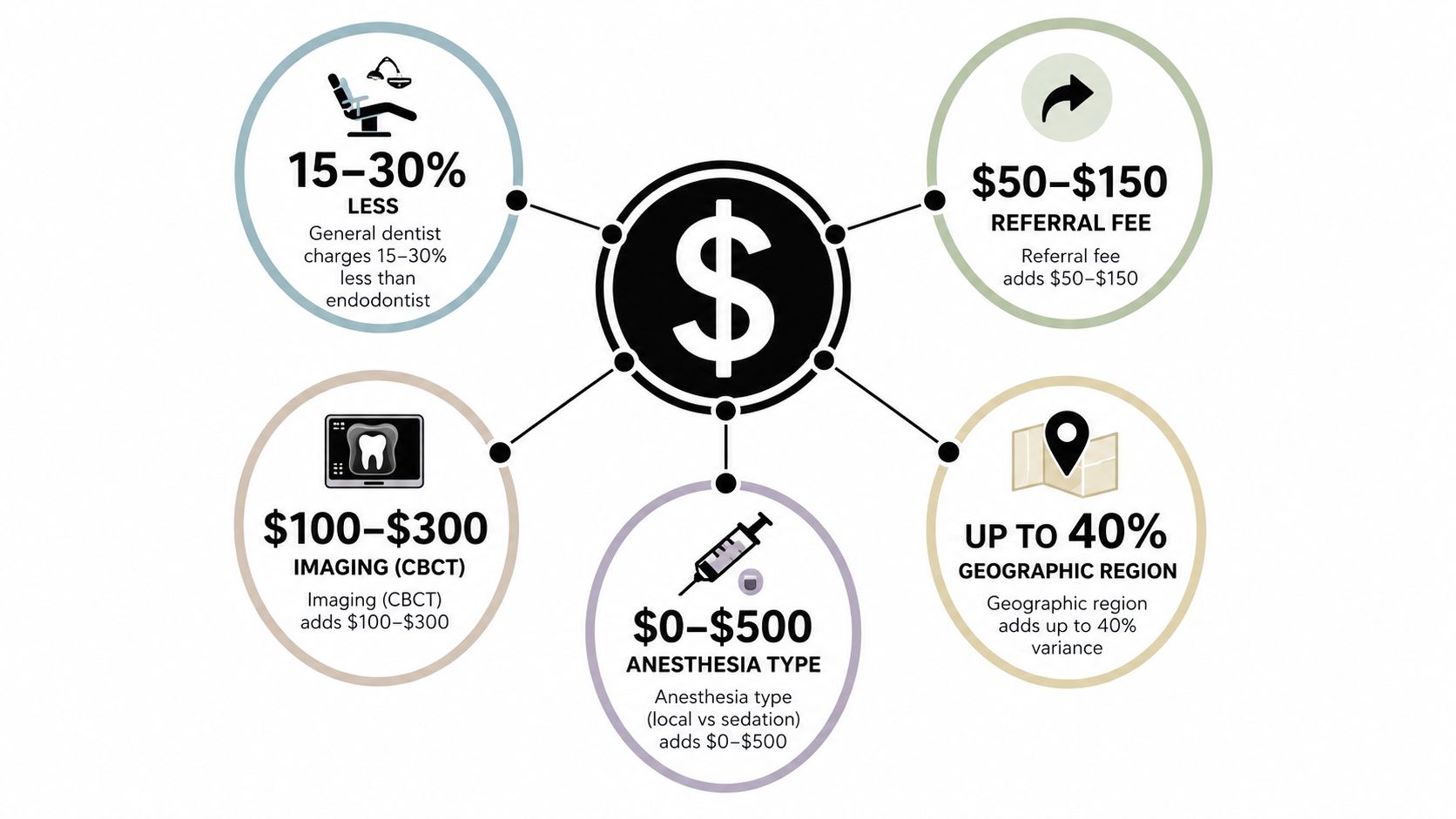
An endodontist usually charges more than a general dentist. That added cost can be justified when the tooth has difficult anatomy, a calcified canal, a curved root, or a previous root canal that requires removal and retreatment.
General dentists often handle routine cases, then refer complex molars to an endodontist. That referral may add a consultation, imaging, and another fee discussion. Ask whether the quoted clinician expects to complete the case before judging the offer. Focus on clinical fit and the full treatment plan rather than the first number on the estimate.
Retreatment deserves closer review. The clinician must address an existing filling or prior intervention before cleaning and sealing the canals again. Calcification, unusual anatomy, and weakened tooth structure can each expand the treatment plan. Request an estimate covering every expected visit, diagnostic imaging, temporary protection, the root canal, and the final crown.
Location and restoration choices
Dental fees vary with local operating costs and practice type. A specialist in a high-overhead urban office may quote a different bundle from a general dentist in a smaller market, even for the same diagnosis.
Crown material also changes the total. Common choices include ceramic, PFM, and zirconia, with different priorities for appearance, strength, and coverage. Ask which material the estimate includes and whether the crown fee covers the laboratory charge. Review how dental crown coverage is usually handled before assuming a dental plan will pay a meaningful share.
Office-manager rule: Get the endodontic fee and restoration fee in writing before deciding whether the bundle fits your budget.
Before accepting a crown estimate, confirm that preparation, temporary coverage, laboratory work, insertion, and follow-up adjustment are included. Compare the complete root-canal-plus-crown bundle with your typical $1,000 to $1,500 dental plan cap. If that cap leaves most of the bill unpaid, request self-pay, discount-plan, in-house membership, and staged-treatment prices in writing.
Why the Cheapest Quote Is Rarely the Best Deal
A molar quote that is $400 lower deserves scrutiny. If one office prices the complete root-canal-plus-crown bundle and another quotes only the procedure, the cheaper number is not a real comparison. Ask for an itemized estimate covering the full treatment path before you book.
A low fee works in your favor when the case is routine and the office clearly lists every required service. Problems start when the estimate excludes the crown, assumes uncomplicated canal anatomy, or comes from a provider who expects to refer the case after beginning treatment.
A missed canal or incomplete cleaning can leave infection behind. You may then pay for another evaluation and possibly specialist retreatment, while the tooth has undergone more work and is harder to restore. Compare the provider's experience with that tooth type, the complete bundle, and the backup plan if treatment fails.
Skipping the crown creates another false saving. A root-canaled tooth that needs cuspal coverage may fracture while you delay the recommended restoration. The decision can then shift from preserving the tooth to extraction and replacement, a much larger treatment commitment.
Judge the lifetime bill
Ask each provider:
- Who will perform the procedure? Confirm the clinician's experience with this tooth type and its canal anatomy.
- What happens if treatment fails? Request the expected retreatment, extraction, or referral pathway.
- What does the bundle include? Confirm imaging, temporary protection, crown preparation, laboratory charges, and insertion.
- Is the tooth restorable? Root canal treatment makes sense only when enough tooth remains to support a durable restoration.
Get the endodontic fee and restoration fee in writing. Then compare the complete bundle with your typical $1,000 to $1,500 dental plan cap. That limit may leave much of the crown and related care effectively self-pay, so request self-pay, discount-plan, in-house membership, and staged-treatment prices before choosing an office.
Choose the lowest complete and clinically appropriate bundle, not the lowest root canal line item.
Smart Ways to Budget and Finance the Treatment
Start by asking for the cash price for the entire root-canal-plus-crown plan. Some offices offer a self-pay adjustment, but the terms vary, so ask whether it applies to both the procedure and restoration, and whether payment must be made on the treatment date.
Compare the available levers
| Option | Typical Savings | Key Requirement | Watch Out For |
|---|---|---|---|
| Cash self-pay arrangement | May reduce the quoted bundle | Payment terms confirmed in writing | Discount may apply only to selected services |
| In-house membership plan | Can reduce participating fees | Enrollment and use at the same practice | Check exclusions, waiting rules, and restoration limits |
| Dental discount plan | Contracted fees at participating offices | Confirm the exact office and fee schedule | A plan fee may outweigh savings if the discount is small |
| Third-party financing | Spreads the balance over scheduled payments | Credit approval and signed terms | Deferred interest can become expensive if the promotional balance isn't cleared |
| Staged treatment | Separates urgent care from final restoration | Dentist confirms the tooth can safely wait | A temporary seal can fail, and follow-up must be scheduled |
Discount plans from providers such as Careington or Aetna Dental Access can help, but don't enroll based on the brand name alone. Ask for the contracted fee for your exact root canal and crown, then compare that amount with the office's cash quote.
Third-party lenders such as CareCredit, Sunbit, and Alphaeon may offer payment plans. Read the agreement carefully, especially whether the promotion uses deferred interest. If the balance isn't paid within the promotional period, accumulated interest may become payable under the agreement's terms.
Staging requires a clinical yes
Some patients complete the root canal first and delay the permanent crown while they save. That can be acceptable for selected low-bite-pressure teeth when the dentist provides a temporary restoration and a clear deadline. It isn't a universal budgeting trick. A tooth exposed to heavy chewing or one with significant structural loss may need faster protection.
An in-house membership plan may be worth comparing with financing if you expect additional dental care at the same practice. If you're also considering replacement treatment, review the broader planning implications in this dental implant cost guide, but don't let a future implant discussion replace a proper assessment of whether the natural tooth can be saved.
Your Decision Checklist Before You Book
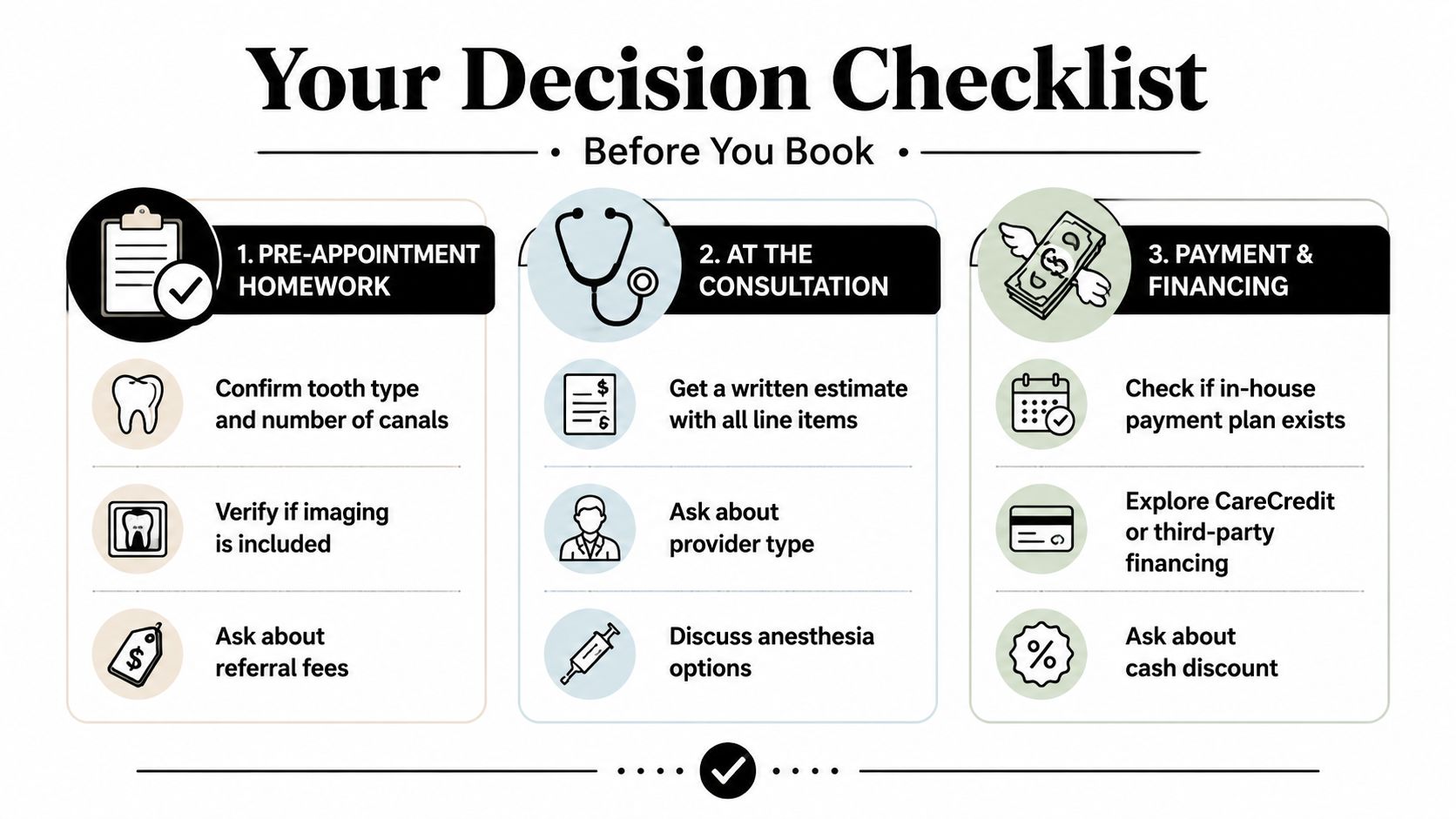
A low root-canal fee can still produce an unaffordable bill if the crown is missing. Before booking, get the complete root-canal-plus-crown bundle in writing, then compare how self-pay, discount plans, in-house membership, and staged treatment fit against the typical $1,000-$1,500 dental plan cap.
Before the appointment
- Identify the tooth: Confirm the tooth number and whether it is an anterior tooth, premolar, or molar.
- Confirm the full treatment: Ask whether the quoted bundle includes diagnosis, imaging, root canal treatment, temporary protection, crown preparation, laboratory work, and crown placement.
- Ask about the restoration: Find out whether a crown or another definitive restoration is expected, and when it should be placed.
- Clarify the provider: Ask whether a general dentist or endodontist will perform the root canal, and why that choice suits the tooth.
- Check imaging: Confirm which radiographs are available and whether new imaging is included.
During the consultation
Request an itemized written estimate, not a verbal total. Compare the office cash quote with any discount-plan or in-house membership price using the same root-canal-plus-crown bundle. A discount plan from Careington or Aetna Dental Access only helps if its contracted fee for your exact treatment beats the office's cash price.
Ask what each crown material includes, whether temporary protection is included, and what happens if the tooth does not heal. The estimate should state the likely cost and pathway for retreatment, extraction, or referral.
Before you authorize payment
- Check financing: CareCredit, Sunbit, and Alphaeon may offer payment plans. Review deferred-interest terms, the promotional deadline, late-payment rules, and whether financing covers both the root canal and crown.
- Ask about membership: Compare an in-house plan with outside financing if you expect more care at the same practice.
- Consider staging carefully: Ask how long the tooth can safely remain under temporary protection. Staging the crown may suit selected lower-bite-pressure teeth, but heavy chewing or major structural loss can require faster protection.
- Review benefits timing: If your dental plan has a $1,000-$1,500 cap, ask whether staging across plan periods is clinically appropriate and what you would pay.
- Pause under pressure: Unexplained referrals or extraction recommendations without a restorability assessment justify a second opinion.
Paul L. Gregory, DDS provides root canal consultations, restorative treatment planning, fee discussions, and payment options for patients paying out of pocket or using financing. Visit Paul L. Gregory, DDS to request an evaluation and a complete root-canal-plus-crown estimate.