

A complete single-tooth dental implant in the U.S. typically totals $3,000 to $6,500, while All-on-4 full-arch treatment runs $18,000 to $35,000 per arch. In Manhattan, the bill is often 20 to 40 percent above the national average, so you should budget like a New Yorker, not like someone pricing a suburban estimate.
Dental implants cost in 2026 is not one number. It's a stack of fees, and the office that gives you a clean, itemized quote is the one taking your case seriously, especially if you're comparing treatment at a Midtown practice like Paul L. Gregory, DDS.
What Dental Implants Cost in 2026
The national market is already in a defined range. A single dental implant, including the post, abutment, and crown, typically lands around $3,000 to $6,500. The published implant cost index puts the average at $4,507 across all 50 states and Washington, DC, and that is the number people ask for first, even though it only makes sense once you know what is included (Tooth Compass).
Full-arch treatment is a different bill entirely. All-on-4 or All-on-6 usually runs $18,000 to $35,000 per arch, and full-mouth reconstruction commonly reaches $36,000 to $100,000+. That is why implant dentistry sits in its own financial category, and why ads for a “cheap implant” are usually leaving something out.
What a Manhattan estimate really reflects
New York City pricing runs higher because the practice is paying for premium space, specialist labor, advanced imaging, and lab work built for precision. That does not mean every Manhattan quote is inflated. It means the bill reflects a denser, more specialized operating environment.
A real local estimate should be broken into the major pieces. You want the surgical phase, the prosthetic phase, and any pre-treatment work needed before the implant can go in. If the office gives you one lump number, you do not have a real cost conversation.
For a Midtown practice like Paul L. Gregory, DDS, the question is simple: does the quote cover the implant only, or the full tooth-replacement bill? If that distinction is missing, the estimate is incomplete.
Practical rule: If the estimate does not say whether it is implant-only or tooth-replacement complete, treat it as incomplete.
The Three Parts of a Single Tooth Implant
A single tooth implant is easiest to understand if you stop thinking of it as one product. A light fixture analogy helps: the implant post is the base screwed into the structure, the abutment is the connector, and the crown is the visible shade everyone sees.
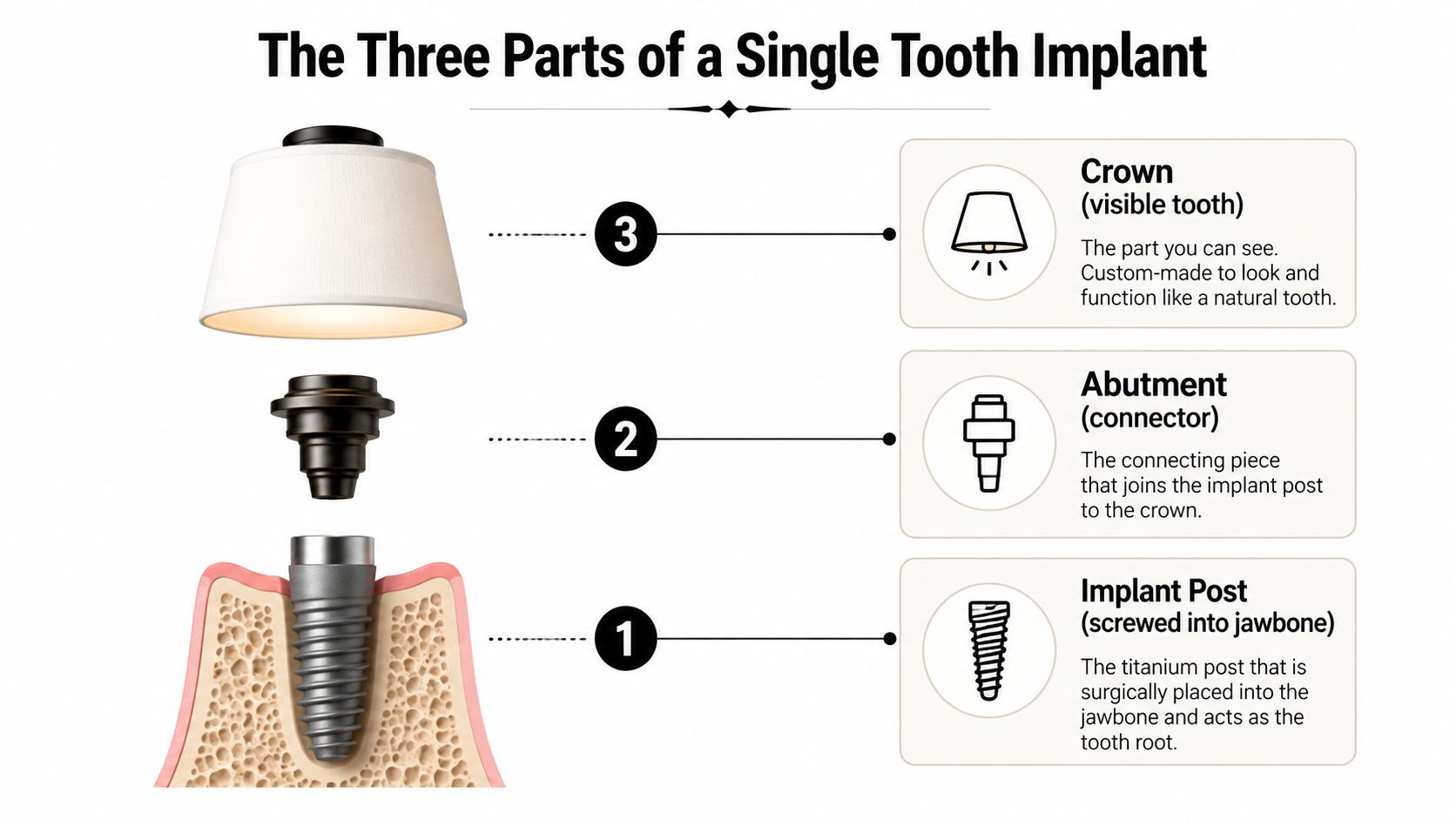
The post is the surgical and material core of the case. One CareCredit breakdown places the implant surgery and materials alone around $2,143, and the crown adds roughly $488 to $3,254, which tells you the final bill is often driven more by the visible restoration than by the titanium fixture itself (CareCredit). That's the part most patients miss.
What each line usually means
- Implant post: This is the piece placed in the bone. It's the root replacement, not the tooth you see.
- Abutment: This is the connector that links the post to the crown.
- Crown: This is the part matched to your bite and shade, and material choice and lab craftsmanship can swing the estimate.
If you want to read implant quotes correctly, separate the fixture from the restoration. A high-end crown can push the total up more than a basic implant system ever will. That's also why a restored implant quote should be compared against a crown discussion, such as the one here, not just against the surgical line.
My rule in practice: the implant is rarely the expensive surprise, the restoration usually is.
Add On Procedures That Move the Bottom Line
The final bill usually does not match the headline price. Patients hear one number and assume it includes the whole case. It rarely does. The extra items are what turn a basic implant fee into a real treatment plan.
A tooth that needs removal first may add $150 to $700 for extraction. Bone grafting can run $300 to $1,200 per site, sinus lifts can reach $1,500 to $5,000, sedation and anesthesia often add $200 to $1,000, digital CBCT scans can cost $250 to $600, and provisional temporary crowns are commonly $200 to $500. Independent coverage notes that these extras can add roughly $2,000 to $5,000 or more to the total, so a base implant quote can look cheaper than it really is when the rest of the plan is missing (Bonita Del Rey).
A Midtown estimate should spell out every one of those items before you sign anything. If it doesn't, ask why.
The line items that usually get left out
- Extraction: Needed when the damaged tooth is still in place.
- Bone grafting: Used when the site does not have enough support.
- Sinus lift: Common in upper back cases when the anatomy leaves too little room.
- Sedation: Sometimes optional, but it changes the total fast.
- CBCT scan: Required for planning, and offices often bill it separately.
- Temporary crown: Important for front teeth, and easy to miss in the quote.
A quoted price can also change once the office adds surgical prep, imaging, and the final restoration. A $2,999 ad is not the final number if the treatment plan still needs those pieces. That is not always bait-and-switch, but it is poor transparency when the patient hears only the starting point.
For a closer look at diagnostics, review digital X-rays and imaging in Midtown.
Single Implants, Multi Unit Bridges, and All On 4 Compared
The right treatment depends on how many teeth are missing and what's left behind. A single implant makes sense for one tooth. An implant-supported bridge makes sense when you're replacing several adjacent teeth and don't need a post for every space. Full-arch work makes sense when the upper or lower arch is failing as a unit.
| Treatment Type | Typical Range | Best For |
|---|---|---|
| Single implant | $3,000 to $7,000 | Replacing one tooth |
| Implant-supported bridge | $6,000 to $14,000 | Replacing three to four teeth on fewer implants |
| All-on-4 or All-on-6 | $18,000 to $35,000 per arch | Rebuilding a full arch |
| Full-mouth reconstruction | $36,000 to $100,000+ | Rebuilding both arches |
That table tells the true story. Per-tooth cost falls as the case gets bigger, which is why a full-arch solution can often be the better value when many teeth are failing at once. The up-front number is larger, but the structure of the case is more efficient.
Why case size changes the math
A single tooth replacement is a precision repair. A multi-unit bridge spreads the support across fewer implants. A full arch turns the quote into a system-level reconstruction, where the cost gets shared across many teeth instead of one.
If you're comparing options, use the right category. Don't compare a one-tooth implant to an entire arch system and call them substitutes. If your bite, bone, and tooth count point to a bridge, a bridge discussion like this one is the correct starting point.
Why the Cheapest Quote Is Rarely the Final Bill
The lowest ad price almost always covers the implant fixture alone. That number gets attention because it looks affordable, but it is only one line on the bill. The crown, abutment, imaging, grafting, extraction, temporaries, and follow-up are usually billed separately, and that is where the quote grows fast.
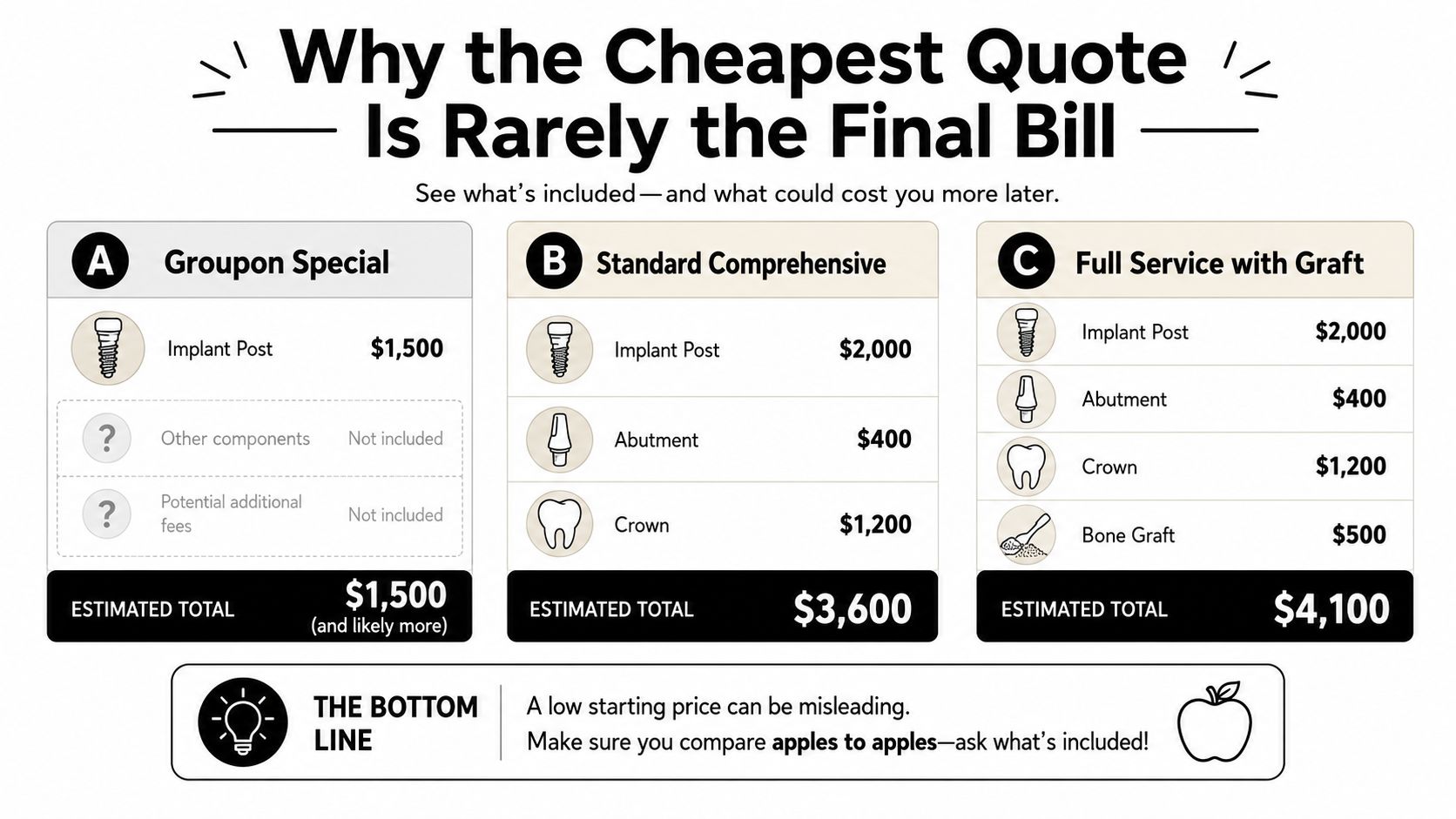
A straightforward front-tooth case can stay clean if the bone is healthy and the restoration is simple. A molar with bone loss is different. Grafting, imaging, and sometimes a more involved surgical plan start stacking onto the total. Full-arch treatment sits in its own category, and a quote that compresses that work into one low number is usually leaving out real line items.
The smart move is to force the office to name the pieces.
How to read the quote before you sign
- Ask what's included: The office should separate the post, abutment, and crown. If it cannot, the quote is too vague to trust.
- Ask what's excluded: Scan, extraction, grafting, sedation, and temporaries are the charges that often appear later.
- Ask who is doing what: Surgery, restoration, and lab fabrication should be clearly assigned to the right providers.
- Ask for a written total: You need the full estimate in writing, not a verbal number that changes once treatment starts.
The rule is simple. Separate implant-only pricing from a tooth-replacement complete estimate. If the office only gives you the first number, the quote is not finished.
The NYC Premium for Implant Dentistry
Manhattan does not price implant dentistry like a lower-cost market, and the reason is plain. Offices here carry higher rent, higher staffing costs, specialist lab fees, premium imaging, and the overhead that comes with patients who expect tighter esthetics and cleaner restorative work. The number on the estimate is often paying for the entire setup around the implant, not only the implant fixture itself.
That premium is real, and it shows up in the market itself. A Midtown office is usually building a plan around more advanced diagnostics, more exact laboratory work, and a clinician who handles complex cases every week. Tooth Compass reflects that kind of geographic spread in published pricing data, and Manhattan sits near the top because the local cost structure is higher across the board.
There are three places the difference usually lands. First, fixture selection, because higher-quality systems cost more and are chosen for predictability and compatibility. Second, the lab tier, because a specialist lab charges more for shade matching, contouring, and a crown that fits the mouth and the bite the first time. Third, surgeon credentials, because board-certified specialists and advanced restorative dentists do not price themselves like cut-rate clinics.
The question is simple. What are you getting for the higher number?
If the office can point to better diagnostics, a stronger lab, and a more experienced clinician, that premium belongs on the estimate. If the quote is higher for no clear reason, push back and ask for the line items. In Manhattan, I expect a premium, but I also expect a reason for every dollar.
Financing, Insurance, and Payment Plans
Most patients do not pay for implant treatment all at once. They break the bill into pieces. That is normal, and a good office should help you structure it without pressure or confusion.
Insurance usually helps more with the crown than with the implant fixture, and many plans cap annual benefits around $1,000 to $2,000. That does soften the bill, but it rarely eliminates it. FSA and HSA funds are often the cleanest way to reduce the after-tax hit, because you are paying with pre-tax dollars instead of full retail income.
The smarter move is to know which bucket each charge falls into before treatment starts. Surgical fees, restoration fees, and any add-on procedures do not always get treated the same way by your plan, so the office needs to spell that out clearly.
This Midtown insurance guide explains how Manhattan offices usually handle benefits, and it is worth reading before you decide how much of the bill to route through insurance. If you have an HSA in a high-deductible year, use those funds before the implant phase starts. That sequencing can save real money without changing the treatment itself.
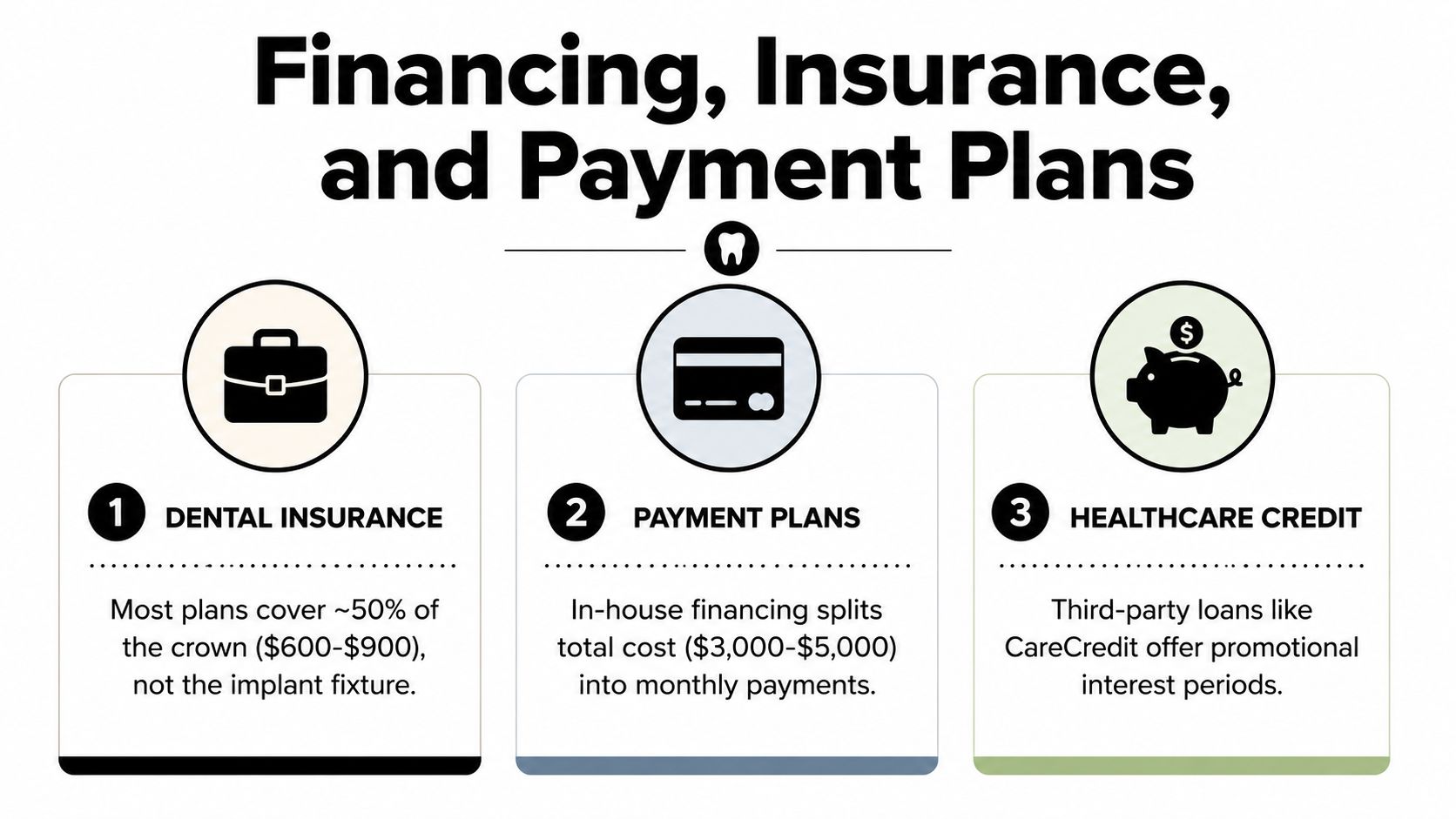
If you want the bill to feel manageable, ask for a written payment schedule before you agree to treatment. The cleanest plans usually combine insurance where it applies, pre-tax funds where possible, and financing only for the part that still remains. That keeps the numbers clear and stops surprises from showing up after surgery.
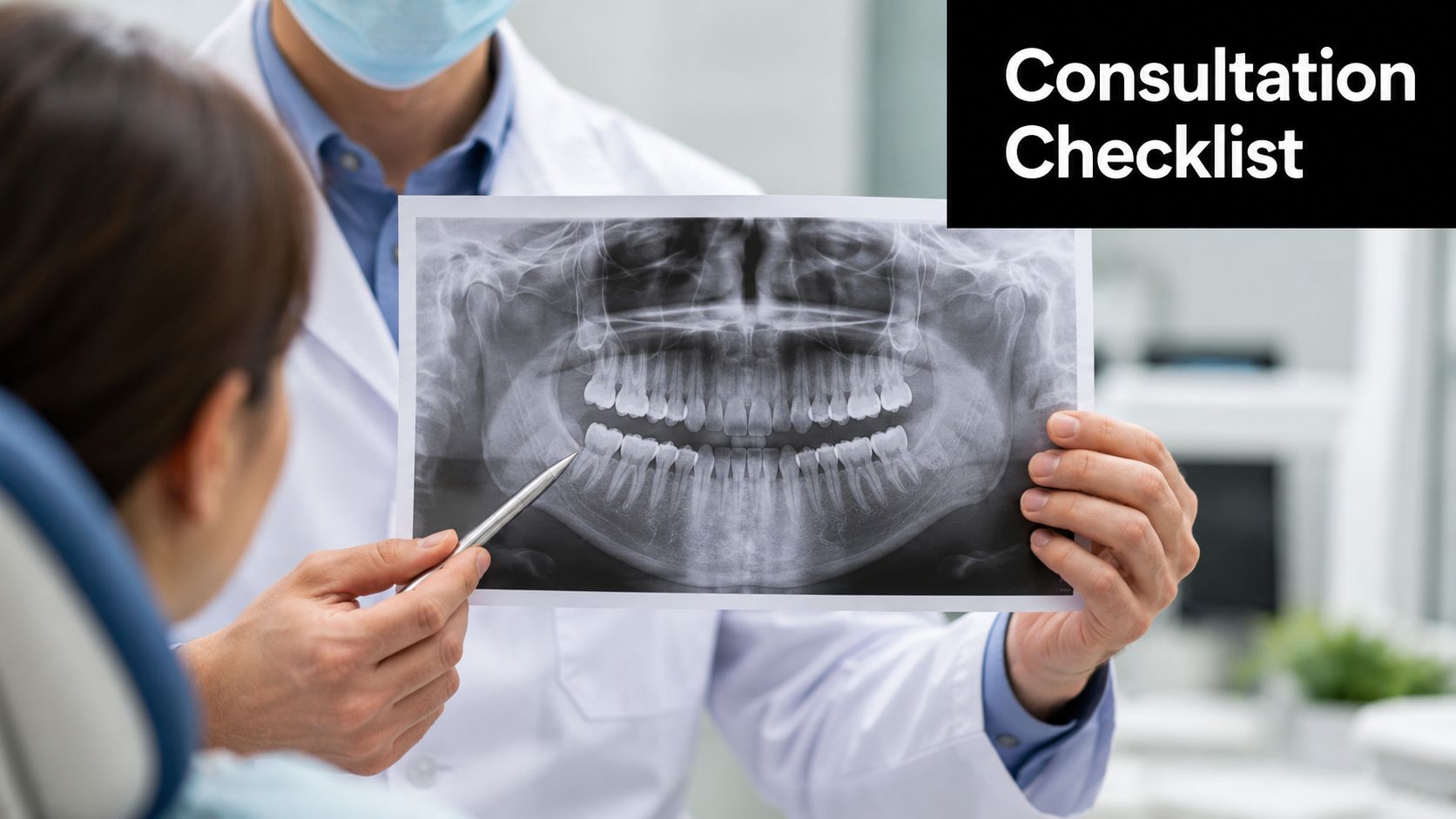
Bringing It All Together Before Your Consultation
Bring one question to the visit. Is this quote complete, or is it only the implant phase? That one question cuts through most of the confusion in implant pricing.
Before you agree to treatment, get these items in writing:
- Itemized breakdown: Post, abutment, crown, and any temporary restoration.
- Diagnostics: Ask whether the CBCT scan is included.
- Site prep: Ask whether extraction or grafting is part of the estimate.
- Credentials: Confirm who places the implant and who restores it.
- Lab details: Ask where the crown is made and what material is being used.
- Follow-up plan: Ask how many post-op visits are included and what warranty applies.
The value argument behind implants is longevity. One economic model found implant survival was 10.4% higher than a fixed partial denture over 10 years (PubMed). That's the reason the upfront bill makes sense for the right patient, especially when you're comparing it with repeated bridge replacement over time.
If you want a straight answer on your own case, bring your questions to Paul L. Gregory, DDS in Midtown Manhattan. The office handles implant planning, restorative dentistry, imaging, and financing conversations in one place, so you can get an itemized treatment plan instead of a vague quote. Visit Paul L. Gregory, DDS and ask for a consultation that spells out exactly what your implant case will cost, line by line.