

Without insurance, scaling and root planing typically costs about $150 to $350 per quadrant, or $600 to $1,400 for a full mouth, and insurance usually pays a share of the plan's allowed fee after you've met your deductible. That second part is where most surprises start, because your share isn't a percentage of whatever number appears on the office estimate.
You're often told you need a "deep cleaning" and given one total. That phrase hides three separate questions. How many quadrants need treatment, which code applies to each quadrant, and what fee your plan allows for that code? Until you have those answers, a percentage like 50% or 80% doesn't tell you what you'll pay.
Think of scaling and root planing cost with insurance as both a math problem and a documentation problem. The math depends on the allowed fee, your deductible, your coinsurance, and your remaining annual maximum. The documentation depends on pocket measurements, X-rays, and plan rules about dates and frequency. A clinically needed treatment can still pay nothing if the record doesn't match the contract, so you need to check both sides before you book.
What Scaling and Root Planing Costs Without Insurance
Uninsured scaling and root planing runs roughly $150 to $350 per quadrant and about $600 to $1,400 for a full mouth. A quadrant is one quarter of your mouth, upper right, upper left, lower right, or lower left. Dentists bill this treatment by quadrant, not as one flat cleaning, which is why two people who both need a "deep cleaning" can get very different totals.
Two codes drive the price. D4341 covers scaling and root planing for four or more teeth per quadrant, while D4342 covers one to three teeth per quadrant. According to a published deep cleaning cost guide, uninsured SRP is commonly estimated at approximately $150-$350 per quadrant, or about $600-$1,400 for four quadrants, while partial-quadrant D4342 treatment may be estimated at roughly $100-$250 per quadrant.
Uninsured Scaling and Root Planing Cost by Scope
| Scope | CDT code | Uninsured estimate | Basis |
|---|---|---|---|
| One quadrant, 1 to 3 teeth | D4342 | $100-$250 | Partial-quadrant estimate |
| One quadrant, 4 or more teeth | D4341 | $150-$350 | Per-quadrant estimate |
| Two quadrants | D4341 | $300-$700 | Calculated from per-quadrant range |
| Three quadrants | D4341 | $450-$1,050 | Calculated from per-quadrant range |
| Four quadrants (full mouth) | D4341 | $600-$1,400 | Published full-mouth estimate |
Read the table by multiplication, not by discount. Two quadrants cost about twice one quadrant, and three quadrants cost about three times one quadrant. There's no automatic full-mouth discount built into these ranges, so the number of quadrants matters more than almost anything else on the estimate.
It's similar to paying a cleaner by the room rather than by the house. If only two rooms need work, you shouldn't budget for four. If all four need work, a quote for one room will badly understate your bill.
What Moves the Cash Price
Several factors place you at the low or high end of a range. Disease severity affects how much buildup sits below the gumline and how long treatment takes. Imaging, the dentist's fee schedule, and geography also change the charge, as does whether a quadrant has one to three teeth involved or four or more.
Before you compare offices, it helps to see how a practice lists its private fees in writing, so you can browse private dental treatment fees as an example of the format to request. For a fuller explanation of the procedure itself, see this guide to periodontal scaling and root planing treatment.
The uninsured figure isn't your final number if you have coverage. It's the starting point that your plan then reprices, reduces, or denies.
That repricing step is easy to miss. Your dentist may charge one amount, but your insurer may recognize a lower amount and base your share on that lower figure. The next step is understanding that split.
How Insurance Splits the Bill
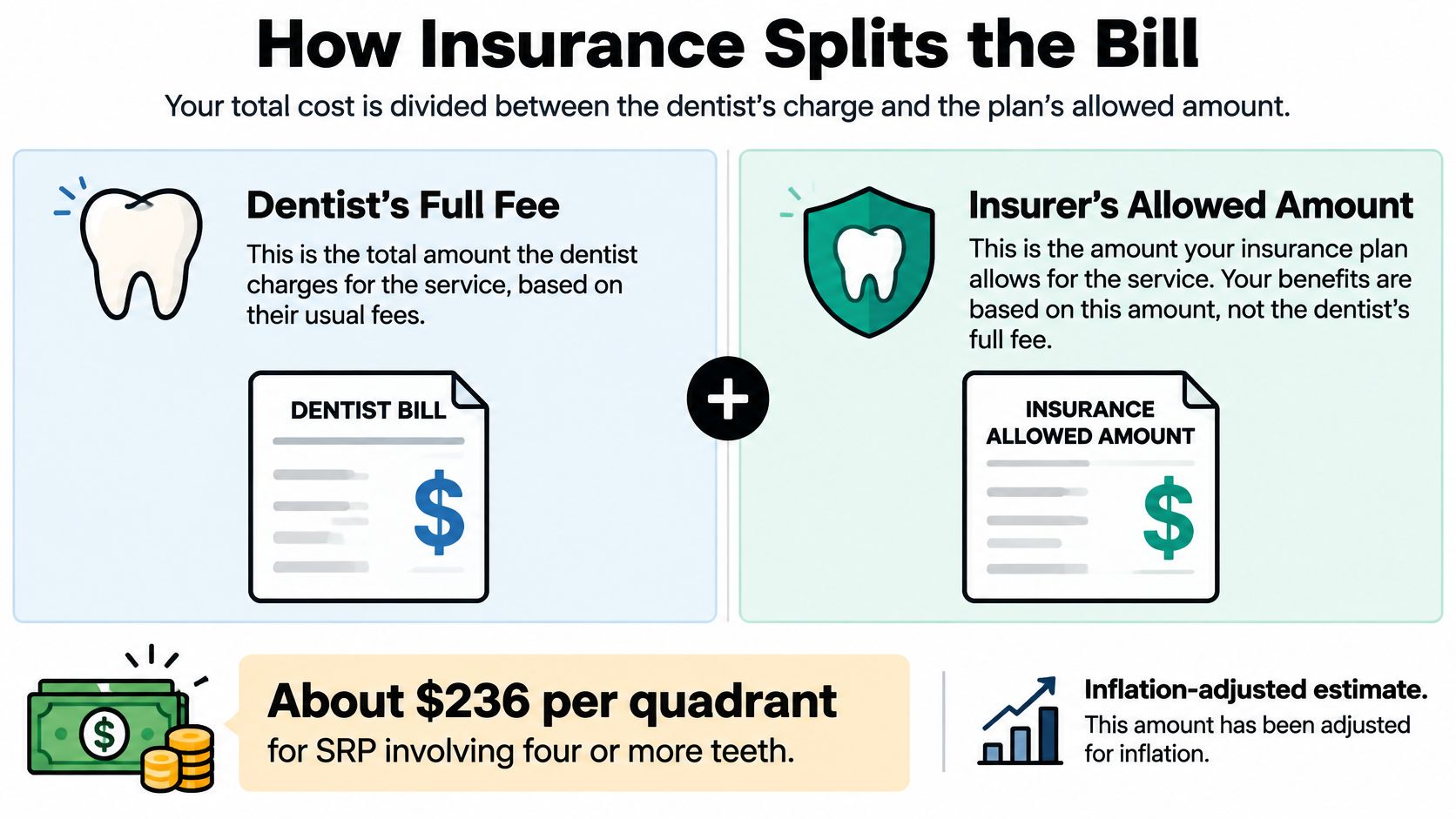
Your bill has two prices, and only one of them usually drives your share. The dentist's full fee is what the office charges. The insurer's allowed amount is the fee your plan agrees to recognize for that code, often through a contract with the dentist.
If your dentist participates with your plan, you typically owe your deductible plus your coinsurance percentage of the allowed amount. Coinsurance is your share after the deductible. If the plan pays 80%, you pay 20% of the allowed amount, not 20% of the office's full fee.
National fee data gives a useful benchmark for the math. A gum disease treatment cost summary citing American Dental Association Health Policy Institute data placed the average fee for SRP involving four or more teeth at approximately $236 per quadrant in inflation-adjusted 2015 dollars. The corresponding average fee for a periodontal-maintenance visit was about $139.
Patient Share at $236 per Quadrant Under Two Coverage Levels
| Quadrants | Allowed fee | Plan pays 80% | You pay 20% | Plan pays 50% | You pay 50% |
|---|---|---|---|---|---|
| One quadrant | $236 | $189 | $47 | $118 | $118 |
| Two quadrants | $472 | $378 | $94 | $236 | $236 |
| Three quadrants | $708 | $566 | $142 | $354 | $354 |
| Four quadrants | $944 | $755 | $189 | $472 | $472 |
Walk through one row slowly. At 80% coverage, one quadrant at $236 leaves you about $47, and four quadrants at $944 leave you about $189. At 50% coverage, you pay half the allowed fee in every row, so four quadrants leave you about $472.
Those figures exclude your deductible. If you haven't met it, you pay that amount first, and the percentage split applies to what remains. If you're unsure how that first-dollar amount works, this explainer on what a dental insurance deductible means walks through it in plain terms.
Where the Annual Maximum Bites
Your annual maximum is the most your plan will pay in a benefit year. Four-quadrant treatment at the $944 benchmark can use a large part of a $1,500 annual maximum, especially once exams, X-rays, medications, or follow-up maintenance are added. That means a plan can approve your treatment and still run out of money partway through your other care that year.
Practical rule: Your share is what's left after the allowed fee, deductible, plan percentage, and annual maximum are applied in that order.
Periodontal maintenance after treatment draws on the same pool of benefits. That's why an estimate that only covers the day of scaling and root planing can understate your cost for the year. Ask what follow-up visits are planned and whether they'll fit inside your remaining maximum.
Coverage Rules That Change Your Claim
A correct fee doesn't guarantee a paid claim. Plans layer rules on top of the code, and those rules check timing, dates, clinical findings, and network status. Each one can change your cost even when the treatment itself doesn't change.
The American Dental Association claims guidance for scaling and root planing identifies D4341 for four or more teeth per quadrant and D4342 for one to three teeth per quadrant. It also notes that plans may require periodontal charting, radiographic evidence of bone loss, documentation of calculus, bleeding on probing, and diseased pocket depths of at least 4 millimeters.
Plan Rules That Change Scaling and Root Planing Claims
| Rule | What the plan checks | Effect on your cost |
|---|---|---|
| Quadrant frequency | Once per quadrant in a consecutive 24-month period | Repeat treatment may be denied or need prior approval |
| Same-day prophylaxis | Prophylaxis and SRP billed on the same date | Payment only for the prophylaxis, so book separate dates |
| Same-day periodontal surgery | SRP on the same teeth and date as surgery | Separate SRP payment may be denied |
| Pocket depth and charting | Diseased pockets of at least 4 mm plus charting, bleeding, calculus and bone-loss films | Missing records can stall or deny the claim |
| Network status | Allowed fee for participating versus nonparticipating dentists | Nonparticipating care can leave a larger balance |
The frequency row surprises people who had treatment at a previous office. Your new dentist may not know your quadrant history, but your insurer does. If a quadrant was treated inside the plan's window, the new claim can be denied even though this office has never treated you.
The same-day rows are about scheduling, not clinical quality. Some plans won't pay separately when scaling and root planing is done on the same teeth and date as periodontal surgery. Others treat a routine cleaning and periodontal treatment billed together as one payable service, so separate dates may be needed for both to receive benefits.
Waiting periods add another timing check. A new plan may not cover periodontal treatment right away, which is why it helps to review how dental insurance with no waiting period differs before you assume a new policy will pay.
What to Ask Before You Book
- Frequency history: When was each quadrant last treated under any plan?
- Same-day rules: Do cleaning and SRP need separate dates under this plan?
- Documentation: Does the chart show pocket depths, bleeding, calculus, and bone loss where present?
- Network status: Is this dentist participating, and what's the allowed fee for each code?
Those four questions take a few minutes. They can prevent a bill that looks nothing like the estimate you approved.
Why Claims Get Denied and What Fixes Them
Patients often ask what percentage their plan covers. The more useful question is why a claim paid nothing and what record could change that result. A procedure can be clinically appropriate and still receive no payment when the file doesn't meet the contract's documentation rules.
Treat 50% to 80% as a typical range, not a promise. An Excellus BCBS periodontal scaling and root planing policy reflects the contract-dependent approach insurers use, which may require periodontal charting, radiographic bone loss, clinical attachment loss, bleeding findings, and evidence of root-surface calculus before processing SRP claims. It also reflects a key distinction, since SRP is generally distinguished from treatment for gingivitis, which may be considered medically unnecessary under some policies.
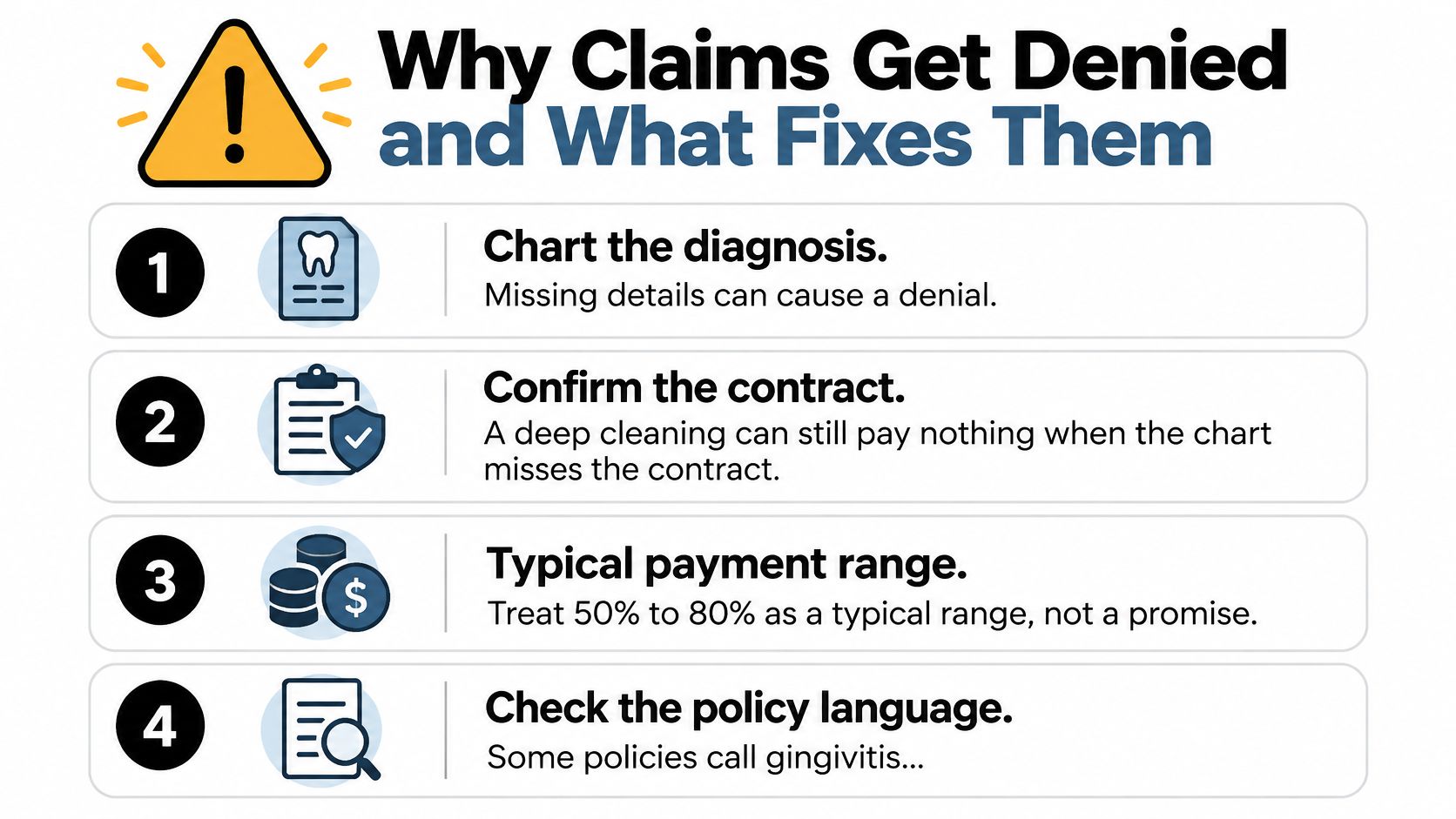
That distinction matters in plain language. Gingivitis is gum inflammation without the deeper attachment and bone changes that define more advanced periodontal disease. If your diagnosis only supports gingivitis, some plans won't pay for scaling and root planing, even if your gums are sore or bleed when you floss.
Confirm These Seven Items Before Treatment
- Current probing depths for the teeth in each quadrant.
- A completed periodontal chart, not just a note that pockets were checked.
- Radiographs showing any bone loss the diagnosis relies on.
- The diagnosis, including clinical attachment loss, bleeding, and root-surface calculus when present.
- Quadrant count, and whether each quadrant is D4341 or D4342.
- Prior SRP dates that could fall inside a 24-month limitation.
- A written pre-treatment estimate using those codes and quadrants.
Offices that submit clean claims tend to gather these items before treatment rather than hunt for them after a denial. Clinic teams reviewing their own workflows can use billing automation guidance for clinic teams to see how record checks and claim steps can be standardized. As a patient, you don't need the software. You need confirmation that the seven items above exist in your file.
If a Claim Is Denied
- Read the explanation of benefits for the exact denial reason, not just the amount owed.
- Ask the office to resubmit any missing chart, images, or narrative the plan requested.
- Request the plan's clinical policy for scaling and root planing so you can compare it to your record.
- Ask for a review when pockets, bone loss, and calculus already meet the stated rule.
A complete file before the visit costs less time and money than appealing a zero payment after treatment is done.
Don't assume a denial means the treatment was unnecessary. It often means the plan didn't receive, or didn't accept, the evidence its contract requires. Your first job is to find out which specific element failed.
Factors That Move Your Out-of-Pocket Cost
Two patients with the same plan percentage can owe very different amounts. The percentage is only one lever. Quadrant count, code selection, add-on services, geography, benefit timing, and network choice can each move the final number while the percentage stays fixed.
Quadrant count comes first because each added quadrant adds another allowed fee. One quadrant and four quadrants aren't versions of the same bill. They're different scopes of treatment with different totals, different effects on your annual maximum, and sometimes different appointment schedules.
Severity can change the code for a quadrant. A quadrant with only a few involved teeth may be billed as D4342, while a quadrant with four or more involved teeth is billed as D4341. More involved teeth usually mean more time below the gumline, more root surfaces to smooth, and a higher fee for that quadrant.
Services That Share Your Benefit Pool
- Exams and radiographs: These support the diagnosis and may count toward the same annual maximum.
- Medications: Any prescribed or locally applied medication can add a separate charge to the course of care.
- Periodontal maintenance: Follow-up visits after SRP continue drawing on benefits after the main treatment ends.
- Other restorative work: Fillings or crowns planned in the same benefit year compete for what's left of your maximum.
Geography changes fee schedules in ways a national average can't capture. The New York Medicaid dental policy and procedure manual lists $45.45 for D4341 and $30.30 for D4342, and limits treatment per quadrant to once every two years, with more frequent treatment requiring prior approval supported by documentation. Those are Medicaid reimbursement figures, not cash prices or commercial plan payments, but they show how widely a recognized fee can differ from an office charge.
Timing across benefit years cuts both ways. Splitting quadrants across a plan-year reset can refresh your annual maximum, which may help if this year's benefits are nearly gone. The trade-off is that a new benefit year can restart your deductible, so you'd pay that first amount again before coinsurance applies.
If a balance remains after benefits are applied, ask how it can be spread out before treatment starts. This overview of dental insurance payment plans explains the questions to ask about timing and installments.
You may also need to send records to an insurer or a prior office during this process. If you only send documents occasionally, affordable faxing for occasional users outlines a low-volume option for getting charts and estimates where they need to go without a dedicated fax line.
You can't control your pocket depths, but you can control network choice, visit timing, and whether your record is complete before the claim goes out.
Those three controllable items are worth your attention. They won't change your diagnosis, but they can change whether the approved treatment is paid at the rate you expected.
What Manhattan Patients Should Expect to Pay
No reliable price is set by neighborhood alone. Patients ask whether treatment costs more in Midtown than in Tribeca, or whether an office near Wall Street follows different insurance rules from one on the Upper West Side. The codes and plan rules don't change by address.
The same framework applies whether you live or work in Midtown, Midtown West, Hudson Yards, the Theatre District, Hell's Kitchen, Chelsea, the Upper West Side, the Upper East Side, Lenox Hill, Turtle Bay, Gramercy Park, the West Village, Greenwich Village, NoHo, the East Village, SoHo, Tribeca, Chinatown, or Wall Street. What changes is the office's fee, its contract with your insurer, and the benefits written into your individual plan.
A New York example shows why the plan document controls. The New York City Municipal Benefits Fund dental plan booklet states that prophylaxis and SRP cannot be performed on the same day, and when both are billed for the same date, payment is made only for the prophylaxis. The same plan limits routine prophylaxis to no more than once during a consecutive six-month period for each covered person.

That rule would apply to a covered patient treated in Chelsea, SoHo, or Lenox Hill in exactly the same way. The neighborhood doesn't soften it or make it stricter. Scheduling the cleaning and the periodontal treatment on separate dates may be necessary for both services to receive benefits under that plan.
A Worked Four-Quadrant Example
Say you need four quadrants and your plan's allowed total matches the $944 benchmark used earlier for illustration. Say your deductible is $50 and it hasn't been met yet. The deductible comes off first, leaving $894 for the percentage split, and this example assumes your annual maximum hasn't been exhausted.
On an 80% plan, the insurer pays about $715 of that $894, and you pay about $179 in coinsurance plus the $50 deductible, for roughly $229 total. On a 50% plan, the insurer pays about $447, and you pay about $447 in coinsurance plus the $50 deductible, for roughly $497 total.
Same mouth, same treatment, same city. The difference between owing about $229 and about $497 is the contract, not the neighborhood.
Network status can widen that gap further. A nonparticipating dentist may not accept your plan's allowed amount as payment in full for covered services in the same way a participating dentist does, so it helps to compare in-network versus out-of-network dentist costs before you choose an office based on location alone.
Use the example as a template, not as your quote. Replace $944 with your plan's actual allowed fee for your quadrants, replace $50 with your remaining deductible, and check your remaining maximum. Those three substitutions turn a generic estimate into your real number.
Confirm Your Benefits Before Booking Treatment
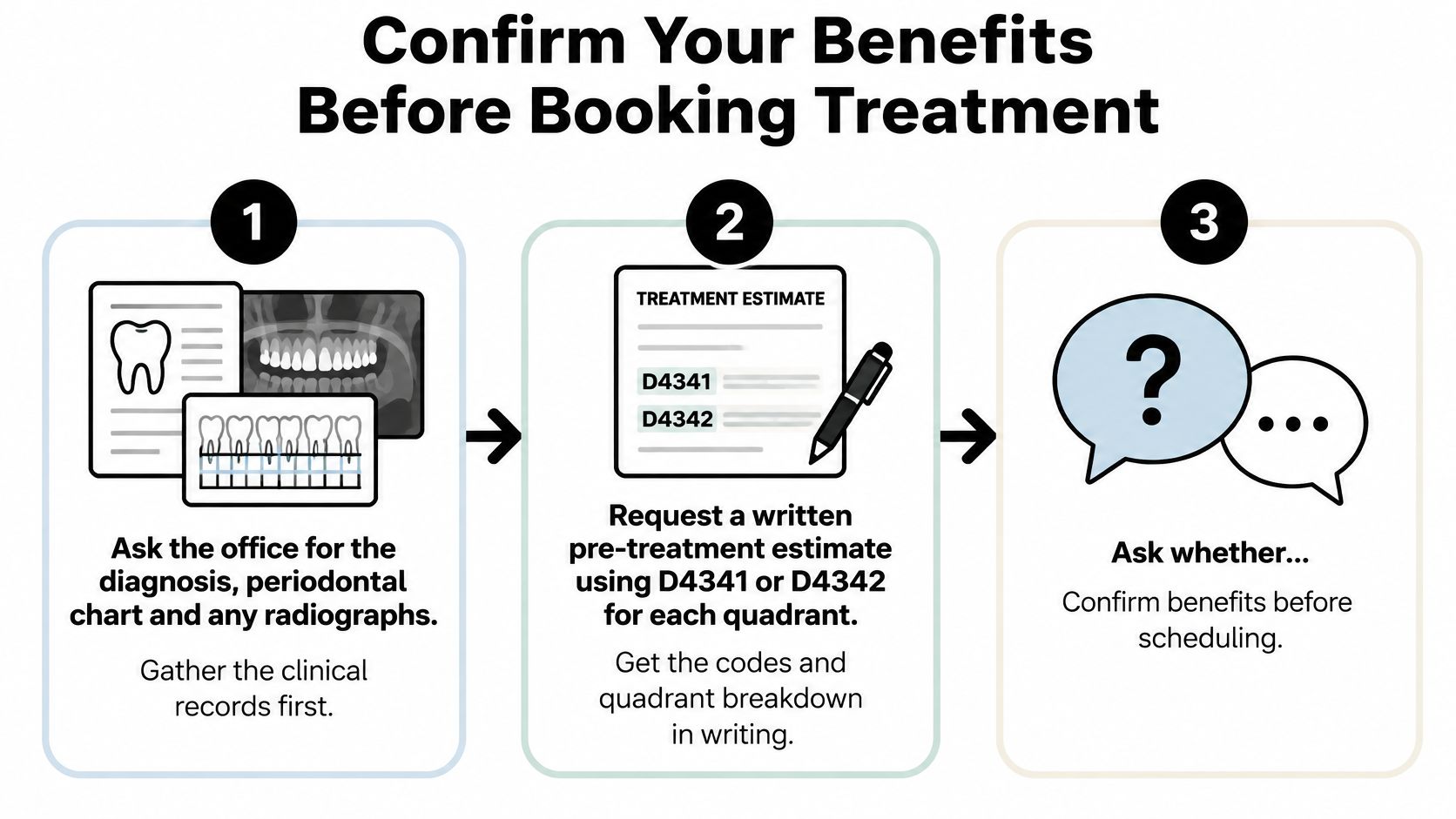
A predictable bill comes from checking benefits in the right order. Each step below prevents a specific surprise, and most of them take one phone call or one written request. Do them before any quadrant is scheduled, not after the first claim comes back.
Eight Steps in Order
- Ask for the clinical record. Request the diagnosis, periodontal chart, and any radiographs so the reason for treatment is documented before a claim exists.
- Request a written pre-treatment estimate. It should list D4341 or D4342 for each quadrant, because a single total can't be checked against your plan's fee schedule.
- Ask about prior authorization and charting requirements. Some plans want records before treatment, and finding out afterward can mean a denial you could have avoided.
- Check your annual maximum and deductible. Confirm how much of the maximum remains and whether the deductible is met, since both change your share directly.
- Confirm frequency history for each quadrant. Prior SRP at another office can still count against a time limit, so give the office your best treatment dates.
- Ask whether cleaning and SRP need separate dates. Same-day billing rules can reduce payment, and splitting visits is easy if you know in advance.
- Confirm network status and the allowed fee. This tells you which price your percentage applies to and whether a balance above the allowed amount is possible.
- Review the explanation of benefits afterward. Compare it line by line to your estimate, and question any code, quadrant, or amount that doesn't match.
If any step produces a vague answer, pause and get it in writing. "Your plan usually covers this" isn't an estimate. A useful estimate names the codes, the quadrants, the allowed fees, your deductible status, and your expected share.
For Midtown patients, Paul L. Gregory, DDS, at 57 W 57th St near Columbus Circle, offers periodontal therapy including scaling and root planing and assists with most insurance plans and claim submissions. You can request the written estimate before scheduling any quadrant, which lets you complete the eight steps above with actual codes and fees rather than assumptions. That's the practical move you can make this week, before treatment dates and benefit years start making decisions for you.
If you've been told you need scaling and root planing, bring your periodontal chart, your quadrant-by-quadrant codes, and your remaining benefits into one conversation before you commit to a date. The team at Paul L. Gregory, DDS provides periodontal therapy including scaling and root planing in Midtown Manhattan and assists with most insurance plans and claim submissions, so you can request a written pre-treatment estimate first. Visit the practice to ask what your plan is likely to allow for each quadrant and what your share would be after your deductible and annual maximum are applied.