

An uninsured dental crown in the U.S. typically costs about $800 to $2,500 per tooth in 2026. Porcelain crowns average about $1,399, while resin or temporary crowns are closer to $697, but those figures are starting points, not the final number on your treatment plan.
You may be asking because a dentist just showed you a cracked molar on an intraoral camera, or because the estimate in front of you has two crown prices that look surprisingly different. In a Midtown office, the fee can seem especially difficult to judge because the crown itself may appear as one line item even though several appointments, professionals, and materials sit behind it.
The useful question isn't only, “How much does a crown cost?” It's, “What does the total episode of care include, and what could still be added?” The answer depends on the tooth, the material, the laboratory work, the condition of the tooth, your insurance network, and the cost of providing care in an urban practice.
What a Dental Crown Costs and Why the Range Is So Wide
A patient arrives at a Midtown dental office with a cracked molar. One treatment plan lists a crown near the lower end of the national range. Another includes a stronger material, a buildup, additional imaging, and a separate temporary restoration. Both quotes may be reasonable because they describe different clinical needs, not different prices for the same service.
For an uninsured U.S. patient, current estimates commonly place a crown between $800 and $2,500 per tooth, according to GoodRx's dental crown cost guide. A separate CareCredit overview of dental crown pricing reports a broad average range of about $697 to $1,399, with porcelain at the higher end and resin or temporary crowns at the lower end. Another benchmark places an out-of-network permanent crown at $1,100 to $2,000.
These ranges reflect different materials, regions, fee schedules, and definitions of what the quoted price includes. A low starting price may cover only the crown. A higher estimate may include the examination, preparation, temporary crown, laboratory work, and follow-up needed to complete the episode of care.
The tooth changes the treatment plan
A front tooth demands close attention to shade, translucency, and how the crown blends with neighboring teeth. A molar must tolerate heavier chewing forces, which may make zirconia, metal, or another high-strength option more appropriate. The dentist also assesses how much natural tooth remains and whether the tooth has received root canal treatment.
A crown may therefore be one part of a larger plan. A core buildup, post, root canal, or gum procedure can be necessary before the final crown is placed. These items address separate problems that affect whether the remaining tooth can support a restoration. They are not merely material upgrades.
Practical rule: Compare treatment plans only after confirming that they describe the same tooth, material, preparation, temporary restoration, laboratory work, and follow-up care.
The crowns for teeth treatment guide can help explain why a dentist may recommend a crown instead of a filling or another restoration. Start the price discussion with that clinical decision, then review each line item on the estimate.
Crown Materials Compared and How Each Affects the Price
Material is one of the clearest reasons two crown estimates differ. The appropriate choice depends on appearance, chewing pressure, remaining tooth structure, space, bite habits, and budget. A dentist shouldn't select a material from price alone.
The broad U.S. benchmarks above place resin and temporary restorations near the lower end, while porcelain, zirconia, and other premium options tend to cost more. Gale Care's crown cost guidance notes that all-ceramic and zirconia crowns generally sit higher because their material and laboratory costs are higher. It also identifies porcelain-fused-to-metal and all-metal crowns as options that are often less expensive than premium ceramic choices.
A side-by-side way to think about the options
| Material | Appearance and function | Cost position |
|---|---|---|
| Resin or temporary | Useful as a short-term restoration or provisional option. It generally isn't the first choice for a permanent, heavily loaded tooth. | Lower end |
| Porcelain-fused-to-metal | Combines a metal substructure with porcelain. It offers strength, though a metal edge may become visible near the gumline in some cases. | Middle range |
| All-ceramic or pressed ceramic | Provides a natural appearance and is often considered for visible teeth where translucency matters. | Higher range |
| Zirconia | Offers a strength and appearance balance that can suit demanding areas, including molars, depending on the case. | Higher range |
| Gold or other all-metal | Prioritizes durability and can require less tooth reduction, but its metallic appearance makes it less appealing in visible areas. | Upper range in some plans |
The exact material ranges supplied in many online articles are not all supported by the verified pricing data available here, so a written estimate is more reliable than a generic material chart. Ask the dentist to identify the proposed material by name and explain why it fits the location and bite.
For example, a highly visible front tooth may justify an esthetic ceramic discussion, while a back molar may call for a material selected primarily for strength and wear behavior. That doesn't mean the most expensive option is automatically better. It means the choice should match the job the crown must perform.
A crown also isn't the same as a veneer. A veneer mainly changes the visible front surface, while a crown covers and reinforces a structurally compromised tooth. The porcelain veneers or crowns comparison can help clarify why the lower-priced-looking option may not be an appropriate substitute.
What Is Bundled Into the Crown Fee Beyond the Crown Itself
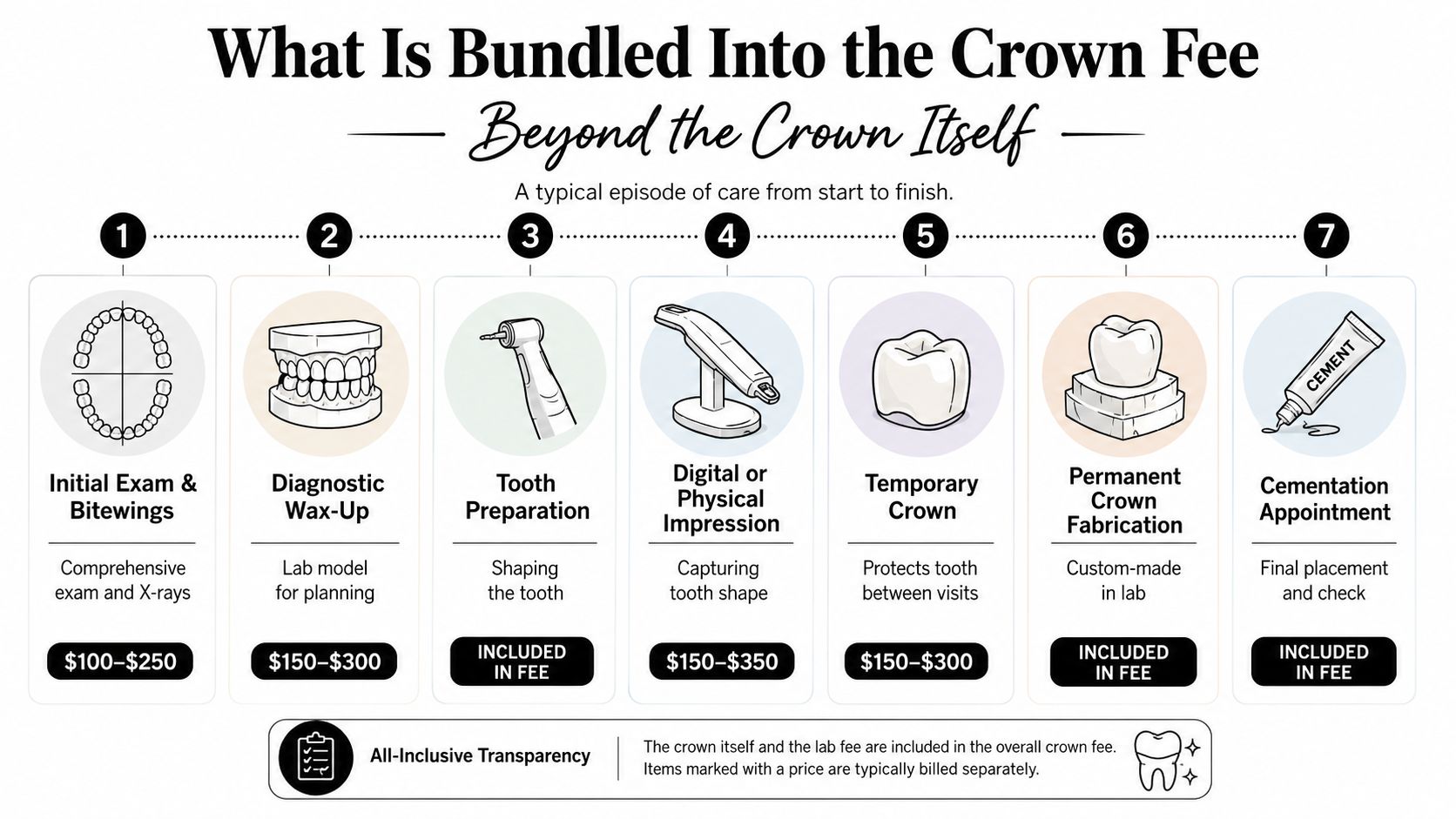
A crown fee is often a bundled episode of care, not a fabrication charge. The office may combine the dentist's examination, preparation time, temporary crown, laboratory communication, final placement, and follow-up into one restoration fee. Another office may list some of those services separately.
The first visit can include an examination and bitewing X-rays, followed by a periapical image or a three-dimensional scan if the tooth's roots, bone, or existing restoration need closer evaluation. The dentist then removes damaged material and shapes the tooth so the crown has enough space and a stable path of insertion. That preparation is time-intensive even when the billing statement folds it into the crown code.
Ask which services are included
The temporary crown protects the prepared tooth while the permanent restoration is being made. Some offices include it automatically. Others show it as a separate line item. The laboratory fee may also be embedded in the crown price, even though an outside technician designs, shades, and fabricates the restoration.
Your treatment plan may contain:
- Diagnostic services: Examination and imaging used to confirm that a crown is appropriate.
- Tooth preparation: Removal of decay or fractured structure and shaping for the restoration.
- Digital or physical impressions: Records that capture the prepared tooth and opposing bite.
- Temporary crown: A provisional cap used between preparation and final placement.
- Laboratory fabrication: Custom production of the permanent crown.
- Cementation: The appointment where the dentist checks fit, contacts, shade, and bite before securing the crown.
- Follow-up care: Adjustments or evaluation after you begin using the restoration.
The total rises when the tooth needs work before preparation. Gale Care explains that a root canal, core buildup, or post can add to the treatment episode. A tooth with substantial decay may need structural support before it can receive a crown, while a tooth with an infection may need endodontic treatment first.
Read the estimate line by line
Look for two separate totals. The first is the crown restoration itself. The second is everything required to make the tooth ready, including diagnostic, endodontic, buildup, or gum treatment. A quote that appears higher may be more complete.
Ask, “If I approve this plan, is the temporary crown included? Are the laboratory fees included? Is the final cementation visit included? What could cause the estimate to change?” Clear answers are more useful than a single advertised starting price.
How Dental Insurance Changes Your Real Out-of-Pocket Cost
A treatment plan can show 50% coverage and still leave you with a large bill. Dental insurance commonly classifies a crown as a major service, then applies its deductible, allowed fee, network rules, exclusions, and annual maximum. The percentage describes the plan's share of its recognized fee, not necessarily half of the office's full charge.
Some plans may contribute roughly $400 to $1,000 toward a crown, while the patient may owe $500 to $1,600 or more, depending on deductibles and remaining benefits. Annual maximums are often only $1,000 to $1,500, so one crown can use much of the benefit available for the year. The insurance coverage guide for dental crowns offers a useful checklist for questions to ask the insurer and dental office.
Start with the allowed fee
Suppose the plan recognizes an allowed crown fee of $1,500 and covers about half of a major service after the deductible. In a simple claim, the carrier pays part of that allowed amount and you pay the rest. The calculation changes if earlier cleanings, fillings, periodontal treatment, or another restoration has already used part of the annual maximum.
Your estimate should separate these line items:
- The office fee, or the practice's full charge.
- The allowed fee, which is the amount the plan recognizes.
- The deductible, if you have not met it.
- The estimated insurance payment, limited by the remaining annual maximum.
- Your estimated balance, including a material upgrade or service the plan excludes.
A pre-treatment estimate can also show whether the insurer downgrades an all-ceramic crown to a less expensive covered option. If the policy pays only for the least expensive adequate treatment, you may owe the difference for zirconia or another premium material. The crown can qualify as a major service while the selected material remains partly outside the benefit.
Before scheduling: Ask how much of your annual maximum remains, whether the tooth has a replacement limitation, and whether the proposed material is covered at the contracted benefit level.
Waiting periods and frequency rules can affect the claim as much as the coverage percentage. A plan may delay major treatment after enrollment or limit how often it pays for replacement crowns. If trauma caused the damage, ask whether medical insurance could coordinate with dental coverage, since the injury's circumstances may change how the claim is processed.
Request the insurer's estimate in writing, then compare it with the office estimate. Confirm what you owe before approving treatment, rather than relying only on the phrase “insurance covers crowns.”
Why a Crown in Manhattan Often Costs More Than the National Average
A crown quote from a Midtown office reflects more than the ceramic or laboratory bill. The episode of care also includes clinical staff, sterilization, digital scanning, diagnostic equipment, reserved appointment time, rent, administrative work, and insurer communication. In a dense, high-overhead setting, each line item supports the visit before the crown is even seated.
A national average provides context, not a guaranteed Midtown price. One 2026 market estimate places the U.S. average at about $1,369 per tooth, with state averages ranging from $1,046 in Alabama to $2,331 in California. That spread shows how geography can shift a fee before material choice or case complexity enters the plan.
What urban overhead changes
A Midtown practice near major transit, corporate buildings, Central Park South, or Columbus Circle may offer appointment times that fit a professional schedule. Extended hours, short-notice emergency access, digital diagnostics, and a central location all require staff and operating resources. Those costs can place a Manhattan quote in the upper half of the national range, even when the basic crown treatment is similar.
The office schedule is part of the price, too. A crown appointment reserves clinical time for preparation, temporary placement, and final seating, while laboratory and administrative teams coordinate the case between visits.
Specialist involvement can raise the fee when the tooth has limited structure, an unusual bite, demanding esthetic requirements, or a place within a larger rehabilitation. A general dentist may manage a routine crown, while a prosthodontist or another specialist may help plan a more difficult case. The important comparison is whether the clinical service, material, laboratory standard, and included visits match across estimates.
A useful quote should state the assumptions behind the amount. If a Midtown estimate approaches the upper end, ask whether it includes premium ceramic, complex preparation, a custom laboratory process, additional imaging, or specialist planning. Ask which services remain separate if those items are excluded.
If you are comparing a crown with a larger restorative plan, such as replacing a missing tooth, review the dental implants cost guide separately. Implant restoration follows a different sequence, so its fee represents a different episode of care.
The video below offers a visual overview of crown treatment and related considerations.
Practical Ways to Plan and Pay for a Crown Without Surprises
The most effective cost strategy begins before the tooth is prepared. Ask the office for an itemized treatment plan and ask your insurer for a pre-treatment estimate. You want both documents because the dental office knows what the tooth needs, while the carrier knows how your benefits will apply.
Request separate entries for the crown, buildup, root canal, post, imaging, temporary restoration, and any gum treatment. Then ask whether the laboratory fee and final placement are bundled. This makes it easier to compare two practices that use different billing formats.
Compare the fee and the benefit
Network status affects more than the headline percentage. An in-network office may have a negotiated allowed fee, while an out-of-network office may bill according to its own fee schedule. Ask the insurer and the dental office to calculate your estimated responsibility using the same assumptions.
If your annual maximum has already been exhausted, network pricing may still reduce the contracted fee, but it won't restore benefits that the carrier has already paid. Get the remaining maximum confirmed before you schedule the procedure.
Choose a payment path deliberately
Many offices can discuss an in-house arrangement that divides payment across appointments. Third-party options such as CareCredit or LendingClub may also be available, sometimes with promotional financing terms. Read the conditions carefully, especially the interest rate that may apply if the promotional balance isn't paid according to the agreement.
If you have an eligible health savings account or flexible spending account, ask whether you can use those funds for the treatment. The tax treatment depends on your account and circumstances, so confirm the rules that apply to you rather than assuming every dental expense is handled identically.
Ask before consenting: “What is my all-in estimate, what does insurance actually expect to pay, what isn't included, and what payment options are available if the carrier pays less?”
Treatment timing can matter when a plan renews its annual maximum. In some cases, a dentist may discuss staging separate treatment across benefit years, but delaying a needed crown isn't appropriate if the tooth is at risk of fracture or infection. Clinical urgency should come before benefit timing.
You can also ask whether the office offers a cash or prepayment adjustment. Any discount should be written into the estimate, along with the policy for changes, remakes, or additional visits.
A Simple Framework for Evaluating Any Crown Quote You Receive
Use five checks to evaluate any crown quote, and ask the office to answer each one in plain language. The goal is to see the full episode-of-care bundle, from tooth preparation through delivery and follow-up.
Separate restoration from preparation
Identify the fee for the crown itself, then list the treatment required beforehand. That may include a buildup, root canal, post, or gum procedure. This distinction shows whether a price difference comes from the restoration's material or from the tooth's condition.
Check the material and its purpose
Find the material line and ask why it suits that tooth's position, visibility, bite pressure, and remaining structure. A higher-priced material can make sense for a particular clinical situation, but the explanation should relate to your mouth rather than a general premium label.
Confirm what the bundle includes
Review whether the estimate covers the temporary crown, impressions or scans, laboratory work, cementation, and follow-up adjustment. Ask whether a missing item is included under another code or billed separately. A quote that looks low may leave out part of the appointment sequence, much like comparing a hotel room rate without checking resort fees.
Run the insurance calculation
Ask the office to apply your plan's allowed fee, deductible, major-service benefit, remaining annual maximum, network status, and material rules. The remaining benefit can matter more than the advertised coverage percentage, particularly when other dental treatment has already used part of the annual allowance. Fav Dentistry's coverage discussion explains why an insurance contribution can still leave a substantial patient balance.
Compare the all-in figure
Compare the complete estimate with the broad uninsured U.S. benchmark discussed earlier, while checking exactly what the quoted amount covers. A Midtown estimate may fall toward the higher end because of location, staffing, diagnostic work, laboratory selection, and appointment convenience. A lower figure may reflect a different material or an incomplete bundle, so ask what remains outside the line items.
For broader planning, restorative and cosmetic dentistry services can help distinguish a crown from related procedures and show how separate treatments fit together. The useful comparison is the total service you are approving, including preparation, restoration, follow-up, and the expected insurance contribution.
When you separate the restoration, preparation, material, insurance contribution, and payment terms before treatment begins, you give yourself a much better chance of avoiding a billing surprise at delivery.
Paul L. Gregory, DDS provides crown consultations and restorative treatment planning in Midtown Manhattan, with modern diagnostics, material discussions, insurance assistance, and clear fee communication. Visit Paul L. Gregory, DDS to request an evaluation and review an itemized crown estimate for your tooth.