

34% of adults in England reported having at least one crowned tooth, and among adults aged 45 to 74, that figure rose to nearly 59%. If your dentist just suggested a crown, you're looking at a mainstream restorative treatment, not some rare or extreme procedure.
That matters because many people hear the word crown and immediately think they're being pushed toward the most aggressive option. In reality, the harder question is often whether a crown is the right balance between saving tooth structure and protecting a tooth that's already at risk. On a busy Manhattan schedule, that decision can feel rushed, especially when you're trying to compare comfort, longevity, and cost without losing the thread.
Why Crowns for Teeth Are More Common Than You Think
A crown recommendation can sound bigger than it is. You sit in the chair, hear that a tooth is cracked, heavily filled, or weakened after root canal treatment, and it is easy to assume you are being pushed into a complicated fix. Crowns are routine in mature dental markets, and that is why they belong in ordinary restorative care, not only in severe cases.
England's Adult Oral Health Survey 2021 found that 34% of adults reported having at least one crowned tooth, with an average of 0.8 crowned teeth per adult. That makes crowns a common part of treatment across a large population, not a rare exception. Older adults need them more often, because wear, fracture, and endodontic treatment become more common over time. The same survey also showed that 37% of adults with teeth had crowns, and nearly 59% of people aged 45 to 74 had one, which reflects how age-related wear shapes real treatment decisions. England's Adult Oral Health Survey 2021
Why patients hear about crowns so often
Crowns also come up often because they solve a structural problem. A tooth that has lost a lot of structure needs more than a patch, especially if the remaining walls are thin or the bite load is high. In one UK practice database, 69% of crowns were new placements and 31% were replacements, which shows that crowns are used to respond to existing damage, not only cosmetic concerns. UK crown utilization data
Practical rule: if a tooth has already been weakened, the crown question is usually about preservation, not perfection.
For a patient comparing options in Manhattan, that is the useful frame. A crown may be recommended because the tooth needs structural support, but that does not mean it is always the only path. Sometimes a more conservative restoration can preserve more natural tooth, and sometimes a broader plan is smarter if several teeth need attention at once, as discussed in this Midtown overview of full-mouth care.
What Dental Crowns Actually Are and How They Work
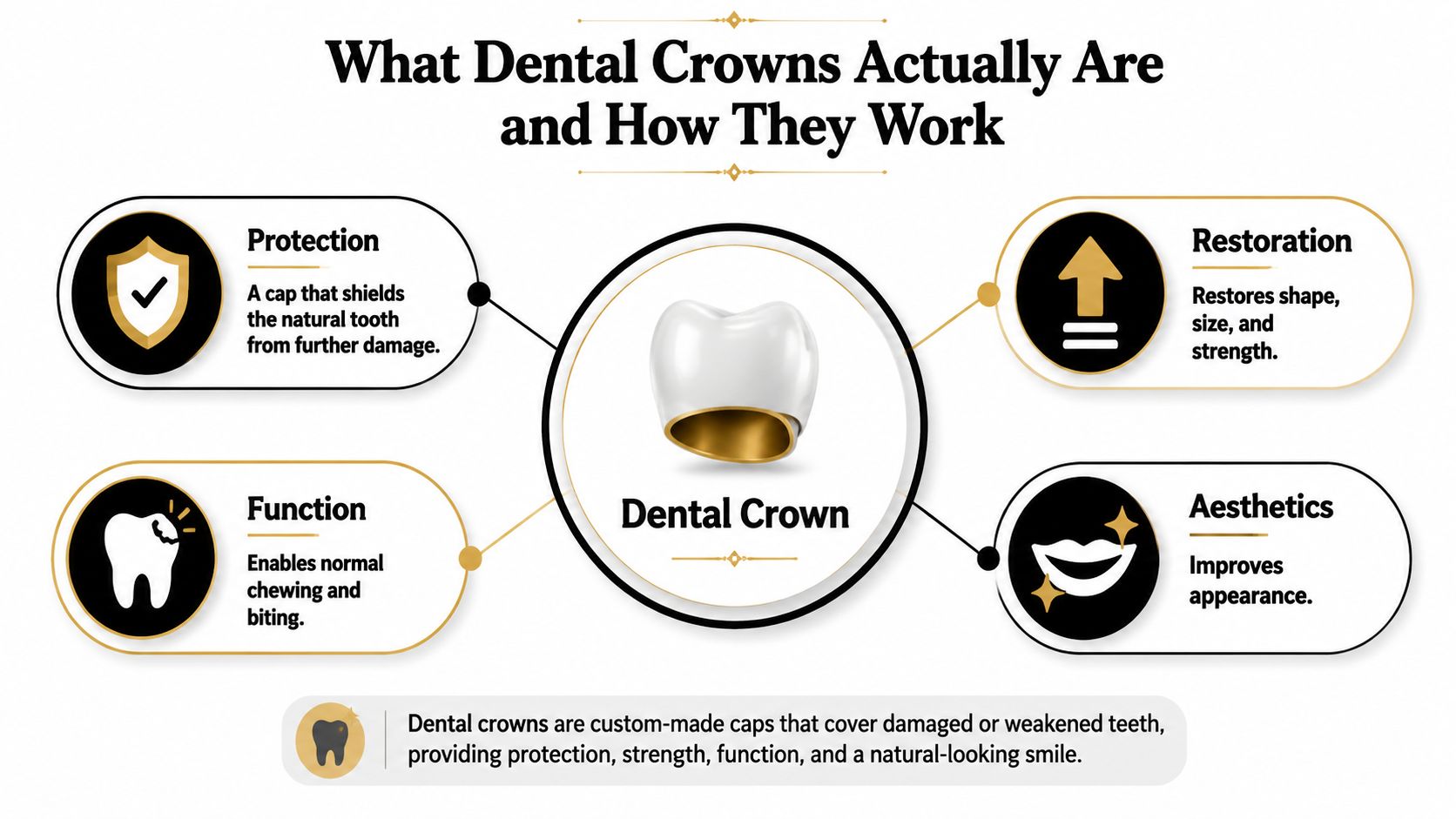
A dental crown is a tooth-shaped cap that fully covers a damaged or weakened tooth. Think of it as a protective helmet for the tooth underneath. It restores shape, size, strength, and appearance, while helping shield the tooth from further fracture or decay.
The basic mechanics
Before a crown can fit, the dentist reshapes the tooth so the new restoration has room to sit securely. The crown is then bonded or cemented over the prepared tooth, creating a single unit that can handle chewing forces more predictably than a heavily compromised tooth alone. That's why crowns are used after root canal treatment, on badly broken teeth, and on teeth with extensive old fillings.
Crowns also help in bridge and implant work, where they serve as the visible, functional part of the restoration. In those situations, the crown isn't just covering damage. It becomes part of the structure that brings chewing function back online.
The best crown is the one that protects what can still be saved.
That principle is worth keeping in mind if you're comparing treatment plans. A good restorative dentist doesn't start with “What can I cover?” The better question is “How much healthy tooth can I keep while still making the tooth strong enough to last?” If you're exploring the role of crowns alongside other fixed restorations, this bridge overview shows how crowns can function as part of a larger repair.
Crown Materials and Types Comparison
A crown can solve the same basic problem in different ways, and the material changes the result in your mouth. Some choices conserve more tooth structure. Others give more room for strength or a more natural look. That matters because a front tooth and a back molar ask very different things of a restoration.
The trade-offs in plain language
Full metal crowns usually need the least space because the material can be made thinner and still hold up well. Metal-ceramic and all-ceramic designs often need more room, since the restoration must be thick enough to resist biting forces and still look like a tooth. Zirconia has become a common choice because it can combine strong performance with better appearance than older metal-heavy designs, which makes it useful where chewing pressure is high but appearance still matters.
| Dental Crown Material Comparison | Best For | Durability | Aesthetics |
|---|---|---|---|
| Full metal | Back teeth where strength and minimal reduction matter | Very strong, requires less tooth reduction | Least natural-looking |
| Porcelain-fused-to-metal | A balance of strength and appearance | Strong, long used in practice | Natural-looking, but metal can show near the gumline |
| All-ceramic or all-porcelain | Front teeth and visible areas | Good for many cases, but material-dependent | Excellent for natural color and light transmission |
| Zirconia | Posterior teeth, implant-supported restorations, high-load cases | Strong, especially in modern translucent forms | Improved esthetics compared with older high-opaque options |
Older prescribing patterns help explain why certain crown types stayed common for so long. In one survey, porcelain-fused-to-metal crowns accounted for 82.9% of full crowns prescribed, and maxillary central incisors were the most frequently crowned teeth at 15.6%. That pattern reflects how dentistry once leaned heavily toward strength and reliability, before newer ceramic systems became more predictable in everyday use. Crown material history and survival data
For patients who want a cosmetic comparison point, veneers are a useful contrast because they cover less tooth structure. Veneers and crowns do different jobs, though. A veneer is usually for changing the visible front surface, while a crown is chosen when the tooth needs more coverage, more reinforcement, or both.
When a Crown Is the Right Choice and When It Is Not
A crown makes sense when a tooth is too compromised for a simple filling to hold up. That usually means the tooth is badly broken, heavily restored, cracked, or weakened after major treatment. It can also be appropriate when the visible part of the tooth needs to be rebuilt for function as well as appearance.
The conservative question matters
The mistake many patients make is assuming the crown is automatically the “upgrade.” Sometimes it is. Sometimes it removes more healthy tooth than necessary. If a filling or onlay can do the job, those options preserve more structure, and preservation should stay at the center of the decision.
Ask this directly: what is the most conservative treatment that still gives this tooth a fair chance?
That question is especially important for cracked teeth, teeth with large old fillings, and teeth that have already had root canal therapy, because those are common reasons a single-unit crown enters the discussion. In many cases, the dentist is trying to prevent a tooth from splitting under normal biting force. In other cases, the tooth may still be solid enough for a more limited restoration.
If your tooth only needs a smaller repair, cavity fillings may preserve more enamel and dentin than a crown would. That doesn't make fillings the answer every time. It means you should ask why the dentist believes a crown, rather than a more conservative option, is the better structural choice.
The clearest sign of good care is a dentist who explains the trade-off without pressure. You should hear why the tooth needs coverage, what would happen if you delayed treatment, and what would be lost if the prep got too aggressive. If those answers are vague, the plan probably needs a second look.
What to Expect During the Crown Procedure
Most crown treatment follows a predictable path, and knowing the sequence makes the process feel less opaque. The first visit is about diagnosis, shaping, and protection. The second visit is about fit, bite, and final placement.
First appointment to final cementation
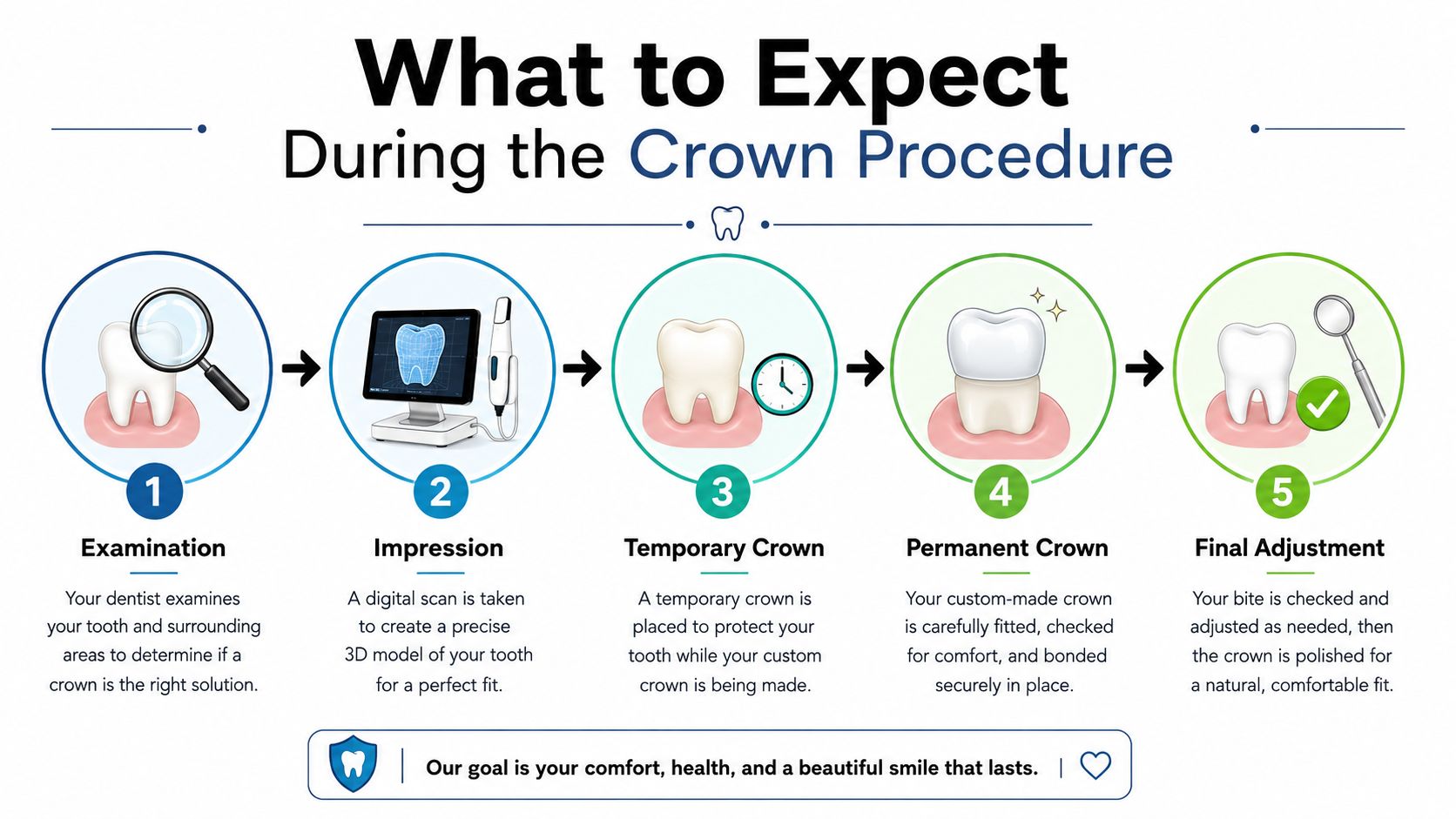
The dentist starts by examining the tooth and planning the prep. A thin layer of enamel is removed so the crown has enough space to fit without being too bulky. The amount of reduction depends on the material, with full metal crowns needing about 0.5 mm of occlusal reduction and ceramic crowns typically needing 1.2 mm or more to avoid leaving the material too thin for bite forces. Tooth reduction and crown design basics)
A scan or impression is then taken, and a temporary crown protects the tooth while the permanent one is made. At the next visit, the dentist removes the temporary, checks the permanent crown for fit and bite, and cements it in place. If you've ever worried about old-fashioned impression trays, digital scanning can make the first visit feel easier and more precise.
Here's the short version of the timeline.
- Examination, the dentist checks the tooth and confirms the indication.
- Impression or scan, the shape of the tooth is recorded.
- Temporary crown, the prepared tooth stays protected.
- Permanent crown, the custom crown is fitted.
- Final adjustment, the bite is checked and refined.
If anxiety makes you tense up in the chair, say so early. A calm pace, clear explanations, and a predictable sequence can make both visits feel much more manageable, especially when the tooth already hurts or has been bothering you for weeks.
Long-Term Crown Success and Realistic Expectations
A crown can solve the immediate problem and still need attention later. That is normal. Patients make better decisions when they understand that a crown is meant to protect a weakened tooth, not turn it into something that never changes again.
What the durability data actually says
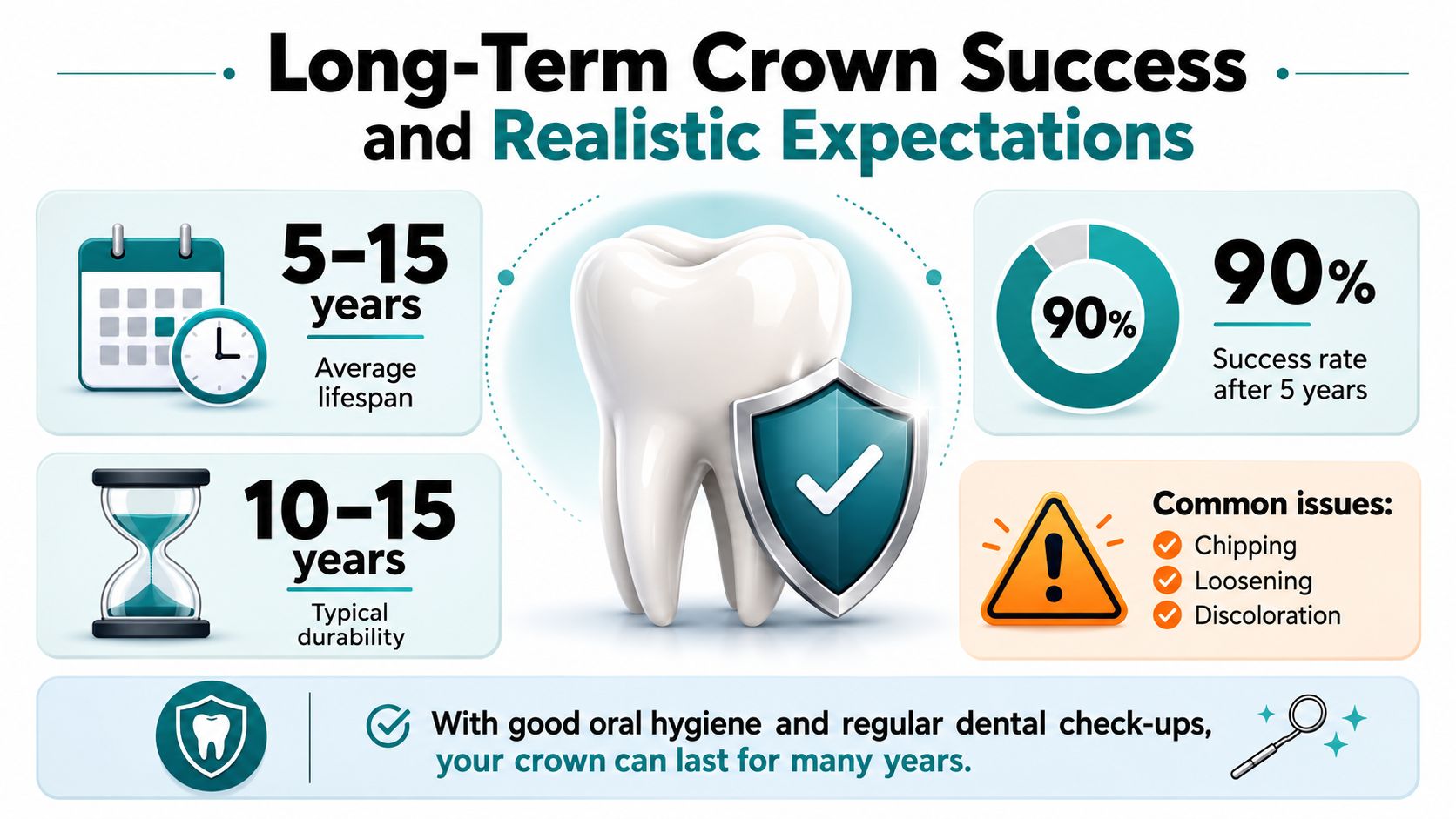
Analysts studying crown outcomes have found that longevity depends on how success is measured. In one large English and Welsh review, crowns had strong long-term performance, and survival looked different depending on whether the endpoint was another dental intervention or extraction of the restored tooth. A separate retrospective clinical study of tooth-supported single crowns found that many crowns remained functional for years, but the survival rate declined over time, which is the pattern dentists expect with restorations that face daily chewing forces and wear. Crown longevity and survival analysis
That difference matters in real life. A crown may stay in place and still need repair if the margin opens, the bite changes, or the porcelain chips. A crown may also protect the tooth for a long time and then eventually need replacement as the tooth underneath changes. The point is not that crowns fail quickly, it is that maintenance is part of normal care.
Signs that need attention
Crowns can loosen, chip, or develop rough edges. Cleveland Clinic advises patients to call if they notice a loose crown, bad taste, cracks or chips, or sharp edges, and NHS-style guidance stresses brushing, flossing, and limiting sugar to protect both the crown and the neighboring teeth. Crown care guidance from Leeds Teaching Hospitals NHS Trust
If something feels different, it deserves a look. A small change in how the crown feels when you bite can be the first sign that cement is wearing down, decay is forming at the edge, or the bite needs adjustment.
That matters for adults who assume a crown is finished once it is cemented. It is more like a repaired window in a building than a sealed box. The repair can last a long time, but it still needs routine care, and small problems are easier to fix before they turn into a larger treatment. The same planning that helps with treatment decisions also helps with follow-up, which is why patients often benefit from reading a clear guide to dental insurance and crown coverage before they commit.
Cost, Insurance, and Timeline Considerations for Crowns
Crowns are a real investment, and the price depends on the material, the amount of work the tooth needs beforehand, and whether the tooth also needs procedures like root canal treatment or a build-up. Insurance may cover part of the treatment, but benefit levels vary, so the office should verify coverage before you start.
What affects the plan
The financial question isn't just “How much does a crown cost?” It's also “What does the tooth need before the crown can even be placed?” That might include removing decay, strengthening the core of the tooth, or fixing a bite issue that contributed to the damage in the first place. A crown that's planned well usually feels less expensive over time than a rushed repair that fails early.
Most single crowns still take two visits spaced about 2 to 3 weeks apart, although same-day options exist in some practices. For Manhattan patients balancing work, family, and transit, that schedule matters as much as the material choice. If you're sorting out coverage and timing, this Manhattan insurance guide can help you think through the administrative side before you commit.
A practical way to judge value is to ask three questions.
- What problem is the crown solving?
- What alternative would save more tooth structure?
- What happens if I wait?
If a practice can answer those plainly, you'll usually walk away with a better plan and fewer surprises.
Making an Informed Decision About Your Dental Crowns
A crown decision should feel like a careful recommendation, not a pressure sale. The right question isn't whether crowns are good in general. It's whether your tooth needs that level of coverage right now, or whether a smaller restoration would keep more of your natural structure intact.
Start by asking your dentist to explain the tooth's condition in plain language. If the tooth is cracked, heavily restored, or weakened after prior treatment, the crown may be the most predictable way to protect it. If the tooth still has plenty of healthy structure, ask whether a filling or onlay can do the job while preserving more enamel and dentin.
Then compare materials. Full metal often wins on minimal reduction and strength. All-ceramic usually wins on appearance for front teeth. Zirconia sits in the middle for many patients because it offers a strong option for back teeth while still looking more natural than older metal-heavy approaches. None of those choices is universally best, and that's exactly why the conversation matters.
The long-term data should also shape your expectations. Crowns have a strong track record, but they still need care, and the definition of success can vary depending on whether you mean avoiding repair, avoiding replacement, or saving the tooth itself. If you're not hearing that level of nuance, keep asking until you do.
A good crown plan protects the tooth you still have, not just the one you wish you had.
For patients who want one office that can look at the tooth, the bite, and the bigger treatment picture together, Paul L. Gregory, DDS offers restorative and diagnostic care in Midtown Manhattan, including crown evaluation and treatment planning. If you're deciding whether a crown is the right choice, visit Paul L. Gregory, DDS to schedule a consultation and get a clear, conservative answer before you move forward.