

A lot of people land in this decision the same way. You bite down on lunch near the office, feel a sharp jolt, then a few hours later you're being told the tooth may need either a root canal or an extraction. You're tired, you're in pain, and what sounds like a simple choice doesn't feel simple at all.
For busy Manhattan patients, the hardest part usually isn't understanding that one option saves the tooth and the other removes it. The hard part is seeing the full chain of consequences. A root canal is about the tooth you have today. An extraction is about the space you'll have tomorrow, and whether you leave it alone, place an implant, use a bridge, or plan for some other replacement.
That difference matters if you work long hours, need to coordinate care around school pickup, or just want one clear answer without a sales pitch. Some teeth are very worth saving. Some are too damaged, too cracked, or too compromised to make preservation realistic. The right choice depends on whether the tooth is restorable, how predictable the repair will be, and what kind of treatment path you can complete.
This guide is written the way a calm chairside conversation should feel. Clear. Practical. Not rushed. You'll see what each procedure involves, what recovery usually looks like, how long different options can last, and why extraction is rarely just one decision.
Introduction When Saving Your Tooth Becomes a Decision
A Midtown dental emergency often starts with ordinary life getting interrupted. A consultant with a swelling molar tries to push through a client meeting. A parent notices a front tooth darkening after an old injury. A commuter heading past Columbus Circle wakes up with throbbing pain and hopes antibiotics alone will fix it.
Then the exam happens, and the decision gets compressed into a few loaded words: root canal or extraction.
Why this choice feels harder than it sounds
The question is often framed as save it or pull it. Clinically, that's too narrow. The better framing is save the tooth now or remove it and choose a replacement path later. That replacement path might be an implant, a bridge, a partial denture, or no replacement at all.
Each path changes more than cost. It changes healing time, the number of visits, how chewing feels, what maintenance looks like, and whether nearby teeth and bone have to adapt to a missing tooth.
Extraction solves today's infection. It also starts a second decision about what will live in that space afterward.
Pain can make people assume the more painful tooth must come out. That's not always true. A very painful tooth may still be a strong candidate for a root canal if enough healthy structure remains and the root is sound. On the other hand, a tooth that doesn't hurt much can still be beyond repair if it has a deep crack or severe bone loss.
What busy NYC patients usually want to know
Most patients asking about root canal vs extraction are really asking four separate questions:
- Can this tooth be saved?
- Which option gets me functional sooner?
- What happens after the first appointment?
- If I remove it, what will replacement involve?
Those are the right questions. They shift the conversation away from fear and toward planning.
Early on, it helps to compare the two paths side by side.
| Question | Root Canal | Extraction |
|---|---|---|
| Main goal | Keep the natural tooth | Remove the damaged or infected tooth |
| What happens to the root | Root stays in place | Root is removed with the tooth |
| Short-term focus | Clean, seal, restore | Remove, heal, then decide on replacement |
| Typical next step | Usually a final restoration such as a crown | Implant, bridge, partial denture, or no replacement |
| Decision hinge | Tooth must be restorable | Often chosen when the tooth isn't predictably restorable |
Understanding Root Canal Therapy and Tooth Extraction
A dentist can't make a sound recommendation until the tooth is diagnosed properly. That means looking at the decay or fracture you can see, and the root, bone, and internal infection you can't.
What a root canal actually does
A root canal treats the inside of the tooth. When the pulp becomes infected or irreversibly inflamed, the goal is to remove that damaged tissue, clean the internal canals, seal them, and then rebuild the tooth so it can function again.
In plain language, the outside shell stays. The infected inner tissue doesn't.
A root canal is often considered when there's deep decay, a failing old restoration, trauma, or a tooth that has nerve pain but still has enough structure to be rebuilt. In many cases, the tooth also needs a crown afterward so it can handle chewing forces more safely. If you'd like a closer look at the treatment sequence, this overview of root canal dental treatment shows how the tooth is cleaned and restored.
What an extraction actually does
An extraction removes the whole tooth from the socket. Sometimes it's straightforward. Sometimes it becomes a surgical extraction if the tooth is broken down, cracked below the gumline, or difficult to remove in one piece.
Once the tooth is out, the body starts healing the socket. That solves the immediate problem of a diseased tooth, but it doesn't replace the function of that tooth. If it's a visible tooth or a key chewing tooth, the next conversation usually turns to what should fill that space.
A quick visual explanation can also help before you decide.
What dentists mean by restorable
“Restorable” is one of the most important words in this decision, and one of the least explained.
A tooth is restorable if there is enough healthy tooth and root support left to clean it, seal it, rebuild it, and expect it to function predictably. That judgment isn't based on pain alone. It depends on things like:
- Remaining tooth structure: If decay or fracture has destroyed too much of the crown, there may not be enough left to hold a reliable restoration.
- Root condition: A vertical root crack or severe root damage can make saving the tooth unrealistic.
- Bone and gum support: A tooth with advanced periodontal loss may not have enough support even if the nerve problem can be treated.
- Position in the bite: Some teeth handle heavy chewing or grinding forces that change the risk calculation.
At a modern Midtown practice, the decision often relies on digital X-rays, intraoral cameras, and digital scans. Those tools help patients see why a painful tooth may still be savable, or why a quiet tooth may not be.
Practical rule: The question isn't “Does it hurt?” The question is “Can it be restored into a tooth you can reasonably rely on?”
How the Procedures Compare Day by Day
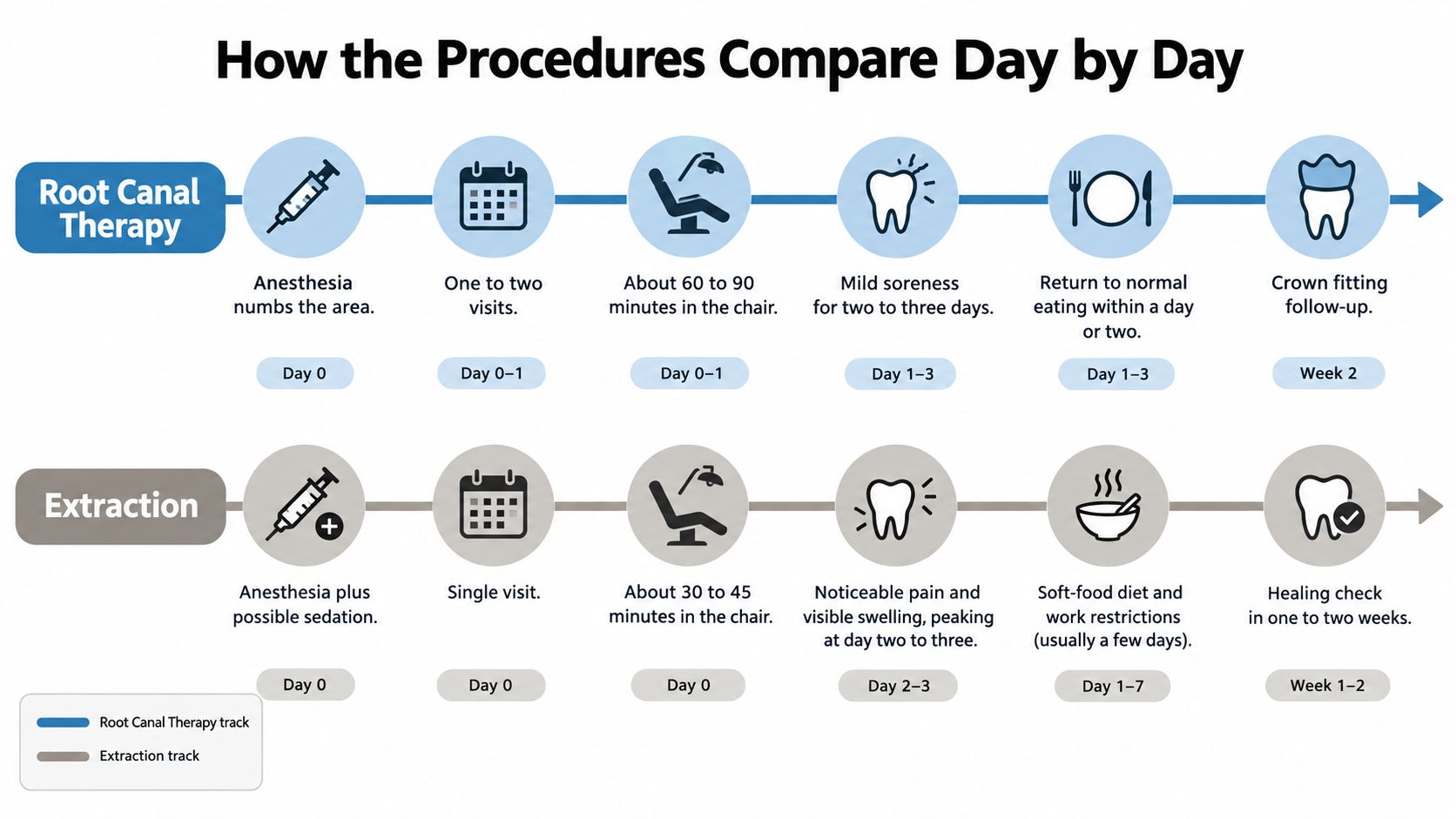
People usually want to know what the appointment will feel like, how sore they'll be afterward, and whether they can get back to work quickly. That's where root canal vs extraction becomes much more concrete.
Day of treatment
A root canal and an extraction both begin with local anesthesia. The area is numbed so you shouldn't feel sharp pain during the procedure. What differs is the goal of the appointment.
With a root canal, the dentist is working inside the tooth, removing infected tissue and sealing the canal space while keeping the root in place. With an extraction, the dentist is loosening and removing the tooth from the bone and gum socket.
That means the root canal is usually a preservation procedure, while extraction creates a healing wound where the tooth used to be.
The key difference is simple. A root canal treats the problem while keeping the natural root. An extraction removes the tooth and starts a healing timeline for the empty socket.
The first few days after
Recovery often surprises people. Many expect the root canal to be worse because it sounds more technical. In reality, the extraction site tends to create more obvious soreness, swelling, and chewing limits in the early healing phase because tissue has been removed.
A root canal tooth may feel tender to biting for a short period, especially if the tooth was badly inflamed beforehand. But there's usually no open socket to protect. After an extraction, you have to protect the clot, avoid disrupting the site, and often shift to softer foods while the area settles.
Here's a plain comparison:
- Root canal: Usually easier to return to a normal routine quickly, though the tooth may still need a final crown visit.
- Extraction: Often faster as a single procedure, but the healing phase asks more of you at home.
- If replacement is planned: The extraction path may involve additional visits later, depending on whether you choose an implant, bridge, or removable option.
Work, eating, and follow-up
For a Midtown patient with a packed calendar, the “faster” option depends on whether you're counting only the first appointment or the full course of care.
Root canal treatment may involve more than one dental visit when you include evaluation, treatment, and final restoration. Extraction may be done in one visit, but if you don't want to leave the space empty, you may begin a much longer sequence after the tooth is removed.
Some patients also need practical guidance on what to do the same night and over the next week. These tooth extraction aftercare instructions help clarify what matters after removal, especially around clot protection, eating, and activity.
Where patients often get confused
The most common misunderstanding is thinking extraction ends treatment. Sometimes it does, if the tooth is nonfunctional and you're comfortable leaving the space. But often extraction only ends the emergency portion.
A helpful way to think about the timeline is this:
- Root canal path: Diagnose, treat infection, rebuild the tooth.
- Extraction path: Remove the tooth, heal the site, decide whether and how to replace it.
That second path isn't automatically wrong. It just needs to be judged, including the time you'll spend completing it.
Long Term Outcomes and What Happens to Your Smile
The short-term experience matters. The long-term result matters more. Root canal vs extraction stops being a pain question and becomes a function question.
How long saved teeth can last
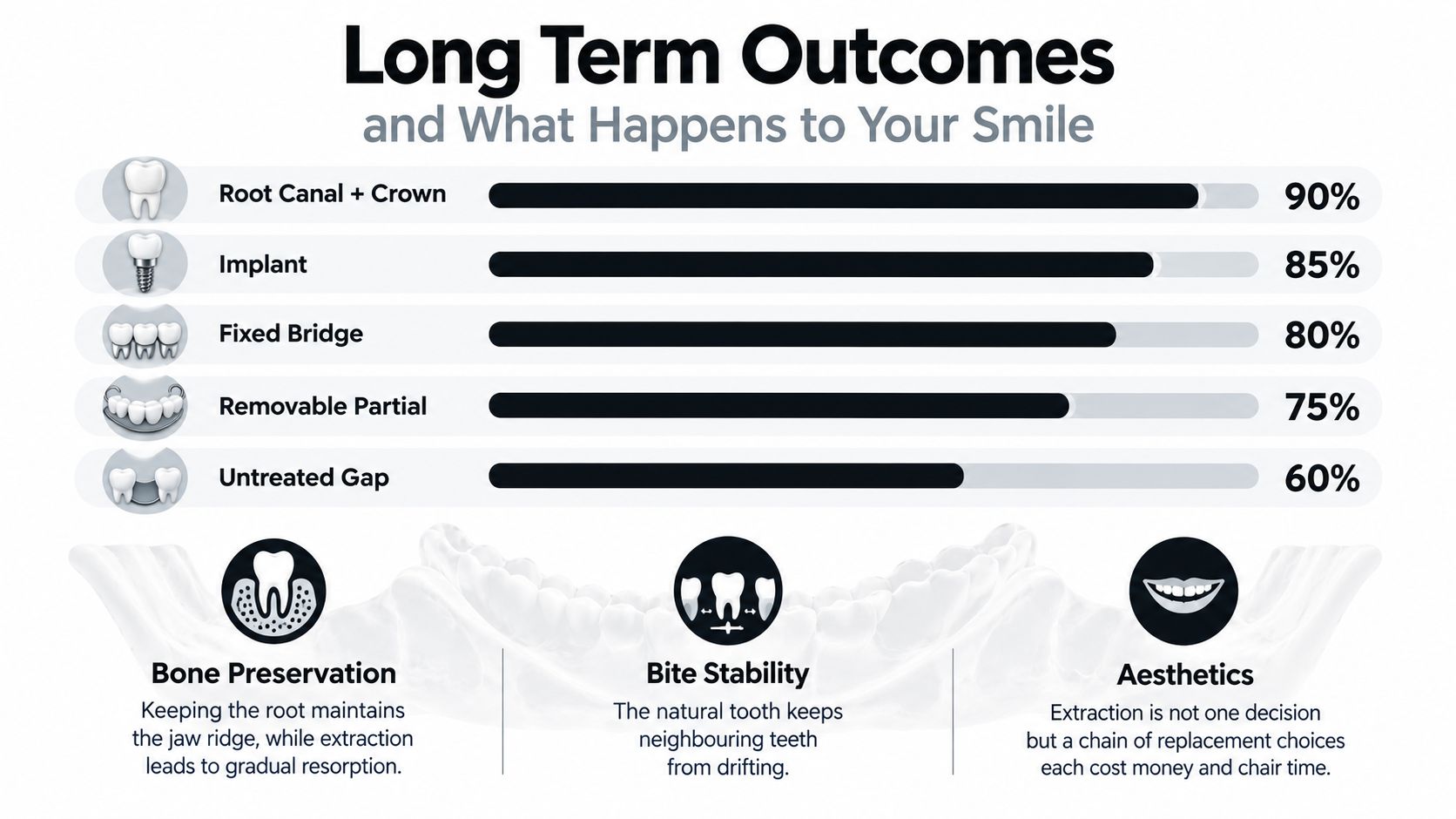
Root canal treatment has a much stronger long-term track record than many people assume. A large national cohort analysis found a median tooth survival time of 11.1 years, with 26.1% of treated teeth estimated to survive beyond 20 years, according to this national cohort study on root canal tooth survival.
Systematic reviews support the same overall picture. One review reported pooled survival of 86% at 2 to 3 years, 93% at 4 to 5 years, and 87% at 8 to 10 years, while another review focused on posterior teeth found roughly 91% survival at 4 to 7 years and 87% at 8 to 20 years, as summarized in this systematic review of long-term survival after non-surgical root canal treatment.
Those numbers don't mean every tooth can or should be saved. They do show that a well-selected, well-restored tooth after root canal therapy is often a durable option, not a temporary patch.
Extraction is not one outcome
This is the part many patients never get told clearly enough. Extraction doesn't have one long-term result. It has several, depending on what replaces the tooth.
A comparative analysis reported 97% survival for root canal therapy and 97% survival for extraction followed by an implant, while extraction followed by a fixed partial denture was 82% over more than six years, according to the AAE review of nonsurgical outcomes and tooth survival.
That means the comparison isn't root canal versus extraction. It's root canal versus extraction plus implant, or extraction plus bridge, or extraction with no replacement.
A removed tooth doesn't tell you the whole story. The replacement choice does.
What happens to your smile and bite
A natural tooth root does more than hold a crown in place. It helps preserve the contour of the ridge and keeps the tooth anchored in the bite you already have. When a tooth is removed, the mouth has to adapt to that absence.
That adaptation can show up in several ways:
- Chewing changes: Back teeth do heavy work. Losing one can shift chewing to other teeth.
- Aesthetic changes: Front teeth and premolars affect smile balance, phonetics, and support for surrounding tissue.
- Treatment cascade: A bridge affects neighboring teeth because they become part of the restoration. An implant follows its own surgical and restorative sequence. No replacement leaves the space to function on its own terms.
If you're weighing a replacement after extraction, understanding the dental implants procedure can help you compare what implant treatment asks of you versus preserving a natural tooth.
True Cost and Time Investment in Midtown Manhattan
The most misleading version of this decision is “Which costs less?” asked without the next question: “Less compared to what complete result?”
The replacement cascade changes the math
In a one-year general-practice analysis, extraction alone had a lower mean cost than root canal treatment, $280.1 versus $689.1, but when extracted teeth were replaced, the mean cost rose to $1,245.5. Quality-adjusted life years did not differ significantly, while tooth-preserving treatment showed better health-state values in the related analysis, according to this cost-effectiveness study comparing root canal treatment and extraction pathways.
That's the key cost lesson. Extraction can look cheaper if you stop the accounting at the day the tooth comes out. If you plan to restore function and appearance later, the numbers can shift quickly.
Here's the comparison in a simpler table.
| Treatment Pathway | Mean Cost | Includes Replacement | Quality of Life Impact |
|---|---|---|---|
| Root canal treatment | $689.1 | No | Quality-adjusted life years did not differ significantly; tooth-preserving treatment showed better health-state values |
| Extraction alone | $280.1 | No | Quality-adjusted life years did not differ significantly |
| Extraction with replacement | $1,245.5 | Yes | Quality-adjusted life years did not differ significantly |
Time has a cost too
New Yorkers feel treatment cost in hours as much as dollars. A root canal path may require multiple appointments if you count the exam and final restoration. Extraction may be completed quickly, but implant planning, site preservation, healing, impressions, and follow-up can stretch the overall timeline.
That doesn't automatically make root canal treatment more convenient. Some patients choose extraction because they need rapid pain relief, can't manage multiple visits, or can't absorb the cost of a root canal plus crown in the moment. In studies from multiple settings, the main reasons for avoiding root canal treatment included the cost of the RCT plus crown (42.9%), more appointments with pain (31.2%), rapid pain relief (59.2%), lack of motivation (51.4%), and lack of awareness (36.1%), as reported in this study on why patients avoid root canal treatment.
Questions worth asking before you decide
A smart cost conversation is specific. Ask for the full pathway, not just the first line item.
- Ask about the final restoration: If the tooth is saved, what will protect it long term?
- Ask what extraction starts: Will you likely want an implant, bridge, or partial later?
- Ask about scheduling burden: How many visits are most patients committing to on each path?
- Ask about insurance handling: Some practices, including this guide to root canal treatment cost without insurance, help patients understand fees and coverage before treatment begins.
If you only compare the first procedure, extraction often looks simpler. If you compare the whole functional result, the answer can change.
Which Option Fits Your Situation Best
A balanced recommendation depends on the tooth, the damage, your bite, your budget, and what kind of follow-through is realistic for you. The same answer won't fit every patient.

Situations where saving the tooth often makes sense
If the root is sound, the crack doesn't extend in a hopeless way, and enough tooth remains to support a reliable restoration, preserving the natural tooth is often the cleaner long-range choice.
That can be especially true in cases like these:
- A front tooth with deep decay or trauma but a solid root: Keeping your own tooth usually supports smile appearance more naturally.
- A back tooth that still has enough structure for a crown: Molars matter for chewing, and preserving one can avoid a replacement decision.
- A previously treated tooth that may be retreated successfully: Sometimes the answer isn't extraction or first-time root canal, but retreatment.
Situations where extraction may be the more realistic path
There are times when removing the tooth is more predictable.
Examples include:
- A tooth fractured below the gumline
- Severe bone loss with poor support
- A root condition that makes sealing and restoring unreliable
- A patient who needs immediate pain relief and cannot commit to the full preservation sequence
Extraction can also be a reasonable temporary decision if a patient can't complete the restorative phase now but plans carefully for replacement later. What's important is making that choice with eyes open.
A quick decision checklist
Use this as a chairside-style filter:
- Is the tooth restorable? If the answer is no, extraction usually moves to the front.
- Will I restore the tooth if it's saved? A root canal without proper final restoration may not be the right investment.
- If the tooth is removed, will I replace it? The answer changes the whole comparison.
- What matters more right now? Fewer immediate visits, preserving the natural tooth, or controlling upfront cost.
- Would a specialist opinion help? In borderline cracked teeth or retreatment cases, it often does.
One practical option for patients who want a focused evaluation is a consultation with a root canal expert, especially when the tooth is painful but the restorability question isn't obvious.
Planning Your Next Step at Paul L Gregory DDS
The next step should reduce uncertainty, not increase it. A good consultation is meant to answer whether the tooth is restorable, what each path would involve, and which timeline makes sense for your life.
What happens at the visit
An exam for this kind of problem usually includes the basics first. Where the pain is, when it started, whether biting triggers it, and whether there's swelling, drainage, or a crack history. From there, digital X-rays and close visual imaging help show whether the issue is mainly inside the tooth, within the root, or in the surrounding bone and gum support.
Digital scans and intraoral photos can make the decision easier to understand because they let you see the same structural concerns your dentist sees. If the tooth is causing acute pain, same-day stabilization may also be possible, depending on what the exam shows.
What to bring to the conversation
You don't need to show up with the right answer. You do want the right questions.
- Bring your calendar reality: Say if you have travel, meetings, or childcare limits.
- State your priorities directly: Some patients care most about preserving the tooth. Others care most about fewer steps right now.
- Ask for the full pathway: For each option, ask what happens after the first procedure.
- Mention anxiety early: That changes how the appointment is paced and explained.
At Paul L. Gregory, DDS, patients can be evaluated with modern diagnostics at 57 W 57th St, with coordinated care across restorative treatment, endodontic planning, oral surgery, and implant discussions when needed. That kind of continuity is useful when the decision isn't only about removing pain, but about choosing the most sensible next phase as well.
If you're dealing with an urgent tooth, don't wait for it to “declare itself.” Most of the time, the sooner the tooth is examined, the more options you still have.
If you're weighing root canal vs extraction and want a clear, non-rushed evaluation, Paul L. Gregory, DDS offers exams, digital imaging, restorative planning, and emergency stabilization in Midtown Manhattan. The goal is simple: determine whether the tooth is predictably restorable, explain the full replacement cascade if it isn't, and help you choose a treatment path you can complete.