

You catch your reflection in a phone camera before an important meeting, dinner, or family photograph. Your teeth look healthy, but coffee, tea, age, and everyday life have gradually taken away some of their brightness. An over-the-counter strip may seem like the obvious next step, yet you may need a visible change on a predictable schedule.
In-office teeth whitening offers that kind of control. A dentist uses a concentrated peroxide gel, protects your gums, monitors the exposure, and adjusts the protocol around your teeth and sensitivity history. The lamp beside the chair may look like the star of the appointment, but the chemistry and clinical supervision do most of the work. You can explore examples of cosmetic outcomes in the dental smile gallery, then use the information below to decide whether chairside whitening fits your goals.
The Moment Most People Book a Whitening Appointment
The decision often happens in a small, unplanned moment. You open your laptop camera before a presentation and notice that your smile looks duller than it did in older photographs. Or you're getting ready for an event and realize that the teeth you see in the mirror don't match the bright, healthy appearance you want in pictures.
That doesn't necessarily mean anything is wrong with your teeth. Surface pigments from coffee, tea, wine, tobacco, and richly colored foods can accumulate over time. Natural aging can also make the warmer color of the dentin more visible beneath the enamel. Whitening becomes appealing when the change feels gradual but the deadline feels immediate.
Why people choose the chair
An over-the-counter strip asks you to manage several variables yourself. The strip must contact the right surfaces, stay in place, and be used consistently. A dentist-supervised treatment removes much of that uncertainty by examining your teeth first and controlling where the gel goes.
The main attraction of an in-office appointment is speed with supervision. The dentist can document your starting shade, isolate the soft tissues, apply a stronger formula, monitor your comfort, and stop or modify the treatment if sensitivity develops. The aim isn't an artificial color. It's a controlled lift of stains on natural enamel, with expectations shaped by your actual tooth structure.
A useful way to think about it: in-office whitening doesn't replace healthy teeth or dental treatment. It brightens natural tooth structure after a dentist confirms that whitening is appropriate.
That distinction matters before a major event. Existing fillings, crowns, veneers, and bonding won't change shade in the same way as natural enamel, so a consultation can prevent an uneven result. A dentist may recommend cleaning, restorative treatment, or a different cosmetic option before whitening if the color concern isn't mainly peroxide-responsive staining.
How Peroxide Whitens a Tooth
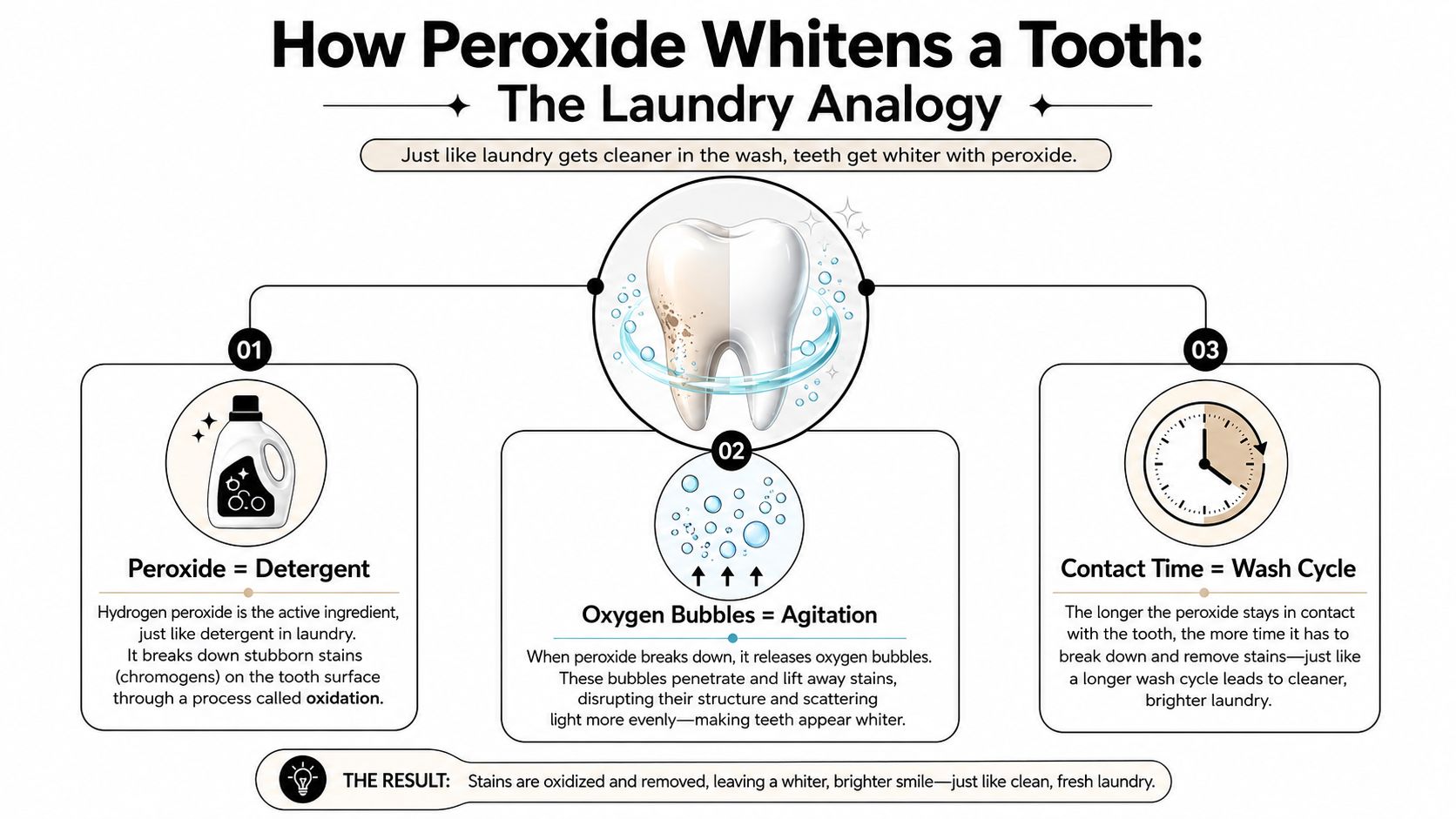
A stained tooth behaves less like a painted surface and more like fabric holding colored particles. Peroxide is the stain-lifting detergent, oxygen activity supplies the chemical agitation, and exposure time determines how long the wash cycle runs. The gel does not paint enamel white. It breaks larger colored compounds into smaller fragments that appear less noticeable.
Hydrogen peroxide can move through enamel toward discoloring molecules inside the tooth. Carbamide peroxide releases hydrogen peroxide more gradually, so dentists choose different formulations for chairside, take-home, and other delivery methods. Through oxidation, peroxide changes stain molecules, reducing the way they absorb and reflect visible color.
Concentration changes the pace and the tradeoff
Modern in-office treatment commonly uses high-concentration peroxide gels, often in the 25% to 40% hydrogen peroxide range, as described in the historical and clinical review of tooth-whitening development. Over-the-counter products generally use weaker formulations intended for unsupervised application, though the strength varies by product.
A stronger gel can produce a faster color change because more peroxide is available during the exposure period. It also makes placement and comfort control more important. The dentist uses cheek retractors, cotton rolls, suction, and a gingival barrier to keep concentrated gel on the intended tooth surfaces rather than on the gums.
The light, when a system includes one, does not replace the peroxide. The active gel does the stain-lifting work. Chairside treatment is best understood as a supervised time-versus-sensitivity choice, not a lamp-powered whitening performance.
The type of discoloration also affects the likely result. Extrinsic stains sit mainly on enamel and often come from foods, drinks, and smoking. Intrinsic discoloration lies deeper in the tooth, often within dentin, and may respond less predictably. Gray, banded, medication-related, or developmental discoloration may call for bonding, veneers, or another restorative approach instead of repeated peroxide exposure.
A clinical trial illustrates the tradeoff. 35% hydrogen peroxide produced greater whitening than 6% hydrogen peroxide, with a mean difference in ΔE00 of 6.3, 90% CI 4.8 to 7.7, while tooth sensitivity occurred more often with the stronger protocol, 74% compared with 44%. The findings are reported in this clinical comparison of peroxide concentrations. In practical terms, concentration can shorten the path to a visible change, while supervision helps balance that speed against temporary discomfort.
What Happens During a Chairside Whitening Visit
A well-managed appointment feels more like a guided process than a dramatic cosmetic performance. You should know what the dentist is applying, why the tissues are protected, and how the treatment can be adjusted if your teeth become uncomfortable.
Before the gel reaches your teeth
The visit begins with a consultation and consent discussion. The dentist reviews your dental history, asks about sensitivity, examines the teeth and gums, and checks whether visible restorations or untreated problems could affect the result. Shade documentation gives you a reference point, although lighting, dehydration, and the measuring method can influence the immediate appearance.
A quick cleaning may remove plaque film and loose surface deposits. That isn't the whitening itself. It gives the gel a cleaner, more even surface to contact.
The team then places cheek retractors, cotton rolls, and a gingival barrier or resin dam. These materials keep the lips and cheeks away from the teeth and protect the gums from concentrated peroxide. If the isolation feels tight or awkward, mention it before gel application. Small adjustments can make the appointment more comfortable.
During the whitening cycles
The dentist applies the gel evenly to the selected tooth surfaces. Many chairside systems use exposure intervals of roughly 15 to 20 minutes, followed by removal and reapplication when appropriate. A standard visit may use more than one cycle, with suction and inspection between applications. The complete chair time commonly falls around 60 to 90 minutes, depending on the protocol and your needs.
The light or laser may be positioned during these intervals, but it shouldn't replace the fundamentals. The important questions are whether the gel contacts clean, isolated enamel and whether the dentist controls the exposure rather than leaving you to guess at home.
You can watch a visual overview of the appointment below. The video should supplement, not replace, a dentist's explanation of the specific system used in your treatment.
After the final cycle, the dentist removes the gel and barriers, rinses your teeth, and records the result. A desensitizing gel or fluoride application may help settle the teeth before you leave. For a short period afterward, you'll usually be advised to limit coffee, tea, wine, dark sauces, and strongly colored foods, especially if they trigger sensitivity or staining for you. If you also need a routine cleaning, reviewing the dental cleaning process can help you understand how that appointment differs from whitening.
Why the Light Is Usually Not the Reason Your Teeth Look Whiter
The bright lamp attracts attention because it's visible. The peroxide gel does its work through oxidation. That difference has shaped a common misunderstanding: patients may assume that a more powerful-looking light must create a more powerful whitening result.
Clinical evidence doesn't support that assumption as a general rule. A 2018 systematic review and meta-analysis found that activating in-office bleaching gel with light didn't improve color change or alter tooth sensitivity, regardless of hydrogen peroxide concentration, as reported in the review indexed by PubMed. A later umbrella review reached the same practical conclusion across LED, halogen, and laser systems, finding no clinically relevant improvement over chemical-only protocols.
What the dentist should prioritize
A clinical evaluation of a 35% hydrogen peroxide system found no statistically significant whitening advantage when light-curing was added to the same gel, while another trial using 15% hydrogen peroxide also found no significant difference in whitening outcome or transient sensitivity. Those findings are summarized in the clinical evaluation of light activation.
Light may still be included in a clinic's protocol. It can provide warmth, and dehydration can make teeth appear temporarily brighter before their moisture balance returns. That temporary visual effect isn't the same as removing more stain.
The practical question isn't “Which lamp do you use?” Ask which peroxide formula the dentist uses, how long it stays in contact with your enamel, and how the gums are isolated.
Some systems may have a genuine photochemical rationale, but the broader evidence doesn't justify treating the lamp as the primary whitening engine. A dentist who explains the gel concentration, contact time, isolation, and sensitivity plan is giving you more useful information than a clinic that focuses mainly on laser branding.
In Office Whitening Compared With Take-Home and OTC Options
Whitening works best when the method matches your deadline and tolerance for sensitivity. In-office treatment is the fast, supervised end of the spectrum. Dentist-supervised trays offer more control over repeated exposure at home, while over-the-counter products provide convenience but less customization.
| Option | Active Concentration | Time to Results | Average Shade Lift | Sensitivity Risk | Typical Cost |
|---|---|---|---|---|---|
| In-office whitening | High-concentration peroxide, commonly within the professional range | Fast, often during a chairside appointment | Visible change varies by starting shade and stain type | Higher when stronger exposure is used | Varies by practice and protocol |
| Dentist-supervised take-home trays | Dentist-selected peroxide formula | Gradual, across repeated home applications | Comparable final whitening can occur with a well-managed protocol | Often easier to adjust | Varies by practice and materials |
| OTC strips, gels, and LED kits | Lower-strength formulas designed for home use | Gradual and product-dependent | More variable because fit and contact differ | Often gentler, but irritation remains possible | Varies by product |
The key comparison isn't “professional versus cheap.” It's speed versus control versus predictability. Chairside whitening may suit someone preparing for an event or wanting a supervised jump-start. Take-home trays can suit someone who prefers shorter exposures, wants to manage sensitivity gradually, or expects to maintain the result. OTC products may be reasonable for mild surface staining when expectations remain modest.
Why final shade and appointment speed aren't the same thing
An umbrella review and recent trials found similar whitening outcomes across different protocols, while in-office methods could produce more sensitivity. The umbrella review of whitening approaches also notes that moderate peroxide concentrations around 25% to 35% may match higher concentrations with less sensitivity, and routine light activation hasn't shown clinically meaningful benefit.
That makes combination care practical for some patients. A dentist may use an in-office treatment for an initial change and then provide a supervised take-home plan for maintenance or gradual refinement. If your concern involves restorations rather than natural enamel, discuss alternatives such as porcelain veneers or crowns before choosing a whitening protocol.
Sensitivity, Safety, and Who Is a Good Candidate
You arrive hoping to leave with a brighter smile, but your first question may be, “Will it hurt?” Peroxide can pass through enamel toward dentin, where fluid movement may briefly irritate the nerve. Gel touching unprotected gums can also cause burning or soreness. The experience depends on the gel's concentration, how long it stays in place, and how carefully the soft tissues are protected.
A dentist should check whether whitening is appropriate before treatment:
- Untreated decay: A cavity can expose inner tooth structure and make peroxide sharply uncomfortable. Treat it first.
- Cracks or exposed roots: These areas may respond strongly because they have less protection.
- Active gum disease: Inflamed gums need attention before cosmetic care. A dentist may recommend nonsurgical gum disease treatment first.
- Visible veneers, crowns, or bonding: Restorations do not lighten like natural enamel, so the planned shade must account for them.
- Pregnancy or relevant medical concerns: Discuss timing, medications, and general health with the treating clinician.
- Intrinsic discoloration: Gray, banded, or medication-related stains may respond weakly and could call for another cosmetic option.
How clinicians reduce the discomfort
A supervised appointment is a time-versus-sensitivity tradeoff, not a contest to use the strongest gel. The dentist can shorten exposure cycles, select a more moderate concentration, and protect the gums with a resin barrier or rubber dam. Fluoride or potassium nitrate products may help when appropriate, and post-treatment trays or other sensitivity measures can be part of the plan.
The light is rarely the main control. Gel strength, contact time, fit, and tissue isolation usually matter more, which is why a carefully adjusted protocol can suit one patient better than a stronger, faster approach.
Most healthy adults with yellow-toned surface staining are reasonable candidates after an examination. Whitening does not repair cavities, strengthen cracked enamel, or change a crown's color. It also cannot promise an even result when discoloration lies deep within the tooth or natural teeth sit beside restorations.
How Long Chairside Whitening Results Last
You leave the appointment seeing the brightest version of your smile. Over the following days and weeks, that shade settles as peroxide's immediate effect fades, new pigments collect, and the tooth's natural color becomes more visible. Whitening is better understood as a gradual shift than a permanent reset.
A 2025 one-year study found that all tested in-office protocols were effective. Traditional protocols maintained whiteness better, while alternative protocols showed more color rebound after 12 months, according to the one-year clinical study. The research also points to a limitation: much of the available evidence examines 35% hydrogen peroxide, leaving fewer long-term comparisons between different protocols.
What brings the color back
Coffee, tea, red wine, curry, dark sauces, and tobacco can place new pigments on enamel. Smoking and vaping may speed up restaining. As the initial peroxide effect settles, the natural color of dentin can also show through more clearly.
Your hygiene routine, diet, enamel condition, and original stain type all affect how long the result satisfies you. Surface deposits can act like a thin film over a clean window, making teeth appear duller even when the underlying shade has changed.
Maintenance does not require repeating the full appointment each time. A dentist might suggest a short take-home tray cycle or a focused chairside touch-up when the shade starts to drift. Rinsing with water after staining drinks, using a straw when practical for cold beverages, brushing and flossing consistently, and attending regular preventive visits can slow that change.
Frequent coffee or tea exposure makes a planned maintenance discussion useful. Ongoing care, including dental periodontal maintenance, can also reduce surface deposits that hide the whitening result. The practical tradeoff is clear: supervised chairside treatment saves time at the start, while sensible maintenance helps preserve the benefit and may limit repeated sensitivity from unnecessary retreatment.
Choosing a Dentist and Questions Worth Asking
A consultation should give you more than a promise of a bright smile. Ask:
- Which peroxide concentration and brand will you use?
- How will you isolate my gums, with a rubber dam, resin barrier, or another method?
- What will you do if I become sensitive, both during and after treatment?
- How will you document my shade, with a visual guide, calibrated device, or both?
- What follow-up or touch-up care is included?
Be cautious if the explanation focuses on a lamp or laser while avoiding the gel, contact time, and tissue protection. Charcoal polishes and other add-ons also deserve questions about evidence and purpose.
Bring your medication list, details of recent dental work, your sensitivity history, and photographs showing the smile shade you prefer. Paul L. Gregory, DDS offers professional teeth whitening alongside cosmetic, restorative, and preventive care, so patients can discuss whitening in the context of their overall dental condition.
At Paul L. Gregory, DDS, you can discuss in-office teeth whitening with a team that also evaluates restorations, gum health, and sensitivity before recommending a plan. Visit the Midtown Manhattan practice to schedule a consultation and find out whether supervised whitening, take-home maintenance, or another cosmetic option fits your smile.