

The advice you'll hear most often about composite vs porcelain fillings is to choose whichever lasts longest, and on that measure porcelain wins. It's half an answer. It scores the material and ignores what happens to the tooth holding it.
Survival rates count restorations still in place at five or ten years. They don't count how many times a filling was patched, how much fresh tooth each repair removed, or whether the tooth ended up needing a crown because there wasn't enough of it left to hold anything smaller. A restoration can survive and still be the wrong long-term choice.
Every replacement enlarges the preparation. That single fact reframes the whole comparison, and it's the one nobody puts in the brochure.
Composite vs Porcelain Fillings at a Glance
The most useful distinction between these materials has nothing to do with color. Composite is a tooth-colored resin placed directly in the mouth and built up in layers. Porcelain, whether feldspathic or glass-ceramic, is fabricated outside the mouth as an inlay or onlay and bonded in at a second appointment. That one fork in the procedure produces almost every other row in the table below.
| Criterion | Composite resin | Porcelain (inlay or onlay) |
|---|---|---|
| Placement | Placed directly in the mouth, built up in layers, finished in one visit | Made outside the mouth as an inlay or onlay, bonded at a second visit |
| Best-suited defect | Small to moderate cavities and chips | Larger defects needing cusp coverage or heavy-load back teeth |
| Appearance over time | Matches well when fresh; can stain and dull with age | Glazed, stain-resistant surface with enamel-like translucency |
| Repair if chipped | Often patched or repolished, keeping the original restoration | A fracture usually means replacing the whole unit |
| Long-term evidence | Indirect resin shows lower 10-year survival than ceramic | Ceramic partial coverage shows higher 10-year survival in reviews |
| Short-term performance | No significant difference in the partial-coverage review | No significant difference in the partial-coverage review |
Those rows hide an asymmetry worth naming. Composite and porcelain are not interchangeable answers to the same question, because they usually answer different defect sizes, so head-to-head survival comparisons are partly comparisons of different problems. A 2021 systematic review and meta-analysis of 13 observational studies reported a five-year cumulative survival rate of 91% for composite-resin inlays, onlays, and overlays, and 90% five-year survival for ceramic inlays and onlays. At five years the materials are nearly even; the ceramic advantage shown in the table emerges over longer horizons. Because these are observational studies rather than randomized trials, the figures bundle material performance together with operator technique and patient selection. Longer-term clinical evidence cited in the same review points the same direction: composite restorations stay serviceable for many years, but survival falls as restorations grow larger, and single-surface composites last significantly longer than multi-surface ones.
That last detail matters more than the headline. Small composites hold up well. Large ones fail earlier, and the bigger the defect, the less the decision turns on material preference at all.
The working rule: composite for small-to-moderate defects where a single visit and the option to patch a chip cheaply matter; porcelain when coverage, wear resistance or color stability justify the second appointment, the higher cost, and a failure mode that usually means a new restoration rather than a repair.
What the table can't settle is how much wall remains on the tooth, how wide that tooth is, and how hard it gets loaded. A filling in a premolar and a filling of the same size in a second molar are different problems with the same name. It also can't price the failure mode: a restoration that survives a decade and then has to be replaced in full can cost more over the tooth's life than one repaired twice along the way. An exam and an X-ray settle the variables of remaining structure and load, and those outrank preference every time.
How Each Filling Is Placed Step by Step
Both procedures start with the same two moves, numbing and decay removal, then split into routes that feel nothing alike. Here's the sequence for each.
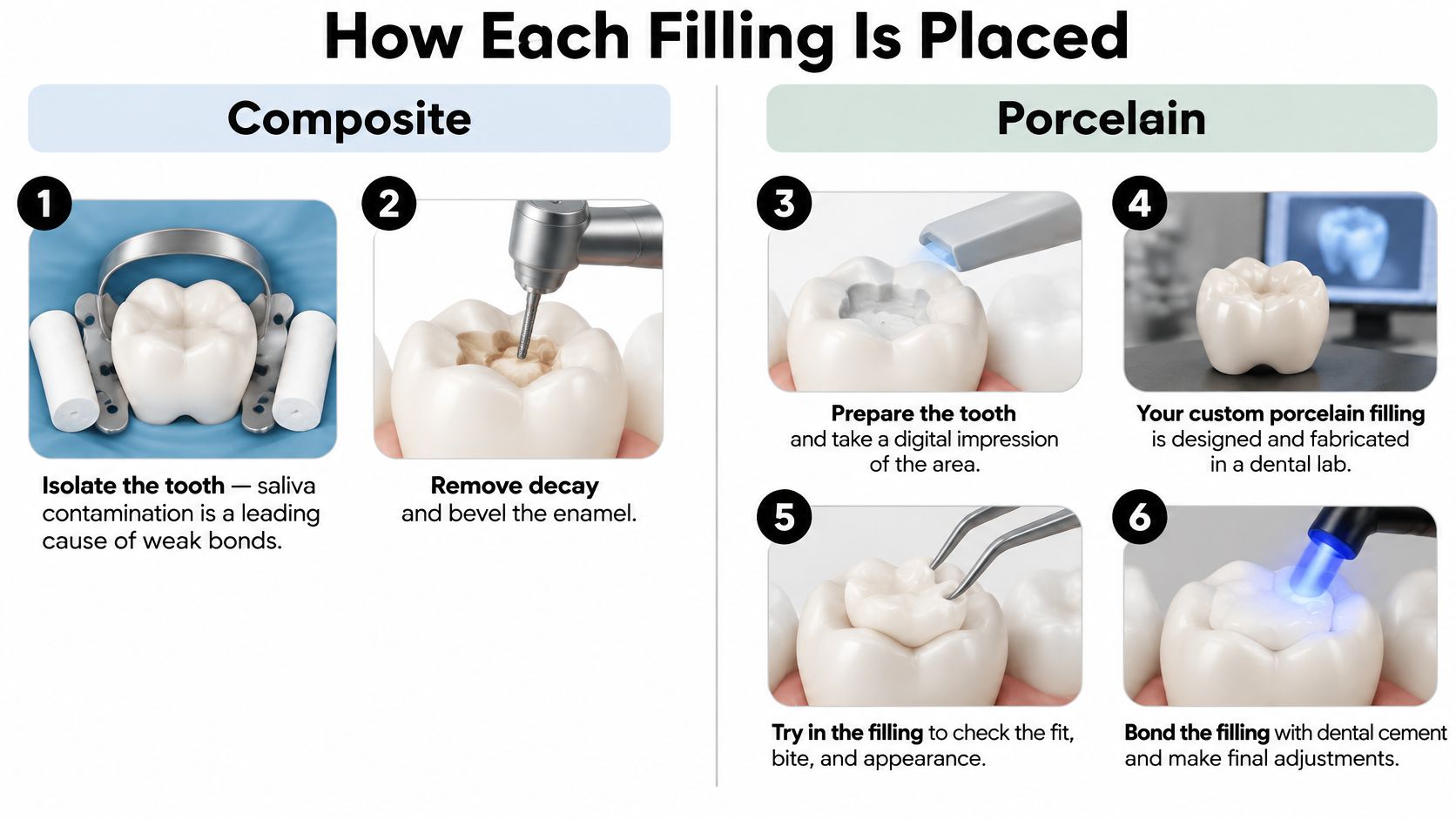
The composite route
- Isolate the tooth. A rubber dam or cotton rolls keep saliva off the field. Saliva contamination is a leading cause of weak bonds, and a bond that fails at the margin is exactly where decay restarts.
- Remove decay and bevel the enamel edges. The bevel widens the enamel surface so the resin attaches to enamel as well as dentin. Enamel bonds hold better and hide the transition line.
- Etch and bond. Phosphoric acid opens microscopic pores in the enamel, the adhesive flows into them, and the curing light locks it in place.
- Build in thin layers. Composite goes in at roughly 2 mm at a time, each layer cured before the next. Thick layers shrink as they set and pull on the margins.
- Shape, check the bite and polish. The dentist sculpts the anatomy, marks the high spots with articulating paper, and polishes to a smooth surface so plaque has nowhere to grip. This is a single appointment.
If you want the patient-side version of that direct appointment, this walkthrough of how dentists fill cavities follows the same steps.
The porcelain route
- Numb the area and remove the decay. Nothing about the cavity changes; only what fills it does.
- Reshape the tooth. The ceramic needs enough thickness to resist fracture and a clean, well-defined margin so the cement line stays thin and cleanable.
- Record the tooth. A digital scan or a physical impression captures the preparation. Scans skip the tray and the gag reflex.
- Fit a temporary. Usually one to two weeks, and it protects the prepared tooth while the piece is made.
- Fabrication happens away from the chair, in a laboratory or a chairside mill.
- Try it in and adjust. The dentist confirms the margins with a probe and checks the bite before anything is cemented. A high spot left here returns as soreness and, eventually, a fracture.
- Bond and polish. Resin cement, careful cleanup at the margins, final bite check.
Expect the preparation visit to run longer than a filling appointment and the second visit to be the short one. That second visit is not paperwork. Fit and bite balance get decided there, and both control how long the restoration lasts.
Appearance and Color Stability Over Time
Appearance is three separate questions, and only one of them gets answered on the day of treatment. How well does the shade match at the chair? How does the surface hold up to coffee, tea and red wine? And how does the material wear against the tooth above it?
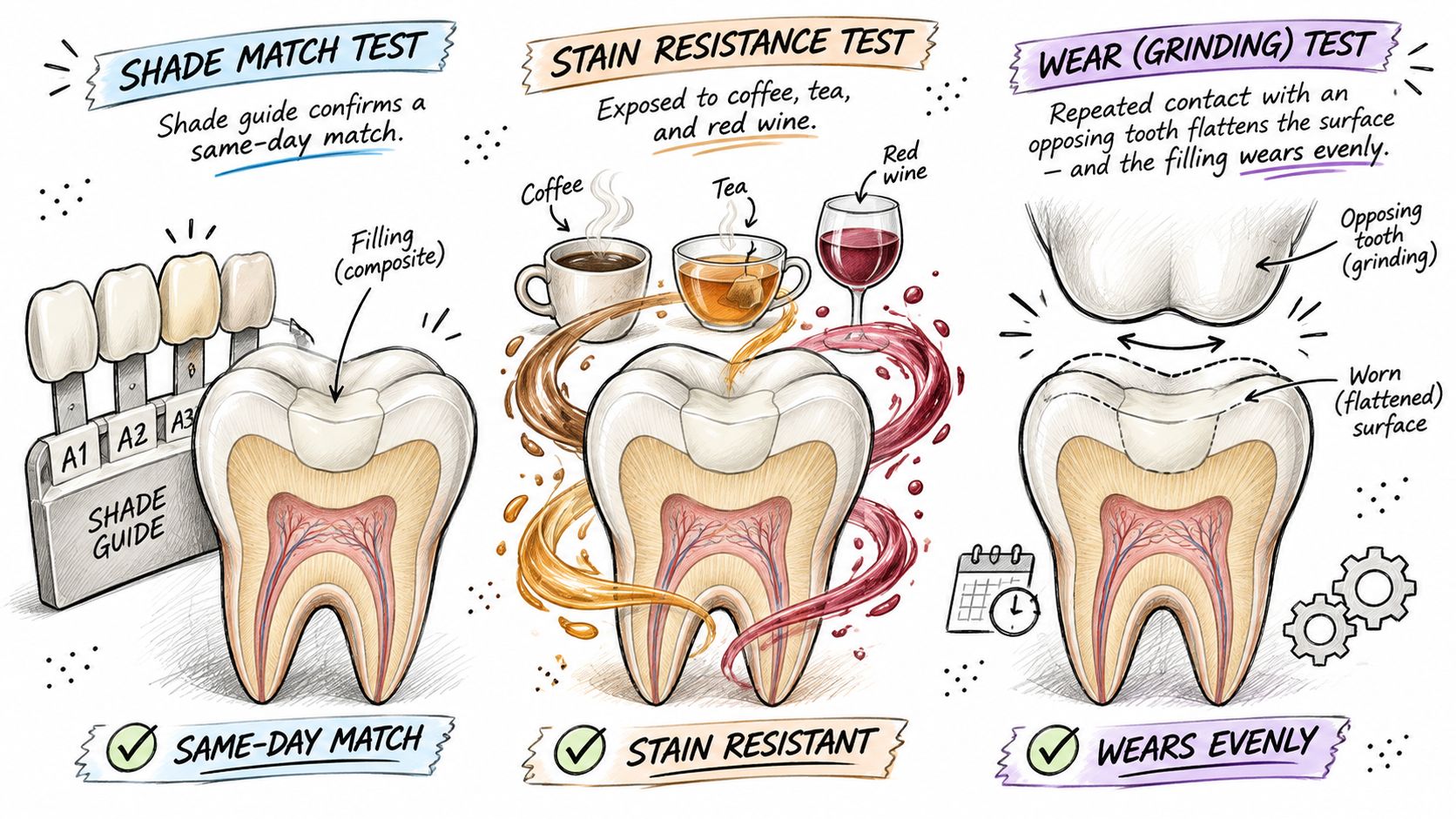
The day-one match
Composite is sculpted in the mouth from several shades plus translucent tints, so a dentist can match the neighboring tooth and blend the transition at the enamel edge. Porcelain is built outside the mouth with a glaze and internal translucency that mimics enamel, and it's characterized before firing. Both can look excellent on day one. The difference shows up later.
Why the two age differently
Resin is softer than enamel. Its surface roughens microscopically with chewing and brushing, and that texture gives pigment somewhere to bind, most visibly along the margin where the polish fades first. A repolish at a hygiene visit lifts most of it, and a small stain at the edge can usually be smoothed rather than replaced.
Glazed porcelain has no resin matrix taking up pigment, so it keeps its color, which counts most on a front tooth or for someone who drinks coffee through the morning.
A filling that matches perfectly on Tuesday can look dull at year two if nobody ever repolishes it.
The wear trade-off nobody mentions
Porcelain is harder than natural enamel. A glaze that wears through, or a surface roughened by a coarse prophylaxis or a heavy occlusal adjustment, can abrade the opposing tooth faster than enamel would. Surface finish and bite balance matter for both materials, which is why an adjusted bite should be rechecked once the anesthesia wears off and again at the next cleaning.
Four checks worth making before treatment:
- Get a shade photo with the shade tabs in the frame, taken before anything is drilled.
- Look at the gum-line margin in a mirror under good light. A visible ledge there will collect stain.
- Ask whether polishing the restoration is part of recall visits, and get the answer before you need it.
- Ask how the surface will be refinished if the bite is adjusted six months later.
Survival Rates and Why Fillings Fail
Survival data is where most comparisons stop, and it is the weakest place to stop. The numbers say a restoration was still in the tooth at follow-up. They say nothing about what the tooth paid to keep it there, or what happens when the next defect forms at its edge.
| Restoration (source) | Five-year survival | Ten-year survival |
|---|---|---|
| Composite inlay, onlay or overlay (2021 review) | 91% | Not reported |
| Ceramic inlay or onlay (2021 review) | 90% | 85% |
| Ceramic inlay, onlay or overlay (2024 pooled study) | Not reported | 91% |
| Indirect composite restoration (2025 retrospective study) | 94.2% | Not reported |
| Ceramic restoration (2025 retrospective study) | 90.9% | Not reported |
| CAD/CAM ceramic restoration (manufacturing review) | 97% | 89% |
| Pressable ceramic restoration (manufacturing review) | 95% | Not reported |
| Stratified ceramic restoration (manufacturing review) | 88% | Not reported |
Ceramic partial coverage lands at about 85% to 91% at ten years across the cited reviews, while the five-year figures for both materials cluster near or above 90%. A 2016 systematic review and meta-analysis screened 1,389 articles and pooled 14 studies covering 5,811 restorations, estimating survival for porcelain and glass-ceramic restorations at 92% to 95% at five years and 91% at ten years; fractures caused 6.2% of failures, endodontic complications 3.0%, secondary caries 1.7% and debonding 0.9%.
The gap that matters: a restoration can be marked as surviving while it is chipped, stained, sensitive or leaking at the margin. The table counts it as a success. Your tooth knows better.
When the reviews disagree
Ceramic's ten-year figure moves depending on which paper you open. The 2021 analysis landed at 85%. A 2024 pooled study of 2,154 ceramic inlays, onlays and overlays reported 91% at ten years. Neither is wrong. Different inclusion criteria, follow-up windows and mixes of tooth type produce different averages, which makes a range the honest answer and a single number a sales tool.
A 2025 retrospective study posted to Preprints.org estimated five-year survival at 94.2% for indirect composite and 90.9% for ceramic. A preprint is a signal, not a verdict.
Manufacturing changes the odds
How the piece is made shifts the number as much as which ceramic is used. A review of ceramic and indirect-composite inlays, onlays and overlays estimated 97% five-year survival for CAD/CAM ceramic restorations and 89% at ten years, 95% at five years for pressable ceramic and 88% at five years for stratified ceramic. Those figures describe laboratory or digitally manufactured partial restorations; chairside composite placed in one visit was outside their scope.
Indirect resin is no automatic middle ground with ceramic-level durability either. One review of indirect resin restorations found intracoronal indirect resin composite failed 18% more often than gold over five to seven years.
What no survival table captures is repair history, and that is the cost this decision turns on. A chipped or stained composite margin can often be smoothed, patched or refurbished without removing the whole filling. A fractured ceramic inlay or onlay generally means a new restoration, a new scan or impression and more tooth structure cut away to fit it, so each remake restarts the survival clock with less tooth than the last cycle had. A filling can win on the survival chart and still lose that accounting.
So the honest reading is narrower than the marketing on either side. Ceramic holds the ten-year advantage in larger restorations, resin stays competitive in small ones, and the literature is too uneven to promise either result for one specific tooth. For the replacement timeline read tooth by tooth, this guide to how long tooth fillings last puts the same survival figures in patient terms.
What Each Filling Costs and What It Buys
Price is the easiest part of this decision to check and the easiest to misread. CareCredit's 2024 U.S. averages put a composite-resin filling at $226 and a ceramic inlay or onlay at $976.
| Filling | Average U.S. price (2024) | Typical appointments |
|---|---|---|
| Composite resin filling | $226 | One |
| Ceramic inlay or onlay | $976 | Two or more |
The two averages translate into chair time.
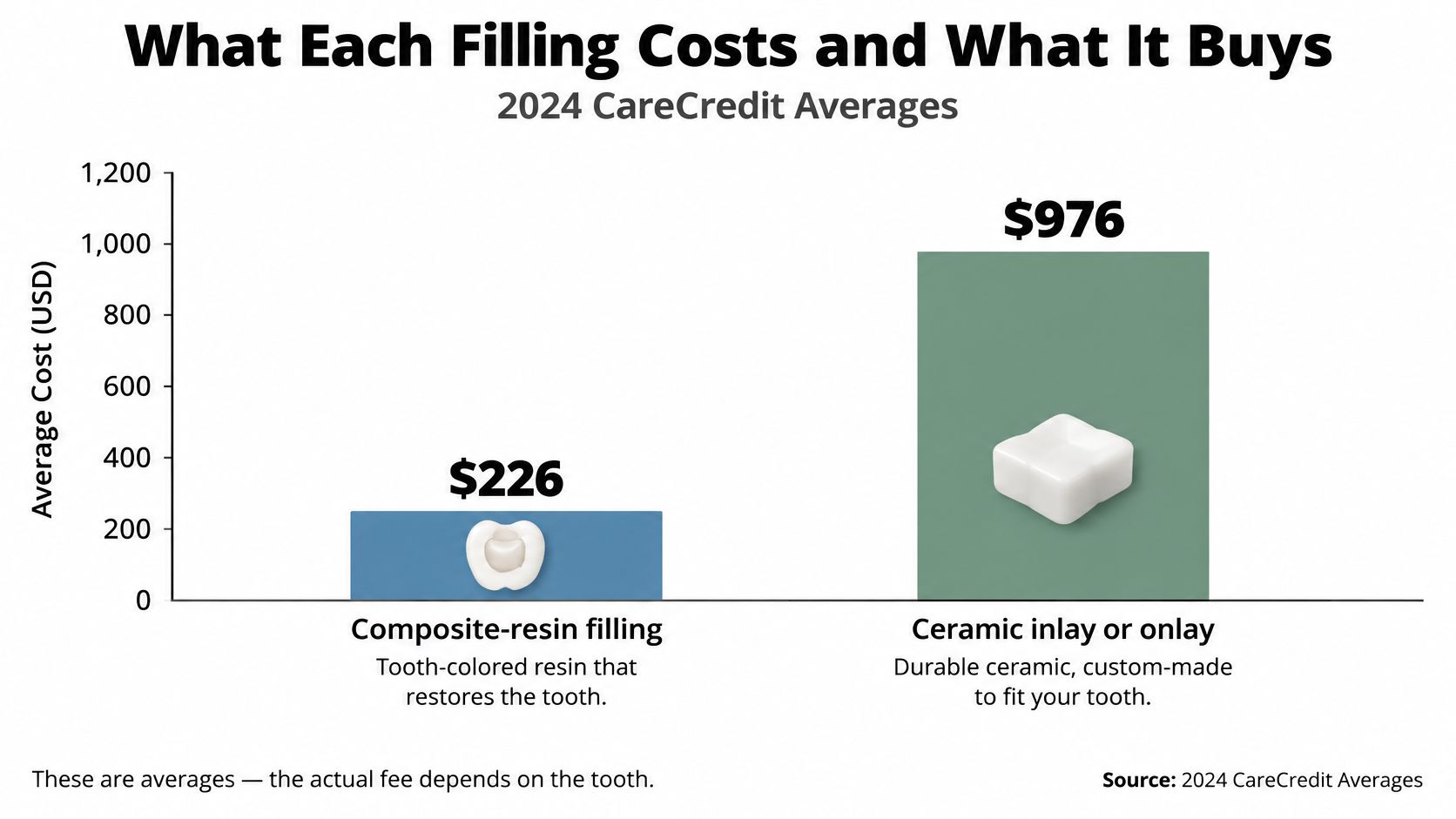
Those are averages, not quotes. The fee moves with the tooth, the number of surfaces involved, the practice, the region and whether imaging is needed that day.
The arithmetic that decides the case is cost per year of service. Porcelain carries roughly four times the up-front fee at those averages, and it earns that back only if it lasts proportionally longer. In a small, well-supported defect it's never asked to, which is why quoting the $976 figure at a patient with a 2 mm cavity misleads in the other direction.
Insurance widens or narrows the gap. Many plans set an allowance for posterior composite and pay a lower share toward porcelain, so the difference at the desk often exceeds the difference on the fee schedule. Request a pretreatment estimate in writing, and check how your dental insurance deductible applies to a restorative visit before you commit.
If a visual walkthrough helps before the consult, this covers both procedures end to end.
Three questions to bring to the front desk: what the fee includes (lab charge, temporary, cement, bite adjustment), how many visits the plan covers, and what the practice's repair or replacement policy does with a chip in year three. Our office files claims with most insurance plans and gives clear fee breakdowns before treatment starts, and we place both porcelain and composite fillings alongside veneers, root canals, whitening and smile makeovers, so the comparison happens in one consultation.
Then price the repair, not just the filling. A restoration replaced twice typically costs more in lost tooth structure than one larger restoration placed properly the first time, and no fee schedule shows that line item.
Matching the Filling to Your Tooth, Bite and Budget
Material preference gets a vote last. Four factors decide the case first: how much tooth wall remains, whether a cusp needs covering, how hard that tooth gets loaded, and how visible it is when you smile.
| Situation | Usually favored | Reason |
|---|---|---|
| Small or moderate cavity with most of the tooth intact | Composite | Conservative, single visit, easy to repair |
| Large back-tooth defect needing cusp coverage | Porcelain or glass-ceramic partial coverage | Ceramic partial coverage outperformed resin over five and ten years |
| Heavy chewing or grinding, sound remaining tooth | Porcelain, if the tooth can support it | Higher reported long-term survival under load |
| Visible front tooth with heavy stain exposure | Porcelain | Stain-resistant surface and enamel-like translucency |
| Short-term need or tight budget | Composite | No significant short-term survival difference in the partial-coverage review |
| Filling that has failed repeatedly on the same tooth | Case review before choosing | The cause, such as margin defects or bite load, decides the material |
Short-term evidence refuses to crown a winner. A review of partial-coverage restorations reported that after one to three years resin-matrix composite had only 1.56 more failures per 100 restoration-years than lithium disilicate, and 1.78 more losses of retention, with the evidence rated low certainty and no statistically significant difference between ceramic and ceramic-based materials. Ceramic's advantage shows up over years, not months.
A meta-analysis of posterior onlays estimated overall survival at 94.2%, declining with longer follow-up and varying by material, with composite onlays losing ground to ceramic as time went on. The authors called onlays conservative and predictable for posterior defects. That's a claim about larger restorations, not about every small filling.
Three cases, three answers
A chipped front edge in Tribeca. A small chip on an incisor that shows when you talk. Composite, layered to match and polished, and a repolish handles the next chip in minutes. Porcelain here means more tooth removed for a defect that doesn't need covering.
A grinding molar in Hell's Kitchen. A teacher who clenches at night with a large defect on a first molar. Porcelain partial coverage suits the load, provided enough sound tooth remains to support the preparation, and a night guard protects the investment. Skip the guard and the ceramic becomes the thing that fails.
A fourth filling on the same Upper West Side tooth. A deep cavity on a back tooth that's been drilled repeatedly. The next step is a cause review, not a material upgrade. Margin breakdown, an uneven bite, dry mouth or decay under an old restoration each call for a different fix.
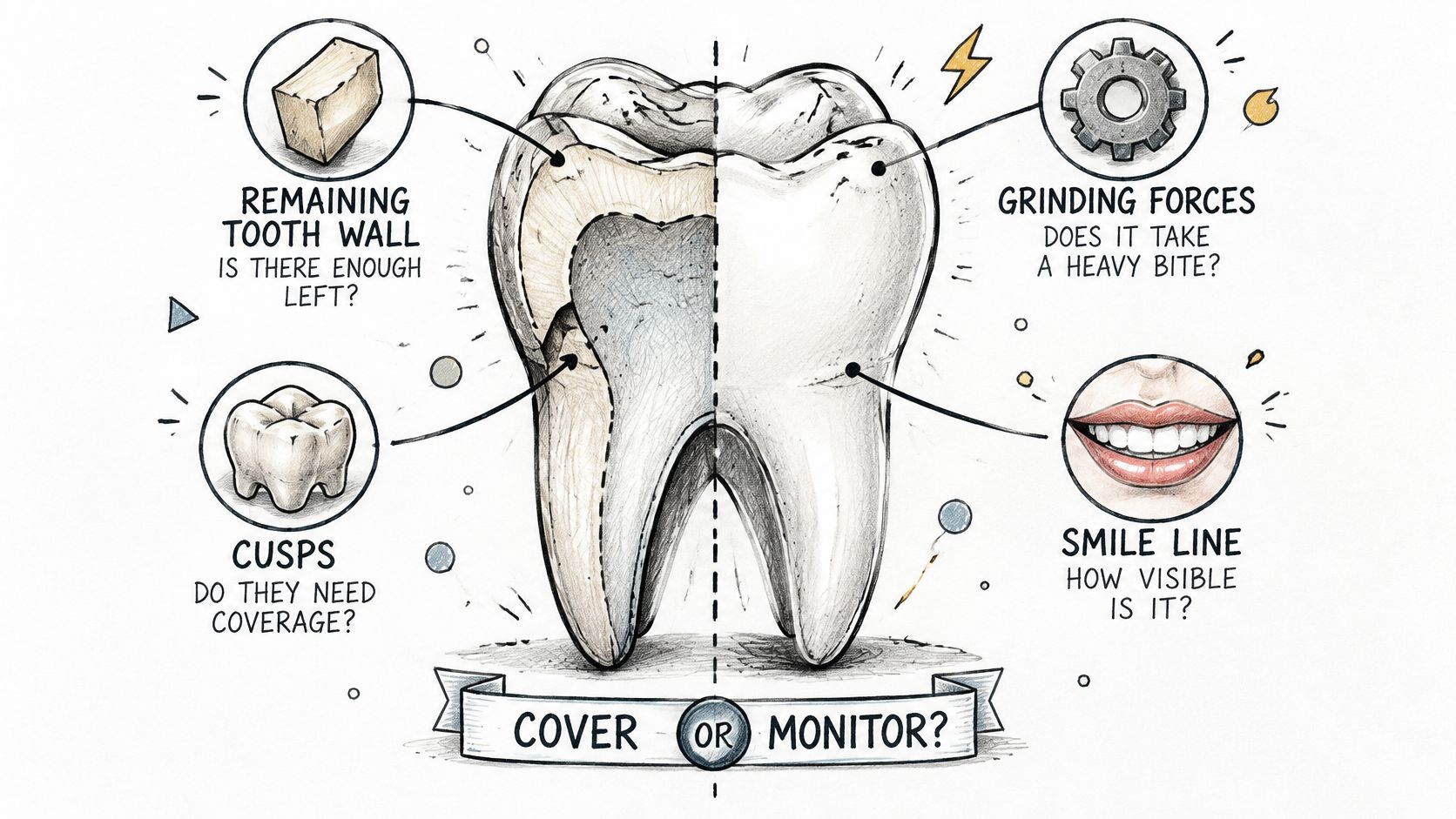
Ask this at the consult: what does this tooth look like in ten years if we repair it twice more instead of covering it once?
Five points to settle before choosing: remaining tooth walls, bite and grinding load, visibility in the smile, budget and plan coverage, and how many times this tooth has already been filled. If the goal reaches past one tooth, the plan changes shape, because our cosmetic treatments include porcelain veneers and crowns, implants, teeth whitening, and orthodontics for teens and adults. When too little wall remains to hold any filling at all, the question stops being which material and becomes which coverage, and our overview of dental crown services explains where that line gets drawn.
Booking Your Visit and Where We Serve Manhattan
The action this week is an exam, not a decision. Come in for an exam with X-rays so the remaining tooth structure gets measured rather than guessed, then ask for both options in writing: the fee, the number of visits, and the repair or replacement policy for each. The number that matters most is cumulative. A cheaper filling that fails twice costs more drilling than a restoration placed once, so include the question of why the last filling on that tooth failed.
Paul L. Gregory, DDS places both composite and porcelain, so the comparison happens in one consultation, with one set of images, at 57 W 57th St near Central Park South and Columbus Circle. Intraoral cameras let you see the same margins and cracks the dental team sees, which makes a written estimate easier to judge on evidence rather than trust. If shade matching for a front tooth is part of your question, the Midtown cosmetic dentist page covers how that planning works.
The practice serves patients from Midtown West and the broader New York metropolitan area, with assistance on most insurance plans and clear communication about coverage and fees. Bring the failing filling, the chipped edge or the estimate you were handed elsewhere, along with the tooth's repair history. Visit Paul L. Gregory, DDS to schedule your exam and get both options in writing.