


You've got a big presentation coming up, you've noticed a chip or some staining in photos, and a smile makeover seems like an efficient fix. But before you book veneers, the more important question is whether your teeth, gums, and bite can support the result you want. A good Midtown cosmetic dentist should answer that before discussing shade, shape, or price.
Cosmetic dentistry works best when it builds on a healthy, stable foundation. I'd put risk screening first, tooth preservation second, and the aesthetic plan after that. It's a less flashy order, but it's the one most likely to leave you happy with your smile years from now.
The First Step Most Midtown Patients Skip
Consider a hypothetical Midtown finance professional, age 38, who arrives expecting to discuss eight porcelain veneers. The teeth that bother him are uneven and worn, and he wants a uniform, brighter smile before an important work event. A thorough examination, though, finds gum inflammation and signs of grinding. Once those issues are addressed and the bite is planned, he may need a night guard and only two veneers to reach a healthy, natural-looking result.
That's not a real patient story or a promised outcome. It illustrates why cosmetic treatment shouldn't start with a tooth count. The first appointment should be a thorough evaluation, including a review of decay, gum health, bite, grinding habits, existing dental work, and any symptoms that could affect treatment planning.
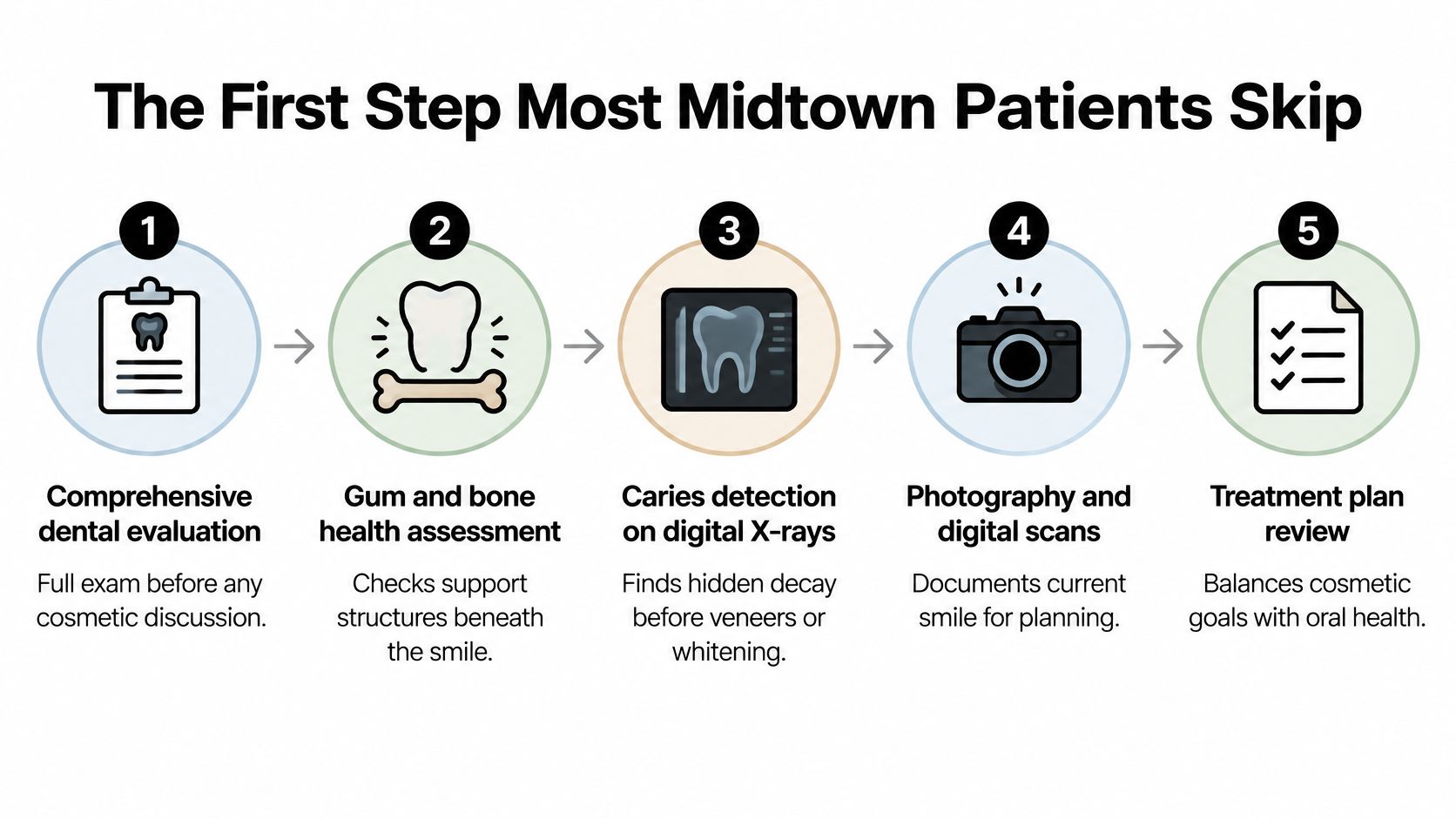
This order matters beyond appearance. The World Health Organization's 2022 global report, based on data profiles from 194 countries, estimated that 45% of the world's population, approximately 3.5 billion people, live with oral disease. It identified untreated cavities, severe gum disease, tooth loss, and oral cancers among the main conditions contributing to that burden. Untreated tooth decay alone affected an estimated 2.5 billion people worldwide, according to the WHO report on global oral health.
In the United States, the CDC found that 21% of adults ages 20–64 had at least one untreated cavity, with rates varying across age groups, in its overview of cavities and tooth decay. That doesn't mean cosmetic care is out of reach. It means diagnosis and prevention belong in the conversation before elective work begins. A beautiful result won't compensate for untreated disease or an unstable bite.
Practical rule: If a consultation jumps straight to veneer count and shade, ask for a full health and function evaluation before you agree to treatment.
Pre-Treatment Checklist That Protects Your Teeth
A checklist makes a consultation more useful. Bring it whether you're visiting a practice in Midtown, Chelsea, or the Upper West Side, and ask the dentist to explain how each item affects your options.
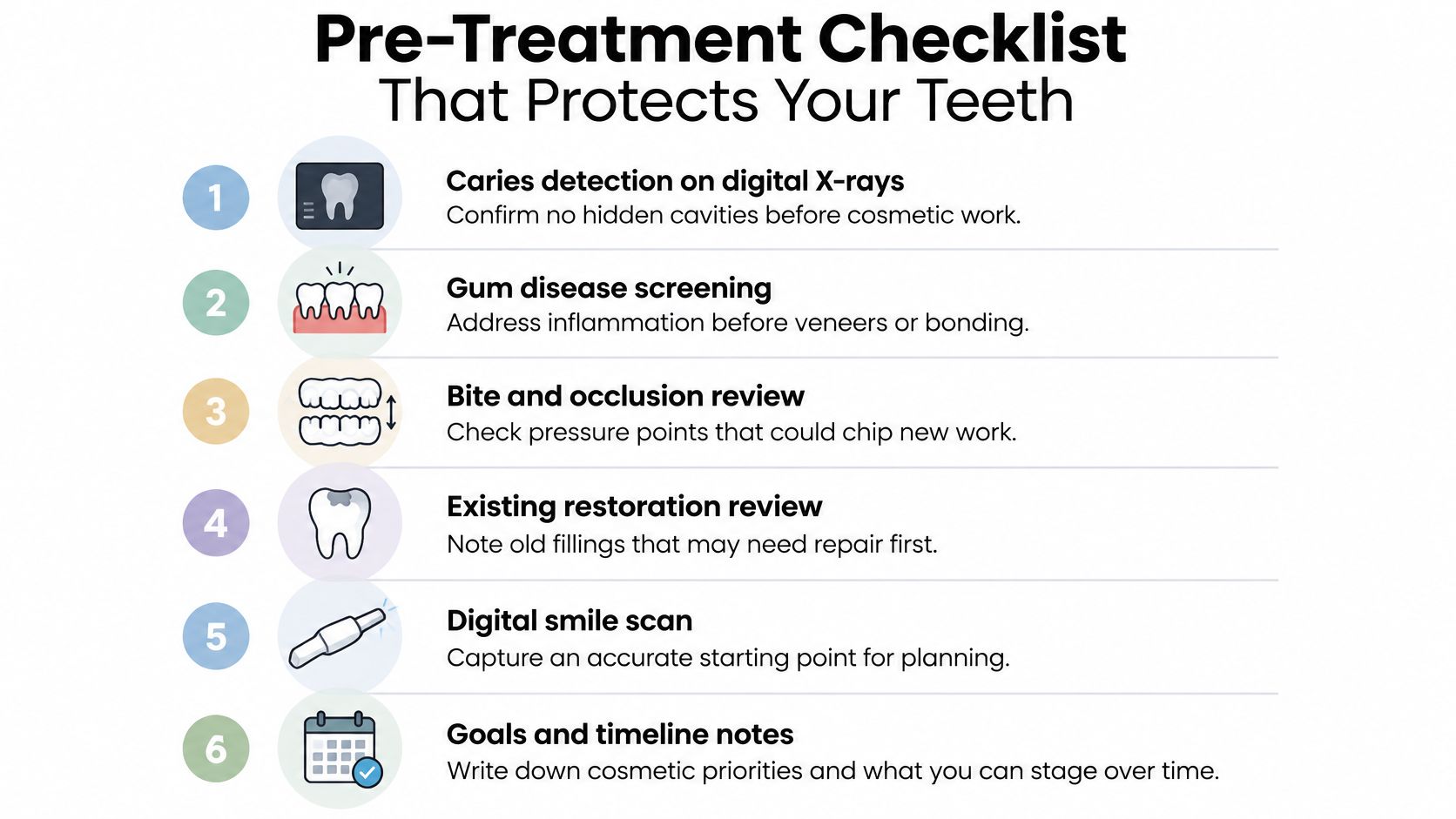
- Check for cavities. Digital X-rays can help identify decay that isn't visible during a visual exam. Ask whether any tooth needs treatment before whitening, bonding, or veneers.
- Assess gum health. Periodontal probing measures the spaces around teeth and helps a clinician evaluate gum inflammation and support. If your gums bleed or look swollen, ask whether that needs attention before elective work. This guide to gum disease care can help you understand the issues to raise.
- Review your bite. Occlusal analysis looks at how your teeth meet. A new restoration can face excessive pressure if the bite isn't considered during planning.
- Screen for grinding and clenching. Ask whether your wear patterns or symptoms suggest bruxism. Grinding can affect a plan's durability and may change whether a night guard is recommended.
- Assess enamel and existing restorations. The dentist should consider how much sound enamel is available for bonding, and whether old fillings, crowns, or other restorations need repair first.
- Record a clear starting point. Photographs and digital scans document tooth positions, proportions, and the existing smile. Bring your goals and timeline, too, so the plan can distinguish what matters most from what can be staged.
A clinician doesn't have to use the same equipment or sequence in every case, but you should understand what's being checked and why. If a provider dismisses questions about decay, gum health, bite forces, or enamel, don't treat that as a minor communication issue. It's a reason to pause before irreversible work.
Conservative Options Before You Commit to Veneers
Match the treatment to the problem, not the other way around. If your teeth are healthy and the main concern is shade, professional whitening may be enough. If you're bothered by mild crowding or spacing, aligners may address the position without covering the tooth surface. Small chips or gaps may suit bonding, while limited reshaping can sometimes be managed with enamel recontouring.
| Option | Reversibility | Tooth reduction | Best for | Maintenance |
|---|---|---|---|---|
| Professional whitening | Reversible; shade may fade | None | Discoloration on otherwise healthy teeth | Touch-ups may be needed |
| Composite bonding | Usually repairable, but not always fully reversible | Often minimal | Small chips, gaps, or shape changes | May need polishing or repair |
| Clear aligners | Teeth can shift again without retention | None for veneer preparation | Alignment concerns | Retainers help maintain position |
| Enamel recontouring | Irreversible where enamel is removed | Limited, case-dependent | Minor uneven edges | Depends on tooth health and bite |
| Porcelain veneers | Irreversible if enamel is prepared | Varies by case | Broader changes to shape, shade, or proportion | Review, maintenance, and possible repair or replacement |
| Full-coverage crowns | Irreversible | More tooth structure is removed | Teeth needing broader structural restoration | Ongoing review and maintenance |
The deciding question is simple: What's the least invasive option that can solve your actual concern? A younger professional in Hell's Kitchen, Hudson Yards, or the Theatre District with healthy teeth who wants a brighter smile might begin with whitening, while someone bothered by alignment may want to discuss orthodontics before committing to veneers. If you're weighing those choices, this overview of whether porcelain veneers fit your goals can help you prepare questions for a consultation.
Be cautious about online promises of “no-prep” veneers. The research cited in a systematic review was insufficient to support a definitive clinical statement about no-preparation veneers. Whether a veneer can be placed with little or no reduction depends on the individual tooth and treatment plan. Ask the dentist to show you how the proposed design will fit, and what could happen if the tooth's shape, position, or bite makes the no-prep approach unsuitable.
What Veneers, Whitening, and Smile Makeovers Actually Deliver

Veneers can change the visible face of a tooth, but they aren't permanent, maintenance-free coverings. They can fracture or debond, and decay or other problems may still develop around or beneath a restoration. A systematic review of 25 studies involving 6,500 porcelain laminate veneers estimated 95.5% cumulative survival at 10 years. When individual failure modes were analyzed separately, estimated survival was 96.3% for fracture, 99.2% for debonding, 99.3% for secondary caries, and 99.0% for endodontic treatment, according to the systematic review of porcelain veneer survival.
Those figures describe study outcomes, not a guarantee for any individual. A separate meta-analysis reported approximately 89% overall veneer survival at a median nine-year follow-up, with estimates of 94% for glass-ceramic and 87% for feldspathic porcelain veneers. The same analysis reported complication rates for debonding, fracture or chipping, secondary caries, severe marginal discoloration, and endodontic problems. Because study design, material, preparation, and patient risk differ, outcomes are better discussed as ranges than promises. See the veneer survival and complication meta-analysis.
A careful process includes a diagnostic wax-up or digital design, followed by a reversible mock-up where appropriate. Use that preview to check proportions, speech, lip support, and the midline before any enamel is removed. Confirm the shade before whitening or bonding, and ask the clinician to record the approved design and discuss sensitivity, chipping, repair, and possible replacement.
Whitening doesn't reshape teeth, and its effect can fade, so ask how to maintain the shade. A coordinated smile makeover may involve more than one procedure and more than one appointment. If you're comparing professional whitening approaches, review the practice's information on in-office teeth whitening.
Grinding needs its own plan. If you clench or grind, ask how that loading changes the design and whether you should wear a night guard. A night guard won't make a restoration indestructible, but ignoring grinding leaves an important risk unaddressed.
For a visual overview of treatment planning, use the following video as a discussion prompt, then ask your dentist how the concepts apply to your teeth.
Credentials, Technology, and Proof to Look For
A polished website isn't proof of sound clinical judgment. Look for evidence that the dentist can explain the diagnosis, show relevant examples, and connect the proposed treatment to your bite and tooth structure. Post-graduate cosmetic training can be useful, but it doesn't replace a clear examination and a plan you understand.
Ask to see before-and-after photographs of cases that resemble your concerns. The images should help you judge proportion and natural appearance, not just brightness. Ask which lab will make the restorations, what materials the dentist is considering, and how the material choice relates to your bite and the plan.

Digital scanners can capture models without conventional impressions, while intraoral cameras can help you see findings chairside. Digital X-rays support diagnosis when imaging is appropriate. The technology is only useful when the clinician uses it to answer a clinical question and explains what the images show. Here's a plain-language resource on digital dental X-rays.
Use the consultation to ask direct questions:
- Experience: How often do you treat cases like mine, and what would make you recommend a different approach?
- Planning: Is a diagnostic wax-up or mock-up included in the planning process, and what does the fee cover?
- Materials: Which material do you recommend, who fabricates it, and why does it fit my case?
- Continuity: Will the same dentist oversee my treatment and follow-up?
I favor a smaller, family-style practice when it offers continuity and can coordinate preventive, restorative, and cosmetic care. A high-volume cosmetic setting may be convenient, but a short appointment and glossy preview don't substitute for follow-through. You want a clinician who knows what was done, how your bite responds, and what to do if something changes.
Total Cost of a Smile Makeover, Not the Headline Price
The headline quote is only one part of the financial decision. Ask for a written plan that separates elective cosmetic treatment from care needed to address decay, infection, pain, or gum disease. Dental insurance policies often exclude procedures performed only for appearance, while coverage for restorative care depends on the plan and the clinical circumstances. Have the office explain what it expects your insurer to cover, what you'll pay yourself, and when charges are due.
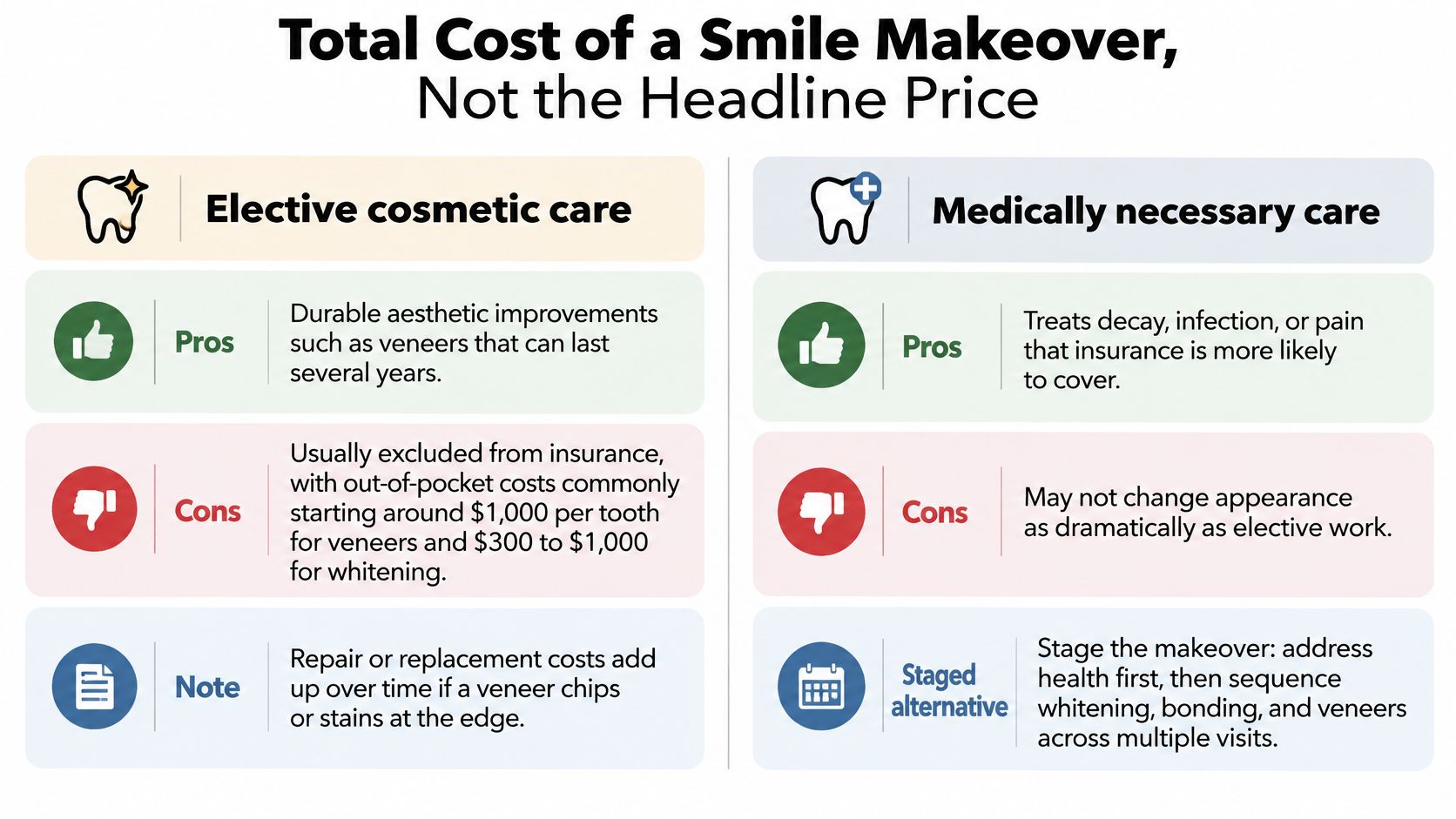
Build a cost-of-ownership view, not just a procedure list. Ask what follow-up is recommended, how the practice handles a chip or debonding, and whether a repair or replacement would change the original plan. Maintenance needs vary, so ask the dentist to describe the schedule for your specific treatment rather than relying on a generic estimate.
Cost can delay care, too. A 2025 peer-reviewed analysis reported that 20.2% of surveyed people delayed oral-health care because of cost, while 36.4% had postponed a dental visit during the previous year (analysis of cost-related delays in oral-health care). That's a reason to ask for staging, not a reason to feel pressured into a large plan. The same analysis reported that 57% of surveyed U.S. adults who manage dental-insurance decisions had delayed treatment to pay for other expenses. Make sure you can afford the treatment and its follow-up before you commit to irreversible work.
A staged plan may begin with stabilizing health, then consider whitening or bonding before veneers. That can lower the initial commitment and let you assess whether a smaller change meets your goals. For questions to raise about fees and veneer planning, use this overview of porcelain veneer cost per tooth. A lower quote isn't a bargain if it skips diagnosis, planning, or a candid discussion of repair.
Manhattan Logistics and Service Area Considerations
A cosmetic plan has to fit your life, not just your smile. If you work in Midtown, need to get back to an office, or are coordinating care around family responsibilities, consider how easy it is to attend consultations, treatment visits, and follow-ups. A convenient location matters most when the practice also explains appointment timing and what to do if a restoration feels wrong after you leave.
Paul L. Gregory, DDS is located at 57 W 57th Street near Central Park South and Columbus Circle. That location can work for patients traveling from Midtown and nearby areas, including Midtown West, Hell's Kitchen, and the Theatre District. The Midtown service area also reaches people coming from Turtle Bay, Chelsea, Hudson Yards, and Gramercy Park. City planning materials group Midtown and Gramercy Park with one community district, Chelsea and Hudson Yards with another, and East Midtown and Turtle Bay with a different one. That's a helpful reminder that Manhattan neighborhood names are practical geographic labels, not always fixed boundaries. See the NYC planning dataset.
The practice may also suit patients traveling from the Upper West Side, Upper East Side, and Lenox Hill, sometimes written as Lennox Hill, as well as the West Village, Greenwich Village, NoHo, East Village, SoHo, Tribeca, Chinatown, and Wall Street. These places aren't all Midtown, and they don't all sit equally close to the office. Be realistic about your commute and how many visits your treatment may involve rather than assuming the word “Manhattan” means nearby.
Check practical access before you choose. Ask whether the office offers short-notice assessment for a cracked tooth or lost crown, what the first step is if you develop pain, and whether teledentistry is available for triage. Find out how the practice handles insurance questions and claim submissions before treatment begins. Those details can matter more to a working professional than an impressive reception area.
A nearby practice is useful. A practice that explains follow-up and responds when something goes wrong is more useful.
Turn a sales consultation into informed consent
Use this short list at any appointment:
- Diagnosis: What needs attention before cosmetic treatment, and why?
- Conservative alternatives: Could whitening, bonding, or aligners address my concern with less alteration to my teeth?
- Preview: Can I review a wax-up or mock-up before committing?
- Risks: What could chip, debond, become sensitive, or need repair, and how would you handle it?
- Maintenance: What care and follow-up will my specific plan require?
- Continuity: Will the same dentist oversee the treatment and review the results?
If your smile concern comes with jaw discomfort, headaches, or clenching, ask whether those symptoms need evaluation before cosmetic planning. For general background, this resource on what to know about TMJ care from Pain and Sleep Therapy Center can help you prepare questions, though your own clinician should assess your situation.
My recommendation is straightforward: choose the clinician who checks health and function first, preserves tooth structure where possible, explains trade-offs without pressure, and gives you a realistic maintenance plan. A smaller practice with continuity of care can make that easier because the dentist can follow the whole plan instead of treating each visit as a separate transaction. Don't choose on speed or headline price alone. Choose a plan you understand and can maintain.
Paul L. Gregory, DDS provides preventive, restorative, and cosmetic dental care, including veneers, whitening, bonding, orthodontics, and treatment for urgent dental concerns. If you're weighing cosmetic work in Midtown, visit Paul L. Gregory, DDS to discuss your goals, the health and function checks your case needs, and a plan with clear follow-up.