

Porcelain veneers typically cost about $900 to $2,500 per tooth in the United States, with a national average near $1,455 per tooth. In New York City, pricing often trends higher, around $1,500 to $3,000 or more per tooth before add-ons.
You're sitting in a Midtown office between meetings, looking at photos of your smile and wondering whether four veneers would be enough, or whether eight would create a more balanced result. The per-tooth number sounds simple until you ask what it includes. Does it cover the scan, temporary veneers, laboratory design, bonding appointment, and follow-up adjustments?
Those questions matter because porcelain veneers are custom restorations, not a prepackaged cosmetic service. A quote reflects the number of teeth, the condition of those teeth, the laboratory process, the dentist's time, and the local cost of running a practice. The porcelain veneer treatment overview can help you understand where the procedure fits within a broader cosmetic plan.
This guide breaks down the porcelain veneers cost per tooth in plain language. You'll see why New York pricing can differ from national estimates, how four, six, eight, or ten veneers affect the budget, and which questions can prevent an incomplete quote from becoming an unwelcome surprise.
Introduction to Porcelain Veneers Cost Per Tooth
You are sitting in a Midtown office between meetings, comparing photos of your smile and wondering whether four veneers would be enough or whether eight would look more balanced. The per-tooth quote sounds straightforward until you ask what sits behind it. Does it include the digital scan, tooth preparation, temporary veneers, laboratory design, bonding visit, and follow-up adjustments?
A porcelain veneer is custom work, so its price resembles a fitted garment more than a packaged service. The dentist evaluates each tooth, plans the proportions, and prepares the surface. The laboratory then creates a restoration with the intended shade, translucency, and contour. Finally, the dentist checks the fit, bite, and appearance before bonding it in place.
That sequence explains why two offices can quote different amounts for the same number of teeth. One estimate may include the scan, temporaries, laboratory communication, and bonding appointment. Another may list only the veneer itself. An itemized budget should show each stage clearly, including preparation, digital records, lab work, provisional restorations, final bonding, and adjustments.
Your location also affects the total. A Midtown practice carries higher operating costs, and complex cosmetic cases may require more design time, additional appointments, or a laboratory with specialized experience. Those factors can shift the fee even when the per-tooth description looks identical.
The porcelain veneer treatment overview provides context for how veneers fit into a broader cosmetic plan. At your consultation, ask which teeth are recommended, what condition they are in, and whether bite or gum concerns need attention before cosmetic treatment.
The 2026 CareCredit veneer pricing guide lists a typical U.S. range of $1,020 to $2,506 per tooth, with an average of $1,455 per porcelain veneer. These figures help establish a starting reference, not a complete NYC treatment estimate.
Chairside rule: Compare itemized treatment plans, not isolated per-tooth numbers.
A clear quote should make every cost visible before you commit.
Understanding What Porcelain Veneers Are and Why Pricing Is Per Tooth
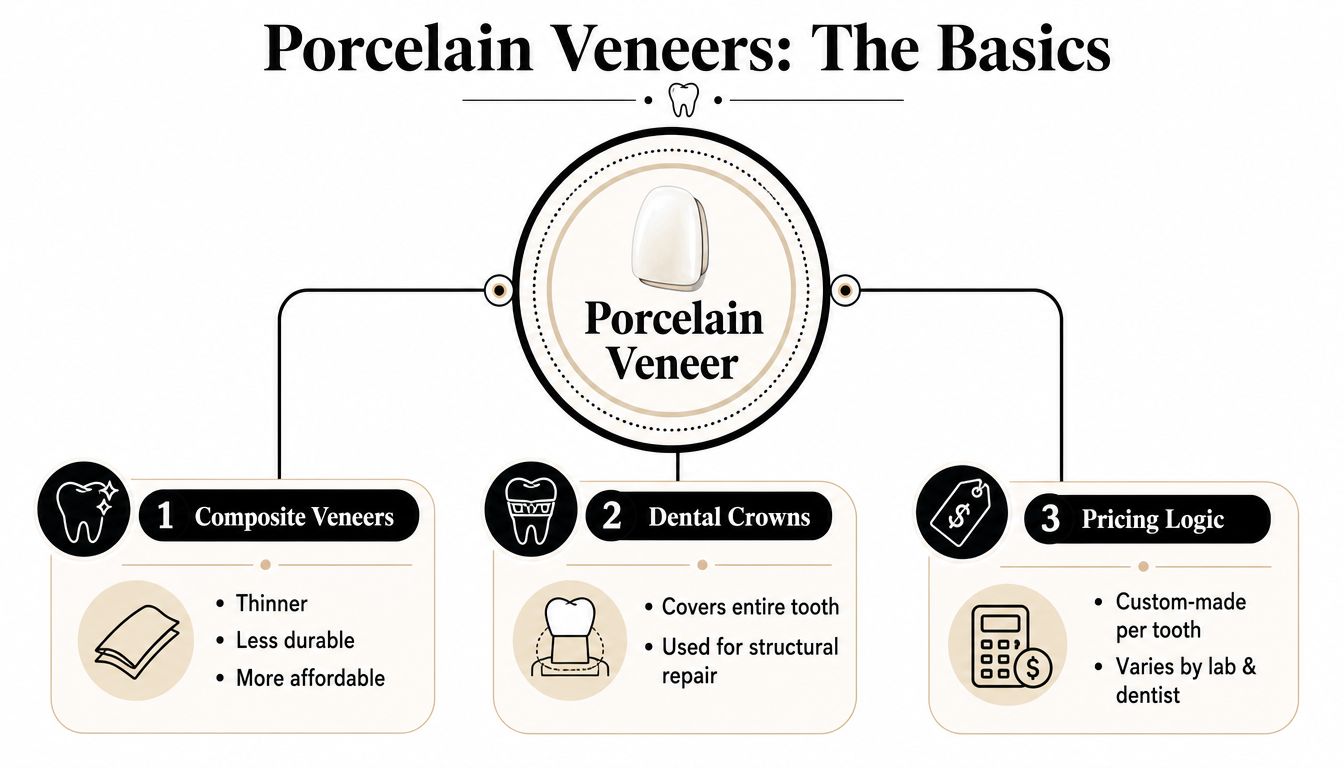
A porcelain veneer is a thin, custom-made ceramic shell bonded to the visible front surface of a tooth. It can change the apparent color, shape, proportions, and edge design of a healthy tooth while preserving more natural structure than a full crown generally requires. The dentist still has to evaluate enamel, bite, tooth position, gum health, and existing restorations before recommending it.
The simplest analogy is custom tailoring. An off-the-rack shirt has a standard size and pattern. A porcelain veneer is more like a jacket made for one person, with measurements, fabric selection, fitting, and final alterations. Each tooth has a different contour, neighboring teeth create different visual requirements, and the laboratory must reproduce the intended shade and translucency.
Veneers, composite, and crowns
Composite veneers use tooth-colored resin applied directly by the dentist. They may be a more affordable approach for selected cosmetic concerns, but they don't involve the same laboratory fabrication process as porcelain. The comparison of porcelain veneer teeth and other restorations can help clarify why material and technique affect the quote.
A dental crown serves a different purpose. It covers the entire visible portion of a tooth and is generally considered when a tooth needs more substantial structural repair. A veneer covers the front surface, so it isn't a substitute for a crown when the underlying tooth lacks adequate strength.
Why each tooth becomes its own project
The dentist and laboratory must coordinate several details for every veneer:
- Shape and proportion: The restoration has to fit the tooth and relate naturally to adjacent teeth.
- Color design: The laboratory may adjust opacity, translucency, surface texture, and edge character.
- Preparation: The dentist determines whether the tooth needs contouring or carefully planned enamel preparation.
- Bonding: The final restoration must be tried in, evaluated, and bonded under controlled conditions.
A six-tooth case therefore isn't just one large veneer with a bulk discount. Six individual restorations must fit together as a visual group. The dentist may also need to plan symmetry across the smile, which can require more design communication and trial fitting.
That per-tooth logic explains why the total rises as more teeth are treated. It also explains why a quote should identify whether the office is charging only for the ceramic unit or for the broader clinical process surrounding it.
What Makes Up the Per Tooth Price
The veneer itself is only one part of the fee. A porcelain case combines diagnosis, digital records, tooth preparation, temporary protection, laboratory artistry, and final adhesive bonding. Published guidance from Champaign Dental Group's porcelain veneer cost breakdown emphasizes that preparation, impressions or scans, laboratory communication, and bonding all influence the final price.
A useful way to read an estimate is to treat it like a production budget. The dentist is coordinating a small clinical project, while the laboratory is creating a custom ceramic piece that must fit one specific tooth and harmonize with the rest of the smile.
The clinical planning layer
The process usually begins with an examination and a conversation about your goals. The dentist may use digital X-rays, intraoral photographs, an intraoral camera, or a digital scanner to understand your teeth and plan the design. Digital scans can create an impression-free model, while traditional impressions remain an option in some offices.
Tooth preparation and contouring follow. The dentist may need to create carefully controlled space so the veneer sits naturally rather than appearing bulky. If the teeth have decay, cracks, gum concerns, or bite problems, those issues can affect the sequence and fee.
The temporary and laboratory layer
Temporary veneers can protect prepared teeth while the laboratory fabricates the final ceramics. They also give you an opportunity to evaluate the general length, shape, and appearance before permanent placement. Ask whether temporaries are included, because a headline per-tooth figure may not make that clear.
The laboratory then fabricates each veneer and manages shade selection, layering, glazing, and finishing. Higher fees often reflect the time required for detailed esthetic matching and communication between dentist and technician, not a different piece of porcelain.
The final bonding layer
At the delivery appointment, the dentist checks fit, contacts, shade, shape, and how your teeth meet when you close and move your jaw. The veneers are then bonded using an adhesive protocol designed for the specific ceramic and tooth surfaces. Minor bite adjustment or polishing may be necessary afterward.
A dental crown cost explanation offers useful context for comparing custom restorative fees, although crowns and veneers solve different clinical problems.
Ask this before accepting a quote: “Which parts cover the clinical appointments, and which parts cover the laboratory work?”
How Much Porcelain Veneers Cost Per Tooth in NYC Versus Nationally
A four-tooth plan in Midtown can look very different from a national online estimate. The reason is not porcelain alone. The quote may include the dentist's preparation time, digital records, temporary veneers, laboratory design, bonding, and follow-up adjustments. NYC rent, staffing, technology, and laboratory coordination also shape the fee.
National pricing guides show a broad range rather than one dependable price. Porcelain veneers are often listed at approximately $900 to $2,500 per tooth, while consumer summaries commonly place many cases around $1,400 to $1,800. Different guides draw from different providers and markets, so their ranges will not match exactly. The national figures provide context, not a substitute for an itemized NYC estimate.
Market comparison
| Market | Typical Per Tooth Range | What Drives Difference |
|---|---|---|
| United States | About $900 to $2,500 | A mix of cities, providers, laboratories, and case types |
| U.S. state examples | About $1,242 in Maine to $2,359 in Vermont | Regional overhead, provider mix, and local fees |
| New York City | Often about $1,500 to $3,000 or more before add-ons | Manhattan overhead, laboratory costs, clinician time, and case complexity |
NYC's range is a market pattern, not a fixed citywide rate. A straightforward case with minimal preparation may sit differently from a highly visible smile design requiring detailed shade work, several mock-up revisions, temporary refinement, and close dentist-technician communication.
Translating the quote into a smile plan
At $1,500 per tooth, four veneers would total about $6,000 before services outside the per-tooth fee. At $3,000 per tooth, the same four-tooth plan would be about $12,000. An eight-tooth plan would be about $12,000 to $24,000 across that range, again before add-ons.
Those calculations show why the number of teeth matters, but they do not tell you whether two quotes cover the same work. One office may include the scan, preparation, temporaries, laboratory design, bonding, and scheduled review. Another may list the ceramic veneer and bonding while billing some of those steps separately.
Use this checklist while comparing NYC estimates:
- Preparation and records: Are the examination, photographs, scans, and tooth preparation included?
- Temporaries: Are temporary veneers included while the laboratory makes the final restorations?
- Laboratory work: Does the fee cover shade selection, layering, glazing, revisions, and communication with the technician?
- Bonding and review: Are final placement, bite checks, polishing, and follow-up adjustments included?
A higher quote may reflect more planning and control for the visible front teeth, not just a more expensive ceramic shell. Ask the office to show each component beside the per-tooth fee before comparing totals.
Hidden Costs and Add Ons That Change Your Total Budget
The most useful veneer estimate answers a question that online price pages often leave open: What does the quoted per-tooth fee include? A single number may cover the veneer and bonding but exclude records, temporaries, sedation, preparation, or follow-up care. Recent pricing guidance places U.S. porcelain veneers around $900 to $2,500 per tooth, while also emphasizing that city, dentist experience, and case complexity can change the all-in figure, as outlined by Dr. Vaksman's 2026 veneer cost guide.
Build an itemized estimate
Bring this checklist to your consultation and ask the office to mark each item as included, excluded, or not clinically indicated:
- Diagnostic records: Confirm whether the examination, digital X-rays, photographs, scans, and study models are part of the consultation or billed separately.
- Smile planning: Ask whether digital design, mock-ups, or preview appointments carry a separate fee.
- Tooth preparation: Clarify whether enamel preparation, contouring, or reshaping is included in the per-tooth figure.
- Temporary veneers: Find out whether temporary restorations are provided between preparation and final placement.
- Laboratory services: Ask whether custom shade selection, layering, glazing, and laboratory revisions are included.
- Sedation options: If dental anxiety is a concern, ask whether sedation or anxiety-management services are priced separately.
- Bonding and delivery: Confirm that try-in, cementation, bite adjustment, and polishing are included.
- Follow-up visits: Ask whether post-placement adjustments or a final polish are covered.
- Repair or replacement policy: Request the office's written policy for a damaged or remade restoration.
Add-ons depend on the starting condition
A healthy, well-aligned tooth may need a relatively straightforward cosmetic sequence. A tooth with severe discoloration, rotation, old filling material, gum irregularity, or a bite concern may require additional planning before the veneer can be placed. The same is true when whitening, gum contouring, orthodontic treatment, or restorative work would improve the overall result.
Don't assume every suggested service is an unnecessary upsell. Ask what problem the additional treatment solves and whether it changes the prognosis, appearance, or fit of the veneers. A clear dentist should be able to explain the reason in ordinary language.
Budgeting habit: Request one written total for the recommended plan, then a separate list of optional services and possible contingencies.
The veneer cost discussion for NYC patients can help you prepare questions, but only a personalized examination can determine which items apply to your teeth.
Financing Insurance and Ways to Make Veneers More Affordable
Porcelain veneers are usually elective cosmetic treatment, so dental insurance may not pay for the cosmetic portion. Coverage can differ if a tooth also has a documented structural problem. Your plan's language controls, so ask the insurer what, if anything, could apply. The earlier CareCredit discussion can help you understand financing options, but the final answer comes from your benefits administrator and dentist.
An HSA or FSA may also be subject to plan rules and tax requirements. A procedure performed in a dental office does not automatically qualify. Ask the administrator, and keep the dentist's written treatment description available if verification is required.
Practical ways to plan payment
Start with the complete written estimate, not the monthly payment. A monthly figure can make a plan look manageable while hiding the full cost, interest, or promotional conditions. Compare these approaches:
- Phased treatment: Treat the teeth that matter most to your smile first, if sequencing will not compromise shade, shape, or the final design.
- Practice payment arrangements: Ask whether payment is due by treatment phase and what must be paid before laboratory work begins.
- Third-party financing: Review the annual percentage rate, promotional terms, application requirements, and consequences of a missed payment.
- Timing around work: Schedule consultation, preparation, and delivery visits around your professional calendar so rushed decisions do not create avoidable changes.
- Insurance coordination: Ask whether the practice assists with claim submissions. Filing a claim does not guarantee coverage.
Phasing can make a plan easier to manage, but it requires careful design. Veneers placed at different times still need to coordinate in shade, shape, and smile proportions. A dentist may recommend treating a visible group together rather than placing one restoration now and matching it much later.
Questions for the financial coordinator
Request the estimate in writing, with definitions for terms such as “case,” “unit,” “temporary,” and “follow-up.” Ask whether the fee changes if the laboratory remakes a veneer because its shade or fit does not match the approved plan. Confirm when you can review the proposed shape before permanent bonding.
Also ask for an itemized budget checklist: examination and planning, preparation, digital scans, laboratory design, temporaries, bonding, adjustments, and follow-up care. In a Midtown office, laboratory coordination and operating costs can affect the quote, while a more complex case may require extra planning or visits. Seeing each component makes the per-tooth fee easier to compare.
For broader insurance questions, the guide to insurance and dental crowns explains how coverage may differ when treatment serves a restorative rather than purely cosmetic purpose. Veneers still require plan-specific verification.
Planning Your Next Step Toward a Confident Smile
A sensible veneer decision starts with the smile you want to change, not with a fixed number of teeth. One tooth may be enough for a localized chip or discoloration. A wider group may be appropriate when symmetry, shade, and tooth proportions need to work together. Your dentist should explain why the recommended number supports the result.
Health comes first. Decay, gum inflammation, cracks, an unstable bite, or significant crowding may need attention before cosmetic treatment. In some cases, whitening, bonding, a crown, or Invisalign clear aligners may address the concern more appropriately than placing a veneer immediately.
Bring these questions to the consultation
- Which teeth are candidates for porcelain veneers, and which aren't?
- What will the final smile look like in a mock-up or preview?
- Will you use digital scans, photographs, and bite records?
- How much tooth preparation is planned?
- Are temporaries, laboratory revisions, bonding, adjustments, and follow-ups included?
- What is the complete fee for the recommended number of teeth?
- Which alternatives could meet part of the goal with less treatment?
- How would a phased plan affect shade matching and design?
A Midtown Manhattan practice such as Paul L. Gregory, DDS provides cosmetic, restorative, orthodontic, preventive, and diagnostic services in one office, including digital scanning and intraoral imaging. That kind of continuity can be useful when a veneer plan intersects with bite care, crowns, gum treatment, or alignment.
The right consultation should leave you with a clear clinical reason for each recommended tooth and a written budget that separates included services from optional additions. Take the estimate home, compare itemized plans, and choose a provider based on communication, planning quality, and suitability for your dental needs, not price alone.
If you're considering porcelain veneers in Manhattan, visit Paul L. Gregory, DDS to discuss your smile goals, diagnostic options, and an itemized treatment estimate. The Midtown team can help you understand whether veneers, staged cosmetic care, or another restorative approach fits your teeth, schedule, and budget.