

A systematic review of 6,500 porcelain veneers found a 95.5% estimated survival rate at 10 years, making porcelain veneers one of the most durable cosmetic dental restorations available. That result applies to carefully selected cases and proper maintenance, not as a guarantee for every patient.
You may be at the stage where you've saved before-and-after photos, compared shades, and started wondering whether porcelain veneer teeth would look natural in your own smile. Perhaps you're a Manhattan professional who wants to repair worn edges before an important career change, soften discoloration that whitening hasn't corrected, or create more symmetry without committing to full crowns.
The important question isn't whether veneers can make teeth look better. It's whether your teeth, gums, bite, and goals make veneers a sound choice. Some patients are better served by composite bonding, orthodontics, whitening, or crowns. A thoughtful consultation should identify that distinction before any enamel is altered.
Considering Porcelain Veneers for Your Smile
A prospective patient once described the decision this way: she liked her smile from a distance, but close photographs showed uneven edges, stubborn color differences, and a small gap that whitening couldn't address. She worked in Manhattan, met clients regularly, and wanted a polished result without a smile that looked artificial. Her concern wasn't whether veneers could change her teeth. It was whether the change would still look like her.
That's the right starting point. Porcelain veneers can alter color, shape, length, and proportion, but the result depends on diagnosis and design as much as ceramic. Tooth position, gum contours, lip movement, facial proportions, and the way the front teeth contact each other all influence the final appearance.
The durability evidence is reassuring. A systematic review of 25 studies involving 6,500 porcelain laminate veneers reported a 95.5% estimated cumulative survival rate at 10 years. The same review reported isolated survival rates of 96.3% for fracture, 99.2% for debonding, 99.3% for secondary caries, and 99.0% for endodontic treatment (systematic review of porcelain laminate veneer outcomes). These figures describe clinical research populations, not an individual promise.
What the survival figure can and can't tell you
A survival rate means the restoration remained in place and clinically acceptable under the study's definition. It doesn't mean every veneer will look unchanged forever, and it doesn't remove the possibility of repair or replacement. Preparation design, enamel preservation, bite forces, hygiene, laboratory quality, and the patient's habits all matter.
Practical rule: Choose veneers because they solve a defined cosmetic problem on a healthy foundation, not because a social-media image makes them appear universally appropriate.
The best consultation should also discuss alternatives. A patient with mild discoloration may benefit from professional whitening, while someone with a small chip may need only bonding. Significant structural weakness can make a crown more appropriate, and tooth-position problems may be better handled with orthodontics first. For a broader view of how cosmetic treatment fits alongside restorative care, review this guide to restorative and cosmetic dentistry in Manhattan.
What Are Porcelain Veneer Teeth
Porcelain veneers are custom-made ceramic shells bonded to the visible front surfaces of teeth. They're designed to improve appearance while covering substantially less tooth structure than a full crown. Depending on the case, a veneer can change a tooth's shade, reshape a worn edge, close a small space, or create a more balanced appearance across several teeth.
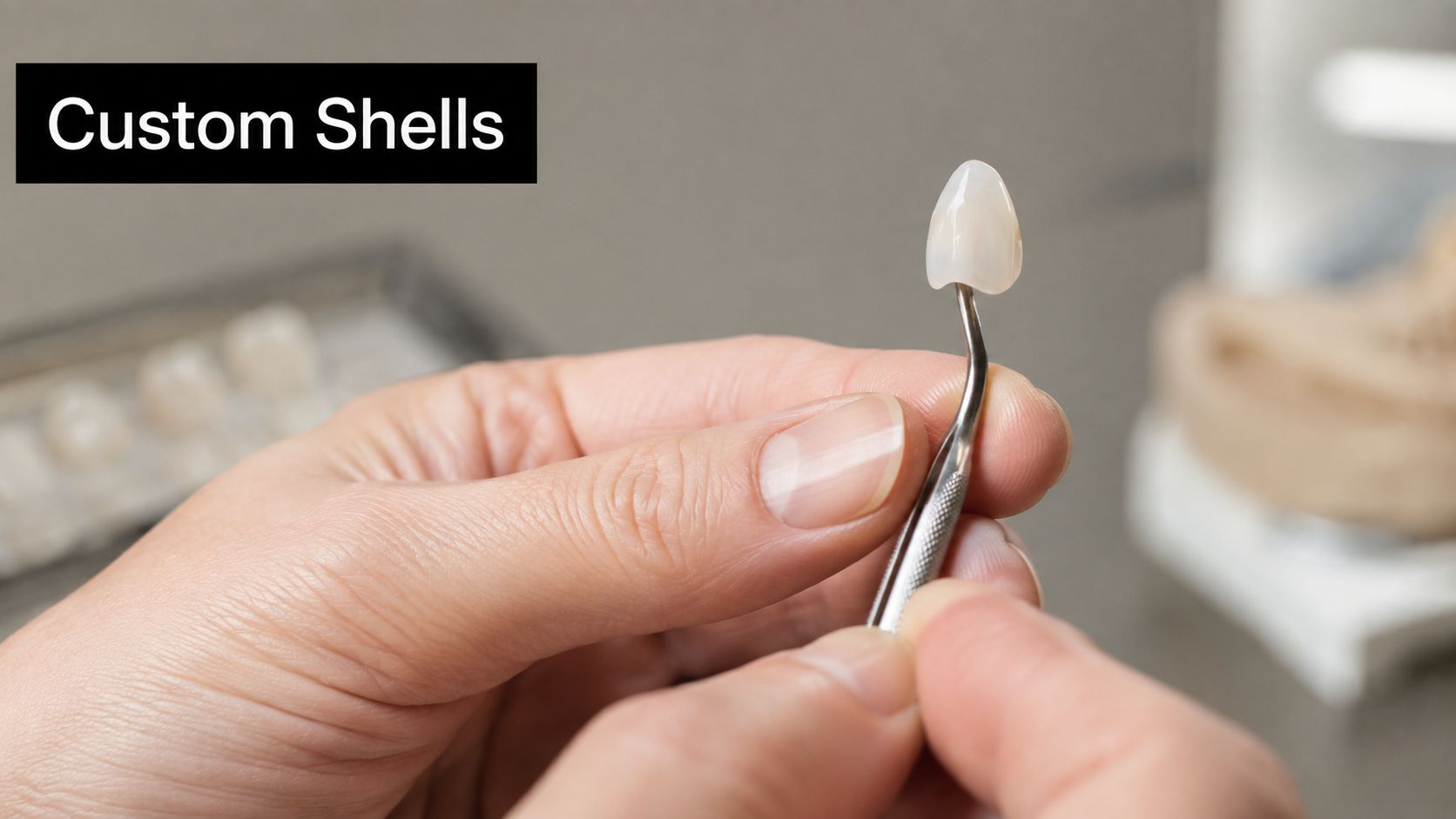
The process begins with diagnosis and design. Your dentist may use photographs, digital scans, shade analysis, and a mock-up to assess how the proposed shape will fit your smile. A dental laboratory then fabricates each shell to match the planned contours, contacts, and color.
Traditional and minimal-preparation options
Traditional veneers usually require controlled enamel reduction so the finished ceramic can sit flush with the surrounding teeth. The preparation is intended to prevent excessive thickness and to create a suitable bonding surface.
No-prep and minimal-prep veneers involve little or no reduction in selected cases. They may work when teeth are small, slightly short, or need limited visual enhancement. They're less predictable when teeth are already prominent, when substantial color masking is needed, or when adding ceramic would create unwanted bulk. “No prep” is therefore a case-specific technique, not a universal benefit.
Porcelain differs from composite bonding in how it's fabricated and placed. Bonding is sculpted directly on the tooth from resin, while porcelain is designed outside the mouth and adhesively cemented after try-in. A crown differs more substantially because it surrounds the entire tooth and is generally chosen when the tooth needs broader structural protection. You can see how a dental practice describes its custom veneer treatment before comparing options with your dentist.
Modern ceramic is selected partly for its ability to reflect and transmit light in a way that resembles enamel. Natural-looking results also depend on contour, surface texture, translucency, and shade selection. Extremely uniform or opaque restorations can look conspicuous even when they're technically well fitted.
Are Porcelain Veneers Right for You
Candidacy starts with the tooth beneath the veneer, not the cosmetic goal. Healthy enamel gives the dentist a more predictable bonding substrate, while dentin and mixed enamel-dentin surfaces generally provide less durable adhesion.
Laboratory data report enamel shear bond strengths around 17 to 25 MPa, while dentin bonding is typically lower and degrades faster. Research also associates enamel-only preparation with stronger, more durable adhesion, making conservative facial reduction and enamel preservation central technical considerations (research on veneer preparation and bonding substrate).
Patients who often qualify
A favorable candidate commonly has:
- Healthy enamel: Enough sound enamel remains on the facial surface and bonding margins.
- Stable gums: There's no untreated periodontal inflammation or active condition likely to change the gum line.
- Controlled bite forces: The front teeth aren't receiving excessive lateral pressure from an unstable bite.
- Clear cosmetic goals: The patient understands which changes veneers can make and which problems require another treatment.
- Good maintenance habits: Daily cleaning and regular examinations are realistic parts of the plan.
Minor chips, localized discoloration, uneven contours, and small spaces may respond well when the underlying teeth are sound. Patients who grind or clench may still qualify, but they should discuss protective measures such as a custom night guard before treatment.
When another treatment makes more sense
Active decay, significant gum disease, insufficient enamel, or severe tooth misalignment can make immediate veneer placement unwise. Treating the foundation first may involve periodontal therapy, fillings, orthodontics, or bite management.
Whitening can be the more conservative first step when the main issue is generalized surface discoloration and the teeth have otherwise acceptable shape. A professional teeth-whitening consultation can help determine whether changing color alone would meet your goal.
Crowns may be more appropriate for teeth with major structural loss, extensive restorations, cracks, or other conditions requiring full coverage. Bonding can make more sense for a small repair where preserving every possible millimeter of enamel matters more than achieving a broad, laboratory-designed transformation.
Clinical perspective: A patient who wants veneers but lacks a stable foundation shouldn't be treated as a poor cosmetic prospect. They need sequencing, and sometimes the safest path begins with health or alignment rather than ceramic.
The Porcelain Veneer Preparation and Bonding Process
The veneer process is planned around fit, biology, function, and appearance. Although the exact schedule varies, treatment commonly involves a consultation, a preparation and records visit, and a final bonding appointment after the laboratory completes the ceramic.
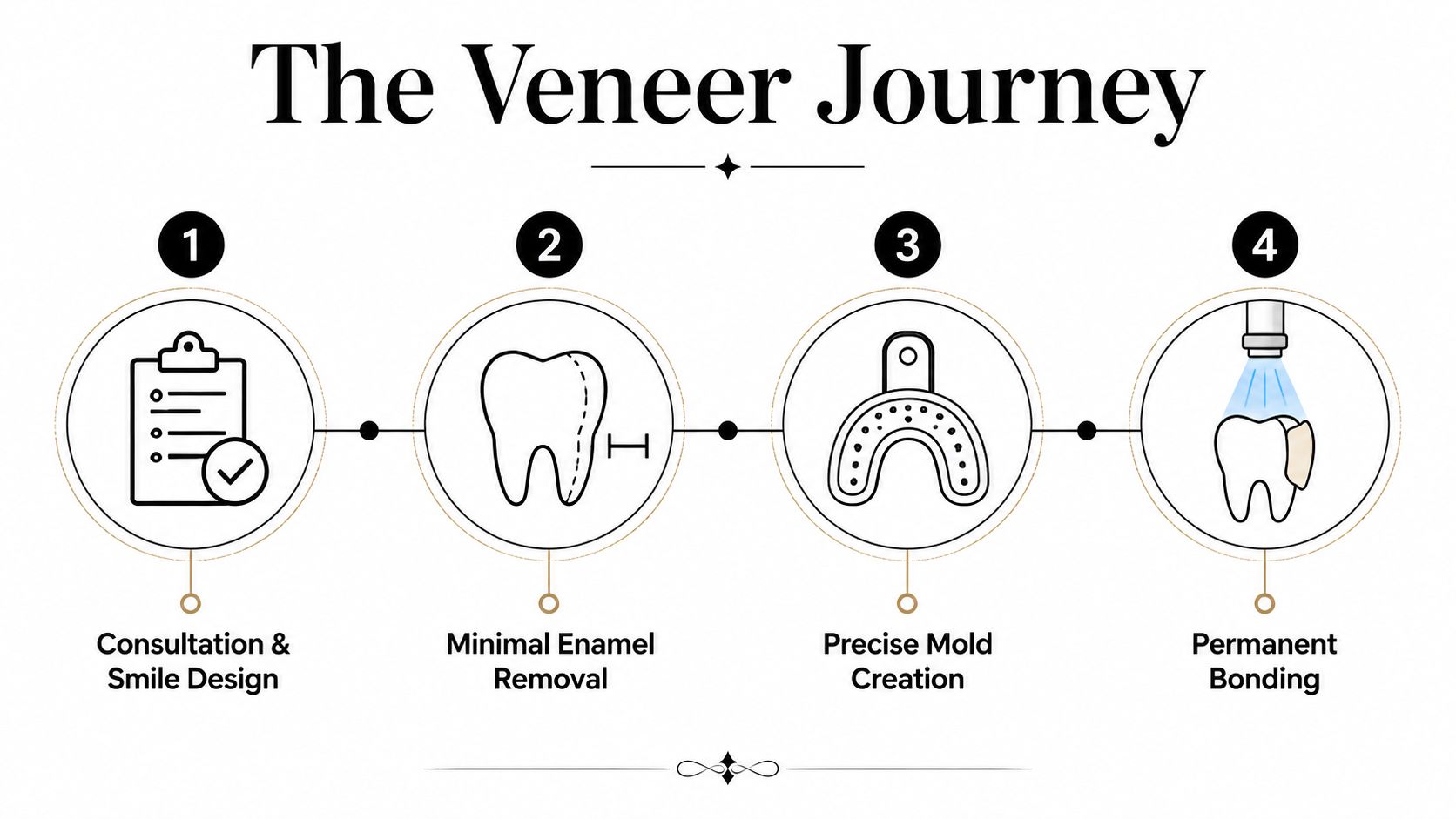
Consultation and smile design
Your dentist first examines the teeth, gums, existing restorations, bite, and smile dynamics. Digital scans, photographs, and intraoral images can help document the starting point. Some practices create a diagnostic mock-up or provisional design so you can discuss length, width, tooth display, and shade before preparation.
This stage is where unrealistic expectations should be identified. A dentist should explain whether the intended shade can be achieved, whether alignment requires orthodontics, and whether the design would require more tooth reduction than you're comfortable accepting.
Preparation and records
At the preparation visit, the dentist removes a carefully controlled amount of enamel where needed. The purpose isn't to “shave down” the tooth indiscriminately. It's to create space for ceramic, establish a clean margin, and help the veneer follow the planned contours without appearing overbuilt.
The prepared teeth are then recorded with digital scans or conventional impressions. Shade selection may involve multiple lighting conditions and photographs because the appearance of ceramic changes with the underlying tooth, surrounding teeth, skin tone, and light environment.
Temporary protection and laboratory fabrication
Temporary veneers may protect the prepared teeth while the dental laboratory creates the final restorations. They also offer an opportunity to assess speech, comfort, length, and general design. Patients should report pressure points, sharp edges, or a shape that feels wrong before the permanent ceramic is bonded.
The laboratory fabricates each veneer to the dentist's prescription. Communication between dentist and ceramist is important, particularly when the case involves multiple teeth and the goal is a natural result rather than a uniform block of color.
Try-in and permanent bonding
At the final visit, the dentist removes the temporaries and evaluates the permanent veneers on the teeth. Fit, contacts, margins, shade, surface texture, and the way the teeth meet are checked before bonding. Adjustments are easier before the resin cement is fully set.
Once the design is approved, the teeth and ceramic are prepared for adhesive bonding. Resin cement secures the veneers, and a curing light hardens the material. Excess cement is removed, the bite is checked, and the edges are polished.
The clinical history behind this process is longer than many patients realize. Temporary cosmetic veneers were associated with Dr. Charles Pincus and Hollywood dentistry in the 1920s. Adhesive bonding advanced through Dr. Michael Bunocore's work in the late 1950s, and permanent attachment of porcelain veneers was established in 1982 (history of porcelain veneers and adhesive bonding).
The process can be visualized in this patient education video:
Comparing Porcelain Veneers to Other Cosmetic Options
Veneers sit between direct bonding and full-coverage crowns. The appropriate choice depends on how much tooth structure remains, how much change you want, and whether the tooth needs cosmetic improvement or structural reinforcement.
| Option | Invasiveness | Main strengths | Main limitations | Often suits |
|---|---|---|---|---|
| Porcelain veneers | Conservative facial preparation in suitable cases | Natural-looking ceramic, broad cosmetic change, stain resistance | Requires enamel alteration in many cases and isn't reversible once prepared | Multiple cosmetic concerns on structurally sound teeth |
| Composite bonding | Minimal tooth alteration in many cases | Direct repair, efficient treatment, easy local repair | More vulnerable to surface wear and discoloration than porcelain | Small chips, minor reshaping, or limited cosmetic corrections |
| Dental crowns | Greater reduction because the entire tooth is covered | Protection for weakened or extensively restored teeth | More aggressive for a healthy tooth with a purely cosmetic concern | Teeth with substantial structural compromise |
Composite bonding can be a sensible first choice when the problem is confined to one small chip or a modest contour change. The material is applied and shaped directly in the mouth, so the dentist can make localized repairs without committing the patient to a larger ceramic treatment.
Crowns address a different clinical need. A tooth with extensive structural loss, a large failing restoration, or a fracture may require coverage around the entire tooth. Placing a crown on an otherwise healthy tooth solely to change its appearance may sacrifice more natural structure than necessary.
Porcelain veneers can offer a broader visual transformation with less coverage than crowns, but they're still a commitment. If enamel is prepared, the tooth will need restoration going forward. For a detailed discussion of the decision between these restorations, review porcelain veneers versus crowns.
The most conservative option isn't automatically the thinnest product. It's the treatment that achieves the goal while respecting the tooth's biology and function.
Porcelain Veneer Longevity and Daily Maintenance
Porcelain veneer teeth can perform well for many years, but longevity is a clinical outcome, not a product guarantee. The strongest available data should shape expectations without being oversold.
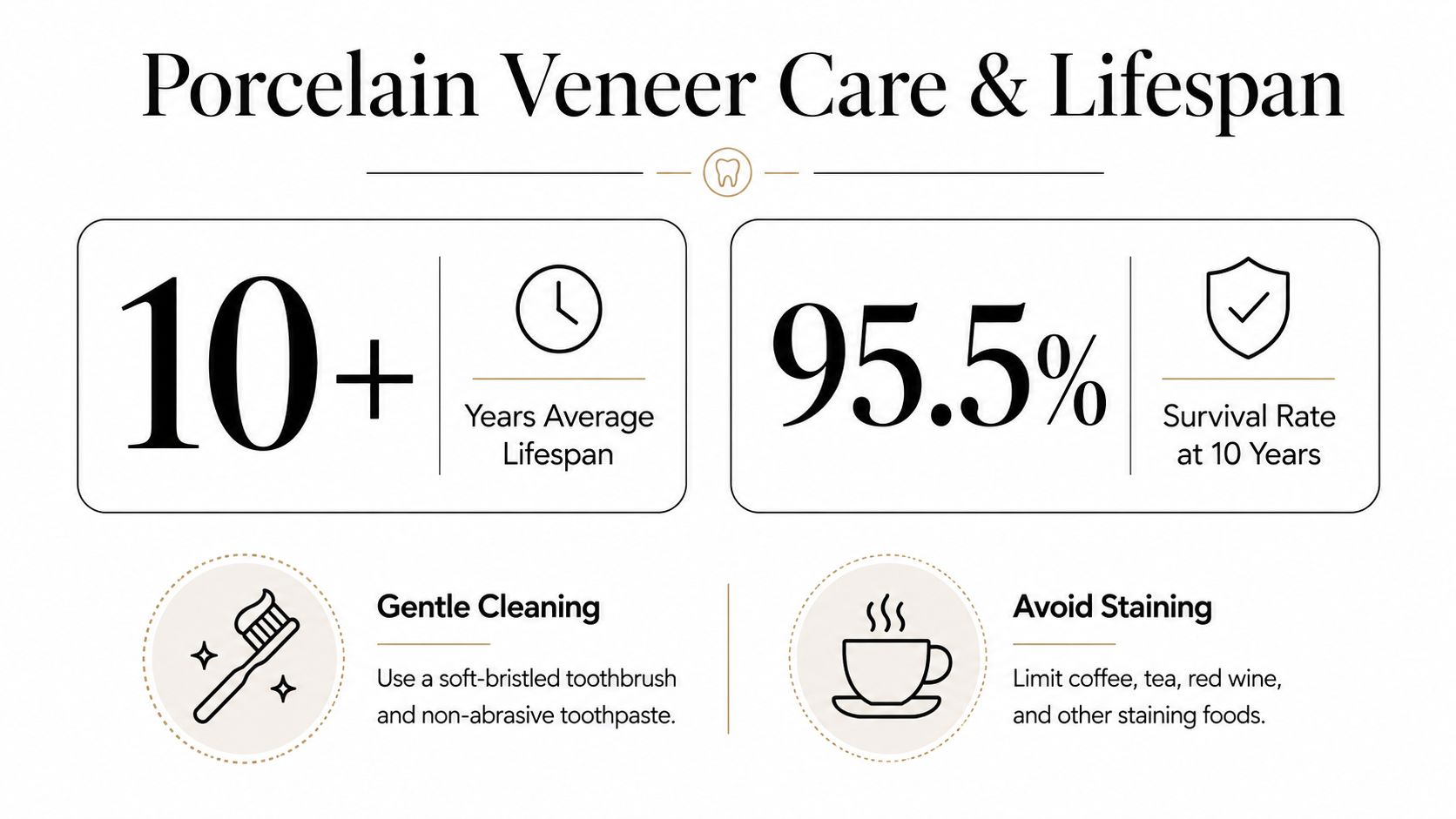
A systematic review of 6,500 porcelain veneers found a 95.5% cumulative survival rate at 10 years. Isolated survival was 96.3% for fracture-related failure and 99.2% for debonding-related failure, indicating that fracture was more common than loss of adhesion in the reviewed evidence (10-year porcelain veneer survival findings).
Protect the ceramic and the natural tooth
Porcelain itself doesn't decay, but the natural tooth around and beneath the veneer remains vulnerable to plaque, gum inflammation, and decay. Your routine should therefore protect both the restoration and its margins.
- Clean gently: Brush with a soft brush and non-abrasive toothpaste, then clean between the teeth every day.
- Monitor the margins: Bleeding, persistent sensitivity, or roughness near a veneer deserves an examination rather than prolonged self-treatment.
- Reduce impact habits: Don't bite ice, pens, fingernails, packaging, or other hard objects with veneered teeth.
- Address grinding: If you clench or grind, ask whether a custom night guard is appropriate.
- Keep preventive visits: Professional examinations and cleanings help identify gum changes, decay, cement issues, or bite problems before they threaten the restoration.
The evidence also reinforces why enamel preservation matters. A strong bond can't compensate for untreated decay, unstable gum health, or repeated excessive force. Maintenance protects the biological foundation, while a properly designed bite reduces the mechanical stress that can contribute to ceramic fracture.
Some veneers may remain serviceable for a long time, but no responsible dentist should promise that they'll last forever. Replacement decisions depend on fracture, marginal changes, wear, recurrent disease, or a change in the patient's goals. The practical objective is to preserve the tooth and make each restoration last as long as the individual case allows.
Porcelain Veneer Costs and Expected Outcomes
The financial decision should begin with the treatment plan, not a per-tooth price seen in an advertisement. Fees vary with the number of teeth, laboratory work, preparation complexity, diagnostic planning, ceramic selection, and the experience of the clinical team.
Insurance commonly treats veneers as elective cosmetic care, although a restoration may be considered differently when it addresses structural damage. Ask for a written estimate that separates examination, imaging, diagnostic design, temporaries, laboratory fees, final bonding, and follow-up care. You should also ask what happens if a veneer chips, debonds, or needs adjustment.
A practical way to judge value
Evaluate the proposal against four questions:
- Does it solve the right problem? Whitening, bonding, or orthodontics may be more appropriate when the concern isn't primarily a shape-and-color problem.
- How much enamel will remain? A lower initial fee isn't worthwhile if the approach sacrifices unnecessary tooth structure.
- What happens to the bite? A beautiful smile that creates uncomfortable contacts can become a functional problem.
- What maintenance is expected? Night-guard use, hygiene, examinations, and future repair should be part of the conversation.
The expected result for a well-selected patient is a coordinated change in shade, shape, length, and symmetry that remains compatible with facial movement and function. Natural-looking porcelain veneer teeth aren't just very white teeth. They have appropriate translucency, surface texture, proportions, and variation.
The guide to porcelain veneer costs can help you prepare questions about fees and treatment scope, but only an examination can determine whether veneers are clinically justified. Paul L. Gregory, DDS offers cosmetic, restorative, preventive, periodontal, orthodontic, and emergency dental services, with digital scanning and intraoral imaging available for treatment planning. If veneers fit your goals, the practice can evaluate your candidacy and coordinate the restorative work required for a stable result.
Visit Paul L. Gregory, DDS for a veneer consultation focused on enamel health, bite, gum condition, smile design, and realistic alternatives. The Midtown Manhattan practice can help you determine whether porcelain veneers, bonding, whitening, orthodontics, or crowns best match your teeth and goals.