

Nationally, a bone graft for a dental implant runs $549 to $5,148 per graft before insurance in the ASQ360° procedural-cost study for Synchrony's CareCredit bone-grafting cost guide. Add the $1,450 to $3,875 implant-placement range, and a graft-plus-implant subtotal lands near $1,999 to $9,023 before the abutment, crown, and related charges.
A graft rebuilds the foundation; it does not finish the tooth. For a Manhattan treatment plan, compare written estimates line by line: which charges sit inside the graft fee, which are billed under implant placement, and which belong to the final restoration.
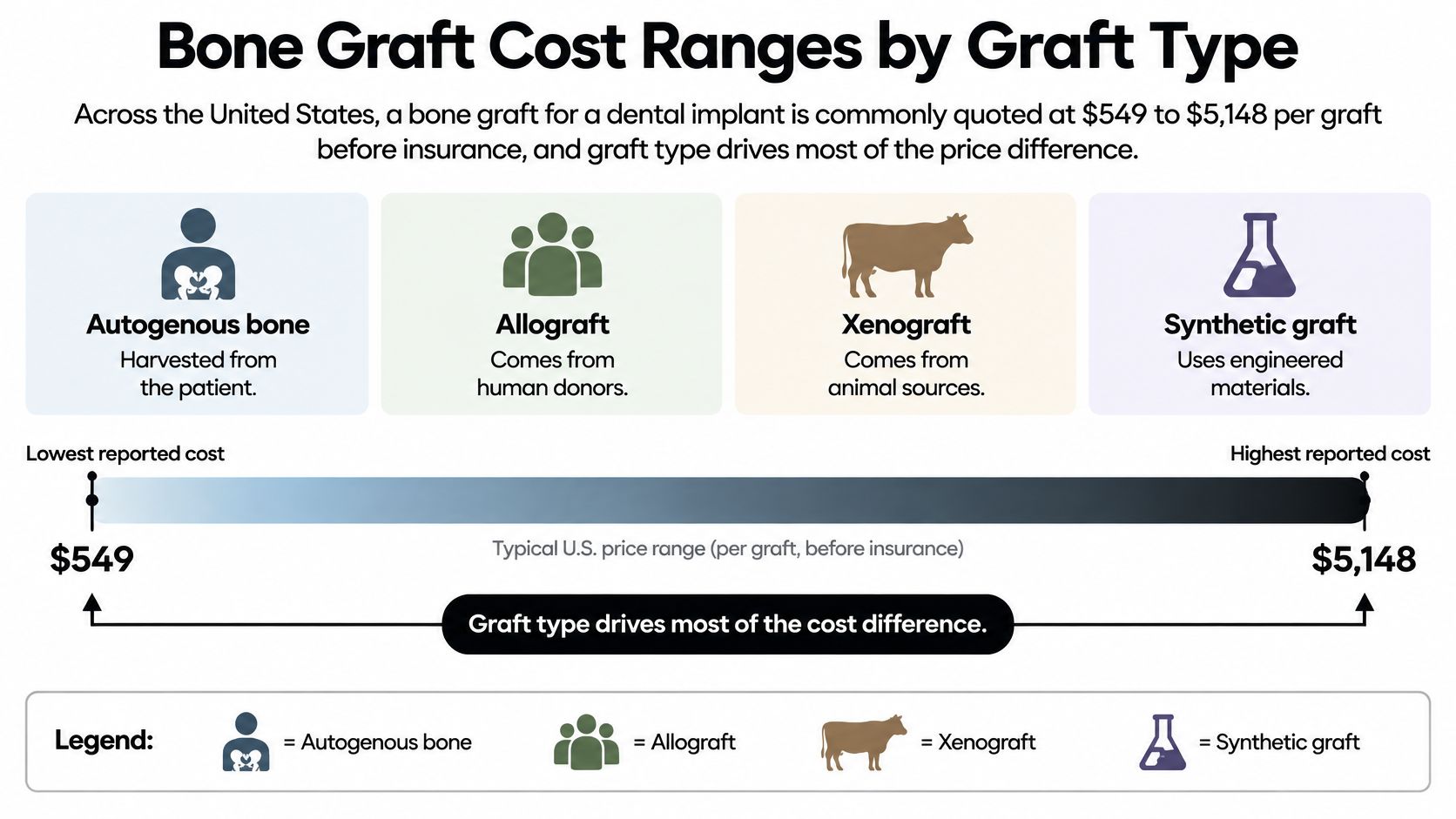
Bone Graft Cost Ranges by Graft Type
Across the United States, a bone graft for a dental implant is commonly quoted at $549 to $5,148 per graft before insurance, with material type accounting for much of the spread in the national procedural-cost study conducted by ASQ360° for Synchrony's CareCredit bone-grafting cost guide. The study's average ranges by graft type appear below; these are national planning figures, not Manhattan quotes.
Bone graft cost per graft by graft type
| Graft type | Material source | Average range per graft |
|---|---|---|
| Xenograft | Animal-derived bone | $549–$1,386 |
| Alloplast | Synthetic material | $576–$1,375 |
| Allograft | Human donor bone | $652–$1,575 |
| Autograft | Patient's own bone, harvested from a second site | $2,161–$5,148 |
| Overall range | All graft types | $549–$5,148 |
The ranges overlap because material isn't the only expense. A small graft using donor bone may require less surgical work than a larger reconstruction using synthetic material.
Why an autograft costs more
An autograft requires the surgeon to collect bone from another location in your body before placing it in the deficient area. That adds a surgical site, operative work, and donor-site management. You're paying for more than a different material.
The other categories use prepared donor or manufactured materials, avoiding that harvesting procedure. That doesn't make them interchangeable, though. Your surgeon must choose a material that suits the shape of the defect and the support needed for the planned implant.
What the graft price doesn't necessarily include
These figures describe the graft procedure, not a completed replacement tooth. Implant placement is a separate surgical service, while the abutment and crown belong to the restorative part of treatment.
A graft estimate may leave out:
- Tooth removal: An extraction may have its own fee.
- Diagnostics: Examination and imaging may be billed separately.
- Surgical additions: Sedation and a barrier membrane may not be included.
- Restoration: The abutment, crown, or temporary tooth requires separate clarification.
- Aftercare: Confirm which postoperative visits are included.
Don't mechanically add advertised prices from different offices. One office may bundle surgical components that another lists individually. Our dental implant cost guide can help you distinguish implant treatment from grafting alone.
Start with the row that matches your likely graft material, then request separate subtotals for grafting, implant placement, and restoration. That makes the national range useful without mistaking it for your actual bill.
Why Implants Often Need a Bone Graft
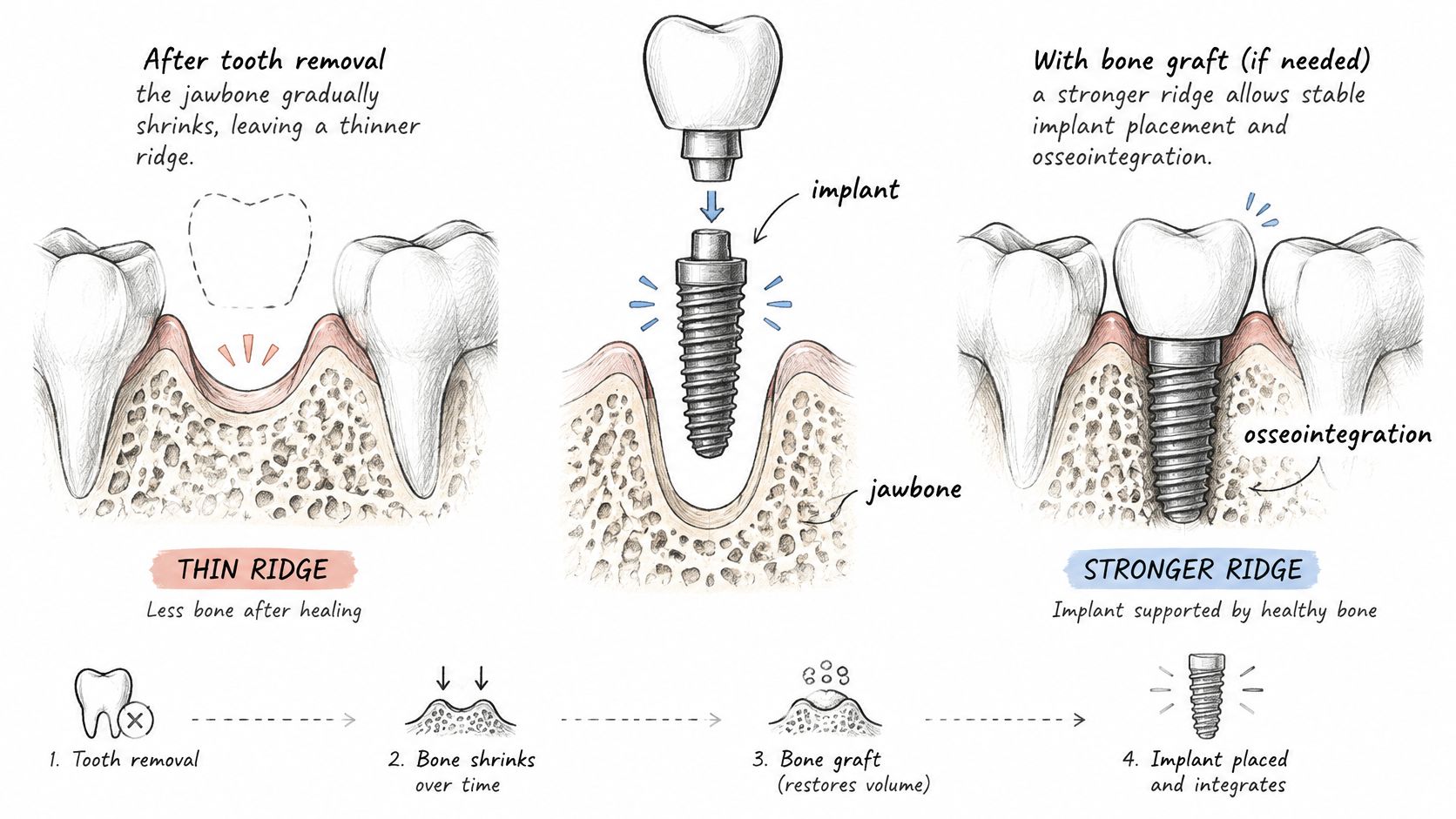
A dental implant is usually a titanium post placed in the jaw. It must become anchored to living bone through osseointegration, the biological connection between bone and the implant surface.
Think of a fence post set into soft soil. The post needs enough firm ground around it to resist movement. A graft helps rebuild the supporting foundation, although living jawbone must also heal and remodel.
After a tooth is removed, the surrounding ridge can shrink as bone resorbs. The surgeon evaluates whether enough bone remains to place the implant in the position needed for the final tooth. The Dental Economics explanation of grafting after tooth removal describes graft materials as scaffolding that helps maintain space, stabilize the blood clot, and support replacement by vital host bone.
The procedure should have a specific name
Socket preservation takes place at an extraction site. The surgeon places material in the socket to help preserve the ridge's shape for future treatment. The existing socket provides a relatively contained space, which helps explain why this is different from rebuilding a substantial missing ridge.
Ridge augmentation addresses a shortage of width, height, or both. Say a tooth has been missing long enough that the ridge has become too narrow for the intended implant position. The surgeon may need to rebuild that contour and protect the graft while it heals, adding complexity.
A sinus lift addresses limited bone height beneath the sinus in the upper back jaw. The surgeon creates room beneath the sinus membrane for graft material. The added work involves nearby anatomy, not just filling a larger socket.
Ask for the procedure name: “A graft” is a category, not a complete explanation of what your surgeon intends to do.
Not everyone needs grafting, and the amount of missing bone alone doesn't determine candidacy. Implant position, remaining bone, oral health, and your medical history all matter. Our guide to who is a good candidate for dental implants explains the broader evaluation.
What Moves the Price of Each Graft
A practical U.S. planning benchmark for bone grafting around an implant is approximately $250–$3,000 per site, according to the MySpecialtyDentist bone-graft cost guide. This is a dental-specialty guide's market estimate, not a government fee schedule or a fixed local fee.
Graft scenarios and what drives their cost
| Scenario | What drives the cost | Planning figure |
|---|---|---|
| Socket preservation after extraction | Contained socket, smaller graft volume | Lower end of $250–$3,000 per site benchmark |
| Ridge augmentation | More graft volume, membrane coverage, longer surgery | Upper end of $250–$3,000 per site benchmark |
| Sinus lift | Sinus membrane elevation and added surgical complexity | Individual surgical estimate required |
| Implant placed after graft | Separate implant fee, added to the graft | $1,450–$3,875 |
The separate implant-placement range is from the national procedural-cost study identified earlier. It doesn't include every component needed to deliver the finished tooth, and it shouldn't be treated as an automatic addition to a bundled office quote.
What the surgeon is actually pricing
The distinction between a small preservation procedure and a larger reconstruction explains more than the material label alone. Your treatment plan should make the following factors visible:
- Defect dimensions: A broad or tall deficiency requires a different reconstruction than a contained opening.
- Graft volume: More missing bone can require more material and additional handling.
- Membrane coverage: A barrier may be needed to protect the grafted space during healing.
- Anesthesia or sedation: Local anesthesia and sedation aren't the same service; clarify what's planned.
- Clinician experience: Training and expertise are part of professional fees, particularly for complex anatomy.
- Three-dimensional imaging: CBCT imaging can help assess the available bone and nearby structures.
- Procedure timing: Grafting during extraction may involve a different visit structure than a separate augmentation.
Consider two people replacing a back tooth. One needs preservation of a fresh extraction socket. The other needs reconstruction of a narrow ridge before the implant can be stabilized. Even if both receive the same graft material, their surgical work isn't equivalent.
A higher estimate needs an explanation
A higher fee isn't automatically excessive, and a lower one isn't automatically incomplete. Ask what clinical difference accounts for the price: a larger defect, a membrane, staged surgery, or another clearly identified service.
Compare the planned work before comparing the totals. A graft that rebuilds missing ridge height isn't the same purchase as a small socket-preservation procedure.
At Paul L. Gregory, DDS, we offer dental implants, All-on-4 dental implants, bone grafting, and dentures. When you're considering implant treatment, ask us for a written plan that identifies the recommended approach and separates its components. That allows you to evaluate the surgical recommendation alongside the financial commitment.
Material Choice and Whether Cheaper Is Better
The cheapest graft material isn't automatically the best value. The right question is whether a material can maintain the space and support healing for your particular defect, rather than whether its purchase price is lower.
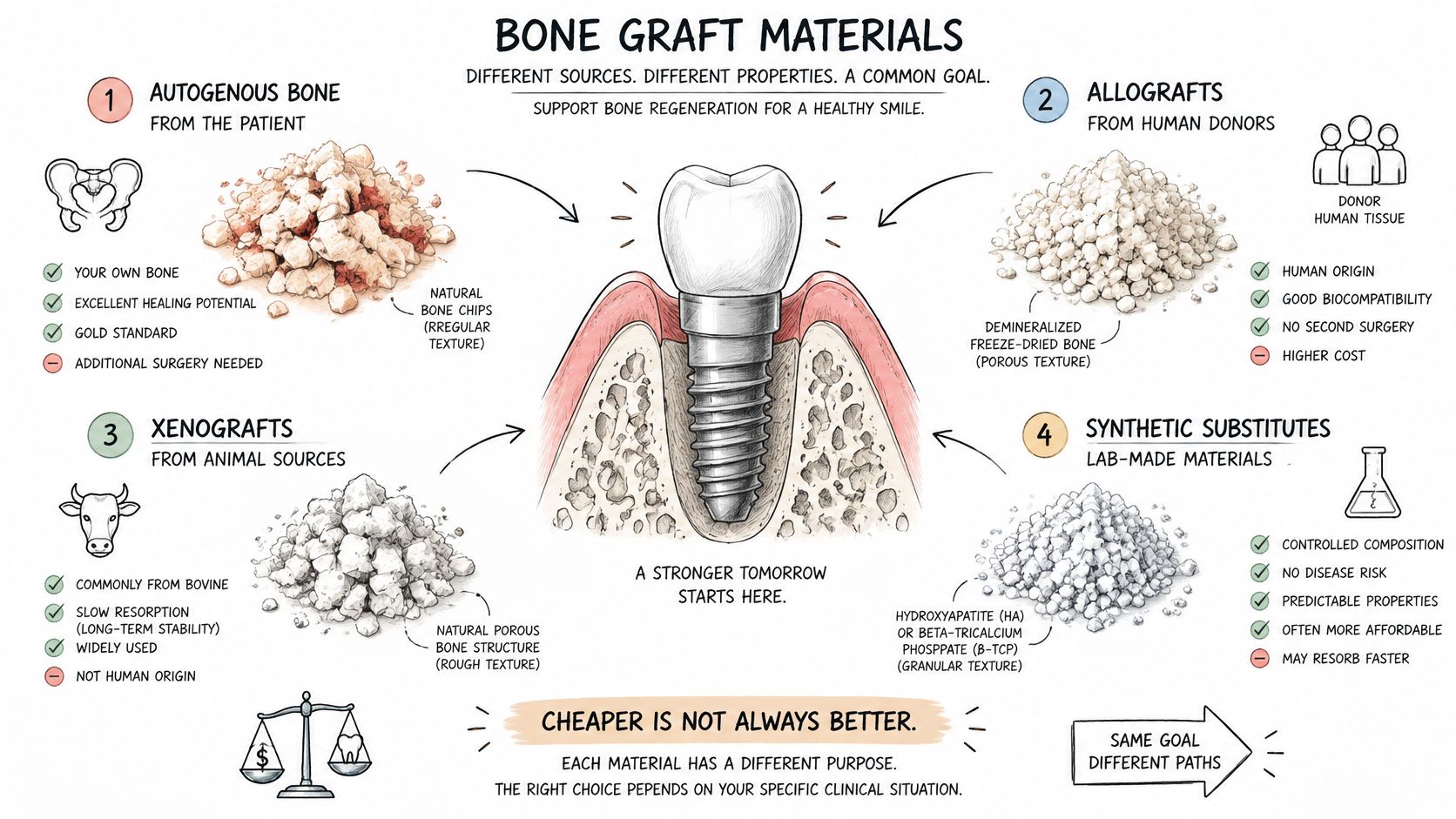
The main families are autogenous bone from your own body, allografts from human donors, xenografts from animal sources, and synthetic substitutes. Synthetic options include hydroxyapatite, beta-tricalcium phosphate, biphasic calcium phosphate, and bioactive glass.
This visual distinguishes those material families.
Material expense isn't the surgical bill
A 2024 review of alveolar bone grafting and ridge preservation reported material-cost ranges of approximately $46.20–$140 for bone-graft substitutes and $12–$189 for socket-sealing materials; it also described a specific comparison in which total treatment cost with demineralized freeze-dried bone allograft was 22.4% of the alternative group's cost.
Those are study-specific material and treatment comparisons, not retail prices for your surgery. Your bill also pays for diagnosis, surgical time, sterile supplies, imaging, anesthesia, membranes where needed, and postoperative management. A package of biomaterial isn't a completed graft any more than a crown blank is a finished dental crown.
What newer evidence can and can't tell you
A 2025 review of guided bone regeneration materials described an analysis containing 90 trials of synthetic substitutes versus 67 involving xenografts, and cited a meta-analysis in which bioactive glass retained more bone volume and resorbed less at six months than autogenous bone, with comparable new-bone formation.
That doesn't establish a universally superior material or a standard patient price. Trial counts don't rank products, and a finding about volume retention doesn't settle every question about your implant site. Availability, anatomy, defect size, clinician expertise, and regulatory status still affect suitability.
For another way to visualize the material discussion, the following video offers additional context.
Our overview of dental implant technologies provides context for discussing technology without assuming that newer means better.
Bring these questions to the consultation:
- Suitability: Which material fits this defect, and why?
- Evidence: What supports using it for the planned reconstruction?
- Overall value: Could a higher upfront price reduce the need for another surgery or a healing delay?
Healing Timeline and Recovery Steps
Your schedule should describe clinical milestones, not promise that every patient will be ready on the same date. Defect size, graft material, bone quality, and the stability achievable at surgery affect when the next phase can proceed.
Use the timeline as a sequence of decisions rather than a calendar guarantee.
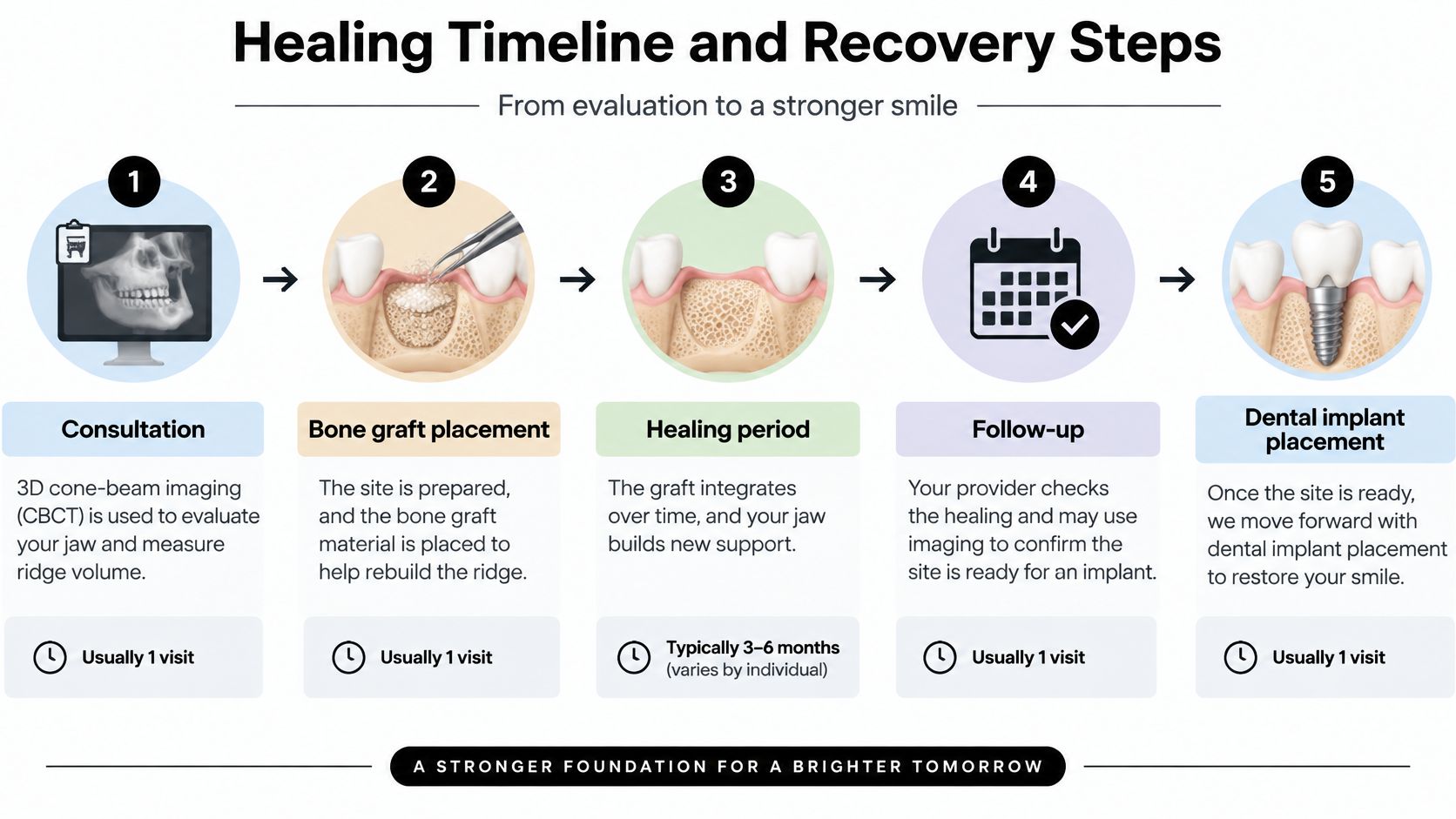
From evaluation to the finished tooth
Consultation and imaging. The clinician examines your mouth and determines whether CBCT imaging is needed to measure ridge width and height. The intended crown position should guide planning, rather than placing an implant wherever bone happens to remain.
Graft placement. The surgeon prepares the site and places the selected material, sometimes with a barrier membrane. For socket preservation, this may occur during the extraction appointment.
Healing and bone maturation. When grafting precedes implant placement, the surgeon reassesses whether the reconstructed site is ready. Gum closure alone doesn't establish that the underlying bone can support the next procedure.
Implant placement and any additional surgical stage. The clinician places the implant when the site can provide the required stability. Some treatment plans involve a later procedure to access the implant before restoration.
Osseointegration and abutment connection. The implant needs to establish its connection with surrounding bone. The abutment then provides the connection between implant and crown, with timing determined by the surgical and restorative plan.
Crown placement. The restorative dentist checks the fit, bite, and appearance of the replacement tooth. Long-term cleaning and maintenance instructions remain part of care after the crown is fitted.
Our dental implant healing guide can help you prepare questions about these transitions.
Protecting the site after surgery
Early swelling and discomfort can occur after grafting. Choose soft foods, avoid chewing directly on the surgical area, and don't probe it with your tongue or fingers. Brush gently around the area as directed, and follow the office's written instructions for rinsing, medications, and activity.
Contact the treating office about uncontrolled bleeding, worsening pain, fever, or swelling that becomes concerning. Don't change prescribed medication or attempt to reposition exposed material yourself.
Aftercare teaching matters beyond the immediate recovery. Anna described that continuity in her feedback: “He even walked me through how to better care for an implant I had done years ago.”
Ask for expected intervals in writing, then mark which phases involve extra appointments, time away from work, and separate charges.
Manhattan Neighborhoods and Visit Planning
Manhattan neighborhoods have no officially fixed boundaries, so treat their names as travel labels. The overview of Manhattan neighborhoods commonly places Midtown between 34th and 59th Streets.
Our office is at 57 West 57th Street, near Central Park South and Columbus Circle, serving Midtown and the wider New York area. For staged treatment, the practical question is how that location fits your home, your office, and your postoperative travel arrangements.
Think in travel corridors
Distance on a map understates the actual trip. Patients coming from the Upper West Side or Upper East Side should weigh crosstown travel as much as mileage. On the East Side, Lenox Hill and Turtle Bay are familiar reference points; to the west sit Hell's Kitchen, the Theatre District, and Hudson Yards.
Farther south, the NYC Insider Guide neighborhood map places Chelsea roughly between 14th and 34th Streets, Gramercy around Park Avenue South from 14th to 23rd Streets, and Greenwich Village roughly from Houston Street to West 14th Street.
From the West Village, Greenwich Village, NoHo, East Village, SoHo, Tribeca, Chinatown, and Wall Street, judge the full door-to-door trip rather than the neighborhood name alone. A route that feels easy for a consultation may need different arrangements after a procedure involving sedation.
Include travel in the treatment decision
A quoted graft fee covers the surgery itself. Each appointment in a staged plan carries its own cost in transit, time away from work, and sometimes an escort home.
- Appointment grouping: Ask which evaluations or restorative tasks can appropriately share a visit, since fewer trips mean fewer days away from work.
- Recovery transport: Confirm whether the planned sedation requires an escort, and line that person up before the surgical date.
- Work planning: Distinguish a brief review from a surgical appointment when you schedule time off.
One patient of about 18 years described Dr. Gregory as the only dentist they trust, citing his long-standing personal touch and noting he had never pushed an unnecessary crown. Staged implant care means returning for planning, surgery, and follow-up visits, so that kind of ongoing relationship matters. Choose a location you can reach comfortably each time.
National cost ranges are not Manhattan quotes. Request a written local estimate directly instead of assuming your neighborhood determines where you fall within a national range.
Insurance, Financing and Itemized Estimates
Dental insurance can reduce your bill without coming close to paying the full treatment cost. Many plans impose annual benefit maximums of roughly $1,000–$2,000, along with frequency limitations, according to the healthinsurance.org explanation of dental implant coverage. A stated coverage percentage therefore doesn't tell you your final out-of-pocket balance.
Coverage also depends on the individual procedures and your policy's terms. A plan's treatment of extraction or grafting doesn't necessarily establish its treatment of implant placement or the crown.
Get answers from the insurer before committing
Ask your insurer these questions, using the proposed treatment codes where available:
- Shared maximum: Do the graft, implant, and restoration draw from the same annual benefit allowance?
- Exclusions: Does the policy exclude implants or related grafting?
- Advance review: Is preauthorization or a predetermination required, and what does that review confirm?
- Frequency limits: Do replacement intervals or prior treatment affect eligibility?
Ask for a written response, and verify how much of your annual benefit remains. A preliminary estimate of benefits isn't the same thing as a final paid claim.
We assist with most insurance plans and claim submissions, with clear communication about fees and coverage. Heather described that support in her feedback: “I was impressed by Dr. Greg's proficiency in my dental treatment and his advice on maximizing my insurance benefit.” Individual benefits still depend on the policy, not a patient testimonial.
Match the estimates line by line
When comparing bone graft cost for dental implant treatment, use a shared checklist rather than comparing the bottom lines alone.
| Item to match | Question for each written estimate |
|---|---|
| Graft procedure and material | Which procedure and material are specified? |
| Barrier membrane | Included in the graft fee or charged separately? |
| CBCT imaging | Included in consultation, separately billed, or not yet determined? |
| Extraction or socket preservation | Which services are listed, and for which site? |
| Anesthesia or sedation | What method is planned and included? |
| Temporary tooth | Is a temporary replacement included or optional? |
| Implant placement | Does the fee cover the implant and placement surgery? |
| Abutment | Is the connecting component included? |
| Crown | Is the final restoration separately priced? |
| Additional surgical stage | Is another procedure anticipated and priced? |
| Follow-up care | Which reviews are included, and what could generate another charge? |
Say one estimate lists a graft, implant, abutment, and crown, while another lists only surgical treatment. The second total may be lower because it stops before the finished tooth, not because the same treatment costs less.
Mark each line included, separately charged, not recommended, or not yet determined. Don't treat a blank as included. Also confirm the graft scenario, anticipated healing intervals, and whether imaging could change the recommendation.
Budgeting rule: An uncertain item belongs on the estimate as an uncertainty, not as an assumed zero.
If you're unfamiliar with how itemized documents separate descriptions and charges, business receipt examples from Smart Receipts provide a useful general illustration. A dental treatment estimate needs additional clinical detail, but the basic principle is the same: each charge should be identifiable.
Compare repayment totals, not just monthly payments
Monthly payment arrangements and third-party credit can spread the expense, but interest and fees may increase what you repay. Review the interest rate, promotional conditions, payment schedule, and consequences of missing a payment. Ask what happens to any promotional balance when the promotional period ends.
Our information on dental insurance and payment plans can help you prepare for that financial discussion. Don't assume a financing product or approval is available until its terms are confirmed.
A patient who has attended the practice for 30 years described receiving help with crowns, root canals, fillings, implants, and closing a front-tooth gap, while valuing efforts to preserve natural teeth. Your own plan should likewise begin with what treatment is clinically appropriate, then explain its costs.
Bring both written estimates, your insurance benefit information, and your remaining annual maximum to the consultation. Leave with one itemized treatment plan you can compare against the material and procedure categories, with unresolved charges clearly marked.
Paul L. Gregory, DDS offers bone grafting, dental implants, All-on-4 full-arch solutions, and dentures, allowing you to discuss the foundation and final replacement together. Visit Paul L. Gregory, DDS to arrange a consultation, bring your estimates and insurance details, and ask for a written plan separating grafting, implant placement, and restoration.