

If a tooth hurts near the root, does that mean you need a root canal, or could the problem be in the gum around it? Root dental care can mean treating the tissue inside a tooth or cleaning the root surface beneath the gum. Those treatments solve different problems, and choosing between them starts with testing, not the location of the pain alone.
What Root Dental Care Means and How Disease Reaches the Root
Root canal therapy treats infected or irreversibly inflamed pulp inside a tooth. Periodontal scaling and root planing removes calculus and bacterial biofilm from root surfaces beneath the gum, where disease has damaged the tooth's supporting attachment.
Think of the distinction as plumbing and foundation work. A root canal treats the tooth's internal system; periodontal treatment addresses the support around it. Neither treatment substitutes for the other, although a tooth can sometimes need both.
Two routes to a root problem
Decay is a common route to pulp damage. The World Health Organization's oral-health estimates, discussed in Oral Diseases, counted approximately 2.03 billion cases of caries in permanent teeth worldwide using Global Burden of Disease 2019 estimates, roughly 29% of people with permanent teeth, including approximately 75 million cases in the United States.
Decay begins in the outer enamel and can progress through dentin, the layer underneath. Once bacteria or their products affect the pulp chamber, the tissue containing nerves and blood vessels can become inflamed. Deep decay, cracks, trauma, and repeated dental procedures can all contribute to pulp injury.
The pulp continues through narrow canals toward the root tips. Irreversible pulpitis means the inflamed tissue can no longer recover predictably; it doesn't necessarily mean an abscess has already formed. If the pulp dies and infection spreads beyond the canal, inflammation and an abscess can develop in the surrounding bone.
Gum disease takes a different route. Plaque accumulates near and below the gumline, and some deposits harden into calculus that a toothbrush can't remove. In susceptible areas, inflammation damages the attachment fibers and supporting bone, leaving a periodontal pocket alongside the root.
That pocket gives bacteria a sheltered place to persist. The pulp may remain healthy even while the tooth loses support, so removing the nerve wouldn't address the cause. Recession can also expose sensitive root surfaces without creating a pulp infection; gum recession treatment addresses a different set of findings from canal treatment.
What the examination needs to separate
The dentist compares a cold test with neighboring teeth, checks tenderness to tapping, and measures the gum pockets with a periodontal probe. A periapical radiograph shows the root and surrounding tip area, while bitewing images help assess decay and bone height between teeth.
A cracked root can imitate both problems. It may produce biting pain, a narrow isolated pocket, or recurring swelling, so neither an X-ray nor a symptom description should stand alone.
Practical rule: A normal, brief cold response argues against opening the pulp unless other findings establish an endodontic problem. The dentist must interpret that response alongside the examination and imaging.
Root Canal Therapy Compared with Root Planing
| Question | Root canal therapy | Scaling and root planing |
|---|---|---|
| What it treats | Infected or irreversibly inflamed pulp | Calculus and biofilm on the root under the gum |
| Where the problem sits | Inside the canals and at the root tip | On the root surface and in the periodontal pocket |
| Typical signs | Lingering cold pain, night pain, swelling at the tip | Bleeding gums, bad breath, pockets of 4 mm or deeper |
| Main goal | Remove the pulp, disinfect, and seal the canals | Clean and smooth the root so the gum can heal |
| Usual course | One or two visits, then a crown or filling | Measure and clean, recheck in four to six weeks, then maintenance |
| What must follow | A well-sealed permanent restoration | Periodontal maintenance every 3–4 months, adjusted to clinical need |
These are common clinical pathways, not appointment guarantees. Anatomy, disease severity, comfort, and the amount of sound tooth remaining affect the individual plan.
Signs That Point to the Right Treatment
Cold pain isn't automatically a reason for a root canal. A quick zing that stops when the cold disappears can come from exposed dentin, recession, or another reversible irritation. Pain that continues after the cold is gone, especially with spontaneous aching or disrupted sleep, raises more concern about the pulp.
A gum pimple can be misleading, too. The visible opening may be where an infection drains, rather than where it started. A dentist may need to trace that drainage pathway and take an image before deciding which tooth or tissue needs treatment.
A same-day symptom lookup
Use these patterns to describe your symptoms when you call, not to diagnose yourself.
Symptoms and the Care They Usually Need
| Symptom | More likely source | Next step |
|---|---|---|
| Cold pain lingering past about 30 seconds | Irreversible pulpitis | Pulp testing and likely root canal |
| Night pain or throbbing that starts alone | Inflamed or dying pulp | Same-day dental exam, not antibiotics alone |
| Pimple on the gum near one root tip | Endodontic abscess | Drainage plus root canal or retreatment when the source is confirmed |
| Sharp pain only as the bite releases | Crack or fractured cusp | Bite test and imaging before a root canal |
| Bleeding gums and stubborn bad breath | Periodontal inflammation | Pocket charting and root planing if pockets are deep |
| Pocket of 4 mm or more with bone loss | Disease on the root surface | Root planing and periodontal therapy |
| Loose tooth with widespread bone loss | Advanced gum disease | Periodontal therapy, not an automatic root canal |
| Several teeth hurt and cold feels normal | Bite, sinus, or muscle pain | Diagnosis before any root treatment |
The duration and pocket measurements above are clinical clues, not stand-alone treatment thresholds. A deep pocket without the rest of the examination doesn't establish the cause, and a cold response can be difficult to interpret in a heavily restored tooth.
What to notice before your appointment
Tell the office whether pain starts by itself, follows hot or cold drinks, or happens when you bite down or release. Mention bleeding, drainage, a bad taste, recent dental work, and whether you can identify a single tooth.
Pain felt mainly near the jaw joint, ear, or sinus may have a non-endodontic explanation. Even severe pain doesn't justify treating a canal until the dentist can identify a reasonable source.
A review of dental abscess symptoms and treatment can help you recognize concerning changes while arranging care. The useful next step is an examination with appropriate imaging, not repeatedly testing the tooth with ice or chewing on it to see whether it still hurts.
What Happens During Each Root Treatment
The procedures share an emphasis on comfort and bacterial control, but the dentist works in different spaces. Root canal therapy requires access inside the tooth; periodontal treatment usually approaches the root from the gum pocket.
This visual summarizes the canal-treatment sequence, although the final restoration schedule is individualized.
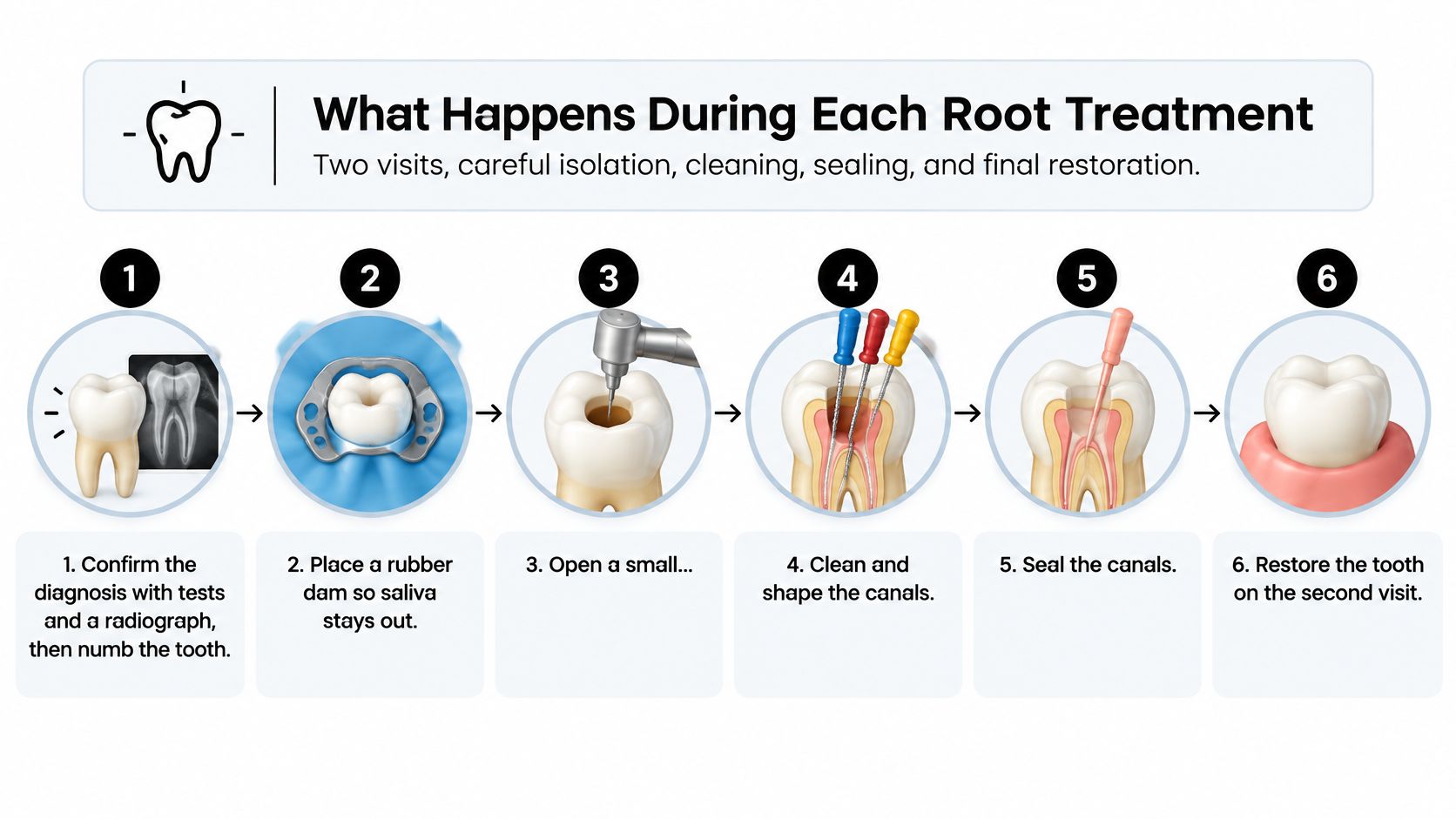
Root canal therapy from diagnosis to restoration
- Confirm the diagnosis and numb the tooth. The dentist reviews symptoms, tests the tooth, and examines a radiograph. Tell the clinician if you still feel sharp sensation after anesthesia so they can adjust it.
- Place a rubber dam. This protective sheet isolates the tooth, keeps saliva out, and helps prevent instruments or irrigating solutions from entering your mouth.
- Create access. The opening is usually through a back tooth's chewing surface or the back of a front tooth. The clinician locates the canal entrances through this opening.
- Clean and shape to working length. The American Association of Endodontists' treatment standards describe an optimal apical termination generally about 0.5–1.0 mm short of the radiographic root tip, with careful length control to avoid injuring tissues beyond the canal.
- Irrigate the canal system. Files can't contact every irregular space. Irrigation helps disinfect areas that instruments can't directly reach.
- Dry and seal the canals. The clinician fills the prepared canal spaces and seals the access, sometimes using a temporary restoration before definitive care.
- Restore the tooth promptly. A durable permanent filling or crown protects against leakage from above. A crown also helps protect a structurally weakened tooth from fracture.
A straightforward front tooth may be completed in one treatment visit, while a molar may need two. Infection, difficult anatomy, retreatment, and restorative needs can change that schedule; don't assume every tooth follows the illustrated timeline.
The accompanying video offers another view of the procedure.
Scaling and root planing beneath the gumline
- Map the pockets and review images. The clinician records where attachment and bone support have been lost.
- Numb the treatment area when needed. Local anesthesia allows thorough cleaning without asking you to tolerate sharp discomfort.
- Remove deposits. Ultrasonic instruments loosen calculus, and hand instruments clean remaining deposits from the root.
- Finish the root surface conservatively. The aim is a clean, biologically acceptable surface that supports healing, not aggressive removal of healthy root material.
- Consider a local medication. ARESTIN, a locally applied antibiotic, may be selected for particular pockets. It doesn't replace mechanical cleaning.
- Recheck healing. A review in about four to six weeks assesses bleeding, pocket depths, and home cleaning.
- Plan continuing care. Maintenance is often scheduled every three or four months. Persistent deep pockets may need further periodontal treatment, including osseous surgery in selected cases.
Periodontal scaling and root planing doesn't repair a weakened chewing surface. A tooth with thin remaining walls may still need a crown for structural reasons, even when its pulp is healthy.
When a Treated Tooth Still Hurts
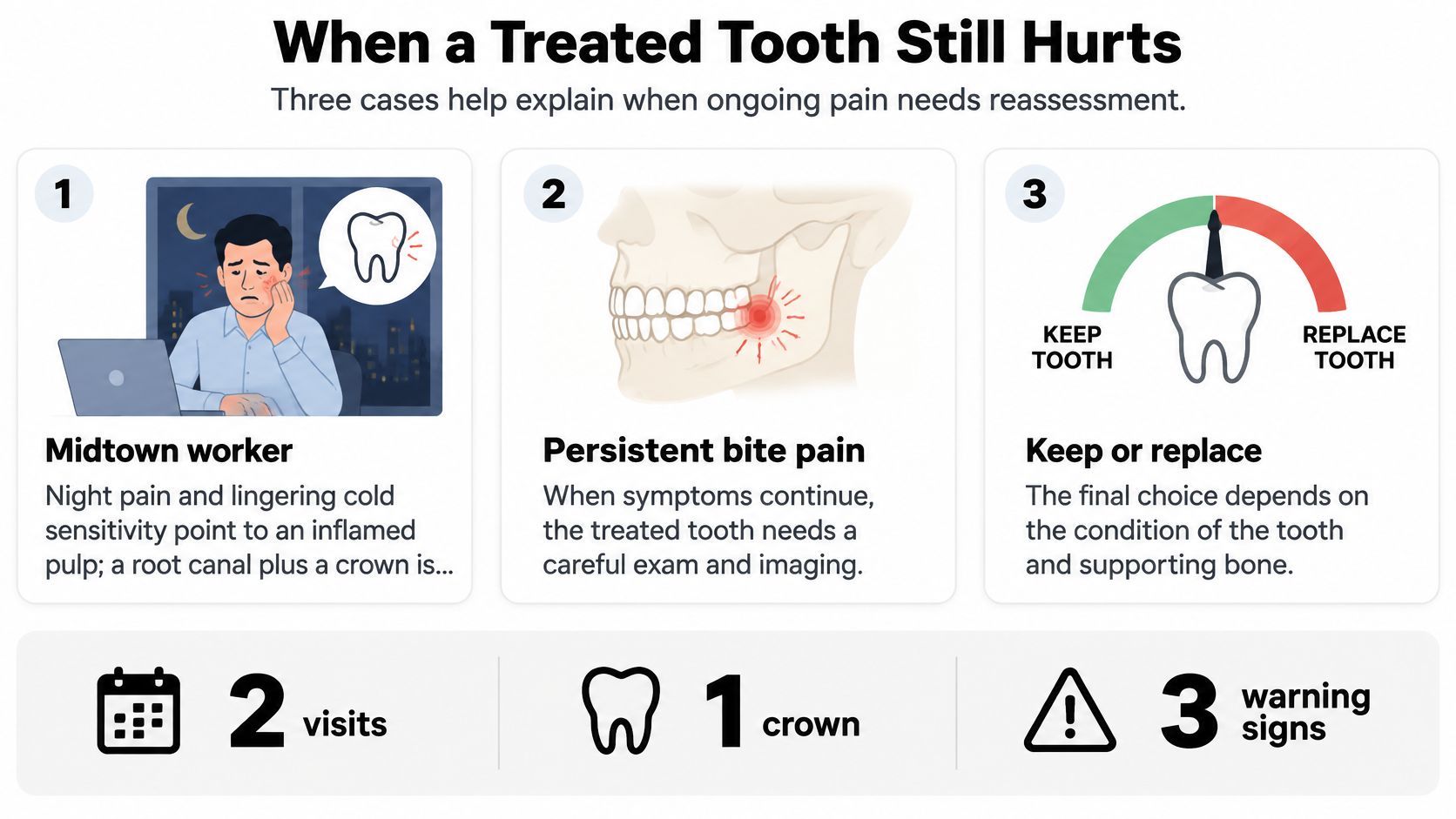
Pain after dental work has a pattern, and the pattern points to the cause. A Midtown worker's tooth aches at night and stays painful long after a cold drink; testing confirms irreversible pulpitis, and because the tooth is restorable, root canal therapy followed by the appropriate restoration preserves it. An Upper West Side patient presents differently: bleeding gums, pocket measurements of five to six millimeters, and a normal cold response. Confirmed periodontal attachment loss calls for root planing, and removing a healthy pulp would treat the wrong problem.
A third patient, aged 62 and from Chelsea, has a root-filled molar that hurts only when chewing. The crown was placed months earlier, a bite test hurts on one cusp, and imaging suggests well-filled canals with a gap at the crown margin. Once further examination rules out a significant crack and recurrent canal infection, a new restoration and bite correction can solve the problem while keeping the tooth.
Retention isn't the same as complete healing
Many root-canal-treated teeth remain in place for years. Retention means the tooth stayed present; it says nothing about whether that tooth was symptom-free or fully healed on imaging. A clinical review of nonsurgical endodontics reports approximately 85–94% clinical and radiographic success for initial treatment and 74–82% for retreatment, with initial outcomes less favorable when apical disease already exists. The same review describes recovery in about 50% of lesions at six months, compared with approximately 88% at twelve months, so an early residual shadow does not automatically establish failure.
Persistent pain calls for a fresh diagnosis before extraction enters the conversation.
Findings that change the decision
A clinical update on endodontic failure and retreatment reports persistent disease in roughly 10–15% of treated cases globally, along with the cause-specific retreatment outcomes shown below. These are reported group outcomes, not personal predictions.
Why a Root Canal Tooth Still Hurts
| Finding | Reported retreatment success | Practical reading |
|---|---|---|
| Missed canal | 81.7% | Retreatment still saves many of these teeth |
| Fill short of the canal end | 66.4% | Cleaning closer to length may be possible |
| Fill past the root tip | 62.2% | Less predictable; reassess before promising success |
| Restoration problem only | 96.2% | A new seal or crown may be enough after infection assessment |
| Crack or root fracture | Lower, and it depends on the crack's extent | Extraction is often considered when the root cannot be saved |
| Ongoing gum disease | Canal retreatment does not address the cause | Root planing or periodontal surgery treats the actual problem |
The clinician should also check for an excessively high bite, an unstable crown, and pain referred from elsewhere. Depending on the findings, the choices include monitored review, bite adjustment, root canal retreatment, apical surgery, or extraction with replacement such as an implant. An emergency department can quiet severe pain and control spreading infection with medication, yet finishing any of these options requires a dental chair and the instruments to complete the job. Lingering pain is a diagnostic fork: each branch leads somewhere different, and only a careful re-examination picks the right one.
Recovery Aftercare and Everyday Prevention
After a root canal
Mild tenderness for two or three days can occur, especially when the tissues around the root were already inflamed. Follow the pain-control plan given at your visit, and check with the clinician or pharmacist before using medication if you have kidney disease, stomach ulcers, take blood thinners, or are pregnant.
Avoid chewing on the treated side until the permanent filling or crown is in place. A temporary filling isn't designed to provide the same long-term seal or protection, and a weakened back tooth may need a crown within a few weeks, according to its restorative plan.
Call the same day if the bite feels high. Contact the dentist promptly for swelling, fever, or pain that increases after the second day rather than gradually settling; don't just increase pain medicine and postpone review.
After scaling and root planing
Tender gums and cold-sensitive roots can make eating and brushing uncomfortable for several days. Use a soft toothbrush with gentle pressure, and follow any specific rinse or medication directions given for your treatment.
If bleeding is heavy on the treatment day, ask whether to pause flossing briefly in that area, then resume cleaning between the teeth as directed. Don't stop cleaning for an extended period because the gums feel tender.
Judge progress at the booked periodontal recheck, not just by how your mouth feels during the first week. Reduced discomfort doesn't prove that a deep pocket has resolved, and temporary sensitivity doesn't mean the treatment failed.
Aftercare priority: Keep the restoration appointment and the periodontal recheck. Feeling better isn't a substitute for finishing care.
Habits that protect both the pulp and the gums
- Use fluoride toothpaste. Brush gently along the gumline rather than scrubbing exposed roots.
- Clean between teeth daily. Choose floss or correctly sized interdental brushes that you can use consistently.
- Repair damaged restorations. Report a cracked filling, broken edge, or food-trapping gap before the tooth becomes painful.
- Discuss clenching. A custom night guard may help protect vulnerable teeth and restorations when indicated.
- Limit repeated sugar exposure and avoid smoking. Frequent sugary drinks promote decay, while smoking works against periodontal healing.
Keep your written root canal recovery guidance available so you know whom to contact if symptoms change outside office hours.
Get Same-Day Help Across Manhattan
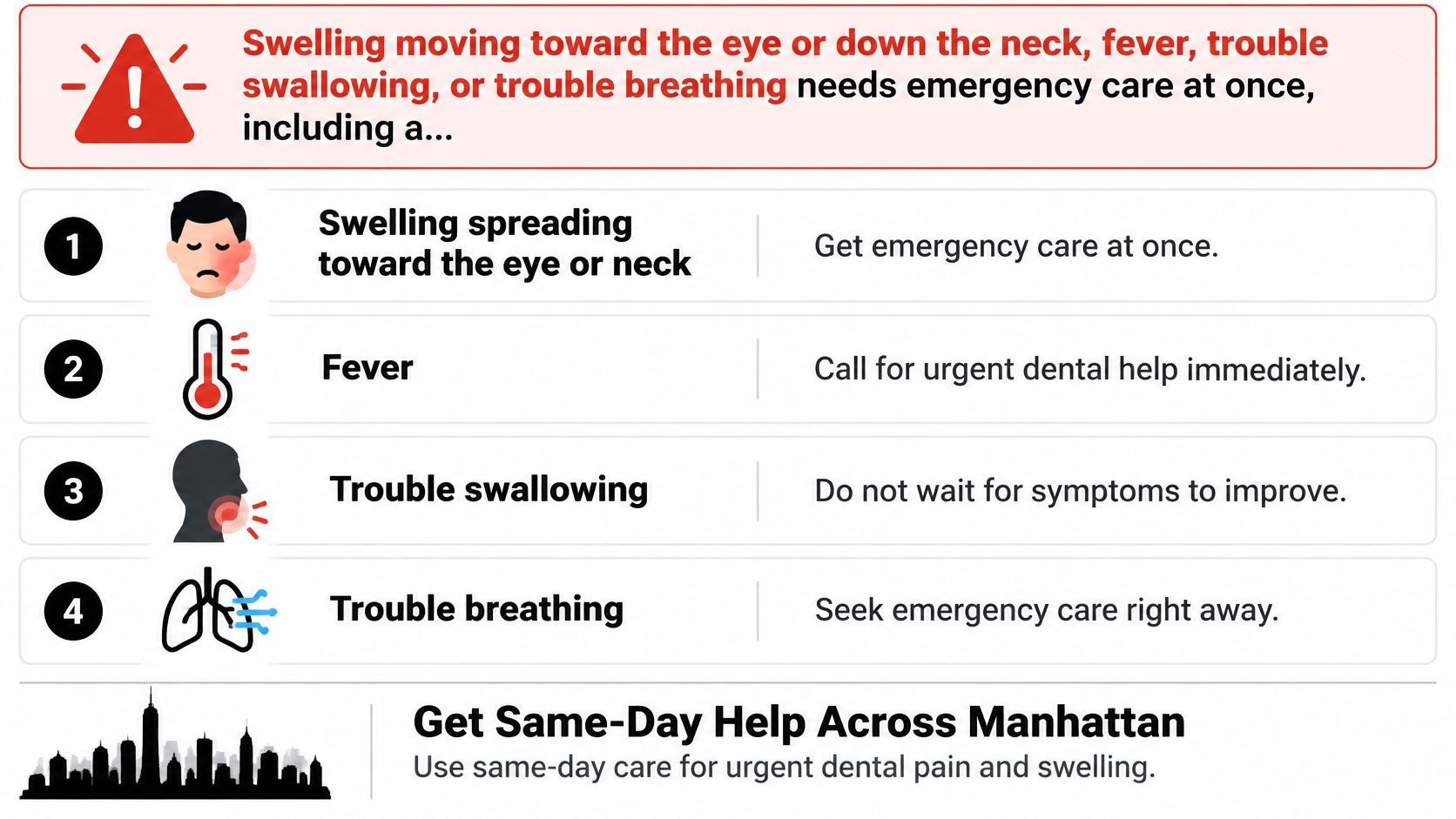
Swelling spreading toward the eye or down the neck, fever with spreading swelling, trouble swallowing, or trouble breathing requires immediate assessment. Go to a hospital emergency department for threatened breathing or swallowing rather than waiting for a dental appointment.
A severe toothache, broken tooth, or gum pimple without those danger signs usually needs urgent dental care. An emergency department can provide medical stabilization, pain relief, and antibiotics when appropriate, but it generally cannot finish root canal treatment, retreatment, drainage when needed, or periodontal scaling and root planing. That difference matters because antibiotics can reduce risk for a time while the source inside the tooth or gum remains.
The American Dental Association's Action for Dental Health resources describe survey findings that approximately 4% of U.S. adults, about 10.7 million people, reported an oral-health emergency-department visit in the prior year; reported use was 9% among adults with Medicaid dental coverage versus 2% with private insurance. Antibiotics alone don't replace treatment of the infected tooth or drainage when needed.
What to do while arranging care
- Save a displaced crown. Keep the area clean and bring the crown to the appointment. Use dental temporary cement only if it seats easily without a high bite, and never use household glue.
- Explain access concerns. Ask about assessment costs, coverage verification, and short-notice appointments rather than assuming insurance acceptance.
- Describe changes clearly. Report swelling, fever, drainage, and difficulty opening your mouth when calling.
The practice at 57 West 57th Street, near Central Park South and Columbus Circle, serves patients from Midtown West and the broader New York metropolitan area, with urgent assessment and short-notice scheduling when available.
Paul L. Gregory, DDS offers diagnostic examinations, root canal treatment and retreatment when indicated, and periodontal scaling and root planing. Visit Paul L. Gregory, DDS to request an assessment, describe your symptoms, and ask about short-notice availability so you can identify which kind of root dental care your tooth needs.