

A dental filling may last about 12.8 years for amalgam and 7.8 years for composite, based on median survival times from a major evidence review. Some fail sooner, while others remain useful for much longer.
That spread is the important part of the answer. A filling doesn't have a printed expiration date. Its service life depends on the material, the tooth's position, the size and shape of the restoration, the way you bite, and whether new decay develops around its edges.
A filling also doesn't usually “wear out” in one dramatic moment. Composite restorations often fail when decay forms beside them, while amalgam restorations more often fracture or lose their original shape, as described in a clinical review of restoration failure patterns. Understanding that difference helps you protect the filling you have and recognize trouble before a small repair becomes a larger procedure.
How Long Do Tooth Fillings Typically Last
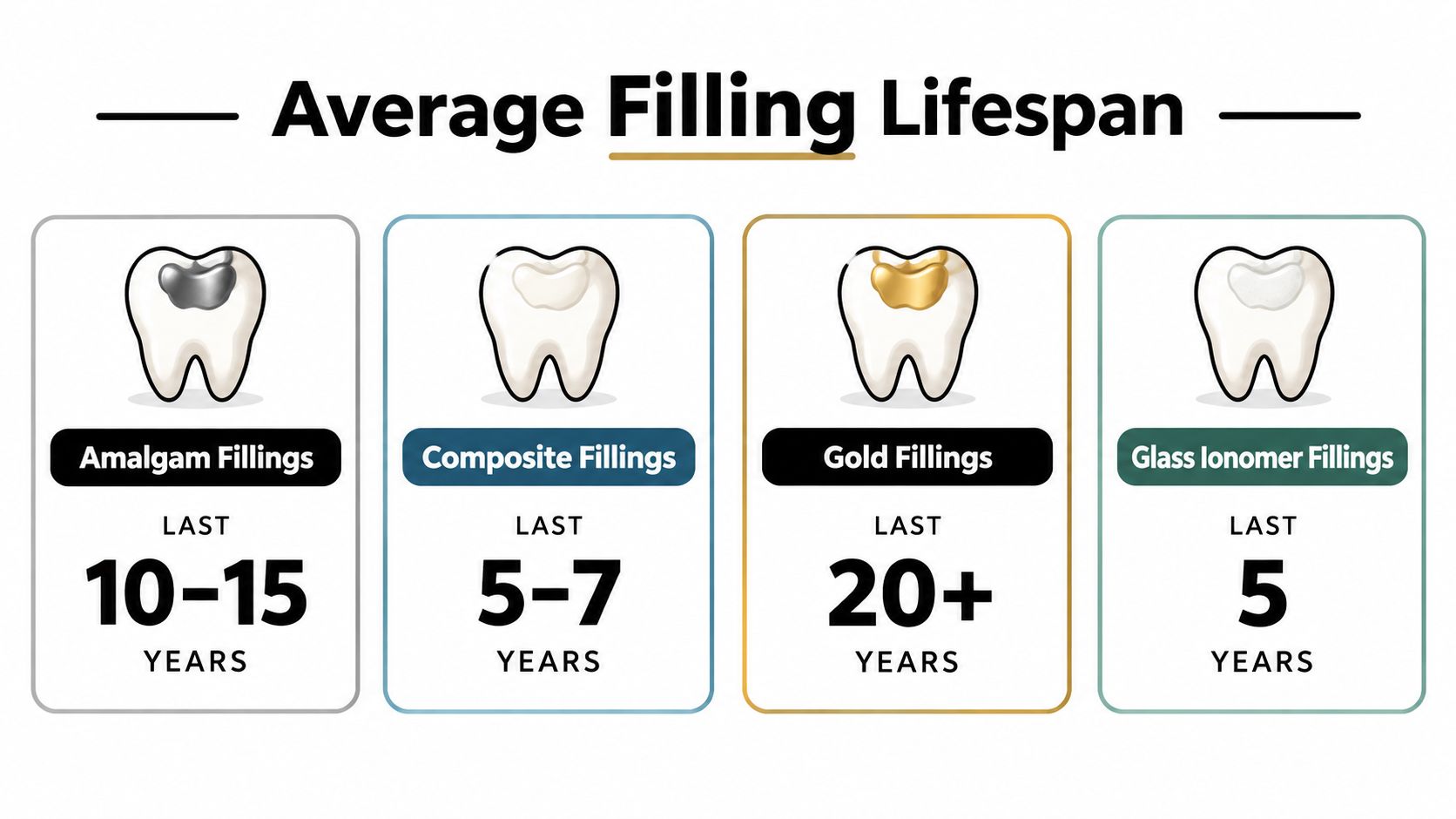
The simplest evidence-based answer is that many fillings last roughly a decade, but the material and conditions can move that estimate considerably. A major evidence review found a Kaplan-Meier median survival time of 12.8 years for amalgam and 7.8 years for composite fillings. In that analysis, one dataset recorded 10-year survival rates of 79.2% for amalgam and 82.2% for composite, while another reported overall 10-year survival of 60% for amalgam and 50% for composite. These differences show why one universal lifespan can be misleading. The full review explains how study setting, operator skill, and restoration complexity affect reported longevity.
A median is not a promise or a deadline. It means half of the restorations in the relevant group lasted less than that point and half lasted longer. One patient's composite filling may need attention earlier because it sits on a heavily loaded molar, while another's may remain stable for many years because the cavity was small, the bite is balanced, and plaque control is consistent.
Why the average can mislead
Historical evidence shows a wide range. Median survival in private dental practices ranged from 7.1 to 44.7 years, while dental education centers reported ranges from 11.4 to 150 years, reflecting major differences in the patients treated, the clinicians placing restorations, and the way researchers defined failure. Another everyday-practice study found that replaced fillings had an average age of 15.3 ± 6.6 years for amalgam and 9.4 ± 5.4 years for composite, with 30% of restorations surviving 10 to 20 years. These findings are summarized in a separate review of filling replacement and failure.
The practical question isn't “What year will this filling fail?” It's “What conditions is this filling facing, and is it still protecting the tooth?” If you're comparing treatment options, understanding the restoration itself can also help you interpret what a filling may cost, since material, technique, and the extent of repair all influence treatment planning.
Practical rule: Treat a filling's expected lifespan as a monitoring range, not a replacement appointment scheduled years in advance.
Filling Material Lifespans Compared
Material choice affects both durability and the way a restoration tends to fail. Amalgam has historically performed well in back teeth under chewing force, while composite resin offers a tooth-colored appearance and conservative bonding. Gold and porcelain can provide durable indirect restorations in selected situations, but they require a different treatment plan and may not be appropriate for every cavity.
The evidence is strongest for comparing amalgam and composite in posterior teeth. A recent cohort reported median survival exceeding 16 years for amalgam and about 11 years for composite resin, while older reviews reported 10-year functional survival of about 72% for amalgam and 56% for composite. The posterior-tooth cohort provides the detailed material comparison.
| Material | Typical Lifespan | Cost Range | Best For | Pros | Cons |
|---|---|---|---|---|---|
| Amalgam | Often around a decade or longer, with evidence showing median survival above 16 years in one posterior cohort | Varies by practice and restoration size | Larger or heavily loaded back-tooth restorations | Durable under chewing forces and historically long-lasting | Metallic appearance and potential fracture-related failure |
| Composite resin | Often several years to around a decade, with one evidence review reporting a 7.8-year median | Varies by practice and restoration size | Visible teeth and small to moderate restorations | Tooth-colored and bonds to tooth structure | More sensitive to moisture, wear, stress, and recurrent decay |
| Porcelain | Can be durable when used as an indirect restoration, but longevity varies by design and case | Usually higher than a direct filling | Selected larger restorations where an inlay or onlay is appropriate | Aesthetic appearance and good form | Requires laboratory or digital fabrication and additional planning |
| Gold | Can provide long service in carefully selected indirect restorations | Usually higher than direct filling materials | High-load areas where durability and fit justify the treatment | Strong, wear-compatible, and long-lasting | More visible and less conservative for small cavities |
The material isn't the whole decision
A tooth-colored composite may be the sensible choice for a front tooth or a small visible cavity, even if another material has a longer historical survival record in back teeth. Preserving sound enamel, achieving a dry working field, matching the shade, and controlling the bite may matter more than choosing the material with the longest average lifespan.
Gold is often discussed as a premium option because it can tolerate demanding function, but it's an indirect restoration rather than a simple one-visit filling in many cases. If you're considering that approach, a guide to dental gold fillings can help clarify why the dentist may recommend an inlay or onlay instead of a direct filling.
Porcelain also requires careful case selection. It may suit a tooth with more extensive structural loss, but it isn't automatically the best answer for every cavity. Ask which material fits the tooth's location, remaining structure, bite forces, appearance goals, and ability to keep the area clean.
Factors That Affect Filling Longevity
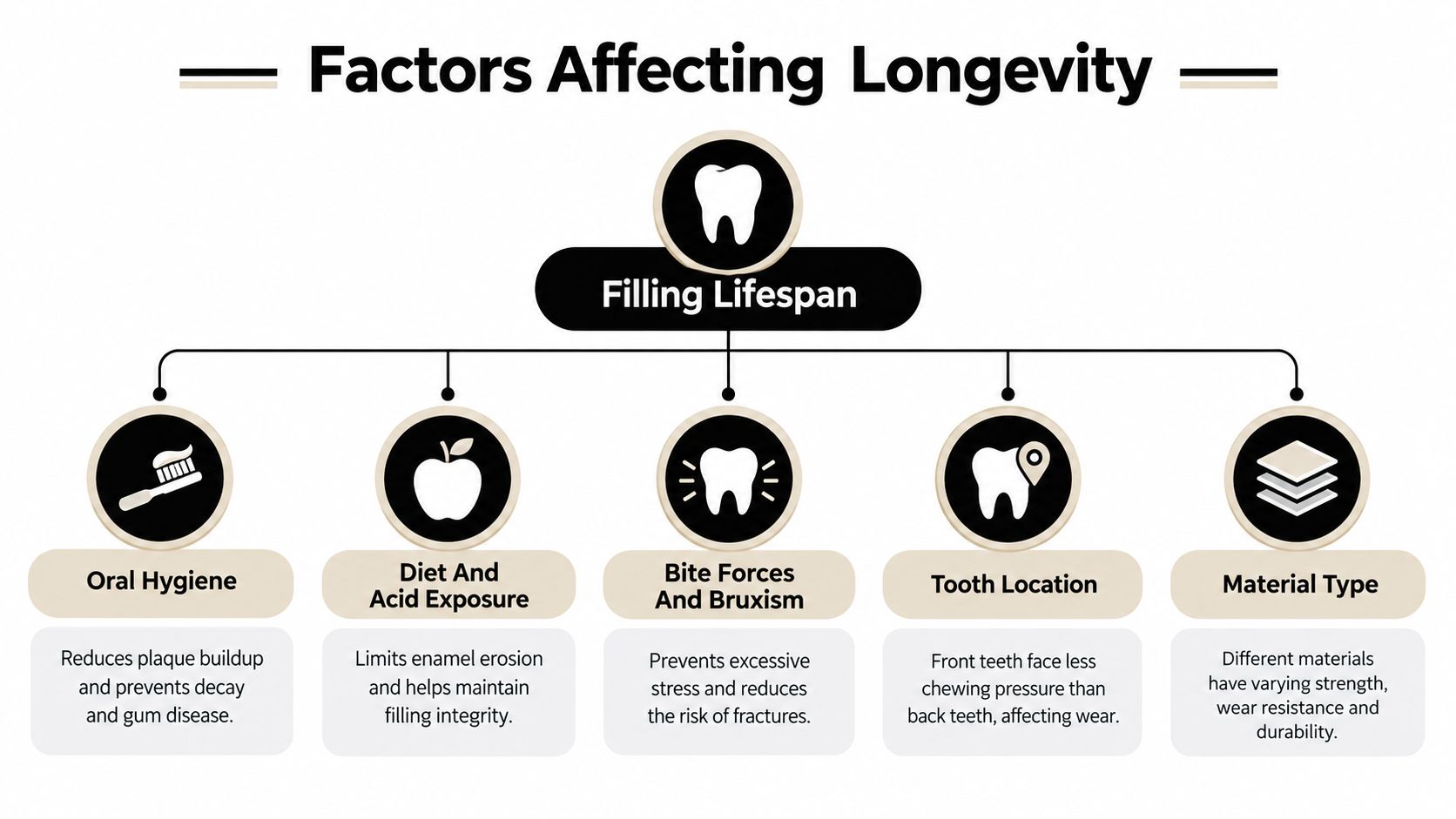
Annual failure rates vary by material, but the reason for failure often matters more than the average lifespan. Two fillings made from the same material can age differently because plaque, acid, chewing pressure, tooth position, and placement technique change the conditions around them. A filling works like a tire: the material matters, yet the surface, load, alignment, and maintenance also determine how long it performs well.
Your daily environment matters
Plaque at a filling's edge can feed decay beside the restoration. Composite fillings commonly fail through secondary caries, while amalgam more often fails through fracture or loss of tooth anatomy. Reported annual failure rates were about 3.06% for composite and 3.55% for amalgam. Oral hygiene and bruxism were also associated with shorter longevity. The evidence review on material-specific failure explains these patterns.
Several risks can act together:
- Oral hygiene: Fluoride toothpaste and cleaning between teeth reduce plaque accumulation around margins.
- Diet and acid exposure: Frequent sugary or acidic intake creates a harsher environment for both the tooth and restoration.
- Bite forces: A molar absorbs repeated chewing pressure that many front-tooth restorations avoid.
- Bruxism: Clenching and grinding can overload a filling, particularly during sleep.
- Placement conditions: Composite requires careful moisture control and precise bonding. How dentists fill cavities explains why technique affects the restoration's seal and function.
Location changes the workload
A small composite on a front tooth may face modest biting forces. A large restoration on a molar may undergo repeated compression and flexing. A filling near the gumline, or in an area that is difficult to isolate, may also face more moisture contamination and plaque retention than one surrounded by easy-to-clean tooth structure.
Bruxism can be easy to miss. Morning jaw fatigue, worn tooth surfaces, chipped edges, headaches, or a partner hearing grinding at night can support a dental evaluation. Depending on the findings, a dentist may suggest a custom night guard, bite monitoring, or earlier review of restorations under heavy load.
A filling doesn't fail in isolation. The tooth, bite, plaque, and restoration share the workload.
The remaining tooth structure matters during future treatment as well. Repeated replacement can gradually weaken a tooth, so repairing a small defect may preserve more structure than waiting for a larger fracture.
Signs Your Filling Needs Replacement
A patient may notice a rough edge while running a tongue over a molar, then dismiss it because there's no pain. Another person may feel a sharp jolt when drinking something cold, or notice food repeatedly catching in the same space. These symptoms don't prove that a filling has failed, but they deserve assessment.
Look for changes rather than waiting for severe discomfort:
- A chipped or cracked edge: A broken section can expose the tooth to additional stress.
- A rough or raised surface: Your bite may feel different, or the restoration may catch floss.
- New discoloration: Darkening near a margin can reflect staining, leakage, or decay, though only an examination can distinguish them.
- Sensitivity: Hot, cold, or sweet foods may trigger a response from the tooth.
- Pain on biting: Discomfort when you chew can point to a crack, an uneven bite, or deeper irritation.
- Food trapping: Repeated packing beside a filling may indicate a changed contact point or damaged margin.
A lost filling is more obvious. You may feel a piece come out while eating, discover a hollow area with your tongue, or suddenly find that the tooth reacts to temperature. Don't use the tooth as a tool, and avoid chewing hard foods on that side until a dentist examines it.
Not every failing filling announces itself
Some restorations look acceptable at home while decay develops underneath or beside them. A dentist may identify a marginal defect, crack, altered bite, or radiographic change during a routine examination before you feel anything.
If pain becomes persistent, swelling develops, or the tooth becomes increasingly tender, seek prompt care. A guide to dental abscess symptoms and treatment can help you recognize when discomfort may involve infection rather than an ordinary restoration issue.
The following video offers a visual explanation of why fillings may need monitoring:
Preventive Care to Extend Filling Life
The most useful maintenance plan is simple enough to follow on a busy morning. Brush twice daily with fluoride toothpaste, clean between the teeth every day, and spend extra time at the margins where the filling meets natural enamel. A small interdental brush or water flosser may help when conventional floss is difficult, but the best tool is the one you'll use consistently.
Make routine care work harder
Fluoride helps strengthen vulnerable tooth surfaces around restorations. Don't rinse aggressively with water immediately after brushing if your dental professional has advised you to let the fluoride remain longer. If you use an electric brush such as an Oral-B iO or Philips Sonicare, keep the pressure light and guide the brush slowly along the gumline rather than scrubbing forcefully.
Diet also affects the environment around a filling. Limit frequent sipping of acidic drinks and repeated exposure to sugary snacks. Water between meals can help clear food residue, while chewing sugar-free gum may stimulate saliva when appropriate for you.
Protect against mechanical stress
If you clench or grind, ask whether a professionally fitted night guard is suitable. An over-the-counter guard may not fit your bite correctly, and a custom appliance can be adjusted to your teeth and restoration pattern.
Maintenance principle: Small changes in plaque control, bite protection, and diet are easier than managing a fractured filling after the tooth has lost more structure.
Keep regular examinations and cleanings so your dentist can compare the restoration over time. The interval should reflect your risk profile, not just a generic calendar. Someone with recurrent decay, heavy grinding, or difficult-to-clean restorations may need closer monitoring than someone with stable fillings and low disease activity.
Report minor changes early. A dentist may be able to smooth a rough edge, adjust the bite, repair a limited defect, or improve the contact without removing the entire restoration. That decision depends on the extent of damage, the presence of decay, and the strength of the remaining tooth.
When to Seek Professional Evaluation
Routine monitoring helps identify a filling problem before it becomes painful. At regular examinations, a dentist can inspect the margins, assess the bite, compare wear, and use dental X-rays when they're clinically appropriate. Intraoral cameras can also make a cracked edge or stained margin easier for you to see.
Arrange an evaluation if you notice:
- Pain or increasing sensitivity: Especially when it persists after the trigger is gone.
- Visible damage: Such as a chip, crack, hole, or filling that has fallen out.
- A changed bite: If the tooth feels taller or uncomfortable when you close.
- Swelling or severe tenderness: These symptoms can require prompt assessment for infection.
- Repeated food trapping: A changed contact or margin may need correction.
A professional assessment doesn't automatically mean a full replacement. The dentist may recommend observation, polishing, bite adjustment, repair, or replacement after examining the tooth. If decay has reached the nerve or the tooth has fractured severely, treatment may involve more than a filling, which is why early evaluation matters.
The median figures, 12.8 years for amalgam and 7.8 years for composite, give useful context, but they don't determine what's happening in your mouth today. Material, tooth location, bite forces, hygiene, and the condition of the surrounding tooth provide a more accurate guide than age alone.
Paul L. Gregory, DDS provides preventive examinations, digital X-rays, composite and porcelain fillings, bite evaluation, and custom night guards for patients managing worn or failing restorations. Visit Paul L. Gregory, DDS to arrange an evaluation in Midtown Manhattan and discuss whether your filling needs monitoring, repair, or replacement.