

How much does a filling cost? In the U.S., the national range runs from $108 to $1,774 per tooth, and a typical composite filling averages $226 nationally, though in Manhattan you should expect a modern tooth-colored filling to land higher, especially if the tooth has more than one surface involved.
That's the answer, not the lazy version you see on generic dental blogs. A filling is not one price, it's a moving target shaped by material, tooth location, cavity size, and the kind of office you're walking into in Midtown.
What a Filling Actually Costs in 2026
A filling has no single sticker price because the dentist isn't selling a one-size-fits-all product. The number changes with the material, the size of the cavity, and the location of the practice. That's why one person gets a straightforward bill and another gets a number that looks like a small repair estimate.
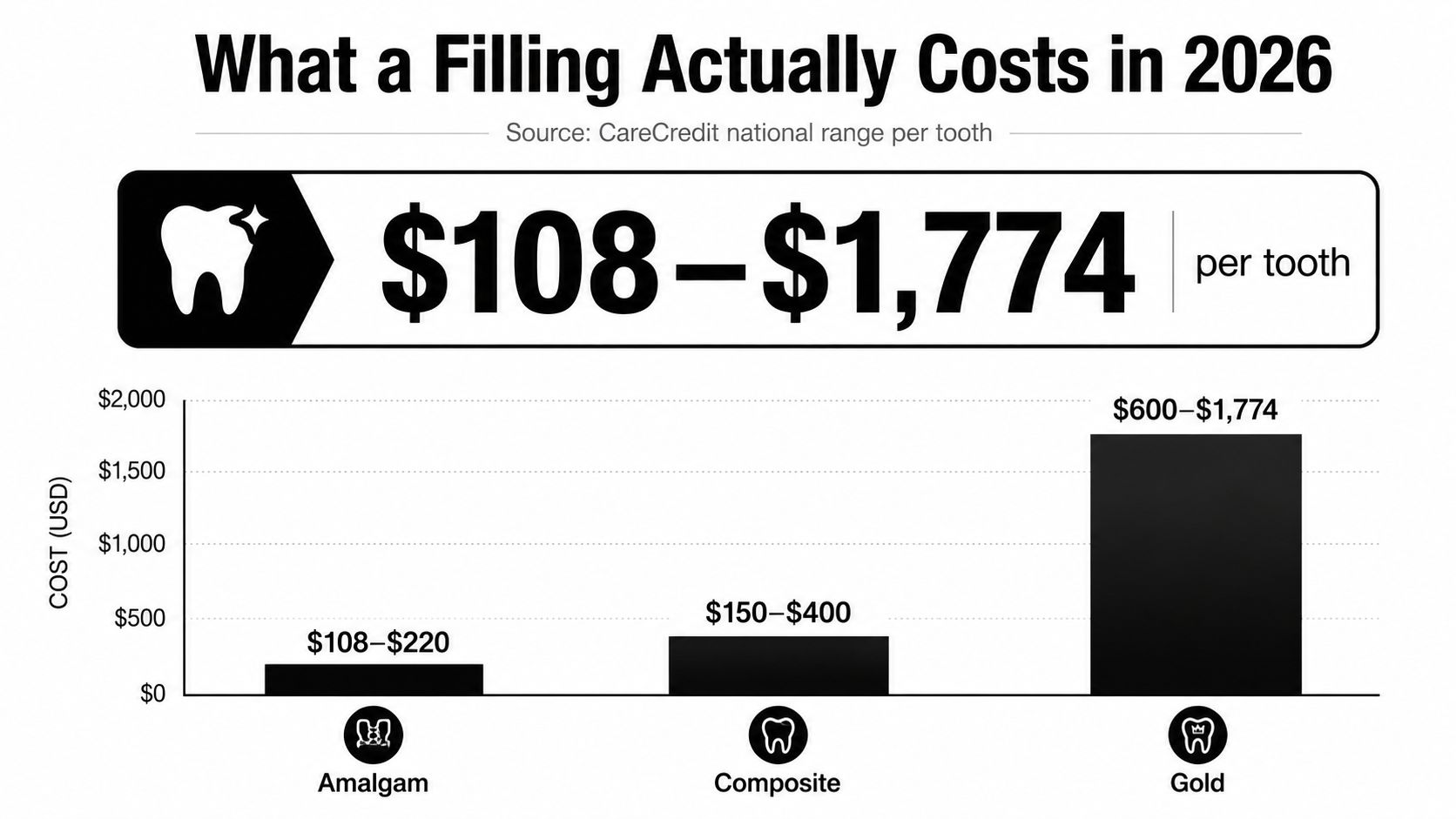
CareCredit's national breakdown gives the clearest anchor point, with a range of $108 to $1,774 per tooth and an average composite filling at $226 nationally. That spread is huge, but it makes sense once you separate an ordinary restoration from a premium cosmetic one. A back-to-basics repair and a visible tooth-colored restoration in a high-cost market are not the same job, and they shouldn't be priced like they are.
If you want the office version of this question, not the internet version, use the same standard I'd use in the chair. Ask what material is being quoted, whether the fee is per tooth or per surface, and whether the price includes the exam, X-rays, and finishing work. If you're comparing offices, start with the treatment code, not the headline number. For a deeper look at how a Midtown office frames cavity care, see cavity fillings at a Manhattan dental practice.
Practical rule: if a quote sounds unusually low, find out whether it covers only the filling material or the whole procedure. Those are not the same thing.
The point is simple. The question isn't “what does a filling cost?” The better question is, “what exactly is being restored, with what material, and how many surfaces are involved?”
Comparing Filling Materials and Their Price Bands
Material drives a lot of the spread you see in filling prices, and the differences are not cosmetic fluff. Some materials are cheaper, some are more durable, some are chosen because they blend in, and some are chosen because they last. That's why you can't compare fillings without naming the material first.
Here's the cleanest comparison of the main U.S. options. The national bands below come from CareCredit, and they're the best starting point for understanding why two offices may quote very different fees for what sounds like “just a filling.”
| Filling Material Price Bands in the United States | Low end | High end | Typical use |
|---|---|---|---|
| Amalgam | $108 | $256 | Durable posterior restoration where appearance matters less |
| Composite resin | $173 | $439 | Tooth-colored, common for visible teeth and most modern fillings |
| Glass ionomer | $116 | $285 | Often used in selected pediatric or temporary situations |
| Gold | $361 | $817 | Chosen by patients prioritizing long-term durability |
| Porcelain ceramic | $755 | $1,774 | Premium cosmetic restoration for visible or highly aesthetic cases |
Composite is the modern default for a lot of patients because it blends with enamel and fits the look patients want in a visible tooth. Amalgam remains a lower-cost option, especially in back teeth where appearance is less important and chewing force matters more. Gold sits in a different category altogether, because people usually choose it for longevity, not stealth.
Glass ionomer is a narrower-use material. Porcelain ceramic is the top-end option, and the price reflects that premium position clearly. If your dentist recommends porcelain on a visible tooth, they're not talking about a routine office fix, they're talking about an aesthetic restoration.
Browse restorative dentistry topics in Manhattan if you want to see how fillings fit into the broader treatment picture.
The blunt recommendation is this. If you care most about cost, ask whether a functional composite or amalgam will do the job. If you care most about cosmetics on a front tooth, expect to pay more and focus on the appearance of the final result, not just the fee.
Why Surface Count and Tooth Location Change the Bill
A filling is rarely priced as a vague “tooth repair.” In real life, it's often priced by how many surfaces of the tooth are involved, and that changes the work quite a bit. A one-surface filling is a simpler job than a three-surface restoration, and a front tooth is not treated the same way as a molar.
Delta Dental notes uninsured composite fillings can run about $145 to $480 for front teeth and $165 to $530 for back teeth, depending on the situation and surface count. Pricing examples cited by a dental clinic source also show the familiar step-up pattern, with one-surface, two-surface, and three-surface fillings at roughly $155, $215, and $305 respectively. That's the part most patients miss when they hear a single “average” online.
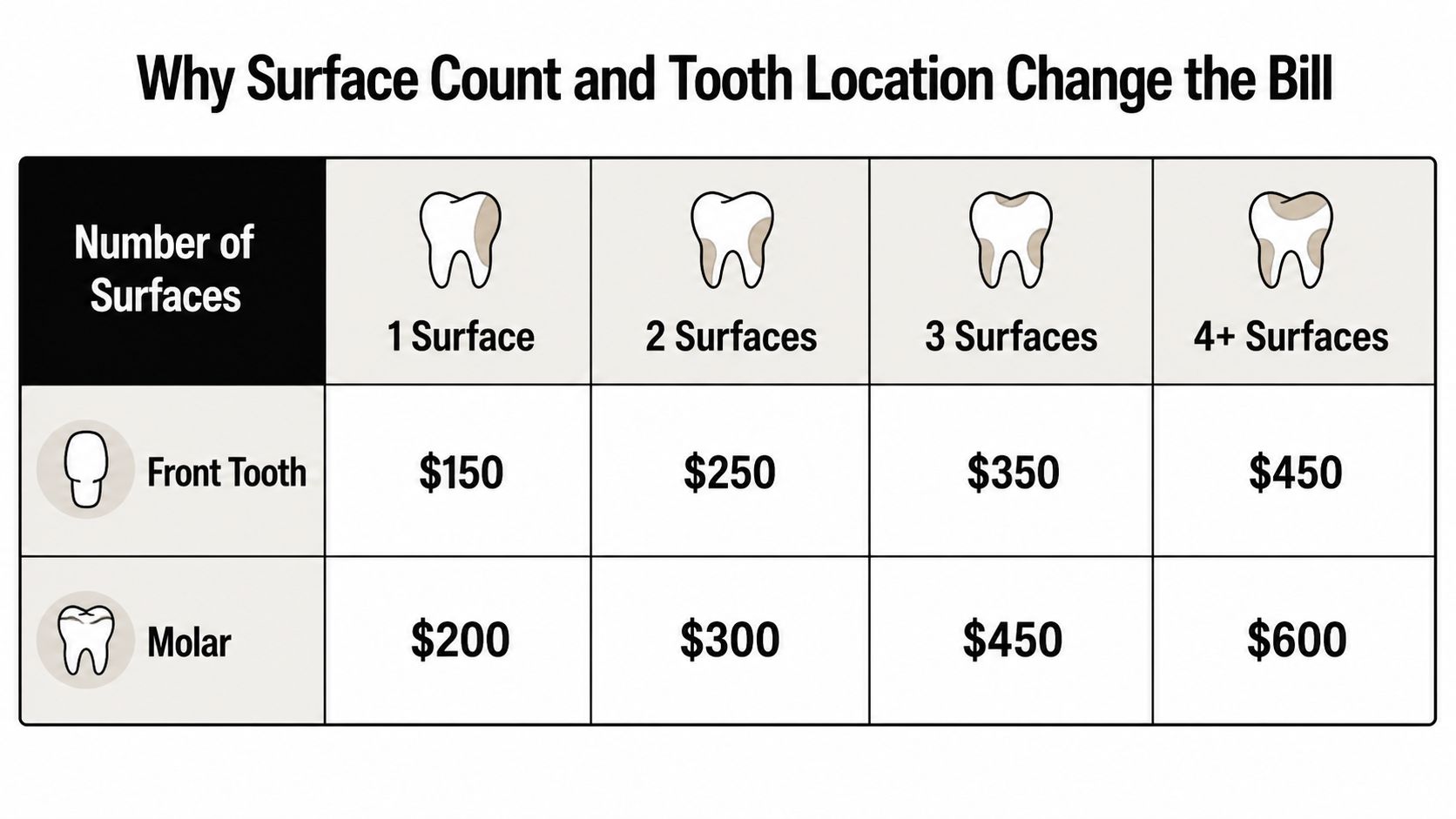
Here's the practical logic. A cavity touching one side of a tooth takes less time, fewer materials, and less shaping than decay that spreads across several surfaces. Back teeth also demand more precision because they're harder to reach and take the full force of chewing. That's why the same office can quote two very different fees for two fillings on the same day.
For a Midtown patient trying to decode a quote, the key question is whether the dentist is talking about a one-surface or multi-surface restoration. If the office skips that detail, ask again. You can't compare estimates until you know what the dentist is repairing.
See how diagnostic imaging supports cavity planning when you're trying to understand why one tooth needs a smaller repair and another needs a bigger one.
A quote that doesn't specify the surface count is incomplete. You're not being difficult by asking. You're being smart.
What Is Inside the Fee You Are Paying
Patients often assume they are paying for resin or silver. That is the smallest part of the bill. The cost comes from the dentist's time, the setup, the isolation, the shaping, and the overhead required to run a sterile clinical practice.
The economics of a filling are simple. The restorative material itself is cheap. Labor, chairside time, and the work needed to place the filling correctly drive the fee much more than the material sitting in the syringe or tray.
What you are usually paying for includes:
- Diagnosis and planning: confirming the cavity, deciding whether a filling is the right treatment, and selecting the material.
- Anesthesia and isolation: numbing the tooth and keeping it dry enough for the filling to bond properly.
- Layering and shaping: building the restoration so it matches the tooth's anatomy.
- Finishing and bite adjustment: smoothing the surface so it does not feel high, rough, or awkward when you chew.
- Sterilization and overhead: instruments, disposable supplies, support staff, and the cost of keeping the office operating.
That is why a filling fee can look high even when the restorative material is inexpensive. You are paying for a controlled clinical procedure, not a simple pile of composite.
A filling placed early usually takes less time and fits a lower-complexity code. Waiting lets decay spread, and then the quote rises because the work gets harder and more involved. Midtown patients who wait often pay for that delay twice, once in discomfort and again in a larger bill.
Read how Midtown professionals view modern dental care if you want a sense of how a local office frames that level of treatment.
Manhattan and NYC Pricing Reality
National averages are useful, but they understate what you'll often see in Manhattan. Midtown offices carry higher rent, higher staffing costs, and a patient base that often expects tooth-colored, cosmetic-grade work even for routine restorations. That changes the quote, and pretending otherwise is a waste of everybody's time.
RealDentalCosts.com notes that a simple filling often lands around $100 to $300 nationally, but can go above $500 and well above $1,000 for porcelain or inlay/onlay work, with Manhattan pricing typically higher than national averages. That tracks with how the local market works. A visible tooth, a busy schedule, and an office built for modern presentation tend to push the fee up, not down.
Read about the Midtown office environment and patient expectations if you want a sense of how local care is framed in this part of the city.
The smart way to judge a Manhattan quote is not to ask whether it matches the cheapest national listing you found online. Ask whether the office is quoting a composite or a more premium material, whether the tooth is front or back, and whether the fee reflects a single surface or several. Those details explain most of the gap before you even get to overhead.
If two offices a few blocks apart quote different numbers, that doesn't automatically mean one is gouging. One may be quoting a cosmetic material, one may include a different diagnostic setup, and one may run a more expensive practice. Judge the quote by scope and material, not by wishful thinking.
How Dental Insurance Handles Fillings
Insurance usually treats fillings as a basic restorative service, which sounds helpful until you read the fine print. Most plans don't pay the whole bill, and they certainly don't pay whatever the dentist wants without limits. They pay according to plan rules, and those rules are where patients get blindsided.
The common pattern is straightforward. Coverage is often a percentage after the deductible, then the insurer applies an annual maximum, frequency limits, and network rules. Many plans also distinguish between in-network and out-of-network reimbursement, and the out-of-network version can be much less generous than patients expect.
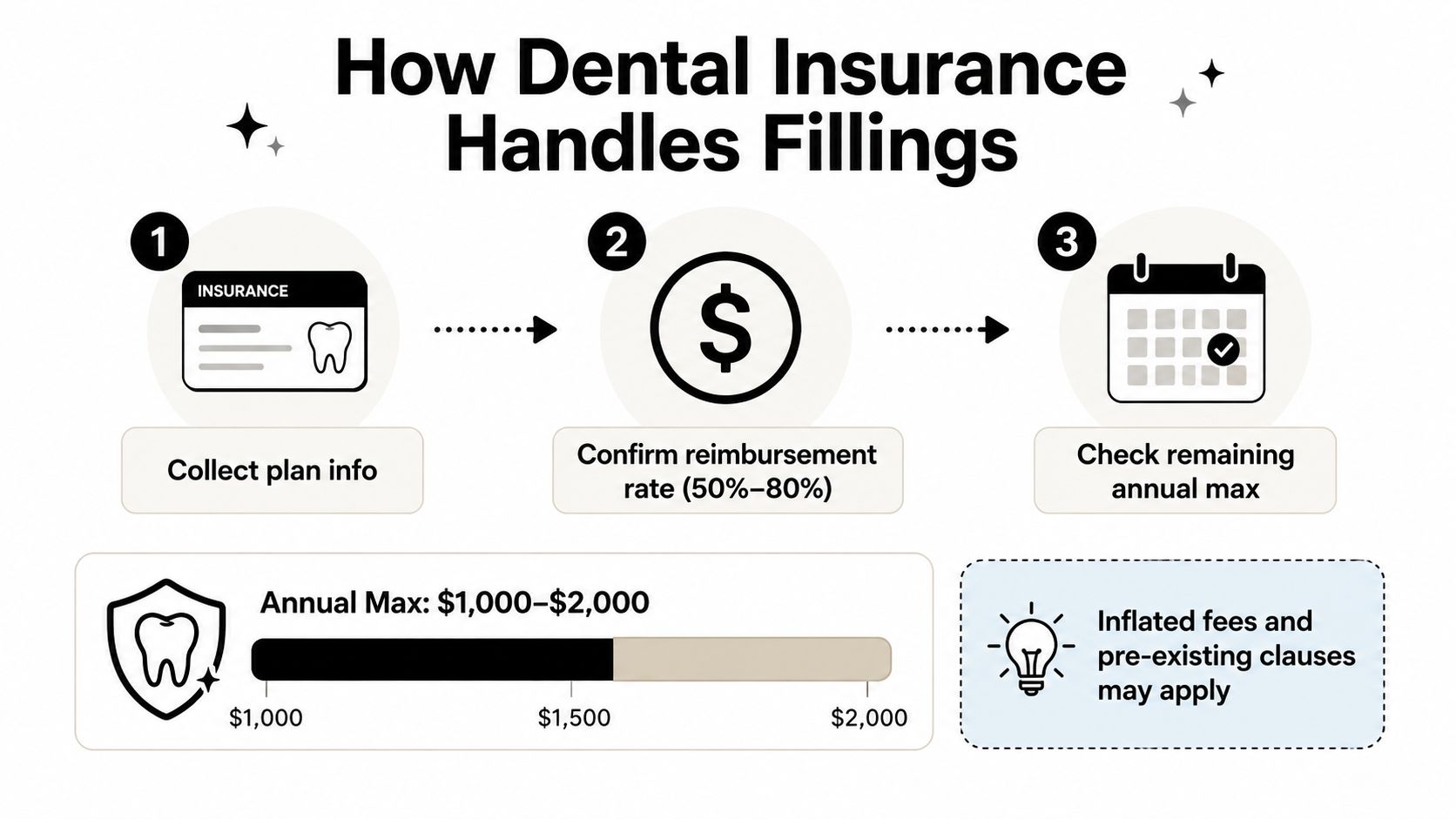
A few things matter before you walk into the chair:
- Collect the plan details. Know your deductible, your in-network status, and whether the office is submitting claims for you.
- Confirm the reimbursement rate. Don't assume the plan will pay most of the bill just because it's a filling.
- Check your remaining annual maximum. If you've already used much of it, your out-of-pocket bill can jump fast.
Practical rule: a “covered” filling can still leave you with a significant bill if your annual max is already close to used up.
Review a Manhattan office's insurance guidance before scheduling if you want to avoid the classic surprise at checkout. Also ask whether the office is billing a single tooth or multiple surfaces, because insurance responds to the code, not your assumption about what “simple” means.
The blunt advice is this. Don't book first and ask about coverage later. Call the insurer and the office before treatment, and get the numbers in writing.
Two Realistic Scenarios From a Midtown Practice
A 32-year-old professional walks in with a small cavity on a front tooth. The dentist recommends a single-surface composite, because the tooth is visible and the decay is limited. That bill lands in the lower band, and the patient leaves with a restoration that blends in instead of shouting from across the room.
A 47-year-old comes in with a cracked molar and decay that reaches several surfaces. The dentist doesn't have the luxury of a tiny repair, because the tooth needs a bigger composite restoration or possibly an inlay-style solution depending on the exam. That bill is much higher, and the patient feels the difference immediately when the treatment plan is reviewed.
The label “filling” hides the gap between those two appointments. One is a clean, contained repair. The other is a more involved restoration that takes longer, demands more shaping, and has a higher chance of needing careful bite adjustment.
That's why a Midtown quote can't be judged by the word filling alone. The question is whether you're fixing a small visible defect or rebuilding a chewing surface that's already breaking down. Those are different jobs, and the bill should reflect that.
The patient who understands this doesn't get caught off guard. They ask better questions, they know why the price changed, and they stop comparing their estimate to someone else's completely different tooth.
Your Pre-Visit Checklist Before Booking a Filling
Before you book, get four things in writing. First, ask for the diagnosis code and material. Second, confirm whether the price is per tooth or per surface. Third, check your insurance coverage and remaining annual maximum. Fourth, request a printed treatment plan so there's no confusion at checkout.

If you're in Manhattan and you need care fast, ask whether the office can handle short-notice visits or triage you by phone before you take time off work. Busy patients don't need a lecture, they need a plan that doesn't waste half a day. A clean written estimate saves time, money, and frustration.
Bring this checklist to your appointment, and don't apologize for using it. The right office will respect that you want clarity before treatment.
If you want a straight answer on your own filling, with no fluff and no billing surprises, book a visit with Paul L. Gregory, DDS. The practice helps Midtown patients sort out material choices, surface counts, and insurance questions before the work starts, which is exactly how you keep a small cavity from turning into a big bill.