

You wake up at 2 a.m. with a tooth that feels like it has its own heartbeat. At first it seemed like ordinary sensitivity. Cold water zinged. Coffee bothered it. Then the pain got deeper, steadier, and strangely harder to ignore when you lay down. By morning, your gum feels puffy or your cheek looks a little fuller in the mirror, and now the question changes from “Is this a cavity?” to “Do I need help today?”
That's a very common path into an abscess.
A dental abscess isn't just a bad toothache. It's an infection with pus trapped in a space that doesn't have room to expand. Think of pressure building inside a sealed box. The box doesn't stretch much, so the pressure rises fast, and your body reads that pressure as pain. If the infection pushes beyond the tooth into nearby tissues, you can also get swelling, trouble opening your mouth, or trouble swallowing.
Patients get confused in two places. First, they aren't sure which symptoms mean “call the dentist today” and which mean “go for urgent medical care now.” Second, many assume antibiotics alone will fix it. In many cases, they won't. The source of the infection usually has to be drained, cleaned from inside the tooth, or the tooth has to be removed.
Introduction to Dental Abscess Pain and Pressure
One of the most unsettling things about abscess pain is how personal it feels. A simple sip of water can set it off. Biting on one side becomes impossible. Some people notice the pain starts as a sharp complaint and then turns into a heavy, throbbing pressure that sits there all day.

Why the pain feels so intense
The pressure matters as much as the infection. When pus collects in a tight space around a tooth or gum, it behaves a bit like air being pumped into a bicycle tire that can't safely expand. The pressure keeps building. That's why abscess pain often feels persistent rather than occasional.
According to Mayo Clinic guidance on tooth abscess diagnosis and treatment, severe dental abscesses are recognized by a symptom cluster that can include localized pain reproducible by palpation, facial erythema or swelling, trismus, dysphagia, fever, and lymphadenopathy. That same guidance explains the cause-and-effect clearly: pressure from pus in a closed dental space drives intense pain, and spread into nearby tissue planes creates jaw or facial swelling and trouble with normal movement.
A tooth can hurt for lots of reasons. An abscess usually stands out because the pain and pressure don't behave like a simple sensitive tooth.
When readers usually get mixed up
People often wait because the pain briefly eases. That can happen if some pressure drains on its own. But relief doesn't mean the infection is gone. It may only mean the pressure changed.
Others focus only on the tooth and miss the bigger issue. Once swelling starts affecting your cheek, jaw movement, or swallowing, the problem is no longer just “inside the tooth.” That's when the infection may be moving into spaces where it can become more dangerous.
If you're trying to make sense of dental abscess symptoms and treatment, the useful way to think about it is simple. Match the symptom pattern to the treatment path. Tooth-centered pressure and pain need dental treatment to remove the source. Spreading swelling or swallowing trouble needs urgent escalation.
What a Dental Abscess Is and Why It Forms
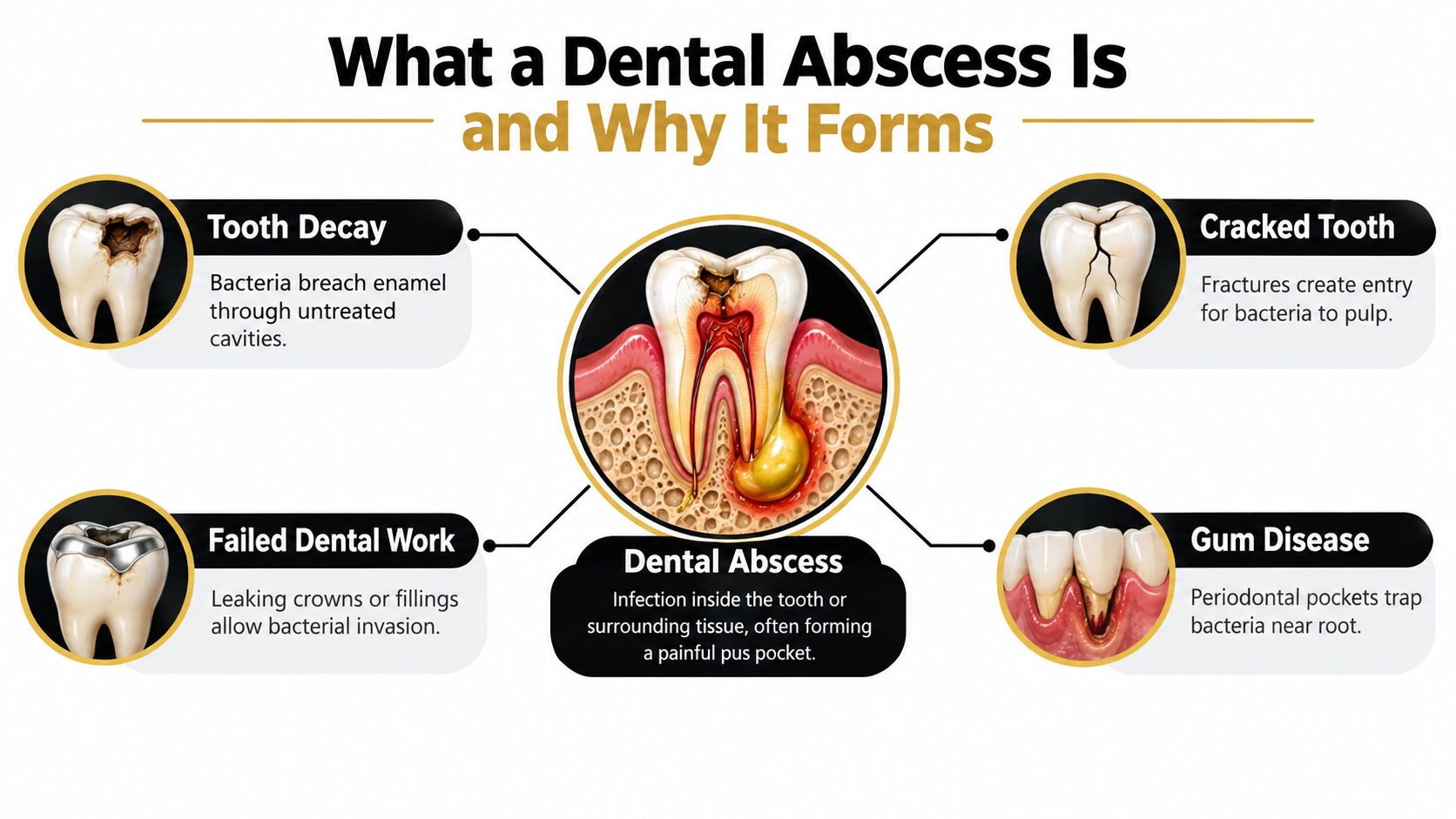
A dental abscess is a pocket of pus caused by bacterial infection. The location can differ, but the basic story is the same. Bacteria get into a place they shouldn't be, your immune system responds, and the resulting battle creates fluid, inflammation, and pressure.
The pressure-box analogy
A healthy tooth is layered for protection. Once bacteria get through those layers, the center of the tooth or the surrounding gum tissues can become infected. Now imagine inflating a small balloon inside a rigid jewelry box. The balloon tries to expand, but the box resists. The force has nowhere to go.
That's why abscesses hurt so sharply. The pain isn't random. It follows the anatomy.
Common entry points include:
- Untreated decay that lets bacteria move inward
- Cracks or fractures that create a hidden path into the tooth
- Leaking or failed dental work that no longer seals the tooth well
- Gum disease that creates pockets where bacteria collect
If you've ever wondered why one infected tooth needs a root canal while another has to come out, the answer often depends on exactly where the bacteria entered and how much healthy structure remains. If you want a clearer picture of when infection inside the tooth leads to pulp treatment, this overview of when a tooth needs a root canal is a useful companion.
The main types dentists look for
Dentists usually think about abscesses by location, because location predicts treatment.
| Type | Where it starts | Typical pattern |
|---|---|---|
| Periapical abscess | Near the root tip | Often begins from decay, deep infection, or a crack reaching the pulp |
| Periodontal abscess | In the gum pocket beside a tooth | More often tied to gum disease and trapped bacteria around the root |
| Pericoronal abscess | Around a partially erupted tooth, often a wisdom tooth | Common when gum tissue partly covers the tooth and traps debris and bacteria |
Why cause determines treatment
A periapical abscess usually means the inside of the tooth is infected. In that case, draining gum swelling without treating the inside of the tooth is only partial work. A periodontal abscess may require cleaning deeper around the root and sometimes drainage. A pericoronal infection often depends on the position and health of the erupting tooth.
Practical rule: The location of the abscess tells your dentist where the bacteria are hiding. That location drives the treatment choice.
Common Symptoms and Red Flags You Should Not Ignore
Try to decode one symptom at a time. “It hurts, but there's no swelling.” Or “My face looks puffy, but the tooth pain faded.” That approach causes trouble. Dentists look for a cluster.
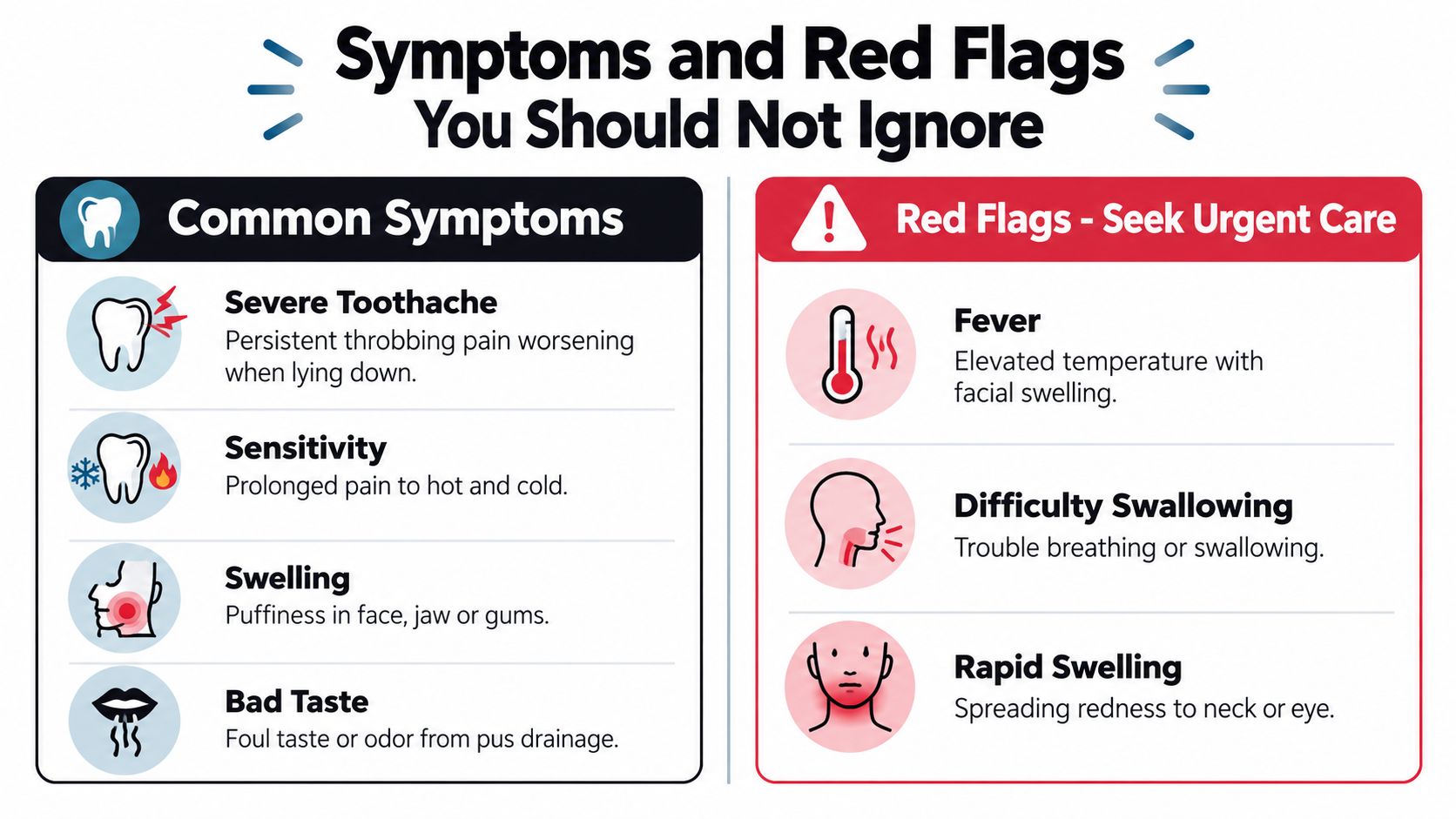
A severe abscess is classically identified by symptoms such as severe localized tooth pain, facial erythema, trismus, dysphagia, fever, and lymphadenopathy, and emergency escalation is recommended when swelling threatens swallowing or breathing, as outlined in StatPearls on dental infections.
Symptoms that fit a localized abscess
A routine abscess still needs prompt treatment, but it may remain limited to the tooth and nearby gum at first.
You may notice:
- Deep, localized tooth pain that you can point to with one finger
- Pain when pressing or chewing because pressure irritates the infected area
- Gum swelling near one tooth or a small bump that feels tender
- Bad taste or odor if fluid drains into the mouth
- Sensitivity that lingers after hot or cold
Here's why those symptoms happen. The pressure from pus irritates tissues and nerves. If the infection tracks toward the gum, you may see a swollen bump. If it partially drains, you may taste something unpleasant and think the problem “broke and healed.” It didn't.
This short video gives a helpful visual explanation of what patients often feel and notice:
Red flags that change the urgency
Some symptoms mean the infection may be extending beyond a straightforward dental problem.
The warning pattern gets more serious when you have:
- Fever, especially with swelling
- Trismus, meaning trouble opening your mouth
- Dysphagia, meaning trouble swallowing
- Rapid facial swelling or redness spreading outward
- Swelling under the jaw or in the floor of the mouth
- Breathing difficulty
Guidance from Choosing Wisely Canada's dental stewardship toolkit highlights under-jaw or floor-of-mouth swelling, difficulty swallowing, trismus, facial cellulitis, systemic illness, and concern for deeper infection as patterns that require urgent evaluation or admission because of airway risk. The same guidance notes that some patients, including those who are immunocompromised or have diabetes, may face higher complication risk.
If your symptoms suggest the nerve inside the tooth is involved, this plain-language review of root canal treatment may help you understand what your dentist is considering.
Routine Symptoms vs Emergency Red Flags
| Symptom Pattern | What It Suggests | Action Needed |
|---|---|---|
| Severe pain in one tooth, tender gum, no trouble swallowing | Localized infection still centered on the tooth or nearby gum | Same-day or next-available dental visit |
| Pain plus cheek or jaw swelling | Infection may be spreading into nearby tissues | Urgent dental evaluation |
| Fever with dental swelling | Systemic involvement | Urgent evaluation, often same day |
| Trouble opening the mouth | Deeper tissue irritation or spread | Urgent in-person assessment |
| Difficulty swallowing or swelling under the jaw | Airway-adjacent spread | Emergency medical care |
| Breathing difficulty with swelling | Possible airway threat | Immediate emergency care |
If swelling is moving toward your throat rather than staying around one tooth, think less about “toothache” and more about “urgent infection.”
How Dentists Diagnose a Dental Abscess
Many patients brace for the unknown when they come in with swelling. In reality, the diagnostic visit is usually methodical. The dentist is trying to answer three questions: Where is the infection, how far has it spread, and can the tooth be saved?

What happens during the exam
The appointment usually starts with your symptom story. Dentists want to know when the pain began, whether it wakes you up, whether biting hurts, and whether swelling is growing. Those details help separate a nerve problem, gum problem, cracked tooth, or active abscess.
Then comes the hands-on exam. Your dentist may:
- Look closely at the gum and tooth for swelling, redness, drainage, or decay
- Press gently on the area to see whether the pain is localized
- Tap the tooth because infected teeth are often sore to percussion
- Check temperature response when needed to learn whether the pulp is still reacting
- Probe around the gumline to look for a deep periodontal pocket
Each test gives a clue. A tooth that is very sore to tapping often points to inflammation around the root. A deep isolated pocket may suggest a periodontal source or a crack. A swollen gum area may be where the pressure is escaping, not where the original problem started.
Why X-rays matter
An abscess can hide below the gumline, so diagnosis isn't based on appearance alone. Dental imaging helps locate the source, assess the root area, and guide the treatment plan. If you've never had modern chairside imaging explained, this page on digital dental X-rays shows how dentists use them to see what the eye can't.
The visible swelling is sometimes only the tip of the iceberg. The source can be deeper, lower, or in a neighboring tooth.
What the dentist is ruling out
Not every severe toothache is an abscess. Dentists also consider a cracked tooth, inflamed pulp without pus, advanced gum disease, sinus-related pain, and post-procedure irritation. The reason the exam feels detailed is simple. Different causes can feel very similar to the patient, but they require very different treatment.
That precision matters. Draining the wrong area or prescribing medication without locating the source may buy time, but it doesn't solve the problem.
Definitive Treatment Options That Remove the Source of Infection
A dental abscess improves when the source is opened, cleaned, removed, or all three. The pressure you feel is like fluid building inside a closed space. Until that space is dealt with directly, the infection still has a place to live.
That is why the treatment path depends on where the infection started and how far it has spread. A small, localized abscess around a tooth and a rapidly spreading facial infection are not handled the same way. One may call for dental treatment in the office. The other may require urgent hospital-level care if swelling is affecting swallowing, the floor of the mouth, or breathing.
Why antibiotics alone usually do not solve it
Antibiotics travel through blood. An abscess is often a pocket of infection with poor circulation, dead tissue, or both. In plain terms, the medicine may reach the surrounding area better than the center of the problem.
The American Dental Association guideline on urgent management of pulpal and periapical dental pain and swelling supports definitive dental treatment first, with antibiotics used selectively for systemic involvement or higher-risk cases, as summarized in the ADA guideline publication.
So if the infection is trapped inside a dead nerve space, sealed at the root tip, or collected under the gum, antibiotics may calm the edges without removing the cause. That is why repeated antibiotic courses often lead to a short lull, then another flare.
The three main treatment paths
Incision and drainage
When pus has collected in soft tissue, drainage releases pressure and lowers the bacterial load. Patients often feel relief because the painful tension drops once that trapped fluid has a way out.
Drainage treats the pressure problem. It does not always treat the source problem.
If the original cause is an infected tooth or a deep periodontal pocket, that source still needs its own treatment or the swelling can return.
Root canal treatment
If the infection began inside the pulp and root canal system, the tooth can often be saved by cleaning the infected internal space, disinfecting it, and sealing it. This is the right path when the tooth is still restorable and the support around it is good enough to keep it functioning.
A patient-friendly explanation of root canal treatment and when dentists recommend it can help if you are trying to picture what that process involves.
Root canal treatment fits a common symptom cluster. Deep tooth pain, pain with biting, sensitivity history, and a dark or heavily restored tooth often point toward an infection that started inside the tooth rather than only in the gum tissue.
Extraction
Sometimes the better answer is removal. A tooth with a severe crack, extensive decay below the gumline, or major loss of supporting bone may not be predictable to save.
In that setting, extraction removes the reservoir feeding the infection. It is a direct treatment choice, not a lesser one. The goal is to stop the infection safely and give the area a chance to heal.
Matching the symptom pattern to the treatment path
Localized swelling next to a salvageable tooth often leads to root canal treatment, sometimes with drainage if pressure has built up in nearby tissue.
A gum boil or fluctuant soft-tissue swelling may need incision and drainage, but the dentist still has to trace it back to the infected tooth or periodontal site.
A tooth that cannot be restored usually points to extraction because keeping a badly damaged shell in place leaves the source behind.
Then there is the red-flag group. Diffuse swelling, fever, malaise, trouble swallowing, voice changes, limited mouth opening, swelling spreading into the cheek or under the jaw, or any sign that breathing could become harder changes the urgency. Those cases may need antibiotics as support, but they also need rapid definitive care and sometimes emergency evaluation because the concern is no longer just tooth pain. It is spread through facial spaces, where delay becomes risk.
When antibiotics are appropriate
Antibiotics have a role when the infection is spreading, when there are systemic signs, or when a patient has added medical risk. They support care. They do not replace opening, cleaning, draining, or removing the source.
That distinction matters because symptom relief can be misleading. A quieter tooth after antibiotics does not always mean the infection is gone. It may only mean the pressure and inflammation have dipped for the moment while the original problem remains in place.
Immediate First Aid While You Wait for Dental Care
The safest plan is to shorten the wait as much as possible. Still, there's often a stretch between noticing symptoms and sitting in the chair. What you do during that stretch can either calm things down or make them worse.
What you can do safely
A few simple steps can reduce discomfort while you arrange care:
- Use a cold compress on the outside of the face if swelling is present. Cold can help with comfort.
- Keep your head raised, especially at night. Lying flat can make pressure feel worse.
- Rinse gently with warm salt water if it feels soothing. Gentle is the key word.
- Use over-the-counter pain relievers as directed on the label if they're appropriate for you.
- Eat on the other side and choose softer foods until you're seen.
These steps don't cure the abscess. They just buy safer time.
What not to do
Some home fixes create real problems.
- Don't try to pop or drain it yourself. You can push bacteria deeper or injure the tissue.
- Don't put aspirin directly on the gum. It can irritate or burn the tissue.
- Don't start leftover antibiotics. The wrong drug, wrong dose, or partial course can muddy the picture without fixing the source.
- Don't apply heat to a swelling that seems to be spreading. Heat can feel comforting, but it's not the move for a facial infection that's enlarging.
If swelling is increasing by the hour, home care has reached its limit.
What to bring and how to get help faster
Bring a list of medications, allergies, and medical conditions. If you've had recent dental work or prior swelling in the same area, mention that early. If the office offers teledentistry, it can help determine whether you need immediate chairside treatment or emergency department care.
For a tooth that may not be savable or needs urgent surgical assessment, an emergency visit focused on tooth extraction and urgent evaluation can be one appropriate route among others, depending on the exam findings.
If you're in Midtown and need same-day assessment, practices such as Paul L. Gregory, DDS can evaluate pain, swelling, and whether the next step is drainage, root canal therapy, extraction, or hospital referral.
Healing Prevention and When to Seek Emergency Care Again
After proper treatment, the pressure starts to settle first. Then the soreness eases more gradually. That's a good sequence. Relief doesn't always mean the area is fully healed, so follow-up still matters.
What normal recovery tends to look like
You may have tenderness for a bit after drainage, root canal treatment, or extraction. Biting can stay sensitive while inflamed tissues calm down. If your dentist planned a crown after root canal therapy, finishing that step matters because the tooth still needs long-term protection.
Good recovery usually means symptoms are moving in the right direction, not bouncing back.
When to call again right away
Contact your dentist promptly if:
- Swelling returns or enlarges
- Pain worsens instead of easing
- You develop trouble swallowing
- You notice new facial redness or firmness
- You feel generally ill after seeming to improve
If you develop breathing difficulty, can't swallow your saliva, or the swelling is pushing into the floor of the mouth or neck, skip the wait-and-see approach and get emergency care.
Preventing the next abscess
Prevention is rarely dramatic. It's mostly about catching smaller problems before bacteria gain access. Regular exams, cleanings, imaging when needed, and early treatment of decay, cracks, and gum disease do the quiet work. Daily brushing and cleaning between the teeth matter because they lower the chance that small defects become deeper infections.
For many Manhattan families and professionals, the best dental home is the one that can handle both the routine maintenance and the occasional urgent surprise without losing continuity.
If you're dealing with swelling, deep tooth pain, or a possible abscess, Paul L. Gregory, DDS provides emergency dental assessment, modern diagnostics, and definitive treatment options such as drainage, root canal care, and extraction planning in Midtown Manhattan. The office also supports longer-term follow-up, so treatment doesn't stop at pain relief.