

A dental bridge is a fixed prosthetic that anchors an artificial tooth, called a pontic, to nearby teeth or implants, replacing one or more missing teeth without removing the appliance. Bridges have a long clinical history, using materials such as porcelain, porcelain-fused-to-metal, zirconia, and gold alloy, and one recent fixed-prosthesis dataset reported zirconia in 76.88% of all prosthetic elements and metal-ceramic restorations in 16%. Material and outcomes research on fixed dental prostheses
You may be asking because a tooth recently cracked, an old crown came loose, or a gap has become harder to ignore in photographs. In a Midtown dental chair, the useful question isn't, “Can this space be filled?” It's, “What kind of support will replace the tooth, protect the bite, and make sense for the teeth and bone you have today?”
When a Missing Tooth Changes Everything
A patient may notice the problem during an ordinary Manhattan day. A molar cracks while biting into lunch near Bryant Park, or a colleague spots a gap during a client meeting. Appearance often brings the concern to the surface, yet the missing tooth can also change how the mouth functions.
Neighboring teeth may drift into the open space, while the opposing tooth can move farther into it. That movement may alter how the upper and lower teeth meet. The jawbone around the former socket also no longer receives the same stimulation from a tooth root, so the ridge can gradually change shape. Some patients chew less comfortably. Others shift food to one side repeatedly and develop muscle fatigue or jaw discomfort.
A dental bridge provides a fixed, non-removable replacement for one or more missing teeth. It remains in place while you speak and chew, unlike a removable partial denture. Depending on the design, it may be supported by natural teeth, implants, or bonded wings attached to neighboring teeth. The gap's length, the condition of the supporting teeth, the bite, and the available bone all affect that choice.
The important distinction: a bridge isn't one universal appliance. It's a family of designs that solve different support problems.
Why the gap deserves an examination
Fixed restorations, including crowns and bridges, have been used across adult European populations, with the reviewed studies reporting different levels of use in Denmark, Switzerland, and Sweden. Review of fixed restorations and restorative materials
Those figures show that fixed restorations are established treatments. At a consultation, the dentist must determine whether the proposed supports can handle the work. The examination includes checking for decay, gum support, cracks, root shape, bite pressure, and the condition of the neighboring teeth.
The decision is therefore mechanical as well as cosmetic. A healthy tooth on each side of a short gap may support a traditional bridge. If neighboring teeth are sound and the bone can support an implant, an implant-supported design may avoid preparing those teeth. A single front-tooth gap may suit a conservative resin-bonded bridge. The four main designs differ because each responds to a different support problem, which is why a Midtown consultation should focus on the gap and its supporting structures, not only on how the replacement will look.
How a Dental Bridge Actually Works
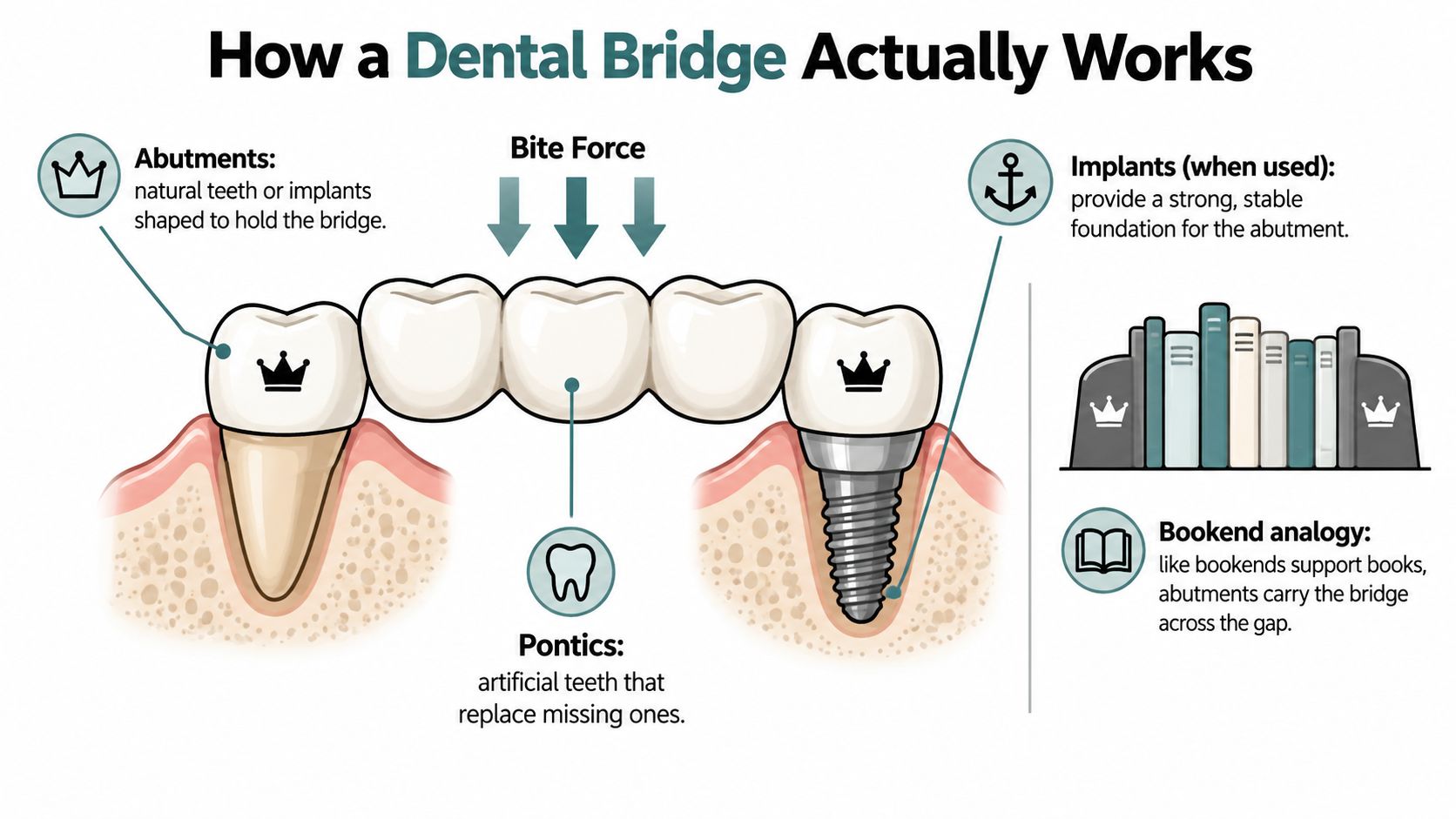
Think of a bridge as a custom row of books held between two sturdy bookends. The abutments are the supports at either end. The pontic is the artificial tooth, or teeth, occupying the empty space. Together, the pieces form one fixed restoration that a patient doesn't remove at night.
With a traditional bridge, the dentist prepares the abutment teeth so they can receive crown-like coverings. Those crowns connect to the pontic in one solid unit. The abutments carry the chewing load, while the pontic sits above the gum ridge and restores the visible shape of the missing tooth.
The three parts to identify
Abutments can be natural teeth or dental implants. Natural abutments may already need crowns because of fillings, fractures, or extensive wear. Implant abutments use implant fixtures as the foundation instead of reducing neighboring natural enamel.
Pontics replace the missing teeth. A back-tooth pontic is designed to tolerate chewing and to allow cleaning beneath it. A front-tooth pontic is shaped with close attention to emergence, contact points, and the gum line so it looks natural when you smile.
The connector joins the pontic to its support. In a traditional fixed bridge, the connector is part of the single manufactured restoration. In a Maryland bridge, thin wings provide the attachment instead of full crowns.
The materials can vary. Porcelain-fused-to-metal combines a tooth-colored outer surface with a metal substructure. Zirconia is an all-ceramic material used in modern fixed prostheses, while metal alloys may be selected when strength and limited space matter. The best material depends on location, bite, aesthetics, clearance, and the design of the bridge.
A bridge restores the crown portion of the missing tooth, but it doesn't recreate a natural root beneath the pontic. Chewing forces pass through the supports rather than directly through the gum ridge under the replacement tooth. That difference explains why bridge planning must focus so closely on the strength and position of the abutments. If you're comparing a bridge with an individual crown, review how crowns for teeth differ in purpose and support.
The Four Main Types of Dental Bridges
A bridge can look like one replacement tooth, but its support system changes from design to design. The right choice depends on the gap, the condition of nearby teeth, your bite, and how much healthy enamel should remain.
| Bridge Type | Anchor | Best For | Main Trade-off |
|---|---|---|---|
| Traditional fixed | Crowns on natural teeth at both ends | A short gap with strong or already restored neighboring teeth | Requires preparation of the abutment teeth |
| Cantilever | One natural-tooth abutment on one side | Selected single-tooth gaps with favorable bite forces | Concentrates force on a single support |
| Maryland, or resin-bonded | Thin metal or ceramic wings bonded behind neighboring teeth | Conservative replacement of a single front tooth | Debonding and minor chipping can occur |
| Implant-supported | One or more dental implants | Healthy neighboring teeth or a longer span of missing teeth | Requires implant treatment and suitable bone |
Traditional bridges
A traditional fixed bridge places crowns on both sides of the gap, with the replacement tooth suspended between them. It may be practical when neighboring teeth already contain large restorations, since reshaping them can also provide added structural coverage. A healthy abutment, however, may still require substantial preparation to receive a crown.
Cantilever bridges
A cantilever bridge attaches to only one side. It can work in selected areas when the bite does not place excessive pressure on that single support. Since chewing force travels through one anchor, the dentist must assess the tooth's position, its strength, the opposing teeth, and the direction of the bite before recommending this design.
Maryland bridges
A Maryland, or resin-bonded, bridge uses thin wings attached to the backs of adjacent teeth. This approach generally preserves more enamel than a full-coverage bridge and may suit a front-tooth gap when conservative treatment and appearance are priorities. The clinical literature reports 91.4% survival at five years and 82.9% at ten years for resin-bonded fixed dental prostheses. Debonding and minor chipping are among the reported technical complications. Meta-analysis of resin-bonded fixed dental prostheses
Implant-supported bridges
An implant-supported bridge attaches to dental implants instead of neighboring natural teeth. That arrangement can leave intact adjacent teeth untouched and support a longer span, but it involves surgery, healing, and evaluation of the available bone.
The practical comparison is straightforward: intact neighbors and suitable bone may favor implant support; heavily restored neighbors may favor a traditional bridge; a carefully selected front-tooth gap may suit Maryland; and a single-sided back-tooth design may suit a cantilever. These are starting points, not automatic prescriptions. A consultation covering restorative and cosmetic dentistry options should also address cleaning access, expected forces, and what would happen if the supporting tooth or implant later needed treatment.
What Happens During Treatment Step by Step
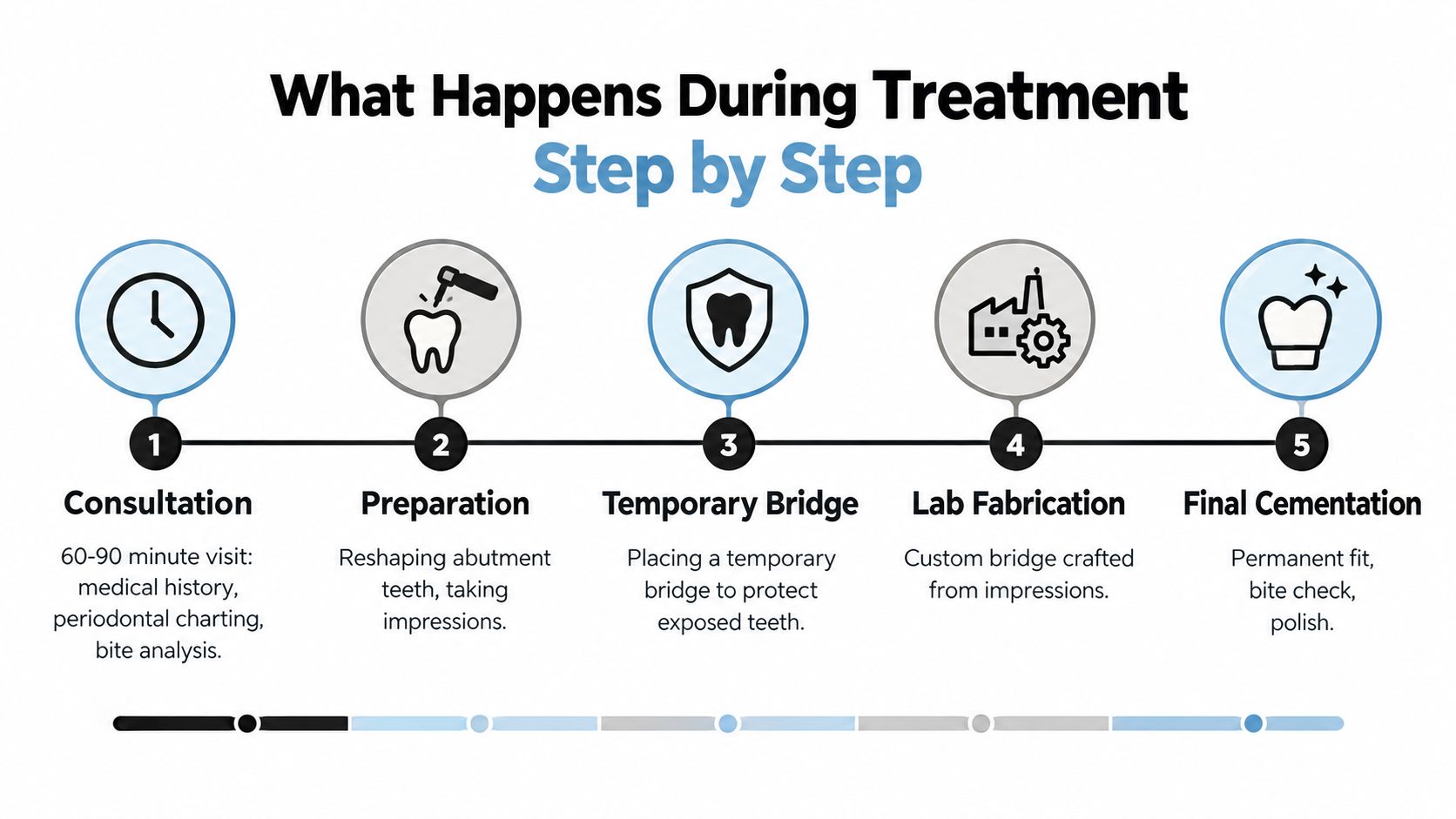
Bridge treatment is a connected process, not just a single appointment where a replacement tooth is cemented. The dentist first determines whether the proposed supports can carry the restoration, then designs the bridge around your bite, appearance, and cleaning needs.
The diagnostic visit
The first visit may include a medical history review, periodontal charting, bite analysis, photographs, and digital imaging. A digital scan can capture the teeth and the space without conventional impression material. When the roots or bone need closer evaluation, the dentist may recommend three-dimensional imaging.
The dentist then explains which teeth or implants will serve as abutments and whether the proposed design is traditional, cantilever, Maryland, or implant-supported. This is the appointment to ask how much healthy tooth structure will be removed and how the bridge will be cleaned.
Preparation and the temporary
For a traditional bridge, the dentist reshapes the abutment teeth under local anesthetic. A temporary bridge protects the prepared teeth and helps maintain the planned bite while the laboratory or office milling system fabricates the final restoration.
The final bridge is tried in before placement. The dentist checks the shade, contours, contacts, margins, and bite. Articulating paper can show where the teeth meet, while you can comment on the shape, speaking comfort, and appearance.
The dentist then isolates the area, places the restoration with the selected cement or bonding system, removes excess material, and checks the bite again. Mild sensitivity can occur after preparation, but persistent pain, a high bite, or a loose temporary deserves a call rather than silent waiting. For a closer look at the diagnostic role of imaging, see this guide to digital X-rays for teeth.
A short review after placement lets the dentist assess the gum response and confirm that your hygiene technique works around the pontic.
Bridges Compared With Dental Implants
A missing tooth can be replaced with a bridge or an implant, but the two options manage chewing forces in different ways. The better choice depends on the condition of the neighboring teeth, the bone, the bite, and the treatment steps you can reasonably undertake.
A systematic review found very similar annual prosthesis survival for implant-supported three-unit fixed partial dentures and tooth-supported three-unit bridges, 97.4% versus 96.4%. It also found similarly low complication rates, while reporting limited information about soft-tissue and hard-tissue outcomes and patient-reported measures. Systematic review comparing implant-supported and tooth-supported fixed partial dentures
Other evidence produces a different comparison. A Canadian health technology review reported six-year implant success and survival of 95% and 97%, compared with 80% and 82% for bridges in one evidence set. Those figures do not establish a universal winner. Results vary with anatomy, restoration design, support quality, and the way success is defined.
| Factor | Dental Bridge | Dental Implant |
|---|---|---|
| Support | Natural teeth, bonded wings, or implants | Implant fixture placed in bone |
| Effect on neighboring teeth | Traditional designs require preparation | Adjacent teeth can remain untouched |
| Surgery | Usually avoids implant surgery | Requires surgical placement and healing |
| Bone considerations | Can often span a gap without replacing the root | Requires adequate bone or additional site development |
| Timeline | Often follows a restoration-focused sequence | Includes surgical and bone-healing stages |
| Main concern | Abutment decay, overload, or technical complications | Surgical risk, integration, prosthetic maintenance, and bone conditions |
The anatomy changes the answer
A tooth-supported bridge may fit well when neighboring teeth already need crowns or have large restorations. Preparing those teeth can provide needed coverage while the connected restoration replaces the missing tooth.
An implant can be attractive when the adjacent teeth are intact and strong. It avoids reducing intact neighboring teeth to serve as supports. The assessment still includes bone volume, gum health, bite, and overall medical factors. See this overview of the dental implants procedure for what surgical placement and healing involve.
Tooth-implant connections require particular caution because natural teeth and implants respond differently under load. A 2024 review reported five-year survival of 77% to 84% and ten-year survival of 72% for tooth-implant connections. Long-term evidence on tooth-implant fixed dental prostheses
At a Midtown consultation, ask, “Which support design creates the most favorable forces for my teeth, bone, and bite?” That question leads to a more useful discussion than asking which option lasts longer in the abstract.
Caring for a Bridge So It Lasts
A fixed bridge still needs daily cleaning on every surface, including the area you can't see beneath the pontic. Food and plaque can collect there, around the connectors, and along the gum line. The restoration may be fixed, but the supporting teeth remain vulnerable to decay and gum inflammation.
Build cleaning into your routine
Use a floss threader, super floss, or a water flosser to clean beneath the pontic. An appropriately sized interdental brush can clean the spaces near the connectors, while a soft-bristled toothbrush reaches the outer surfaces. Fluoride toothpaste helps protect exposed tooth structure, and a low-abrasion formula is sensible when ceramic surfaces need regular brushing.
A hygienist can demonstrate the correct angle instead of assuming that ordinary floss will pass beneath the bridge. If the contact is too tight or the pontic sits too close to the tissue, the dentist may need to adjust the restoration or recommend a different cleaning aid.
Protect the restoration from concentrated force
Avoid chewing ice, biting thread, tearing packaging, or using the bridge as a tool. Hard, sticky foods can loosen a restoration or damage the cement layer, particularly when the bridge already has a compromised support.
Patients who clench or grind may benefit from a custom night guard. A guard won't repair an overloaded abutment, but it can reduce direct contact and help protect ceramic and natural teeth during sleep.
Call the office promptly if the bridge rocks, the gum becomes red, you notice a persistent bad taste, or biting produces new sensitivity.
Professional hygiene visits allow the team to inspect the abutments, margins, gum tissue, contacts, and bite. Ask for a personal maintenance interval rather than assuming every bridge follows the same schedule. Guidance on caring for the supporting crown can also help, especially if your bridge includes full-coverage abutments. Tooth crown after-care guidance
Long-term bridge performance depends on the condition of the supports, the fit, your bite, and the care routine you can maintain consistently. A survival result in a study doesn't mean a bridge will remain free of every repair or adjustment, so report small changes before they become larger problems.
Midtown Costs, Insurance, and Your Next Step
A bridge fee depends on what your examination finds. The plan may include diagnostic records, treatment for decay or gum disease, preparation of the abutment teeth, a temporary restoration, laboratory fabrication, and final placement. An implant-supported bridge may also involve surgery, implant components, healing evaluations, or bone and gum treatment.
Insurance often classifies bridges as major restorative care, but each contract handles coverage differently. Missing-tooth clauses, deductibles, waiting periods, replacement rules, and annual maximums can change your share. Ask the insurer and dental office to review the estimate together. A pre-treatment estimate gives you a clearer idea of your expected payment before tooth preparation begins.
| Bridge Type | Fee Drivers | Insurance Category | Average Lifespan |
|---|---|---|---|
| Traditional fixed | Materials, abutment preparation, laboratory work, and the number of supporting teeth | Often major restorative care | Depends on support, bite, material, and maintenance |
| Cantilever | Design, abutment requirements, and the forces placed on the bridge | Often major restorative care | Depends heavily on force and case selection |
| Maryland, resin-bonded | Conservative tooth preparation, design, and laboratory work | Coverage varies by plan | Evidence reports strong survival over time, as noted earlier |
| Implant-supported | Implant surgery, components, bridge fabrication, and any bone or gum treatment | Implant and prosthetic coverage may differ | Depends on implant health, prosthesis, bite, and maintenance |
The meaningful comparison extends beyond the starting fee. Ask how much natural tooth preparation each option requires, whether a future repair could affect neighboring teeth, how many visits fit your schedule, and whether the support remains practical if another tooth later needs treatment. The four designs work differently, so cost should be considered alongside mechanics and long-term maintenance.
Bring this question to your Midtown consultation: “Can you show me the traditional, resin-bonded, cantilever, and implant-supported options for my specific gap, and explain what would make each one fail?”
Paul L. Gregory, DDS provides restorative planning for bridges, crowns, and implant-supported tooth replacement. Clinical examination, digital imaging, and intraoral scanning can help evaluate which design fits your teeth, bite, schedule, and long-term goals. Visit Paul L. Gregory, DDS to request a Midtown consultation.