

You're probably reading this with one hand on your jaw and the other on your phone, trying to decide whether this is a middle-of-the-night problem or a true same-day dental emergency. If you typed emergency tooth extraction near me, you're likely past the point of hoping it settles on its own, and what matters now is getting the right care fast, without wasting time in the wrong place.
A tooth can hurt badly for reasons that don't all lead to extraction, but some problems do move there quickly. The practical question is simple. Is this a tooth that needs to be evaluated, stabilized, and maybe removed today, or is it something a dentist can treat another way once you're seen?
Recognizing When You Need an Emergency Extraction
A molar that starts throbbing at 2 a.m. can make every option feel urgent. The cleanest way to think about it is the same way a dentist does, by separating pain, infection, and trauma. A tooth that is just sensitive after cold drinks is not the same as one that is cracked, loose after an accident, or surrounded by swelling that keeps growing.
Symptoms that push this into true same-day care
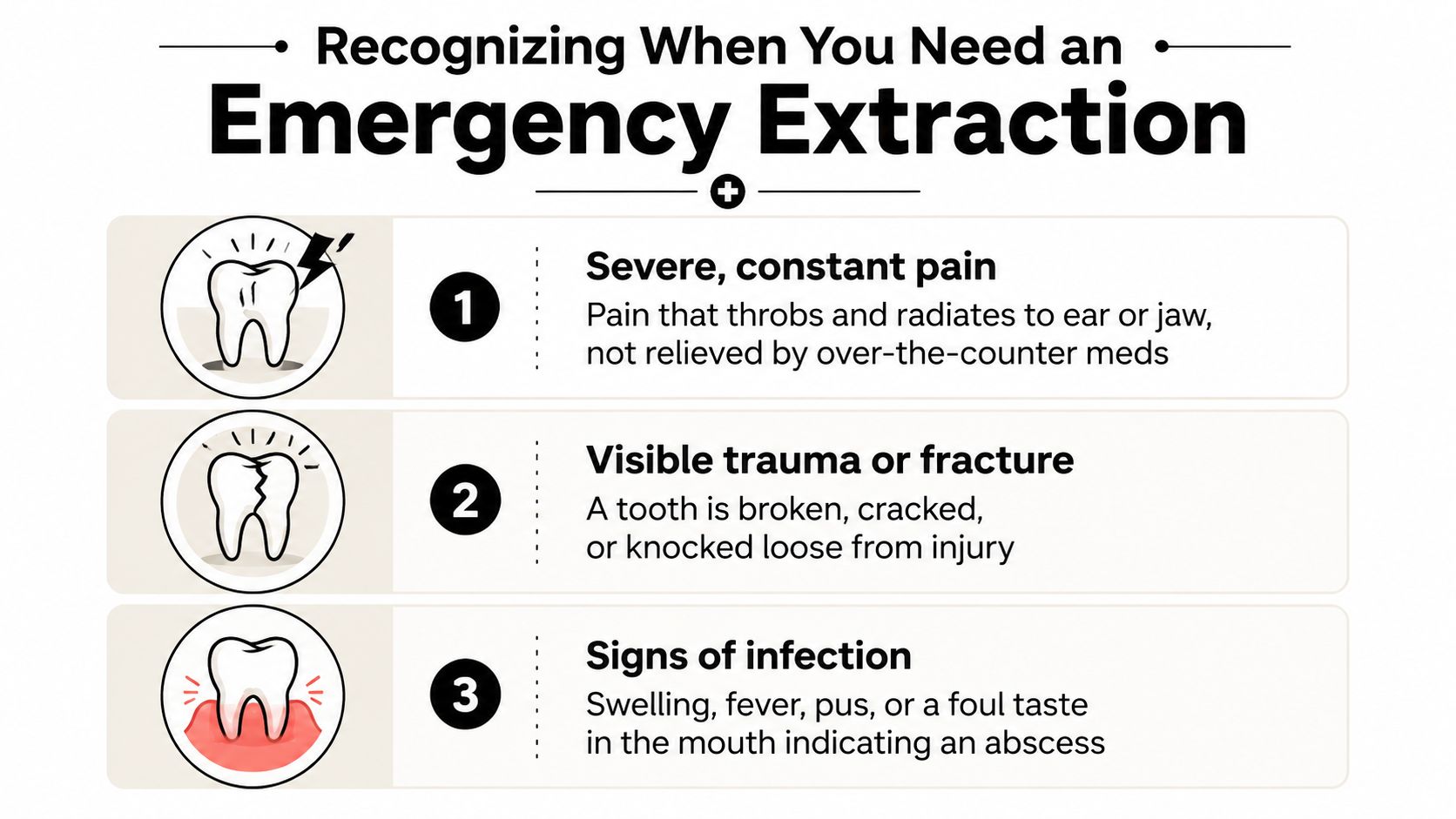
If the pain is constant, radiates to the ear or jaw, and doesn't back off with over-the-counter medicine, that deserves prompt evaluation. If there's facial swelling, pus, a foul taste, or fever along with localized pain, infection is no longer a wait-and-see issue. Trauma matters too, especially if the tooth is mobile, visibly displaced, or fractured down below the gumline.
Practical rule: If swallowing, breathing, or opening your mouth is getting harder, skip the search and seek urgent medical attention right away.
There's also a gray zone where the tooth may not be an absolute extraction emergency, but extraction could still be the fastest route to relief. That includes a tooth that's so broken down it can't be predictably restored, or a tooth that's repeatedly flaring despite past treatment. The point is not to self-diagnose the exact procedure, it's to describe the situation clearly when you call.
What to tell the office when you call
Keep it short and concrete. Say whether the tooth is swollen, loose, fractured, draining, or causing pain that wakes you up. If you had trauma, say so immediately. If you're calling after hours, mention whether you can swallow normally and whether the swelling is changing quickly.
That wording helps the front desk sort you into the right time slot faster. It also keeps you from being bounced between general advice and a vague “we'll see you next week” response when your symptoms really do need a chair today.
Immediate Self-Care Before Your Appointment
Once you've made the call, the goal is to reduce pain and protect the tooth without making the problem messier. The basics are simple, but the details matter. For dental pain, ibuprofen and acetaminophen are commonly used together, and the key is to take them only as directed on the label or by your dentist. Don't put aspirin directly on the gum, because that can irritate tissue and increase bleeding.
What helps right away
A cold compress on the outside of the cheek can calm swelling and make the area feel less hot and tight. Use it in short intervals, then give the skin a break. A gentle saltwater rinse can help keep the mouth cleaner around the sore tooth, but don't swish aggressively.
Eat softly, drink water, and avoid chewing on that side. If the tooth is partly broken or hanging loose, leave it alone and don't probe it with a finger, toothpick, or floss. The less you disturb the area, the less likely you are to trigger more bleeding or push bacteria deeper.
What not to do
Do not try to pull the tooth yourself. Don't use sharp tools, pliers, or improvised “home extraction” methods. If a tooth is cracked or dislodged, this is not the time for experimentation.
For a broken-tooth situation, this guide on what to do next is a useful companion read while you wait for your appointment. If you're trying to sleep, prop your head up so blood pressure in the area stays lower and throbbing is less intense. If you've ever used clove oil, be careful with it, because overuse can burn soft tissue.
What Happens During an Emergency Tooth Extraction
A rushed appointment still has a sequence. The dentist first confirms whether the tooth can be saved or whether removal is the more reliable choice, and that decision is usually based on the exam and radiographs. Digital X-rays are often what make the difference between guessing and seeing the root shape, surrounding bone, and nearby structures clearly, which is why the imaging step matters so much in urgent cases. This overview of digital X-rays for teeth is useful if you want to understand why that image is taken before anything starts.
The clinical workflow in plain language
A simple emergency extraction usually follows a staged process. The dentist reviews the film, explains what's going on, gives consent, and numbs the area with the right anesthetic technique for that tooth. For many lower molars, that means an inferior alveolar nerve block. For many upper teeth, it's more often a supraperiosteal infiltration.
Practical rule: If numbness isn't complete, say so before the dentist starts. Inadequate anesthesia is one of the fastest ways to make an urgent visit feel worse than it should.
Once the area is numb, the dentist protects the airway with gauze, loosens the tooth with an elevator, and removes it with forceps if the anatomy allows. If the root fractures or the tooth is more complex, the procedure can shift to a surgical approach. After removal, the socket is cleaned if needed, then gauze pressure is used to help stop bleeding.
Why the setting and technique matter
The difference between a smooth extraction and a frustrating one often comes down to imaging, numbness, and experience. In large observational studies, simple tooth extraction had 90 complications in 8,455 extractions, or 1.06%, with higher rates in peripheral centers than tertiary centers, 2.3% vs 0.84% (source). More complex extractions, including third molars, carry more risk, so case selection really does affect outcomes.
The sounds are usually more dramatic than the sensation. Pressure, cracking, and tugging are normal. Sharp pain is not, and that's why the anesthetic check matters before the dentist continues.
Finding Same-Day Dental Care Near You
The phrase “near me” sounds like a geography problem, but in dentistry it's mostly an access problem. A hospital can calm pain, look for infection, and keep you safe, but it usually can't offer definitive extraction on the spot. Urgent care clinics often have the same limitation, because they may not have dental instruments, imaging, or a dentist who can remove the tooth that day.
Comparing the main options
| Care Setting | Can Perform Extraction | Average Wait Time | Typical Cost Range | Best For |
|---|---|---|---|---|
| Hospital ER | Usually no | Varies by volume | Higher, often includes medical evaluation | Swelling, fever, airway concerns, severe trauma |
| Urgent care clinic | Usually no | Often quicker than ER | Varies | Pain control, initial triage, general medical review |
| Dedicated dental office | Yes, when the tooth can't be saved | Same-day when available | Depends on the procedure and insurance | Definitive extraction, imaging, dental follow-up |
The ADA notes that ED dental visits average $749 when not hospitalized, about three times the cost of a dentist visit, with annual costs around $1.6 billion (ADA emergency department referrals). That doesn't mean the ER is wrong, it means it's often the wrong final stop if the fix is a dental procedure.
How to call so you get to the right chair
Say “I have swelling and severe tooth pain, and I need to know if you can extract today.” That question is sharper than “Do you take emergencies?” because it asks about the exact service you need. Ask whether the office has X-ray capability, whether the dentist does extractions in-house, and whether they reserve urgent slots.
For Manhattan patients, Paul L. Gregory, DDS emergency dentistry is one example of a practice that offers short-notice assessment and extraction when the tooth can't be saved. That kind of setup matters because the visit ends with treatment, not just another referral.
Recovery and Post-Extraction Care Essentials
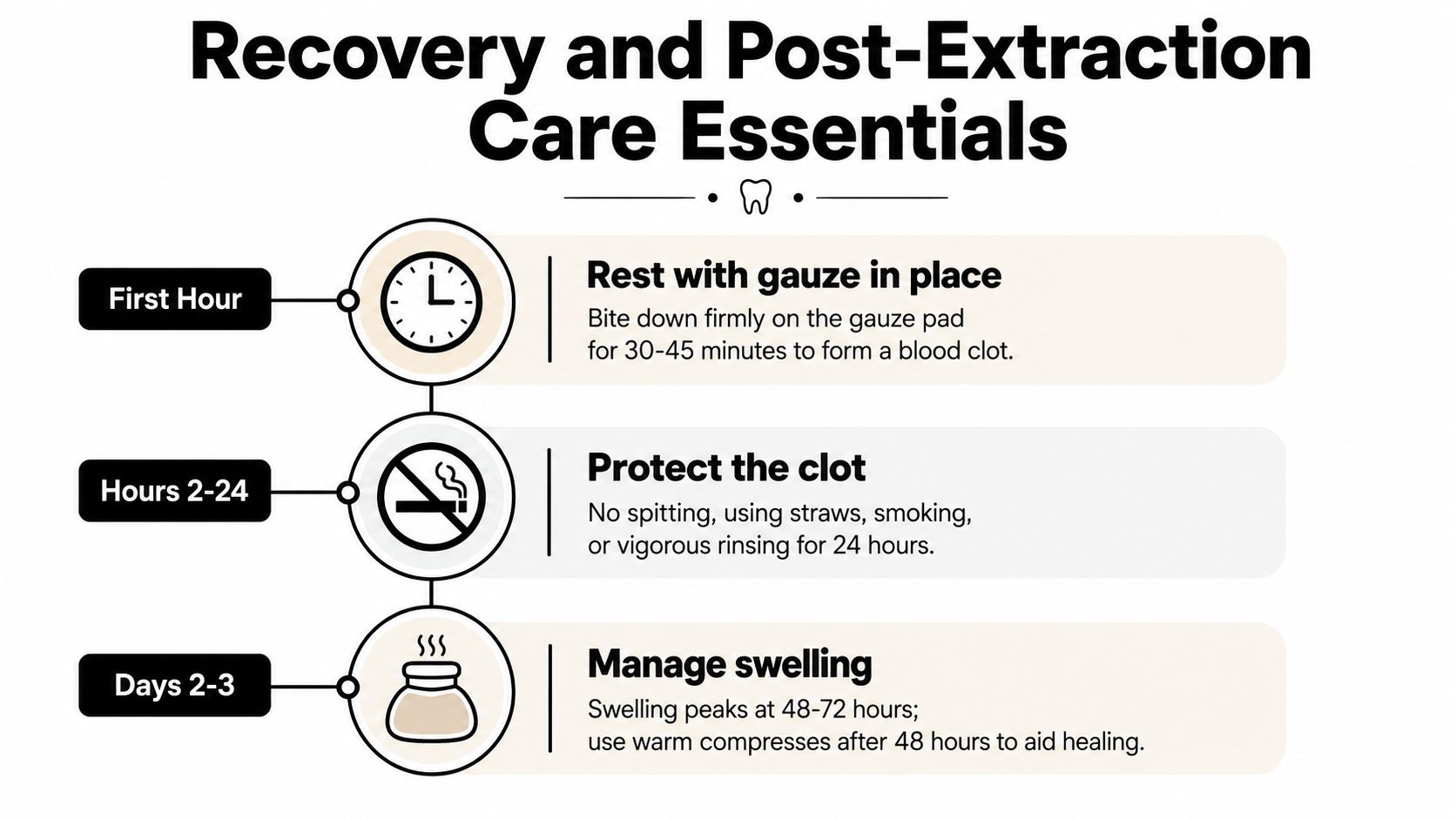
The extraction ends in the office, but healing starts at home. The first hour is about building a stable clot, because that clot is what protects the socket. Bite on the gauze firmly, stay quiet, and don't keep checking the site every few minutes.
The first day matters most
For the first 24 hours, protect the clot. That means no spitting, no straws, no smoking, and no aggressive rinsing. If you disturb the clot, you raise the risk of dry socket, which is one of the most painful post-extraction problems.
Use cold packs early if swelling is building, then switch to warmth after the first couple of days if your dentist tells you to. Eat soft foods that don't require much chewing, and avoid hot, crunchy, or spicy meals that irritate the area. Sleep with your head propped up so the socket throbs less overnight.
Red flags after you go home
A little bleeding is normal early on. Persistent bleeding that soaks gauze for hours, swelling that gets worse after the initial days, fever, or a foul taste should trigger a call back to the dentist. Those symptoms can point to infection or a clot problem that needs a closer look.
The most common recovery mistakes are simple. People spit, suck through straws, or smoke because they forget the socket is still open.
If you want a broader look at what comes next after tooth removal, this explainer on implant healing gives context for longer-term planning after extraction.
Preventing Future Dental Emergencies
Most emergency extractions don't arrive out of nowhere. They're usually the final stop after decay, cracks, or repeated infection have been building for a while. The useful habit is to catch trouble when it still looks like a repairable tooth, not a midnight crisis.
Build a plan before the next flare-up
If you've had one urgent episode, line up a practice that can see urgent cases before the next one hits. Keep a small home kit with gauze, temporary filling material, and dental wax if you're prone to broken fillings or sharp edges. Know what your insurance tends to cover for urgent visits so you're not trying to decode benefits while you're in pain.
Routine visits still matter because they catch problems before they become extraction-level problems. A regular dental cleaning can surface decay, gum changes, or cracks early enough that you have treatment choices instead of just one choice.
What to watch for over time
Recurring abscesses are a warning sign. So are teeth that keep cracking, biting pain that never quite settles, and radiographs that show a tooth losing support. Those are the moments when a planned extraction or root canal is usually easier than waiting for the tooth to fail in a more dramatic way.
If you're trying to stay ahead of the next emergency, don't wait until you're at the mercy of a search result. Build a relationship with a dentist who can triage quickly, stabilize pain, and tell you when a tooth is no longer worth saving.
Paul L. Gregory, DDS provides urgent dental assessment, digital diagnostics, and extraction when a tooth can't be saved, which is exactly the kind of support an anxious patient needs when pain doesn't have time to wait. If you're dealing with a toothache, swelling, or a broken tooth and want a calm, practical plan, visit Paul L. Gregory, DDS to get started.