

In most U.S. states, dental hygienists don't place fillings, but a small number of states and Canadian provinces allow it under specific supervision and training. The answer is jurisdictional, so the same procedure may be legal for a qualified hygienist in one place and outside that professional's scope in another.
So why can a hygienist remove plaque, examine your gums, take X-rays, and discuss a suspicious area, while a dentist handles the drill and filling? The confusion comes from treating “dental care” as one job. In practice, dental teams divide care into prevention, diagnosis, treatment planning, and restoration, and licensing rules assign those tasks differently.
The word filling also gets used loosely. A patient might use it to describe a sealant, a temporary dressing, a restoration started by a dentist, or a definitive composite or amalgam filling. Those procedures aren't interchangeable under dental practice acts.
This guide shows you how to understand the distinction, compare the major regulatory models, and read your own state's rules without relying on a simple yes-or-no list.
Why the Filling Question Is More Complicated Than It Sounds
A routine hygiene appointment can feel thorough. The hygienist may review your health history, take radiographs, chart your teeth, measure gum pockets, remove calculus, polish enamel, apply fluoride, and point out an area that needs the dentist's attention. From a patient's perspective, it's reasonable to ask why the same person can identify a problem but not repair it.
The answer is scope of practice. A license doesn't authorize every task a clinician may have seen or practiced during training. It defines which procedures that professional can legally perform, under what supervision, and sometimes with what additional credential.
A filling usually involves more than placing material into a tooth. The clinician may need to confirm that decay exists, determine whether the tooth can be restored, administer anesthesia, remove diseased tooth structure, shape the cavity, protect the pulp, place the restorative material, and adjust the bite. A state board may reserve some or all of those steps for a dentist.
Practical rule: Ask who is legally authorized to perform each step, not simply whether someone has handled filling material before.
The same distinction matters when you're researching treatment costs. A page about how much a filling costs may describe the complete restorative appointment, while your hygienist's role may be limited to detection, prevention, and follow-up care.
There's another common mix-up. Dental hygienists and dental therapists aren't the same profession. A therapist may have restorative training and legal authority to place fillings, while a hygienist in the same country or state may remain focused on prevention and periodontal care. The reliable method is to identify your professional category, locate your state or national regulator, and read the exact rule for diagnosis, tooth preparation, and restoration.
What Dental Hygienists Are Actually Trained and Licensed to Do
Dental hygiene is organized around prevention and maintenance. The hygienist's work helps control plaque, calculus, gum inflammation, and other conditions that can make future dental treatment more likely. Typical responsibilities can include periodontal probing, scaling, root planing, fluoride application, sealant placement, oral hygiene instruction, charting, and radiographs within the applicable supervision framework.
These tasks don't make the hygienist a junior dentist. They represent a distinct clinical role. A hygienist evaluates gum health, removes deposits that patients can't safely remove at home, teaches techniques for brushing and interdental cleaning, and alerts the dentist when a finding needs diagnosis.
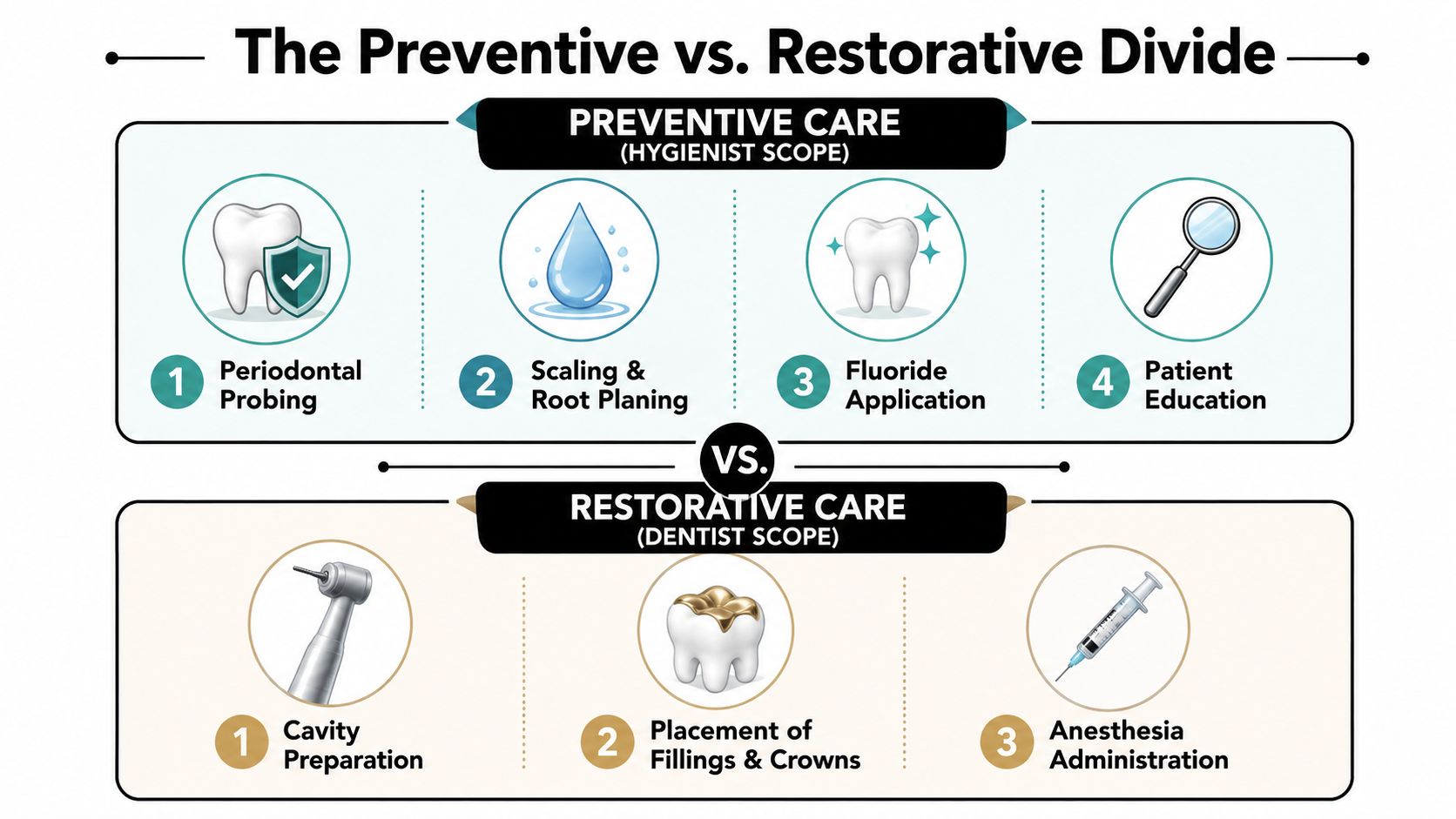
Prevention and restoration use different skill sets
Think of the hygienist as a maintenance technician and the dentist as the clinician responsible for structural repair. A maintenance technician can identify wear, remove buildup, recommend better upkeep, and document a developing issue. Structural repair requires a separate decision about what material to remove, how much tooth to preserve, and how to rebuild the tooth so it functions properly.
Restorative procedures may include caries excavation, matrix band placement, composite placement, amalgam condensation, and bite adjustment. In most jurisdictions, the legal authority for those procedures belongs to dentists, although selected jurisdictions allow limited restorative functions for hygienists or other licensed professionals.
Training overlap doesn't settle the question. A hygienist may understand restorative materials or observe filling procedures, but the dental practice act controls what the hygienist may legally perform and bill. The dentist's presence also doesn't automatically expand a hygienist's authority. Supervision rules can permit some tasks while leaving irreversible treatment outside the hygienist's scope.
For routine preventive care, a practice may coordinate a professional dental cleaning and exam with the hygienist leading the maintenance portion and the dentist reviewing findings that need diagnosis or treatment planning.
How U.S. State Rules Decide Who Can Place a Filling
The United States doesn't have one nationwide answer. Each state sets its own dental scope rules, and those rules may distinguish between direct restorations, temporary materials, tooth preparation, finishing, supervision, and additional credentials.
Minnesota provides a useful example because it changed its Dental Practice Act in 2003 to add restorative procedures for registered dental assistants and registered dental hygienists, as documented in the Minnesota dental hygienist workforce chartbook. Legal permission still didn't mean widespread use. The same chartbook reports that only about 4% of dental hygienists had the credential to perform restorative procedures. Among that small group, 3% said they performed those procedures all the time, while 73% said they never did.
That gap matters. A state may create an expanded pathway, but a hygienist still needs the required education, credential, employer authorization, appropriate supervision, and a practice willing to use the permission. Patients shouldn't assume that every hygienist in an expansion state can place a filling.
A practical map of U.S. categories
| Category | Who Can Place a Filling | Example States | Supervision Required |
|---|---|---|---|
| Dentist-focused scope | Usually a dentist, with other team members limited to assisting or defined support tasks | Many U.S. jurisdictions | Follow the state's dentist and auxiliary supervision rules |
| Restorative endorsement | A registered hygienist or another qualified auxiliary may perform specifically authorized restorative steps | Minnesota provides a documented example | The required level may include indirect or other state-defined supervision |
| Limited expanded functions | A hygienist may place, contour, cure, adjust, or finish specified materials, sometimes after dentist preparation | Nevada is a notable example | Follow the statutory conditions and dentist oversight requirements |
The table is a mental map, not a substitute for the law. Even where a hygienist can place restorative material, the rule may leave diagnosis, cavity preparation, treatment planning, and final responsibility with the dentist. A practice may also divide the work, with the dentist preparing the tooth and another licensed professional placing or finishing the material.
To check your own state, search the state dental board's official site for dental hygienist scope of practice, restorative procedures, direct restoration, and supervision. Then look for four separate answers:
- Can the hygienist diagnose decay?
- Can the hygienist prepare or cut the tooth?
- Can the hygienist place and finish restorative material?
- Must the dentist be physically present, or is another form of supervision allowed?
If the rule uses terms you don't understand, ask the practice to identify the exact credential and statutory authority. The 2026 state-by-state workforce update also highlights how duties vary by state, while ADHA materials note that some jurisdictions tie restorative services to specific supervision and training requirements.
How Other Countries Handle Hygienists and Fillings
International rules reveal why a universal answer fails. Countries often separate dental hygienists from dental therapists, but they don't draw the boundary in the same place.
In England, General Dental Council scope distinctions generally place preventive and periodontal work within the hygienist role, while dental therapists and dentists can provide direct restorations. A GDC scope-of-practice checker identifies permanent restorations or fillings as outside the dental hygienist scope while listing direct restorations for dental therapists and dentists.
That distinction is easy to miss because both hygienists and therapists may work in preventive care. A therapist is a separate licensed professional with a broader clinical remit. Recent UK guidance also makes the difference more important by distinguishing expanded access rights from authority to restore teeth, as discussed in coverage of the newer scope legislation.
Quebec illustrates a different model. Its regulation permits dental hygienists to insert and sculpt filling materials and to place a temporary filling without drilling. Nevada, in the United States, authorizes hygienists to place, condense, contour, adjust, cure, and finish certain direct restorations, including amalgam, resin-based composite, and glass ionomer, under the conditions set by law. In Canada, a provincial policy model can require the dentist to prepare the tooth first, after which the hygienist places, carves, and finishes the restorative material with documentation of the divided responsibilities.
| Country or region | Who places fillings | Supervision required | Typical scope |
|---|---|---|---|
| England | Dentists and dental therapists for direct restorations | Follow GDC scope and applicable treatment rules | Hygienists focus on prevention and maintenance |
| Quebec | Qualified hygienists may perform specified restorative steps | Follow provincial regulation and training requirements | Inserting and sculpting filling materials, plus defined temporary filling work |
| Nevada | Authorized hygienists may handle specified direct restoration steps | Follow statutory supervision and credential rules | Placement and finishing of listed restorative materials |
| Canada, dentist-prepared model | Dentist prepares the tooth, hygienist may place and finish material | Dentist oversight and required documentation | Divided restorative workflow |
The pattern is consistent even when the details differ. Restorative authority is conditional, role-specific, and local. A patient who moves from London to Quebec, or from New York to Nevada, can encounter a completely different answer without either clinician changing professions.
How a Filling Visit Actually Works at a Typical Practice
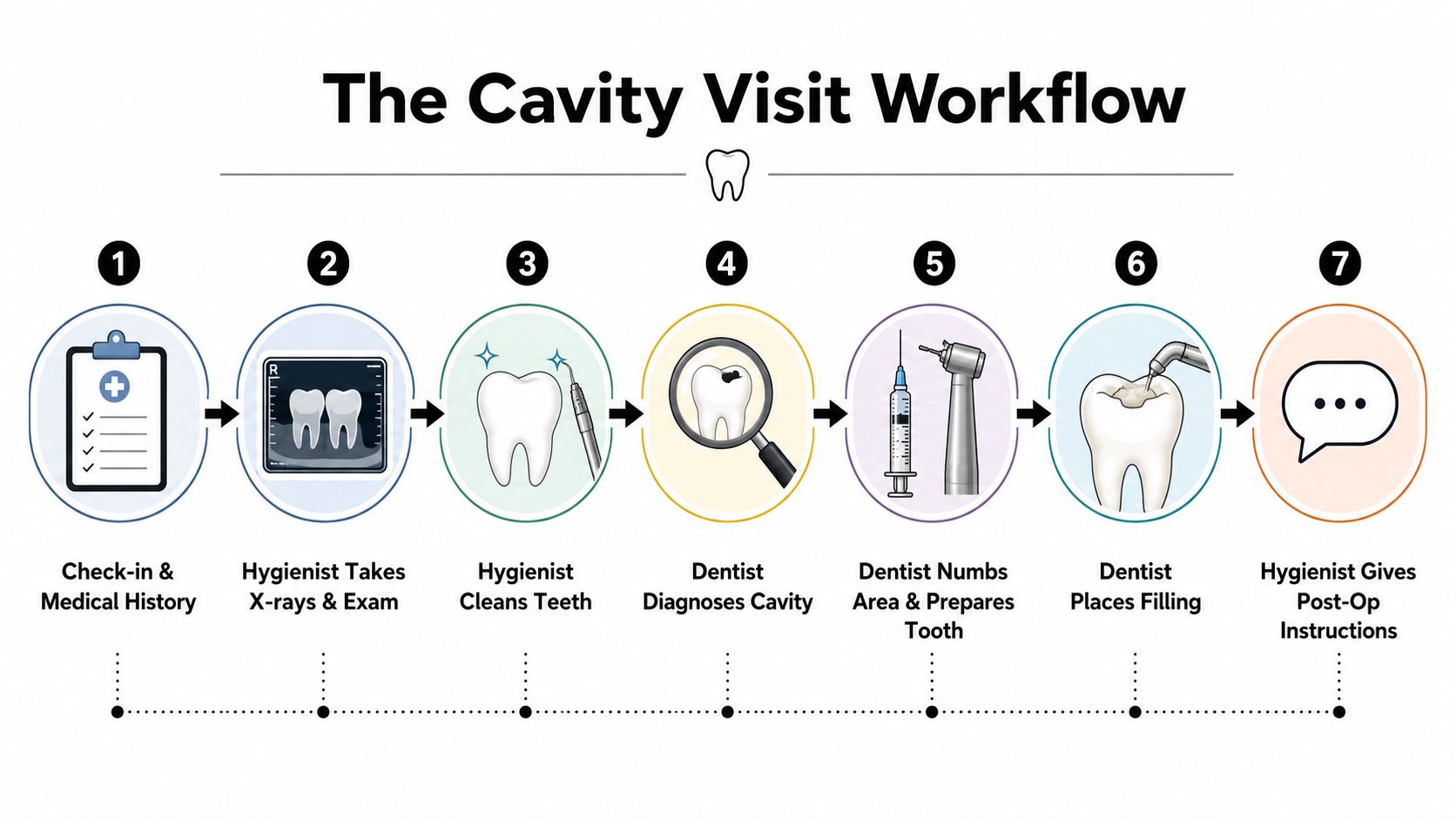
A typical cavity visit is a relay, not a single-person procedure. The hygienist may gather information and manage preventive care, while the dentist makes the restorative decision and performs the irreversible treatment.
The appointment often begins with medical history review and imaging. Depending on the practice and applicable rules, the hygienist may take digital radiographs, chart existing restorations, assess gum health, perform an oral cancer screening, clean the teeth, apply fluoride, and flag suspicious pits, grooves, or radiographic findings.
Where the dentist takes over
The dentist reviews the findings, examines the tooth, and determines whether the area is active decay, staining, an old restoration, enamel variation, or something that needs monitoring. That diagnosis comes before a filling. Not every dark groove requires drilling, and not every radiographic change has the same treatment.
If restoration is appropriate, the dentist typically administers anesthesia when needed, isolates the tooth, prepares the cavity, and places the composite or amalgam. The dentist then checks the bite and polishes or adjusts the restoration. In some jurisdictions, a qualified expanded-function assistant or hygienist may perform specifically permitted placement or finishing steps, but the delegation depends on state law and credentials.
In New York, including typical Midtown Manhattan practice workflows, patients should expect the dentist to retain responsibility for the drill, tooth preparation, and placement of composite or amalgam restorations. The hygienist remains a co-pilot, gathering clinical information and supporting prevention, not the pilot directing the restorative procedure.
A filling appointment may also include explanations about why the lesion developed, how to protect nearby teeth, and whether fluoride, sealants, diet changes, or improved interdental cleaning could prevent another restoration.
For a patient-friendly explanation of the treatment itself, see how dentists fill cavities.
This video offers another visual explanation of the cavity-treatment process:
The Real Role Hygienists Play in Avoiding Fillings Altogether
A filling is an important repair, but it isn't the only way to measure a hygienist's value. The more useful question may be whether the hygiene team helps keep a weak spot from becoming a restoration.
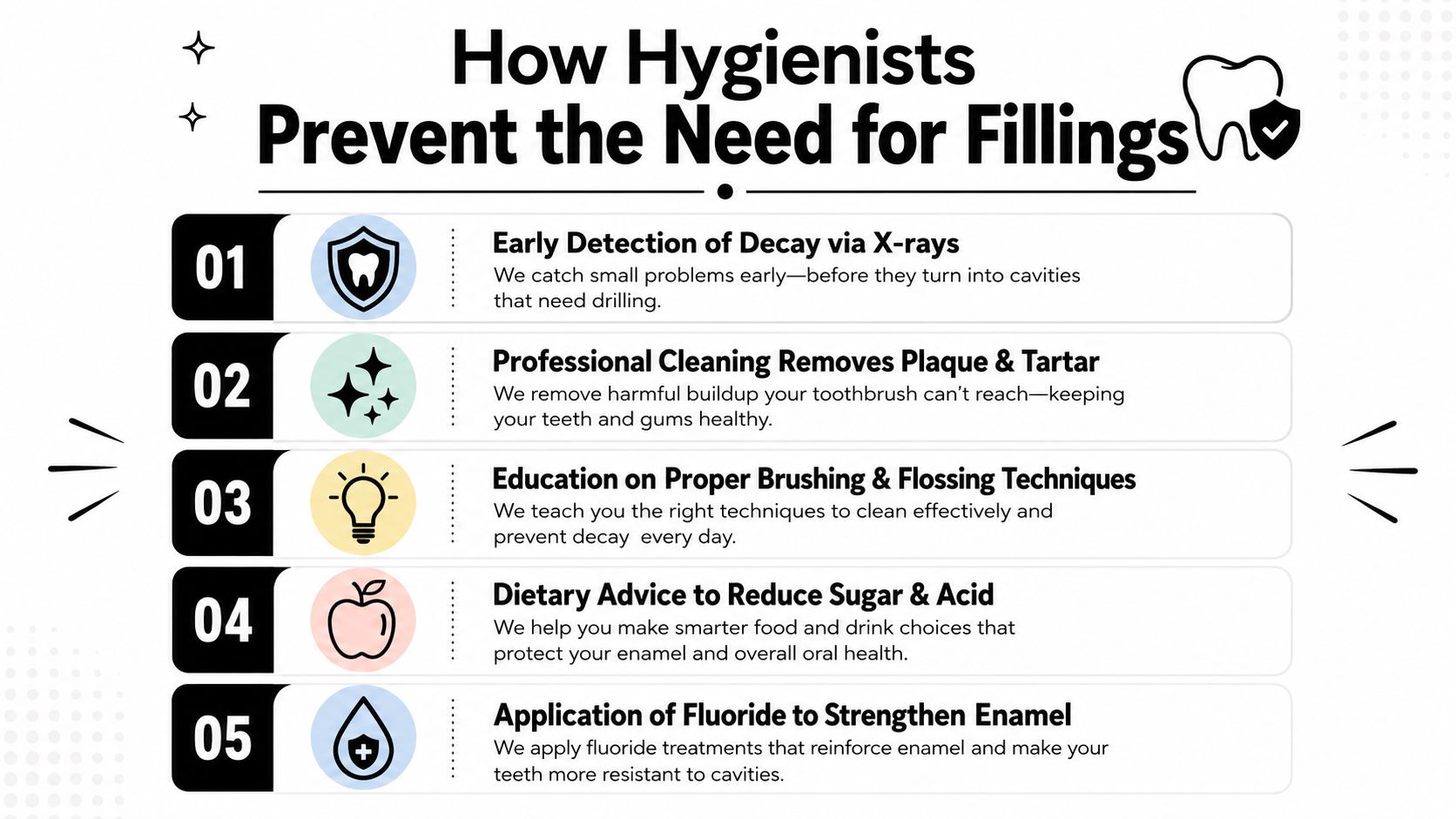
Hygienists support that outcome through several connected actions:
- Plaque and calculus control: Professional scaling removes deposits that encourage gum inflammation and make home care harder.
- Fluoride support: Fluoride applications and product advice help patients strengthen vulnerable enamel where appropriate.
- Sealant placement: Sealants can cover susceptible pits and grooves when the patient and dentist determine that protection is suitable.
- Behavior coaching: A hygienist can demonstrate brushing angles, interdental brush use, floss technique, and ways to reduce repeated sugar or acid exposure.
- Early communication: Detailed charting and radiographs can alert the dentist to a developing concern while the treatment decision is still conservative.
The hygienist doesn't independently decide that a tooth has been “saved” from a filling. The dentist may diagnose a lesion, recommend fluoride or monitoring, or choose another approach based on the tooth's condition and the patient's risk. The hygienist's contribution is making prevention practical and consistent between diagnostic visits.
A successful hygiene visit may end with no filling scheduled because the team identified risk early and gave the patient a workable plan.
Prevention also includes periodontal care. Scaling and root planing, maintenance instruction, and control of inflammation support a healthier mouth, although they don't replace cavity diagnosis or restorative treatment. Diet counseling can focus on the pattern of sugar and acid exposure rather than turning the discussion into a list of forbidden foods.
The dental cleaning process shows why the appointment is more than polishing. It combines deposit removal, assessment, and individualized guidance. For many patients, the most valuable hygienist isn't one who places a filling. It's the clinician who helps make a filling less likely to be needed.
Questions to Ask at Your Next Dental Appointment
Scope of practice starts with location. Before you ask whether your hygienist can place a filling, identify the state or country whose rules govern the appointment, then ask the practice to explain who will perform each step.
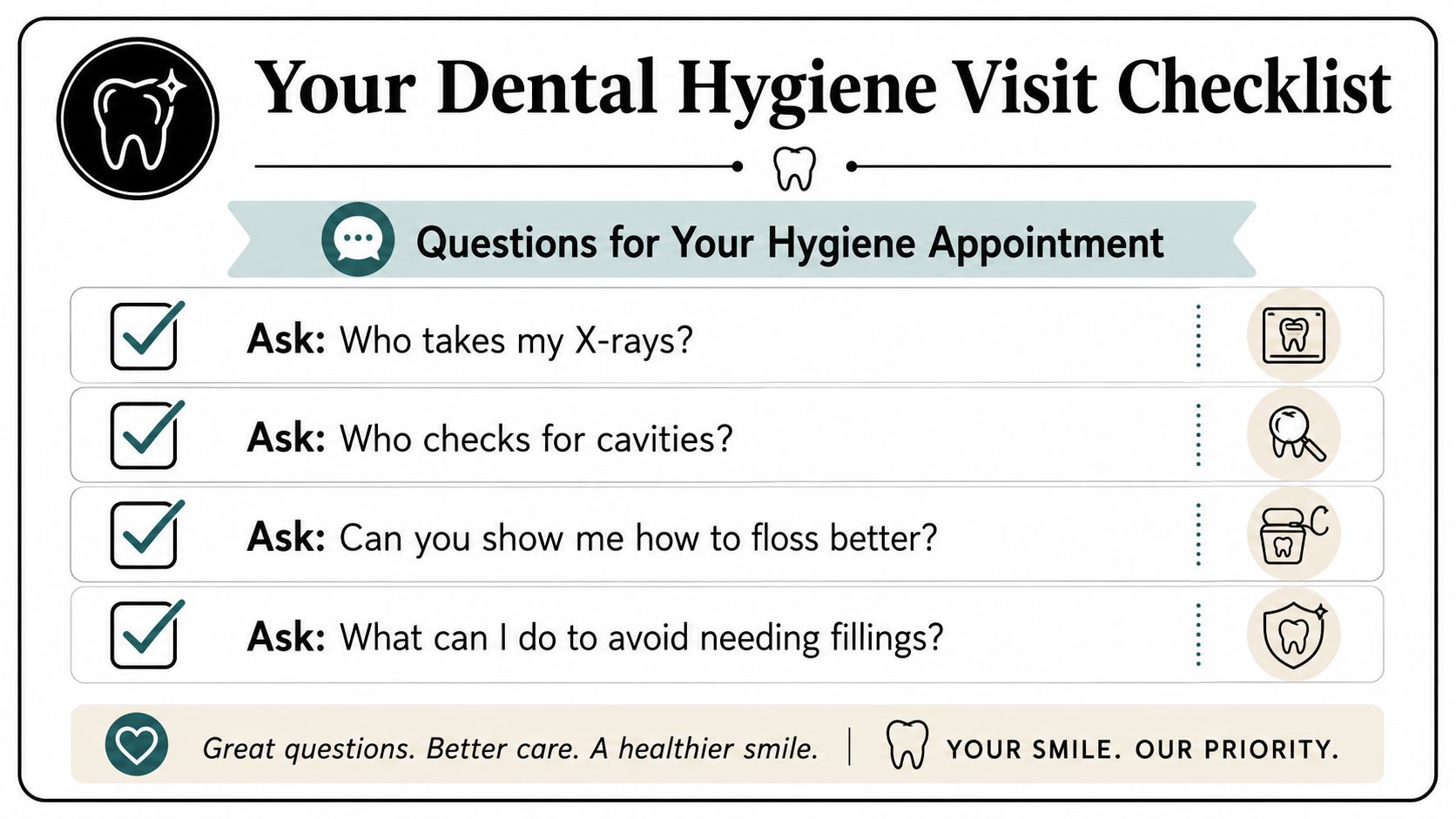
Use questions that separate diagnosis, preparation, placement, and supervision:
Confirm who does what
- Who places my filling today? Ask for the person's professional title, not just their name.
- Is that person a dentist, dental hygienist, or dental therapist? Those titles can carry different restorative authority.
- Who diagnoses the cavity? Diagnosis and restoration may belong to different clinicians.
- Who prepares the tooth? This is often the legal dividing line between preventive support and restorative care.
Clarify credentials and oversight
- Does the clinician hold a restorative endorsement or permit?
- What type of supervision applies? Ask whether the dentist is providing direct, indirect, or another state-defined form of supervision.
- Will the dentist be on-site? Physical presence may be required for some procedures and not others.
- What happens if the dentist finds deeper decay, a cracked tooth, or pulp involvement? A clear answer shows how the practice handles complications and changes in treatment.
Ask about prevention
- What did you see today that affects my cavity risk?
- Would fluoride, a sealant, or a change in home care help this tooth?
- Can you demonstrate a better brushing or interdental-cleaning technique?
- Which eating or drinking habits are contributing to repeated acid or sugar exposure?
If staff members aren't sure, don't treat a casual front-desk answer as the law. Contact your state dental board and ask for the published scope rule covering hygienists, direct restorations, supervision, and restorative credentials.
If you have persistent pain, swelling, a broken restoration, or symptoms suggesting infection, ask for a dentist's evaluation rather than waiting for a routine cleaning. Complex concerns may require evaluation by an endodontic provider, and this root canal expert resource can help you understand when tooth pain needs more than preventive care.
Paul L. Gregory, DDS provides preventive exams and cleanings alongside diagnostic and restorative care, including composite and porcelain fillings, so the full cavity-management process can be coordinated in one practice. Visit Paul L. Gregory, DDS to request an appointment and discuss who should evaluate, restore, and help protect your tooth.