

You're sitting in the dental chair with a cracked or heavily restored back tooth, and your dentist gives you a choice: tooth-colored composite, ceramic, amalgam, or gold. The gold option sounds old-fashioned and expensive, but it also raises a reasonable question. Could paying more now reduce the number of times that tooth needs treatment later?
A dental gold filling is best understood as a longevity-versus-upfront-cost decision. Gold won't be right for every tooth or every budget, but its wear behavior and long clinical record make it worth considering when long service, chewing comfort, and fewer replacement cycles matter more than matching the color of your smile.
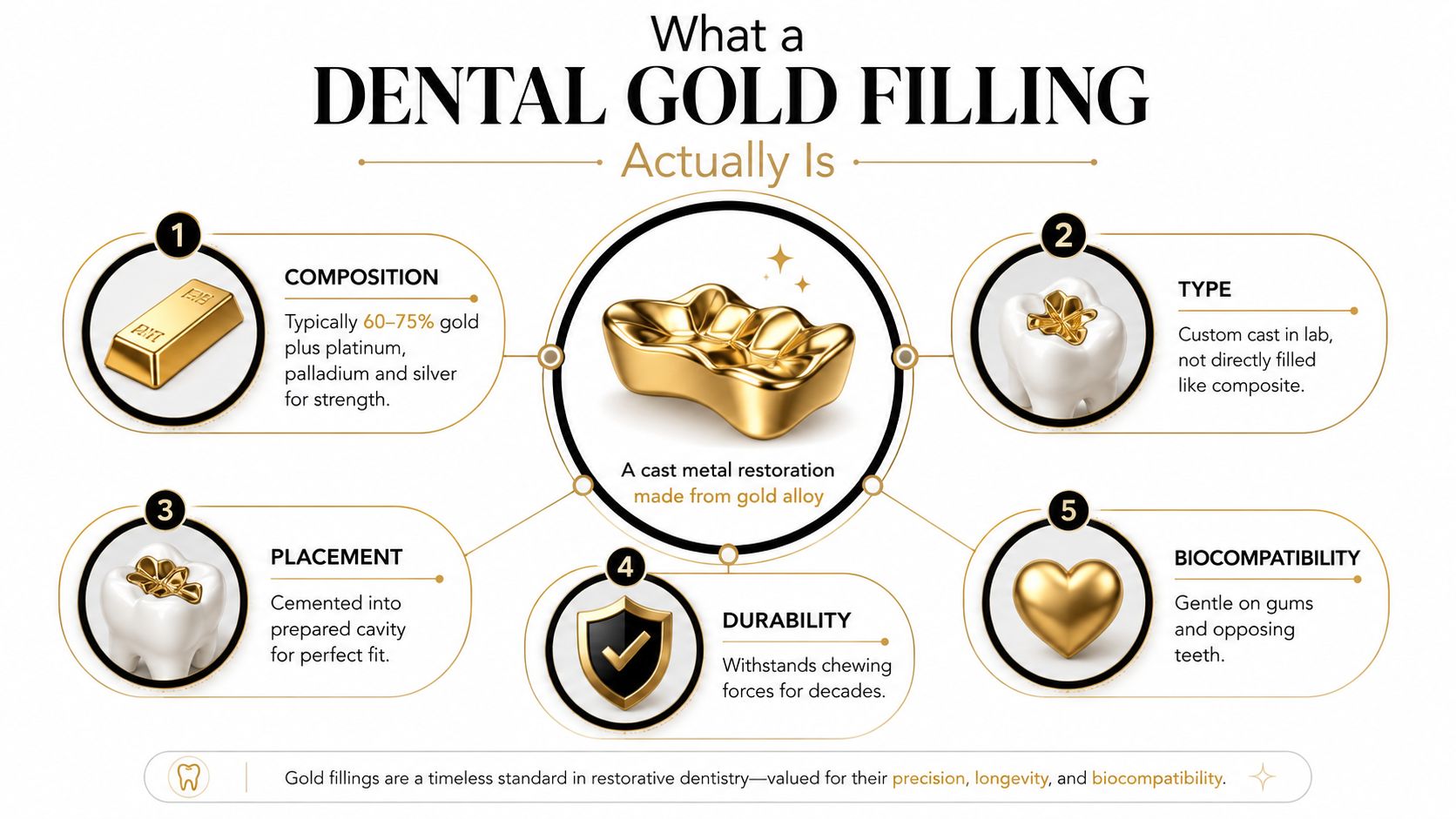
What a Dental Gold Filling Actually Is
Your dentist may use the phrase “gold filling” while referring to several different restorations. The common feature is a custom-made cast gold alloy restoration, usually fabricated outside your mouth and then bonded or cemented into the prepared tooth. It isn't soft material packed directly into a cavity like a traditional amalgam filling, and it isn't shaped and hardened chairside like composite resin.
A gold restoration may be an inlay, which fits inside the tooth's cusps; an onlay, which covers one or more weakened cusps; or a full gold crown, which covers the tooth more extensively. Patients often call all three “gold fillings,” but the amount of tooth covered, the preparation, and the fee can differ substantially.
Why dentists still consider gold
Gold has one of the longest documented histories of any restorative dental material. A historical review reports that gold was used in dentistry more than 2,500 years ago, and that dental applications eventually grew to consume more than 80 tons of gold annually worldwide. The same historical record describes proposals for gold fillings as early as the 1450s. (Historical overview of gold in dentistry)
The reason is practical rather than nostalgic. Properly selected gold alloys tolerate chewing forces, resist corrosion in the mouth, and can be polished to a smooth finish. Gold also wears at a rate close to natural enamel, which can be gentler on the opposing tooth than a rough or overly abrasive surface.
The central trade-off is simple. Gold usually asks you to spend more and wait longer at the beginning, in exchange for the possibility of keeping a stable restoration for many years. Whether that exchange makes sense depends on the size and location of the cavity, your bite, your cosmetic priorities, and how likely you are to need replacement treatment.
A Brief History of Gold in Dentistry
Gold entered dentistry long before electric drills or modern laboratory casting. In central Italy, Etruscan craftspeople used gold wire to secure replacement teeth more than two millennia ago. Later practitioners shaped gold foil and plate for patients who could afford the time and meticulous handwork those techniques required.
The major shift was precision. Instead of hammering or condensing gold directly into a tooth, dentists began producing a separate restoration that matched the prepared space. W.H. Taggart's early twentieth-century work with the lost-wax technique helped make accurately fitted gold inlays and onlays practical. A laboratory forms a wax pattern from the prepared tooth, replaces that pattern with molten alloy, then refines the casting until its fit and surface are suitable for the mouth.
From craft material to standardized alloy
As cast restorations became more practical, gold moved from a specialized craft into routine clinical use. A study of a nineteenth-century Washington, DC cemetery found that 83.3% of adults buried in the 1890s had restorations. For that decade, researchers recorded 13 gold restorations and 26 amalgam restorations. Across the complete sample, they identified 104 gold restorations among 153 restorations of all types. (Smithsonian historical poster on dental restorations)
Clinical experience also created a need for consistent alloy requirements. ADA Specification No. 5 was established in 1966, followed by DIN 13 906 in 1975 and ISO 1562 in 1976. Depending on the alloy category, the standards required gold combined with platinum-group metals to make up 75% to 83% by weight.
These milestones explain the modern reputation of cast gold. Its history supports a longevity-focused decision, not a promise that every restoration will last indefinitely. The higher upfront cost reflects precise laboratory work and material standards, while the potential benefit is avoiding repeated replacement of a restoration that remains stable for many years.
Gold Fillings Compared to Other Materials
A patient with a heavily used back tooth may value a restoration that stays stable for years, even if its initial fee is higher. The better question is how each material handles chewing, wear, appearance, and the possibility of replacement. Gold is smooth, resilient, and compatible with enamel wear. Composite is attractive and conservative, but it may chip or lose its seal. Ceramic looks natural, though its glass-like behavior requires careful design and polishing. Amalgam remains functional and economical, while its appearance and material concerns make it less appealing to many patients.
Gold's wear behavior has strong laboratory support. After 200,000 cycles in a three-body wear test, a soft gold alloy lost 51 micrometers, close to human enamel at 57 micrometers and well below dentin at 164 micrometers. The authors concluded that the alloy's wear rate corresponded to enamel. (Wear study of dental gold alloys)
| Material | Wear on opposing tooth | Fracture risk | Typical lifespan |
|---|---|---|---|
| Gold | Generally close to natural enamel when properly finished | Low, though the tooth around it can still fracture | Long-term service is a primary advantage |
| Amalgam | Functional, but its surface and aging behavior vary | Can contribute to cracks in a weakened tooth | Often durable, but replacement may eventually be needed |
| Composite resin | Can wear and chip under heavy loading | Higher risk in large back-tooth restorations | Often shorter than cast metal in demanding areas |
| Ceramic | Can be smooth and enamel-friendly when polished correctly | More brittle than gold | Strong option with aesthetic benefits, but fracture remains a concern |
The everyday difference
Gold wears at a rate compatible with enamel, so the opposing tooth generally experiences less abrasion than it would against a rough or poorly finished surface. Ceramic is closer to glass against enamel. A well-designed ceramic restoration can perform very well, but a rough surface, unfavorable bite, or sharp edge can increase wear or fracture risk.
Gold also handles large restorations differently from composite. Composite bonds directly to the tooth and can preserve healthy structure, but a broad restoration may flex or chip when the remaining cusps are already thin. A gold onlay can cover and protect those cusps without requiring full coverage. If the tooth needs broader protection, compare this option with the dental crowns described in this guide.
The practical decision is longevity versus upfront cost. Gold may make more sense when chewing forces are high and repeated replacement would be difficult. Composite or ceramic may be preferable when appearance, conservative preparation, or the location of the tooth carries greater weight. Your dentist should assess the tooth, bite, remaining enamel, and decay risk before comparing fees alone.
How Long Gold Restorations Really Last
Gold restorations have one of the strongest longevity records of any indirect dental material. In a retrospective clinical study of 72 indirect posterior gold restorations followed for 63 to 117 months, the mean service time was 88.1 months. No failures occurred during the first five years. Between years five and ten, the study recorded one replacement and one additional repair, with a 98.6% survival rate at nine years and a 91% success rate. (Clinical study of posterior gold restorations)
Those figures describe one specific group, not a guarantee for every patient. Gold restorations performed especially predictably in premolars, where survival and success were higher than in molars. Bite forces, tooth anatomy, oral hygiene, decay risk, restoration design, and grinding habits all affect how long the result lasts.
What usually causes trouble
Gold is less prone to fracture than a brittle material, but the tooth around it can still develop problems. Recurrent decay at the margin remains a concern when plaque collects or cavity risk is high. An imperfect contact, an uneven bite, or an undetected crack can also shorten the restoration's service life.
For gold, caries, not fracture, was the most common failure mode in the clinical evidence reviewed earlier. That shifts the focus from the metal alone to the health of the tooth and its margins.
Practical rule: A long-lasting gold restoration still needs a healthy tooth, a clean margin, and regular professional monitoring.
At ten years, a successful gold inlay may feel completely ordinary. You chew normally, floss around it, and notice no rough edge. At twenty years, its value may be that the tooth has not needed another preparation. At thirty years, it may still be serviceable, although the tooth and surrounding tissues have changed with age.
Aftercare remains part of the longevity equation. Guidance on tooth crown after-care is relevant whenever a restoration covers or protects substantial tooth structure. The upfront fee matters, but so does the possibility of delaying another replacement and another round of tooth preparation.
How a Gold Filling Is Placed Step by Step
A cast gold inlay or onlay usually requires an indirect workflow. The dentist prepares the tooth in one visit, a laboratory fabricates the restoration, and the dentist seats it during a later appointment.
Visit one
The dentist numbs the tooth with local anesthetic, removes decay or the old restoration, and shapes the cavity. Rounded internal angles and clearly defined margins help the laboratory create a restoration that seats fully without creating unnecessary stress points.
The dentist then records the tooth with a digital scan or a material such as polyvinyl siloxane. A bite registration shows how the upper and lower teeth meet. Because the restoration must remain comfortable during chewing, the dentist places a temporary restoration to protect the prepared tooth while the laboratory completes the cast.
The laboratory stage
The laboratory creates a pattern from the dentist's scan or impression, commonly using a lost-wax casting process. The technician casts the pattern in a noble or high-noble alloy that follows an applicable dental alloy specification, then adjusts and polishes the restoration.
This stage explains why a gold filling generally costs more than a direct composite. You're paying for clinical preparation, impression or scanning, laboratory craftsmanship, alloy, finishing, and a second appointment.
Visit two
The dentist removes the temporary and tries in the gold restoration. They check the margins, contacts, and bite both on the model and in your mouth. Minor adjustments ensure that floss passes properly and that the restoration doesn't feel high when you close.
The dentist then cements the inlay or onlay with a suitable cement, such as resin cement or glass ionomer, depending on the case. Final flossing and bite verification complete the appointment. The overall process commonly takes about two to three weeks, although laboratory schedules and clinical circumstances can change that timing.
You may feel pressure during the try-in and cementation, but local anesthesia helps keep the preparation comfortable. Temporary sensitivity or an unfamiliar bite can occur afterward. A bite that still feels high, pain that lingers, or sensitivity that worsens deserves a call to the office. For a broader explanation of cavity treatment, see this guide to how dentists fill cavities.
The procedure is easier to visualize in motion:
When the Higher Cost of Gold Is Worth It
Gold makes the strongest financial argument when replacement risk matters as much as today's fee. A restoration that costs more at the beginning may become reasonable if it remains stable while a less expensive alternative needs repeated repair or replacement. That calculation also includes additional appointments, injections, temporary restorations, and the gradual removal of more tooth structure during future treatment.
A clinical review found that gold restorations remain among the longest-lasting indirect restorations, with 10-year survival commonly around 85% to 96% and 20-year survival still near 87% in some cohorts. A meta-analysis also found that indirect composite restorations had an 18% higher failure rate than gold over five to seven years. (Meta-analysis of indirect restorative materials)
Situations that favor gold
Gold deserves serious consideration when the restoration is large, located on a posterior tooth, or exposed to substantial chewing pressure. It can also make sense when a patient has repeatedly replaced composite restorations in the same area or clenches and grinds.
| Clinical scenario | Best material | Why |
|---|---|---|
| Large posterior cavity with weakened cusps | Gold onlay or another cuspal-coverage restoration | Protects vulnerable tooth structure while offering durable wear behavior |
| Repeated failure of composite in the same tooth | Gold, if the tooth and bite are suitable | Reduces dependence on a material that has already required replacement |
| Small occlusal pit | Composite may be sensible | A conservative, tooth-colored direct restoration may meet the need |
| Visible tooth or smile zone | Composite or ceramic | Appearance may matter more than maximum posterior durability |
| Limited budget or need for same-visit care | Composite or amalgam, depending on the case | Lower initial cost and simpler scheduling may outweigh long-term advantages |
| Tooth with limited remaining prognosis | The least invasive suitable option | A long-lived restoration has less value if the tooth may soon need broader treatment |
Gold isn't a moral upgrade, and it doesn't repair a poor diagnosis. If the cavity is small, composite may preserve more tooth and cost less. If appearance dominates the decision, ceramic or composite may be preferable. If you're comparing broader coverage, review the factors that affect dental crown cost rather than assuming every gold restoration is priced the same.
The fair question is not, “Is gold expensive?” It's, “Which option gives this tooth the most sensible service for the money, the time, and the amount of healthy tooth remaining?”
Availability, Insurance, and Pricing in 2026
Gold restorations remain available, but they're less routine than composite or ceramic. The main reasons are practical: cast gold typically requires laboratory fabrication, more than one appointment, specialized preparation, and a patient willing to accept visible metal. Some general dentists place gold regularly, while others refer the laboratory work or offer it only for selected posterior cases.
A current policy discussion in Japan illustrates a wider supply pressure. A January 2026 update reported that revised reimbursement had not eliminated the negative spread between payment and market-linked pricing for gold-based dental materials. That doesn't determine a Manhattan fee, but it shows how reimbursement rules and precious-metal pricing can affect whether laboratories and offices continue offering these restorations. (MouthHealthy information on gold inlays)
What to clarify before accepting a quote
Don't assume the word “gold” describes one standard product. Ask whether the dentist is recommending an inlay, onlay, or crown, which laboratory will fabricate it, and whether the fee includes the temporary, laboratory work, cementation, and follow-up adjustments.
| Restoration type | National fee range | Manhattan fee range | Typical PPO coverage |
|---|---|---|---|
| Single-surface gold inlay | Varies by office and laboratory | Varies by office and laboratory | Plan-specific, often subject to major-restoration benefits |
| Two-surface gold inlay | Varies by office and laboratory | Varies by office and laboratory | Plan-specific, with deductibles and annual limits |
| Full gold crown | Varies by office and laboratory | Varies by office and laboratory | Plan-specific, often subject to major-restoration benefits |
I'm leaving the fee fields qualitative because a reliable, universal 2026 fee schedule wasn't provided. A dentist's office can give you the actual estimate after examining the tooth, and your insurer can confirm the allowed amount, waiting periods, exclusions, and whether the laboratory is in network.
CAD and cast workflows can make impressions and design more efficient, but they don't remove the cost of alloy, laboratory expertise, clinical time, or a second appointment. If your dentist doesn't place gold in-house, ask whether a trusted restorative laboratory can fabricate it and who will handle any adjustment or remake.
For a related starting point, compare the material-specific questions in this guide to filling costs. The number that matters is your complete treatment estimate, not a generic online range.
Questions to Ask Your Dentist Before You Decide
Bring a short list to your consultation. A good discussion should leave you understanding not only the material's strengths, but also why it suits this particular tooth.
Ask about experience and design
- Clinical experience: How often do you place gold inlays or onlays, and who will adjust the restoration if the bite feels high?
- Laboratory details: Which dental laboratory will fabricate the work, and what alloy specification or alloy category will it use?
- Tooth-specific prognosis: How long might this restoration reasonably serve in this tooth, given its size, location, bite, and remaining structure?
- Restoration type: Is this a filling, an inlay, an onlay, or a full crown, and why is that design appropriate?
Ask about the complete financial decision
- Total fee: Does the estimate include the examination, preparation, temporary restoration, laboratory fee, cementation, and follow-up?
- Alternatives: What would composite and ceramic cost for the same tooth, and what compromises would each option involve?
- Failure policy: If the restoration fails within five years, what does the office or laboratory cover?
- Try-in process: Will I be able to evaluate the fit and bite before final cementation?
These questions help separate a thoughtful recommendation from a material preference. They also expose hidden differences between offices, such as laboratory quality, appointment structure, and aftercare.
A useful decision test: Choose gold when keeping the tooth stable for more than twenty years matters most and the upfront fee fits your budget. Choose composite or ceramic when appearance, lower initial spending, or same-visit treatment carries greater weight.
Your dentist should also assess decay risk, grinding, gum health, and whether the tooth needs a filling at all. A restoration can be beautifully made and still fail if the underlying tooth lacks enough healthy structure or if recurrent decay goes untreated.
If you're considering a dental gold filling in Midtown Manhattan, Paul L. Gregory, DDS provides restorative consultations that can include fillings, inlays, onlays, and crowns, with digital diagnostics and assistance reviewing insurance and fees. Visit Paul L. Gregory, DDS to schedule an evaluation and discuss which restoration best fits your tooth, priorities, and long-term plan.