

Yes, general dentists routinely do root canals, and in the United States they handle almost 70% of them. The key question isn't whether they can do it, it's whether your tooth belongs in a general dentist's chair or needs a specialist's hands.
You might be sitting there with one aching tooth, a referral slip, and a lot of questions. That's the right moment to get blunt about the decision, because the provider choice should match the tooth, the anatomy, and the dentist's own experience, not just the name on the door.
| Criteria | General Dentist | Endodontist |
|---|---|---|
| Core role | Handles routine root canal therapy as part of general practice | Focuses on root canal treatment and related complex cases |
| Best fit | Straightforward front teeth, uncomplicated premolars, some simple molars | Molars, retreatments, curved canals, difficult anatomy, failed prior treatment |
| Case volume | Lower day-to-day volume in root canals | Much higher root canal volume |
| Technology focus | Varies by office, often depends on the dentist's setup | More likely to use advanced endodontic tools |
| After the procedure | Often manages the restoration in the same office | Usually sends you back to the referring dentist for the final restoration |
| Practical question | Convenient when the case is simple and the dentist does these often | Better when precision, retreatment, or anatomy raises the risk |
The Short Answer Every Patient Wants First
Yes, general dentists can do root canals, and they do them every day. In the U.S., general dentists perform almost 70% of all root canal treatments, so this is standard dentistry, not a backup plan for a specialist-only procedure. The key question is whether your tooth and your dentist are a good match. PubMed study on U.S. root canal treatment patterns
A front tooth with a straight canal is one case. A lower molar with extra roots, tight curves, or a previous failure is another. The decision should come down to the tooth in front of you, the dentist's experience with that type of case, and whether their office is set up to handle it well.
A good dentist does not ask only whether the procedure is allowed. A good dentist asks whether the case belongs in their chair or should be referred out.
Practical rule: if the tooth is straightforward and the dentist does root canals often, staying with that office usually makes sense. If the tooth is a molar, a retreatment, or has difficult anatomy, referral usually gives you a better chance at a predictable result.
If you are in pain right now, get evaluated fast. A general dentist can often be the quickest way to find out what is going on, and if you need an emergency dentist in Manhattan, that office should also be able to tell you whether the tooth can be treated there or needs a specialist.
The decision comes down to a practical checklist. You want to know which teeth are predictable, which ones are borderline, and which ones are trouble before anyone starts filing canals.
What Makes a General Dentist Qualified to Do Root Canals
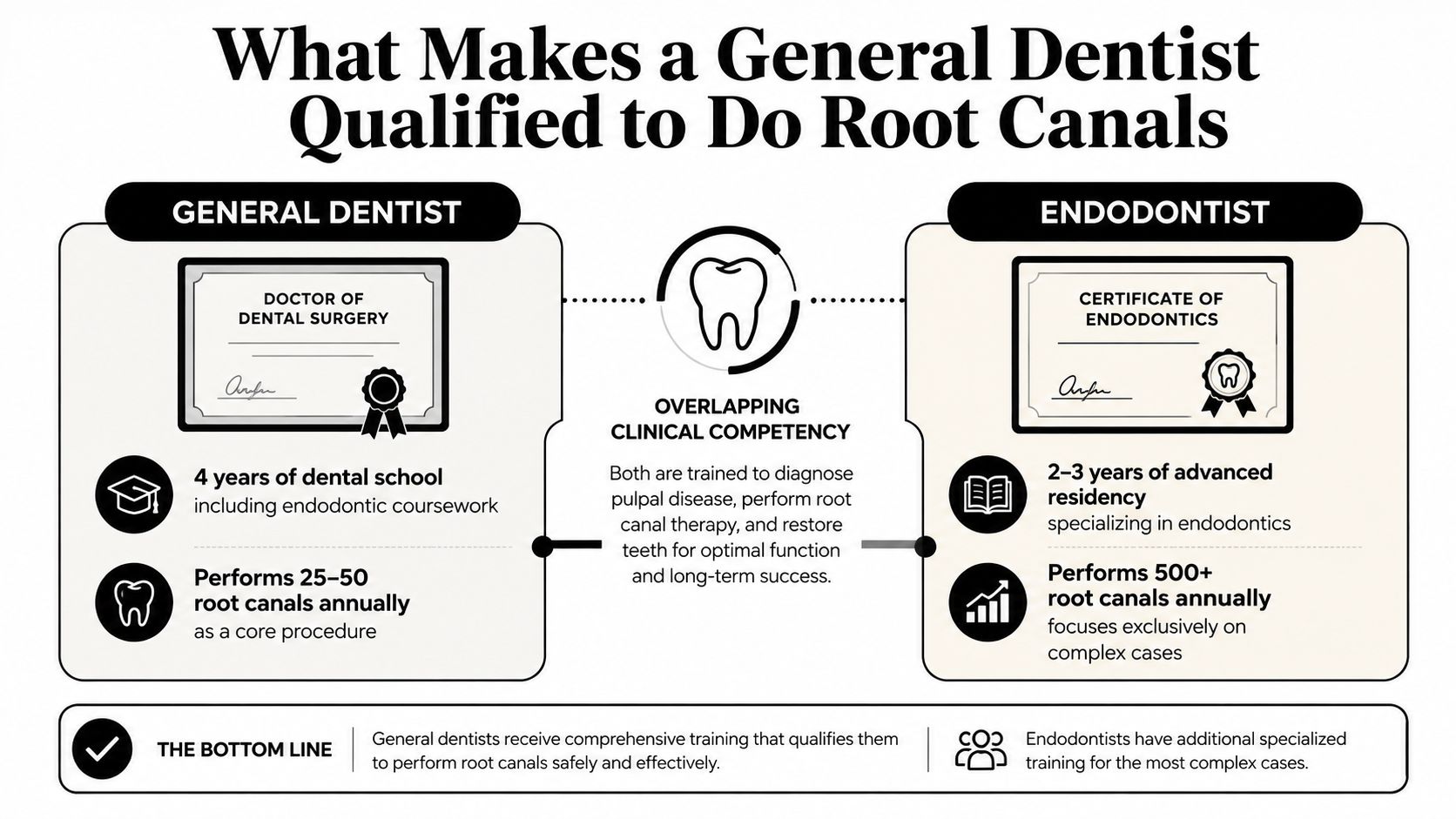
A general dentist is qualified to do root canals because endodontic care is part of dental school training and daily general practice. This isn't an exotic procedure outside their scope. The difference is usually not licensing, it's how much of their week they spend doing it, and how many difficult cases they see.
Training versus repetition
General dentists learn the basics of root canal therapy, including diagnosis, isolation, cleaning, shaping, and sealing the canal system. Endodontists go further and build their practice around those same steps all day, every day. That difference in repetition matters because root canals reward consistency more than bravado.
The American Association of Endodontists says endodontists average 25 root canal treatments per week compared with about 2 per week for general dentists. That's a real volume gap, and it explains why some general dentists are highly comfortable with routine cases while others prefer to refer sooner. AAE patient resource on dentist vs. endodontist differences
A dentist who does root canals regularly can be a strong choice for a simple case. A dentist who only does them occasionally may still be excellent, but the margin for error gets tighter as the tooth gets more complicated.
What to ask about before you say yes
You don't need to quiz your dentist like an examiner. You do need a straight answer to a few things:
- Monthly volume: Ask how often they do root canals, not just whether they can do one.
- Case mix: Ask whether they're comfortable with molars or mostly do front teeth and premolars.
- Technology: Ask whether they use magnification or a surgical microscope for hard-to-see canals.
- Referral threshold: Ask what would make them send you to an endodontist instead.
If you want a Manhattan example of a general practice with a broad restorative workflow, Paul L. Gregory, DDS is one option where root canal care sits inside a larger treatment plan that can include restoration afterward.
The bottom line is simple. A general dentist is qualified for root canals, but qualification alone doesn't tell you whether they're the right person for your tooth. That's a case-selection question.
General Dentist vs Endodontist at a Glance
A root canal is not a popularity contest between providers. The question is who is better matched to your tooth, your anatomy, and the amount of endodontic work that office handles on a regular basis.
| Criteria | General Dentist | Endodontist |
|---|---|---|
| Training depth | Trained in root canal therapy as part of general dentistry | Additional specialty training focused on the pulp and root canal system |
| Best use case | Routine teeth, especially straightforward anatomy | Complex teeth, hard-to-find canals, retreatments |
| Daily focus | Broad dental care plus occasional root canals | Root canals and related specialist procedures |
| Comfort with difficult cases | Depends heavily on the dentist's personal volume and tools | Built for difficult cases by design |
| Follow-up care | Can often complete the restoration in the same office | Often sends you back to your general dentist for the crown or final restoration |
| Patient experience | Convenient when diagnosis, treatment, and restoration happen in one place | Useful when the case needs a higher level of technical focus |
| Best question to ask | “Do you do this type of tooth often?” | “Can you handle the canal anatomy I have?” |
For practical planning, see our overview of dental treatments to understand where root canals fit in broader care. A general dentist usually gives you the simplest path when the tooth is straightforward, because the same office can often diagnose the problem, treat it, and handle the restoration afterward. That saves handoffs and keeps the treatment sequence in one place.
An endodontist earns the referral when the tooth is doing something difficult, and precision matters more than convenience. Narrow canals, unusual anatomy, and repeat treatment all push the case toward specialty care. If the office can't clearly explain why they are comfortable with your specific tooth, that is your cue to slow down and ask for a referral.
Use the match between case and provider, not the title on the door, to make the decision. A dentist with strong volume, the right tools, and a clear referral threshold can be the right call. A dentist who rarely does these procedures should say so plainly and send you out before the case gets harder.
Which Teeth Are a Green Light, Yellow Light, and Red Light
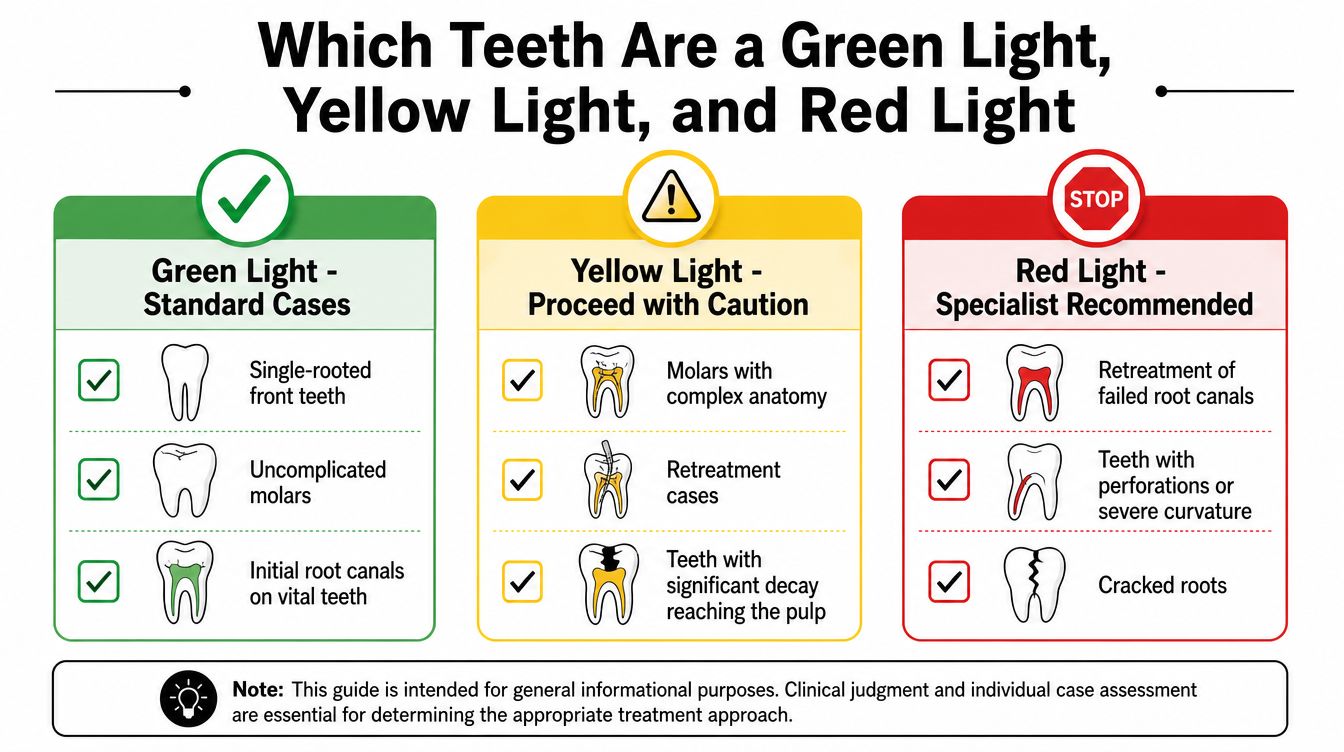
Not every root canal request deserves the same answer. The tooth type, the canal shape, and whether this is a first-time treatment or a repeat job all change the odds, which is why the smartest dentists think in buckets.
Green light cases
Green light cases are the teeth most general dentists handle predictably. That usually means anterior teeth, like incisors and canines, and straightforward premolars with a clean path to the root tip. Those teeth are easier to isolate, easier to see, and usually less likely to hide surprises.
That lines up with the large U.S. dentist survey, where 99% of general dentists who do root canals said they treat anterior teeth and 95% said they treat bicuspids. U.S. survey of general dentists performing endodontic treatment
If you're pointing to a front tooth and asking whether your regular dentist can handle it, the answer is often yes. This is the case where staying local makes sense if you trust the office and they do these procedures regularly.
Yellow light cases
Yellow light cases are the ones that depend on the dentist in front of you. A first molar with straightforward anatomy can be reasonable in a capable general practice. A premolar with mild curvature can also be fine, but only if the dentist has the experience and tools to see the canal system clearly.
You should ask direct questions instead of assuming. If the dentist hesitates, mentions limited visibility, or talks about unusual root shape, that's not a weakness. It's a sign they're thinking like a good clinician.
Red light cases
Red light cases are usually better handled by an endodontist. That includes retreatment after a prior root canal, teeth with severely curved or calcified canals, and molars that already look difficult before the procedure even starts. The same goes for persistent infection, failed prior treatment, or a tooth that has already tested the limits of ordinary access.
Among general dentists who do root canals, only 62% report doing molar cases and 18% report performing retreatment. That gap tells you where the field naturally narrows. U.S. survey of general dentists performing endodontic treatment
Practical rule: if the tooth is a molar, has already failed once, or looks anatomically messy on the X-ray, referral is usually the smarter move.
If you're trying to make the call in real life, wisdom teeth removal is a good reminder of a broader rule in dentistry, not every tooth is best treated in the same office setting just because it can be touched in the same chair.
The cleanest takeaway is this. Front teeth and simple premolars are generally green light. Borderline molars need judgment. Failed, curved, or stubborn teeth are red light until proven otherwise.
What Happens After the Root Canal Is Done
The procedure itself is only half the decision. What happens after the canal is cleaned and sealed often matters just as much, because the tooth still needs a final restoration to stay protected.
In many general practices, the same office handles both the root canal and the restoration. That can shorten the total timeline, reduce back-and-forth, and keep the dentist who treated the infection involved in the repair. If you're trying to avoid extra coordination, that's a real advantage.
By contrast, endodontists commonly send the patient back to the referring dentist for the crown or final filling. That's not a flaw. It's just a different workflow. The tradeoff is simple, specialist precision up front, then a handoff for the rebuild.
The National Dental Practice-Based Research Network found that 82% of nonsurgical root canal treatments are completed in one appointment, with endodontists doing single-visit care more often than general dentists, 84% versus 79%. Study on one-appointment root canal completion and provider differences
Why the handoff matters
A root canal tooth is weaker after treatment, so the final restoration isn't an afterthought. If the tooth sits too long before it's sealed and protected, you're taking on avoidable risk. That's one reason a coordinated general dentist can make sense when the case is simple enough to stay in-house.
Clinical reality: the best root canal is the one that gets finished properly. Diagnosis, cleaning, sealing, and restoration need to work as a sequence, not as disconnected events.
If you want a practice that keeps the treatment path under one roof, dental crowns are part of the same conversation because the crown is often the last step that makes the whole tooth worth saving.
A general dentist is often a strong choice when the case is straightforward and you want one office to manage the whole repair. When the tooth is more complex, the endodontist can handle the canal and your general dentist can complete the crown afterward. Both models work, but the right one depends on the tooth and the timeline.
Comparing Long-Term Success Rates
Patients want the straight answer first. General dentists do a good job with root canals, and endodontists have an edge when the tooth is harder to treat.
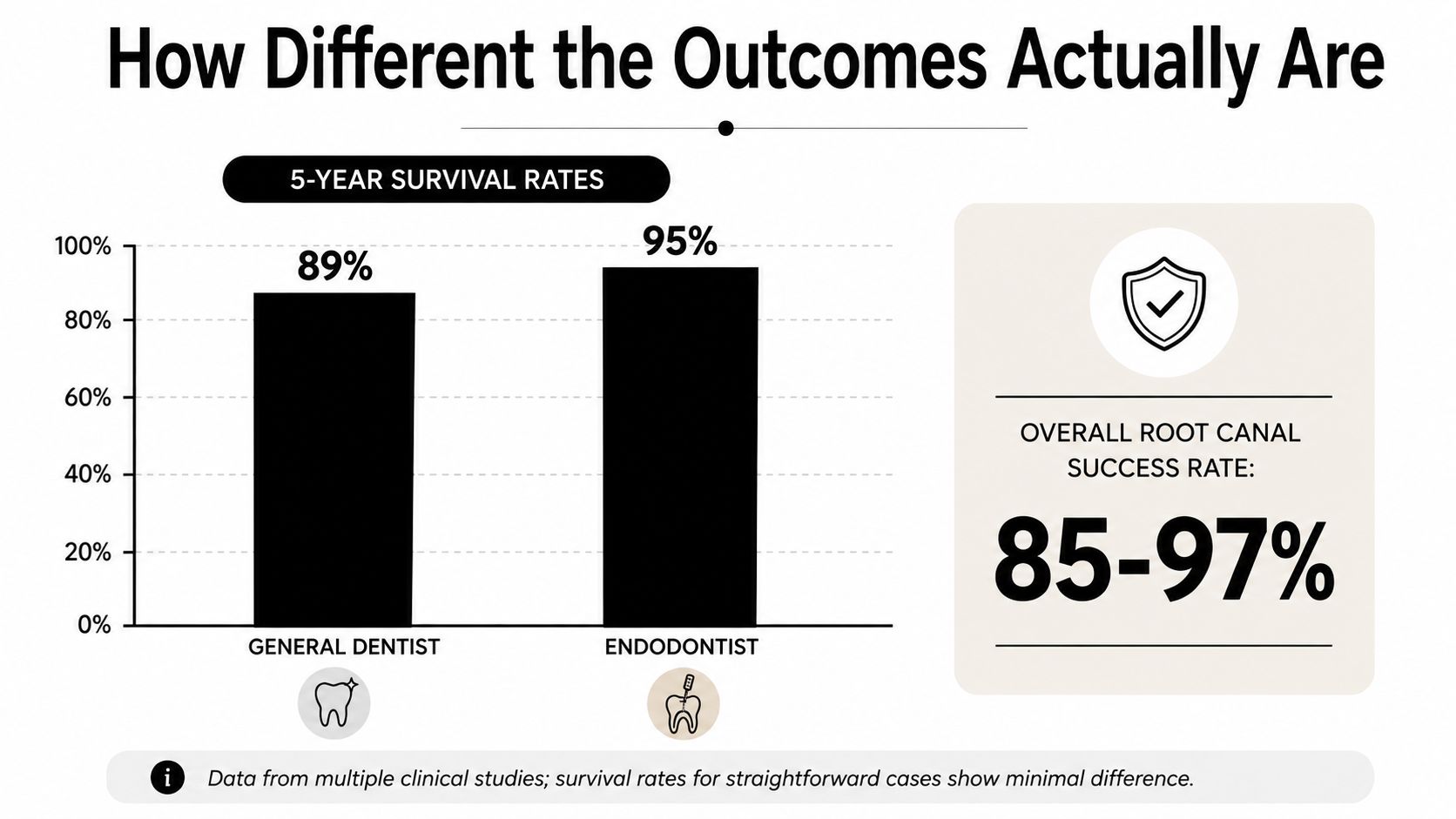
A very large study tracked 487,476 initial nonsurgical root canal treatments and found tooth survival of 98% at 1 year, 92% at 5 years, and 86% at 10 years. The study also found that endodontists had a statistically higher success rate at the 10-year mark. Large study on long-term root canal survival
What that means in plain English
Those are strong results across the board. Root canal therapy holds up well, and both provider types deliver good outcomes overall. The specialist advantage matters more once the tooth becomes difficult, because the anatomy is working against the procedure.
Case selection drives the comparison. Endodontists see more molars, more retreatments, and more unusual canal anatomy. That means the raw comparison slightly understates the skill involved in the toughest cases, because specialists are often treating teeth other offices already passed on.
General dentists achieve excellent results with predictable teeth, and endodontists add the most value when the canals are curved, hidden, calcified, or already treated once before.
How to use the evidence
If you have a simple front tooth or an uncomplicated premolar, the outcome difference usually is not the main issue. Office experience, convenience, and whether your dentist does these cases often enough matter more.
If you have a molar, a retreatment, or a tooth with a history of failure, the average gap matters more in your own mouth. That is where specialist care earns its place.
The numbers support a practical approach. Keep simple cases with a general dentist who does root canals regularly. Send difficult teeth to an endodontist.
When to Stay and When to Ask for a Referral
Stay with your general dentist when the tooth is straightforward, the office does root canals regularly, and you already trust the clinician. A front toothache in a practice that handles endodontics competently is a reasonable place to start, especially if you want diagnosis, treatment, and restoration managed in one place.
Ask about referral when the problem tooth is a throbbing lower molar, the dentist says the canals look difficult, or the office only does root canals occasionally. That doesn't mean your dentist is incapable. It means the tooth may be beyond the point where convenience should win.
If the tooth has already had a failed root canal, specialist care should be the default. Retreatment is a different job from a first-time case, and the margin for error is smaller.
A patient with significant dental anxiety may still do well with a general dentist who handles both the root canal and the crown calmly and efficiently. The key is not the label. It's whether that dentist has the volume, equipment, and communication style to keep the visit controlled.
Ask these questions before you agree:
- How often do you do this exact type of tooth?
- Would you treat this yourself or refer it out if it were your own tooth?
- Do you use a microscope or magnification for canal work?
- What would make you change your mind and send me to a specialist?
A good general dentist won't take offense at those questions. The best ones answer quickly and specifically. If they hesitate, that's useful information too.
When I talk patients through this in Manhattan, I want them to leave with one rule: the right answer depends on the patient-dentist pairing, not just the tooth. A dentist who refers out when the case is outside their comfort zone is doing the right thing.
Questions Patients Ask Before Deciding
Can a general dentist do a root canal on a molar? Yes, often, but not always. Molar anatomy is where the decision gets harder, so if the dentist doesn't do many molars, a referral is the safer move.
Does it hurt more with one provider than the other? Not if anesthesia is done well. The main difference is usually not pain, it's complexity and how confidently the clinician can get through the canal system.
Will insurance treat a specialist visit differently? Sometimes it does, and that can affect your out-of-pocket cost. Ask your plan before you book, because coverage details vary and the office staff can usually help you sort it out.
What if your dentist recommends referral halfway through? That's a good sign, not a red flag. It means they care more about the result than about keeping the case for themselves.
If you're still unsure, ask one final question: “Do you think this tooth is routine for you, or routine for an endodontist?” That gets you a real answer fast.
Paul L. Gregory, DDS provides root canal treatment, diagnostic care, and restoration planning in one Manhattan office, which can be useful when you want the tooth evaluated, treated, and rebuilt without unnecessary handoffs. If you need a straight answer about whether your tooth belongs with a general dentist or should be referred out, visit Paul L. Gregory, DDS and ask for an in-office assessment.