

You bite into lunch and the molar that lost part of its filling last month flexes under the pressure. It doesn't snap, but it doesn't feel solid either. That's the moment people start asking when do you need a dental crown, and the useful answer isn't the size of the cavity or the fact that a root canal was finished. It's how much healthy tooth is still there to carry the bite.
I would start with the remaining walls, not the old filling. A full cover is the right call when those walls can't hold a restoration. A filling or an onlay can still be the better choice when they can.
What a Crown Protects and Why Dentists Recommend One
You close on a sandwich and feel a back tooth give. The filling is still seated, but the tooth moves a little, as if the shell around it is too thin.
A dental crown is a fixed cap that completely covers a natural tooth. Think of a helmet holding a cracked shell together. The UK National Health Service lists a broken, decayed, or otherwise damaged tooth among the main reasons for that cap. A better look can be part of the result, but the job that matters is structural. The crown carries biting forces so a weakened tooth is less likely to split.
A tooth usually needs that cover when it no longer has enough healthy structure to function safely with a filling. Common situations include a large filling occupying at least half the tooth's width, severe decay that has destroyed most of the original tooth, loss of one or more walls, a painful internal crack, or a completed root canal. Crowns also secure dental bridges and restore implants, so the same cap can be one piece of a larger plan.
Cavity size alone doesn't settle it. The exam has to weigh how much sound enamel and dentin remain, whether the tooth can be isolated and sealed, where it sits in the bite, what you feel, and what the X-ray shows. A crown isn't automatic for every cavity, discoloration, or root-canal tooth. If enough healthy structure remains, a filling or a conservative indirect restoration keeps more of your own tooth. The situations below are where that answer is usually no.
Situations That Usually Call for a Crown
| Situation | Typical finding | Usually recommended |
|---|---|---|
| Large filling covering half the tooth width or more | Little sound tooth left around the filling | Crown usually recommended |
| Severe decay that has destroyed most of the tooth | Decay extends beyond what a filling can hold | Crown usually recommended |
| Loss of one or more tooth walls | Tooth flexes under biting forces | Crown usually recommended |
| Painful internal crack | Pain on biting; crack seen on exam or X-ray | Crown often recommended to hold the tooth together |
| Completed root canal treatment | Internal structure lost; tooth more prone to fracture | Crown often recommended; check remaining walls first |
| Broken or failing large filling | Restoration cracked or leaking on a weakened tooth | Crown if the remaining tooth is weak; filling replacement if strong |
| Tooth used as a bridge abutment | Tooth must support a fixed bridge | Crown required for support |
| Small cavity in healthy enamel | Enough sound structure remains | Filling usually sufficient |
Read each row as an indicator, not a rule. The dentist still weighs the remaining tooth, the bite, and the X-ray together.
Rows that point toward a crown
A filling that already covers half the width, decay that has eaten most of the tooth, and a missing wall all leave too little shell to grip a direct restoration. The tooth flexes, the filling leaks, and the next break takes more tooth with it. A painful crack seen on exam or X-ray is similar: the crown's job is to hold the pieces so chewing doesn't drive the crack farther.
A finished root canal often belongs in the same group because internal structure is gone, but the remaining walls still get checked first. A broken large filling on a weak tooth usually moves to a crown. The same break on a strong tooth can be a new filling. A tooth that has to hold a fixed bridge needs a crown for support. That isn't optional.
The row that stays a filling
A small cavity in healthy enamel still has sound structure around it. A filling is usually enough, and cutting the tooth down for a crown would throw away tissue you still need.
Practical rule: Count how many rows match your tooth or your symptoms, write that list down, and bring it to the appointment.
If timing matters, a same-day tooth restoration visit can start that check before the tooth splits. Once a crown is the plan, it also helps to know how long dental crowns last under ordinary chewing, grinding, and home care, so you can judge the trade-off against keeping more of the tooth.
Warning Signs That a Tooth Needs a Crown
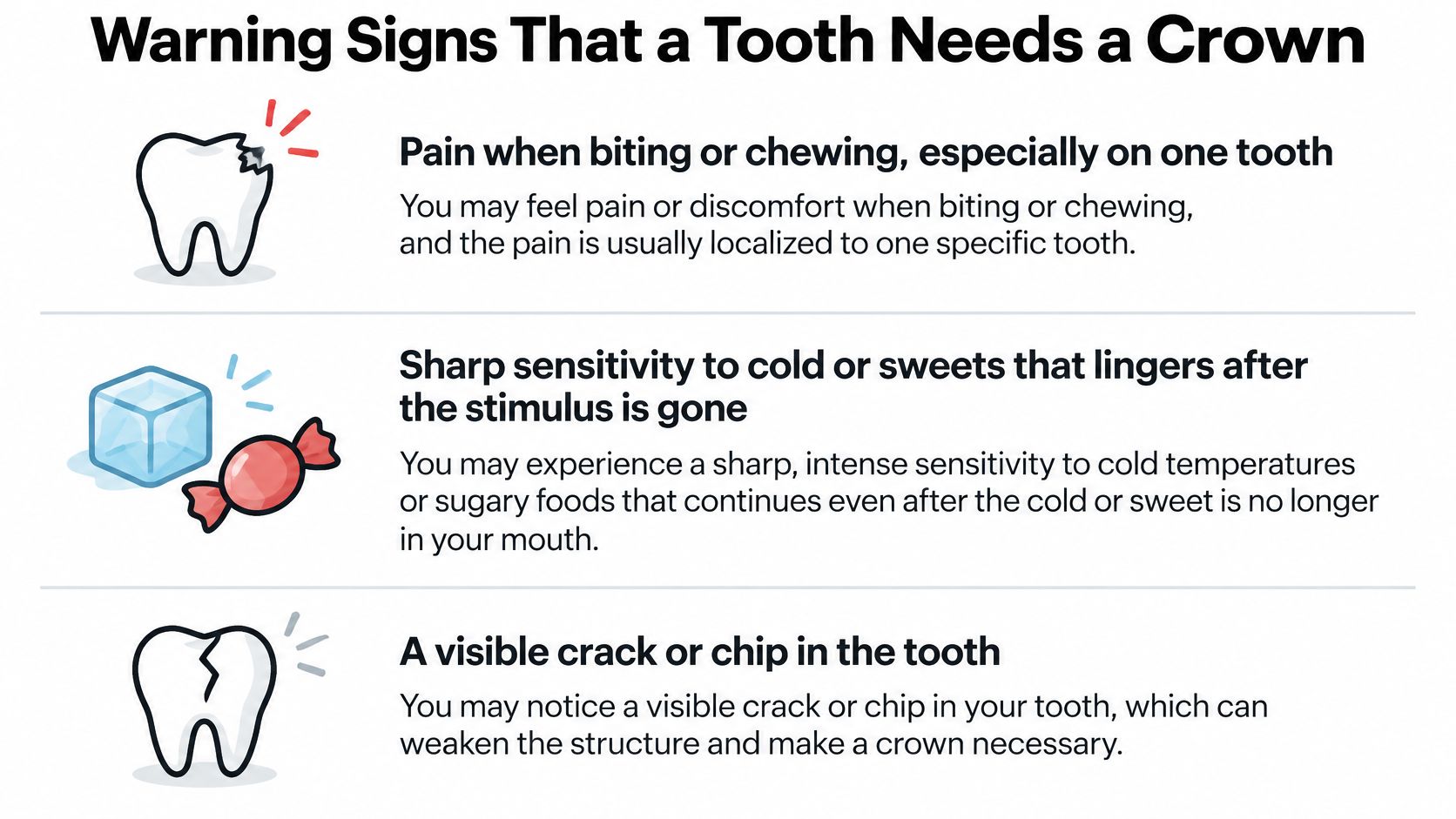
Symptoms tell you to get checked. They don't, by themselves, prove a crown is the right restoration. Note which of these fit, how long they've lasted, and when they started.
- Pain on one tooth: Pain when biting or chewing, especially on a single tooth, often means a crack or a weak wall is flexing.
- Lingering sensitivity: Sharp pain to cold or sweets that stays after the stimulus is gone is different from a quick zing that fades.
- A crack or chip you can see: A line, a missing corner, or a rough edge is worth mapping before it lengthens.
- Soreness after a root canal: A treated tooth that stays tender may be short on structure, not just healing.
- A loose, fractured, or missing filling: Once the plug is gone, the walls around it take the full bite. If a tooth filling fell out, keep the piece and avoid chewing there.
- Dark decay at an old filling edge: Stain or a soft spot at the margin means the seal has failed.
- A shorter, worn tooth: A tooth that looks flatter or shorter than its neighbors has lost height that a filling may not rebuild.
The exam, bite testing, and X-rays show how much tooth is left. That finding, not the symptom list, decides crown, onlay, or filling.
Signs that shouldn't wait
Swelling of the gum or face, a bad taste, pain that keeps throbbing, or a tooth that has already split needs a same-day or next-day visit. Bring the written record of what you feel, which tooth, and when it started. Those details keep the visit focused on the tooth that is failing.
How Much Tooth Is Left Decides Crown, Onlay or Filling
The chart label matters less than the tooth in front of you. A root canal or a large filling does not settle the restoration by itself. I decide by counting lost surfaces, then checking the cusps, marginal ridges, crack path, bite load, and the band of sound tooth available around a future margin.
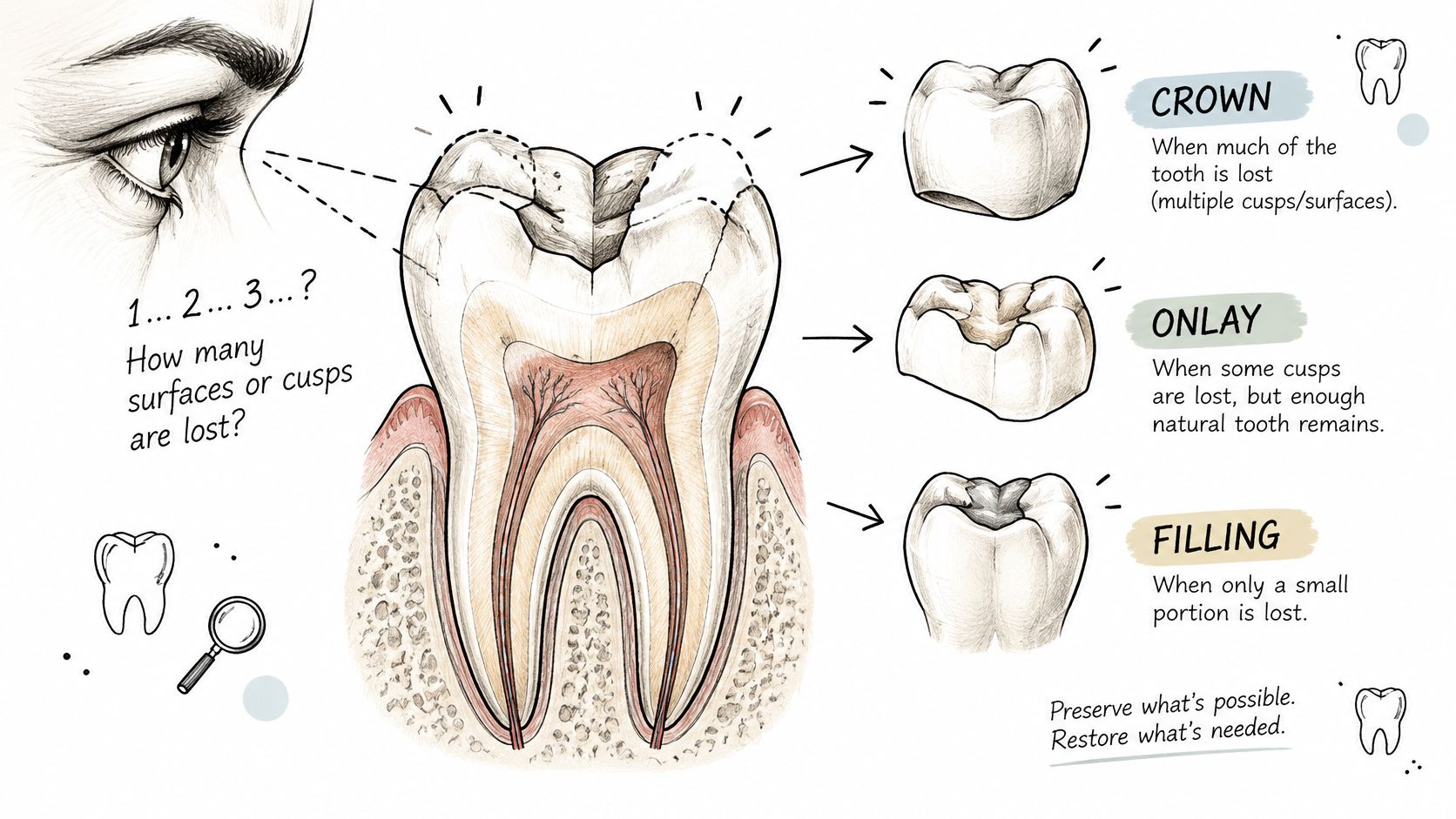
With one to three surfaces lost and stable cusps, direct composite or an adhesive partial-coverage restoration may preserve more tooth. With four to five surfaces lost, undermined cusps, or a crack running toward the gumline, full cuspal coverage becomes more defensible. A national practice-based survey of 1,777 clinicians ranked fractured or cracked teeth, endodontic treatment, and broken restorations as the leading crown indications, followed by active caries and large restorations. The same work points to the practical test: sound enamel and dentin, cusp support, crack location, bite load, and whether a ferrule can be built.
The band that makes a crown hold
The ferrule is a band of sound dentin above the preparation margin. It gives the crown something firm to grip, so biting force is less likely to split the tooth or its core. A crown without that band depends more on the core and the bonding material, which is a weaker plan when heavy chewing forces are present. The tooth also has to be restorable, easy to keep clean at the gum, and able to support a durable margin. “Root canal completed” is not the same assessment.
| Restoration | Tooth structure removed | Best fit |
|---|---|---|
| Direct filling | Smallest removal | One to three surfaces lost with stable cusps |
| Onlay | Moderate partial-coverage removal | Posterior tooth with partial loss where cusps can be partly covered |
| Full crown | Greater circumferential removal | Four or more surfaces lost, undermined cusps, or weak walls after root canal |
A direct filling removes the least tooth structure. An onlay covers damaged cusps without circling the whole tooth, so it can be a useful middle step when enough sound wall remains. A full crown trades more tooth removal for wrapping and protecting the remaining structure. That trade-off deserves respect, especially for a young patient or a tooth likely to need more than one restoration over time. A systematic review of posterior onlays and partial crowns found they performed comparably to full crowns over short-term follow-up. That evidence does not make onlays always superior, and evidence for severely damaged posterior teeth does not show a clear meaningful difference.
Ask to see on the X-ray how much sound tooth surrounds the planned margin, whether a ferrule can be built, and whether an onlay is realistic. A permanent dental filling still wins when the walls are intact. Inadequate walls, decay that wraps the tooth, a fracture below the gum, or a bridge abutment are the cases where full coverage earns the extra removal.
Why Root Canal Teeth Often Get Crowns
A root canal can leave a tooth feeling quiet and settled, yet the chewing surface still has to work hard. Once infected pulp is removed, the tooth has less internal structure. Back teeth carry heavy forces, and the remaining walls have to resist splitting under that load.
A systematic review of single crowns on root-canal-treated teeth covering 10 eligible studies estimated 10-year survival of 81% for teeth restored with crowns, compared with 63% for teeth restored with direct materials such as resin composite, amalgam, or cement. In that Europe PMC summary, crown survival fell from 94% during the fifth year to 81% by the tenth year, while the direct-restoration group stayed around 63%.
Survival has a narrow meaning here. It says the tooth or restoration stayed in service under the study definitions. It does not promise that a crown lasts forever, and it does not turn every root-canal tooth into a crown case. Position, remaining walls, chewing force, grinding, hygiene, material, and new decay all change the result. Broader restoration research in that review put roughly 96% 10-year survival on gold indirect restorations, about 90% on porcelain-fused-to-metal crowns, and roughly 75–80% on all-ceramic crowns.
A successful root canal treats the infection. It doesn't put the missing walls back.
The practical question is how much sound tooth remains after the root canal and buildup. A small access opening with strong walls may be restored more conservatively. A molar with broad cavities, thin walls, or undermined cusps usually needs full coverage. I recommend looking for a restorable margin and enough tooth structure to hold it before committing to any crown.
What you can change is smaller and still useful: a night guard if you grind, regular cleanings, and a prompt look at new biting pain rather than waiting for a split. If you're weighing root canal treatment and the restoration that follows, ask whether the crown is planned soon after treatment and what protects the tooth until it is cemented.
What to Do When a Crown Fails or Chips
A tooth that needs a crown and a tooth that needs its crown replaced are different diagnoses. Failure mode sets both the urgency and whether the tooth can still be saved.
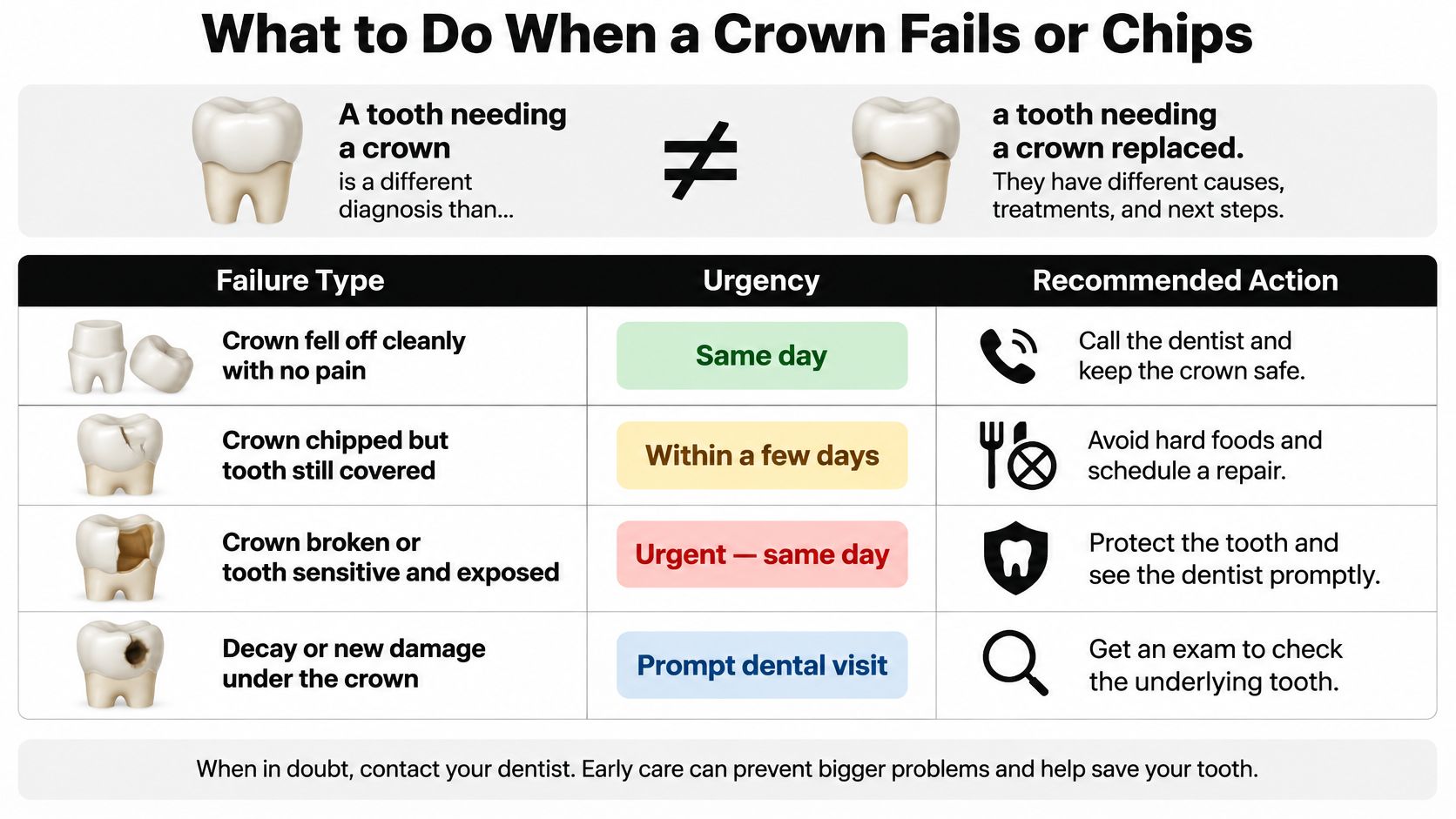
| Problem | Urgency | Likely next step |
|---|---|---|
| Loose crown, no pain | Schedule soon | Re-cement if the crown and tooth are sound |
| Chipped ceramic edge, no pain | Routine visit | Smooth a minor chip or replace the crown |
| Recurrent decay at the crown margin | Soon | Remove decay and repair or replace the crown |
| Gum inflammation around the crown | Routine | Gum treatment, hygiene plan and crown check |
| Lingering pain, swelling or bad taste | Same day | Assess for infection; may need root canal retreatment |
| Sharp fracture of the tooth | Same day | Decide whether the tooth is restorable or needs extraction |
A loose crown, a ceramic chip, decay at the edge, sore gums, signs of pulp infection, and a crack in the tooth underneath don't share one prognosis. A systematic review in the Journal of Prosthetic Dentistry literature reported that catastrophic, nonrestorable failures were more common with crowns than with onlays, though the overall comparison remains limited. Repairability depends on both the crown and the tooth left under it. If a tooth crown falls off, don't wait for it to happen again before you get it looked at.
- Stay off that side. Hard and sticky foods lever a loose crown or drive a crack. Soft food on the other side buys time.
- Keep the crown, don't re-glue it. Store cement from a pharmacy can trap decay or seat the cap in the wrong place. Bring the crown in.
- Book same day or next day if it hurts, swells, or moves. A short visit can re-cement a sound crown, smooth a small chip, or find a fracture or infection before the tooth can't be restored. For a sharp break with an exposed edge, broken tooth emergency treatment guidance is a useful checklist while you arrange care.
- Ask what this crown can still do. Re-cement, smooth, or replace are different plans. The answer depends on the cap and on the tooth, not on how old the crown is.
Book a Crown Assessment Before the Tooth Breaks
A tooth that has lost enough structure can fail suddenly, especially when a crack reaches the margin or a large filling no longer supports the chewing surface. Bring the warning signs you have noticed, the teeth involved, and any past X-rays or root canal records. Then ask focused questions.
- How much sound tooth remains around the planned margin?
- Is an onlay or a filling a realistic alternative on this tooth?
- What protects the tooth until a crown, if one is needed, is placed?
Paul L. Gregory, DDS offers dental crowns, fillings, bridges, implants, cleanings, exams, and X-rays, so you can bring the tooth, the symptoms, and any old X-rays to a visit at the Midtown office. The same structural criteria apply whether you come from Midtown, Chelsea, the Upper West Side, the Upper East Side, Lennox Hill, Turtle Bay, Hell's Kitchen, the Theatre District, Gramercy Park, the West Village, Greenwich Village, NoHo, the East Village, SoHo, Tribeca, Hudson Yards, Chinatown, or Wall Street. Neighborhood doesn't change how much tooth is left.
Short-notice visits are available, and the practice makes every effort to schedule dental emergencies as quickly as possible, including an emergency dentist and emergency tooth extraction near 57th Street. Book before a cracked tooth becomes non-restorable, and say so when you call if you have pain, swelling, or a loose crown.
If a molar is flexing, a root canal tooth is waiting on coverage, or a crown has shifted, visit Paul L. Gregory, DDS and bring the tooth, the symptoms, and any old X-rays so the margin can be judged before more structure is lost.