

Mild cold or sweet sensitivity after a cavity filling often starts within 48 hours and commonly fades over days to a few weeks, while pain past four weeks, lingering heat or cold pain, biting pain, or swelling needs a dentist. The most useful distinction is whether the discomfort stops quickly and keeps improving, or lasts longer, appears without a trigger, or gets worse.
A sensitive tooth doesn't automatically mean the filling failed. It means you need to pay attention to what triggers the pain, how long it lasts, and whether the pattern is changing.
Why a New Filling Can Feel Sensitive
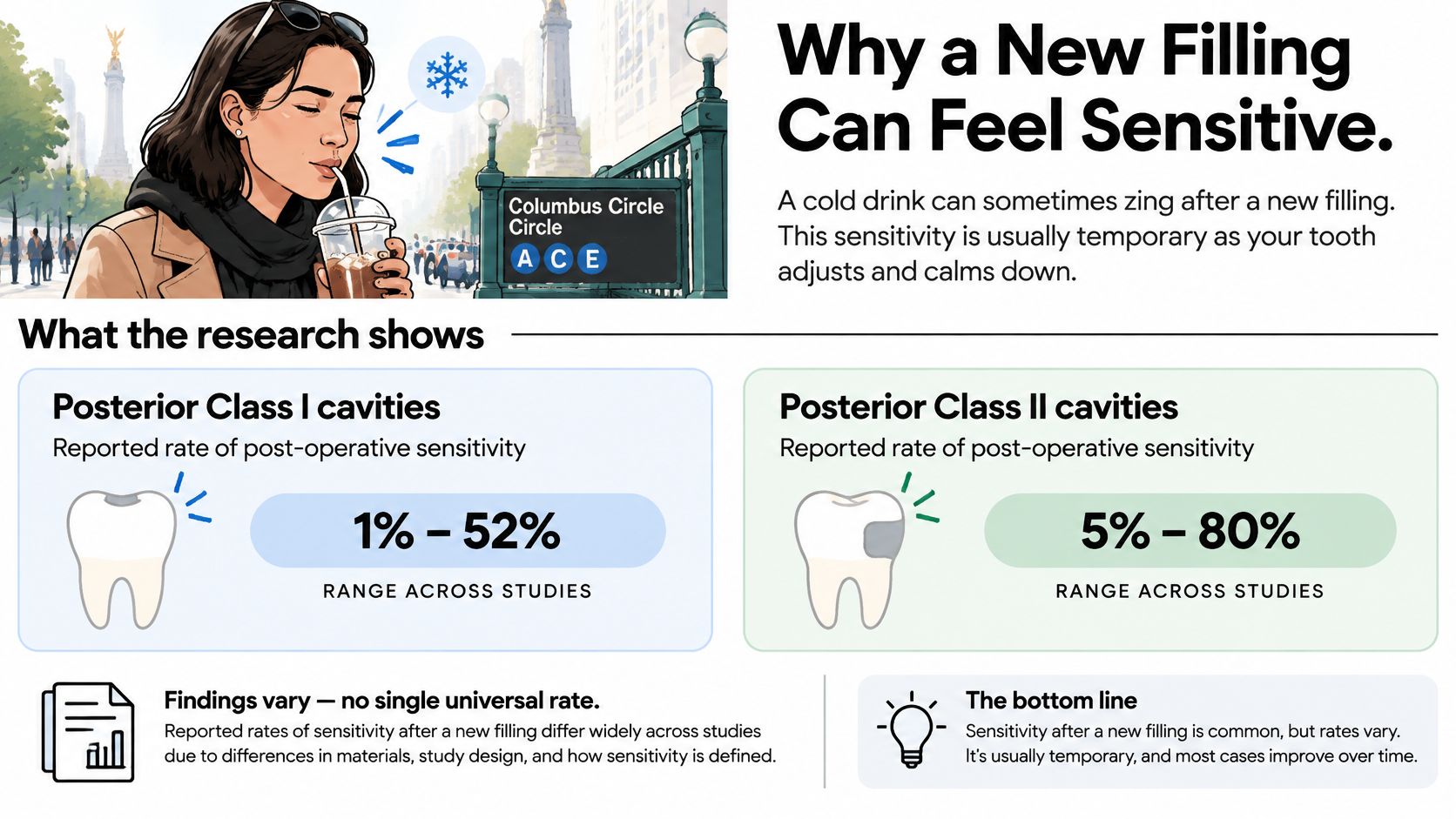
An iced drink zings against your newly filled tooth as you walk back toward Columbus Circle. The sting disappears when you stop sipping, but it's enough to make you wonder whether something went wrong.
Post-filling sensitivity is a recognized outcome, not a universal one. A clinical report in the Pakistan Oral & Dental Journal describes 26.3% of treated teeth developing sensitivity after posterior Class I and Class II cavities were restored with a self-etching adhesive and nanofilled composite, with approximately 75% of those cases resolving within one week; it also discusses a separate posterior-composite estimate of 20.3%, with a 95% confidence interval of 15.7% to 25.9% and symptoms typically beginning within 48 hours, alongside lower reported rates of about 13% for Class I composites and 5% for simpler Class I cavities.
Those percentages describe different groups and treatment conditions. They don't predict exactly what your tooth will do.
The range is more informative than a single headline rate.
What changes your individual recovery
Class I cavities involve pits and grooves, commonly on chewing surfaces. Class II cavities involve the surfaces between back teeth, which can make the restoration more complex.
Deep decay, a larger restoration, and a pulp that was irritated before treatment can change recovery. The pulp is the living tissue inside the tooth, including its nerves and blood vessels. Removing decay repairs the damaged structure, but it doesn't instantly settle every irritated tissue.
Understanding how dentists fill cavities helps separate the restoration itself from the tooth's response to treatment.
- More reassuring: A short, sharp response to a trigger that becomes less noticeable.
- Worth checking: Pain that lasts longer, occurs without a trigger, or increasingly interrupts eating.
- Not proof of failure: An isolated early twinge without a worsening pattern.
A search for “cavity filling sensitive” can make every possible cause sound equally likely. They aren't. Your symptom pattern is more useful than the mere presence of discomfort, especially when deciding whether to monitor the tooth or arrange an examination.
Sensitivity Patterns and When to Call
The pattern determines the urgency. Use the character of the pain, not just the calendar, to choose your next action.
Post-filling sensitivity patterns and what to do
| Pattern | Usual course | Action |
|---|---|---|
| Brief cold, sweet, or air zing that stops in seconds | Often begins soon after treatment and improves over days to a few weeks | Monitor if it steadily lessens |
| Pain only when biting | May continue if the filling contacts too heavily | Call for a bite check |
| Cold or heat pain lasting many seconds or minutes | Not ordinary brief tubule sensitivity | Arrange a dental examination promptly |
| Spontaneous throbbing, night pain, or pain that worsens | Suggests pulp inflammation more than a simple interface zing | Book a prompt visit |
| Still sensitive after four weeks | Routine sensitivity is expected to settle sooner | Contact the clinic |
| Swelling, fever, pus, or trouble swallowing or breathing | Not a healing pattern | Seek same-day urgent care; breathing or swallowing difficulty needs immediate emergency care |
The Loul Dental Studio symptom guide distinguishes brief sensitivity that stops within seconds from biting pain persisting for a week or two, and recommends evaluation within days for lingering thermal pain, spontaneous throbbing, nighttime pain, or worsening symptoms. Separately, NHS dental-filling guidance says sensitivity should normally resolve within a few weeks and advises contacting the clinic if it persists beyond four weeks.
A brief sting and a lingering ache mean different things
Say cool water causes a momentary sting, but your tooth feels comfortable afterward and you're noticing less discomfort overall. Monitoring is reasonable because both the duration and direction are reassuring.
Now consider a tooth that aches after the drink is gone. Even if the filling is recent, that lingering response deserves a call. Don't wait for a routine recovery deadline when the pain has already changed character.
Pain on biting also deserves its own assessment. If your teeth don't seem to meet evenly, or the treated tooth feels as though it touches first, explain that when booking. You don't need to keep testing it with hard food.
When not to fit the appointment around work
Swelling, fever, or pus calls for urgent assessment rather than another trial of sensitive toothpaste. Difficulty breathing or swallowing requires immediate emergency medical care, not waiting for a dental office to reopen.
For pain without those emergency signs, describe whether it interrupts sleep, occurs at rest, or follows chewing. That information helps distinguish a routine follow-up from a more urgent tooth-pain assessment.
You also don't have to determine whether the cause is a high filling, a crack, or pulp inflammation before calling. Those are diagnoses for the examination. Your job is to report the pattern accurately.
Decision rule: Monitor improving, stimulus-linked sensitivity. Call for lingering, biting, nighttime, or worsening pain. Seek urgent care for swelling, fever, or pus, and immediate emergency help for trouble swallowing or breathing.
How to Ease a Sensitive Filling at Home
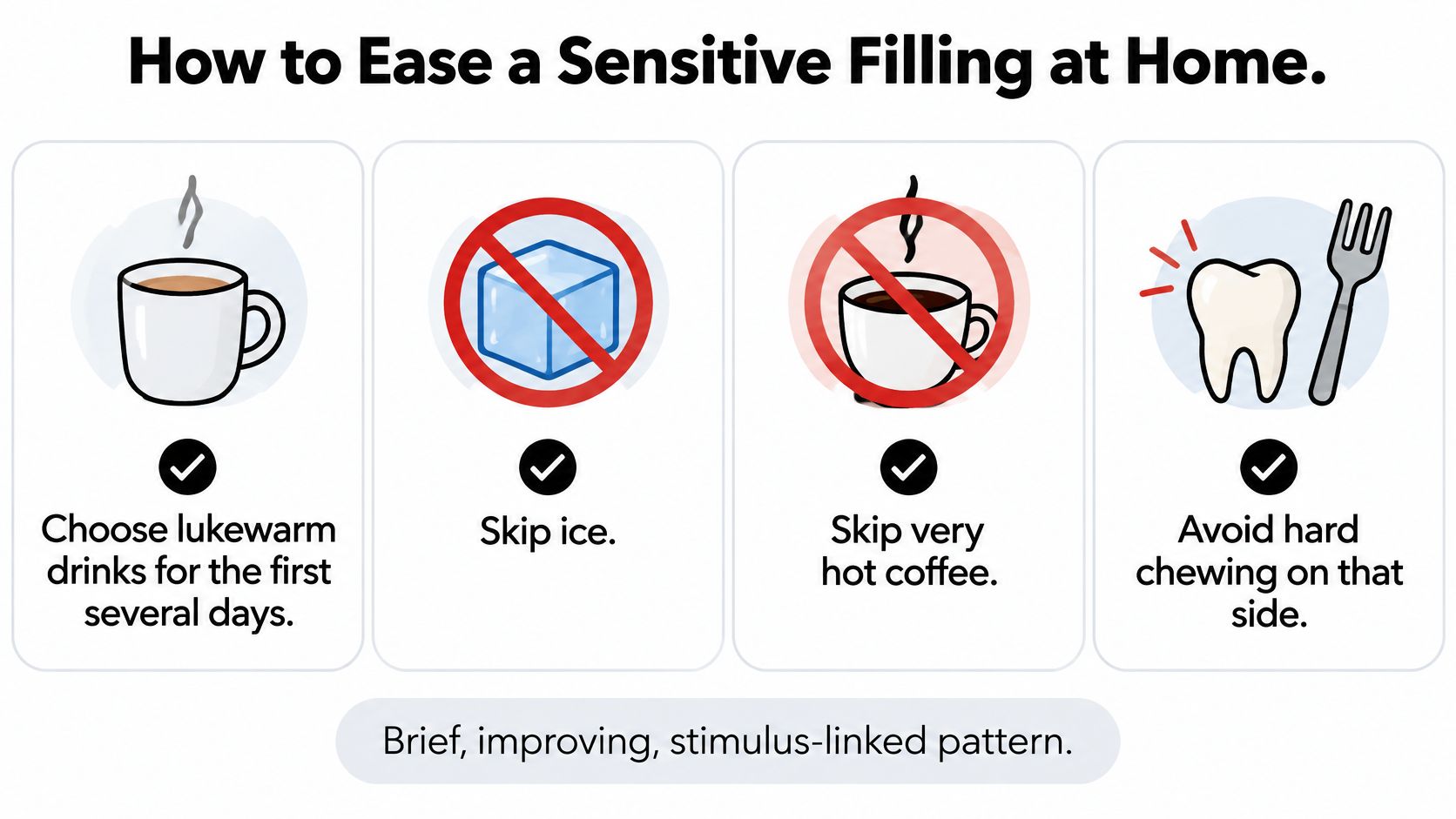
Home care is appropriate for brief, improving, stimulus-linked discomfort. It isn't a substitute for an examination when chewing hurts, pain wakes you, or swelling develops.
The DentalBlue patient guide describes routine sensitivity lasting several days to a few weeks, with deeper cavities, pre-existing sensitivity, and clenching or grinding potentially extending recovery. The important feature is gradual improvement, not forcing the tooth to meet a rigid deadline.
Use these measures to reduce avoidable triggers while you observe that improvement.
Make everyday eating and cleaning gentler
Choose lukewarm drinks and softer chewing. Skip ice, very hot coffee, and hard foods on the treated side while it's reactive. This reduces provocation, but it won't correct a filling that meets too heavily.
Keep brushing the tooth. Use a soft-bristled toothbrush and fluoride toothpaste, cleaning gently along the gumline and filling margin. Avoiding the area lets plaque collect; aggressive scrubbing won't make the tooth recover faster.
Pause obvious food triggers. If sweets or acidic drinks reliably sting, leave them out while the tooth settles. Don't repeatedly sip something painful to check whether you're better, and don't interpret avoiding a trigger as proof the underlying problem has resolved.
Try a desensitizing toothpaste appropriately. A fluoride toothpaste containing potassium nitrate is a practical option when used according to its directions. It can help surface sensitivity, but it doesn't treat infection or explain spontaneous pain.
Track the response rather than repeatedly testing it
Continue an existing prescribed night guard if it fits comfortably. If the filling has changed its fit, contact the office rather than forcing it into place. Don't improvise or reshape a guard at home.
Record the trigger, duration, and bite response. Note whether discomfort follows cold, sweets, or chewing, whether it stops promptly, and whether ordinary closing hurts without any temperature trigger. Observation is useful; deliberate painful testing isn't.
Act when the pattern changes. Call if improvement stalls, biting becomes painful, or warning symptoms appear. If material seems missing or you can feel a new opening, follow guidance for a filling that has fallen out rather than treating it as ordinary sensitivity.
Home-care limit: Comfort measures can reduce triggers. They can't adjust a high bite, seal a broken restoration, or treat an infected tooth.
How Dentin and Shrinkage Stir the Nerve
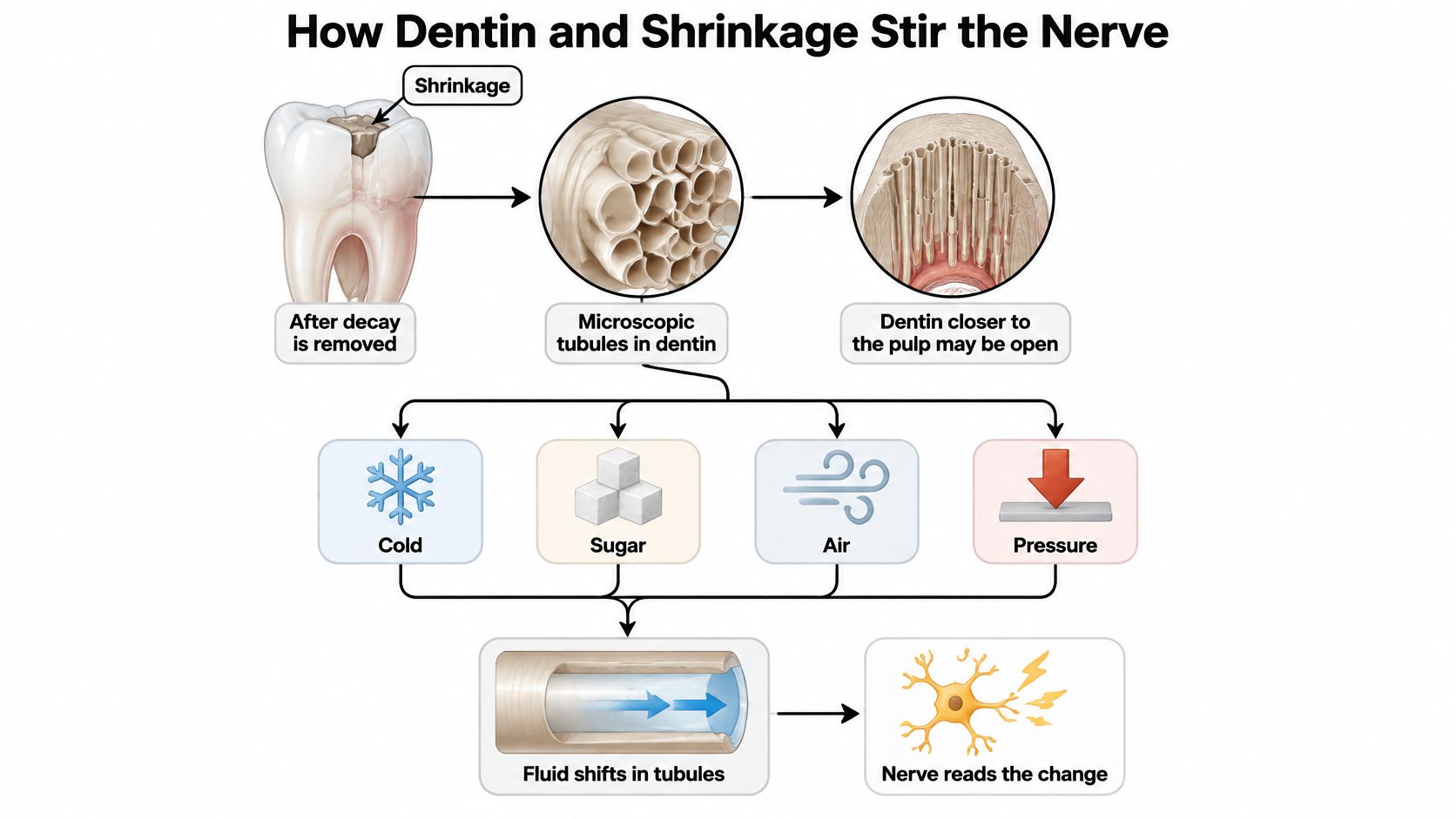
Consider a filled molar that reacts when cold water touches it, then becomes comfortable again. The sensation can begin in dentin, the layer beneath enamel, rather than from the filling material directly touching a nerve.
Dentin contains microscopic channels called tubules. When decay is removed, the dentist may be working closer to the pulp, with less dentin remaining between the restoration and living tissue.
Cold, sugar, air, and pressure can cause fluid movement within those channels. The nerve detects that movement as a short, sharp sting, much as a draft through a cracked window can feel larger than the opening itself.
The relationship between the restoration, dentin, and pulp helps explain these triggers.
What happens as composite hardens
Resin composite hardens through polymerization, a chemical setting process activated with a dental curing light. During that process, the material contracts and places stress on the bonded surfaces.
A clinical paper available through PubMed Central describes approximately 2% to 5% volumetric polymerization shrinkage in resin composites and reports postoperative sensitivity in 8% of posterior restorations in a randomized clinical study. If contraction stress exceeds the bond strength at the dentin-composite interface, microscopic gaps can form.
Those gaps may permit fluid movement and leakage at the restoration edge. Sensitivity or marginal staining can follow, although a cold sting alone doesn't prove that a gap exists.
Several contributors can overlap
The dentist considers the whole restoration rather than assuming one material or adhesive caused the problem.
- Remaining tooth structure: A deep cavity leaves less dentin to protect the pulp, while a large restoration can alter how the remaining tooth flexes.
- Surface preparation: Over-dried dentin or incomplete adhesive penetration can affect the interface.
- Bite contact: A high contact concentrates chewing pressure on the treated tooth.
- Placement and curing: Moisture contamination, placement stress, and incomplete curing can compromise the restoration.
Preventive technique includes moisture control, appropriate adhesive application, stress-reducing placement, thorough light curing, and a careful bite check. These are separate clinical steps, not interchangeable features of a premium material.
For the patient, the useful distinction remains concrete: a short response after a trigger is compatible with fluid-related sensitivity. An ache that begins while you're sitting at rest, especially if it throbs or disturbs sleep, shouldn't be explained away as simple movement inside dentin tubules.
Why the Filling Material Rarely Decides It
Tooth-colored doesn't automatically mean sensitivity-free. Choosing a material and choosing how to investigate pain are separate decisions.
Conventional composite and bulk-fill composite differ in how they're formulated and placed. Self-etch and total-etch describe bonding approaches, not entirely different categories of finished filling. None is a guarantee that an already irritated tooth will stay comfortable.
A Cochrane evidence summary on permanent back-tooth filling materials reports postoperative pain of about 5% in both compared resin-composite groups, with sensitivity-event estimates from 0% to 10%, but judges the evidence very low certainty; a newer 2026 comparison described in the evidence notes reported a mean pain difference of −1.204 points favoring bulk-fill composite over conventional composite (p=0.043). That single newer comparison doesn't establish a settled clinical trend.
What the evidence says about filling materials and sensitivity
| Factor | Sensitivity evidence | Limit of that evidence |
|---|---|---|
| Conventional resin composite | Most patients in the compared groups had no sensitivity; pain occurred in a minority | Very low-certainty evidence; depth and bite still matter |
| Bulk-fill composite | A newer comparison favored bulk-fill for postoperative pain | A single comparison doesn't establish universal superiority |
| Amalgam | No basis for promising it is universally gentler after deep decay | Choice also involves appearance, repair options, and durability |
| Self-etch vs total-etch | No meaningful sensitivity difference in pooled randomized trials | Bonding approach alone doesn't resolve technique or diagnostic issues |
The stronger bonding comparison is a systematic review and meta-analysis indexed in PubMed: across 25 randomized controlled trials and 2,580 restorations, the relative risk under USPHS criteria was 1.00, with a 95% confidence interval of 0.96 to 1.04, and the visual-analog-scale standardized mean difference was 0.02, with a 95% confidence interval of −0.15 to 0.20. These findings don't support switching bonding systems as a reliable cure for postoperative sensitivity.
Choose for the tooth, not a promise
Composite offers tooth-colored appearance and can often be repaired locally. Amalgam may be considered for durability in selected back teeth, but its metallic appearance and different repair considerations also matter. Neither choice bypasses the need to assess remaining tooth structure, bite forces, and pulp health.
Likewise, composite versus porcelain fillings involves questions beyond whether a newly treated tooth briefly reacts to cold.
Don't replace a sound filling solely because of mild early sensitivity. First establish whether the problem is the bite, the restoration, the tooth structure, or the pulp.
Persistent pain needs a diagnosis, not a search for a magic adhesive. Replacing a restoration without identifying the cause may expose the tooth to another procedure without solving the original problem.
Real Patterns After Deep or High Fillings
These hypothetical situations show why two people with a sensitive filling may need different next steps. The history before treatment matters as much as what happened afterward.
A sensitivity assessment considers the tooth, restoration, and timing together.
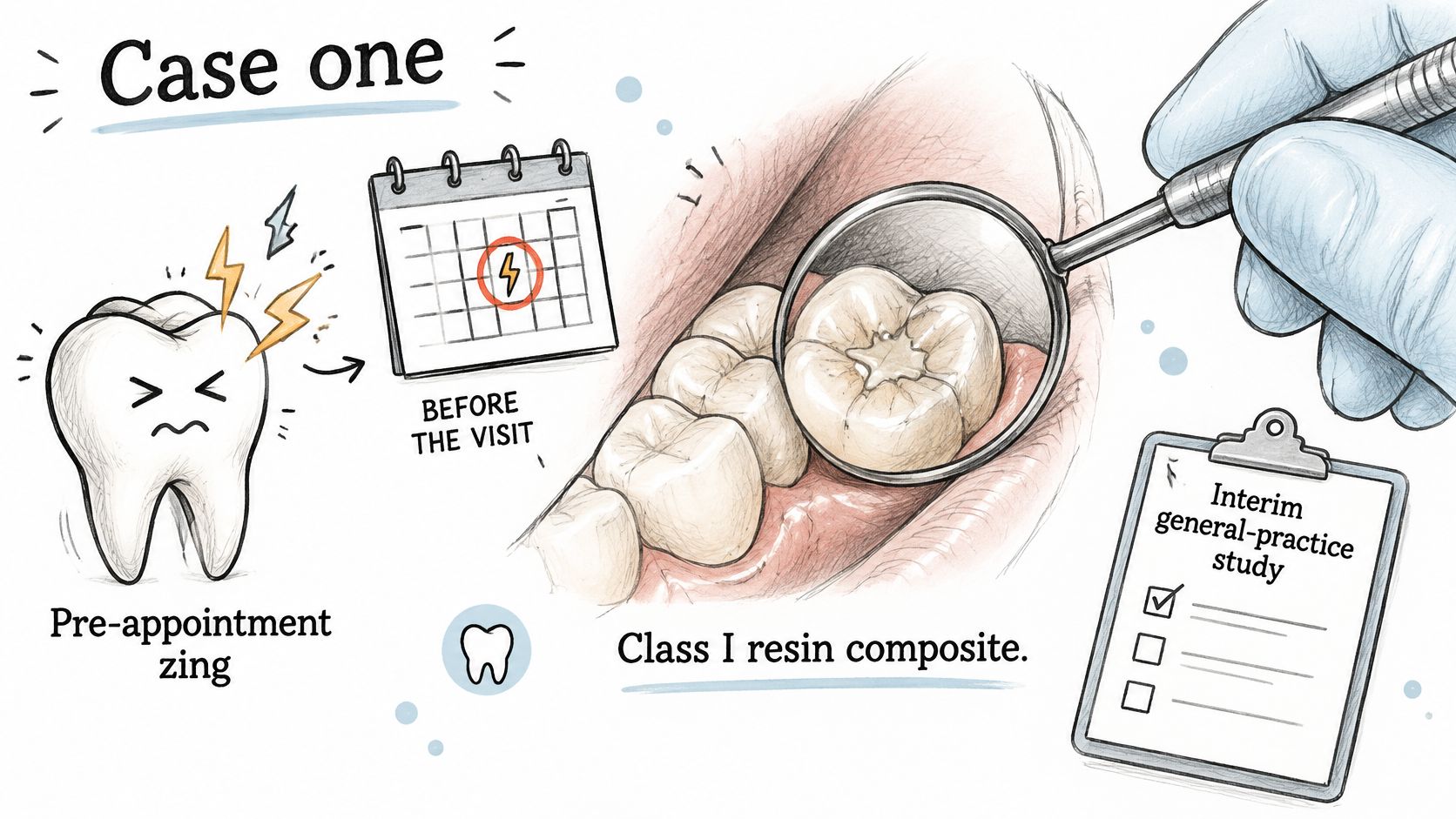
A molar that already reacted before treatment
Say your molar was sensitive before the appointment and still reacts afterward, although the sting is gradually shorter. That history doesn't prove the new filling is defective.
In an interim general-practice study of Class I resin-based composites, 54.6% of teeth with baseline data had some hypersensitivity before treatment and 52.4% of followed teeth reported some at one week; air-blast sensitivity declined from 31% to 26%, with 50.9% of initially air-sensitive teeth remaining sensitive and 16.0% of initially non-air-sensitive teeth developing it. The same paper discusses a sample of 123 restorations in which cavity depth, calcium-hydroxide liner use, and restorative material didn't significantly predict pain or hypersensitivity.
The decision is to assess the direction of recovery and the original pulp irritation, not automatically replace the restoration.
A tooth that hurts when the teeth meet
Now suppose cold water is comfortable, but closing your teeth causes a sharp catch. A high contact is one possibility, though cracks and other causes must also be considered.
Arrange a bite assessment rather than relying on toothpaste. The dentist can mark tooth contacts with articulating paper and examine the restoration before deciding whether adjustment is appropriate. A larger structural problem may instead raise the question of when a dental crown is needed.
This video provides additional context for discussing a treated tooth with your dentist.
A deep filling followed by nighttime aching
A tooth that develops lingering temperature pain or throbbing at night needs pulp testing, not an assumption that deeper fillings always hurt longer. The examination determines whether the pulp can recover and what treatment is appropriate.
Patient accounts illustrate why diagnosis matters, without predicting anyone else's outcome. One reviewer described major sensitivity after treatment elsewhere, relief at Dr. Gregory's first visit, ongoing checks, AI-assisted X-ray review, and accommodating scheduling. Heather wrote, “Dr Gregory saved me from getting a root canal that I did not need.”
The useful question is the same in each case: Is this fading, trigger-linked discomfort, or biting, lingering, or nighttime pain?
Book a Sensitivity Check in Midtown
Keep monitoring a brief zing that's clearly fading. Book a check when chewing hurts, temperature pain lingers, sleep is interrupted, or symptoms aren't settling; seek urgent help for swelling, fever, pus, or swallowing or breathing difficulty.
A focused description makes the appointment more useful. You don't need technical language or a self-diagnosis, just an accurate account of what happens.
What to bring to the appointment
- Treatment history: Note the filling date, which tooth was treated, and whether it hurt beforehand.
- Trigger details: Explain whether cold, heat, sweets, closing, or chewing starts the discomfort.
- Duration and change: Describe whether the sting stops promptly or leaves an ache, and whether you're improving.
- Previous adjustments: Mention any bite check, replacement, or other treatment already attempted.
At our Midtown office, Dr. Gregory explains the findings and proposed treatment, and our team discusses coverage and fees before treatment begins. We're located at 57 W 57th St, near Central Park South and Columbus Circle, with short-notice scheduling for urgent concerns.
Patients describe that communication in practical terms. One reviewer said Dr. Gregory explained that broken fillings were causing tooth and inner-ear pain, while Linda clarified insurance coverage and helped account for the patient's budget. Ramon describes a convenient Midtown location and a clean, friendly office; Carmel wrote, “He has his patients' best interest at heart and has never tried to upsell me on anything like other dentists have.”
A practical next step across Manhattan
Whether you're coming from Midtown, Chelsea, the Upper West Side, the Upper East Side, Lenox Hill, Turtle Bay, Hell's Kitchen, or the Theatre District, the reason to book is the symptom pattern, not proximity alone.
The same applies to patients in Gramercy Park, the West Village, Greenwich Village, NoHo, the East Village, SoHo, Tribeca, Hudson Yards, Chinatown, and near Wall Street. A busy schedule shouldn't mean waiting through worsening pain, but a mild response that's clearly easing doesn't automatically require emergency treatment.
Tell us what starts the pain and what happens after the trigger stops. That's a useful starting point for deciding what needs checking.
Paul L. Gregory, DDS offers sensitivity assessments, bite checks, restorative care, and emergency evaluation for painful or broken fillings. If your filled tooth hurts when you bite, reacts with lingering pain, or isn't improving, visit Paul L. Gregory, DDS to request an appointment and describe your symptoms.