

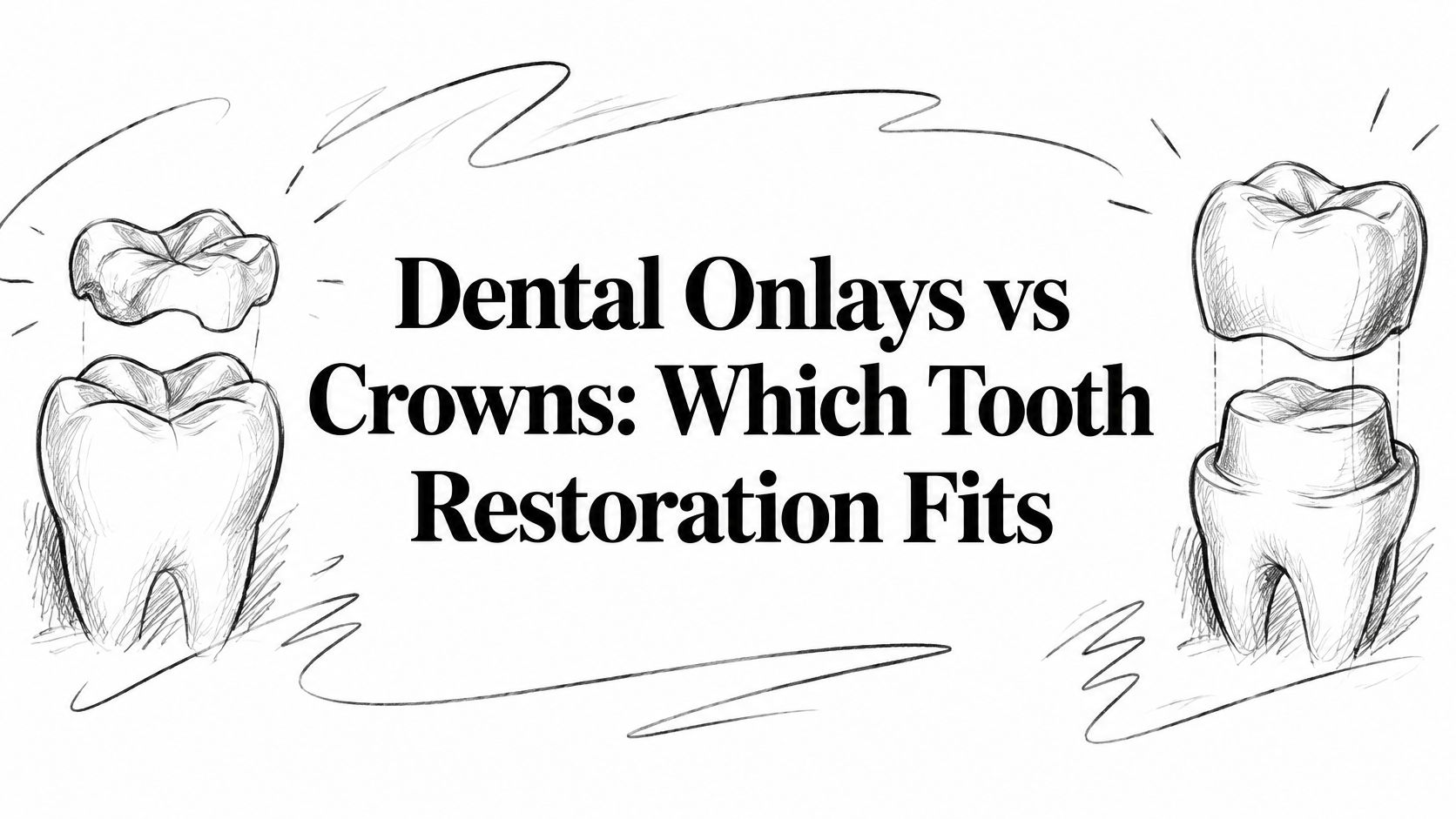
If an onlay and a crown can both last well, shouldn't you also ask which option leaves your tooth easier to save if something goes wrong? That question often gets lost when patients compare only the first price and expected lifespan.
The choice between dental onlays vs crowns is really about matching coverage to damage while protecting your future treatment options. A smaller restoration isn't automatically safer, and a full cap isn't automatically stronger for every tooth.
Onlay vs Crown at a Glance
An onlay restores the chewing surface and one or more cusps, bonding to the tooth that remains. A crown covers the entire visible tooth and is cemented or bonded over the prepared surface. The main difference is how much of the tooth each covers, and how much sound structure remains afterward.
Onlay and crown compared on the criteria that matter
| Factor | Onlay | Crown |
|---|---|---|
| Tooth coverage | Chewing surface and one or more cusps; other surfaces remain exposed | Entire visible tooth, all the way around |
| Tooth structure removed | Preparation removes about 20-45% less coronal tooth structure than crown preparation, according to a 2024 systematic review | More, because all sides are reduced to accommodate a full cap |
| Best fit | Large damage where enough supported cusps, walls, and bonding surfaces remain | Extensive loss, weak or widely cracked walls, undermined cusps, or a need for circumferential coverage |
| Survival evidence | A 2022 systematic review and meta-analysis found no significant difference at 1 year, OR 0.55, 95% CI 0.02-18.08, P=0.127, or 3 years, OR 0.65, 95% CI 0.20-2.17, P=0.747 | The same analysis did not establish that crowns were universally more durable |
| Failure mode | Some failures may be repaired or replaced while retaining the tooth | Deep tooth fractures can lead to root canal treatment or retreatment, a post, extraction, or implant planning |
A comparison of survival alone cannot tell you what happens after a restoration fails. An onlay may leave more options for repair or replacement if the tooth remains sound, while a deep fracture under a crown can require a larger treatment plan. The outcome depends on the damage and remaining tooth, not just the restoration's name.
What the terms mean
Both options are restorations, treatments that rebuild damaged tooth structure. A cusp is a raised point on the chewing surface. Remaining walls are the sound portions surrounding the damaged area.
Research results are not personal guarantees. Studies differ in materials, patient groups, follow-up periods, and definitions of failure, so no row establishes a fixed winner. To understand why the amount of retained tooth matters, consider the remaining walls and cusps, then weigh both the restoration's expected performance and the options available if it fails.
How Much Healthy Tooth Each One Keeps
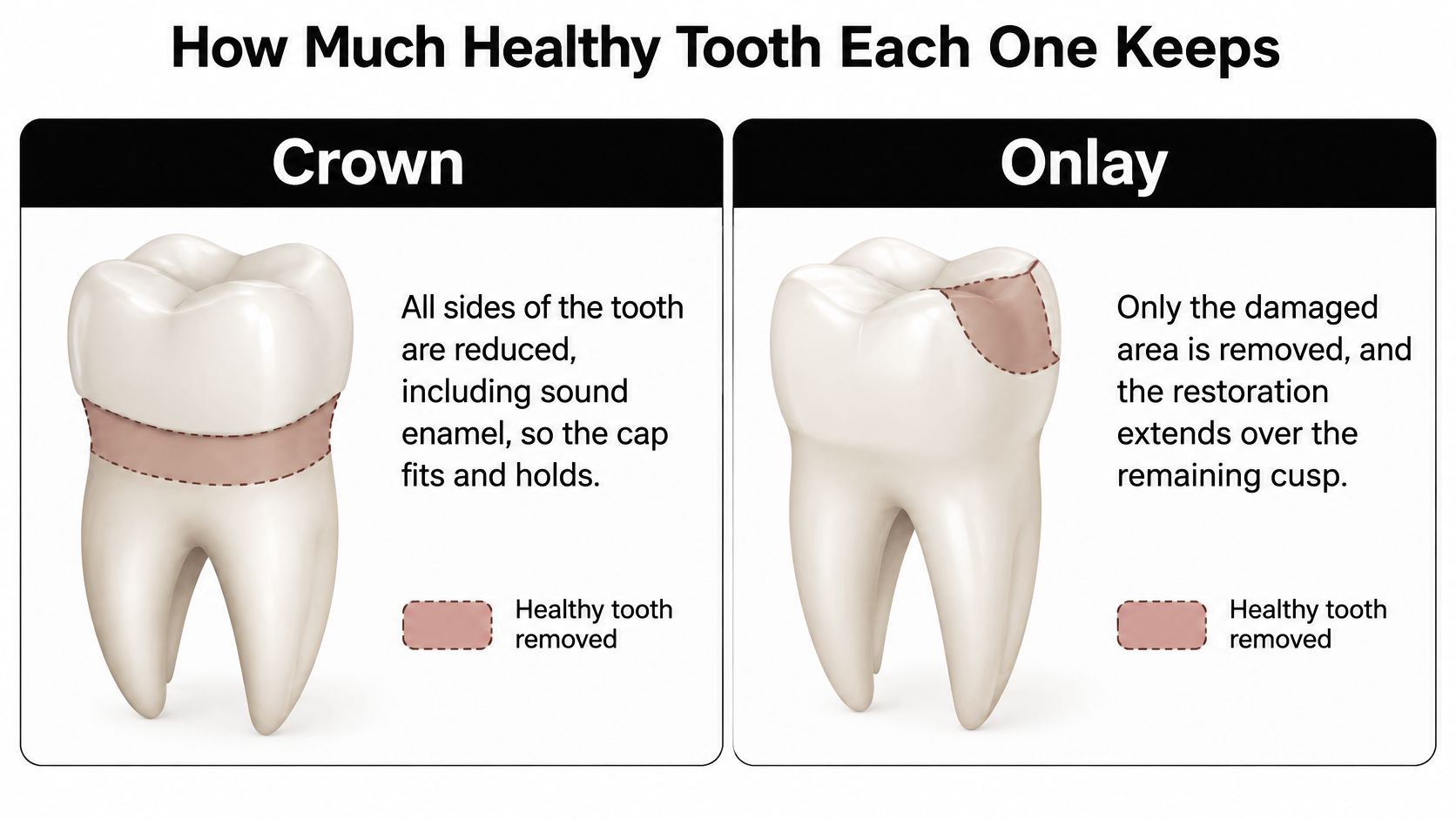
A crown preparation creates room around the whole visible tooth. The dentist reduces the chewing surface and sides, including some sound enamel, so the restoration can seat properly with adequate material thickness.
An onlay preparation follows the damaged area more selectively. The dentist removes decay or an old restoration, shapes suitable bonding surfaces, and covers cusps that need protection while retaining sound outer walls where possible.
The preparation difference is easier to understand visually.
What preservation actually buys you
A 2024 systematic review of onlays and crowns reported that onlay preparation removes approximately 20-45% less coronal tooth structure than crown preparation and leaves substantially thicker dentin walls, while emphasizing that comparative evidence remains limited.
Coronal structure means the tooth portion above the root. Dentin is the supporting tissue beneath enamel, so preserving it matters when planning how the remaining tooth will handle chewing forces and possible future treatment.
Say a molar has a large filling-type defect but retains two well-supported cusps and substantial outer walls. An onlay may replace the missing chewing surface without cutting those walls down for a cap. If the same tooth instead has a cracked cusp, thin surrounding walls, and widespread damage, a crown may offer more appropriate coverage.
Where conservation stops being safe
The dentist needs to check more than how much tooth is visible:
- Remaining enamel and walls: Are they sound enough to support the restoration and provide predictable attachment?
- Cusp support: Is solid tooth supporting each cusp, or has decay hollowed it out?
- Damage near the gumline: Can the margins be accessed, cleaned, and kept dry during bonding?
A deep crack or poor moisture control can change the recommendation even when an onlay looks attractive on paper. Our explanation of composite versus porcelain fillings also helps distinguish material selection from the separate question of how much coverage a tooth needs.
Practical rule: Preserve sound tooth when it can support a predictable restoration, not simply to choose the smallest treatment.
At your visit, ask how many sound walls remain and which healthy surfaces would be removed for each option.
How Long Each Restoration Lasts in Practice
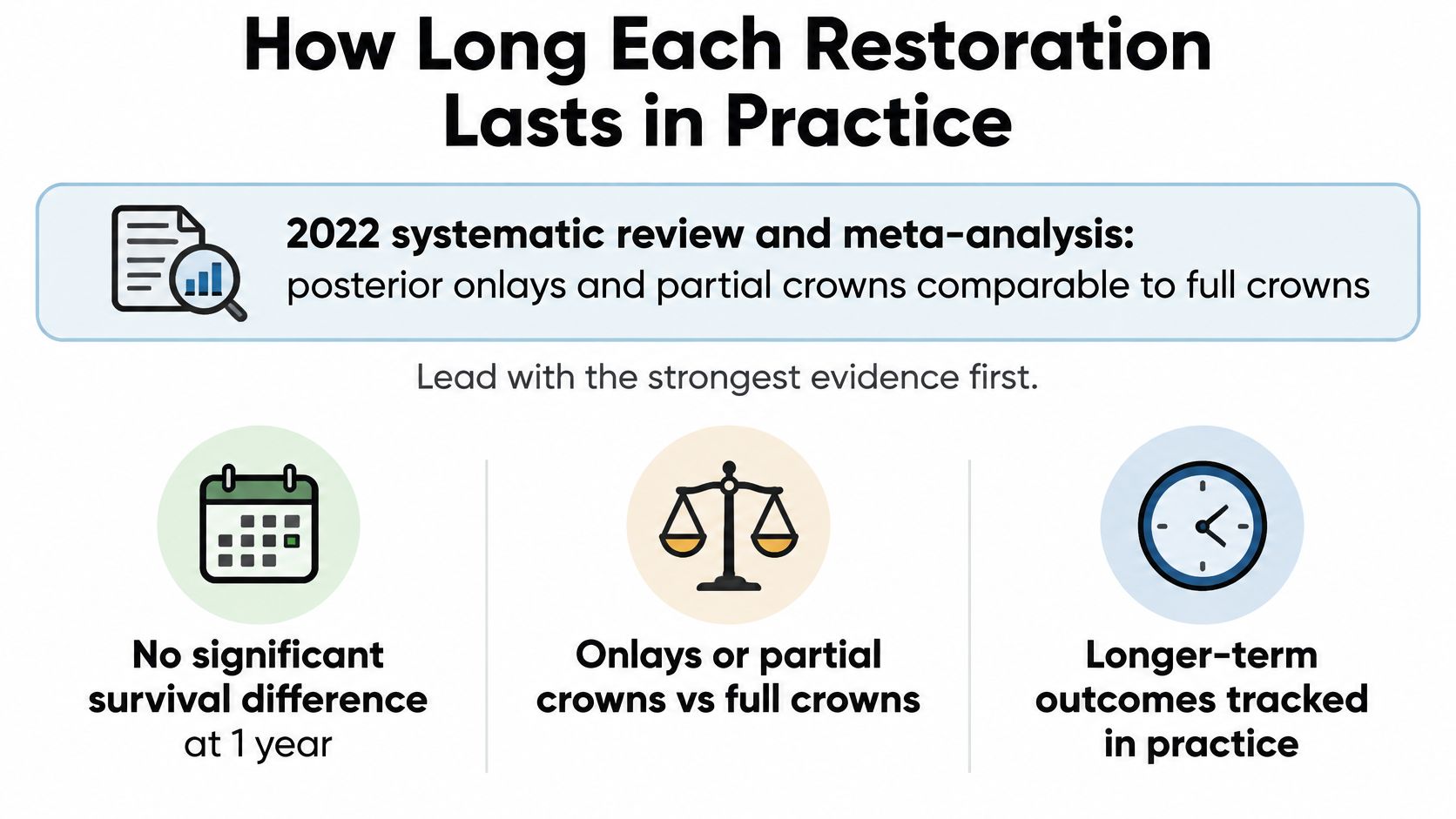
The strongest comparative evidence supports short- to medium-term comparability in appropriately selected posterior teeth, not a universal lifespan advantage. The 2022 systematic review and meta-analysis indexed by Medscape found no statistically significant survival difference, with considerable uncertainty around the early estimate.
This visual summarizes the main finding before the individual results.
Survival figures behind the durability claim
| Source | Follow-up | Onlay result | Crown result | How to read it |
|---|---|---|---|---|
| 2022 systematic review and meta-analysis | 1 year | OR 0.55, 95% CI 0.02-18.08 | No significant difference, P=0.127 | Very wide interval; not proof that onlays last longer |
| Same meta-analysis | 3 years | OR 0.65, 95% CI 0.20-2.17 | No significant difference, P=0.747 | Medium-term comparability on posterior teeth |
| Ceramic study cited in that review | 6.6 years | 96.1% survival | 80.0% survival | An individual study cannot settle the choice |
| IPS e.max study cited in that review | 4 years | 98.99% survival for inlays/onlays | 98.85% for single crowns | Nearly identical results in that cohort |
| 2024 review of 11 studies of root-canal-treated posterior teeth | 2 years | Survival 95-100%; success 86.6-96.6% | Comparable crown range not stated in the review summary | Favorable onlay findings, not a matched head-to-head guarantee |
| Same review of root-canal-treated posterior teeth | 3 years | Survival 90.7-100%; success 86.6-96% | Comparable crown range not stated in the review summary | Short- to medium-term evidence; study designs and materials differed |
| 2025 randomized metal-restoration study, 60 per group | 18 months | Survival 95%; success 91.7% | Survival 90%; success 90% | P=0.294 and P=0.604, respectively; neither difference significant |
| 2025 lithium-disilicate comparison | 24 months | 83.3% survival, 15 restorations | 100% survival, 15 restorations | Small groups; not a universal verdict |
Survival isn't the same as success. A restoration may remain in place yet need an adjustment or develop another complication, and study authors don't always use identical outcome definitions.
The very wide early confidence interval means the estimate is imprecise. Likewise, a favorable ceramic result doesn't prove that every onlay material will behave the same way, and a small study favoring crowns doesn't overturn the broader uncertainty.
Apply the evidence to your tooth
Bite force, decay risk, cracks, isolation during placement, and the amount of usable tooth all influence the outcome. A restoration name alone can't account for those differences.
For practical maintenance context, Seven Oaks Dentistry and Sleep Medicine's crown longevity guide for Wesley Chapel families is a useful companion resource. Our guide to how long dental crowns last also helps frame questions about ongoing care.
This video offers another way to visualize restorative treatment.
What Happens When Each One Fails
The first fee and expected lifespan don't tell you what happens after a problem. Repairability, remaining tooth structure, and retreatment complexity can matter just as much when you're trying to keep a natural tooth.
A systematic review of posterior teeth with substantial structural loss found that onlay failures appeared less catastrophic than crown failures, although the evidence wasn't sufficient to establish definitive superiority. That distinction deserves a place in the consultation, not just in a discussion after something breaks.
A chipped onlay and a fractured tooth aren't equivalent
Consider a ceramic onlay with a small fractured edge. If the underlying tooth is sound and the defect is accessible, the dentist may be able to polish or repair it. A larger fracture might require replacing the onlay while keeping the tooth.
Now consider a crown that fractures together with a deep portion of the supporting tooth. Treatment may involve root canal treatment or retreatment, rebuilding the tooth with a core, or placing a post when appropriate. If the fracture makes the tooth unrestorable, extraction and replacement planning may follow.
These are scenarios, not predictions. An onlay can fail severely, and a crown can have a straightforward, repairable problem.
The important distinction is whether only the restoration failed or whether the tooth became harder to save.
Count the whole recovery process
Retreatment may mean more than purchasing another restoration. You may need diagnostic appointments, temporary protection, endodontic care, healing time, or replacement-tooth planning.
For a busy professional or parent, that means comparing appointment demands and uncertainty alongside the initial bill. Preserving usable tooth today may leave more options later, but inadequate coverage can also expose a compromised tooth to avoidable damage.
Grinding and clenching belong in this discussion. A custom night guard and monitoring of occlusion, meaning how the teeth contact during biting, may form part of protecting either restoration.
If a restoration becomes loose or comes off, save it and arrange an assessment rather than assuming the tooth is lost. Our guidance on what to do when a tooth crown falls off explains the immediate practical concerns.
Bring these questions to the consultation:
- Failure consequence: If this restoration fails, what would most likely happen to the tooth?
- Repair options: Could a chip, loose restoration, or damaged margin be repaired?
- Next treatment: Would replacement remain possible, or could I need more extensive care?
- Protection: Does my bite require a guard or additional monitoring?
Which Restoration Fits Your Tooth
A 2025 randomized clinical study assigned 120 patients with root-canal-treated molars, with 60 per group, to metal onlays or metal crowns; at 18 months, intact-restoration survival was 95% versus 90%, and success defined as no food impaction was 91.7% versus 90%, with neither difference statistically significant, P=0.294 and P=0.604.
The practical lesson is that root canal treatment doesn't automatically make an onlay a second-choice restoration. But those metal-restoration findings aren't a guarantee for a different material, bite, or tooth condition.
Which restoration usually fits each situation
| Situation | Usually Better Fit | Why |
|---|---|---|
| Large filling-type loss with most cusps and walls intact | Onlay | Preserves healthy structure while using suitable remaining tooth for attachment |
| Root-canal-treated molar with adequate walls | Onlay or crown | Selected teeth can support either approach; the randomized metal-restoration trial didn't establish a significant difference |
| One or more cusps undermined, cracked, or fractured | Crown when damage requires circumferential support | Widespread weakness can require more complete coverage; an isolated damaged cusp may still be covered by an onlay |
| Crack extending toward or below the gumline | Restorability assessment, then crown if feasible or extraction review | A crown cannot make an unrestorable deep crack safe |
| Little sound tooth remaining | Crown with a core, sometimes a post, or extraction review | Attachment and support may be inadequate without rebuilding, and some teeth cannot be restored predictably |
| Heavy grinding or clenching | Coverage selected for the loading pattern, with a night guard considered for either option | Repeated loading affects both restoration designs |
Use the table as a starting point
Match the walls, cusps, and cracks, not just the size of the old filling. A large filling can leave strong outer walls, while a smaller defect can hide a crack in a strategically important area.
A cusp problem also needs interpretation. Onlays are specifically designed to cover cusps, so a damaged cusp alone doesn't automatically require a crown. The question is whether the remaining tooth can safely support a partial design or needs support around its circumference.
The dentist examines the tooth and bite and reviews appropriate X-rays. Some cracks don't show clearly on an X-ray, so direct inspection, symptoms, and findings after removal of an old restoration may influence the final recommendation.
- Bring the history: Mention previous root canal treatment, pain on biting, and any past fracture.
- Describe loading habits: Report clenching, grinding, or repeated restoration breakage.
- Clarify uncertainty: Ask what finding during preparation could change the planned restoration.
Our explanation of when you need a dental crown can help you connect a recommendation to the tooth's actual condition. The decision should come with a reason tied to your examination, not a preference for one procedure.
What Each Visit Actually Involves
For a laboratory-made restoration, treatment commonly involves a preparation appointment followed by a fitting appointment. Digital chairside fabrication can change that sequence, so confirm the anticipated workflow rather than assuming every onlay or crown requires the same schedule.
Local anesthetic is used when needed, and the dentist checks that you're comfortable before working. Tell us if you're anxious or have had trouble getting numb, so that concern is addressed before preparation begins.
Preparation and the temporary restoration
The shared sequence is straightforward:
- Diagnosis and bite assessment: The dentist examines the tooth, reviews X-rays, and checks how it contacts the opposing teeth.
- Removal of damaged material: Decay and the old filling are removed so the underlying structure can be assessed.
- Preparation: The tooth is shaped for the agreed restoration, with the design adjusted if hidden damage changes what's safe.
- Recording the shape: A digital scan or conventional impression records the prepared tooth and surrounding bite.
- Temporary protection: When laboratory fabrication is needed, a temporary protects the preparation between appointments.
The shaping is the main difference. An onlay preparation retains suitable outer walls and creates space over the chewing surfaces needing coverage; a crown preparation creates space around the entire visible tooth.
A root-canal-treated molar may need a core, a buildup that replaces missing structure, before either restoration. A post isn't automatically required and isn't used to make a tooth stronger.
Fitting and attachment
At the fitting appointment, the temporary is removed and the dentist checks the restoration's margins, contacts with neighboring teeth, and bite. The piece shouldn't create a high contact that makes that tooth meet first when you close.
An onlay is typically bonded to the remaining enamel and dentin under controlled moisture conditions. A crown may be conventionally cemented or adhesively bonded, according to its material and the prepared tooth.
Before treatment: Have the estimate explain what happens if removing the old filling reveals a crack that changes an onlay plan to a crown.
Before you leave, understand how to clean around the restoration and which symptoms warrant a call. Persistent biting pain, a loose temporary, or a bite that feels uneven deserves assessment rather than repeated testing by chewing on it.
Costs and Insurance Before You Book
There's no single fee that makes every onlay cheaper than every crown. Ceramic, metal, or composite, laboratory requirements, tooth complexity, temporary protection, and appointment needs all affect the estimate.
Insurance may apply different benefit rules to the procedure codes. A tooth-colored restoration on a back tooth can be a functional restorative treatment, not automatically a separate cosmetic package.
Compare estimates for the same tooth
Request a written breakdown covering:
- Material and procedure: The proposed restoration and each clinically appropriate alternative.
- Included services: Laboratory work, temporary protection, and the anticipated appointments.
- Insurance calculation: The allowed amount, applicable benefits, and estimated patient share for the relevant code.
- Additional treatment: Whether a core, root canal treatment, or other care is separate.
- Future care: Likely charges and coverage questions if repair or replacement becomes necessary.
Our explanation of insurance coverage for dental crowns provides useful preparation. We assist with insurance questions and claim submissions, and our office has offered to review a patient's dental insurance plan options to help them select the best one.
Include replacement only when it's relevant
If a tooth may not be restorable, Eric Wiitala DDS's resource to compare dental bridge price ranges can help you identify questions about replacement options. It isn't a substitute for a Manhattan estimate or a reason to replace a tooth that can be predictably retained.
Our broader care includes porcelain veneers and crowns, implants, teeth whitening, and orthodontics for teens and adults. For this decision, keep the estimate focused on the damaged tooth and its realistic future needs, rather than unrelated cosmetic services.
Confirm the Choice at the Manhattan Office
How can you tell whether an onlay or crown fits your tooth? At Paul L. Gregory, DDS, the consultation connects the recommendation to the tooth's remaining structure and the care it may need later. The office is at 57 W 57th St, near Central Park South and Columbus Circle, and serves Midtown West and patients across the New York metropolitan area.
A visual explanation can help make the proposed coverage easier to understand.

Ask the dentist to show which parts of the tooth remain, where the damage extends, and how much coverage the suggested restoration needs. The choice also affects what may be possible if the restoration later loosens, breaks, or the tooth develops further problems. Understanding repair and replacement options helps you consider the full treatment pathway, not just how much of the tooth is covered today.
The practice offers crowns, inlays and onlays, as well as fillings, bridges, dentures, implants, and root canal treatment. Its other services include dental cleanings and exams, X-rays, pediatric dentistry, periodontal therapy, emergency dental care, teledentistry, wisdom teeth removal, oral surgery, Invisalign, teeth whitening, and veneers.
Before leaving, make sure you understand why the dentist recommends that restoration, what alternatives are appropriate, and what further treatment might be considered if it fails. A clear explanation should connect the tooth's condition with both the immediate choice and its possible next steps.
Visit Paul L. Gregory, DDS to arrange a consultation and discuss suitable coverage, repairability, and the estimated treatment pathway for your tooth.