

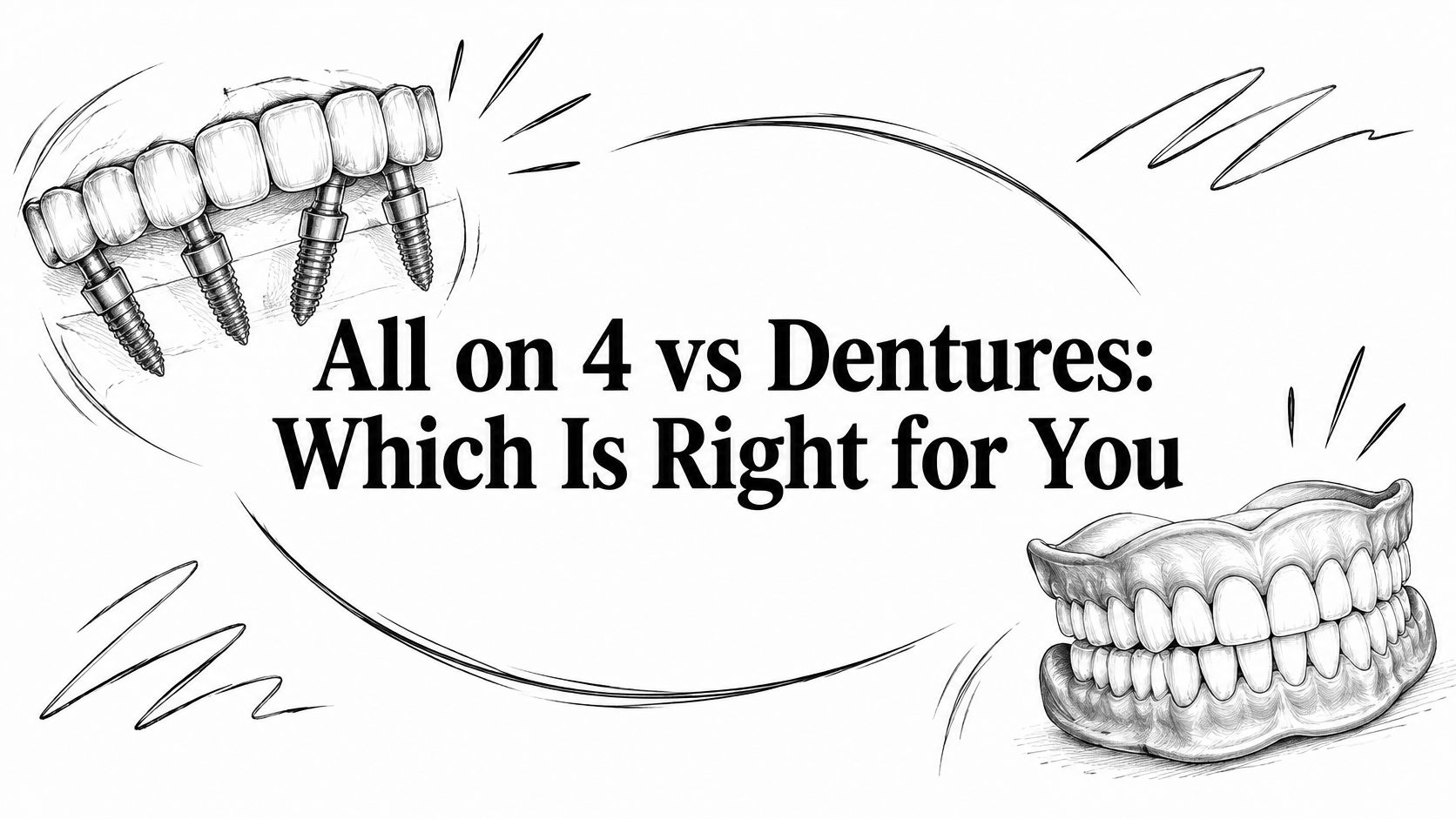
Edentulism, the complete loss of natural teeth, affects a pooled 22% of people worldwide, and country-level estimates run from 1% to 70%, according to a Cochrane review of the global evidence. A condition that common should never be settled with a slogan, yet most advice on all on 4 vs dentures collapses into one line: fixed is premium, removable is budget.
Two options dominate that conversation, a fixed full-arch implant prosthesis and a conventional complete denture. A third sits between them, the implant overdenture, a removable denture that clips onto a small number of implants. It gets a fraction of the attention, and for many patients it's the design that best fits their anatomy, their dexterity and their budget.
What follows separates what the clinical literature shows from what treatment advertising promises. The numbers are named, including the ones that are less flattering to the fixed option, and every difference is tied to the patient factor that decides it.
All on 4 vs Dentures at a Glance
| Criterion | All on 4 | Conventional dentures |
|---|---|---|
| Attachment | Four implants per arch support a fixed prosthesis | Rests on the gums and bone ridge, with suction and adhesive helping hold it in place |
| Stability while chewing | Anchored to implants | May move during chewing or speaking |
| Daily removal | Stays in place and is cleaned in the mouth | Removed for cleaning |
| Surgery required | Yes, for implant placement | No |
| Upfront cost | $15,176 average per arch (range $11,640 to $27,500, US 2024) | No implant-placement or bone-grafting fees. Total cost depends on denture type and any relining or remakes |
| Prosthesis survival evidence | 85% to 100% over follow-up periods of up to 20 years | No implant-anchored survival figure; performance depends on fit, ridge changes and adhesive |
| Maintenance | Professional recall visits and prosthesis checks | Adjustments, relining and eventual replacement |
Attachment shapes the practical differences. A fixed All-on-4 prosthesis is supported by implants; a conventional denture rests on the gums and ridge. For patients who want more retention but need a removable appliance, an implant overdenture offers a middle option: it attaches to implants but can be taken out for cleaning.
The figures need context. The All-on-4 cost is a 2024 national U.S. average per arch, not a local quote. The survival range comes from selected clinical cohorts, not a single jaw or a guarantee for an individual patient. Conventional denture costs also vary with the type selected and later relining or replacement.
The decision is therefore about more than the initial bill. Anatomy affects whether implants are feasible, while dexterity and cleaning habits affect how manageable each design will be day to day. This comparison of which tooth replacement suits you best offers another perspective on removable and fixed options.
How Each Option Works and Why It Matters
A full denture can fit well for years, then loosen as the ridge beneath it changes. A patient who once ate comfortably may find the denture clicks during conversation or shifts when biting. The prosthesis may be unchanged; the supporting anatomy is not.
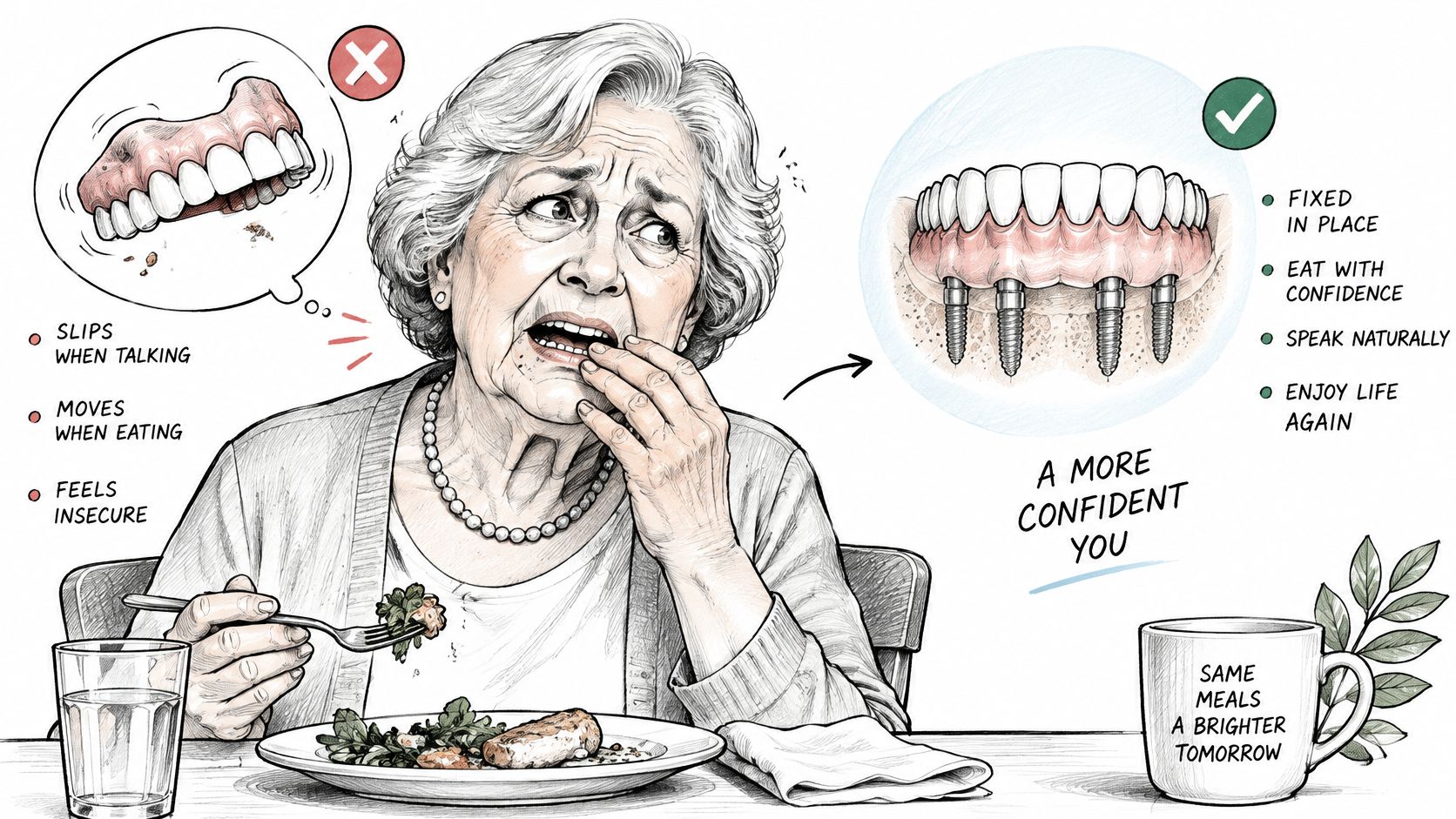
All-on-4 uses four strategically positioned implants to support a fixed full-arch prosthesis. The wearer does not remove it for routine cleaning. The concept was developed by Paulo Maló and colleagues in the 1990s, with a first documented patient in 1998 and a foundational study of edentulous mandibles published in 2003, according to Nobel Biocare's account of the All-on-4 concept.
Five-year follow-up reports on immediately loaded upper-jaw treatment show high implant and prosthesis survival in selected patients. These findings are not a guarantee for an individual. Bone volume and quality, general health, smoking, hygiene, bite forces, maintenance and prosthetic design all affect treatment planning and outcomes.
A conventional complete denture rests on the gums and bony ridge. Border seal, suction and sometimes adhesive help hold it in place, and the wearer removes it for cleaning. It avoids implant surgery, though fit still depends on the shape and condition of the supporting ridge. For an overview of complete and partial dentures, the key distinction is that these appliances rely on oral tissues rather than implant attachments.
An implant overdenture offers a middle option. It attaches to two to four implants for retention but remains removable, allowing the wearer to take it out for cleaning. The choice is therefore not only between fixed implants and a tissue-supported denture: anatomy, ability to clean the prosthesis and attachments, and willingness to manage ongoing maintenance all matter. A guide to full mouth restoration in Dubai illustrates how planning considers the prosthesis and implant arrangement together.
Stability, Chewing and Daily Comfort Compared
Function is where the two designs separate most visibly, and it's also where the patient-reported evidence is strongest.
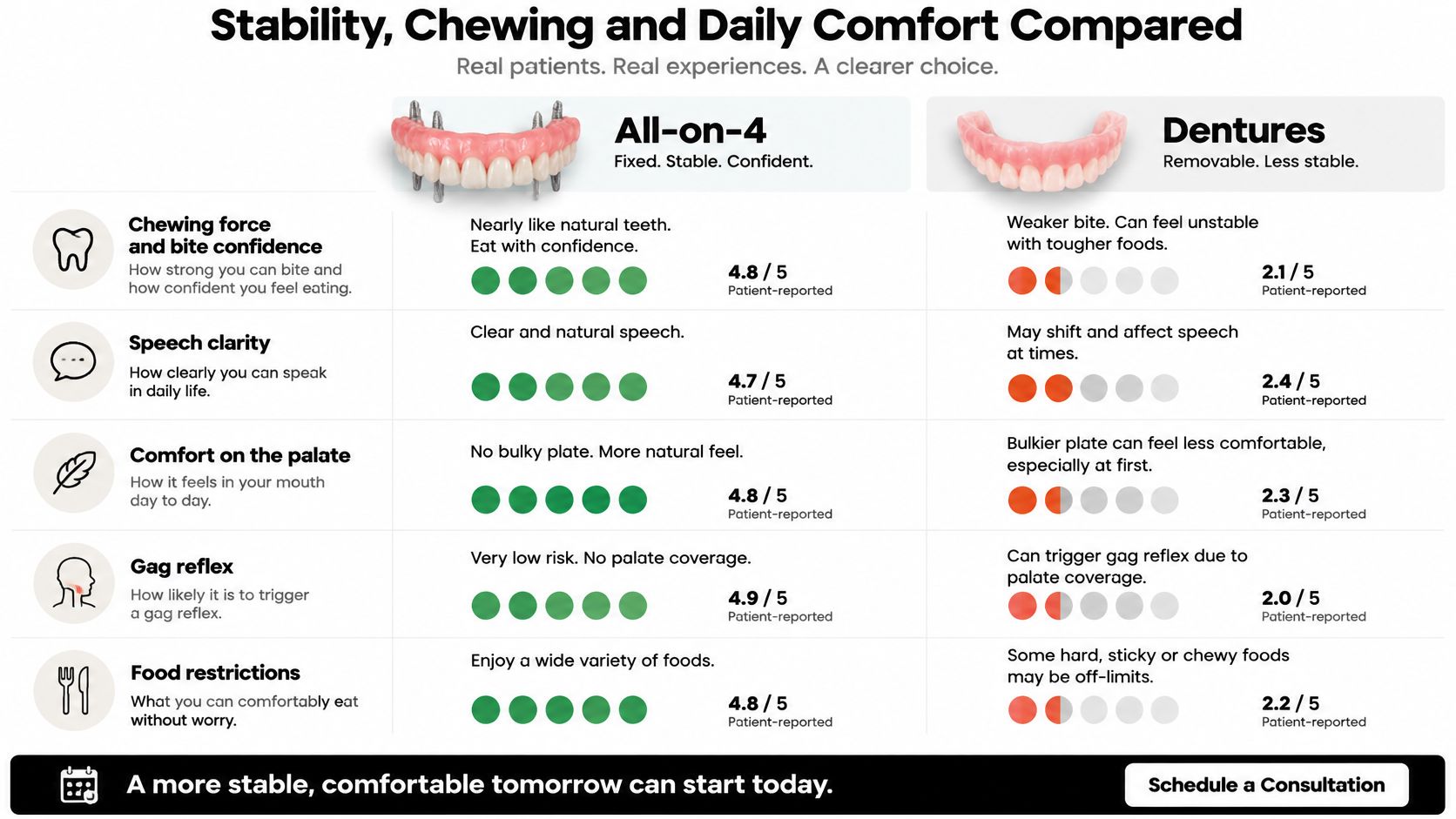
A comparative clinical study found that both fixed and removable implant-supported prostheses produced significantly greater improvements in satisfaction and oral-health-related quality of life than complete dentures, with no significant satisfaction difference between the two implant-supported groups (comparative study of implant prostheses and complete dentures). That single finding reframes the usual sales pitch. The performance upgrade comes from implant anchorage, not from the fixed design on its own.
Chewing, Speech and Palate Comfort
Bite confidence is the first thing patients mention. A denture transmits load through the mucosa, so harder textures lift the base at the moment of force, and the lower arch is worse because there's less surface for a seal. Steak, raw apples, corn on the cob and crusty bread move onto the avoid list for many people, not because chewing is impossible but because it stops being predictable.
A patient who spent a decade ordering around the edges of a menu typically reports eating those foods again after implant treatment. That outcome describes restored comfort and function, and it's worth keeping in proportion, which the nutrition evidence below explains.
Speech changes follow the same logic. A base that shifts during talking forces the tongue and lips to compensate, and full palatal coverage reduces tongue space and can dull temperature and texture. A gag reflex is the extreme version of that problem, and it decides the question for some patients before cost ever enters it.
Where the gain comes from. Implant anchorage delivers most of the stability difference. A fixed bridge and a removable overdenture both capture it. A conventional denture captures none of it.
What Better Chewing Does Not Guarantee
Reviews consistently find better oral-health-related quality of life and masticatory performance with implant-supported prostheses, but the evidence does not establish that improved chewing automatically produces better nutritional biomarkers or major downstream health savings (review of long-term outcomes and prosthetic decision-making). Claims that a new arch will transform general health overshoot what the literature supports. Eating comfortably is the documented benefit.
The fixed design carries a maintenance trade too. Cleaning happens in place and needs interdental brushes, floss threaders or an oral irrigator worked under the prosthesis, and acrylic fracture remains a documented technical event even when every implant stays integrated. A removable overdenture can deliver much of the same retention with easier access for cleaning, which matters for anyone whose schedule or hands make a twenty-minute hygiene routine unrealistic. A fixed arch suits the patient who wants continuous stability and is willing to do that work.
Who Qualifies for All-on-4 and Who Should Choose Dentures
Candidacy isn't a verdict. It's a set of factors that push toward one design or another, and the table below shows which way each one pushes.
| Factor | Points toward All-on-4 | Points toward denture or overdenture |
|---|---|---|
| Bone volume | Enough bone to anchor four implants | Limited bone or patient declines grafting |
| Smoking | Non-smoker or committed to quitting | Active smoker, higher implant risk |
| Periodontal and systemic health | Controlled gum disease and stable diabetes | Uncontrolled disease that needs stabilizing first |
| Hygiene ability | Can clean under a fixed bridge with brushes, floss threaders or irrigators | Prefers to remove and clean the prosthesis nightly |
| Dexterity | Good dexterity for implant-level cleaning | Limited dexterity favors easy removal |
| Gag reflex | Tolerates a fixed prosthesis with palate coverage | Strong gag reflex favors a smaller removable base |
| Budget | Can absorb higher upfront cost and maintenance | Needs lower initial cost |
| Tolerance for removable appliances | Prefers a fixed prosthesis | Accepts removal for cleaning |
No single row decides the case. Bone volume can often be rebuilt with grafting, and dexterity can be supported with the right brushes, but a strong gag reflex and a broad palatal extension are a pairing that no amount of coaching fixes.
Three Patients, Three Different Answers
The retiree on a fixed income with a loose lower denture. Her upper denture is tolerable and her lower one isn't, which is the classic pattern. A two-implant mandibular overdenture stabilizes the arch that bothers her at a fraction of the cost of two fixed arches, and it's the design most likely to change her daily experience.
The professional with a dense calendar and careful hygiene. He wants nothing to do with nightly removal and he'll show up for recall visits. A fixed All-on-4 prosthesis fits that profile, provided he accepts the cleaning routine underneath it and the possibility of a repair to the acrylic or a screw.
The patient with a strong gag reflex. A fixed upper prosthesis with wide palatal coverage may be tolerated worse than a smaller removable base. For her, the honest first move is often a conventional or implant-retained removable design, with the fixed option revisited if the reflex proves manageable.
The Middle Option Most Comparisons Skip
An implant overdenture uses fewer implants and stays removable. A 2025 Cochrane review reports uncertainty about the optimal implant number, attachment design, and whether fixed or removable prostheses are preferable, while identifying a two-implant mandibular overdenture as an international first-line option for many edentulous patients (Cochrane review of implant-supported overdentures).
The outcome data support that standing. Evidence comparing conventional dentures with implant-supported mandibular overdentures found a five-year success rate of 94.9% for implant overdentures versus 76.9% for conventional dentures, a difference reported as statistically significant at p<0.001, with implant survival above 98% and average marginal bone loss of about 1.23 mm (comparison of conventional dentures and implant overdentures).
Before a fixed arch is recommended, three factors need an honest assessment: smoking, uncontrolled periodontal disease and diabetes, all of which materially affect implant outcomes. A provider who skips them is selling a product, not planning treatment.
How the Treatment Process Unfolds Step by Step
The clinical sequence for a fixed full-arch restoration is predictable, and knowing it makes the consent conversation far easier.
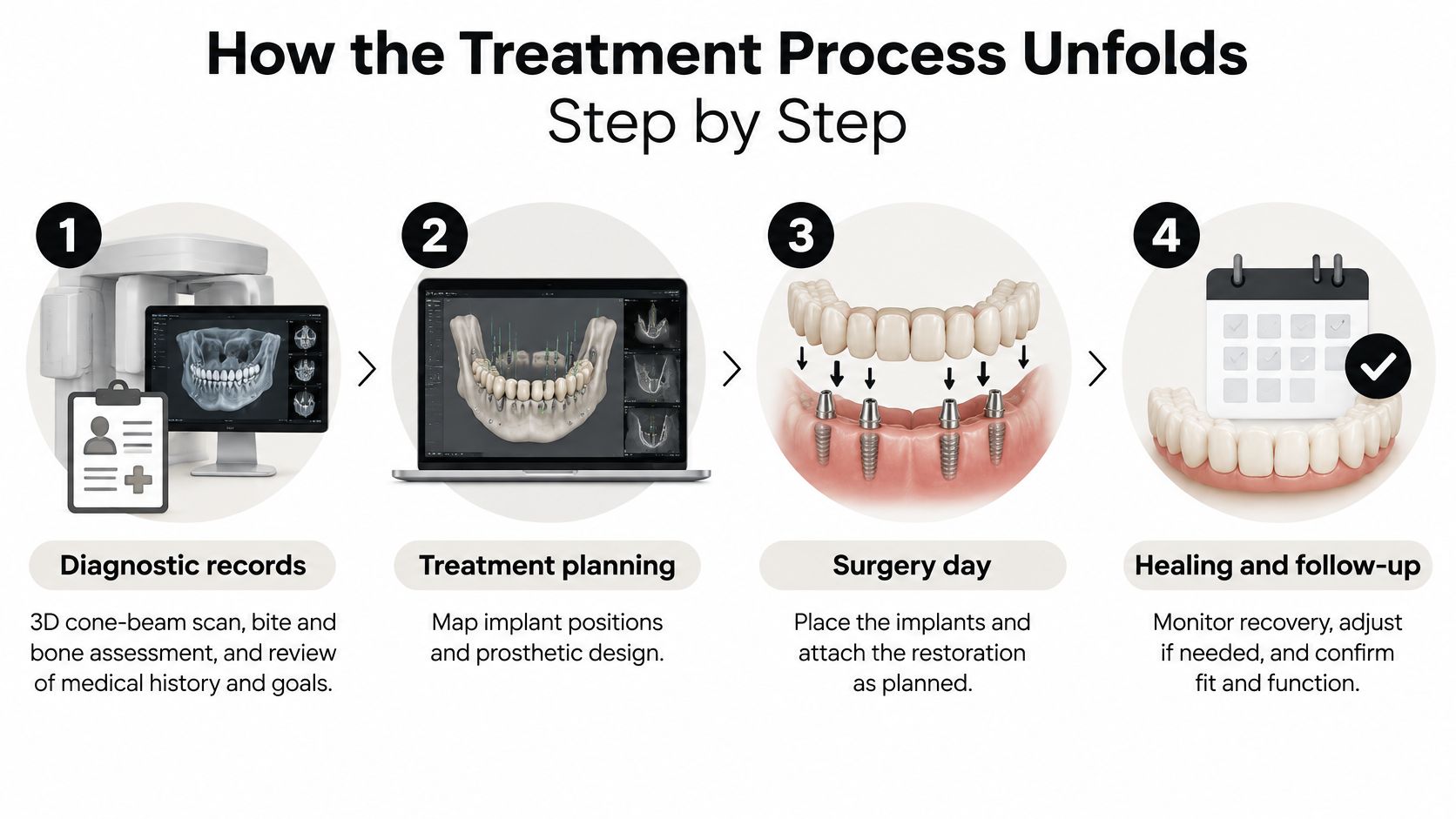
- Diagnostic records. A 3D cone-beam scan, bite registration, bone assessment and a review of medical history and medications. Implant positions get planned against bone density and nerve location, not chosen in the mouth.
- Extractions and grafting, if needed. Failing teeth come out, and a graft may go in at the same visit so the implant site has something solid to integrate with.
- Implant placement. Four implants per arch, usually angled toward the back of the jaw to avoid the nerve and to use denser bone at the front.
- A provisional fixed prosthesis. A temporary fixed arch is fitted within a few days, which is what immediate loading means, so you leave with teeth that stay in place.
- Integration. Several months of healing while the implants fuse to bone. The provisional stays in function, and so does a softer diet.
- The final prosthesis. Impressions, bite records, a try-in and delivery, with occlusal adjustments once the arch is in service.
- Recall. Hygiene visits and prosthesis checks, because the parts that wear are the acrylic, the screws and the framework, not the implant itself.
The denture route is shorter and simpler: impressions, a try-in, delivery, then adjustments or relining as the ridge changes underneath.
What Patients Underestimate
The stage that catches people out is the middle one. A provisional arch looks finished and isn't, and biting into a hard roll during month two can chip it. Plan on a modified diet for the integration period, and plan the final delivery date as an estimate rather than a fixed appointment.
Recovery has its own timeline of swelling, stitches and soft-food weeks, and it's worth reading about All-on-4 dental implant recovery before booking surgery rather than after. We place dental implants, All-on-4 restorations, bone grafts and dentures in the same office, so one set of records can carry both a fixed plan and a removable alternative without repeating imaging.
Maintenance, Repairs and Lifespan Over Time
A fixed All-on-4 arch and a removable denture need different maintenance, and both can require repairs or replacement. Long-term planning should account for the prosthesis as well as the supporting teeth or implants. Implant survival alone does not capture issues such as chipped acrylic, loose screws or changes in denture fit.
A systematic review reported All-on-4 prosthesis survival rates from 85.0% to 100% across follow-up periods extending to 20 years, with marginal bone loss of up to 1.9 mm after five years (systematic review of All-on-4 outcomes). The review also reported five-year implant survival commonly ranging from 94.5% to 99.6%.
| Task or event | All on 4 fixed prosthesis | Conventional denture |
|---|---|---|
| Daily cleaning | Brush and clean under the prosthesis | Remove, brush and soak nightly |
| Professional visits | Hygiene visits and prosthesis checks | Adjustments as the ridge changes |
| Common repairs | Acrylic fracture, screw loosening and framework issues | Relining, rebasing or replacement |
| Prosthesis replacement interval | Depends on wear and fracture history | Depends on ridge changes and material wear |
A fixed arch requires daily cleaning beneath it, using tools such as interdental brushes or an irrigator, along with professional hygiene visits. A conventional denture is removed for cleaning and may need adjustment or relining as the ridge changes. An implant overdenture offers a middle option: it is removable for cleaning, while implants provide support. Its maintenance needs depend on the attachment system and the patient's ability to remove and clean it.
A separate review of the All-on-4 treatment concept noted that evidence is stronger for short-term outcomes than for follow-up of five years or longer (review of the All-on-4 treatment concept). For background on factors that affect longevity, see this guide to dental implant lifespan.
Planning rule. Account for repairs and prosthesis replacement, not only the implants. Acrylic, teeth and screws can need attention before the implant itself does.
Costs, Insurance and Total Value Over a Decade
A 2024 U.S. cost study commissioned by Synchrony and conducted by ASQ360° reported an average All-on-4 price of $15,176 per arch, with a range of $11,640 to $27,500 (summary of the 2024 U.S. dental cost study). One arch means one jaw, so treatment for both jaws involves two arches.
| Option | Upfront cost | Ongoing costs |
|---|---|---|
| All-on-4 (per arch) | $15,176 average, range $11,640 to $27,500 (U.S. 2024) | Recall visits, prosthesis repairs |
| Conventional complete denture | Get a provider-specific written estimate | Relining, adjustments, eventual replacement |
| Implant overdenture | Get a provider-specific written estimate | Attachment replacement, maintenance visits |
The upfront estimate is only part of the ten-year comparison. A denture may need relining or replacement, while a fixed arch may need repairs to its prosthesis. The timing and cost depend on the treatment plan and the patient's needs, so compare written estimates that include expected maintenance rather than relying on the initial fee alone.
Three checks make the comparison more useful:
- Request an itemized written estimate covering imaging, surgery, the prosthesis and first-year maintenance. Confirm whether implant overdenture options are included alongside fixed All-on-4 and conventional dentures.
- Check your insurance benefits before treatment begins. Extractions, implant surgery and the prosthesis may be handled as separate benefits; ask the insurer what it covers for each option.
- Compare projected ten-year totals, then divide each by ten. This gives an approximate annual cost and makes ongoing maintenance easier to compare with the initial price.
For a breakdown of the factors behind the per-arch figure, see this guide to All-on-4 dental implant costs.
Confirm Your Candidacy Before You Book a Consultation
Before choosing a full-arch treatment, ask the clinician to assess which options fit your anatomy and daily care routine. Request a written plan that compares a fixed All-on-4 restoration, a removable implant overdenture and a conventional denture. A removable overdenture can be a meaningful middle option: it uses implants for retention but can be taken out for cleaning.
Bring details of your denture history, including where it rubs, when it began moving and which foods you avoid. Share your medical history, medications and smoking status, since these can affect treatment planning. Ask whether 3D imaging and a bone assessment are appropriate. If grafting may be needed, learn what bone grafting for dental implants involves before ruling out an implant option. Also ask how the office handles implant complications and prosthesis repairs.
Location can help with access to care, but it cannot determine clinical fit. A Manhattan neighborhood map places the Upper West Side roughly between West 59th and West 110th Streets, and the Upper East Side from East 59th to East 96th Streets. A Midtown office near West 57th Street is within reach of neighborhoods across Manhattan, including both Upper Sides.
What location doesn't change. Your jaw anatomy, ability to clean the restoration and budget still shape which option is suitable.
Paul L. Gregory, DDS offers dental implants, All-on-4 dental implants, bone grafting and dentures at its Midtown office at 57 W 57th St. If your denture no longer stays in place, book an evaluation and ask for the available plans in writing, including maintenance and repair considerations. Visit Paul L. Gregory, DDS to schedule a consultation. For dental practices seeking to get high-value patients booking appointments, this resource offers a separate perspective.